Home Blog Page 50

Senegal’s Baaba Maal returns after years with new album

0
This undated handout photo shows Senegalese singer-songwriter and activist Baaba Maal. Amid a changing, modernizing world with climate change threatening his home, Maal released his first album in seven years, “Being,” on Friday, March 31, 2023. The genre-crossing album, released by Marathon Artists, is explores those themes and showcases traditional African instruments along with futuristic electronic sounds. Photo: Matthew Donaldson/AP
Baaba Maal by Matthew Donaldson of AP
This undated handout photo shows Senegalese singer-songwriter and activist Baaba Maal. Amid a changing, modernizing world with climate change threatening his home, Maal released his first album in seven years, “Being,” on Friday, March 31, 2023. The genre-crossing album, released by Marathon Artists, is explores those themes and showcases traditional African instruments along with futuristic electronic sounds. Photo: Matthew Donaldson/AP

Amid a changing, modernizing world with climate change threatening his home, Senegalese singer-songwriter and activist Baaba Maal is releasing his first album in seven years, “Being.”

The genre-crossing album, released by Marathon Artists last Friday, is explores those themes and showcases traditional African instruments along with futuristic electronic sounds.

The first single from the record, “Yerimayo Celebration,” is a jubilant, rabble-rousing celebration of Maal’s roots in the small town of Podor in north Senegal, and the fishing community at its heart. Maal was born into a fisherman class and was expected to follow that career path, but he befriended Mansour Seck, a griot — or traveling storyteller and musician — and was welcomed into his family.

“I never thought I would stay in one place and doing one thing every day in my life. This is why music is a really good opportunity for me to go away, first, like a young person, like going on an adventure,” he said. “And it’s a way to liberate me and the people of my generation of this caste system where you have to stay in this place, do the same thing like your father or grandfather.”

Maal’s latest single, “Freak Out,” features vocalist Esau Mwamwaya of The Very Best. The video accompanying the track shows scenes from the Blues Du Fleuve festival, which Maal founded in his hometown on the Senegal River, bringing together musicians, artists, singers, activists and more from all over West Africa. Maal calls it “The Glastonbury of Africa.”

The veteran musician is headlining the Barbican in London for the first time in 20 years on May 30 and the audience can expect a unique experience.

“Music is a celebration and music is a party and when it comes to an African party, it has to be an African party,” he added.

As well as being a musician, Maal is also an activist on the topics of climate change and refugees. Since 2003, he has been committed to various development challenges in Africa, working with different United Nations organizations.

His NANN-K Trust recently opened a solar-powered irrigation project in Senegal to fight desertification, which is one of the main drivers of people leaving on dangerous migration routes. The project will train people to start similar schemes in their own communities and Maal is a particular believer in putting power in the hands of young people and women.

“We are chanting, we are crying, we are saying loud that we need a green Africa and a green Africa to make people to live really a normal life, to face climate change, desertification — all of that,” he said.

Maal also contributed to the soundtrack of “Black Panther: Wakanda Forever,” and the 69-year-old’s participation in Marvel’s blockbuster franchise has brought him to a new, much younger audience. He believes the franchise can inspire new hope for the African continent.

The movies are set in the fictional African paradise of Wakanda, a country that is rooted in tradition and yet has the most advanced technology in the world. The visionary musician sees a template for Africa in the “Black Panther” films’ Afrofuturism.

“I have a feeling … that something great should be coming from this continent again, and something positive for the world,” he said. He characterizes it as “a door which is open for Africa, not just for Baaba Maal.”

“It’s for the continent,” he said.
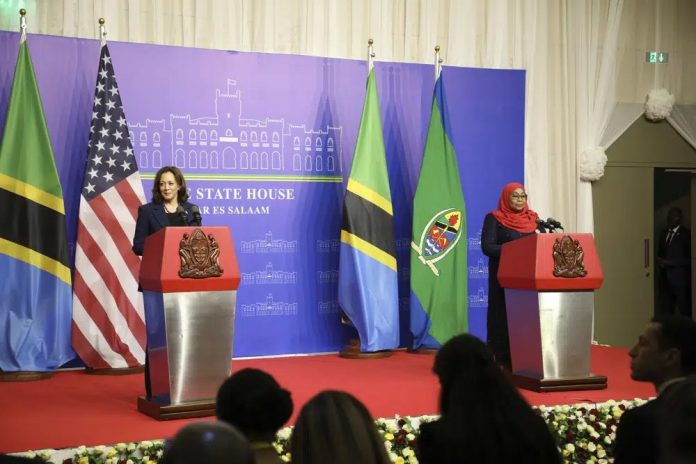
Photos: Vice President Kamala Harris historic Africa visit

0
Suluhu and Kamala
Photos: Vice President Kamala Harris historic Africa visit

Bob Lee, Cash App founder, fatally stabbed in San Francisco

0
Bob Lee, the founder of Cash App, died early on Tuesday morning, April 4, 2023, after being stabbed in downtown San Francisco. Photo: Courtesy of Bob Lee Twitter Page @crazybob
Bob Lee Cash App Founder via Bob Lee Twitter
Bob Lee, the founder of Cash App, died early on Tuesday morning, April 4, 2023, after being stabbed in downtown San Francisco. Photo: Courtesy of Bob Lee Twitter Page @crazybob

SAN FRANCISCO (AP) — Bob Lee, a technology executive who created Cash App and was currently chief product officer of MobileCoin, was fatally stabbed in downtown San Francisco early Tuesday, according to the cryptocurrency platform and police.

Also Read: Why are Black people more likely to use Cash App despite security concerns?

The San Francisco Police Department said in a statement that officers responded to a report of a stabbing near the city’s Embarcadero waterfront at 2:35 a.m. Tuesday. They found Robert Lee, 43, suffering from apparent stab wounds.

“Officers rendered aid and summoned medics to the scene” but Lee died at a hospital, police said.

“This investigation is still in the early stages. Because of this we are not commenting on evidence, nor will we speculate on the circumstances surrounding this horrific crime,” Police Chief Bill Scott said in the statement.

MobileCoin confirmed Lee’s death Wednesday in response to an email from The Associated Press.

“Our dear friend and colleague, Bob Lee passed away yesterday at the age of 43, survived by a loving family and collection of close friends and collaborators,” MobileCoin CEO Josh Goldbard said in a statement.

Lee was fatally stabbed in the densely populated Rincon Hill neighborhood of San Francisco, near Google’s office and Oracle Park, home to the San Francisco Giants. The neighborhood is a mix of offices and modern condo buildings.

1000
A woman walks past flowers left outside an apartment building where a technology executive was fatally stabbed in San Francisco, Wednesday, April 5, 2023. Bob Lee, a technology executive who created Cash App and was currently chief product officer of MobileCoin, was fatally stabbed in San Francisco early Tuesday, April 4, 2023, according to the cryptocurrency platform and police. AP Photo by Eric Risberg

His death further enflamed debate over public safety in San Francisco and its moribund downtown, which has not yet bounced back from the pandemic. Twitter’s owner Elon Musk took to the social media site to post that “violent crime in SF is horrific and even if attackers are caught, they are often released immediately” and tagged the city’s district attorney.

San Francisco suffers from property crime more than violent crime such as murder, rape, robbery and assault.

In a statement, San Francisco Mayor London Breed called the homicide “a horrible tragedy” and said that the city is prioritizing public safety.

“I’m confident that when the police make an arrest in cases like this, our district attorney will do what’s necessary to hold any individuals accountable for their actions,” she said.

Goldbard said Lee was “made for the new world.”

“From large contributions to Android at google, to being the first CTO of Square, in that time creating Cash App, and working with us here at Mobilecoin, Bob surely had an impact that will last far beyond his short time on earth,” Goldbard said.

Lee came to MobileCoin as an early stage investor and advisor, then became chief product officer and helped launch the Moby app, Goldbard said. Lee was the chief technology officer at digital payments company Square in 2013 when it launched a money transfer application now known as Cash App.

Among the tech leaders to share their devastation about Lee’s death was venture capitalist Wesley Chan, co-founder of FPV Ventures. Chan said he befriended Lee more than a decade ago when they both worked at Google, at a time when software engineers like Lee were helping to build the Android smartphone operating system before its 2008 release.

“He was an incredibly iconic founder in the tech world,” Chan said by phone Wednesday. “He wrote large parts of Android when he was at Google. He became the CTO of Square and helped build Cash App. His resume reads something like a Fortune cover article.”

But Chan said Lee was also generous in helping to coach and champion other engineers and tech entrepreneurs who’d call on him for advice. And he was modest about his key role in developing successful products, such as the widely used Cash App.

“With everything that Bob worked on, it was always a pleasant surprise,” Chan said. “That’s one of the things I loved about him. He was always humble about it, he’d say, ‘Oh, I don’t know if it’s going to work or not, but we’ll try.’”

Prominent venture capitalist Ron Conway, founder of the San Francisco-based investment firm SV Angel, tweeted Wednesday that Lee’s loss was an immense tragedy.

“Deepest condolences to Bob’s family and to the entire tech community,” Conway said. “Remembering fondly when Bob gave an inspiring talk at our CEO Summit. We’ve lost a great innovator, intelligence, and spirit. Praying a suspect is apprehended swiftly.”

The police statement did not provide any details on the circumstances of the stabbing.

“This is an open and active investigation. For that reason we are not releasing further information,” Officer Niccole Pacchetti, a public information officer, said in an email. “We will provide further details when they become available.”

ACER seeks $3 million from legislature to fill gap left by Walmart in Brooklyn Center

0
This Walmart at 1200 Shingle Creek Crossing in Brooklyn Center will close for good on April 21, 2023. Photo: Tom Gitaa/Mshale
Brooklyn Center Walmart on April 4 2023 by Tom Gitaa
This Walmart at 1200 Shingle Creek Crossing in Brooklyn Center will close for good on April 21, 2023. Photo: Tom Gitaa/Mshale

With the Brooklyn Center Walmart slated to close later this month, a local economic development and advocacy group seeks state aid to help fill the hole left behind.

Sponsored by Rep. Samantha Vang (DFL-Brooklyn Center), HF3175 would appropriate $3 million for African Career, Education and Resources, Inc. to purchase a strip mall on Shingle Creek Parkway in Brooklyn Center for a retail incubator.

The bill was heard Monday on an informational basis by the House Capital Investment Committee. No action was taken.

“We want to invest in our community at a time when others are disinvesting,” said ACER Executive Director Nelima Sitati Munene.

Samantha Vang
Rep. Samantha Vang of Brooklyn Center. Photo: Minnesota House of Representatives
1 edited
ACER Executive Director Nelima Sitati Munene. Photo: Courtesy ACER

The aim is to provide affordable space for microbusinesses to get established and grow. The 400 or so one-, two- or three-person operations serve a critical role in the community, but it’s a niche that hasn’t been well served, Munene said.Business owners often cannot afford rent in regular retail space and try to make a go of it in office buildings and other commercial spaces ill-suited for shoppers.

ACER aims to not only provide an affordable home for those types of small businesses but offer technical assistance and wraparound services, such as bookkeeping.

The benefit would be multifold, Munene said, growing wealth in the community through successful businesses, expanding employment opportunities and increasing access to desired goods. Retailers could fill food gaps, especially ethnic food gaps.

According to ACER, the northwest suburbs are home to an estimated 4,500 immigrants, mostly from Liberia, Somalia and Nigeria.

Bassekou Kouyate & Ngoni Ba will bring Mali to the Cedar

0
maxresdefault
Bassekou Kouyate & Ngoni Ba will bring Mali to the Cedar

Bassekou Kouyate turns the traditional on its head, drawing world-wide music from his historically Malian and West African instruments. He and his band, Ngoni Ba, which includes family members such as his spouse the lead vocalist, Amy Sacko, and one of his sons, his nephew, and his little brother take the stage at the Cedar Cultural Center on Earth Day, April 22nd.

While tradition runs deep, starting in his childhood when he took up the ngoni, the 57-year-old griot seeks to expand. Kouyate spoke to Mshale through a translator. He said, “I have a different style from my father (Mustapha Kouyaté) and grand-father. I have a different mentality.”

But rather than swap out the age-old instrument for a more current banjo or even a steel-string guitar, Kouyate remains committed to the traditional ngoni.

He said, “The ngoni instrument has existed since before Jesus Christ was born. It’s the oldest instrument in Mali, in Western Africa, it’s been played for many centuries. I wanted to play it my own way. I wanted to make it known everywhere, give it more value. I want to play for everybody.”

But where his father played traditional music that was played for kings, great warriors, and marabouts, Bassekou Kouyate said, “I like to be open to world music, jazz, blues…I want to play for everybody. My father never did that.”

Bassekou Kouyate
Bassekou Kouyate and his band Ngoni Ba are set to perform at the Cedar in Minneapolis on Saturday, April 22, 2023. Photo: Bassekou Kouyate Facebook

Another departure from playing how it has always been played is that Bassekou Kouyate stands as he strums. “Traditionally people sit to play ngoni,” he said, “but it’s not good, not for me. I like to communicate with my audience, I want to be in front of the stage, standing up, and be in contact with the public.”

Most significantly, Bassekou Kouyate wants to buck the current mindset of many in his country and by using traditional musical instruments and through the study of Malian music, improve his country’s future.

With growing intensity, he said, “In Mali, we have a problem with extreme Islam: Wahhabism. They want to destroy traditional music, they want all the power, all the money. They want to stop music and any message that is anti-islamist.”

Kouyate wants to counteract the Wahbabist ideas. “We singers, we can convey a message, convince people. We can tell people what is wrong, we can sing to tell people what is happening. They (the islamists) don’t want [us to do that].

Kouyate’s medium to accomplish his goals is education. He is building a music school in his home village Garana, 160 Km from Bamako, Mali. Children study from the age of 5 to about 20 or 25 years in Mali. Kouyate explained, “They can sleep there, stay there, learn how to play an instrument, how to make instruments and how to sell instruments. We will have music lessons, ngoni, balafon, guitar, and also dance lessons, and dyeing, too, all the cultural life.”

“The Wahhabists,” said Kouyate, “are going to teach children directly. They want to destroy everything, all the photos, your father’s photos, your grand-father’s. They want to take away everything and start from zero, teach children.”

But the school’s not finished yet. “I need more time, more money. So I have to do a lot more concerts,” said Kouyate.

Tickets to Bassekou Kouyate & Ngoni Ba 8 pm show are available on the Cedar website.

Ladysmith Black Mambazo offers musical tonic in these troubled times

0
Ladysmith Black Mambazo during their concert at the Dakota in downtown Minneapolis on Tuesday, March 28, 2023. Mshale Staff Photo by Richard Ooga
LBM in Minneapolis 3 28 23 FeaturedImage
Ladysmith Black Mambazo during their concert at the Dakota in downtown Minneapolis on Tuesday, March 28, 2023. Mshale Staff Photo by Richard Ooga

It’s impossible to walk away from a Ladysmith Black Mambazo show disappointed. They are consistently harmonic, tender, and impressive. They displayed all of these traits and more on stage at the Dakota in Minneapolis on March 28th.

Their 75-minute set, one of two for the evening, opened without preamble from the a cappella group. In their brown trousers, earth-toned tunics accented with gold cord, red socks, and brilliantly white sneakers, they walked with decorum onto the stage singing.

Our attention riveted to these gentlemen, ranging in age from their most senior singer, Albert Mazibuko, 74, to their newest member who took his father’s place less than ten years ago, Sabelo Mthembu, 40, to their youngest member Mfanafuthi Dlamini who at 37 is exactly half the age of Albert Mazibuko. They are timeless. And tireless.

Their second number, Nomathemba, is a song about hope. The style of singing Ladysmith Black Mambazo performs is Isicathamiya. There is no direct translation for this word, but once you’ve heard it and seen it, you’ll never forget it.

Tuesday evening, the nine men sang with tight harmonies, interspersed with whoops and tremolos and clicks especially from Mthembu who echoes his father with seemingly extraneous, yet integral and essential sounds that make isicathamiya music memorable and thrilling.

True to the Zulu heritage, Ladysmith Black Mambazo executed uniform choreographed steps and kicks and hand gestures inherent to their music. After they sang Hello My Baby, which included singing, “kiss me twice” accompanied with throwing us kisses, Albert Mazibuko explained the Zulu dance.

He described how the stomp is performed by lifting one’s leg up so that the upper part of the leg is parallel with the floor, then bringing the foot down to make a loud stomp. However, when the foot is kicked over the top of the dancer’s head—and yes, they all offered this dance move—the foot is touched lightly on the floor, not bashed down.

Joseph Shabalala’s four sons, Thamsanqa, Sibongiseni, Thulani, and Msizi, rotated the frontman-position, but never with an air of self-importance. They each set the tone of gratitude and humbleness. This mindset imbued their sound, rich and layered, so that in the audience, we easily could forget there were no instruments supporting them as rhythmic bass notes and higher-pitched melodies seemed to create an entire orchestra.

Nearing the end of the show, having danced and sang for 50 minutes without becoming breathless, Thulani Shabalala admitted, “This group was formed in 1960 and we aren’t as young as we used to be.” Member Pius Sheri, 46, kept kicking up his toes past his forehead, but like others closer to his age, Abednego Mazibuko, 69, reined back their exuberance and  kicked instead to his shoulders.

Poignantly, when the group sang their iconic, Homeless, co-written by Joseph Shabalala and Paul Simon, we were taught the Zulu word for thank-you, Ngiyabonga.

Thankful the audience was, from the small children to the adults. Thankful to hear their enduring, comforting music and find inspiration in their dance and smiles.

Dr. Stephanie Burrage appointed as Minnesota’s first chief equity officer

0
Dr. Stephanie Burrage was appointed as Minnesota's first chief equity officer by Gov. Tim Walz on Wednesday, March 29, 2023. Photo: Courtesy of Gov. Walz Office
Stephanie Burrage headshot
Dr. Stephanie Burrage was appointed as Minnesota's first chief equity officer by Gov. Tim Walz on Wednesday, March 29, 2023. Photo: Courtesy of Gov. Walz Office

Minnesota Gov. Tim Walz on Wednesday, March 29, announced the appointment of Dr. Stephanie Burrage as the state’s first chief equity officer. She is currently the deputy commissioner of the Minnesota Department of Education and a senior advisor to the Governor’s Office.

Once she assumes office, she will assist the governor’s office in the creation of a new Equity and Opportunity Office.

Dr. Burrage’s new role and office is separate from that of the existing chief inclusion officer which seeks to diversity the state’s workforce. The chief equity officer will instead focus on addressing racial inequality on the state.

​“Our mission is to make Minnesota the best state to raise a family for everyone. This role was created to serve communities across Minnesota and help eliminate disparities across race, geography, ability, gender, sexual orientation, and economic status,” said Governor Walz. “Dr. Burrage understands the importance of community and relationship building and will use her strengths and expertise to advance equity in communities across Minnesota.”

Governor Walz Presser on Stephanie Burrage Appointment
Minnesota Gov. Walz at a press conference on Wednesday, March 29, 2023 where he announced the appointment of current deputy commissioner of education Dr. Stephanie Burrage as the state’s first chief equity officer. Photo: Gov. Tim Walz Twitter

Dr. Burrage brings an impressive resume of work and credentials to her new position. Before she joined the education department, she held school district leadership positions in Minnesota and Michigan. She earned a bachelor of arts in secondary education from Western Michigan University, a master’s degree in elementary education from the University of Wisconsin, and a second master’s degree in educational administration from Saint Mary’s University. She earned her doctorate in educational policy and administration from the University of Minnesota.

​ Mr. James Burroughs, Children’s Minnesota Senior Vice President, was the state’s first chief inclusion officer when Gov. Mark Dayton appointed him in 2016.  Mr. Burroughs praised Dr. Burrage’s appointment.

“Her knowledge, temperament, passion and community relationships will benefit the Governor’s Office in developing strategies to finally eliminate racial disparities in the State of Minnesota. I look forward to partnering with Dr. Burrage and the community to end racial disparities in Minnesota and throughout the nation,” said Mr. Burroughs.

African American Leadership Forum launches policy fellowship

0
Attendees listen to speakers during the "African American Lobby Day" on March 3, 2023 at the Minnesota State Capitol rotunda. Mshale Staff Photo by Richard Ooga
Audience at African American Lobby Day March 3 2023 by Mshale

The African American Leadership Forum (AALF), Minnesota’s premier Black nonprofit that focuses on tackling the multifaceted disparities faced by the state’s Black population, has launched its first ever policy fellowship aimed at helping it expand its capacity to develop “unique and innovative policy solutions” that will lead to advocacy and action.

Ms. Amber Jones, the managing director for policy impact at AALF, said this is the first time the organization is offering a policy fellowship. A cohort of three fulltime fellows will be hired for a period of two years with each earning an annual salary of $75,000 with benefits.

“AALF is intentionally thinking broadly about the experience needed to complete this experience, as we are seeking to elevate lived and professional experiences that can inform policy leadership but may not include the ‘typical’ characteristics,” Ms. Jones said in a statement.

She said AALF is looking for candidates who are “policy entrepreneurs,” a growing segment of public policy practitioners that Harvard and other leading institutions like Cambridge University have described as “energetic actors who engage in collaborative efforts in and around government to promote policy innovations.”

Amber Jones by Mshale
Amber Jones, managing director for policy impact at the African American Leadership Forum speaks during the annual “African Heritage Day at the Hill” at the Minnesota State Capitol on March 13, 2023. Mshale Staff Photo by Richard Ooga

Ms. Jones said AALF’s definition of a policy entrepreneur is one who is not satisfied with the status quo, adding that desired candidates will be those who “employ nontraditional strategies in their work, including their lived experiences, as that enhances their ability to create policy solutions that address the needs of those most impacted and often overlooked.”

AALF has been on an upward trajectory since the killing of George Floyd and last year the 15-year-old organization took a giant step when it hired Mr. Adair Mosley as its first CEO.

Applications for the policy entrepreneurs fellowship opened yesterday (March 28), and will close on April 19th at 11:59 P.M. CST.

AALF will host a virtual information session regarding the fellowship program on Wednesday, April 5 at 12 P.M. CST. To register for the session, follow this link.

Full requirements and how to apply can be found at https://aalftc.org/policy-entrepreneur-fellowship.

Harris in Africa looks to painful past, innovative future

0
maxresdefault 1
Harris in Africa looks to painful past, innovative future

ACCRA, Ghana (AP) — Vice President Kamala Harris on Tuesday stood before a monument commemorating Ghana’s independence from colonialism and envisioned a grand future between the U.S. and Africa, propelled by innovation on the continent. But she’s also insisting on exploring past wounds, heading to a seaside fort where enslaved Africans were loaded onto ships bound for the Americas.

“We have an intertwined history, some of which is painful and some of which is prideful,” she told a crowd of gathered at the Black Stone Gate, the monument bearing the words: “Freedom and Justice” and 1957, the year the country became independent. “And all of which we must acknowledge, teach and never forget.”

The events on her second full day in Ghana is part of a weeklong trip that will include visits to Tanzania and Zambia. Harris is the most high-profile member of President Joe Biden’s administration to visit Africa as the U.S. escalates its outreach to the continent.

As the nation’s first Black and South Asian vice president, Harris is a powerful symbol in Gha na, and thousands waited hours at the Independence Square for a chance to see her. After the speech, Harris was to tour the Cape Coast Castle and speak there, too.

“Because of this history, this continent of course has a special significance for me personally, as the first Black vice president of the United States,” she said to huge cheers from the crowd. “And this is a history, like many of us, that I learned as a young child.”

VP Harris and Ghana President at Table
U.S. Vice President Kamala Harris, left, meets Ghana President Nana Akufo-Addo, opposite, in Accra, Ghana, Monday March 27, 2023. Harris is on a seven-day African visit that will also take her to Tanzania and Zambia. AP Photo by Misper Apawu, Pool

Tracy Sika Brobbey said “it’s a special moment” to see the first woman vice president. Margaret Mintah, who waited alongside her, said Harris “gives us some kind of hope, that we can believe that anything is possible.”

“It’s like a blessing,” she added.

Harris pledged a new era of partnership with Africa, envisioning “a future that is propelled by African innovation.”

Much of her remarks focused on innovation and entrepreneurship, part of her effort to spotlight Africa as a place for American private-sector investment. It’s something that Ghanaian President Nana Akufo-Addo said he hopes to see after years of being overlooked.

“We must invest in the African ingenuity and creativity, which will unlock incredible economic growth and opportunities,” Harris said, highlighting the continent’s innovations to deliver emergency healthcare supplies and provide vaccines, and in farming and mineral processing.

The U.S. must be guided “not by what we can do for our African partners, but we can do with our African partners.”

But Harris also homed in on areas for work, including promoting democracies across the world, progress in the digital economy in Africa, and the empowerment of women.

“Women around the world must be able to fully participate in economic, political and social life, and they must be able to participate equally including in leadership roles,” she said. “The empowerment of women is rooted in the concept of freedom, not just freedom from violence or want, but freedom to create one’s own future.”

U.S. outreach is part of the global competition over Africa’s future, with China and Russia each defending their own interests in the continent as well. But Harris has been careful to play down the role of geopolitical rivalries during her travels here.

“Together we can unleash growth and opportunity that far exceeds what either the public or private sector can achieve on its own,” she said.

Harris spoke of the vast capabilities of the continent’s youth, calling them “dreamers and innovators;” Africa’s population has a median age of 19. “It is your spark, your creativity and your determination that will drive the future.”

“Imagine a future where every person is connected to the digital economy, where every young person trusts that their voices are heard, a future that is propelled by African innovation,” she said.

On Monday evening, Harris and her husband, Doug Emhoff, attended a banquet dinner hosted by Akufo-Addo. In addition to officials from both countries, American celebrities, businesspeople and civil rights leaders also attended. Guests included actors Idris Elba and Rosario Dawson and director Spike Lee.

Ladysmith Black Mambazo promises a dream of a show

0
Ladysmith Black Mambazo 2023
Ladysmith Black Mambazo will perform two shows the evening of Tuesday, March 28, 2023 at the Dakota in downtown Minneapolis. Photo: Courtesy of Ladysmith Black Mambazo

What Joseph Shabalala started over sixty years ago and Albert Mazibuko joined in 1969 has become for the Twin Cities a perennial experience. Ladysmith Black Mambazo troops on stage at the Dakota March 28th giving us all an opportunity for mindfulness if you’ve seen them before and delightful surprise if you’ve never indulged in their show.

Albert Mazibuko spoke with Mshale recently. He confirmed how this musical group appeals to both the veteran attendee and to the novice.

“I think people, they need to hear [us] because the music of Ladysmith Black Mambazo, it’s about comforting people and encouraging them, we make them see the world is not as bad, sometimes, as they see it,” he said.

This a cappella group has performed in the Twin Cities many times yet people still want to hear them over and over again. Mazibuko related how they are both fluid, changing according to the public’s tastes, and also static, providing the same message that their founder received in a series of dreams in 1964.

“We are going with the times because in the world, we see what niche [needs] to be addressed so [through] our music we try to make ourselves to understand the life that you are living,” said Mazibuko.

“It’s a drive behind us that Joseph used to take, the power that’s behind us and how he phrased it, that there’s something that is squishing us to drive this mission and try to make people understand…I think that’s the reason that it drives us and also makes us changeable with the times.”

Integral to Ladysmith Black Mambazo’s mbube singing is the dancing. Learned as children, the Ingoma features high kicking motions.

Mazibuko remarked, “For the dance? It’s a bonus in our music. If you sing Zulu music, so your singing is not complete until you dance.”

At age 74, Mazibuko embraces the adage, use it or lose it. “Amazingly, yes, I still do that [kick over his head]. I amaze  myself, I think, Wow, I still can do that. I think it’s going to stay with me until the end.”

Ladysmith Black Mambazo’s longevity is not only about audience connection. The members truly desire to continue, reluctant even, to make way for a younger generation. Although, Mazibuko admitted, “we have some people who are already in the pipeline” to step forward when space opens up within the group.

But that time is not yet. Mazibuko insisted, “there’s no one ready to go away from Ladysmith Black Mambazo because I think it’s the best place to be.”

Tickets for the early and only 6:30 show are available at the Dakota website.

Sona Jobarteh brings impeccable Gambia music to the Dakota stage

0
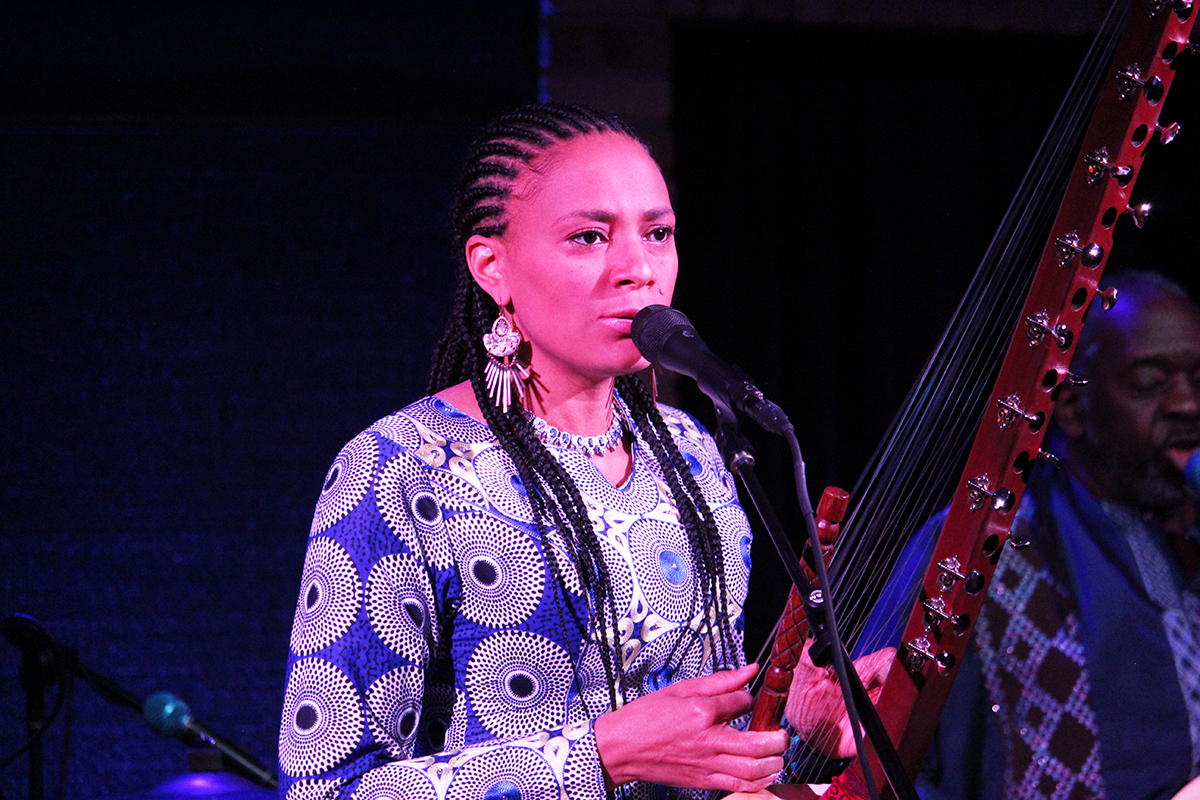
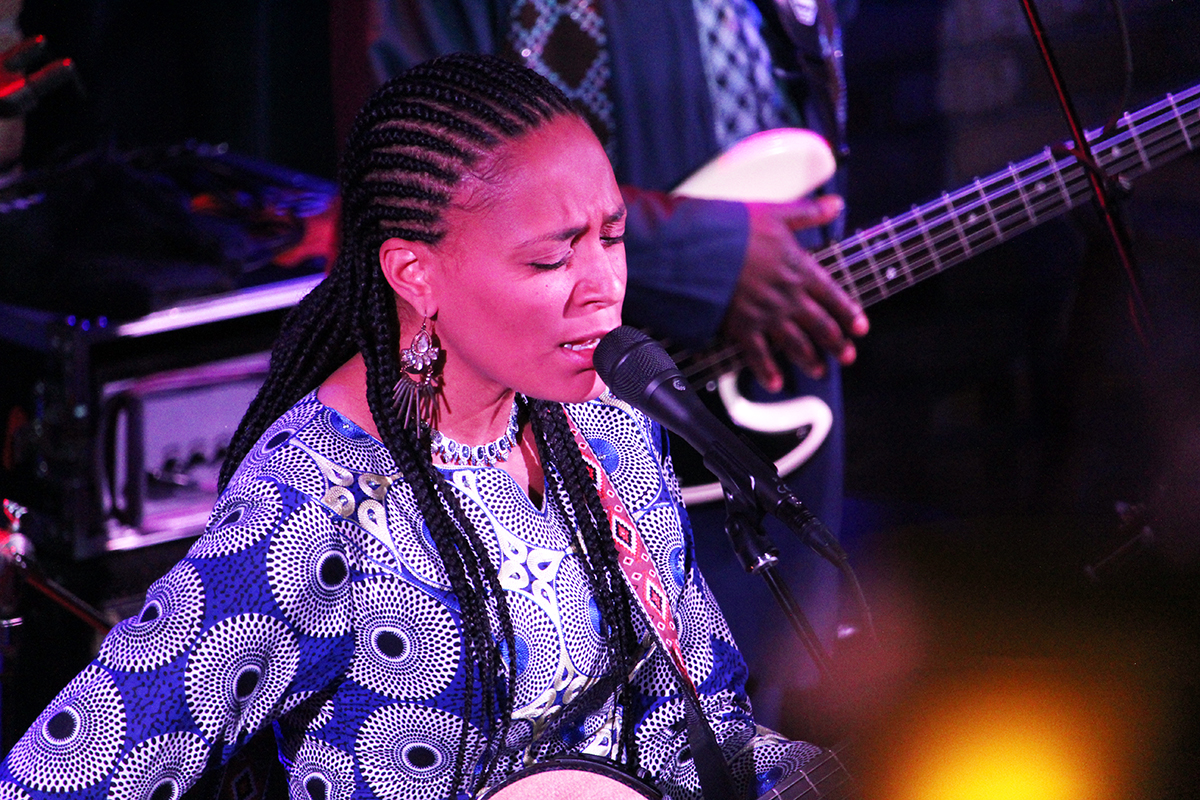
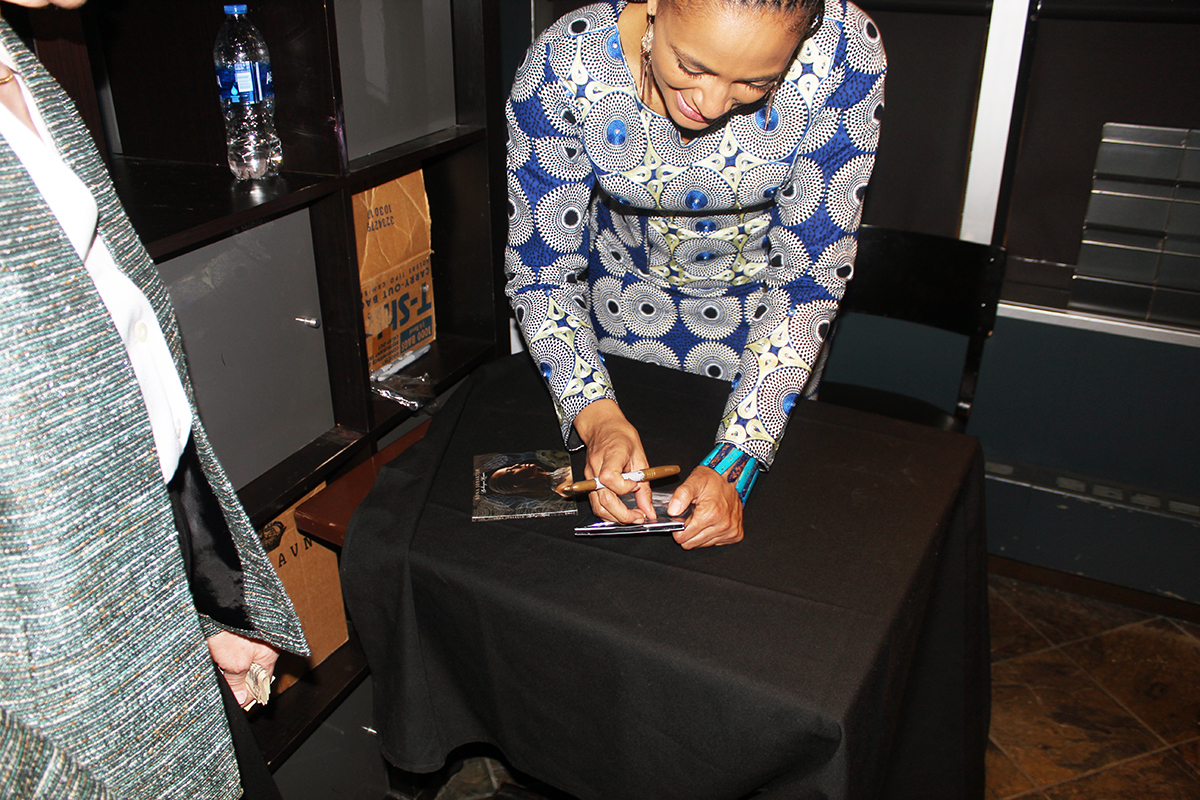
Gambia’s first female virtuoso player of the kora, Sona Jobarteh, playing the kora at the Dakota in downtown Minneapolis where she kicked off her 2023 North America tour on Monday, March 20. Mshale Staff Photo by Jasmine Webber
Sona Jobarteh Minneapolis2023 ThumbnailFeature
Gambia’s first female virtuoso player of the kora, Sona Jobarteh, playing the kora at the Dakota in downtown Minneapolis where she kicked off her 2023 North America tour on Monday, March 20. Mshale Staff Photo by Jasmine Webber

Before this week is out, Madison, Chicago, and Atlanta will find themselves plunged into the deep well of music created by Sona Jobarteh and her band. Monday night, the first day of spring, Minneapolis audience at The Dakota welcomed Jobarteh from her Gambian home to the first gig of her North American tour 2023.

A ground-breaking virtuosic kora player of a griot family that includes grandfather, Amadu Bansang Jobarteh, and cousin, Toumani Diabaté, Sona Jobarteh stands shoulder-to-shoulder with them.

Tuesday’s show immediately pointed to the band’s skill and interdependence as they played off one another earnestly and whimsically. Like a murmuration of starlings, though we didn’t know which way they would turn, they always did so in unison no matter how sharp the ascent.

The second number, Jarabi, from her album, Fasiya, hinted at the level of involvement she hoped to attain from the audience. She coaxed us into singing a short phrase, Wee-oh, Jarabi, over and over, which we willing did. Jobarteh told us that tonight “sets the tone for the next two months, no pressure!”

Following Jarabi, we heard Mamamuso, also from her first album.  Mamamuso is a tribute to her late grandmother, Kumunaa, who encouraged her to learn and study the kora despite the 700-year precedent of father-to-son teaching and playing of the instrument.

Interspersed between songs, Jobarteh offered us an education on the family of instruments played by griots: the calabash, which was played by band member Mamadou Sarr from Senegal; the 21-stringed kora played by Sona; and though not present on stage, the “grandfather of them all,” the balafon. All three of these instruments use a gourd or gourds as the resonator.

Jobarteh’s most recent album, Badinyaa Kumoo, a seven-year-long production was introduced with the show’s fourth number, Nna Kangwo. Dressed in a form-fitting two-piece outfit, a study in blue with patterned circles nestled next to one another, Jobarteh performed this piece, prefaced with a story about including a harmonica player on the album’s recording.

Jobarteh explained that after finishing the song and listening to it, she could hear that something was missing. In her quest to find the missing element, she determined it was a harmonica. “A harmonica?” She said quizzically, but continued, “I don’t question the inspiration, I simply trust it and follow.”

When her fingers pluck the strings, they move with mad speed, it’s as if she’s typing out words as she strums and picks. “The purpose of music is to communicate,” she said, “music is the language of our lives.”

Jobarteh talks a lot during her two-hour show and they only played eight songs, but her spoken words carry such weight and the music, not catchy ear-worms, but consummate pieces, are all delivered with reverence and profundity. My seat mate said the evening went by like a flash of lightning and it carried the same power.

The show included Gambia, a number currently trending in social media. “In Gambia, we have a different version of time, it’s called Tomorrow,” she said eliciting laughter. The song, written to mark the new year, however is about independence, which “has not been achieved on every level on my continent,” she said.

At the end of the show, Jobarteh urged an audience member to come to the stage. Chérif Keïta, a professor at Carleton College, has been an inspiration and even an inadvertent contributor to her music when she named her album, Fasiya, after one of his books. She sang a song of unity, which drives her greatest hope, a unity of the African continent even as each culture retains its tradition, culture, and values.

Talking to acoustic guitarist Eric Appapoulay after the show, he confirmed Jobarteh’s skills at bringing audiences and people together. “She starts slow and builds to include everyone,” he said.