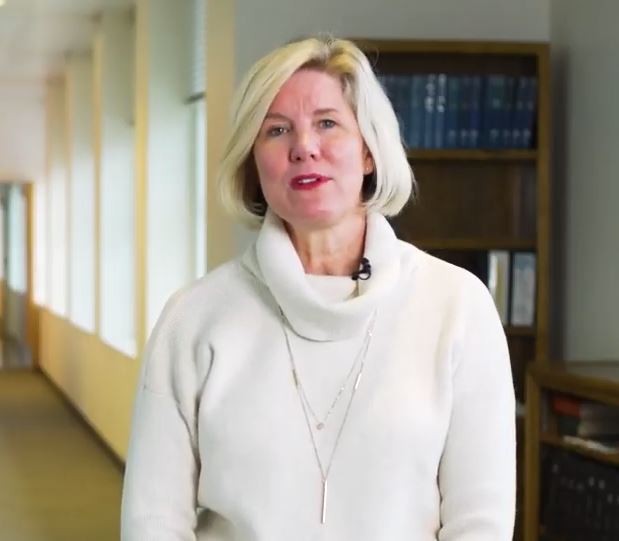
Minnesota infectious disease director Kris Ehresmann, seen here doing a COVID-19 public service announcement, announced on Thursday, January 20, 2022 that she will be retiring on February 2, 2022 after 30 years of service to the state. She had been eligible to retire at the start of the pandemic two years ago but stayed on to help with the state's response to the pandemic. Photo: Minnesota Department of Health YouTube
Minnesota infectious disease director Kris Ehresmann, seen here doing a COVID-19 public service announcement, announced on Thursday, January 20, 2022 that she will be retiring on February 2, 2022 after 30 years of service to the state. She had been eligible to retire at the start of the pandemic two years ago but stayed on to help with the state's response to the pandemic. Photo: Minnesota Department of Health YouTube
Minnesota Department of Health Infectious Disease Director Kris Ehresmann announced Thursday that she will retire Feb. 2 after 30 years at the department. She had been eligible to retire two years ago but stayed on to help with the state’s response to the COIVID-19 pandemic.
Emily Emerson, the current assistant director of the Infectious Disease Epidemiology, Prevention and Control Division, will assume the role of interim director. MDH will launch a national search for a new director, the department said in a statement.
Ehresmann had become a fixture at the state’s daily media briefings regarding the pandemic alongside Minnesota Governor Tim Walz and health commissioner Jan Malcolm.
A statement from the health department said she played leading roles in many public health issues in recent decades, including Minnesota’s measles outbreak in 2017 – the largest measles outbreak in the United States that year – Ebola preparedness in 2014, the fungal meningitis investigation and response of 2012, H1N1 pandemic response in 2009, post-9/11 readiness work in the early 2000s, and dozens of other high-profile public health issues.
Minnesota Lt. Gov. Peggy Flanagan described Ehresmann as an “extraordinary public servant” that was key in helping the state navigate the pandemic.
Ehresmann at one time served on the U.S. Centers for Disease Control and Prevention’s Advisory Committee on Immunization Practices (ACIP), becoming only the second nurse to ever be named to the panel.
“Kris Ehresmann is a true leader, and her experience and skill as a top public health adviser has been instrumental in leading Minnesota through the COVID-19 pandemic,” Gov. Walz said in a statement. “It has been an honor to work alongside Kris. Her efforts to keep Minnesotans safe and healthy have left a legacy that will impact our state for years to come.”
“Kris’s expertise and ability to communicate complicated public health messages with clarity and compassion has made her an invaluable gift to the residents of Minnesota,” said Dr. Michael Osterholm, director of the University of Minnesota’s Center for Infectious Disease Research and Policy and a former state epidemiologist at MDH. “She will be truly missed.”
Candidates for the Brooklyn Park City Council East District Feb. 8, 2022 special election will meet in a candidate forum presented by Mshale on Jan. 20, 2022
Candidates for the Brooklyn Park City Council East District Feb. 8, 2022 special election will meet in a candidate forum presented by Mshale on Jan. 20, 2022
The four candidates vying for the Brooklyn Park City Council East District open seat in the upcoming Feb. 8 special election will gather tonight at a live in-person candidate forum hosted by Mshale in partnership with Hmong TV, Insight News and Somali TV of Minnesota.
Moderated by Mshale reporter Cynthia Simba, candidates will be taking questions formulated by Mshale’s editorial team from 6:30 p.m. to 8:00 p.m.
The forum will be streamed live on Facebook pages of the participating media entities. The live forum can also be viewed on the Brooklyn Park Highlights, a popular Facebook group for the city’s residents. There will be no live audience.
The four candidates participating are Abraham Bah, Xp Lee, Benjamin Osemenam and LaDawn Severin.
Voting is already underway. Absentee voting started on Dec. 27. Voters can vote absentee between 8 a.m. to 4:30 p.m. Monday through Friday at City Hall, 5200 85th Ave. N.
Application forms for absentee ballots are available at City Hall and on the city’s website at brooklynpark.org. Voters can request an absentee ballot application mailed to them by calling 763-493-8119 or 763-493-8180.
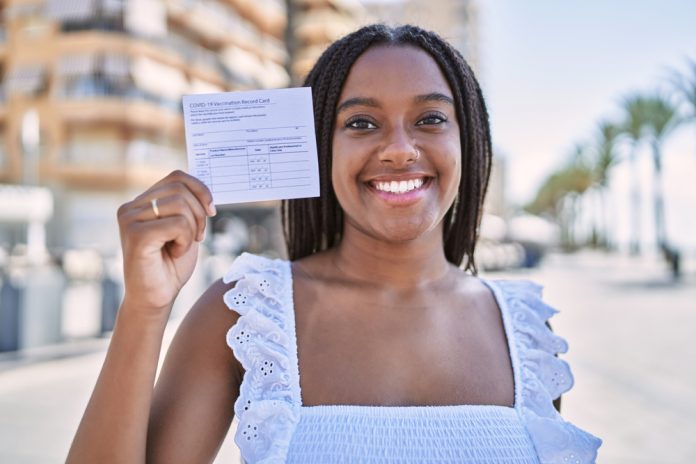
Starting January 19, 2022 one will need to show proof of COVID-19 vaccination or a negative test to enter a bar or restaurant for indoor dining in the cities of Minneapolis and St. Paul, mayors of the two cities announced on Jan. 12, 2022. Photo: Shutterstock
Starting January 19, 2022 one will need to show proof of COVID-19 vaccination or a negative test to enter a bar or restaurant for indoor dining in the cities of Minneapolis and St. Paul, mayors of the two cities announced on Jan. 12, 2022. Photo: Shutterstock
To address the surging omicron COVID that is hitting Minnesota, the mayors of Minneapolis and St. Paul on Wednesday issued new rules for those visiting bars and restaurants and other community venues.
To enter these establishments for indoor dining or drinking, one will need to show proof of COVID-19 vaccination or a negative test. The negative test has to be less than 72 hours.
Locations that provide takeout service only are exempt. Children under 2 are also exempt from these requirements as they cannot be tested for COVID-19.
The new rules take effect in both cities on Jan. 19 and Jan. 26 for ticketed events. It applies to indoor restaurant spaces, coffee shops, cafes, bars, sports venues, entertainment venues, and conventions.
One can show proof of their vaccination by presenting their physical vaccination card or a photo of the same. Minnesota’s Docket app is also acceptable.
Exceptions apply to athletes, performers and supporting staff (such as coaches, trainers, road crew) competing or performing at any space of public accommodation; K-12 and early childcare settings; hospitals; congregate care facilities or other residential or healthcare facilities; locations that provide takeout service only; food or drink as part of a religious practice; outdoor spaces; grocery stores, convenience stores and other establishments that primarily sell food and other articles for offsite use except in seated dining areas within those stores; and soup kitchens and other sites serving vulnerable populations (e.g., People Serving People).
St. Paul Mayor Melvin Carter and Minneapolis Mayor Jacob Frey made the announcement together during a virtual press conference.
“This is a critical next step to avoid closures, we want to stay open, and we need to stay safer,” said Mayor Frey.
“While this is a tool no one ever wants to have to use, amid these ongoing concerns that we hear from public health professionals and amid the staggering increases we’ve experienced” in COVID cases, “we must continue to leverage every tool we have available,” Carter said. “Only by working together can we all help prevent the spread of COVID, conquer this together and keep our economy moving forward together.”
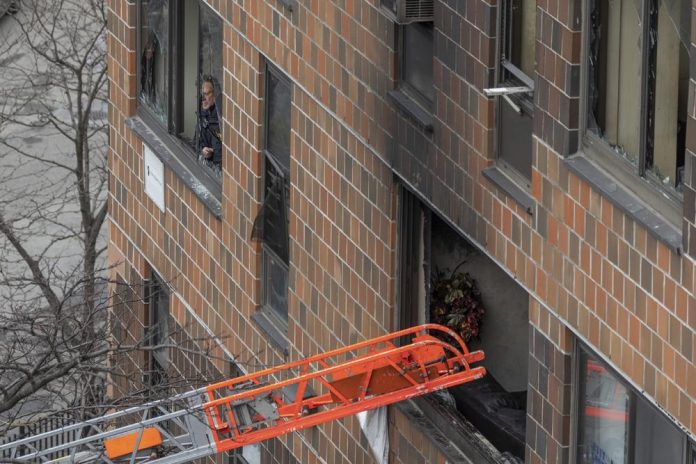
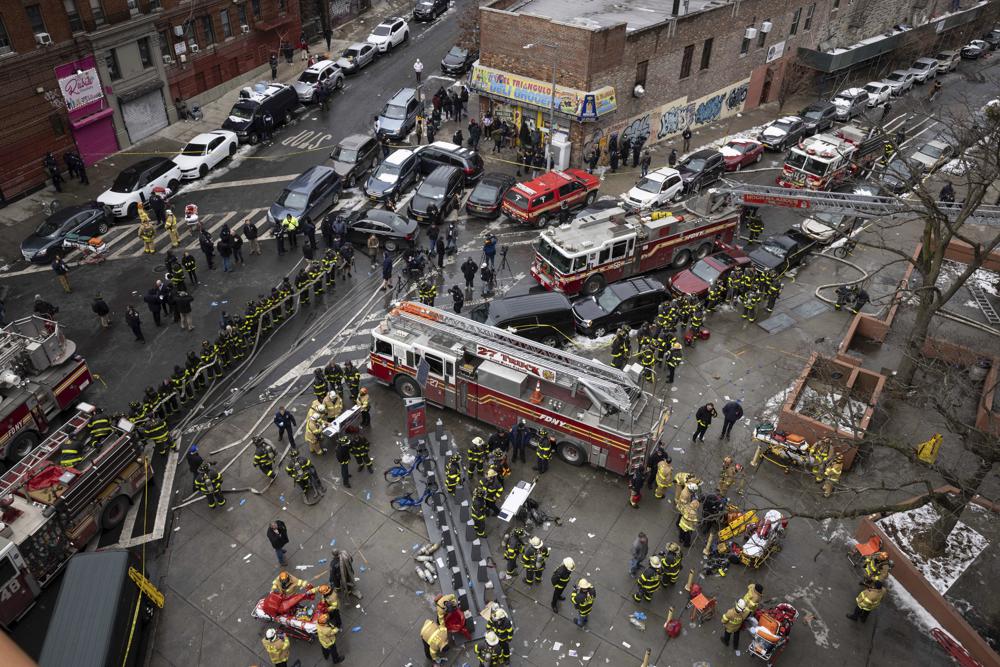
A ladder leads up to a window after a fatal fire at an apartment building in the Bronx on Sunday, Jan. 9, 2022, in New York. The majority of victims were suffering from severe smoke inhalation, FDNY Commissioner Daniel Nigro said. Photo: Yuki Iwamura/AP
A ladder leads up to a window after a fatal fire at an apartment building in the Bronx on Sunday, Jan. 9, 2022, in New York. The majority of victims were suffering from severe smoke inhalation, FDNY Commissioner Daniel Nigro said. Photo: Yuki Iwamura/AP
Sorrow welled across a Bronx community Monday, a day after a fire and choking smoke engulfed a high-rise apartment building and claimed the lives of 17 people, eight of them children.
As survivors recalled the frantic chaos of their escape, bereft family and friends of those who perished coped with shock, disbelief and pain.
“Some people don’t even know that their loved ones are gone,” said Fathia Touray, speaking to The Associated Press from her home in the United Arab Emirates. Her mother and siblings lived on the building’s third floor, where the fire started. One sister was rushed to a hospital, but is now in stable condition. The rest of her immediate family escaped.
Mayor Eric Adams said Monday morning that several people were still in critical condition after a malfunctioning space heater sparked the city’s deadliest fire in three decades.
Renee Howard, 68, became emotional as she spoke about the lives lost.
“I’ve never experienced such devastation. My neighbors died, children died — I don’t understand, I don’t understand,” she said as she broke into sobs.
“I don’t remember all their names right now,” she said, before rattling off a few, including one boy who she described as having “such beautiful angelic eyes.”
All those lives, she said, were “snatched away in a second.”
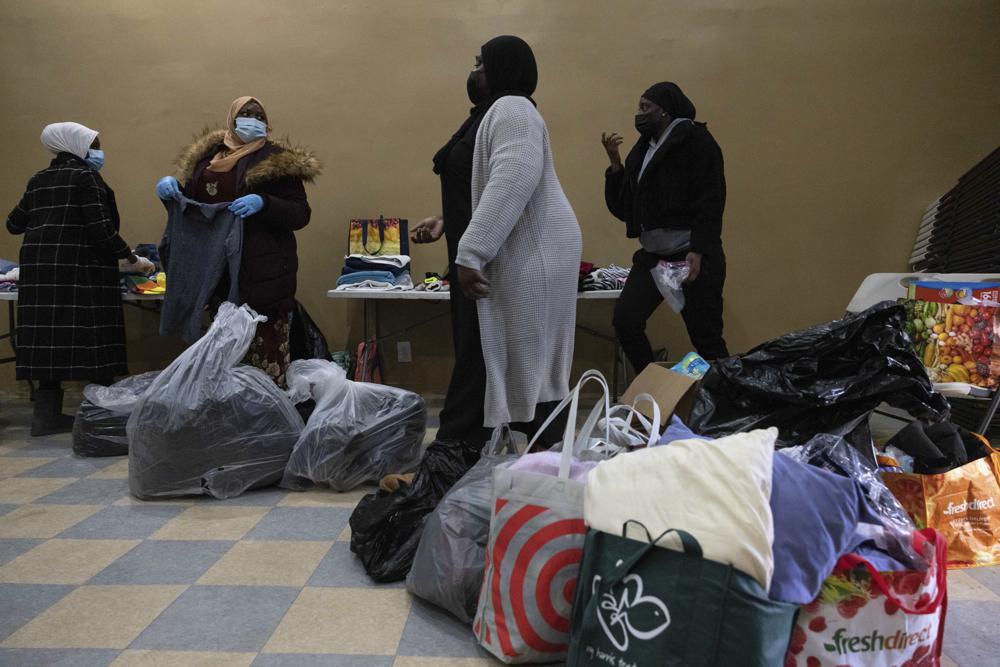
People prepares donations at Gambian Youth Organization near the apartment building in the Bronx on Monday, Jan. 10, 2022, in New York. Doctors are working to save the lives of several people gravely injured when smoke from a fire knocked them out or trapped them in their apartments in the New York City high-rise building. Photo: Yuki Iwamura/AP
She joined other residents, surviving family and strangers alike in prayer Monday to console the grieving.
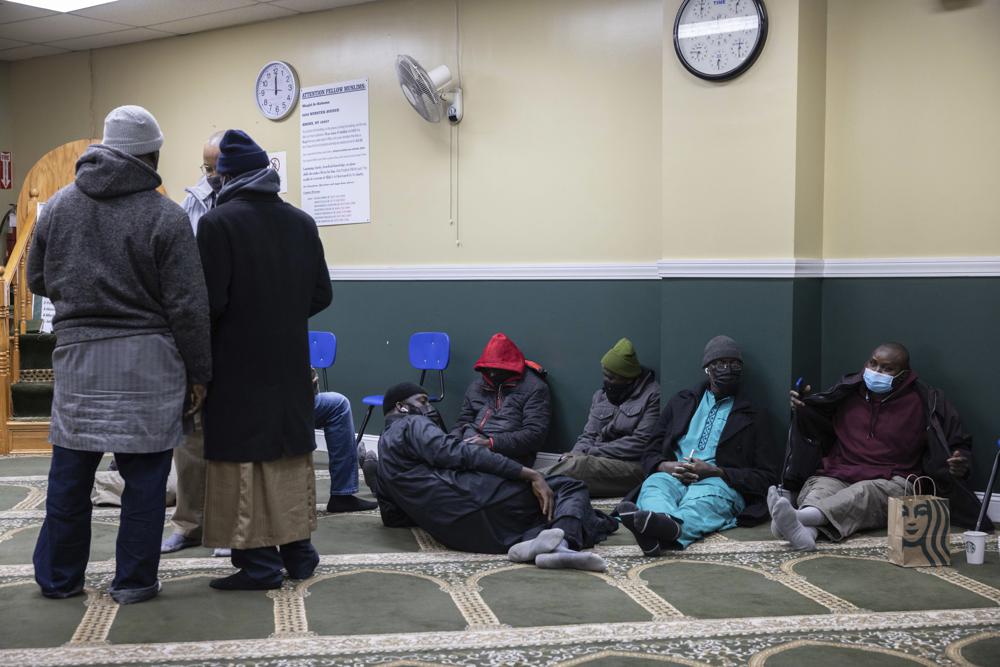
At Masjid-ur-Rahmah, a mosque just a few blocks from the apartment building, more than two dozen people came together in solidarity. Many of those who pray at the mosque live in the building.
About a dozen women wept inside the mosque, mourning the loss of three young children in the fire. Members of the congregation weren’t sure about whether the children’s parents’ survived, and many family members feared the worst.
“To God we belong and to God we return,” said the mosque’s imam, Musa Kabba, who urged congregants to be patient while awaiting news about loved ones.
Family members gather and wait for information about missing loved ones at Masjid-Ur-Rahmah near the apartment building which suffered the city’s deadliest fire in three decades, in the Bronx borough of New York on Monday, Jan. 10, 2022. Photo: Yuki Iwamura/AP
Many who lived at the apartment complex had formed a close-knit community, and soon word spread about who might have died amid the smoke and fire.
“I’m so sorry for the people that lost their children and their mothers because we all are one. And for this to happen, it’s horrible,” said Tysena Jacobs, a building resident.
Mahamadou Toure struggled to find the words outside a hospital emergency room, hours after the fire took the life of his 5-year-old daughter and her teenage brother.
“Right now my heart is very …,” Toure tried to tell the Daily News, before composing himself.
“It’s OK. I give it to God,” he continued.
Neighborhood residents, Johanna Bellevue among them, donated clothes and other necessities to survivors.
“Baby clothes, baby food, books, jackets, sneakers, whatever I can,” Bellevue said. “I can’t do much but what I have.”
At an assistance center set up at Monroe College, Stefan Beauvogui and his wife went through rooms of clothes and household goods.
Beauvogui has lived in the building for about seven years, he said. He and his wife were in their apartment on the 4th floor along with their 6- and 9-year-old sons when his wife smelled smoke Sunday morning, he said.
Firefighters work outside an apartment building after a fire in the Bronx, Sunday, Jan. 9, 2022, in New York. Photo: Yuki Iwamura/AP
His family were waiting Monday to be let back into their apartment to see the extent of damage.
Meanwhile, The Mayor’s Fund to Advance New York City launched a relief fund to aid displaced residents.
“The city stands ready to give impacted families all the support they need,” Adams said.
Many of those displaced were immigrants from the West African nation of Gambia.
“This is a very close-knit community,” said Touray, who lived in the building herself for many years and has kept close contact with family and friends in the United States despite moving to the United Arab Emirates.
Her family moved to the building nearly four decades ago. Soon, others from Gambia, some from the same village as her own, would arrive. Over the years, they formed a community in one enclave of the Bronx.
“These are working class, first-generation immigrant families surviving,” she said, “and just trying to thrive in the U.S.”
“We’ve lost a lot of close family friends,” said Touray, who said she expected to fly back to the United States to be with family.
___
Associated Press writers David Porter and Deepti Hajela and news researcher Rhonda Shafner contributed to this story.
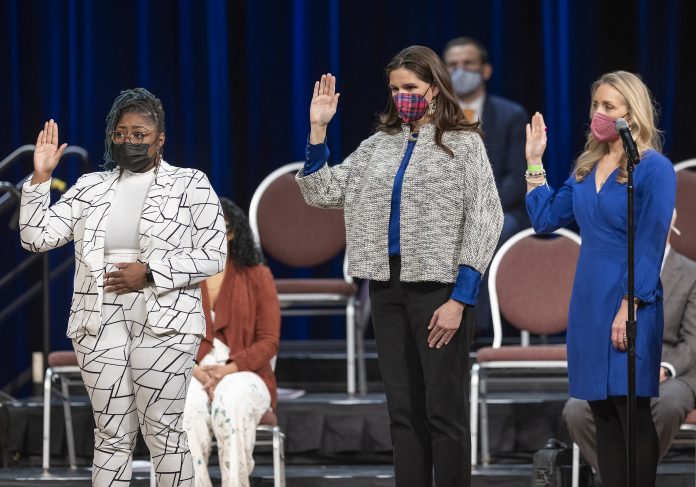
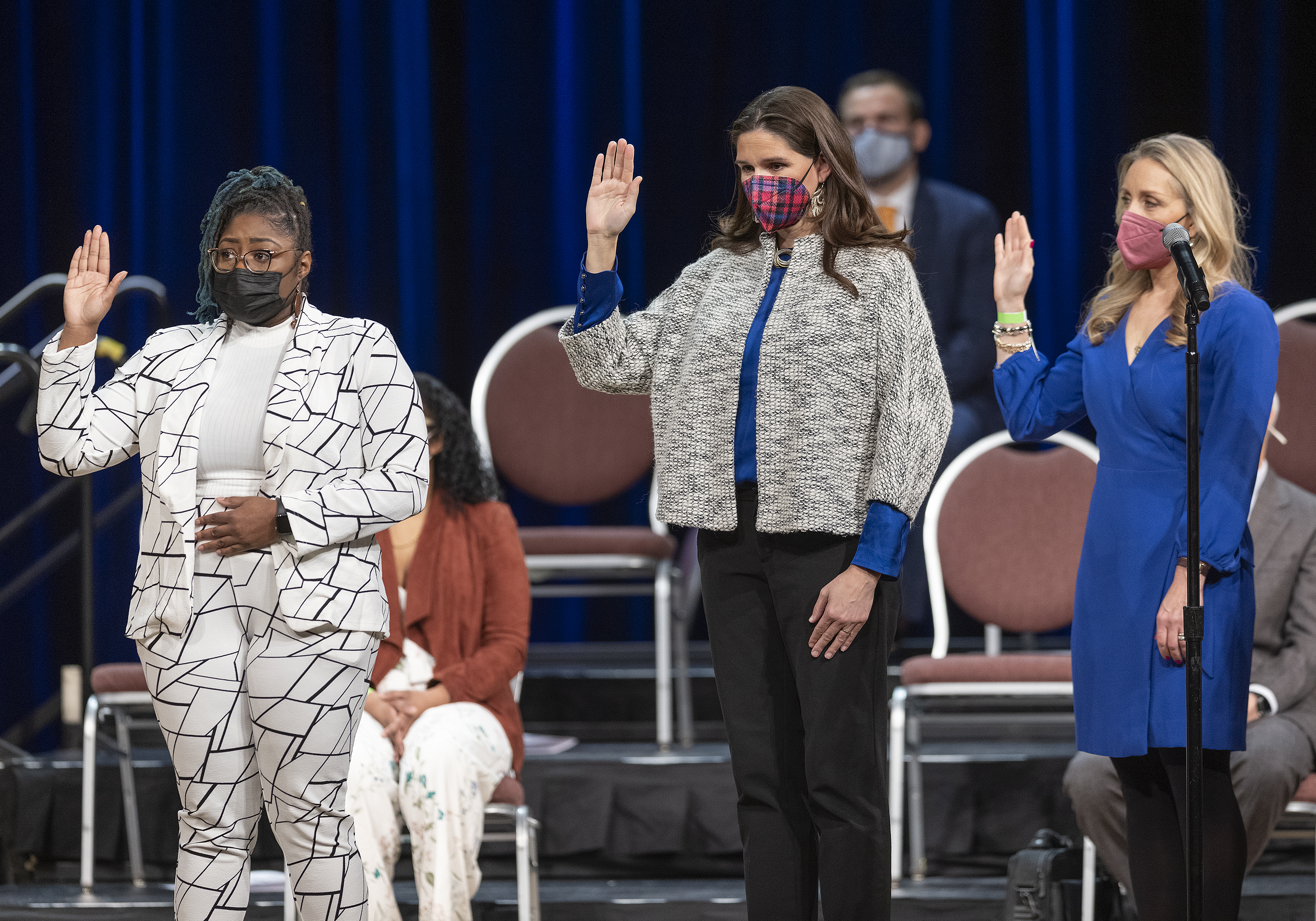
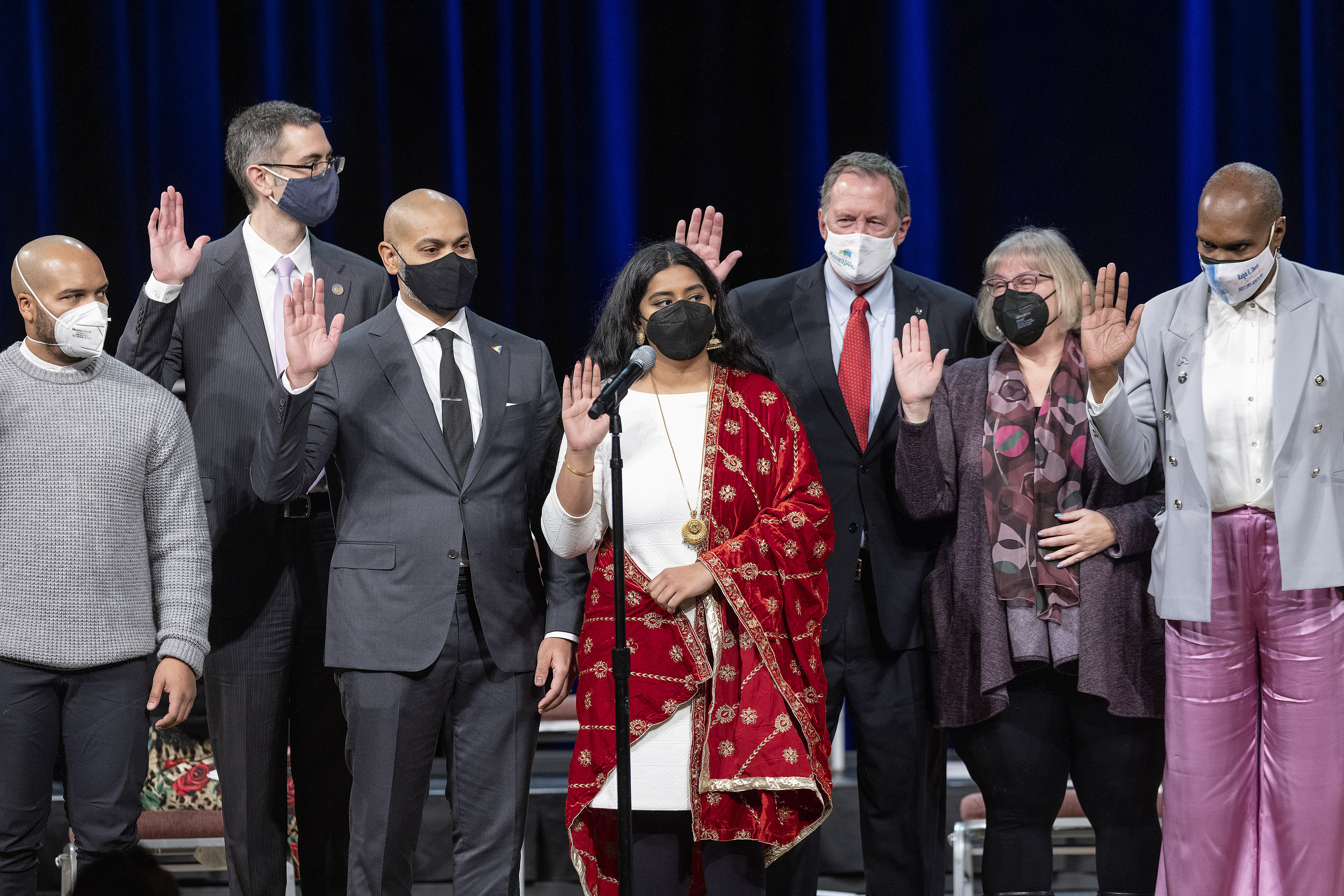
From left, Council Member Robin Wonsley Worlobah, Council Vice President Linea Palmisano, Council Member Emily Koski were sworn in during the Minneapolis inaugural ceremony Monday, Jan. 10, 2022 at the Minneapolis Convention Center in Minneapolis, Minn. Credit: Pool Photo by Elizabeth Flores
From left, Council Member Robin Wonsley Worlobah, Council Vice President Linea Palmisano, Council Member Emily Koski were sworn in during the Minneapolis inaugural ceremony Monday, Jan. 10, 2022 at the Minneapolis Convention Center in Minneapolis, Minn. Credit: Pool Photo by Elizabeth Flores
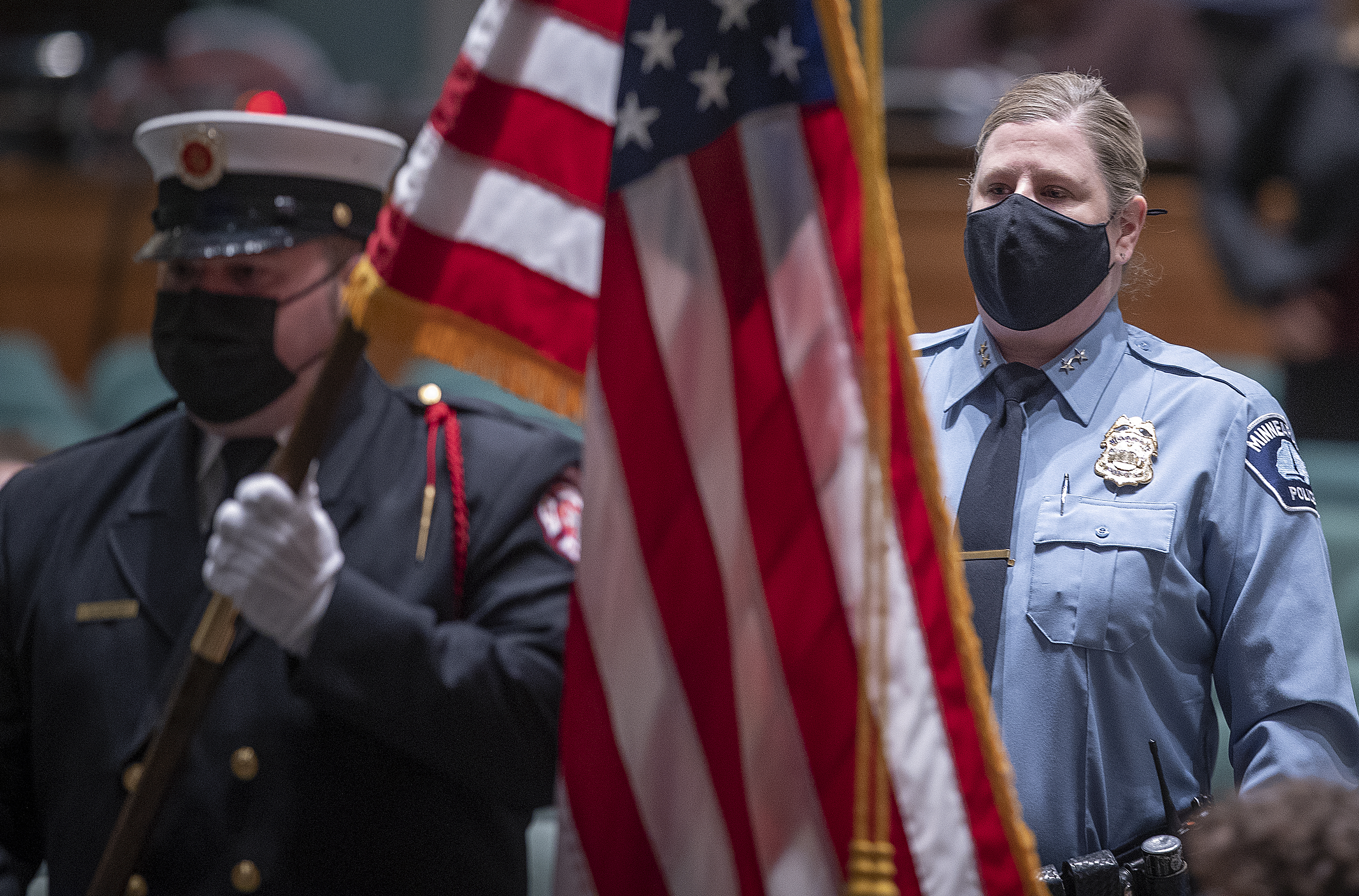
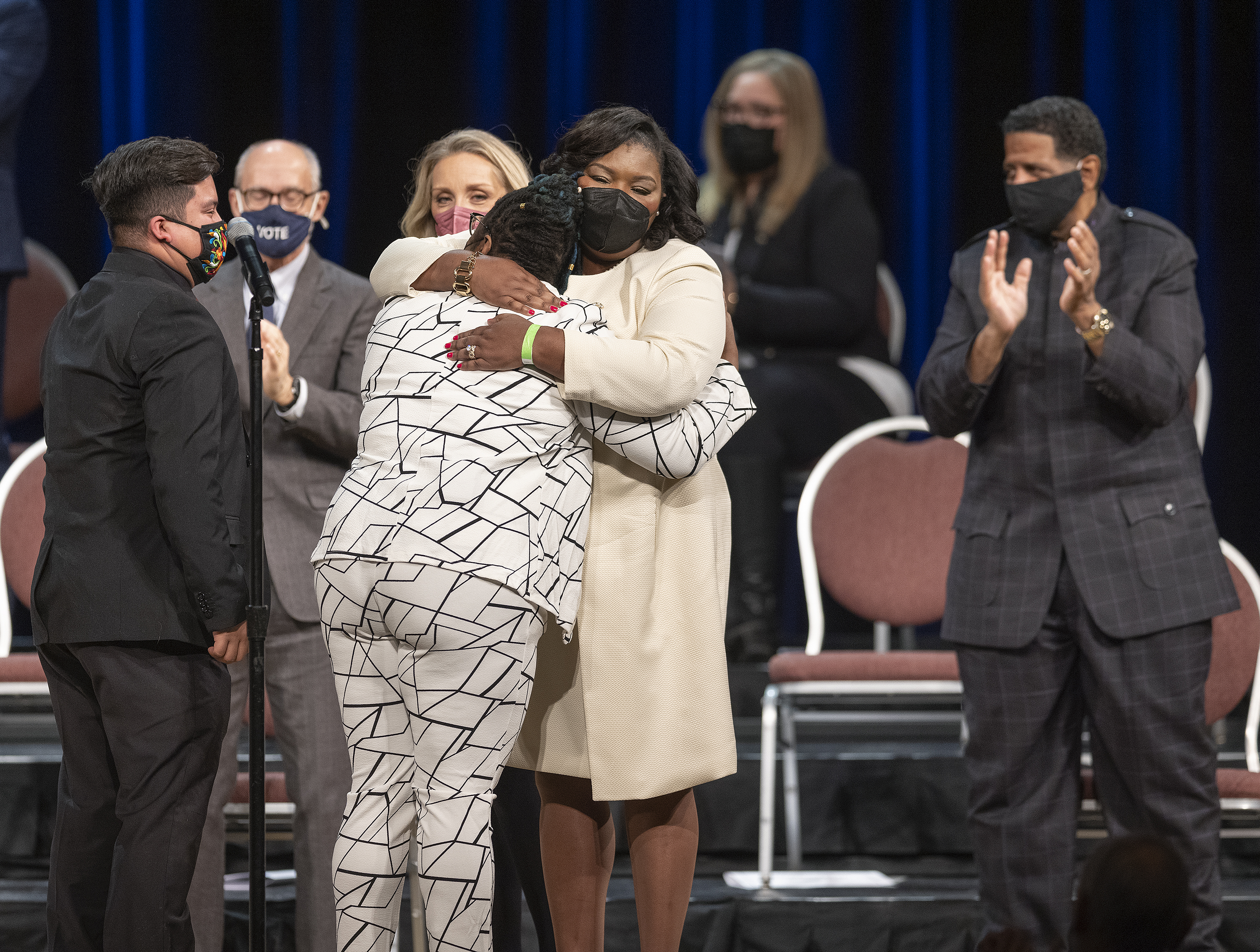
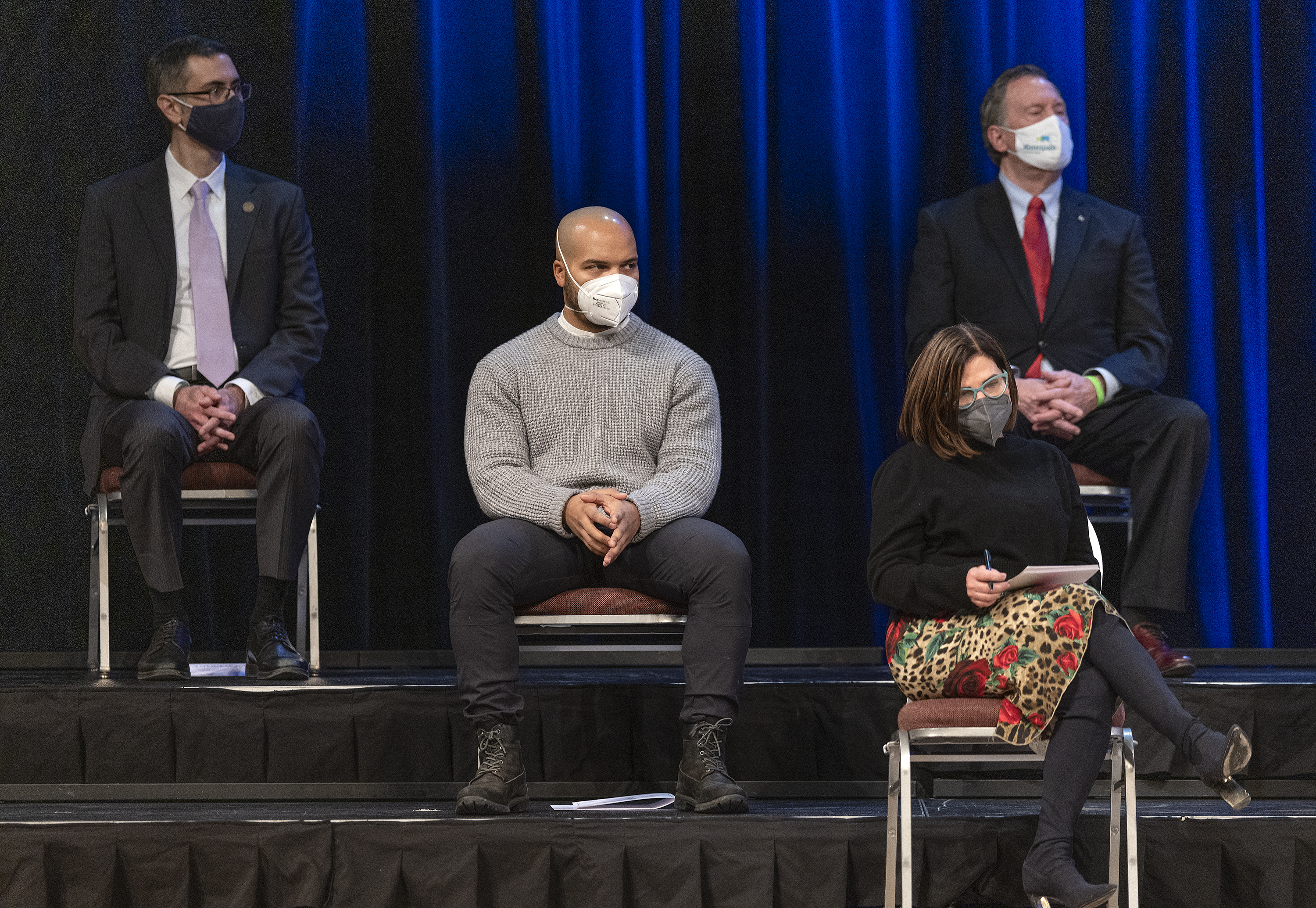
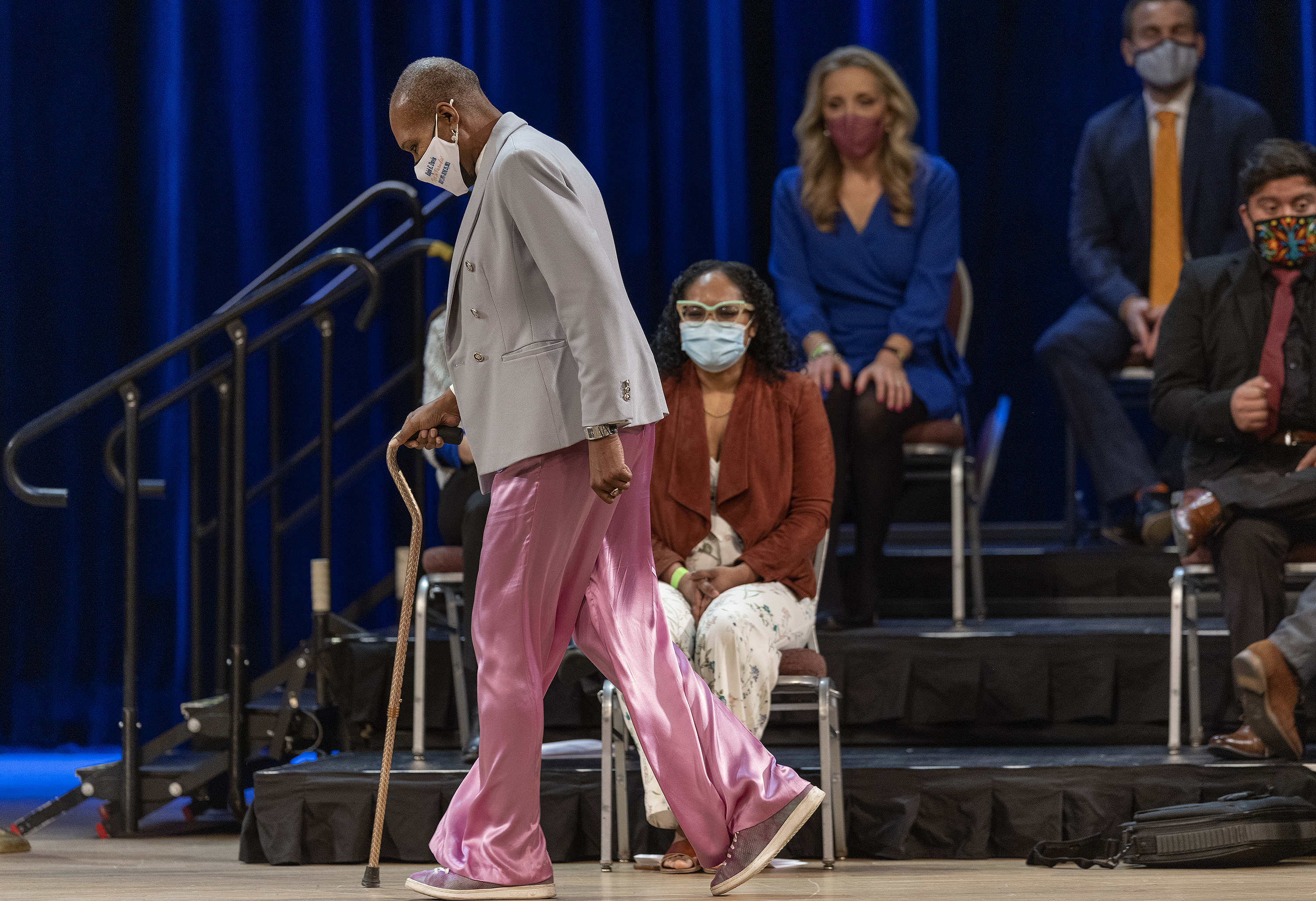
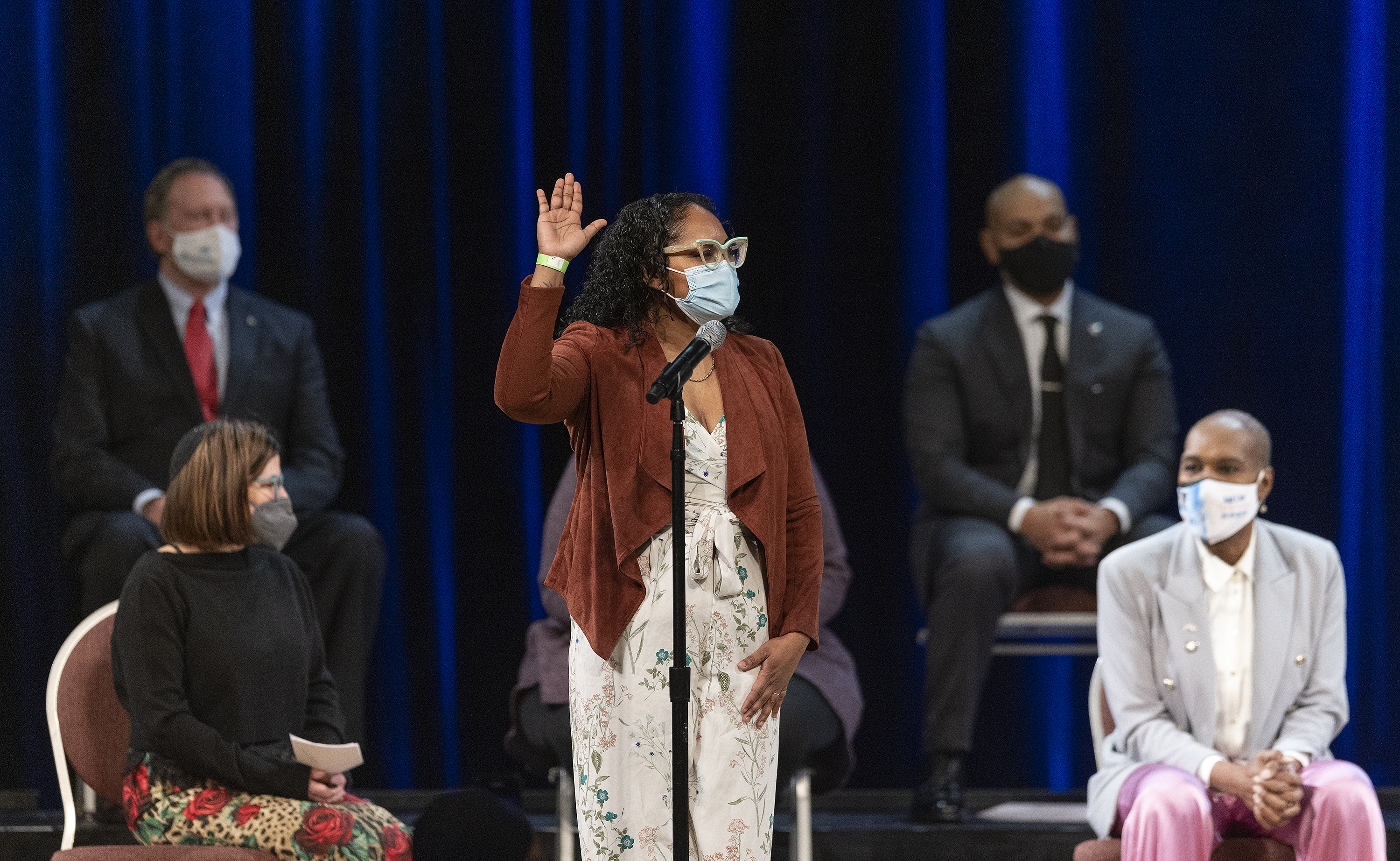
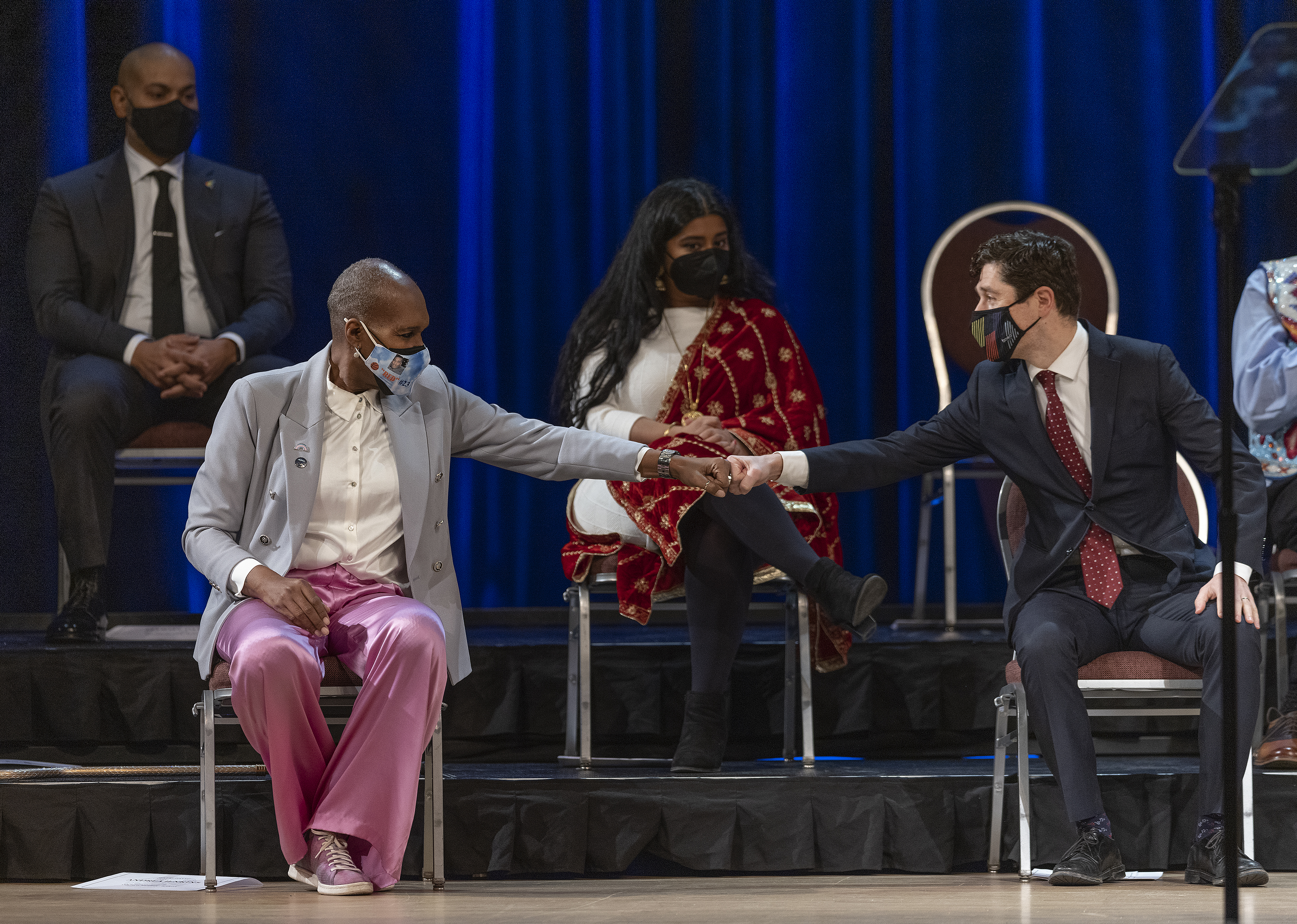
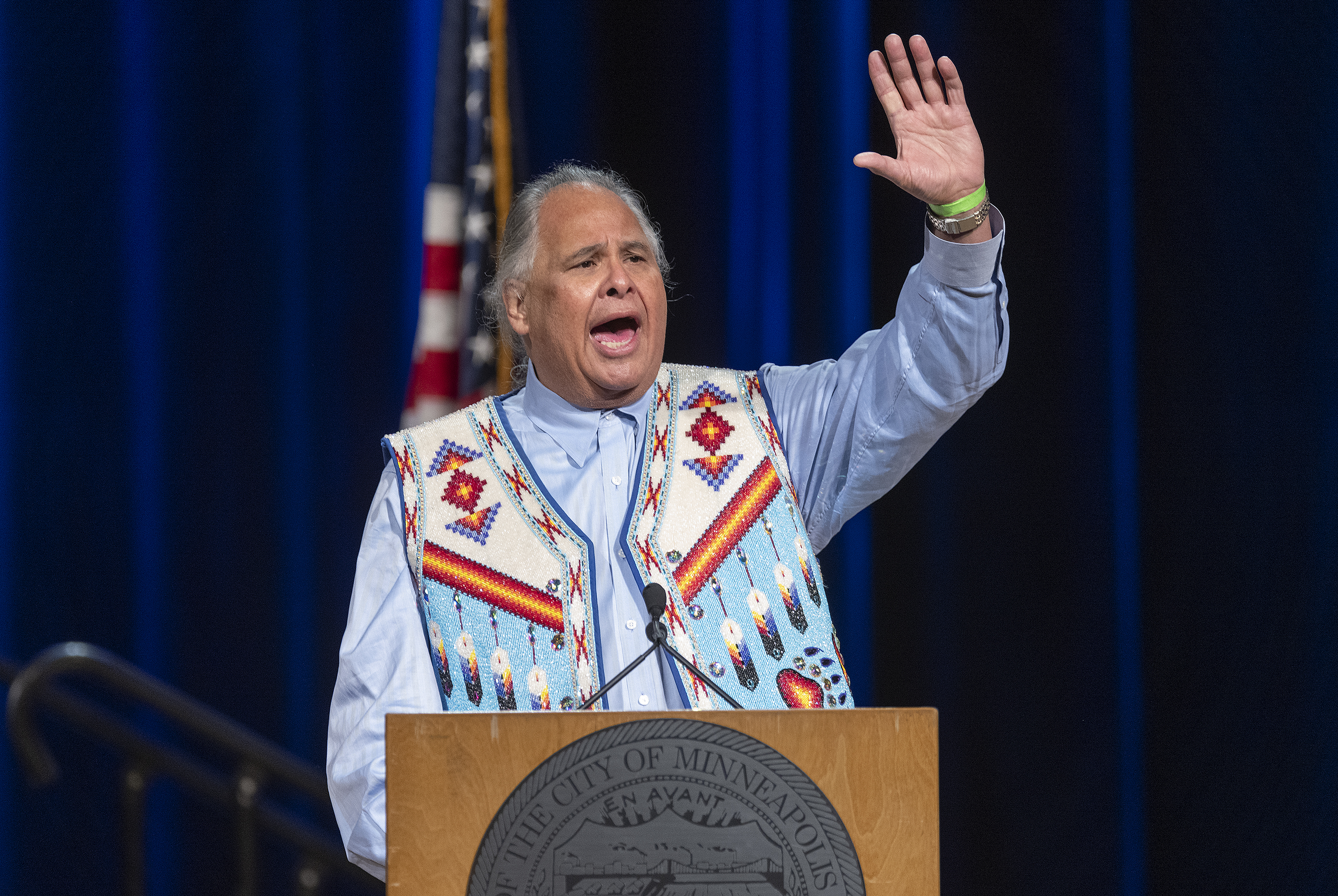
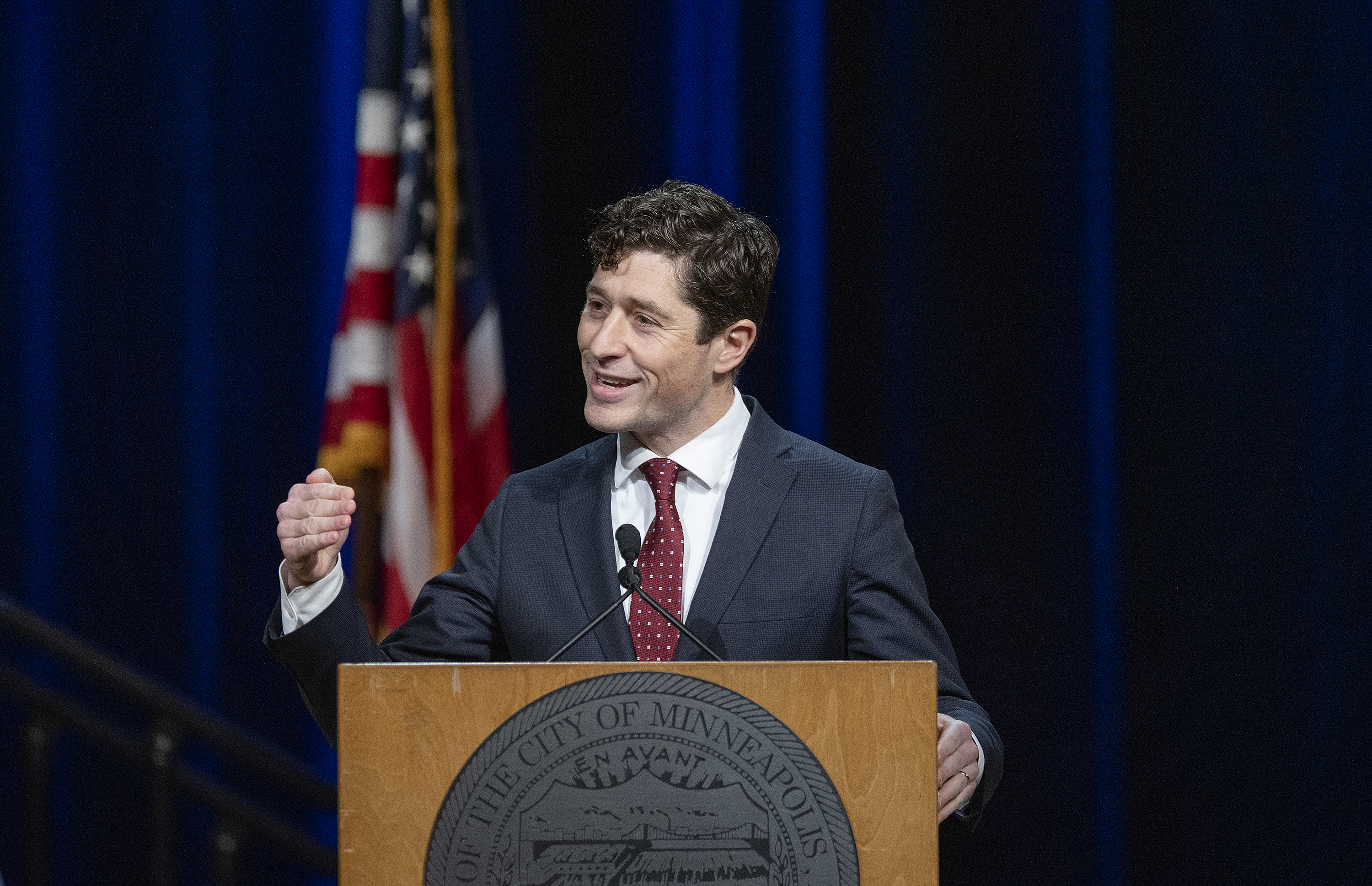
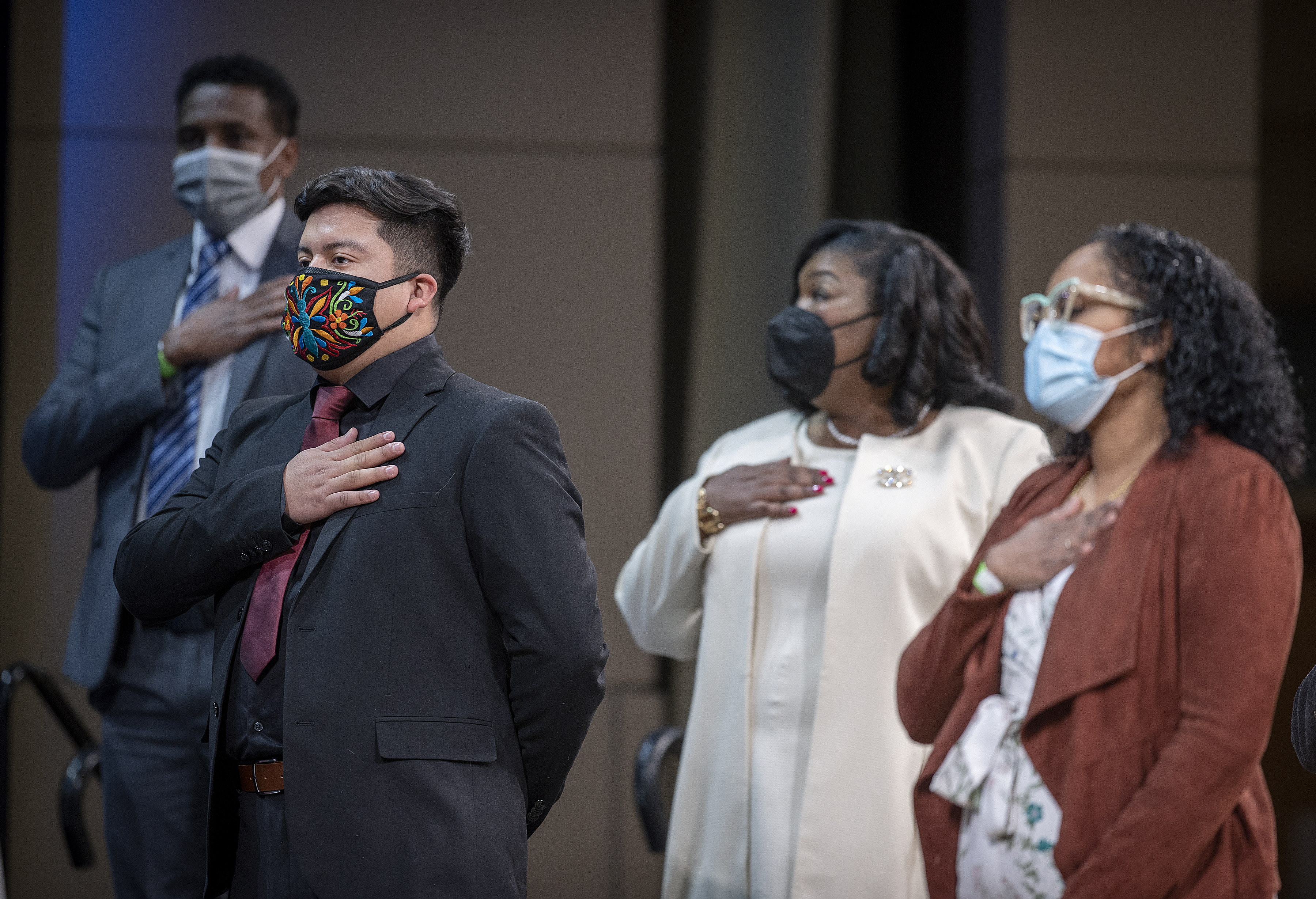
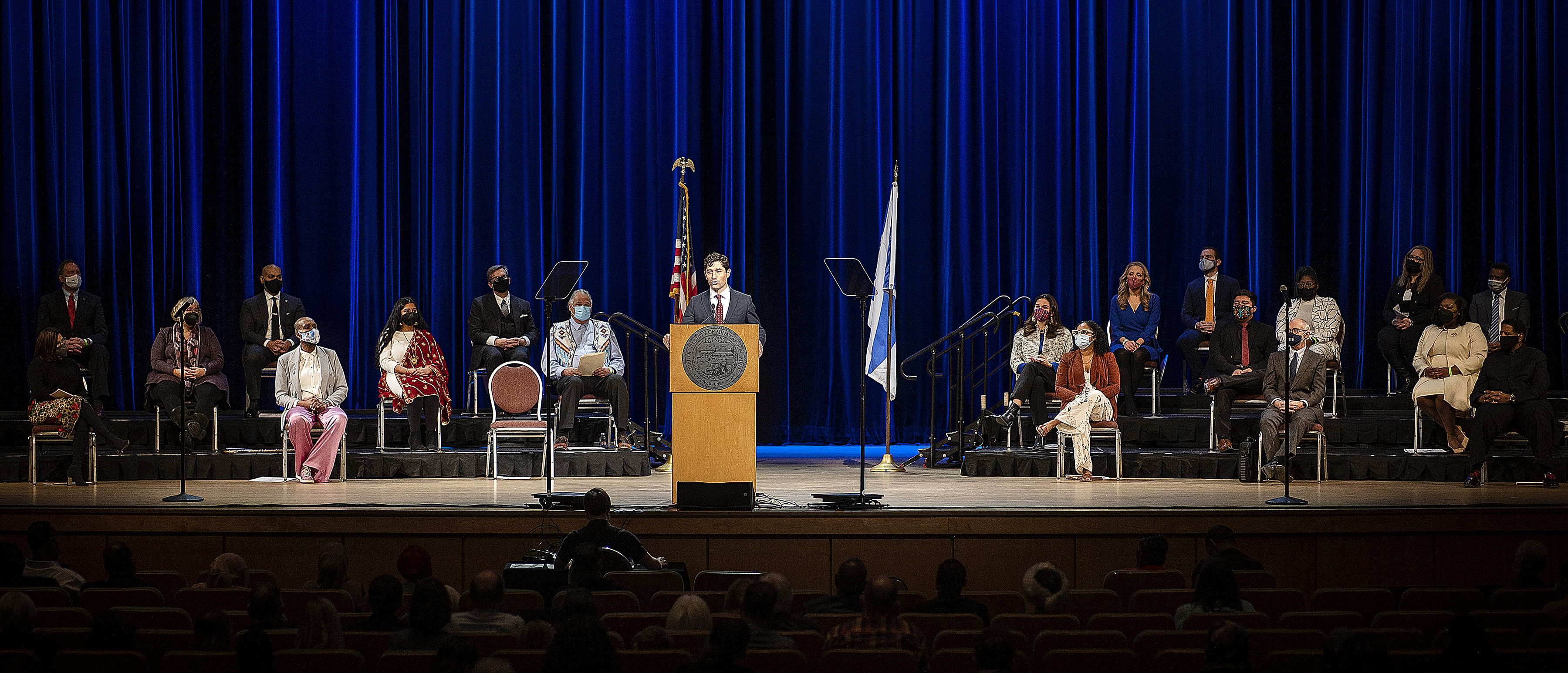
Minneapolis held a low-key but historic inauguration for its new City Council on Monday, January 10, 2022. The ceremony featured newly re-elected Mayor Jacob Frey, City Council Members and members of the Board of Taxation and Estimates. It was an historic occasion as for the first time in the history of Minneapolis, people of color are the majority in the 13-member council. Eight of the 13 members are people of color.
Council members in a historic move elected Andrea Jenkins as the council president, becoming the first openly transgender Black woman to take the post. Jenkins represents Ward 8 where George Floyd was murdered by former Minneapolis Police officer Derek Chauvin.
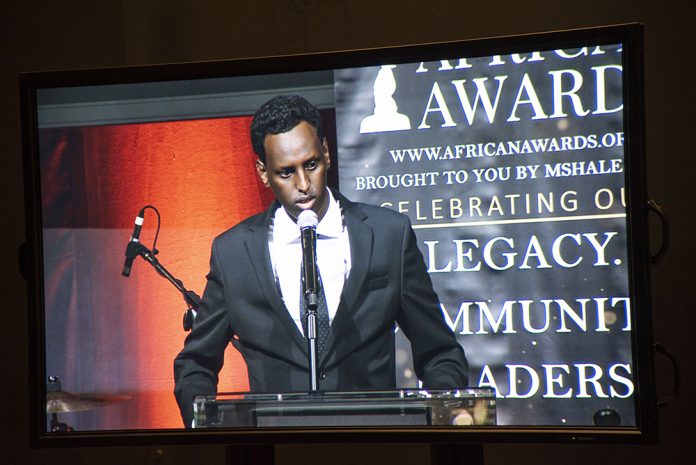
Hamse Warfa delivering the keynote address at Mshale’s annual African Awards Gala on Saturday, October 12, 2019 at the Target corporate headquarters in Minneapolis. It was announced on Monday, January 10, 2022 that the deputy commissioner at the Minnesota Department of Employment and Economic Development has been appointed by President Biden to serve as a senior adviser at the State Department.
Hamse Warfa delivering the keynote address at Mshale’s annual African Awards Gala on Saturday, October 12, 2019 at the Target corporate headquarters in Minneapolis. It was announced on Monday, January 10, 2022 that the deputy commissioner at the Minnesota Department of Employment and Economic Development has been appointed by President Biden to serve as a senior adviser at the State Department.
After three years leading Gov. Walz’s efforts in providing resources and training to Minnesota workers and businesses as deputy commissioner in the state’s economic development agency, Hamse Warfa announced his departure Monday following his appointment by President Biden to serve as a senior adviser in the U.S. State Department.
Since 2019 when he was appointed to the Department of Employment and Economic Development (DEED) by Gov. Walz, Warfa has been the highest-ranking official in the executive branch of government born in Africa. He was a volunteer on Biden’s 2020 presidential campaign as an economic policy committee member.
Speaking to Mshale after the announcement from the governor’s office, Warfa said he will be relocating to Washington in about two weeks.
In his new role as senior adviser at the State Department, Warfa will focus on civilian security, democracy and human rights. Originally from Somalia where he fled the civil war, Warfa said his lived experience under authoritarianism as a child “taught me things could get worse quite rapidly.”
As deputy commissioner at DEED, Warfa is credited with advocating for the largest job bill in state history and providing workforce training to more youth and adults. His boss, DEED Commissioner Steve Grove, in a statement described Warfa as an extraordinary leader under whose leadership “new workforce training programs were established to support African immigrants, increase Black workers in Tech and provide free online training open to all Minnesotan adults during the height of the pandemic.”
In a joint statement Gov. Tim Walz and Lt. Gov. Peggy Flanagan described Warfa’s work in their administration as “transformational” and expressed gratitude for his service to the state and “his commitment to building an equitable economy that works for everyone.”
The two went on to say that “he approaches his work with a clear mission to ensure that the most impacted individuals and communities are centered in decision-making.”
Commissioner Grove signaled that Warfa’s work and legacy will continue to benefit the state.
“He brought true passion to his work, and I know he’ll bring that same heart to Washington as he fights for democracy around the world,” Grove said in his statement.
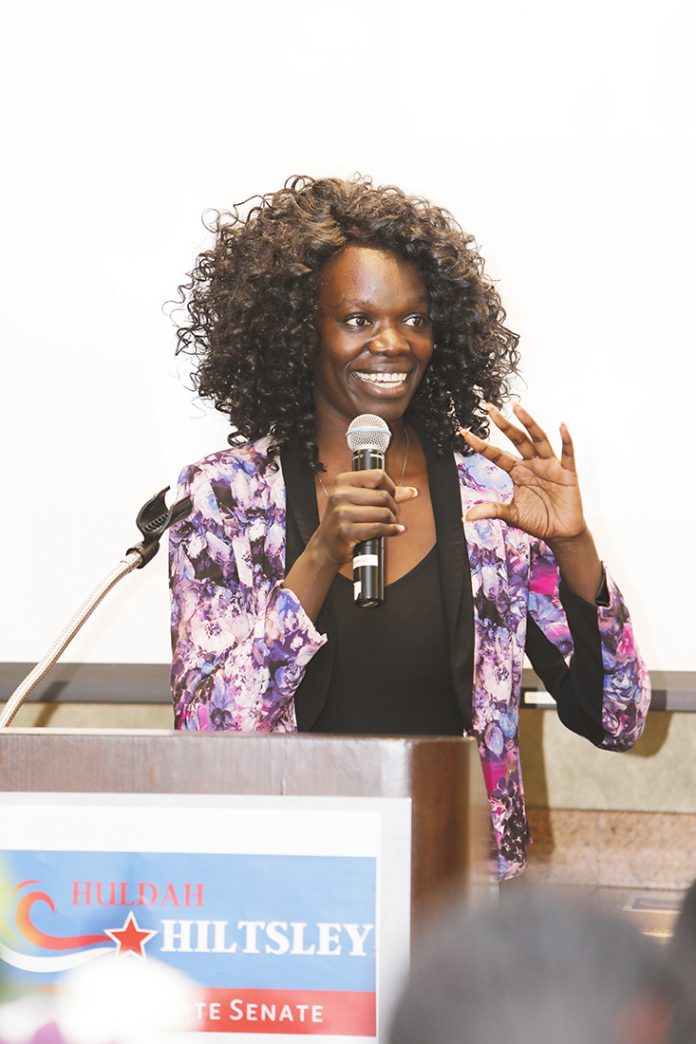
Huldah Momanyi-Hiltsley is a candidate for the Minnesota state Senate to represent Senate District 40 in the 2022 elections. If elected, she will be the first Black woman to serve in the state Senate. Photo: Richard Ooga/Mshale
Huldah Momanyi-Hiltsley is a candidate for the Minnesota state Senate to represent Senate District 40 in the 2022 elections. If elected, she will be the first Black woman to serve in the state Senate. Photo: Richard Ooga/Mshale
Huldah Momanyi-Hiltsley says she wants to be the next lawmaker to represent District 40 in the Minnesota State Senate. If she’s successful, the Kenyan American would be the first Black woman to ever be elected in the 67-member upper house of the state legislature.
“What has lacked over the years [in District 40] has been the representation in leadership, from the school board all the way to the House of Representatives, and the Senate in terms of what that demographic looks like,” she says.
Momanyi-Hiltsley, who is currently the president of Mwanyagetinge, an organization of Kenyans in Minnesota, has lived in Brooklyn Center for more than twenty years. She says that the city’s representatives need to resemble their constituents. She considers fair representation as a key to solving the district’s issues.
She decided to run for the seat after Sen. Chris A. Eaton, who has represented District 40 since 2011, announced that she will not seek reelection in 2022.
Members of the Minnesota Senate are eligible to serve four-year terms if elected in years ending with a two or a six, and two-year terms if elected in years ending with a zero.
Located just north of Minneapolis, District 40 is home to the most culturally diverse population in the state. About 60 percent of the district’s residents are persons of color, according to the 2020 U.S. census data. Currently, the district includes the city of Brooklyn Center and part of Brooklyn Park in Hennepin County, though the final boundaries won’t be known until redistricting is completed.
U.S. law mandates that every ten years, boundaries of congressional and state legislative districts must be redrawn to ensure representation in legislatures reflects census data. Momanyi-Hiltsley says the redrawing of district boundaries has always reflected the changing demographics of Minnesota.
“What I want to see is fairness across the board,” she says. “I’m hoping that once that’s set and done we can look at it and say redistricting was done fairly and that every voice was counted in terms of what the demographics looks like.”
But Momanyi-Hiltsley says she’s not running merely to make history as the first Black woman in the state senate. She has a plan. She wants to address public safety, affordable housing, small business and education support, as well as immigration reform. Of the issues listed, she considers public safety to be the most critical.
“I’m looking forward to finding sustainable solutions that create an environment where everybody thrives,” she says.
Early last year, District 40 was thrust into the national media as reports of the killing of Daunte Wright surfaced from Brooklyn Center. Wright, an unarmed 20-year-old Black man was shot and killed by police officer Kim Potter during a traffic stop on April 11.
“All the residents no matter your background no matter your race no matter what community of color or any community you come from, you as a resident of District 40 [should] feel safe,” she says.
Momanyi-Hiltsley says she wants to build trust between the residents and law enforcement. While some activists and legislators have called for total disbandment and defunding of the police, she says does not support legislation that would dismantle law enforcement but would rather explore ways in which the police and citizens are able to have greater trust for each other.
If elected, she says she will take a collaborative approach in addressing the district’s issues and needs with regards to safety.
“I think that the more we collaborate, the more that we talk about what we want this community to look like the more we will create an environment where all of us thrive,” she said.
Chelsea Youngquist, a local activist and resident of District 40, says the inequality in the distribution of resources in the district has kept parts of the city flourishing, while others have been deteriorating.
“We need change in our district,” Youngquist says. “I think that a lot of our constituents’ needs aren’t being met by the current folks in office.”
Youngquist says Momanyi-Hiltsley is the right person to represent the district in St. Paul. She says she so strongly believes in Momanyi-Hiltsley that she has volunteered for the campaign.
“One meeting with Huldah and you’re a fan because her intelligence and her commitment to her community is very obvious and contagious,” Youngquist says. “She will ensure that more voices are being heard. That’s why I like her.”
Human resources specialist and long-term friend of Momanyi-Hiltsley, Mary Ngunu, has witnessed the candidate take on community leadership roles in times of uncertainty. During the early days of the coronavirus pandemic, Momanyi-Hiltsley banded with other community members to create a task force to ensure that members of the community had access to the essential resources they needed during the long lockdown. She even led a search for Keegan Oyugi, a young Kenyan American who went missing last summer and was later found dead weeks after a single-vehicle car crash.
“I’d like to see someone who puts actions behind words,” Ngunu said. “It would be great to see someone who stands behind the public and that is Huldah.”
After living in District 40 for over two decades Momanyi-Hiltsley says she considers the area’s diversity as its greatest strength. It is the main reason she and her family enjoy living there, she says.
“The demographics have changed drastically over the years, which is a good thing,” she says.
African immigrants like the rest of America endured a life under the grip of the COVID-19 global pandemic for a second consecutive year. Still, 2021 also had its joyous moments, including African immigrants that took the opportunity to start their own businesses, or in the case of others, enter politics and succeed.
Mshale’s coverage of the second year of the pandemic showed the resilience and creativity with which African immigrants dealt with the challenges and successes of 2021. As we close out 2021, here are the stories that were read the most on Mshale.com.
Gov. Walz and Lt. Gov. Peggy Flanagan visit the Stillwater COVID-19 Rapid Testing site on October 21, 2021. Photo: Courtesy Gov. Walz Office
Gov. Walz and Lt. Gov. Peggy Flanagan visit the Stillwater COVID-19 Rapid Testing site on October 21, 2021. Photo: Courtesy Gov. Walz Office
The holiday rush to get COVID-19 tests to help with family gatherings may soon subside but with the highly contagious omicron variant still with us, the need for regular testing is becoming necessary.
According to the Minnesota Department of Health COVID dashboard, the seven-day average case rate in the state had been declining for most of December pre-holidays but has started climbing.
If you need a COVID test now in Minnesota, the state has over 20 community testing sites that provide free tests. You can get the rapid test (antigen), with results available within 1-3 hours or you can take the saliva (PCR) test with results available 24-72 hours. For international travel, you need the PCR test.
Tests are free and they welcome walk-ins.
Follow this link for State of Minnesota community testing sites near you.
Hennepin County and the Metropolitan Council are inviting community members to join an Anti-Displacement Workgroup for the Blue Line extension. The line extension will link downtown Minneapolis with Brooklyn Park. Photo: Sam Wagner/Shutterstock
Hennepin County and the Metropolitan Council are inviting community members to join an Anti-Displacement Workgroup for the Blue Line extension. The line extension will link downtown Minneapolis with Brooklyn Park. Photo: Sam Wagner/Shutterstock
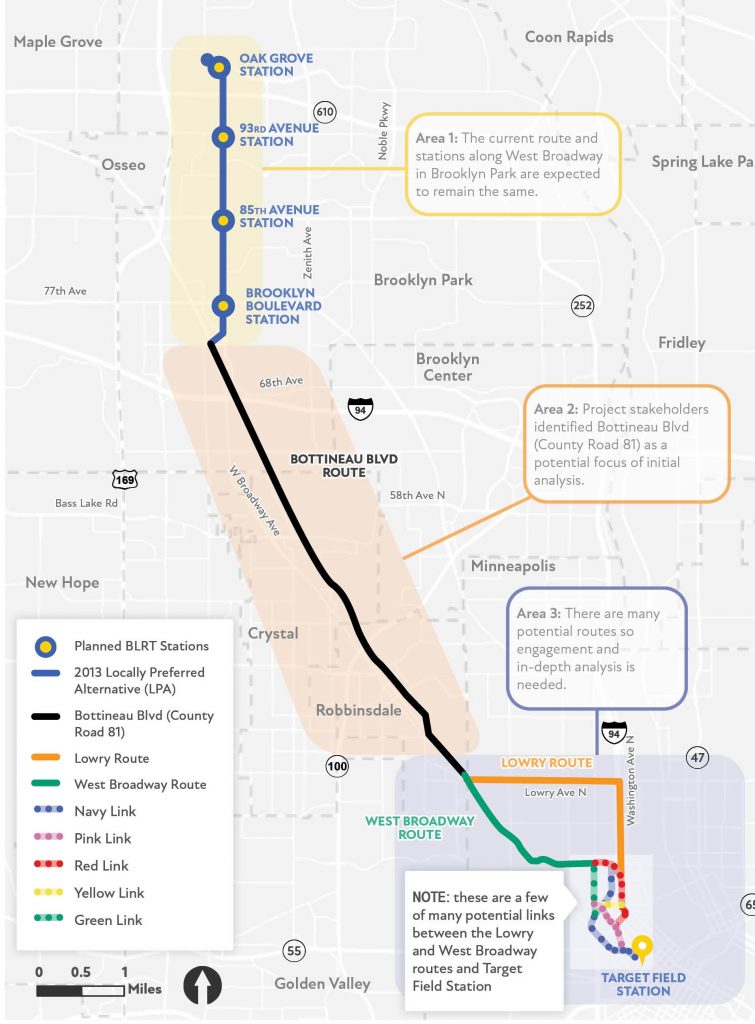
Hennepin County and the Metropolitan Council are seeking applications from community members and others to serve on a 21-member Anti-Displacement Workgroup for the Blue Line light-rail line extension, which will link downtown Minneapolis with Brooklyn Park.
The deadline to apply is Jan. 14.
The goal of the workgroup is to ensure existing residents and businesses along the line are not displaced during its construction. It will include 21 initial members, with representation from community members, government staff, as well as staff from foundations and philanthropic organizations serving the project area.
The Metropolitan Council has tasked the University of Minnesota’s Center for Urban and Regional Affairs (CURA) with the responsibility of working with the communities in north Minneapolis, Robbinsdale, Crystal and Brooklyn Park “to evaluate the potential for current and future displacement related to planning, construction and operation of the Blue Line light rail,” according to a statement.
Community members that join the workgroup will be asked to commit to twelve to eighteen months, depending on the needs of the work.
Hennepin County Commissioner Jeff Lunde, whose district includes all of the cities the extended line will go through except north Minneapolis, said in a statement that the anti-displacement efforts will be critical to the success of the project, adding “I am proud to have pushed for this initiative in partnership with Commissioner Fernando. While our districts experience different challenges and have different development landscapes, we share the goal of having this project benefit current residents.”
The proposed route for the Blue Line extension from downtown Minneapolis to Brooklyn Park. Photo: Courtesy Metropolitan Council
Commissioner Irene Fernando’s district includes north Minneapolis. She said in a statement that the workgroup gives the community a chance to “co-design policy and have their experiences inform programming that will ensure current corridor residents experience the lasting benefits of light rail.”
Metropolitan Council Member Reva Chamblis, who lives in Brooklyn Park, said the long-term success of transit projects rely on strong community support.
“Throughout the METRO Blue Line Extension Project planning, I heard the concerns from the community about how the project may adversely impact neighborhoods and the fear of being displaced from their homes and businesses. I applaud the projects willingness to hear and address these concerns,” Chamblis said.
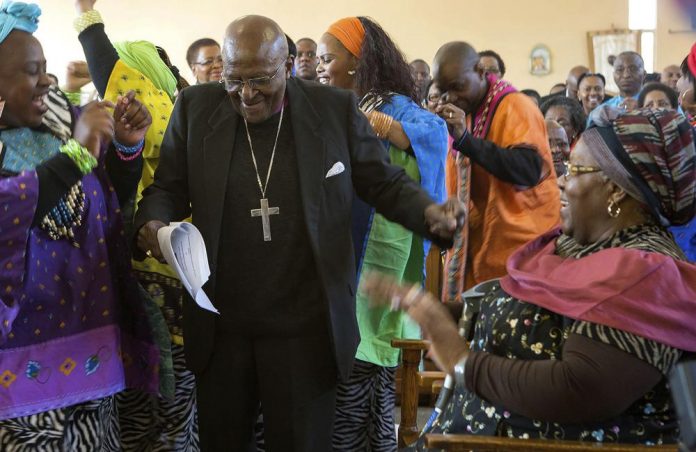
Tutu breaks into dance after renewing his wedding vows to his wife of 60 years, Leah, right. Photo: AP File
Tutu breaks into dance after renewing his wedding vows to his wife of 60 years, Leah, right. Photo: AP File
JOHANNESBURG (AP) — Desmond Tutu, South Africa’s Nobel Peace Prize-winning icon, an uncompromising foe of apartheid and a modern-day activist for racial justice and LGBT rights, died Sunday at 90. South Africans, world leaders and people around the globe mourned the death of the man viewed as the country’s moral conscience.
Tutu worked passionately, tirelessly and non-violently to tear down apartheid — South Africa’s brutal, decades-long regime of oppression against its Black majority that only ended in 1994.
The buoyant, blunt-spoken clergyman used his pulpit as the first Black bishop of Johannesburg and later as the Anglican Archbishop of Cape Town, as well as frequent public demonstrations, to galvanize public opinion against racial inequity, both at home and globally.
Nicknamed “the Arch,” the diminutive Tutu became a towering figure in his nation’s history, comparable to fellow Nobel laureate Nelson Mandela, a prisoner during white rule who became South Africa’s first Black president. Tutu and Mandela shared a commitment to building a better, more equal South Africa.
Upon becoming president in 1994, Mandela appointed Tutu to be chairman of the country’s Truth and Reconciliation Commission, which uncovered the abuses of apartheid.
Tutu’s death on Sunday “is another chapter of bereavement in our nation’s farewell to a generation of outstanding South Africans who have bequeathed us a liberated South Africa,” South African President Cyril Ramaphosa said.
“From the pavements of resistance in South Africa to the pulpits of the world’s great cathedrals and places of worship, and the prestigious setting of the Nobel Peace Prize ceremony, the Arch distinguished himself as a non-sectarian, inclusive champion of universal human rights,” he said.
Tutu died peacefully at the Oasis Frail Care Center in Cape Town, the Archbishop Desmond Tutu Trust said. He had been hospitalized several times since 2015 after being diagnosed with prostate cancer in 1997.
“He turned his own misfortune into a teaching opportunity to raise awareness and reduce the suffering of others,” said the Tutu trust. “He wanted the world to know that he had prostate cancer, and that the sooner it is detected, the better the chance of managing it.”
In recent years he and his wife, Leah, lived in a retirement community outside Cape Town.
Former U.S. President Barack Obama hailed Tutu as “a moral compass for me and so many others. A universal spirit, Archbishop Tutu was grounded in the struggle for liberation and justice in his own country, but also concerned with injustice everywhere. He never lost his impish sense of humor and willingness to find humanity in his adversaries.”
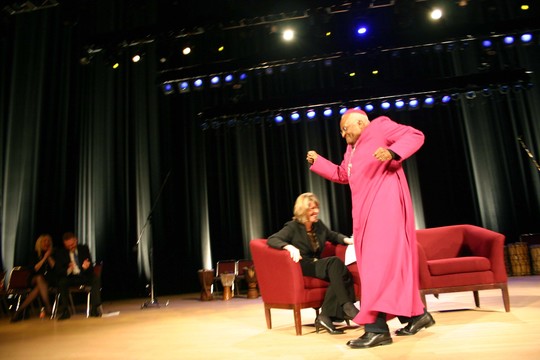
Desmond Tutu leaves the stage at the Minneapolis Convention Center in April 2008 after a speech. Photo: Edwin Okong’o/Mshale
Tutu’s life was “entirely dedicated to serving his brothers and sisters for the greater common good. He was a true humanitarian” said the Dalai Lama, Tibet’s exiled spiritual leader and Tutu’s friend.
“His legacy is moral strength, moral courage and clarity,” Anglican Archbishop of Cape Town Thabo Makgoba said in a video statement. “He felt with the people. In public and alone, he cried because he felt people’s pain. And he laughed — no, not just laughed, he cackled with delight — when he shared their joy.”
A seven-day mourning period is planned in Cape Town before Tutu’s burial, including a two-day lying in state, an ecumenical service and an Anglican requiem mass at St. George’s Cathedral in Cape Town. The southern city’s landmark Table Mountain will be lit up in purple, the color of the robes Tutu wore as archbishop.
Throughout the 1980s — when South Africa was gripped by anti-apartheid violence and a state of emergency gave police and the military sweeping powers — Tutu was one of the most prominent Black leaders able to speak out against abuses.
A lively wit lightened Tutu’s hard-hitting messages and warmed otherwise grim protests, funerals and marches. Plucky and tenacious, he was a formidable force with a canny talent for quoting apt scriptures to harness support for change.
The Nobel Peace Prize in 1984 highlighted his stature as one of the world’s most effective champions for human rights, a responsibility he took seriously for the rest of his life.
With the end of apartheid and South Africa’s first democratic elections in 1994, Tutu celebrated the country’s multi-racial society, calling it a “rainbow nation,” a phrase that captured the heady optimism of the moment.
In 1990, after 27 years in prison, Mandela spent his first night of freedom at Tutu’s residence in Cape Town. Later, Mandela called Tutu “the people’s archbishop.”
Tutu also campaigned internationally for human rights, especially LGBTQ rights and same-sex marriage.
“I would not worship a God who is homophobic,” he said in 2013, launching a campaign for LGBTQ rights in Cape Town. “I would refuse to go to a homophobic heaven. No, I would say, ‘Sorry, I would much rather go to the other place.’”
Tutu said he was “as passionate about this campaign as I ever was about apartheid. For me, it is at the same level.” He was one of the most prominent religious leaders to advocate LGBTQ rights — a stance that put him at odds with many in South Africa and across the continent as well as within the Anglican church.
South Africa, Tutu said, was a “rainbow” nation of promise for racial reconciliation and equality, even though he grew disillusioned with the African National Congress, the anti-apartheid movement that became the ruling party after the 1994 election. His outspoken remarks long after apartheid sometimes angered partisans who accused him of being biased or out of touch.
Tutu was particularly incensed by the South African government’s refusal to grant a visa to the Dalai Lama, preventing the Tibetan spiritual leader from attending Tutu’s 80th birthday as well as a planned gathering of Nobel laureates in Cape Town. The government rejected Tutu’s accusations that it was bowing to pressure from China, a major trading partner.
Early in 2016, Tutu defended the reconciliation policy that ended white minority rule amid increasing frustrations among some Black South Africans who felt they had not seen the expected economic opportunities since apartheid ended. Tutu had chaired the Truth and Reconciliation Commission that investigated atrocities under apartheid and granted amnesty to some perpetrators, but some people believed that more former white officials should have been prosecuted.
Desmond Mpilo Tutu was born Oct. 7, 1931, in Klerksdorp, west of Johannesburg, and became a teacher before entering St. Peter’s Theological College in Rosetenville in 1958. He was ordained in 1961 and six years later became chaplain at the University of Fort Hare.
He then moved to the tiny southern African kingdom of Lesotho and to Britain, returning home in 1975. He became bishop of Lesotho, chairman of the South African Council of Churches and, in 1985, the first Black Anglican bishop of Johannesburg. In 1986, Tutu was named the first Black archbishop of Cape Town. He ordained women priests and promoted gay priests.
Tutu was arrested in 1980 for joining a protest and later had his passport confiscated for the first time. He got it back for trips to the United States and Europe, where he spoke with the U.N. secretary-general, the pope and other church leaders.
Tutu called for international sanctions against South Africa and talks to end apartheid.
Tutu often conducted funeral services after the massacres that marked the negotiating period of 1990-1994. He railed against black-on-black political violence, asking crowds, “Why are we doing this to ourselves?” In one powerful moment, Tutu defused the rage of thousands of mourners in a township soccer stadium after the Boipatong massacre of 42 people in 1992, leading the crowd in chants proclaiming their love of God and themselves.
As head of the truth commission, Tutu and his panel listened to harrowing testimony about torture, killings and other atrocities during apartheid. At some hearings, Tutu wept openly.
“Without forgiveness, there is no future,” he said at the time.
The commission’s 1998 report lay most of the blame on the forces of apartheid, but also found the African National Congress guilty of human rights violations. The ANC sued to block the document’s release, earning a rebuke from Tutu. “I didn’t struggle in order to remove one set of those who thought they were tin gods to replace them with others who are tempted to think they are,” Tutu said.
In July 2015, Tutu renewed his 1955 wedding vows with wife Leah, surrounded by their four children.
“You can see that we followed the biblical injunction: We multiplied and we’re fruitful,” Tutu told the congregation. “But all of us here want to say thank you … We knew that without you, we are nothing.”
Tutu is survived by his wife of 66 years and their children.
Asked once how he wanted to be remembered, he told The Associated Press: “He loved. He laughed. He cried. He was forgiven. He forgave. Greatly privileged.”