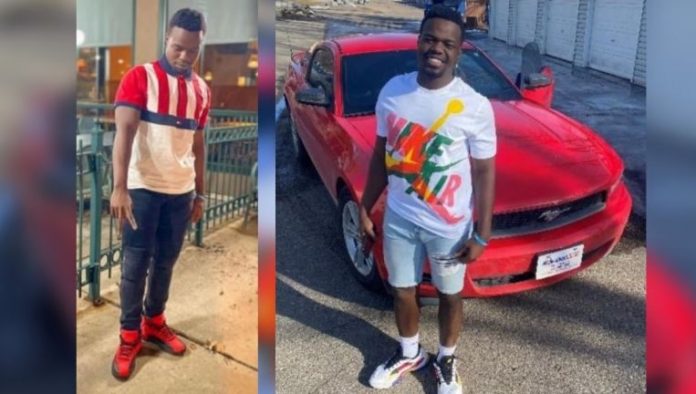
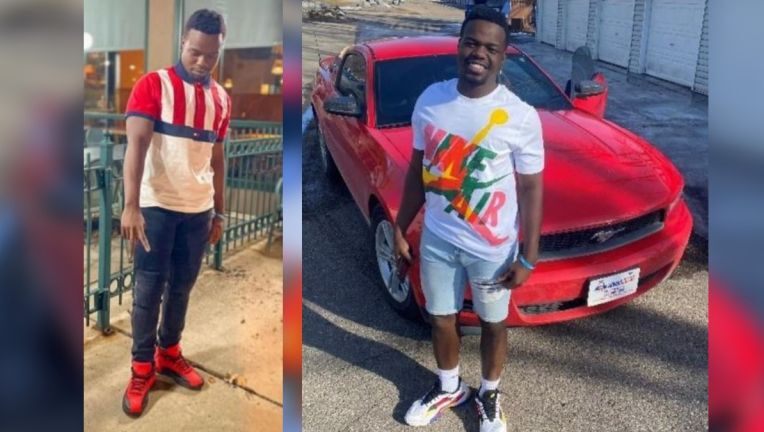
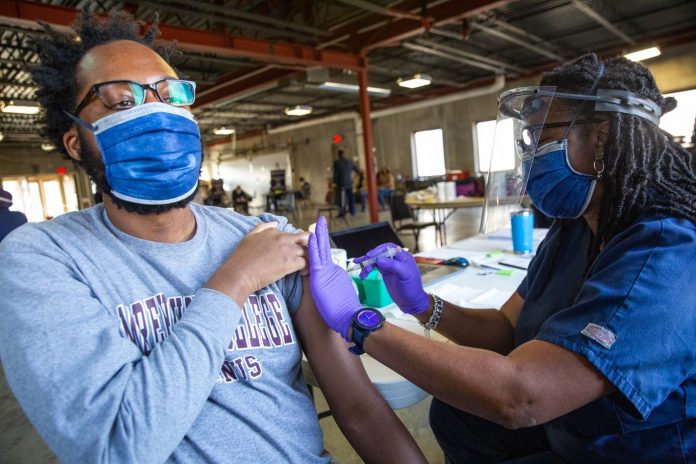
Kenyan-American Keegan Oyugi of St. Bonifacius, Minnesota was last seen wearing the outfit seen in the left photo and seen driving a 2012 red Mustang (at right). Photo: Oyugi Family
Kenyan-American Keegan Oyugi of St. Bonifacius, Minnesota was last seen wearing the outfit seen in the left photo and seen driving a 2012 red Mustang (at right). Photo: Oyugi FamilyKenyan-American Keegan Oyugi of St. Bonifacius, Minnesota was last seen wearing the outfit seen in the left photo and seen driving a 2012 red Mustang (at right). Photo: Oyugi Family
This is a developing story and will be updated.
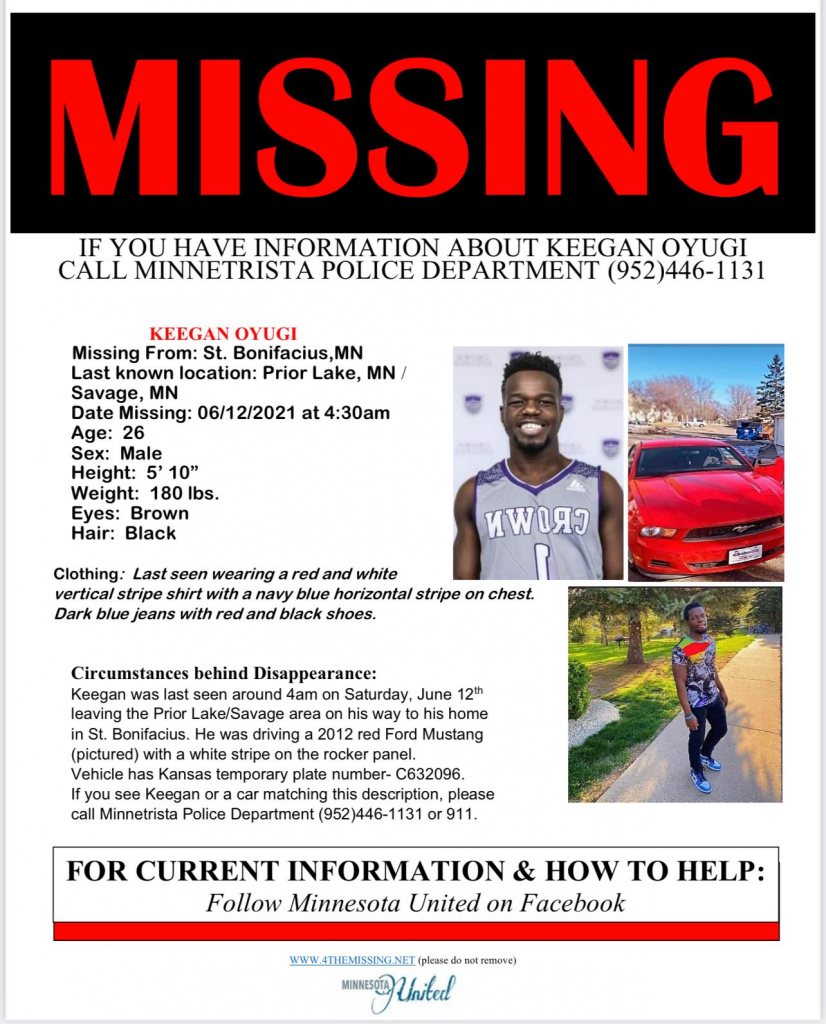
Kenyans in Minnesota have organized a search for Keegan Oyugi who has been missing since 4:30am Saturday, June 12. Oyugi had sent a text to his younger brother that he was headed home from the Prior Lake/Savage area to their home in St. Bonifacius. He never made it home.
Oyugi’s parents, Richard and Mirriam Onkunya, from Wichita, said during a Friday Zoom meeting organized by Minnesota Kenyans Association (MKA) to discuss the search on Saturday, that police have told them that their son’s cell phone was last pinged at 4:00pm on Saturday, twelve hours from when he texted his brother.
The location of the ping is near a Storage Mart.
MKA, which is the consortium of Kenyan associations in Minnesota, with consulting assistance from Minnesota United, a volunteer search and rescue organization, is reaching out to the community and asking for volunteers to help in the search on Saturday at 9:00am.
Minnesota United, which joined the Zoom call to give advice on how to proceed with the search, suggested a search radius of five miles from the Storage Mart. Volunteers will meet at the address below and receive direction from designated team search leaders, Lillian Otieno and Huldah Momanyi.
A circulating flyer of the missing Kenyan-American, Keegan Oyugi, of St. Bonifacius, Minnesota. He has been missing since June 12, 2021. Kenyans in Minnesota have planned a search in Chaska on Saturday, June 19, 2021. Photo: Minnesota United
Oyugi graduated from Wichita Southeast High School and went on to play basketball at Neosho County Community College in Kansas. He then moved to Minnesota in 2017 to enroll at Crown College where he also played in the basketball team. He graduated from Crown in 2019.
He was driving a 2012 red Ford Mustang with a white strip on the rocket panel. The car has a Kansas temporary plate with number: C632096.
Anyone with information should call the Minnetrista Police Department at (952)446-1131 or call 911.
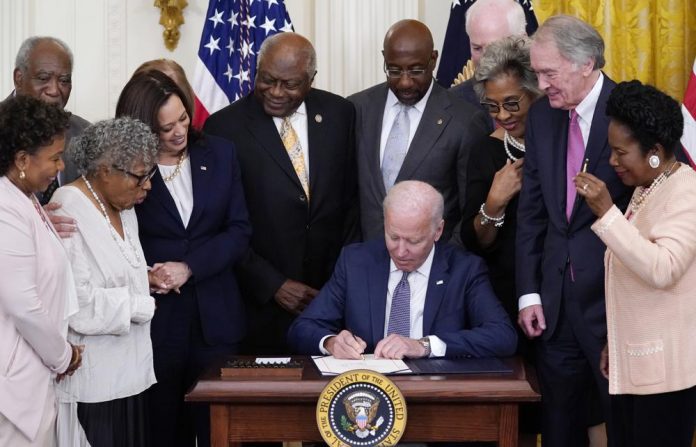
President Joe Biden signs the Juneteenth National Independence Day Act, in the East Room of the White House, Thursday, June 17, 2021, in Washington. From left, Rep. Barbara Lee, D-Calif, Rep. Danny Davis, D-Ill., Opal Lee, Sen. Tina Smith, D-Minn., obscured, Vice President Kamala Harris, House Majority Whip James Clyburn of S.C., Sen. Raphael Warnock, D-Ga., Sen. John Cornyn, R-Texas, Rep. Joyce Beatty, D-Ohio, Sen. Ed Markey, D-Mass., and Rep. Sheila Jackson Lee, D-Texas. (AP Photo/Evan Vucci)
President Joe Biden signs the Juneteenth National Independence Day Act, in the East Room of the White House, Thursday, June 17, 2021, in Washington. From left, Rep. Barbara Lee, D-Calif, Rep. Danny Davis, D-Ill., Opal Lee, Sen. Tina Smith, D-Minn., obscured, Vice President Kamala Harris, House Majority Whip James Clyburn of S.C., Sen. Raphael Warnock, D-Ga., Sen. John Cornyn, R-Texas, Rep. Joyce Beatty, D-Ohio, Sen. Ed Markey, D-Mass., and Rep. Sheila Jackson Lee, D-Texas. (AP Photo/Evan Vucci)
Beginning on Friday, June 18, federal employees enjoyed the country’s 12th—and perhaps most significant—paid holiday. President Joe Biden and Vice President Kamala Harris held a signing ceremony, officially marking Juneteenth as a federal holiday.
Because Juneteenth falls on a Saturday this year, workers are enjoying the new holiday one day early.
“Black history is American history, and I am proud to stand alongside President Biden and my fellow congressional colleagues in reaffirming that sacred principle,” Congressional Black Caucus Chair Joyce Beatty (D-Ohio) stated.
“While we rightfully celebrate this momentous moment today, the Congressional Black Caucus recognizes that the work to build a brighter tomorrow for Black Americans is far from over. ‘Our Power, Our Message’ remains the same: equity, equality, and justice for all people.”
President Biden thanked Congress, especially the Congressional Black Caucus, and gave a special acknowledgment to Opal Lee, a 94-year-old activist who for years has been championing the Juneteenth holiday and was there to witness the signing of the bill into law.
“I’ve got so many emotions… I’m so delighted to know that, finally, we’ve got a Juneteenth bill passed!”
Biden said, “You know, I said a few weeks ago, marking the 100th anniversary of the Tulsa Race Massacre, great nations don’t ignore their most painful moments …They embrace them. Great nations don’t walk away. We come to terms with the mistakes we made. And in remembering those moments, we begin to heal and grow stronger.”
Before attending the White House signing ceremony, Congresswoman Beatty witnessed the bill’s engrossment while flanked by CBC members and House Speaker Nancy Pelosi.
President Biden and Vice President Harris had made it a mission of their administration to undo as much systemic racism and defeat White supremacy.
With a diverse cabinet and staff, and policies that aim to level the playing field for African Americans and other people of color, the administration has worked diligently in living up to its mission. Juneteenth was established on June 19, 1865, more than two years after the issuance of the Emancipation Proclamation.
Union soldiers —led by General Gordon Granger—arrived in Galveston, Texas, with the news that the Civil War was over and all previously enslaved people were free.
President Abraham Lincoln signed the Emancipation Proclamation in September 1862 to free enslaved people in Confederate states. However, it wasn’t until nearly three years later that news of the proclamation reached Black people in Texas.
The fight to formally recognize Juneteenth has been a decades-long effort culminating in the broad bipartisan passage of the Juneteenth National Independence Day Act. Before the U.S. House of Representatives’ historic vote, Congresswoman Beatty called on her colleagues to support the measure.“You can’t change the future if you can’t acknowledge the past,” she proclaimed.
Congresswoman Maxine Waters (D-Calif.), Chairwoman of the House Committee on Financial Services, applauded signage of the bill.
However, Congresswoman Waters said recognition comes 156 years late. “While this is certainly welcomed,” stated Waters, “it comes 156 years late, and after legislation to protect voting rights and address police abuse sits idle because of Republican Senators who refuse to understand the need to protect our communities and our right to participate in this democracy.”
“To put this moment into perspective, the establishment of Martin Luther King Jr. Day as a federal holiday happened in 1986, and we are still fighting for our civil rights,” she stated.
Congresswoman Waters continued: “We are still waiting for Senate passage of the George Floyd Justice in Policing Act. We are still waiting for lynching to be classified as a federal hate crime. We are still waiting for the terrorists who destroyed Black Wall Street during the Tulsa Race Massacre to be held accountable, and we are still waiting for Black history to be accurately taught in our schools.”
The congresswoman insisted further that “as we celebrate the passage of this legislation, let us be clear that we will not be distracted or appeased.”
“We will not simply accept Juneteenth as a federal holiday in exchange for real action that honors our history and our place in this country and moves us closer to achieving justice,” Congresswoman Waters remarked.
She said she fully expects her colleagues to join her urgent calls for the passage of the John Lewis Voting Rights Advancement Act and the Senate passage of the For the People Act.
“In the final analysis, it will be shown that platitudes and niceties are one thing but having the courage and taking real action on this issue is another,” Congresswoman Waters demanded.
“Let us honor this day by working toward a nation in which Black lives and Black votes are protected and respected.”
COVID-19 mortgage payment forbearance is currently available to FHA-insured borrowers. Photo: Gaudi Laub/Shutterstock
COVID-19 mortgage payment forbearance is currently available to FHA-insured borrowers. Photo: Gaudi Laub/ShutterstockCOVID-19 mortgage payment forbearance is available to FHA-insured borrowers. Photo: Gaudi Laub/Shutterstock
Sponsored Content from U.S. Department of Housing and Urban Development
COVID-19 mortgage payment forbearance is available to FHA-insured borrowers
As the impacts from the COVID-19 pandemic continue to ripple across our nation, an escalating foreclosure crisis among FHA-insured borrowers is reaching a cataclysmic point impacting hundreds of thousands of borrowers. We understand that many homeowners may be struggling and unable to make mortgage payments due to the COVID-19 pandemic.
If you are current on your mortgage payments or are already on a mortgage payment forbearance, please disregard this message.
If you or someone you know are one of the many FHA-borrowers in communities across the country having difficulty paying your mortgage due to the pandemic, we urge you to act now.
FHA’s special COVID-19 mortgage payment forbearance is currently available to FHA-insured borrowers.
There are two ways to get more information on the special COVID-19 mortgage payment forbearance:
First, contact your mortgage servicer, the entity to which you make your mortgage payments.
If you are unable to contact your mortgage servicer right now, get help from a HUD-approved Housing Counseling Agency.
Call, email or visit the website of your mortgage servicer using the contact information on your monthly mortgage statement.
State that you have a financial hardship due to COVID-19 and request a COVID-19 forbearance. A COVID-19 forbearance allows you to reduce or suspend your mortgage payments for a period of time.
Contact a HUD-approved housing counseling agency in your local area. To find a HUD-approved agency, call (800) 569-4287, or use the online search at www.hud.gov/housingcounseling
Explain your situation. Housing counselors are trained to assess your financial situation and explain the options available to you.
A HUD certified housing counselor may be able to help you work with your mortgage servicer to obtain a COVID-19 forbearance.
You are not alone during these difficult times. The COVID-19 mortgage payment forbearance is available now so please seek assistance to obtain this option.
Boy learning math with cash and money planning. Photo Credit: Getty Images
Boy learning math with cash and money planning. Photo Credit: Getty Images
Sponsored Content from JP Morgan Chase
5 Ways to Teach Kids Money Basics
Multiple studies have shown that the earlier kids develop healthy money habits, the better their prospects of having strong financial health into adulthood.
According to research, we start grasping money basics when we are three. This gives us a great opportunity to introduce conversations about ways to save, think about spending, and the value of money early in our kids’ lives.
It used to be that children learned about money when shopping out with parents, but as more transactions happen digitally, they can lose touch and important learning moments may be harder to find. But the good news is that parents can now use a mobile phone to have conversations with their kids about the best ways to earn, save and spend money and encourage good habits.
Our team at Chase in the Twin Cities is focused on creating tools and resources that support financial health. To help kids practice and learn how to earn, spend and save, we created Chase First Banking— an account that can help make financial education easy, fun and immersive. It helps parents to have real-time conversations around how much can kids get for allowances or chores, where they are approved to spend and how much, and how to set up savings goals right from the Chase Mobile app, and kids have access to their own debit card.
To create this account, we spoke to a lot of parents, children and experts about how we can help start healthy money conversations with kids and here are five tips to help you get started:
Encourage them to save: When your child gets their allowance or receives birthday money, talk to them about the importance of setting some money aside for savings. The more you help them do it, the more you reinforce it as a habit that will help them develop a savers mentality.
Involve your children on important family money decisions: When you are considering an important family purchase, engage your children and help them understand what goes into the decision. Be it a new house, or even a couch, refrigerator or car, what are important factors to consider? Your child can benefit from knowing how much you are comfortable spending, why you choose to shop at certain merchants, and how you compare prices and options.
Shop online together: Online shopping became increasingly popular in 2020 with social distancing. Involve your children in these transactions by shopping with them. Ask them to help you find better deals and to add up totals in your cart before paying. After you’ve made your decision on what to purchase, help them understand that digital purchases still need to be paid with real money from their bank account.
Take them to the bank: A lot can be learned during a branch visit, including how to withdraw and deposit money or checks, how to use ATMs safely, and how to talk about setting up financial goals.
Talk about money values: Kids can learn a lot from knowing it’s ok to talk about money, so it’s smart to talk openly about the things you too have learned. What was the first big purchase you made on your own? How did you get that first paycheck? What was your favorite treat to buy as a kid? Who first talked to you about money? Do you remember opening your first account?
While most children understand that money doesn’t grow on trees, it is still important that they see and experience how to shop for the things that they want and how to make smarter financial decisions. By starting to have money conversations early you’ll help them develop good habits that will last a lifetime. You’ll be surprised what you may learn from them and how quickly they’ll catch on.
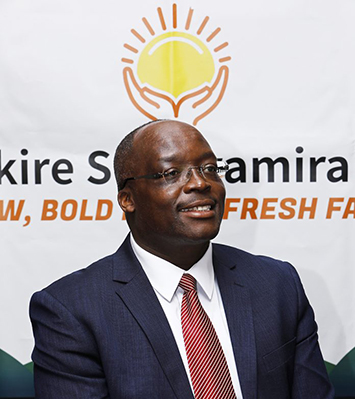
Henry Ongeri, a Minnesota based Kenyan-American lawyer speaks during the launch of his gubernatorial campaign for Governor of Nyamira County held at Ebenezer Community Church in Brooklyn Park, Minnesota on Saturday, June 5, 2021. Photo: Richard Ooga/Mshale
Henry Ongeri, a Minnesota based Kenyan-American lawyer speaks during the launch of his gubernatorial campaign for Governor of Nyamira County held at Ebenezer Community Church in Brooklyn Park, Minnesota on Saturday, June 5, 2021. Photo: Richard Ooga/Mshale
BROOKLYN PARK, Minn. – Kenyan-American Minnesota lawyer, Henry Ongeri, formally kicked off his campaign for governor of Nyamira County in the 2022 election Saturday afternoon at an event at Ebenezer Community Church.
Ongeri is hoping to succeed Gov. Amos Nyaribo, who was sworn into office in late December 2020 to finish the remainder of the late Gov. John Nyagarama’s term. Nyagarama who was half way through his second term died of coronavirus complications. It is widely expected that Nyaribo will seek his own mandate from the electorate next year.
“I am not seeking to be governor so I can be called governor,” Ongeri said.
Ongeri is joining what is expected to be a crowded field of contenders once campaigns begin. A handful of candidates have already set up social media pages for prospective campaigns.
At the launch attended by the who is who of the Kenyan civic leadership in Minnesota, Ongeri said he is is acutely aware of the angst the diaspora and those in Nyamira feel towards the underdevelopment of their county.
“The opportunities that are in Nyamira are undercut by two things, poor leadership and you wanna know the second one? poor leadership,” Ongeri said. “How does a building in June 2021 fall on people in Nyamira county after we have sunk over 300 million into it, how do people not get angry? Our movement is a rejection of that and we are going to go to every length to say it, denounce it, condemn it and yes eradicate it, when I am Nyamira governor that is going to be history.”
“My goal as governor is to fully integrate the diaspora into the development of Nyamira and that is nothing new just like how the Jews, the Filipinos treat their diaspora as one of their greatest assets,” Ongeri said.
Nyamira, Ongeri said, must fully embrace its diaspora and the knowledge they bring because as matters stand, “we are dismissed, we are ignored and we are discriminated against except when we send money home.”
Among actions he will take when governor is to establish an office for diaspora affairs in his county cabinet.
Ongeri dismissed critics who question the diaspora’s understanding of issues in Kenya saying diaspora Kenyans address challenges in Kenya through digging deep into their pockets even when they don’t have the money.
“I know the issues very well as every week I have to pay for the diabetes medicine my sister needs after they (authorities) have stolen the money that should be paying for it,” said Ongeri.
Ongeri is a prominent figure in Minnesota’s immigrant leadership circles and some of the initiatives he has been involved in were highlighted in this previous Mshale story where he discussed his candidacy.
“We are looking very deep into the future as we want people to imagine Nyamira 100 years from now,” Ongeri said. “We want you to think beyond the election cycle I will be governor for 10 years but I w ant to be known for 100 years for the things that I did.”
The crowd that showed up when it was 98 degrees Fahrenheit outside, included prominent figures in the African immigrant community that have run for office in Minnesota, including Janet Kitui, Boni Njenga, Henry Momanyi and Ben Muko. Geoffrey Gichana, the former president of Mwanyagetinge, in remarks to the audience said he will be running for Senator of neighboring Kisii county in the 2022 elections and looks forward to working with Ongeri “once they take office.” The quintet offered words of encouragement to Ongeri as they urged the diaspora to increase their civic participation both locally and in Kenya.
Dr. Joash Omandhi, host of the Dr. Omandhi Show on KJTV, a former Kenyan parliamentary aspirant was also present as was the current president of Mwanyagetinge, Huldah Momanyi Hiltsley.
“As an immigrant this is a profound day not just for me but also for our community,” Ian Oundo of Coon Rapids said. Oundo, a native of Uganda, is the former civic engagement director for Minnesota’s Democratic Party before he left to found Makesi Creative Strategies, a political consulting firm.
Others were there to issue forceful words of support and solidarity to a longtime comrade in arms.
“I am here to support my brother Henry, and if a South Sudanese like me can support him then I am sure the people of Nyamira can also vote for him,” Ladu Gubek said. Gubek has spent the last 20 years advocating for the African immigrant community alongside Ongeri.
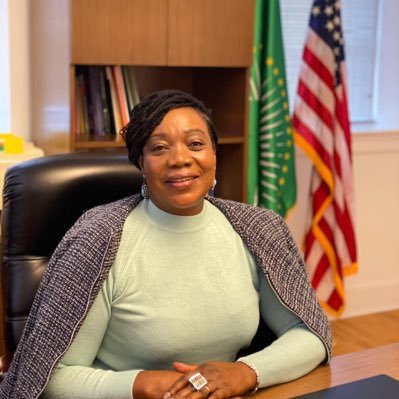
Her Excellency Hilda Suka-Mafudze, the African Union ambassador to the United States will keynote the Books for Africa warehouse grand opening in Marietta, Georgia on Saturday, June 26, 2021. Photo: Courtesy Twitter
Her Excellency Hilda Suka-Mafudze, the African Union ambassador to the United States will keynote the Books for Africa warehouse grand opening in Marietta, Georgia on Saturday, June 26, 2021. Photo: Courtesy TwitterHer Excellency Hilda Suka-Mafudze, the African Union ambassador to the United States will keynote the Books for Africa warehouse grand opening in Marietta, Georgia on Saturday, June 26, 2021. Photo: Courtesy Twitter
MARIETTA, GA – Books for Africa has announced the opening of their newest warehouse facility in Marietta, commemorating the event with a grand opening celebration on June 26th from 1 to 4PM.
The Saint Paul, Minnesota based organization has been in the Atlanta metro area since May 2009 when it originally moved its main warehouse there.
The Warehouse Grand Opening event is free to the public and will include refreshments, live music from Books for Africa’s very own band, a keynote address from African Union Ambassador to the United States, Her Excellency Hilda Suka-Mafudze, remarks from BFA founder and board president, Tom Warth, and BFA Board President Joni Sussman, and other dignitaries. The event will also feature a live exhibition of the departure of a shipping container of books to Africa.
The 33-year-running nonprofit has is the largest shipper of donated text and library books to the African continent, shipping over 51 million books to all 55 countries, with a mission to end the book famine in Africa by collecting, sorting, shipping and distributing high quality books to children in Africa.
The organization still operates a smaller warehouse at its headquarters in Saint Paul.
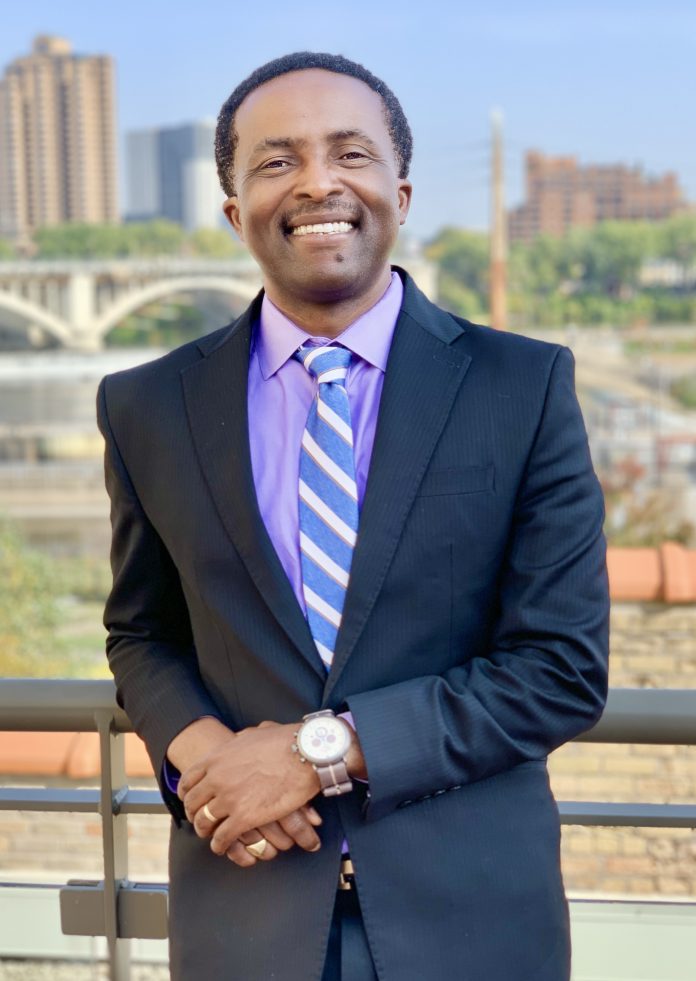
Twin Cities attorney, Paschal Nwokocha, has been honored by the Supreme Court of the state of Minnesota and Minnesota/Dakotas Chapter of the American Immigration Lawyers Association for his pro bono work. Photo: Courtesy Paschal Nwokocha
Twin Cities attorney, Paschal Nwokocha, has been honored by the Supreme Court of the state of Minnesota and Minnesota/Dakotas Chapter of the American Immigration Lawyers Association for his pro bono work. Photo: Courtesy Paschal Nwokocha
From a very early age, Paschal O. Nwokocha knew he wanted to dedicate his life to serving the most vulnerable in society. The obvious path towards that goal was through his Catholic faith. At the age of 16, he enrolled at Seat of Wisdom Seminary, in Owerri, Nigeria, his country of birth.
“I was supposed to be a Catholic priest,” Nwokocha said.
That, however, changed in 1992, when he left the seminary and came to the United States to study at the University of St. Thomas, a Catholic institution located in the Twin Cities. After graduating with a degree in Philosophy, he decided to go to law school.
Today, Nwokocha is one of the most distinguished immigration lawyers in the state of Minnesota. He is also an educator and the co-author and co-editor of the Immigration Practice Deskbook, a guidebook designed to help attorneys understand the complex field of U.S. immigration law.
But those who know Nwokocha say you wouldn’t know how accomplished he is because he has remained modest and compassionate. Although he didn’t end up being a priest, he is still a devout Catholic, who believes so strongly in serving those in need that he left a job as an environmental attorney to venture into immigration law. Through his firm, Paschal Nwokocha & Chukwu Law Offices, LLC, he has spent more than 20 years representing corporations, businesses, individuals, and families in immigration cases. Many of his clients are people who can’t afford to pay for his services. But he still provides them with the same high quality of legal representation he gives his paying clients.
“One thing that is clear to me is that without representation, the chance of any immigrant prevailing is very, very minimal,” Nwokocha said. “So, I believe that our skills and our knowledge in immigration law can be put to use, not just to those who can pay our fees, but to those who by no fault of their own cannot afford it.”
Attorneys in the United States are not required to provide free legal services, but according to the American Bar Association (ABA), “every lawyer has a professional responsibility to provide services to those unable to pay.” It recommends that each lawyer do a minimum of 50 hours of pro bono work per year.
Nwokocha goes far beyond that minimum recommendation. In May, the Supreme Court of the state of Minnesota honored him for taking more than 100 pro bono cases through Volunteer Lawyers Network (VLN), a Minneapolis-based nonprofit that links low-income clients to attorneys.
“The Minnesota State Bar Association Access to Justice Committee has brought to my attention a small number of attorneys whose commitment to pro bono has been exceptional,” Chief Justice Lorie S. Gildea wrote in a letter to Nwokocha. “You are one of those few. You are answering the highest calling of our profession by helping make equal access to justice a reality.”
Colleen R. Beebe Purisaca, who began volunteering at VLN in 1997 before becoming the managing attorney for its Immigrant Legal Services Program, said the 100 cases Nwokocha was honored for do not tell the whole story of his compassion. She has spent her entire law career in nonprofits operating in the areas of refugee, immigrant, and human rights, and has known Nwokocha for as long as he has been a lawyer. They met when he started volunteering at Park Avenue Legal Clinic, which she cofounded in 1997.
“I have always been impressed by Paschal because he is such a very kind person,” Purisaca said. “He really cares about people.”
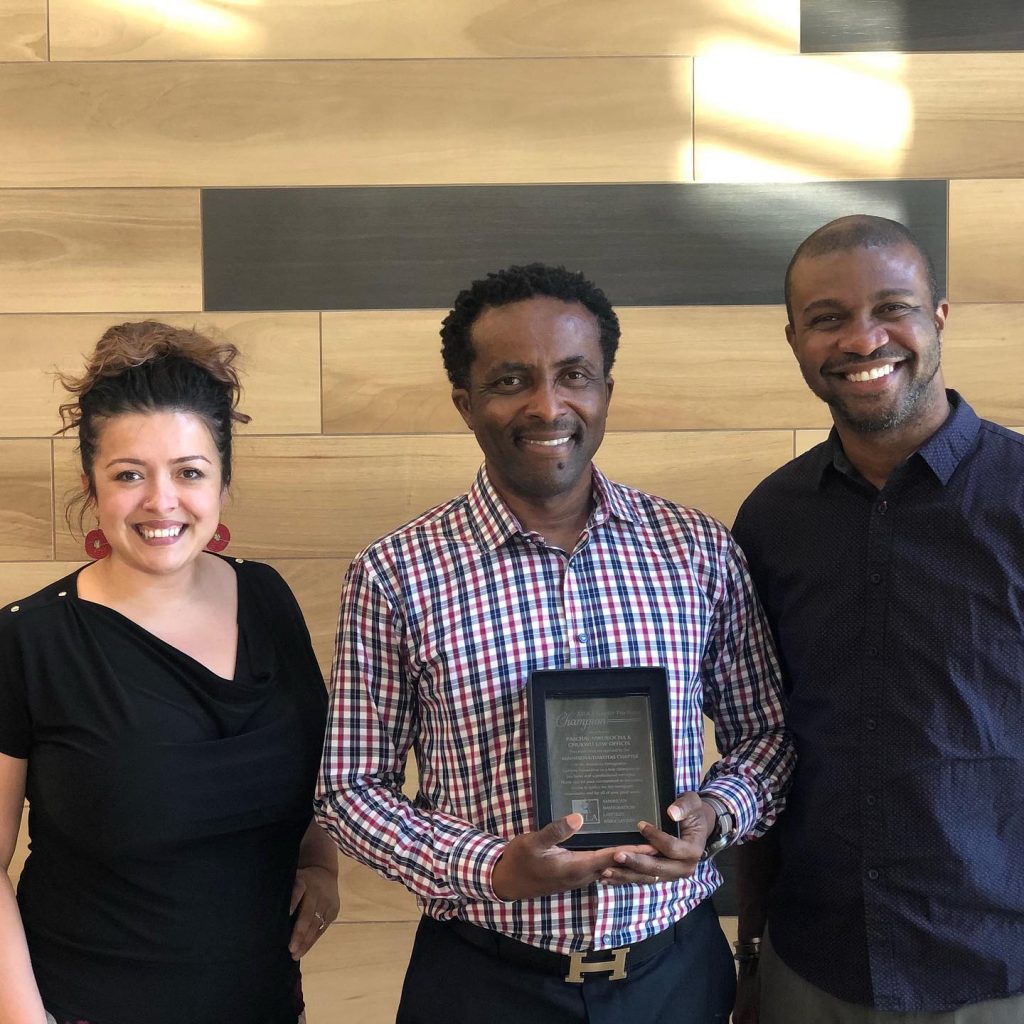
Twin Cities attorney Paschal Nwokocha, flanked by his law firm partner, Obi E. Chukwu, and associate Nysha D. Operana, holds the “Pro Bono Champion” award that the firm received from the Minnesota/Dakotas Chapter of the American Immigration Lawyers Association (AILA). Photo: Courtesy Paschal Nwokocha
Purisaca said the more than 100 cases of pro bono were just the ones Nwokocha himself had taken and did not include numbers of his associate attorneys, Obi E. Chukwu, and Nysha D. Operana. She said Nwokocha has created a “culture of pro bono” at his law firm, taking on some of the most complex immigration cases.
“These are not cases that are just easy cases,” Purisaca said. “They range from cases that take maybe a few weeks, to 10 years to work through the immigration system. It’s a huge commitment and they have several cases like that at their law firm.”
For its collective pro bono work, Nwokocha’s firm also received the “Pro Bono Champion” award from the Minnesota/Dakotas Chapter of the American Immigration Lawyers Association (AILA), a professional organization he and Purisaca are both members of.
“We [at AILA] really admire and respect Paschal and everyone who works at his law firm,” Purisaca said. “I think we need to give credit to the soft-spoken people who don’t always promote their own worth.”
Nwokocha’s immigrant origin is a major factor in his commitment to taking as many pro bono immigration cases as his firm can.
“Being an immigrant myself, and being surrounded by immigrants, I get to see what people go through,” Nwokocha said. “There are so many cases I get to review and say, ‘Wow! If only they had a lawyer, this would have turned out differently.’”
Ben Omorogbe, who has known Nwokocha from their law school days at the William Mitchell College of Law, said what drives Nwokocha is something more than just being an immigrant helping fellow immigrants.
“There is something visionary about him,” said Omorogbe. “He has this genuine interest and strong desire to help others.”
Omorogbe, the vice president and associate group general counsel at Travelers Insurance, said he wasn’t surprised to hear that the Minnesota Supreme Court and AILA honored Nwokocha for his exemplary service.
“He has been active in the community and has been doing phenomenal work, both as an attorney and as a member of the Twin Cities community,” Omorogbe said. “The awards reflect well on him and on the community because he puts in a lot of time and he’s very dedicated to what he does.”
Omorogbe said Nwokocha’s desire to help others went beyond offering free legal services. Outside his legal work, Nwokocha has been very involved in organizing African immigrant lawyers in the Twin Cities, Omorogbe said.
“He has been very instrumental in bringing them together in support of each other, and in the process, learning about law and life in general,” Omorogbe said.
Although Nwokocha’s firm is well known today for its immigration work, he didn’t start out as an immigration attorney. After law school, he took a job at the Minnesota Attorney General’s office, where he worked as an environmental lawyer. Adonis Neblett, who is now the general counsel at Minnesota Pollution Control Agency, was Nwokocha’s first supervisor. He said even back then he could tell that there was something exceptional about Nwokocha.
“He was warm and personable,” Neblett said. “Everybody [in the profession] is smart, everybody is capable, but not everybody can connect with people the way he does.”
Nwokocha rose through the ranks to become an Assistant Attorney General for the state of Minnesota. But in January 1999, he left to start his private practice. Neblett said that was a brave move that not even he – a much more senior attorney than Nwokocha – could have had the courage to make.
“When he exhibited the initiative and ambition to go out and establish his own practice, that says it all,” Neblett said. “He did something that I would have wished to do as a younger man, and would not dare to do as an older man.”
Neblett remembers occasionally visiting Nwokocha in those early days of his individual practice in a small office located on the first floor of a building. Neblett said he would wonder how Nwokocha got the confidence to leave a secure job and venture into the unpredictable area of private practice.
Twin Cities attorney Paschal Nwokocha with his team of attorneys and staff from his downtown Minneapolis law firm. He was recently honored by both the Minnesota Supreme Court and Minnesota/Dakotas Chapter of the American Immigration Lawyers Association for his pro bono work. Photo: Courtesy Paschal Nwokocha
“He had to have a vision,” Neblett said. “How do you have the confidence and the faith to say that ‘I will take this path, and I fully anticipate that this will blossom, I will be able to help people, and provide more than adequately for my family?’”
Neblett said Nwokocha was even more daring because he left the area of environmental law he had worked in for so long to go into immigration law, which is not known for being lucrative.
“When you start helping people trying to maintain their status in the United States, not all of them are coming here with significant income,” Neblett said. “That was a practice that he was able to embrace.”
Neblett, who Nwokocha affectionately refers to as “my elder brother,” said he was relieved when he visited Nwokocha in a new office and found that he had recruited other lawyers as his associates.
“I knew then he was up to something good and was doing well,” Neblett said.
What continues to impress Neblett is that throughout Nwokocha’s rise to become a distinguished attorney and leader in the area of immigration law, he has retained his humility.
“In a world where we like to toot our own horns, that ready smile and warmth that he exudes is so refreshing.”
Black Nurses Rock Minnesota-Twin Cities Chapter president Kelly Robinson (right) vaccinates her son, Dwayne Robinson, during a clinic put on by Black Nurses Rock with Ramsey County inside of Shiloh Missionary Baptist Church in St. Paul in March 2021. Photo: Evan Frost/MPR
Black Nurses Rock Minnesota-Twin Cities Chapter president Kelly Robinson (right) vaccinates her son, Dwayne Robinson, during a clinic put on by Black Nurses Rock with Ramsey County inside of Shiloh Missionary Baptist Church in St. Paul in March 2021. Photo: Evan Frost/MPRBlack Nurses Rock Minnesota-Twin Cities Chapter president Kelly Robinson (right) vaccinates her son, Dwayne Robinson, during a clinic put on by Black Nurses Rock with Ramsey County inside of Shiloh Missionary Baptist Church in St. Paul. Photo: MPR Photo by Evan Frost
Last week Minnesota Governor Tim Walz announced a vaccine incentive program called “Your Shot to Summer” as he tries to get 70 percent of Minnesotans age 16 and up vaccinated by July 1.
The giveaways include visa gift cards, fishing licenses, state park permits and amusement park tickets to Mall of America Nickelodeon amusement park as well as the Minnesota State Fair.
The first 100,000 Minnesotans who get their first shot from May 27 through June 30 will
be able to choose the incentive of their preference.
After you get your first shot
After you receive your first shot, go to mn.gov/covid19/summer and choose your preferred incentive starting June 1 through June 30.
Here is the full list of available incentives:
Great Lakes Aquarium Pass
● Eligible for one entrance to the Great Lakes Aquarium in Duluth. Valid until July 1, 2023.
The Minnesota Department of Health will provide recipients’ contact information to the
Aquarium which will mail tickets to Minnesotans who select this option.
Mall of America Nickelodeon Universe Pass
● Eligible for a 30-point ride pass at Nickelodeon Universe that can be redeemed through
September 1, 2021. The Minnesota Department of Health will provide recipients’
contact information to Mall of America who will send information to redeem the pass.
Minnesota Fishing License
● Eligible for one individual Minnesota resident annual fishing license effective through
February 2022. Must be redeemed by July 30, 2021. Recipient must be eligible to hold a
Minnesota fishing license. The Minnesota Department of Health will provide recipients’
contact information to the Department of Natural Resources which will reach out to
Minnesotans to complete their fishing license application.
Minnesota State Parks Pass
● Eligible for one Minnesota State Parks annual pass. Minnesotans will receive the pass in
the mail from the Department of Natural Resources. The Minnesota Department of
Health will provide recipients’ contact information to the Department of Natural
Resources which will mail the State Parks pass.
Minnesota Zoo Admission
● Eligible for one adult admission at the Minnesota Zoo through September 8. The
Minnesota Department of Health will provide recipients’ contact information to the
Minnesota Zoo which will email information in order for Minnesotans to redeem their
admission.
Northwoods Baseball League Tickets
● Eligible for one reserved ticket to attend a Northwoods League baseball game during the
2021 season. The Minnesota Department of Health will provide recipients’ contact
information to the Northwoods League and Minnesotans will call the ticket office of the
team they select and provide their full name and address for verification to reserve their
ticket. Tickets are based on availability at the time of calling. Participating teams include
the Rochester Honkers, Willmar Stingers, Mankato MoonDogs, St. Cloud Rox and the
Duluth Huskies. Please wait at least one week before calling to request tickets.
State Fair Tickets
● Eligible for two admission tickets to the 2021 Minnesota State Fair. The Minnesota
Department of Health will provide recipients’ contact information to the State Fair which
will email tickets no later than July 16, 2021.
Valleyfair Single-Day Admission
● Valid for one Valleyfair admission ticket and the chance to purchase additional tickets for
the same date at a discounted rate during the 2021 season. The Minnesota Department
of Health will provide a unique code via email in order for Minnesotans to redeem this
offer.
Visa Card
● Eligible for a $25 Visa Card to be used anywhere Visa is accepted. Minnesotans will
receive the cards by mail or email from the Minnesota Department of Health or a State
of Minnesota Vendor.
Henry Ongeri, a Kenyan-American lawyer in Minnesota, is a candidate for governor in the County of Nyamira in Kenya. Photo: Richard Ooga/Mshale
Henry Ongeri, a Kenyan-American lawyer in Minnesota, is a candidate for governor in the County of Nyamira in Kenya. Photo: Richard Ooga/Mshale
A Minnesota based Kenyan-American lawyer says the deteriorating socioeconomic conditions of his people in his home county of Nyamira in Kenya, has spurred his interest in running to be governor.
Henry Ongeri, a 49-year-old Brooklyn Park resident, told Mshale that he wants to transform the culture of the county, and use its resources wisely to spur economic growth.
“I got into this race because Nyamira needs a reset so that we can address the challenges it faces,” said Ongeri, a partner in the Diaspora Lawyers TransAtlantic Law Firm that he cofounded. “As governor I bring a perspective that our county lacks having lived and worked in the west for almost 20 years.”
Nyamira is one of Kenya’s 47 counties that came into existence after the March 2013 general election, each with a governor and county assembly based on ward representation. In Nyamira’ s case, it has 20 Wards, each represented by a Member of the County Assembly, commonly referred to as MCAs.
Governors are term limited to two terms and the first set of governors that were elected, and managed reelection for a second term, can no longer run as governors in the 2022 national election. In the case of Nyamira, its inaugural governor, John Obiero Nyagarama, died of coronavirus complications on December 18, 2020 halfway into his second term. His deputy Amos Nyaribo was sworn into office in shortly after to finish the remainder of Nyagarama’s term.
A native of the county that he now wants to lead, which he claims has been on a downward spiral since devolution came, Ongeri said he finally wants to address the “longstanding challenges” that current leaders have been unable to address.
Ongeri says while many counties have benefited from devolution, that has not been the case with Nyamira as it has continued to lag other high performing counties.
“The ingredients to make Nyamira a model county are there, and all we need is proper and focused leadership,” Ongeri said.
A leading research firm in Kenya, InfoTrak, in a 2020 published survey, the second of such surveys since the system of county governments was introduced in the country, ranked Nyamira in the bottom half of the 47 counties in terms of performance in responsibilities assigned from the national government to the devolved units (counties). The devolved responsibilities included agriculture, education, water management, trade planning, energy and tourism among others.
Ongeri said he fears that Nyamira will continue underperforming without visionary leaders, he envisions a complete overhaul of the leadership at the county, to set it on the right trajectory. The husband and father to three boys, Ongeri said young people in Nyamira need visionary leadership, the kind he can bring, that can help them see a brighter future of possibilities.
“I want them to want to be proud to live and work in Nyamira, that there’s opportunity there,” Ongeri said.
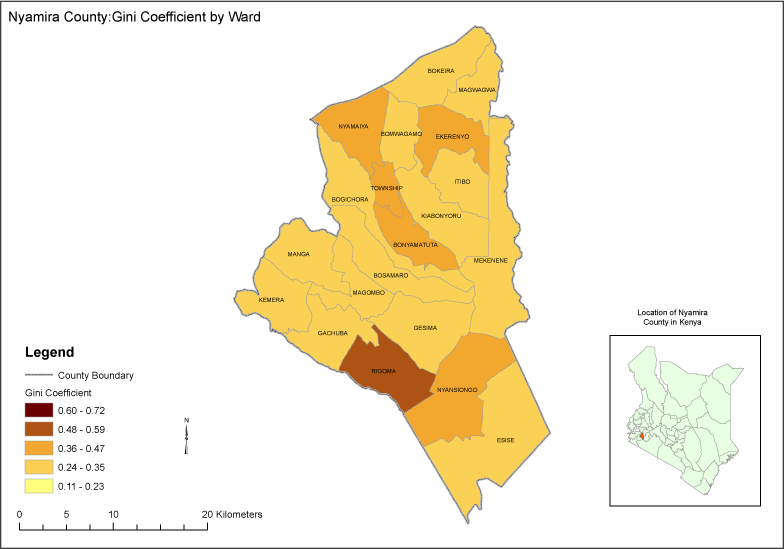
A map of Nyamira County in Kenya with its 20 wards shown. Henry Ongeri, a Kenyan-American lawyer from Minnesota has launched a bid for governor of the county in the 2022 elections. Photo: Courtesy County Assembly of Nyamira
Focusing on the county government, Ongeri decried the practice of the County Assembly and the executive of holding important conferences and seminars in neighboring Kisii county.
“Those are millions of shillings each year that the elected leaders directly control, we need Nyamira money to stay in Nyamira for the benefit of the local people that are helping generate it,” he said.
Ongeri said the failure by the current crop of leaders to facilitate investments in the hospitality industry, that would see the building of the necessary conference facilities in the county, is to blame for the scenario where important meetings are being held in Kisii county.
“If elected the first order of business is to take stock of what we have, ‘Do you know for example there are projects funded and marked complete but have not been done?’” Ongeri asks wide eyed, rhetorically.
Both Kisii and Nyamira counties are home to the Abagusii, who account for upwards of 70 percent of the Kenyans in Minnesota. Abagusii are also among the largest communities of Kenyans in the United States, and by extension account for a big slice of the US$3.094 billion in remittances sent to the country from overseas Kenyans in 2020. Kenyans in the US account for over 56 percent of the country’s remittances.
A nod to the importance the Abagusii play in foreign exchange earnings for the country came on October 21, 2020 when President Uhuru Kenyatta officiated the opening of the Central Bank of Kenya Kisii Centre to “ease the distribution of cash” in seven counties surrounding Kisii that include Nyamira. Kisii Center became only one of four such currency centers in the country.
Josephine Ongaga, who hails from Nyamira and now lives in Minneapolis, said she’s not someone who follows politics much, but Ongeri stands out as a promising candidate because his track record in Minnesota speaks for itself.
Ongaga, is in a position to know what ails her ancestral home of Nyamira and what it might take for what Ongeri calls a “takeoff.” For years before moving to the United States she worked with the country’s agricultural ministry, traversing the agriculture rich western region of Kenya which includes Nyamira where she worked with farmers to help them improve crop yields. Her work with farmers saw the ministry send her to Ireland on a scholarship for further agricultural studies.
“He has that spirit of action that is needed and not just empty words.” Ongaga said, “What I have seen him do with our community here, I am convinced if he is given a chance, he can do a lot for Nyamira.”
Ongaga is referring to the leadership and guidance of various organizations that Ongeri is associated with in the last two decades, which includes among others, the founding of the Pan African Business Association, Minnesota’s pioneer African chamber of commerce.
Of the many immigrant empowerment endeavors that Ongeri is associated with, the two he is most proud of are the roles he played in making it easier for immigrant lawyers who have moved to Minnesota to be admitted to the State Bar in order to practice.
“The first case I ever argued in this country was before the Minnesota Supreme Court,” said Ongeri as he smiled.
The other notable one he is most proud of was his early work with ISAIAH Minnesota to help ease the credentialing of nurses in Minnesota that trained overseas.
Another supporter of Ongeri is Yabesh Simba who spoke to Mshale via phone. He is a Lakeville, Minnesota resident who was born and raised in Nyamira before coming to the United States 30 years ago.
“People like Henry is what we need all over Kenya and not just Nyamira.” Simba said, “He is selfless and I am convinced he will not get there and try to enrich himself, but work for the people.”
Should Ongeri succeed in his quest and prove his Minnesota supporters right, he will join one other notable Minnesota Kenyan from the Abagusii who went on to play an important role in Kenya’s development, University of Minnesota and University of St. Thomas alumni, Bitange Ndemo, who worked briefly for Medtronic after graduating before moving back to Kenya.
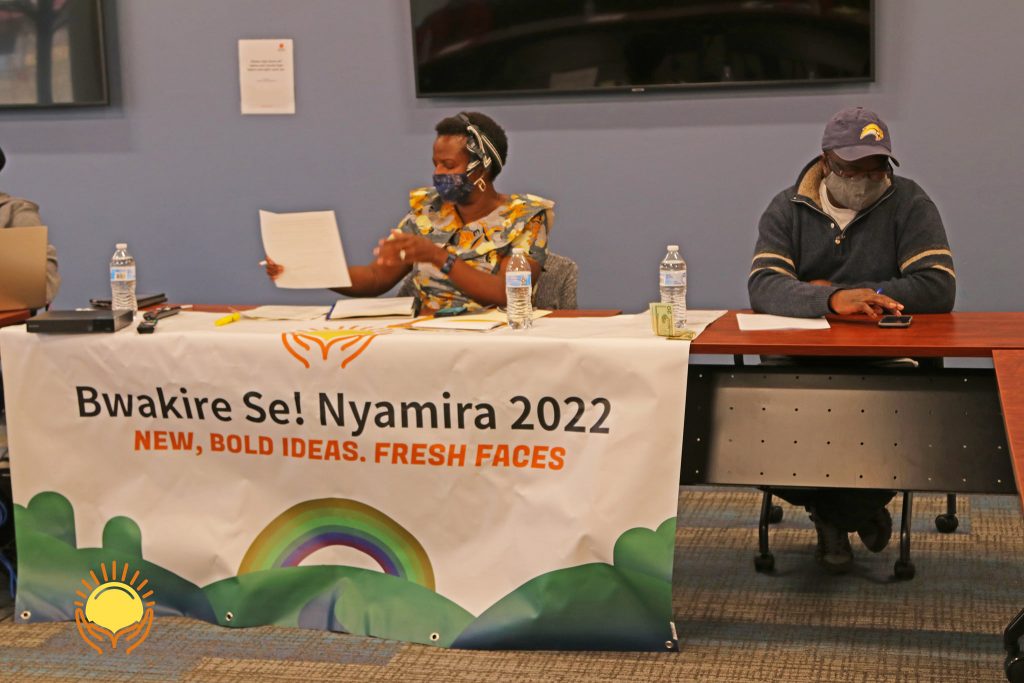
Supporters of Henry Ongeri who is vying to be Governor of Nyamira County in Kenya at a campaign prelaunch planning event in Brooklyn Center, Minnesota in March 2021. Photo: Courtesy of Bwakire Se! Facebook Page
One person excited to hear of a diaspora Kenyan going back to run for office is Kenyan-American professor, Makau Mutua, of the State University of New York (SUNY) Buffalo School of Law. Mutua served as the dean of the Buffalo School of Law between 2008-2014.
Mutua told Mshale that he encourages Kenyans in the diaspora that want to run for office and are able, to do so as “We deserve no less.”
“The diasporans who want to run for office must be well prepared for the rough and tumble of Kenya politics. It’s highly gendered, ethnicized, and awash with dirty money,” said Mutua. “Avoid corrupt practices, including vote-buying. If you can’t run a clean campaign, then lose honorably.”
On Saturday, June 5, 2021 at 5pm, Bwakire Se! will launch at the Ebenezer Community Church in Brooklyn Park, Minnesota. Bwakire Se! is what Henry Ongeri and his supporters are referring to as the “movement” that will propel him to office. Bwakire Se! is the Abagusii way of referring to a “New Dawn.” It blends elements of Barack Obama’s Yes We Can! and the legendary Paul Wellstone’s grassroots approach.
Candidate snapshot: Henry Ongeri
Age: 49 Spouse: Dorothy Ongeri, born and raised in Kenya and a practicing pharmacist in Minnesota Children: Three sons; Ongeri , Nyakundi and Mogaka aged 18, 15 and 10 Education: Bachelor of Laws (University of Nairobi); Master of Laws (Mitchell Hamline School of Law); Juris Doctor (Hamline University) Licensed: To practice law in Minnesota and New York Political/Civic experience: Chairman, Peter Kenneth for President Diaspora Team, 2011-2013; Executive Director of Pan African Business Alliance; Immigrant Community Organizer, Kerry-Edwards U.S. Presidential Campaign, 2004; Numerous pro bono legal services to community groups Website:www.henryongeri.com
Komborrah, a soccer center at the Albertville Outlet Mall in Minnesota owned by Kenyan-American businessman Naftali Kokiro, will grand open on Saturday, May 29, 2021.
Komborrah, a soccer center at the Albertville Outlet Mall in Minnesota owned by Kenyan-American businessman Naftali Kokiro, will grand open on Saturday, May 29, 2021.
As the Covid-19 pandemic reached the United States in early 2020 and governments ordered businesses to close to curb the spread of the virus, Naftali Kokiro saw an opportunity.
Before the pandemic, Kokiro had been selling soccer balls branded “Komborrah”, which is an altered form of a Swahili word that means “missile.” The word is used in East Africa to refer to a shot on goal, especially of a fast-moving ball from a distance.
Kokiro began selling the balls after striking a partnership with a former professional soccer player named John “Baresi” Odhiambo, who played for Harambee Stars, Kenya’s national team. Odhiambo, who started the Komborrah brand, had reached out to Kokiro to see how he could help market the balls. They had only been selling a few balls, mostly within their community of soccer enthusiasts. But that changed when the pandemic began in early 2020.
“Covid is what gave us a big boost,” said Kokiro, a Kenyan who moved to the United States in 1998.
As indoor sports and fitness facilities were ordered to close, the popularity of outdoor activities like soccer began to rise. Sales of Komborrah soccer balls began to increase steadily and before long the inventory was exhausted. Kokiro’s success motivated him to further expand Komborrah beyond just selling individual soccer balls. He assembled a team of professionals with various skills to partner with him and Odhiambo. They include a patent lawyer, an information technology specialist, as well as experts in marketing and logistics.
“We have five core people I brought in because you have to cover your weaknesses,” Kokiro said. “You can’t do it all.”
The founding team decided to scale up their business and open a soccer center named Komborrah. Eight months ago, Kokiro began searching for a location for the business. On Saturday May 29, Komborrah will open its doors to the public at the Albertville Outlet Mall. The 8,000-square-foot space will have a soccer apparel and equipment store, an indoor training facility, and a small fitness gym. Komborrah will also offer skills training and development independent from club associations.
Komborrah joins a growing list of African immigrants who have defied the downward trend of brick-and-mortar stores seen during the pandemic to launch their dream businesses. In October, Miriam Mongare, who immigrated from Kenya 10 years ago, launched Miriam Fitness, a women-only gym, in Bloomington, Minn. And in April, Ghanaian immigrant Emmanuel Boateng and his Jamaican-born wife Tani opened United People Apparel at Mall of America.
The founders of Komborrah are betting the potential for growth soccer has in United States.
Although soccer is the most popular sport globally, it has much lower interest in the United States, where American football, basketball and baseball dominate. But Kokiro said the low popularity of soccer in the United States provides opportunities for creative entrepreneurs to grow the sport.
Still, soccer remains extremely popular among immigrant communities in the United States. For some immigrant parents, it is a lifelong hobby that they feel obligated to pass on to their children.
“I’m a diehard soccer fan,” said Richard Ooga. “I’m a lunatic in soccer.”
Ooga, a photographer who grew up playing soccer in Kenya before moving to the United States, introduced his children to the sport early. His youngest son plays in a competitive youth team that travels for tournaments around the state and the country.
Beyond tradition, Ooga and other parents see soccer as a safer alternative to traditional American football, which in recent years has been blamed for brain injuries sustained from concussions that occur when players are hit hard on their heads.
“Other sports like American football, it’s scary to watch people play,” Ooga said.
“Safety is one of the most important considerations you have to make [as a parent].”
For aspiring entrepreneurs who have ambitions to venture into business, Kokiro has some advice.
“Don’t be afraid to fail,” said Kokiro, who has also owned a window-cleaning business for many years. “Personally, I’ve tried so many businesses. It’s not really a fail. You sharpen yourself.”
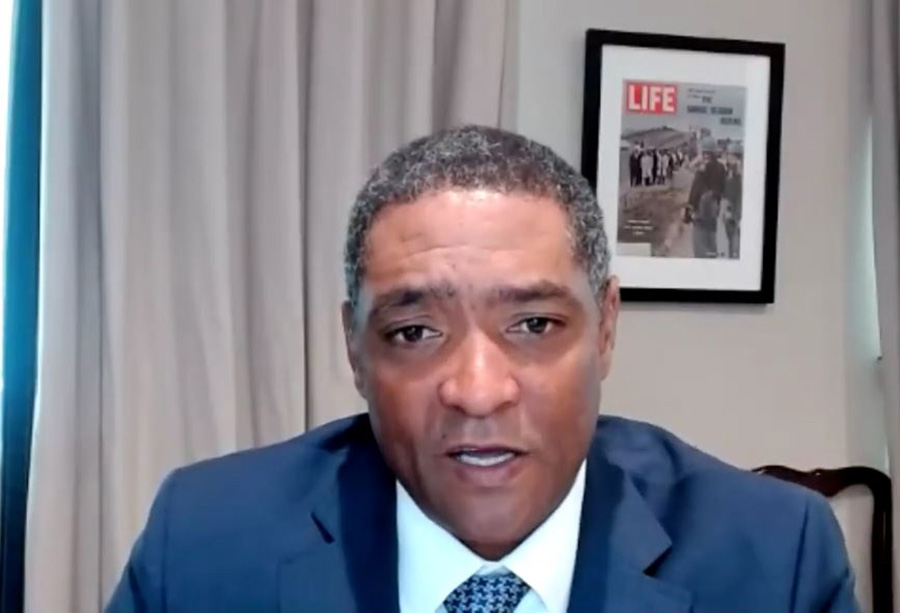
Cedric Richmond, a senior advisor to President Joe Biden and director of the White House’s Office of Public Engagement speaking Tuesday, May 25, 2021 at a virtual event to release a survey by Reimagine Main Street. Photo: YouTube Screenshot
Cedric Richmond, a senior advisor to President Joe Biden and director of the White House’s Office of Public Engagement speaking Tuesday, May 25, 2021 at a virtual event to release a survey by Reimagine Main Street. Photo: YouTube ScreenshotCedric Richmond, a senior advisor to President Joe Biden and director of the White House’s Office of Public Engagement speaking Tuesday, May 25, 2021 at a virtual event to release a survey by Reimagine Main Street. Photo: YouTube Screenshot
More than a year after the Covid-19 pandemic shut down the United States, minority small business owners appear more optimistic than their white counterparts that they will recover, according to a study published Tuesday.
The study was released at a virtual event that brought together partners from the public and private sectors to try and chart a way forward for small businesses as they recover from the economic downturn caused by the pandemic. The survey was carried out by Reimagine Main Street, a project of Public Private Strategies, which is focused on helping small businesses and their workers recover from the effects of Covid-19.
“The differences are most stark when we overlay race, ethnicity, gender and age,” said Tammy Halevy, one of the leads of the survey.
Of the more than 1,300 respondents surveyed between April 28, and May 12, 2021, 80 percent of Black and Hispanic small business owners, and more than 70 percent of Asian-American and Pacific Islanders (AAPI), said they were optimistic about the future of their businesses, compared to 70 percent of white small business owners.
Although Covid-19 vaccines have created a general sense of optimism about the future of small businesses, survey results revealed that there were still challenges that were not experienced equally across communities of entrepreneurs, with minorities often at a disadvantage.
Cedric Richmond, a senior advisor to President Joe Biden and director of the White House’s Office of Public Engagement, said that while the Biden administration had made a lot of progress in helping small businesses as they recover, there was still more work to be done. He stressed the importance of partnerships between the government and the private sector to support small businesses that struggled through the pandemic, and to ensure as many as possible of those that closed down reopened.
“We want to make sure that we have meaningful dialogue between the Biden-Harris administration, small business owners, and those in the private and public sector who are seeking to engage,” Richmond said. “When you start talking about small business especially, people who burst their tails every day to keep people employed, and they employ more than anyone else in this country, it is important that they have a real seat at the table. Real input.”
Part of the government’s response has been to streamline and expedite the process of getting money to small businesses through the Paycheck Protection Program (PPP), which was passed by Congress in 2020 as part of the CARES Act to offer small businesses easy access to loans they could use to help mitigate Covid-19-related economic decline and keep people employed.
“PPP was a mess, especially for small businesses seeking to navigate it,” Richmond said.
Large corporations initially took advantage of loopholes in the PPP law to get millions of dollars in loans that were intended for small businesses. That left a lot of small business owners, many of who weren’t savvy enough to navigate the process, helpless. Many closed because they couldn’t pay their employees to continue working during the pandemic.
“For the millions of Main Street small businesses, especially Black- and Brown-owned small businesses, we know that they had to struggle through the health aspect of the pandemic, but also the economic struggle,” Richmond said.
He said since the Biden administration took over in January, it had distributed more than $250 billion in relief to small businesses. More than 95 percent of those PPP loans went to businesses with fewer than 20 employees, he said.
“If they succeed and flourish, we know that the country will do the same,” Richmond said. “We know the struggles. More than 400 small businesses have closed since the beginning of the pandemic and we want to send that in the opposite way.”
Indeed, it seems like access to PPP funds has helped many small businesses stay afloat. According to the Reimagine Main Street survey, more than 60 percent of AAPI, Black, Hispanic, and White small businesses owners who received PPP loans said the money played a significant role in keeping their businesses running. Richmond promised that the Biden administration would do everything to help small businesses, especially restaurants, recover fully.
“Coming from the great city of New Orleans, which is a great port city but we are also a big tourist city, restaurants and that whole industry are critical and we know how many people restaurants employ,” said Richmond.
Richmond said the government had aside nearly $30 billion for restaurants.
“We expect to be oversubscribed, which is a good thing in terms of making sure that we used every dollar that we have, but unfortunately few businesses may not get it. But there is additional help out there,” Richmond said.
He said there were other ways small businesses that don’t get access to the loans could indirectly benefit. One is using the employee retention tax credit, which would allow them to cover up to $28,000 per employee in payroll costs, he said.
“We’re going to do everything we can to help small businesses, especially those small restaurants to survive,” Richmond said, adding that partnerships with the private sector would be key.
Franz Paasche, the senior vice president of corporate affairs and communications at PayPal, said his company had been involved from the early days of the pandemic in making sure small businesses, especially those from minority communities, survived.
“Paypal has been very focused on doing our part to advance racial equity, to work to close the racial wealth gap, and to make a contribution to empowering small businesses that have been inordinately affected by the pandemic,” Paasche said. “During this past year, it has been particularly important for us to be supporting Black-owned small businesses, and small businesses owned and led by underrepresented minorities.”
PayPal was one of the private sector financial institutions that partnered with the government to distribute PPP loans. The company disbursed over $2 billion of PPP money, with loans averaging $29,000, Paasche said.
Richmond agreed that it was important for the process to support small businesses recovering from the Covid-19 economic downturn to be equitable with specific targeting of the way contracts are awarded, he said.
“As important as capital is to business, access to contracts is even greater,” Richmond said. “If we are very intentional about using small businesses in the community, then they can take that access to capital and that access to contracts to really invest back in small businesses, create more jobs and increase their sustainability. But that can’t come all from government. We can’t do it all. We need partners out there being intentional about what we’re doing.”