Influenza is an illness that affects people of all ages worldwide. Symptoms range from mild to severe, and it is a major health issue around the world. Everyone can help fight the spread of influenza each year by getting vaccinated. Vaccination is also one of the best ways to reduce your chance of getting ill.
What is influenza?
Influenza is an illness caused by viruses that infect the nose, throat, and lungs. Most people get the flu during the colder months, beginning in October and lasting through the spring. Influenza can be spread in the air when people with the virus cough or sneeze, or a person can become infected by touching a surface with the virus on it and then touching their mouth or eyes.
Who gets influenza?
Anybody can get influenza! But, some people are more likely to become very sick with influenza. Those at highest risk include: young children, people 65 years of age and older, pregnant women, and people who are already sick with diseases like pneumonia, asthma, chronic lung disease, HIV, heart disease and diabetes.
What are the signs and symptoms of influenza?
Influenza symptoms include a sore throat, runny nose, and cough. People with influenza also feel very tired and may have a fever, chills, and body aches. Children who have influenza may have different symptoms than adults, like diarrhea and vomiting in addition to the other symptoms. Influenza symptoms usually come on very suddenly.
How is influenza treated?
Most of the time, influenza can be treated at home. It is important to rest and to drink plenty of water. Stay home while you are sick and for at least 24 hours after the fever is gone so you do not spread the flu to others. Sometimes influenza can be severe. If a person is having trouble breathing, feeling dizzy or confused or having chest or abdominal pain they should go to the hospital. In some cases doctors may also give medications to help your body fight the virus.
How can I prevent influenza?
The most important way to prevent the flu is to get vaccinated! Everyone 6 months of age and older should get the influenza vaccine every year. The influenza vaccine reduces the chances of getting the flu.
The vaccine may be given as a shot in the arm or as a spray in the nose. Talk with your doctor if you have an egg allergy or if you have had a reaction to the vaccine in the past. As the influenza season is currently approaching, it is important to get vaccinated now!
Other ways to avoid getting sick are:
Clean your hands often with soap and water, or an alcohol‐based hand cleaner.
Avoid touching your eyes, nose and mouth.
Avoid close contact with people who are sick, if possible.
Places providing Influenza vaccination:
To find a flu shot clinic near you, ask your health care provider or visit our website at: www.mdhflu.com and click on “Find a Flu Shot Clinic.”
It has been said before elsewhere and by us ad nausea every election that comes around that it is the most important one of our lifetime, that it has become almost cliché.
However, unless you are so detached from our political system, it is hard to argue with folk that this indeed is a very important election. For one, if you voted in 2008, we all know how historic that election was which saw the eventual election of President Barack Obama, becoming the first black president of our country. If you are one of those that voted for him, he is asking once again for your vote and it is up to you to reaffirm your support for him or against him.
We believe this will be a very revealing election about our country as far as the presidential election goes. Will the economic woes we have endured these past four years trump all other considerations of how the president has run the country or will we as a nation (especially those who voted for him the first time) take into consideration the total picture and calculate based on what the president has had to work with on the strength of what he was handed when he took over?
Secondly, what makes this a very important election (outside of the presidential race) for those of us in Minnesota are two constitutional amendments. One is an amendment to the constitution to require government issued photo ID to vote in elections. The second is a constitutional amendment to recognize marriage as being that between a man and a woman, in effect banning same sex marriage in the state constitutionally – it is already illegal in Minnesota to marry someone of the same sex. The constitutional amendment is to make it impossible for courts to go round the public and make them legal.
The two amendments by themselves obligate you to show up and vote and make your voice heard. Our perspective on the voter ID amendment is that it is an unnecessary amendment and is a form of voter suppression. Our position we have found out over the last few months is shared by many of you who happen to be African immigrants. Our hope is that this amendment will be defeated by the voters and urge you to vote accordingly.
The marriage amendment is a difficult one for our community that is overwhelmingly religious whether Christian or Muslim. The vast majority of the community we serve is opposed to same sex marriage. We are however urging you as a voter to think strategically when you decide on how to vote on this very serious amendment.
Mshale is not a champion of same sex marriage and do not see ourselves going down that road anytime soon. However, we do not believe the constitutional marriage amendment is necessary as state law already takes care of this adequately. We believe constitutional amendments should be reserved for the most important of issues and even then to be used to expand rights, not suppress them. Unfortunately, the messengers and champions of the marriage amendment happen to be the same who are always out to restrict many other rights immigrants and people of color enjoy. We would therefore let you vote your conscience on the marriage amendment.
Keep in mind that on your ballot if you choose not to vote on the two amendments, that is the same as voting NO and it will be counted as voting against them.
Voices of Strength—featuring a consortium of African artists—brings a festival of dance, theater, and storytelling to the Walker Arts Center stage during mid-October. In performances both ticketed and free, audiences will have the opportunity to engage with five contemporary theater makers/choreographers and cultural leaders— Nelisiwe Xaba (South Africa), Kettly Noël (Haiti/Mali), Gbahihonon Nadia Beugré (Côte d’Ivoire), Maria Helena Pinto (Mozambique), and Bouchra Ouizguen (Morocco)—as the artists express their truths in multiple mediums.
Patrons of the shows can expect to see modern dance using graphic, innovative techniques as they examine the topics of race, culture, and gender. Upon viewing a quarter-hour clip of the show, sophomore dance major at the University of Minnesota, Maja Brunes, describes the performance as multi-layered with a fluidity of movement that segues one storyline into another.
From Mozambique, choreographer Pinto describes her hope for the project, which mirrors the aspiration of MAPP International, the entourage that nurtured and now conveys Voices of Strength to six different cities in the United States on their current tour.
On the idea behind bringing African dance to the USA, Maria Helena Pinto says, “We live on different continents. We come from different cultures. But we can find a common platform to…see what we can do together, to find one reality of a woman that can also be [a reality] for other women of the world.”
Cathy Zimmerman, co-director of MAPP International Productions, adds, “By taking signs of democracy and shaping them into choreographic and theatrical work, and using the work to stimulate new ideas of womanhood, citizenship and community, these artists have rendered the making of art into a practice of freedom. We at MAPP International were inspired and determined to find a way to bring these artists to the United States where their works are largely unknown.”
An undertaking such as this, “can be a long story,” says Emily Harney, director of community engagement and marketing at MAPP, “as it takes a lot of work to make an ambitious tour like this happen. We cannot stress enough how important the long relationships we have with many of these artists allowed for the trust that underlies such a tour.”
Along with the trust carefully cultivated, another quality deeply ingrained in each woman fills them with the confidence needed to perform on a global level about topics that Nadia Beurgré from the Ivory Coast says previous generations wouldn’t even touch. “I am not afraid [of these issues],” says Beugré, “because I…I have faith in myself.”
Harney provides background detailing how the Walker Art Center became a contributing sponsor to MAPP and specifically to these five artists who comprise Voices of Strength. Harney explains, “The Walker Art Center is a founding member of The Africa Contemporary Arts Consortium and has been a committed and active presenter of contemporary African performance for several years. The Walker’s Senior Curator of Performing Arts, Philip Bither, was one of the Consortium members who saw much of this work during his travels abroad.
“As MAPP International developed the idea for this ‘mini-festival’ of performance by women working on the Continent, the Walker was an early supporter and then committed to presenting the project over a year ago.”
Philip Bither, William and Nadine McGuire Senior Curator of Performing Arts, expands on the significance of their upcoming presentation. “While showcasing work from Africa, Voices of Strength also reinforces contemporary dance as a truly global art: the technical innovation and fresh approaches in these pieces is proof of Africa’s important role in the international constellation that is furthering the form worldwide.”
Alex Nkosi when he was featured on CNN's African Voices in September 2012.
Alex Nkosi when he was featured on CNN's African Voices in September 2012.Alex Nkosi when he was featured on CNN's African Voices in September 2012.
Alex Okosi left Nigeria as a young boy in the late 1980s to seek a better future in the United States.
By the early 2000s, the music executive was carving a successful career with broadcasting giant MTV, holding strategic positions within the influential medial company both in the United States and Europe.
Yet, Okosi never forgot where he came from. His dream had always been to promote his continent’s diverse music scene and vibrant youth culture.
In the mid-2000s, at a time when not many were convinced about his continent’s economic potential, Okosi helped persuade his bosses to launch a dedicated MTV channel for Africa.
Today, as the senior vice president and managing director of MTV Networks Africa, Okosi runs MTV Base, the company’s first localized television service targeted exclusively at sub-Saharan Africa.
“We’ve … been quite lucky in being able to create a brand that we have taken from our international stable and bring into the continent to be able to create content and experiences that people enjoy, localizing them to make sure that they cater to the attitudes and tastes of African audiences,says Okosi, now based in South Africa.
Born in the West African country of Nigeria, Okosi moved to the United States at the age of 12. He excelled throughout school, graduated with high honors in 1994 and won a scholarship to St. Michael’s college in Vermont.
He credits his mentor Midge Monte for shaping his character and showing him the value of working hard to achieve your goals.
“Midge was such an important an influential part of my life as she served as my guardian the last two years of my high school career and has since remained a huge part of my life,” says Okosi. “Midge also instilled in me the importance of hard work and commitment as one strives to be successful.”
Okosi’s determination and academic excellence helped him land a job with MTV straight after university. His talents soon started to shine — Okosi worked both in MTV’s New York and West Coast offices before moving to London to be part of the company’s international strategy team.
He first planted the seed of bringing MTV to Africa during a business lunch with the head of the broadcasting giant. Okosi was convinced about the power and value of the African market, but putting together a viable business plan was far from easy — a lack of data on the size of the advertising market, coupled with infrastructure challenges, hampered Okosi’s ambitions.
Rollin Williams, emeritus professor of social work. (Lanny Nagler for UConn)
Rollin Williams, emeritus professor of social work. (Lanny Nagler for UConn)
The University of Connecticut’s first African-American professor, Rollin Charles Williams, died Monday, Sept. 24, in Waterford, Conn., after a short illness. He was 90 years old.
Rollin Williams, emeritus professor of social work. (Lanny Nagler for UConn)
A professor emeritus at the time of his death, Williams was hired as a full-time assistant professor in the School of Social Work in 1957. During his 30 years with the University, Williams spent time running the admissions office and as an interim dean.
A warm, engaging man and gifted storyteller, Williams stayed in touch with many of his former students and held many fond memories of the University. He bequeathed a significant portion of his estate to UConn as a sign of his appreciation.
“After I arrived at UConn, I received requests from five different schools of social work because they wanted black professors,” Williams said in an interview earlier this year. “Affirmative action laws had been passed. But I said no, I wouldn’t take those jobs, because UConn took me when it didn’t have to.”
“The University was truly fortunate that Professor Williams chose to share his intellectual gifts with our students and campus community, and that he was so strongly dedicated to UConn, despite other schools’ attempts to lure him away,” said President Susan Herbst. “He exemplified the highest ideals of service, scholarship, and integrity, and leaves a legacy that we can all strive to emulate.”
The dean of the School of Social Work, Salome Raheim, announced Williams’ death to her faculty and staff earlier this week. “Rollin had a deep fondness for the UConn School of Social Work, and we are grateful for his commitment and contributions,” Raheim said. “The School of Social Work community joins Rollin’s family and friends in mourning his loss.”
Born on March 19, 1922 in Kansas City, Mo., Williams was raised in Tulsa, Okla. during a period of racial turmoil in the city. He graduated valedictorian of his high school class and performed as a solo violinist with the school orchestra. He also earned honors as the Oklahoma state typewriting champion.
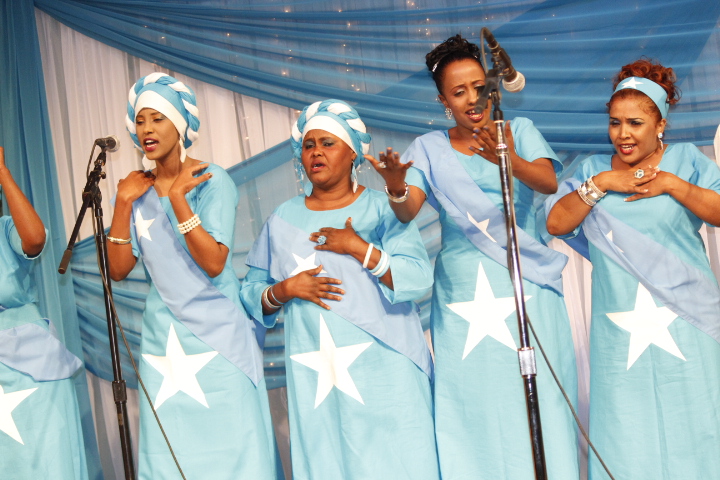
Some of the singers that provided entertainment during Saturday's celebration. Photo: Siyad Salah
Some of the singers that provided entertainment during Saturday's celebration. Photo: Siyad SalahSome of the singers that provided entertainment during Saturday's celebration. Photo: Siyad Salah
Thousands of Somalis congregated at the Minneapolis Convention Center on Saturday to celebrate the newly elected president for Somalia Hassan Sheikh Mohamud. Despite similar celebrations marking a historic milestone in home and abroad, this took the title “New Beginning”: the rebirth of Somalia.
After battling 20 years of civil war, Somalis yearn stability. Singers, politicians, elders and many more filled the auditorium seats. Many of the youth were represented in this event unlike any other. It was an opportunity for the young generation to reconnect with their people. Many waved the Somali flag proudly while others repeatedly chanted, “Somalia Hanoolato,” which meant live Somalia.
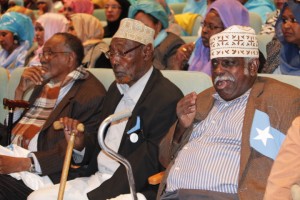
Somali elders at the celebration in Minnesota to mark the election of Somalia's new president, Hassan Sheikh Mohamud. Photo: Siyad Salah
Community leaders took the stage to discuss policy issues in Somalia, calling for the reestablishment of the Somali Army (SNM). Some of the leaders demanded from the Somali president to elect his new prime minister earning themselves a standing ovation from the audience. A representative on behalf of US Sen. Amy Klobuchar also attended the event. In hand was a letter from her that was read to the audience. Klobuchar, in her letter, stated that she would fight to convince “the White House to work with President Hassan Sheikh Mohamud and his delegates.” Klobuchar’s main goal was to bring the 21 years of turmoil to an end.
Somali singers and musicians entertained the audience conveying a message of hope and unity among Somalis. While the Singers made sure the audience where uplifted and entertained, they took upon themselves to encourage the newly elected president of Somalia at the same time pleading for stability in their homeland.
Even though such events have occasional incidents of violence, this gathering carried a tight security. We want people to feel safe and comfortable, the security personnel told Mshale.
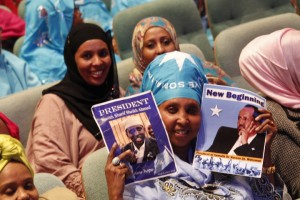
A Somali lady captures the mood at the celebration on Staurday in Minneapolis to mark the election of president Hassan Sheikh Mohamud. Photo: Siyad Salah
The event gave opportunity to local and international nonprofits to showcase their work to the community. UK Somali Health Care Foundation and US drew a lot of attention as people where enthused by posters and images of people in need of medical attention. Every organization displayed and showed their commitment and works in the Somali community.
Mr. Ahmed Nuur Yusuf, a 27-year-old, fond of his people and his country, said “Peace is what we have been working so hard to get. The Somali people seized this opportunity and a new dawn has begun.”
“I just hope this change is for the better and that the President follows through with his plans,” Nimo Yusuf said. “I am glad to see the drastic change happening in our country.”
“Everybody was very passionate about President Hassan Sheikh Mohamud,” said Mohamed.
Lack of paid sick days for immigrant caregivers risky for U.S. economy
Considering that Paula Osorio has multiple jobs and no paid sick days, the nosebleed could not have come at a worse time: right before her shift caring for an elderly woman in a private home.
In a nursing home or hospital, she would be able to lean on other caregivers. But the patient in her care, 91-year-old Elda Frank, has just her – Osorio, an immigrant from El Salvador.
Thankfully the two women, who have spent a lot of time together for five years, share a deep bond. Osorio cooks Frank’s favorite meals, bathes her and reminds her to take her medicine. Sometimes Osorio even visits Frank on her evenings off because she knows Frank is alone and needs help.
It is this tight-knit relationship that made her feel comfortable to call Frank’s son to suggest that Osorio’s partner, Roberto, go in her place. She then took the day off to go to the doctor.
“I think it’s fine because Roberto is very nice to my mom, too,” said Frank’s son Bruce, a 57-year-old computer engineer and father of three in Foster City. “I told Paula ‘to take the time that you need’, that if she can’t make it, I can find someone or go myself. ”
Osorio has two jobs: she works in Frank’s home during the week and cleans other houses on the weekends. In neither of these jobs is she able to earn paid sick days. When she is sick, she has to choose between going to work ill – and potentially putting the people she works with at risk — or taking the time off to go to the doctor and lose a much-needed paycheck.
In 145 countries, businesses provide workers with paid sick days. But the United States isn’t one of them. Nearly 40 percent of U.S. workers lack access to paid leave to care for themselves or a sick family member.
A Shortage of Caregivers, Many Have No Paid Sick Days
America is suffering from a shortage of caregivers. And of the existing caregivers, many have no basic worker protections like paid sick days.
About one in every eight Americans is 65 or older, a rate that is expected to almost double by 2030 as baby boomers and Generation Xers age, according to the U.S. Administration on Aging. The number of adults requiring care is expected to balloon from 13 million in 2000 to 27 million in 2050, according to Caring Across Generations, a growing national movement anchored by the Domestic Workers Alliance and Jobs With Justice that has a coalition of over 200 organizations. (Disclosure: MomsRising, my employer, is a partner organization of Caring Across Generations.)
Already, many families are scrambling behind closed doors to care or find care for their loved ones while balancing jobs, other dependents – such as children in the home – and other responsibilities. As for the caregivers themselves, they are almost always an afterthought. No one considers what happens to them or their children when they become sick.
A whopping 62 percent of personal care and service workers lack a single paid sick day, according to the Institute for Women’s Policy Research. Besides the emotional and physical costs to caregivers’ families, the lack of a national paid sick days policy has been costly to all U.S. workers and the economy.
Federal legislation called the Healthy Families Act would require employers with 15 or more employees to earn up to seven paid sick days a year. If passed, the Healthy Families Act would expand access to paid sick days to 90 percent of private sector workers. But the bill has stalled in Congress.
Only one state (Connecticut) and a handful of cities (San Francisco, Seattle and Washington, D.C.) guarantee paid sick days to workers. These state and local laws allow workers to accrue paid sick time, typically an hour for every 30 hours worked. A study of the paid sick days law in San Francisco found that after the enactment of the legislation the city had a healthier workforce and actually experienced job growth compared to surrounding areas — including San Mateo County where Osorio works — that don’t have a similar law in place.
These findings contradict that of the U.S. Chamber of Commerce and other business interests that claimed employees would “abuse the system.” Employees ended up using less than half of the days they had accrued, according to the report.
Yet, these same business interests continue to fight paid sick days laws both on the national and local levels. Their effects have been felt in every U.S. household requiring a caregiver.
“I knew a caregiver who needed a hysterectomy,” said Myrla Baldonado, a Filipina caregiver in the Chicago area. “She had to find and pay someone else out of her own pocket so that she could still have a job when she got out of the hospital….This situation of paying somebody to fill in especially when somebody is sick happens all the time. Caregivers keep it a secret that they are going for medical consultations or procedures that might make it appear that they have a serious illness which might cause them to lose their jobs.”
After much soul-searching, Baldonado recently cut back on caregiving to focus on advocating on behalf of caregivers. She is now on staff at the Latino Union of Chicago, although she still fills in for caregiving friends who need time off.
Baldonado said that caregivers are not only vulnerable to exploitive labor conditions but also illnesses in nursing homes and private homes that have sick residents. Due to the physical demands of the job – lifting an elderly person in and out of the bathtub, bed or wheelchair – these workers are also prone to injury.
Every year, employees who come to work sick – many because they lack paid sick days – cost the United States $160 billion. Low-income workers who don’t want to miss a day of pay are very likely to go to work sick, get injured or infect their co-workers and those in their care, which in turn affects other families, too. This is especially true during flu season.
Three years ago, the H1N1 flu pandemic swept through the nation, claiming at least 11,000 lives. What is especially astonishing is that according to research by the University of Pittsburgh, 5 million cases of the flu could have been prevented that year if the United States had simply had a paid sick days policy.
Who Is Caring for Mom?
Osorio is a spry 66-year-old woman, who, even though she is smaller than Frank, has no problem helping her out of bed or off the couch, or bathing her. No matter how unpleasant the task at hand is, Osorio is forever winking, smiling and joking with Frank. “What party are you going to this Sunday?” asked Osorio, who very well knew that Frank had her 91st birthday party coming up.
Osorio was born and raised in the small town of San Ildefonso in San Vicente, El Salvador, a region known for its breathtaking views of the volcanic peaks of Chichontepec. It is also an area of extreme poverty, dotted by multigenerational families living in shacks, barefoot and undernourished children playing with equally skinny and undernourished dogs, and it is not uncommon for poor single mothers to seek work in the country’s capitol San Salvador or the United States.
Osorio herself was raised by a beloved grandmother named Maria. Osorio said she spent her childhood days alongside her abuelita Maria, washing clothes in a river, making their own tortillas and soaps and sleeping outside in a hammock as her abuelita, a midwife, delivered babies.
“She was my mother and father,” Osorio said of her grandmother. “Even after her death, I still feel her in my heart.”
Maria Osorio delivered all four of her granddaughter’s babies and helped raise them until she died before the start of the country’s civil war in 1980. Between 1980 and 1992, the country was entrenched in a bloody civil war that claimed 100,000 lives in a country of six million. During this time, Osorio made tortillas to sell and provide for her four children. She was constantly worried that her daughters would be kidnapped by guerrilla soldiers.
Osorio recalled running home with an armload of wet laundry every time the guerrillas approached the river. Her daughters hid under their beds whenever unknown men came to their home. At times, guerrillas would ask that Osorio feed them. She refused. “I wouldn’t give them anything because I had to pay to make the tortillas!” she said.
It may sound like a gutsy move, but Osorio was very afraid, especially for her oldest daughter, Blanca, who she sent to live with other family members in San Vicente. Blanca would eventually make her way to the United States and send for her mother in 1992. To be with her daughter in California, Osorio would leave behind her three other children, including her youngest, a 12-year-old son named Rene.
“It’s hard,” Osorio said of having to leave behind her children. “I got here and I cried.”
An Opportunity for Immigrant Caregivers, American Families and Economy
“Paula has been a blessing,” Frank’s son, Bruce, said. “She has done so much for my mom. She will come over to see my mom at night out of her own free will. It is amazing what she does. We can’t ask for a better person for my mom.”
Prior to Osorio’s arrival, Frank said his mother went through at least two caregivers provided by the county. In between caregivers, it fell on him to care for his mother, who suffers from dementia, near blindness due to macular degeneration, a heart condition and limited mobility.
The thought of Osorio ever becoming ill troubles him deeply.
“Of course, we always worry,” he said. “If she doesn’t come in, who’s going to take care of my mom? In my mom’s case, she has me. But there are people who don’t have anybody.”
For Jodeen Olguin-Tayler, field director for Caring Across Generations, the aging of the baby boomers presents an opportunity to help both families and caregivers as well as strengthen the U.S. economy.
“Home care workers are sometimes the only support and care that elderly and people with disabilities can rely on to allow them to live at home with dignity and respect,” Olguin-Tayler said. “Ensuring that home care workers have dignified working conditions, including paid sick days, will create stability in the home care industry, and formalize the industry so that it can grow to meet the needs of our country and create the jobs our economy needs to get back on track.”
The U.S. taxpayer is already feeling the pinch of not putting in place basic worker protections like paid sick days. Research shows that paid sick days would decrease the number of stomach flu cases in nursing homes. In California, for example, between 30 and 45 fewer nursing homes would have norovirus outbreaks each year under a paid sick day policy – and these are the homes that are forthcoming about such outbreaks. In Denver, Colorado, which failed to pass a paid sick days policy earlier this year, there were 526 cases of norovirus stomach flu infections in nursing homes in 18 months. Five of these cases led to hospitalizations.
Considering that many of these seniors are covered by public insurance programs like Medicare and Medicaid, the taxpayer should feel leery.
Paid Sick Days Makes a Difference in the Lives of Caregivers
When Osorio first arrived in California in 1992, she cared for two girls in Hayward. The girls’ mother was a nurse who not only paid Osorio when she was sick, but also took her to her clinic for treatment.
“They treated me so well,” Osorio said of the family. “We still keep in touch.”
Eventually, the girls would grow up and it was time for Osorio to find another job. For 10 years, she worked at an industrial Laundromat where she had full benefits, including health insurance. It came in handy. During that time, she contracted uterine cancer and had to miss six months of work for a hysterectomy and 28 treatment sessions.
“I have never dyed my hair,” Osorio said with a grin, as she parted the roots of her dark curly hair to prove it. “Even when I was treated for cancer, I didn’t lose my hair or go gray.”
Osorio credits her faith, relationship with Roberto and love of work that have kept her young during the most arduous moments of her life. Roberto has helped her over the years, whether emotionally or financially. Work has allowed her to sustain herself and send money to her children and grandchildren in El Salvador.
Recently, in Frank’s one-bedroom apartment in San Carlos, Osorio revealed a photo of the plaid-skirted and olive-skinned 11-year-old girl that keeps her going: Rene’s daughter — her granddaughter — Nicole.
Thanks in part to cash remittances from her grandmother, Nicole is attending a private school in San Salvador and not only learning how to read and write in Spanish – but in English, too. “Nicole tells me, ‘I am going to make something of myself,’” Osorio says assuredly.
With that, Osorio flashes her signature smile, tends to Frank and says a little prayer that she won’t get sick. “If something happens to me, who will take care of her?” she wonders aloud.
To learn more and take action on federal legislation for paid sick days, click here. To ensure that domestic workers, including immigrant caregivers, receive basic job protections, learn more about the Caring Across Generations campaign.
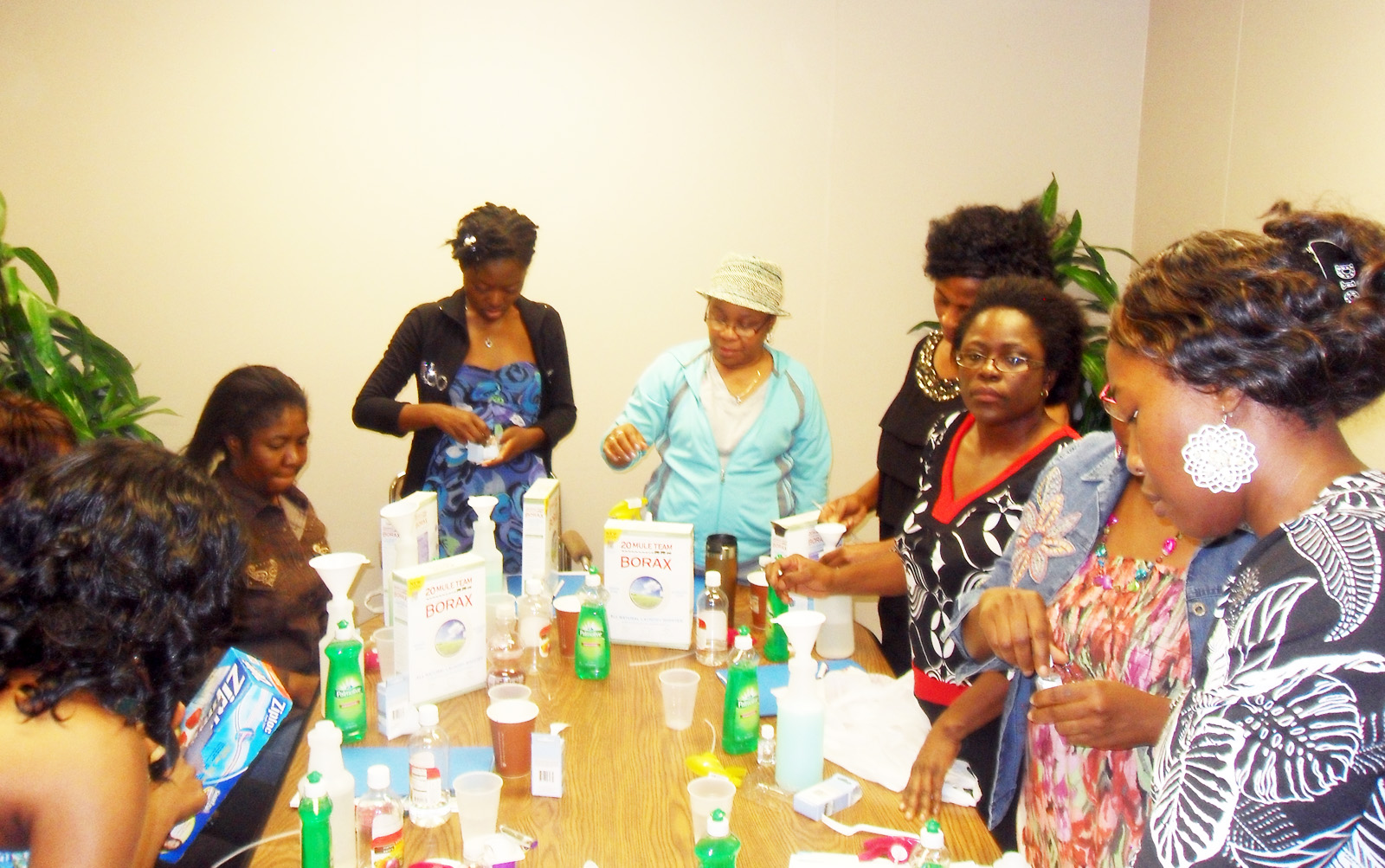
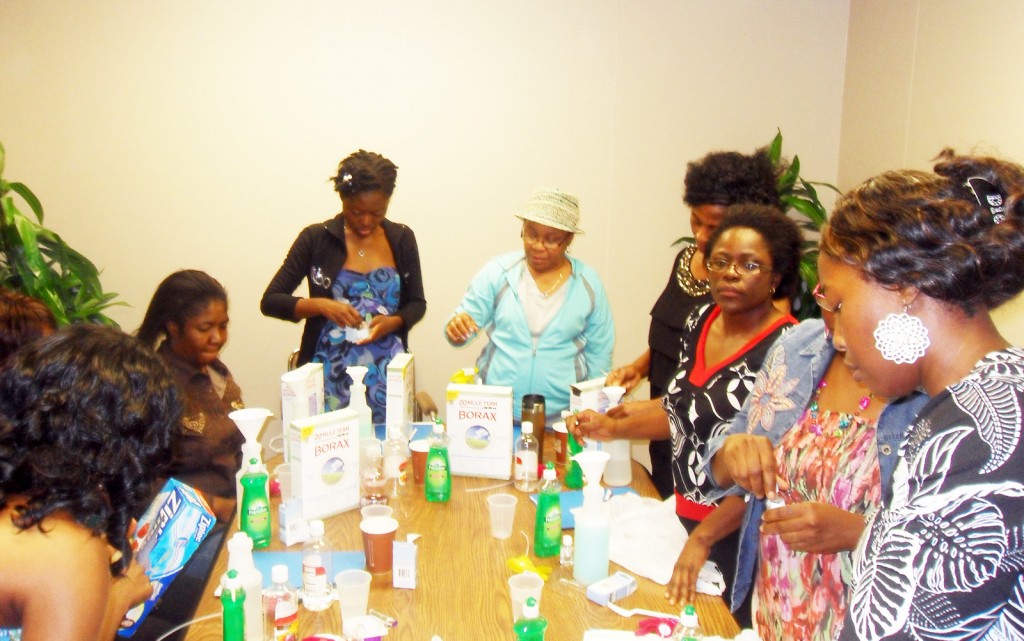
African women at a summer training session offered by the Minnesota African Women's Association (MAWA). Photo: Ken Forbin/Mshale
African women at a summer training session offered by the Minnesota African Women's Association (MAWA). Photo: Ken Forbin/MshaleAfrican women at a summer training session offered by the Minnesota African Women's Association (MAWA). Photo: Ken Forbin/Mshale
The Minnesota African Women’s Association (MAWA) this past summer, engaged women from different parts of Africa across the Twin cities, in a series of training programs and activities that made the summer very enriching.
On Saturday August 18th 20012, about fifteen women from different African countries attended a two- hour training program at the MAWA office conference room in Brooklyn Park, Minnesota.
The training, which is part of the “Community Power Project”, was funded by the Solid Waste Management Coordination Board. The focus was health-related: Smart choices: Creating Non Toxic Environments for Children.
At the training session, female community leaders from different African communities were trained on how to effectively educate women groups in African communities to make smart choices when using cleaning products that contain harmful chemicals at home. Participants at the training, were from various health and human service professions, and came from African countries, like Cameroon, Liberia, Nigeria and Togo.
Mostly made up of nurses, dental hygienists and social workers from across the Twin cities, the participants learned and engaged each other in information sharing on how best they can each transfer the knowledge and skills gained, to their respective communities in a culturally competent manner.
According to one of the participants, Mrs. Maureen Tambi, the most exciting and educational part of the training was the hands-on Activity session where the women learned how to make non toxic cleaning products by themselves. She said the training provided both useful information on how to avoid toxic chemicals at home and a skill set on how to make homemade cleaning supplies that are cheap and environmentally friendly.
Julia Earl, the trainer and presenter of the Smart Choices session said that the training was both useful and timely because of the increase in children’s exposure to toxic materials, especially from cleaning supplies used at home. She added that the prevalence of some illnesses like; autism and hyper activity in children have now been associated with exposure to toxic chemicals.
Commenting on the fact that the group consisted mostly of health professionals, Julia said it was an added advantage because the women grasped the knowledge faster and engaged each other in really resourceful conversation.
But the Smart choice training session was only one of the several other programs MAWA is offering this summer. On August 11th 2012, MAWA sponsored a Shoulder-to-Shoulder training for parents of Amakolo participants and other African refugee and asylee community leaders. “Shoulder to Shoulder” is an approach that teaches parents some innovative ways of dealing with their teenage children.
Last year, the training session was offered only to MAWA staff that in turn carried the message to the various African communities. This year however, thanks to more funding, MAWA extended the training to involve leaders of community based organizations. Participants came from Somalia, Sudan, Liberia and Cameroon and in the course of the training; these parents learnt that the best way to deal with their teenage children, is through Positive Parenting.
The Positive Parenting approach is where one the parents are warm, supportive and encouraging while being firm, consistent and clear with limits and boundaries. The training is particularly important to African mothers because due to cultural differences, child up bringing in America has now become a little more challenging.
A third workshop offered by MAWA was a health-related one for young people. MAWA is offering the nationally acclaimed curriculum, BART: Becoming A Responsible Teen, to 180 African teenagers. This training targets teenagers from African immigrant families and its first session begins August 28th through the 31st. MAWA’s objective for this program is to respond to a growing need.
Explaining the structure of the program to Mshale, Nambangi of MAWA noted that the BART program is gender based. There will be groups of 8 to 15 teenagers for girls and another for boys. Also commenting on the relevance of the program, she said that with the rise in teen pregnancy among African teenage girls, such a program is not only necessary but urgent. Statistics from the Minnesota HIV/AIDS Surveillance System on the prevalence of HIV/AIDS among African teens also reiterates the urgency for such a program that responds to building HIV/AIDS awareness as well as teen pregnancy prevention education.
A total of 144 girls and 36 boys are anticipated to benefit from the program. While three African Community groups have already indicated their interest in having their teenagers go through this training, MAWA is willing to extend the program beyond its own AGILE participants to include more teenagers from two more African community groups. Leaders of teen initiatives in African communities are encouraged to put together groups of 12-15 girls and boys and register with MAWA.
Amanda Seales, left, declined to appear at a conference hosted by President Teodoro Obiang, seen right at an African Union summit
Amanda Seales, left, declined to appear at a conference hosted by President Teodoro Obiang, seen right at an African Union summitAmanda Seales, left, declined to appear at a conference hosted by President Teodoro Obiang, seen right at an African Union summit
Actress and sometimes MTV host Amanda Seales says she knew “absolutely nothing” about Equatorial Guinea when she received an invitation to the Leon H. Sullivan Foundation’s biennial summit, held last week in the tiny African nation. The 31-year-old has acted in a Nickelodeon series, hosted on MTV, released music, poetry, and visual art, and earned a master’s in African American studies from Columbia University. It’s easy to see why the Sullivan Foundation, an organization dedicated to continuing the work of social activist and religious leader Leon Sullivan, decided that Seales had something to add to what their promotional materials describe as “a gathering of the African Diaspora.”
And it’s just as easy to see why Seales, who has never visited Africa, might have jumped at the opportunity, especially after running an internet search for pictures of Equatorial Guinea, a coastal nation with a population of only 600,000. “There’s this beautiful island, and there’re white sand beaches,” she told me. “And I’m like what, that’s where we’re going? And I’m told we’re going with the government, so we’ll be taken care of.”
That last part ended up being a problem for Seales. Some time before the summit, an aunt alterted her to the Equatoguinean government’s record of human rights abuses. Seales, worried that attending might help legitimize an oppressive, autocratic government, cancelled.
Had Seales accepted, she would have joined a long and prominent list of celebrities who have appeared on behalf of dictatorial governments. In 2009, Sting performed for the daughter of the dictator of Uzbekistan, for which he was reportedly paid between two and three million dollars. (Two years later and perhaps chastened by the international backlash, he canceled a concert in Kazakhstan over its suppression of workers.) In 2011, Beyonce Knowles and Hilary Swank made paid appearances at a New Year’s celebration for one of the sons of Muamar Gaddafi and a birthday party for a Chechen warlord, respectively. As the Washington Post put it at the time, “A raft of Western entertainers and celebrities, including Mariah Carey, Usher, Beyoncé and Sharon Stone , have hired themselves out to some of the world’s most odious human rights abusers, their children or close associates.”
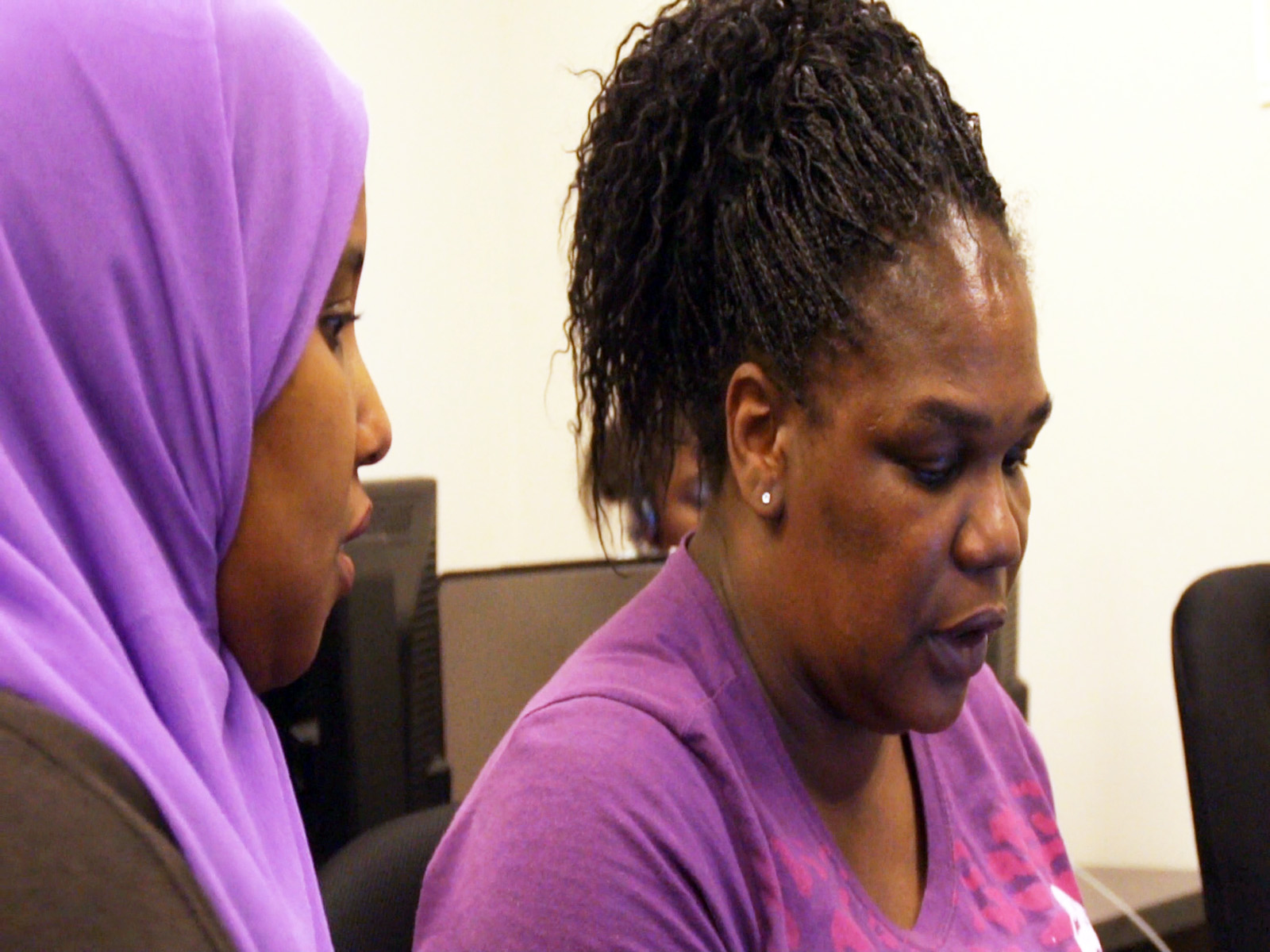
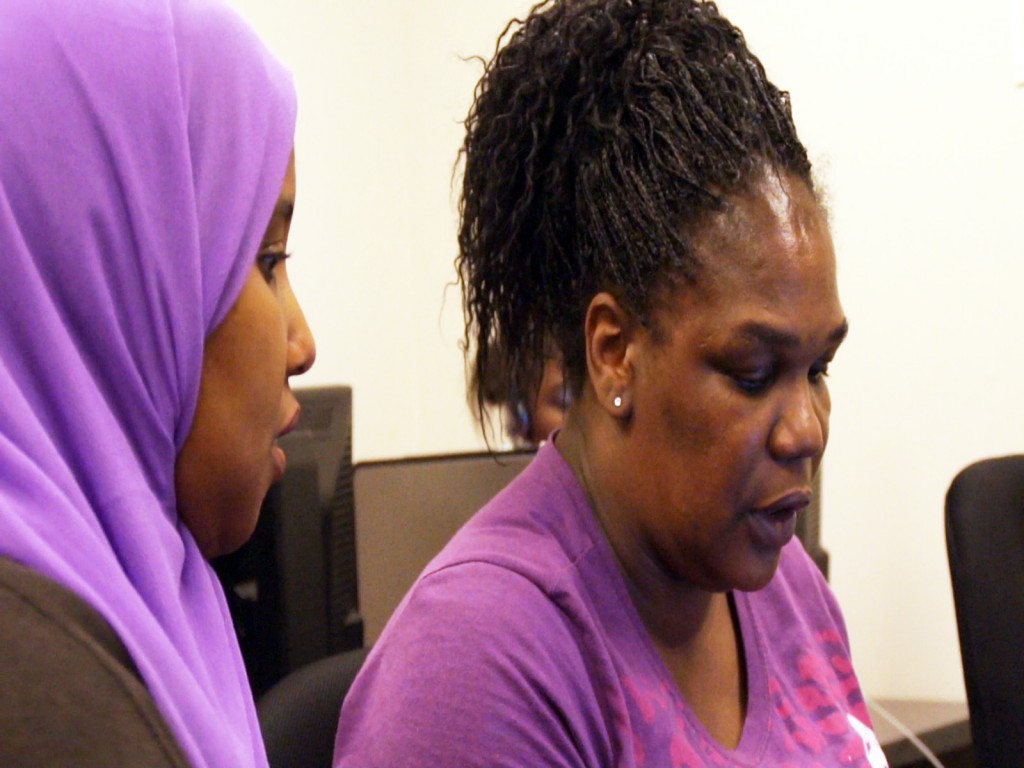
Kadra Abdi (left) an Apprentice at the University of Minnesota Broadband Access Project (BAP) Glendale Center helps a user navigate a computer application at the center. BAP is part of the Obama administration Stimulus efforts. Photo: Tristan Waters
Kadra Abdi (left) an Apprentice at the University of Minnesota Broadband Access Project (BAP) Glendale Center helps a user navigate a computer application at the center. BAP is part of the Obama administration Stimulus efforts. Photo: Tristan WatersKadra Abdi (left) an Apprentice at the University of Minnesota Broadband Access Project (BAP) Glendale Center helps a user navigate a computer application at the center. BAP is part of the Obama administration Stimulus efforts. Photo: Tristan Waters
“It is my first time to touch computer and I am very happy,” exclaims Zulfa Fara, an older Ethiopian immigrant currently using a public computer center developed through the Broadband Access Project (BAP), a program of the University of Minnesota’s Urban Research and Outreach-Engagement Center (UROC). In response to the growing digital divide among underserved communities in the Twin Cities Metro, the BAP was developed to increase broadband access, awareness, and use in four federally designated poverty zones in Minneapolis and St. Paul. This project is funded through a federal grant from the Broadband Technology Opportunities Program.
Fara, mentioned above, was working at the Minneapolis Public Housing-Glendale lab, located at 92 SE St. Mary’s Avenue, when she was interviewed. This lab is one of 12 new or enhanced community-based BAP public computer centers in Minneapolis and Saint Paul. While this is one of the smaller centers – with only five computers – it is still having a significant impact.
Kadra Abdi, the University of Minnesota Broadband Access Project Apprentice who works at the Glendale center, explains how the small size allows her to make strong connections with clients, “We’re a small center so we don’t have a lot of training but we assist people in other ways. We give them one-on-one assistance; we sit with them as they’re trying to learn basic computer skills.” Larger BAP computer labs offer technology training with trainings covering topics such as Microsoft Office, financial support, social media for business use, and even Internet programming and design. Through these trainings and the assistance offered in each lab, the BAP aims to help people develop to meet the increased technological demands of today’s world. People of all ages find that computer use at these centers plays a large role in their everyday life. Abdi taught Fara how to set up and use an email account so she can communicate in the workplace and with loved ones all over the world. Fara explains how valuable this tool has become to her, “I’m so happy, believe me or not, because I send to my kids email to Ethiopia, to Africa, and they send me back. In the job place also they send me. It’s a big knowledge I get, big knowledge, oh so happy.“
Deshawn King, a regular visitor to the center, uses the computers to do homework and submit schoolwork. She is pursuing her Certified Medical Assistant degree from a local college and appreciates that there is no time limit on BAP computers, unlike those at the public libraries. “You don’t get but an hour at the library and you have to let somebody else get in,” she says, “here I’m able to get a lot in. Whenever I have to do homework and submit it I’m able to do it over here. There’s a lot of lab work and stuff that we have to look up.” Because her schoolwork requires a lot of time and effort having a computer center staffed with helpful employees keeps her motivated. It’s easy to tell by the look in her eyes that even though the work is hard, King is highly determined. “I come here every day, every day because the work that you have to have for college is persistent. I don’t know what I would so without it, it would be very hard to submit my work,” she explains.
Not only does the center supply a beneficial resource to those with more professional pursuits, it also provides a way for young people to feel connected and involved with their peers through social networking sites such as Facebook and Twitter. Kadra covers the variety of ways access to a computer can be helpful to community members saying, “[People will come in] if they want to learn how to type or open their first email account, or if they just want to come in and build a resume and other things like job research, cover letters. If they want to set up a Facebook account if they’ve never done it before or try to figure out how to use YouTube. Those are just some of the things we can help with for our clients.” Building their technology skills leads to greater employability and begins to close the digital divide.
The positive effects of this program are tangible. In the six months she has worked at the center, Abdi has been able see the lab make strong impacts on people’s lives. “I had people who came here and the computer lab helped them get a job because they were here to do their resume, they were able to pull a resume together from the start and apply to jobs here and after that got a job somewhere. So that was a really good thing to see,” she explains. Fara sums it up best, “We are happy, not only me, other people here. When we need help, it’s good to learn.” “
For more information or to find a computer lab near you visit www.bap.umn.edu, call 612-625-BAP1 (2271), or email [email protected]..
Ikram Ali orginally from Somalia has taken advantage of MAWA’’s Certified Nursing Assistant program. Photo: Frederick Ndip/Mshale
Ikram Ali orginally from Somalia has taken advantage of MAWA’’s Certified Nursing Assistant program. Photo: Frederick Ndip/MshaleIkram Ali orginally from Somalia has taken advantage of MAWA’’s Certified Nursing Assistant program. Photo: Frederick Ndip/Mshale
Marianne Neba is 18 years old, a native of Cameroon who immigrated to the United States a few years ago and recently graduated from Park Center High school Brooklyn Park, Minnesota. For the last three years, Neba has been a participant of the AGILE/Amakolo African Girls Pathways to Success project offered by the Minnesota African Women Association (MAWA).
Neba has been accepted to the University of Minnesota Duluth in the fall and hopes to major in biology and chemistry.
Ikram Ali is 19 and a native of Somalia who grew up in Syria. Ali immigrated to Minnesota in September 2011. Ali was trained as a nurse in Syria and wishes to accomplish her lifelong dream of becoming a registered nurse.
In the meantime, Neba and Ali are both undergoing Certified Nursing Attendants (CNA) training at the North American Medical Academy in Minneapolis. Neba hopes the training will enable her find a job so she can subsidize her college
program. For Ali, the training will help her find gainful employment and serve as a springboard to her goal of becoming a registered nurse.
Neba and Ali, like many other young African immigrant/refugee women and girls living in the Minneapolis/St. Paul metro area have taken advantage of the Amakolo African Girls Pathways to Success Project; a project of MAWA. According to Ms. Melissa Nambangi, Executive Director of MAWA, the goal of the Amakolo project is to provide African immigrant and refugee girls with a “pathway to success” through intensive group and individual education, counseling, and academic support, and mentoring. “While all immigrants face difficulties resettling, it is much more dramatic and challenging for African females,” Ms. Nambangi stated.
Some of these girls lived in refugee camps where they received little or no education, lived in poverty, and have had no role models. Others have also faced subjugation and sexual violence ingrained in some African cultures. The Amakolo program provides education and information about healthy youth development, personal financial management, career paths, and
attending and paying for college.
Participants receive an initial $250 stipend to open a college savings bank account and those who choose to pursue the CNA program certification examination fees covered by MAWA, thanks to funding from some local foundations and the Office of Refugee Resettlement.
18 year old Marianne Neba, a native of Camerron, has been a participant of the AGILE/Amakolo African Girls Pathways to Success project offered by the Minnesota African Women Association (MAWA). Photo: Frederick Ndip/Mshale
Neba heard about MAWA’s AGILE program from other African immigrant students who were participants of the program at her Park Center high school and decided
to join. A member of the Somali community in Minneapolis referred Ikram to MAWA.
Neba particularly credits the Amakolo Project for building her confidence and raising her self esteem. She stated that prior to enrolling in the Project, she faced difficulties making friends and integrating a school system that is very different from the one she attended while in Cameroon. The Project provided her the opportunity to learn and appreciate her cultural heritage while being able to integrate into the American school culture. She strongly urges other African immigrant and refugee girls to join AGILE/Amakolo.
For Ikram, the Amakolo program has given her a renewed sense of hope and provided an opportunity to gain valuable skills. Besides, she credits the CNA certification program sponsored through the project for giving her the opportunity to earn a living.
“While many young African immigrant girls are taking advantage of the AGILE program, it is unfortunate that some parents and guardians of African refugee girls are reluctant to provide the necessary immigration information to enable their girls receive the financial incentives offered by the Amakolo project” stated Ms. Nambangi. Ms. Nambangi intimated that the Amakolo program has been a lifeline for many young girls and appeals to parents to take advantage of the Amakolo program while it exists by enrolling their girls.
The Amakolo project is funded by the Office of Refugee Resettlement and is intended for African refugee and asylee girls who have lived in the US for less than five years. It is a project of MAWA’s AGILE program (African Girls Initiative for Leadership and Empowerment), an 8-year old after-school program that serves the needs of over 120 African girls annually in nine schools and
community sites across the Twin Cities metro.
AGILE is open to all African immigrant girls, refugees andasylees included and focuses in facilitating the integration of these girls into their respective school systems and assist them in preparing for college.


 Influenza is an illness that affects people of all ages worldwide. Symptoms range from mild to severe, and it is a major health issue around the world. Everyone can help fight the spread of influenza each year by getting vaccinated. Vaccination is also one of the best ways to reduce your chance of getting ill.