Who are the most influential icons in contemporary African pop culture?
In September, I put out a request for nominations for a list of the 40 most powerful celebrities in contemporary Africa. Within three weeks, over 7,500 entries flooded in. This is the result of your choices.
The debut list of The 40 Most Powerful Celebrities In Africa includes actors, cerebral authors, musicians, movie producers, supermodels, TV personalities and athletes, drawn from all across Africa and traverses the generational divide.
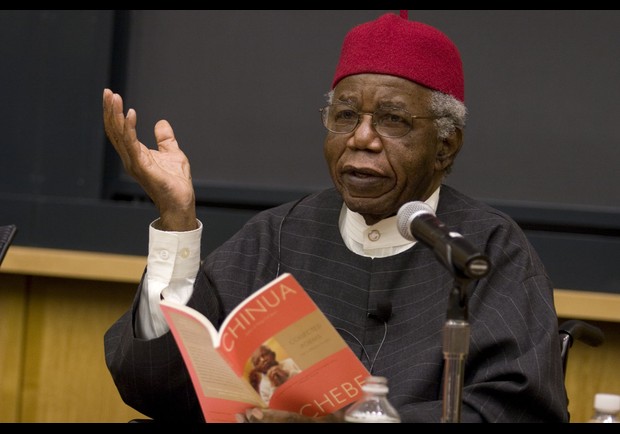
Don’t be surprised to meet timeless artistic greats like Nigerian novelist Chinua Achebe (ranked No. 1) and Zimbabwe’s Oliver Mtukudzi listed alongside younger up-and-comers like famed Kenyan crooner Eric Wainaina, Ivorian soccer sensation Didier Drogba (No. 3) and Nigerian screen goddess Genevieve Nnaji. Perhaps not surprisingly, the list is dominated by musicians.
America is a melting pot – a coming together of different peoples from different countries, religions, ethnicities and ideologies. It began with immigration and it moves forward with it. But it’s never been easy being different in America.
Author Jay Feldman’s new book takes a look at how difficult it has been for every kind of American minority you can imagine. His book is called Manufacturing Hysteria: A History of Scapegoating, Surveillance and Secrecy in Modern America and he spoke with New America Now Host Shirin Sadeghi about the history of American hysteria.
Sammy Malakwen, of Kenya, has won the Twin Cities Marathon with a time of 2 hours, 13 minutes and 11 seconds. The 33-year old resides in Twin Harbors, Minnesota.
In the women’s marathon, 23-year old Yeshimebet Tadesse-Bifa of Ethiopia, finished tops with a time of 2 hours, 28 minutes and 24 seconds.
In the 10-mile race, Mo Trafeh of Morocco won with 46:46 finish. The 26-year old Moroccan lives in Duarte, California. With his win, he takes home a bonus of $10,000 on top of the $12,000 prize money for finsihing first among all runners (men and women). Women this year were given a seven minute head start in the race to equalize the chances of winning the $10,000 bonus.
Kenyan, Janet Cherobon-Bawcom, 33, sealed teh fate of this year’s Twin Cities Marathon as an African affair when she won the women’s 10-mile race with a time of 54:15. She lives in Rome, Georgia.
Saul Mendoza of Wimberley, Texas,won in the wheelchair division.
Race officials were expecting 19,000 to participate in this year’s 30th edition of the Twin Cities Marathon.
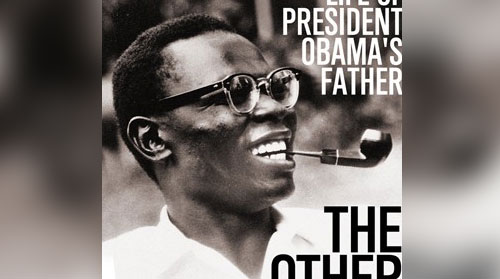
His son is the most powerful African-American in history, but his story, you will find, is even more fascinating. Barack Obama Senior was a man who was too much for this world – too intelligent, too charming and too idealistic.
In utter contrast to his son, Obama senior was a man whose public image was politically incorrect and rebellious – he said and did as he wished, often without regard for his safety or his future. In the end, he died young, having only met his now-famous son once. New America Now Host Shirin Sadeghi spoke with Sally Jacobs, journalist and author of the biography The Other Barack: The Bold and Reckless Life of President Obama’s Father.
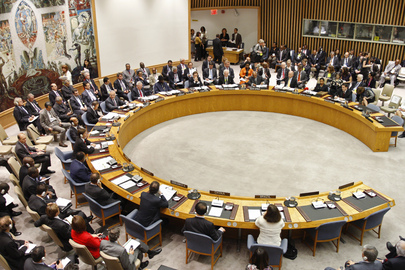
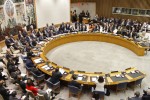
Africa renews call for permanent seat on UN Security Council
West African countries today called for enlarging the 15-member Security Council to give their continent its due representation on the United Nations body whose decisions are legally binding, as opposed to the recommendations issued by the 193-member General Assembly.
They also voiced full support for mediation as a means of pre-empting crises, the theme of this year’s Assembly annual general debate.
“Negotiations for Security Council reform must be intensified with the adoption of a precise timetable for their conclusion,” Foreign Minister Nassirou Bako-Arifari of Benin told the Assembly, proposing 2015 as the target date for giving Africa permanent representation on an enlarged body.
“It is time to put an end to this intolerable injustice which excludes a whole continent Africa, the only one, from the supreme decision-making body on international security.”
He also called for reinforcing the operational capacities of the UN and regional organizations to face the world’s multiple crises. “At the global level we believe in the virtues of multilateralism; that’s why we have even more need for a UN which must be entrusted with a more decisive role in world governance, a UN which will be the spearhead for actions that will promote, within a framework of inclusion, lasting global solutions to all types of crises,” he said.
Mr. Bako-Arifari also appealed for international help to fight piracy that has recently intensified off Benin’s coast in the Gulf of Guinea.
Foreign Minister Djibrill Yipènè Bassolé of Burkina Faso said his country had been engaged for more than a decade in efforts to reform the UN “to allow it to conform with the exigencies of a world that is in full transformation.
“For Burkina Faso, reform must take into account the interests of all Member States and increase the effectiveness of our Organization in handling peace and security, stability and development in all parts of the world,” he said.
With regard to mediation he cited the role of Burkina Faso’s President Blaise Compaoré in helping to resolve crises in Guinea, Côte d’Ivoire and Togo.
Mauritania’s Foreign Minister Hamady Ould Hamady called for Security Council reform that would include permanent representation for Africa and the Arab Group. “The Security Council must fairly reflect the will of the entire international community,” he said.
He also noted that organized crime, such as kidnapping, terrorism, and drug, weapon and human trafficking, had been expanding for many years in the Sahara region, posing a threat to peace and stability. In cooperation with neighbouring countries, Mauritania had put a stop to the activities of those terrorist groups and made it impossible for them to move freely, he added.
Late start, numerous speeches, mar ‘Town Hall’ meeting
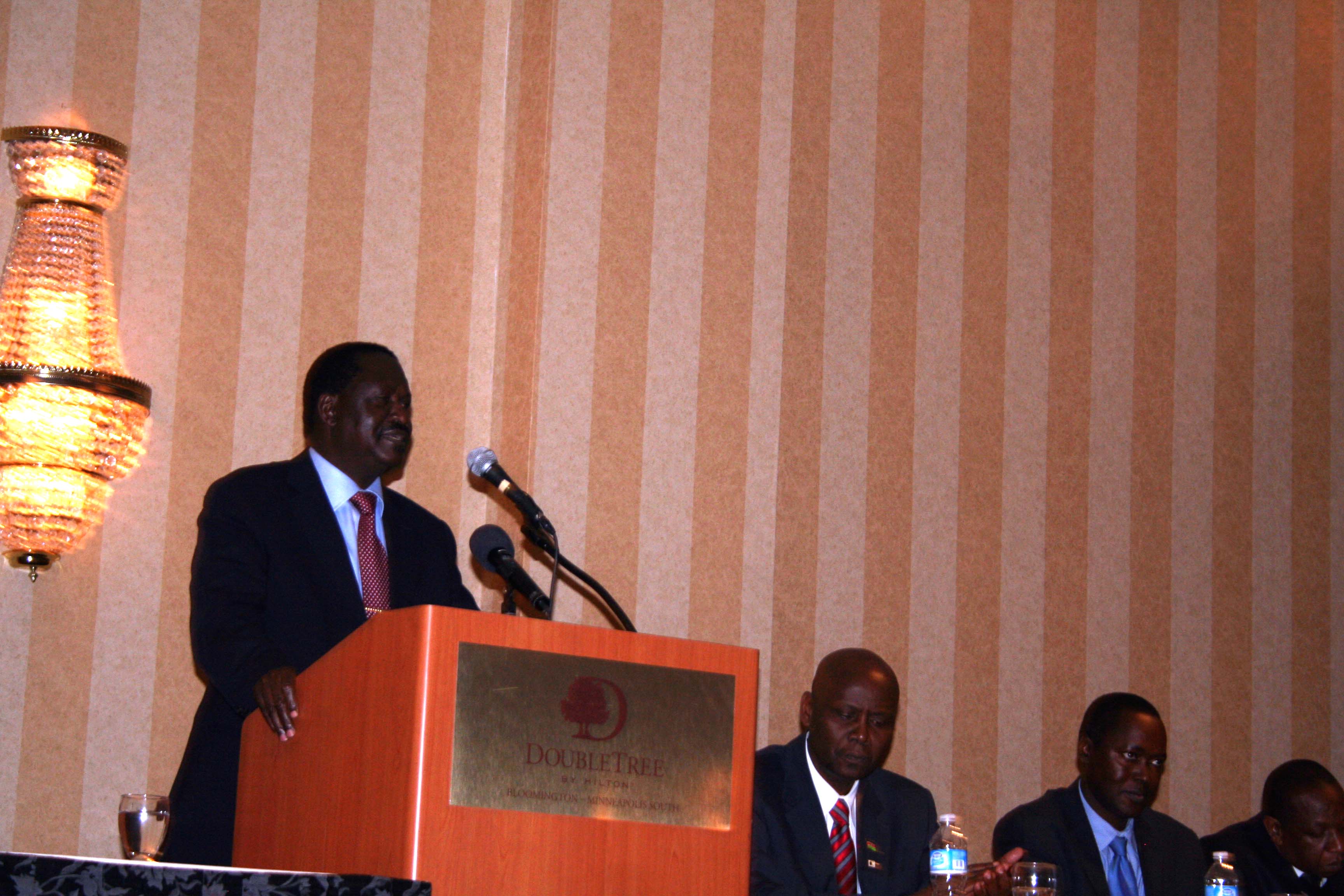
BLOOMINGTON, Minn – Prime Minister Raila Odinga of Kenya has shot down calls by Kenyans abroad for the creation of a ministry in charge of Diaspora affairs. Instead, the prime minister said the Diaspora desk in the Ministry of Foreign Affairs will be strengthened.
The prime minister made the remarks when he addressed about 700 Kenyans that packed a ballroom at a local hotel here.
Mr. Odinga said the new constitution the country adopted last year places a limit on the number of ministries that can exist and besides government was “already too big”.
After many years of successfully lobbying for dual citizenship, the Kenyan Diaspora has slowly taken up the cause of a ministry dedicated to them as the next big challenge.
The prime minister however did reveal that a voter registration exercise for the Diaspora is on a pilot stage at the Kenya High commission in London and that Kenyans abroad should ready themselves to vote in next year’s general elections.
The prime minister was in the US for an official visit to the United Nations for a Horn of Africa Crisis meeting where he presented the report of the “Nairobi Declaration” following a meeting of the East African countries. “I am happy to report to you that the UN adopted the report”, he said.
The prime minister who has had an “on again and off again” type of relationship with Minnesota Kenyans was making his first visit to Minnesota as prime minister. He was last here in February 2007 for a campaign stop, just months before the disputed December 2007 general election that plunged Kenya into violence.
He has come full circle with Kenyans in Minnesota. He was met with a hostile crowd in 2000 during his “cooperation years’ with then president Daniel Arap Moi. By 2007 when he visited again, he was back in the good books of the predominantly pro-reform Kenyan crowd that resides here. Among his critics at the Town hall was one Judy Onsomu who nevertheless said she would keep an open mind and hear Mr. Odinga out.
A noticeable difference with this visit was the Secret service protection that he enjoyed which prevented the backslapping, vigorous handshaking and photo opportunities that a Raila visit provided in the past.
Late start
The meeting got off to an inauspicious start. Advertised on the Kenya embassy website with a start time of 1:00 P.M., the meeting did not get underway until two hours later. When it got underway, speeches from numerous local personalities as well as three members of parliament in the prime minister’s delegation took another two hours. With the ‘Town Hall’ meeting advertised to end at 5:00 P.M., it was not until 5:10 P.M., that the prime minister took to the podium to address a now restless crowd.
After giving a laundry list of the accomplishments of the coalition government he is a part of with President Mwai Kibaki, the prime minister seemed to be in his element when he segued into what many in the audience believed brought him to Minnesota – next year’s general elections. “He only came here to campaign period” declared Ali Mohammed, a nine year Minnesota resident from Kenya, as he waited an agonizing two hours for the meeting to begin.
To that effect, Mr. Martin Ogindo, the Member of Parliament for Rangwe constituency who was in the prime minister’s delegation, had set the tone for him. MP Ogindo told the audience that “his people” had prayed to God for PM Odinga to “get a promotion” and the “almighty instructed us to go forth and vote accordingly”, he said to sustained laughter from the audience.
Mr. Odinga likened himself to a pilot in a plane on the runaway about to take off, with the plane being Kenya in this instance. He dismissed as irrational the fear some Kenyans have of a Luo president “I do not want to be president for the Luos but for all Kenyans”, he told a cheering crowd. He said Luos are Kenyans like everyone else. Mr. Odinga who represents Nairobi’s Langata constituency in parliament said the area is one of the most cosmopolitan in the country “and all those people have voted for me.”
“We are not crooks”
At one point, Assistant Minister Richard Onyonka, who commanded the podium for a period of time tried to explain the reasoning for Kenyan members of parliament not paying taxes. After proclaiming he was a product of the Diaspora, he used the America is a democracy argument as the now exasperated crowd got ready to shout him down for what they called “lame excuses”.
He told the crowd that the MPs have been misunderstood and that the country including the Diaspora should look at it from their point of view “as we are not crooks,” drawing derisive laughter from sections of the audience.
Another Member of Parliament, Mr. Hussein Ali of Mandera East looked on quietly as Mr. Onyonka made his case.
Town Hall? which Town Hall?
If there was a low point in the ‘Town Hall’ meeting other than the late start, the Onyonka explanation on MPs nonpayment of taxes was one of them. The other was an attempt by the local organizing committee to redefine a Town Hall meeting as Kenyans here have come to understand it in the American context and from previous such meetings.
By the time the question and answer session came around, more than an hour after the meeting was supposed to have ended, the audience was quickly told that time constraints would not allow for “many questions’ said Mr. Onyonka. Additionally, the audience was to limit their questioning of the prime minister to the themes that were projected on the PowerPoint in the hotel ballroom screen. The themes included among others security and agriculture.
In the intervening period as the Q & A format was being discussed at the high table, an impromptu Harambee (fundraiser) for Mauryn Masire Moore, a Kenyan stabbed to death by her Liberian husband in Minnesota, was contemplated. The local community is planning to send her body to her parents in Mombasa.
The fundraising idea was quickly discarded but the disarray along with the Q & A format disgusted enough of the audience for almost a third of them to empty the ballroom. Some were already running late for evening work shifts.
The prime minister however gave a donation of $2,000 towards the harambee to be held later. The MPs and civil servants accompanying him gave $100 each.
Ida Odinga
Making her first visit to Minnesota, at the urging of her “Facebook friend” was Mrs. Ida Odinga, wife to the prime minister. Mrs. Odinga who received loud applause from the ladies in the audience gave brief remarks. Saying she did not want to make a long speech as “kazi yangu ni kuchunga mzee (my role is to take care of my husband)” she nevertheless shared the audience the various community development efforts she is involved with.
The 48th County
Kenya’s Ambassador to the United States, Mr. Elkanah Odembo, accompanied the prime minister to Minnesota. The ambassador said that in the past, a lack of institutions and structure has been a hindrance to engaging the Diaspora in “meaningful ways” but that the new constitution the country adopted “has changed that”.
Mr. Odembo said that should the Kenyans in the U.S. be constituted as Kenya’s 48th county, it would be the “most affluent county”.
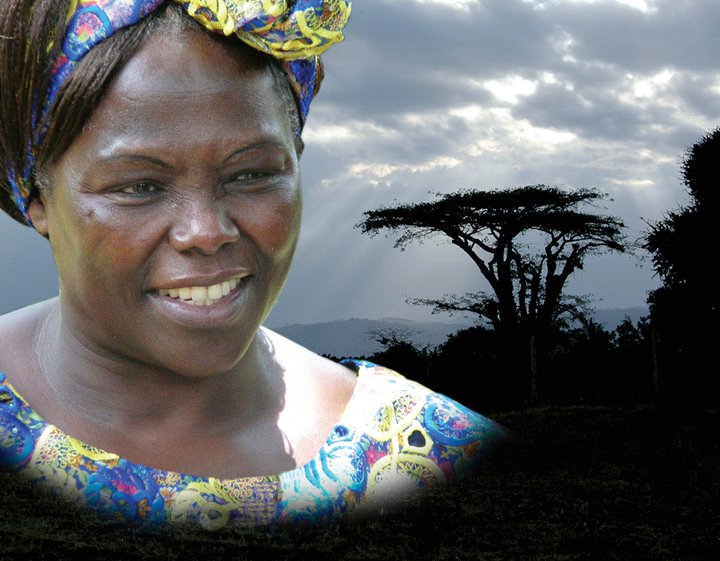
Nobel Peace prize winner Wangari Maathai of Kenya has died after a long battle with cancer. Kenyan press reports say the first African woman Nobel Peace laureate passed away in Nairobi on Sunday, September 25 at 10:00 P.M. local time.
Kenyan media attributed the source as the Greenbelt Movement organization of which she founded in 1977.
The Greenbelt Movement said in a statement that her death was a great loss for those who knew and admired her “determination to make the world a more peaceful, healthier, and better place.”
Wangari Muta Maathai was born in Nyeri, Kenya in 1940. The first woman in East and Central Africa to earn a doctorate degree. Wangari Maathai obtained a degree in Biological Sciences from Mount St. Scholastica College in Atchison, Kansas (1964). She subsequently earned a Master of Science degree from the University of Pittsburgh (1966). She pursued doctoral studies in Germany and the University of Nairobi, obtaining a Ph.D. (1971) from the University of Nairobi where she also taught veterinary anatomy.
She became chair of the Department of Veterinary Anatomy and an associate professor in 1976 and 1977 respectively. In both cases, she was the first woman to attain those positions in the region. Wangari Maathai was active in the National Council of Women of Kenya in 1976-87 and was its chairman in 1981-87.
It was while she served in the National Council of Women that she introduced the idea of planting trees with the people in 1976 and continued to develop it into a broad-based, grassroots organization whose main focus is the planting of trees with women groups in order to conserve the environment and improve their quality of life.
Professor Maathai, as she was fondly referred to by friends and admirers, is survived by her three children Waweru, Wanjira, and Muta and a granddaughter, Ruth Wangari.
Testimonials are being accepted at her Facebook page while funeral arrangements will be announced soon, according to the Greenbelt Movement.
As one might expect from its rock-star provenance, EDUN offers altruism with an edge. But although U2 frontman Bono and his wife, Ali Hewson, founded the label to buttress the languishing economies of Kenya, Uganda, and Mali, it’s shied away from making its African connection too literal in its clothes. At the Spring/Summer 2012 show at New York Fashion Week on Sunday, however, Sharon Wauchob, a year into her creative directorship under Louis Vuitton Moët Hennessy, appears to have belayed that order by presenting one of EDUN’s most “ethnic” collections to date.
Despite a profusion of shells, feathers, horn, and demure African floral prints, Wauchob’s third outing at the helm has lost none of EDUN’s cool-girl-in-school verve. In an apparent attempt to overcompensate, however, EDUN makes unlikely bedfellows of fishnet mesh, parachute drawstrings, and oversize curtain grommets (the type you’d pick up in packs of eight for $12.99 at your neighborhood Jo-Ann). Overall, the impression is of someone trying too hard, although the coordinating bicycle bloomers, we’d allow, are a pleasant and unexpected touch. Some of the tailored separates (a boxy hemp/recycled-polyester gabardine, a pressed front-tie oxford shirt) are even work-appropriate.
If anything was amiss, you couldn’t tell from the looks of the captive audience, which included bold-faced luminaries like Christy Turlington, Michael Stipes, Courtney Love, Naomi Campbell, Sting and Trudie Styler, and Helena Christensen in the front row.
Ten years after the 9/11 terrorist attacks, the Department of Homeland Security (DHS) and Immigration & Customs Enforcement (ICE) still insist that their enforcement priorities are terrorists, serious criminals, and persons who pose a threat to national security. But the Transactional Records Access Clearinghouse (TRAC) reports that this claim is misleading. The number of removal cases pending before the Immigration Courts continues to rise, reaching a total of 285,526 at the end of July 2011. This represents an all-time high and a rise of 3.7 percent from three months ago. Only 8.3 percent of the pending cases involved foreign nationals charged with aiding terrorism, criminal activities, and actions adverse to national security. This portion has fallen by 9.1 percent during the last 10 months. Meanwhile, those charged with purely immigration violations made up 90 percent of the cases, with the total number rising from 1.2 million before 9/11 to 1.9 million post-9/11.
To help ease the rising backlog in Immigration Courts, the Obama Administration recently announced that it would aggressively pursue “high priority cases” while focusing less on “low priority cases.” This policy is not an Amnesty Program, is not a deferral of removal program for those who might quality for benefits of the DREAM Act (if passed), and is not an abandonment of U.S. immigration laws. It does not confer any lawful status to the millions of undocumented immigrants present in the United States. It does, however, provide additional guidance to DHS in exercising prosecutorial discretion to ensure that limited resources are spent on the agency’s enforcement priorities.
John Morton Memo
In his June 17, 2011 Memorandum, ICE Director John Morton notes that DHS officials should consider the “totality of the circumstances” in deciding whether to prosecute a case. Morton provides a non-exhaustive list of factors, which ranges from age and the circumstances of the person’s arrival in the U.S. to community ties and cooperation with law enforcement authorities. The memo also describes special factors that indicate whether a case is high priority or low priority.
High priority cases include persons who pose a clear threat to national security; serious felons; repeat offenders; known gang members; and those with a record of egregious immigration violations. In contrast, low priority cases include veterans and members of the U.S. armed forces; long-time permanent residents; minors and elderly persons; individuals present in the United States since childhood; victims of domestic violence, trafficking or other serious crimes; those with serious mental or physical disability; those with serious health conditions; and pregnant or nursing women.
Interagency Process
Department of Homeland Security Secretary Janet Napolitano also sent a letter to Senator Dick Durbin (D-IL) and 21 other senators, on August 18, confirming that the Administration is implementing the Morton Memo. She described an agency-wide expansion of prosecutorial discretion guidelines that instruct their agents to focus on dangerous criminals. She noted that the DHS has made tremendous progress in focusing on high priority cases. For example, in fiscal year 2010, ICE removed 79,000 more persons who had been convicted of a crime than it did in fiscal year 2008. For the first time ever, over 50 percent of the foreign nationals removed from the United States in a fiscal year were convicted criminals.
To continue on this path, the DHS revealed a new interagency process to ensure that resources are focused on the Administration’s highest enforcement priorities. As part of this process, an interagency group of DHS and Department of Justice (DOJ) officers and attorneys, including representatives from DHS, the Executive Office for Immigration Review (EOIR), and the Office of Immigration Litigation at DOJ, will identify low-priority removal cases that should be considered for an exercise of discretion. The review will be conducted on a case-by-case basis and involves nearly 300,000 pending cases that are at the various stages of enforcement proceedings.
Impact on All Stages of Enforcement Proceedings
The interagency group will determine whether pending removal cases are low priority enough to be administratively closed. When a case is administratively closed, it is no longer active and no action will be taken, unless either the government or the foreign national asks for the case to be made active again. Administrative closure does not grant any lawful status. The person is still in removal proceedings, but the case is temporarily suspended and no future hearings are held unless the case becomes active again. Persons granted administrative closure might be able to apply for employment authorization in the United States. With an employment authorization document (EAD), the person can legally work in the United States and obtain a social security number for work. In some states, this allows the person to apply for a driver’s license or other identification. An EAD does not give a person lawful status; it provides only temporary permission to work.
Immigration authorities can also grant deferred action to those who already have a final removal order. When deferred action is granted, no action will be taken to remove the person from the country. The period of time in which a person is in deferred action status is considered to be a stay authorized by the Attorney General and the person does not accrue any unlawful presence during that period of time. Persons granted deferred action are eligible to apply for employment authorization in the United States.
The interagency group will also issue guidance to prevent low priority cases from entering the system in the first place. Going forward, immigration authorities are expected to review the facts of the case before it places the person in removal proceedings. DHS may choose to refrain from issuing a Notice to Appear and referring a low priority case to the Immigration Court.
It is unclear how the interagency group will weigh and consider different factors or when a specific case might be reviewed. Also, just because a case seems to fit in one or more category does not necessarily mean that it will be considered “low priority.”Only the immigration authorities will make that decision. Moreover, Immigration Courts do not have the power to order ICE to exercise prosecutorial discretion and consider a case as low priority.
Prosecutorial Discretion – Myths and Benefits
The latest guidelines on prosecutorial discretion do not offer a safe way for undocumented immigrants to turn themselves into DHS. There is no guarantee that a case will be considered “low priority.” Any person who comes into contact with immigration authorities could still be arrested, detained or even removed from the country. There is no application to be completed, no form to be filed, no filing fee that can be paid, and no specific guidance from immigration authorities as to how and when the cases will be reviewed. As the process develops, more details could become available on official government websites, such as USCIS.gov and USICE.gov.
At best, the Obama Administration has provided a temporary reprieve to those who fall in the low priority categories. But no immigration laws are being suspended or overturned. The Administration has made it clear that it will continue to enforce existing laws. If the Administration follows through on its announcement, however, those who are not terrorists, serious criminals or national security threats are less likely to face imminent removal. Furthermore, the process might reduce the Immigration Court backlog by temporarily shifting low priority cases out of removal proceedings and accelerating high priority cases.
While enforcement officials are instructed to exercise prosecutorial discretion, foreign nationals and their attorneys could also initiate a request for this temporary, limited relief. In some cases, when the DHS does not oppose, Immigration Courts may continue the removal hearing or grant administrative closure if the case is deemed a low priority. When the positive factors outweigh the value of deporting the person, it is often more cost-effective to take the case off the burgeoning Immigration Court docket and focus on those who pose a threat to national security. The latest guidelines from the Administration remind enforcement officials to save dwindling resources for high priority cases.
Nothing in this article should be taken as legal advice for an individual case or situation. The information is intended to be general and should not be relied upon for any specific situation. For legal advice, consult an attorney experienced in immigration law.
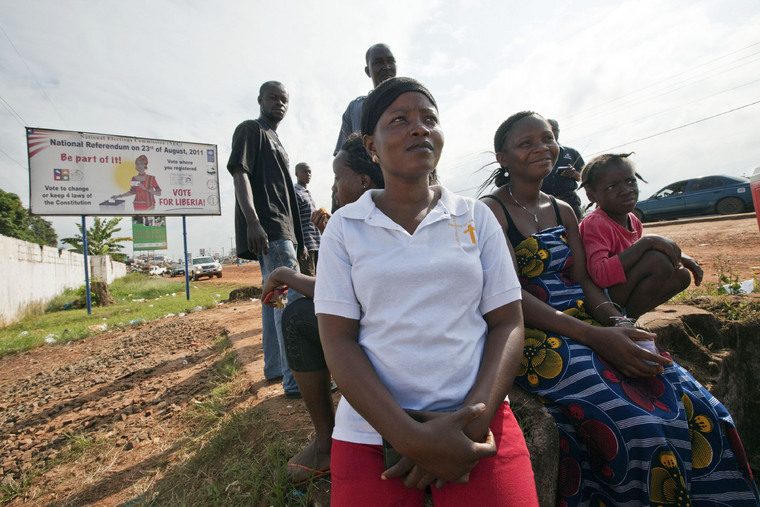
While the upcoming elections provide an opportunity to consolidate Liberia’s hard-won peace, the country will continue to need international support, particularly in strengthening its security institutions, the United Nations envoy to the West African nation said today.
The presidential and legislative polls scheduled for 11 October are the second elections since the end of the country’s decade-long war eight years ago, but they are the first being organized and run by the Liberians.
“If the elections are successful, it does not mean that the work is finished,” Ellen Margrethe Løj, the Secretary-General’s Special Representative and head of the UN Mission in Liberia (UNMIL), told the Security Council.
“Liberians will still require considerable assistance and support in rebuilding their lives and their country. This process will have to continue to be a joint undertaking between Liberians and the international community,” she stated.
Briefing the 15-member Council on the latest developments, Ms. Løj said that planning for the elections and addressing developments along the border with Côte d’Ivoire amid the post-election crisis that took place there have been the focus of the country’s security institutions for many months.
At the same time, planning for the handover of security responsibilities from UNMIL to national institutions has continued, albeit slowly due to the challenges of the last few months, she pointed out.
“But planning for transition is just the first step,” she said. “The Government and the international community will have to continue to build the capacity of the security sector to prepare for the actual handover of security responsibilities.”
In this connection, she reported that the completion of the first of five planned regional justice and security hubs, in Gbarnga, is expected by the end of this year. It will begin some functions even before that with the deployment of 70 police support officers before the elections.
“The hubs will be a critical step in effectively decentralizing rule of law and security agencies and increasing access to justice and security in distant parts of the country,” Ms. Løj said, while also underlining the importance of donor support in establishing the hubs.
The first hub in Gbarnga will be fully financed by the UN Peacebuilding Fund and it is expected that the entire compound will be ready by the end of the year, Ambassador Zeid Raad Zeid Al Hussein of Jordan, who serves as chair of the UN Peacebuilding Commission’s country-specific configuration for Liberia, told the Council.
Liberia is one of five countries – along with Burundi, the Central African Republic (CAR), Guinea-Bissau and Sierra Leone – currently on the agenda of the Commission, which was set up in 2005 to help countries emerging from conflict make an irreversible transition from war to sustainable peace.
Countries can also avail themselves of financial assistance from the Peacebuilding Fund to jump-start rebuilding projects.
Prince Zeid added that it was clear from the Commission’s visit in June that the Liberian National Police, “notwithstanding some very notable improvements in training and some infrastructure, will not be ready any time soon to cope with either a possible increase in the levels of organized crime, nor with any sudden spasms of widespread violence, unless it is more robustly supported.”
In her briefing, Ms. Løj also reported that the country has continued to recover economically, with a number of new economic concessions approved and international investment continuing to increase. A number of pieces of important legislation have been passed, and the 2011-2012 national budget is almost eight times the size of what it was six years ago.
“While economic recovery and development is crucial for attaining long-term sustainable peace, in the coming months, all eyes will be focused on Liberia’s elections and the country’s ability to pull off a national event of that magnitude,” said Ms. Løj.
Yayne Abeba is an Ethiopian American commentator and comedian. In the aftermath of 9/11, she found herself wondering why people her family considered friends were being treated like they were enemies.