Home Blog Page 227

Ghana’s Dr.Nii Quaynor Honored by the Internet Society

0
1635
Ghana's Dr.Nii Quaynor Honored by the Internet Society

The Internet Society has awarded pioneering Internet engineer Nii Quaynor the prestigious Jonathan B. Postel Service Award for 2007 for his leadership in advancing Internet technology in Africa and galvanizing technologists to improve Internet access and capabilities throughout the continent.

The Internet Society presented the award, including a $20,000 [USD] honorarium, during the 70th meeting of the Internet Engineering Task Force (IETF) in Vancouver, BC, Canada.

Dr. Quaynor has selflessly pioneered Internet development and expansion throughout Africa for nearly two decades, enabling profound advances in information access, education, healthcare and commerce for African countries and their citizens, said Internet Society president Lynn St. Amour.

Today, Dr. Quaynor continues to champion not just technological advances but also African involvement in Internet standards, processes and deployments, discussion on Internet policies and regulations, and ensuring African interests are well-represented globally. He has shaped a community of Africans who share his vision and reflect the dedication shown by Jon Postel.

"I am humbled by the award and what Jon Postel represents to our community in Africa. Jon Postel’s efforts and the global view he maintained on the operation of the domain name system and the numbering services assured that Africa would share in the Internet growth and early. I thank the Internet Society for the recognition and am very pleased to be associated with Jon’s memorial, said Dr. Nii Quaynor. We will work to develop more African engineers to meet the fast network growth needs of the region, being a late starter, and to join the technical policy processes. Our overall objective is to strengthen education and research in network technologies in Africa.

The annual Internet Society award is named after Dr. Jonathan B. Postel to commemorate his extraordinary stewardship exercised throughout his thirty-year career in networking. Between 1971 and 1998, Postel managed, nurtured and transformed the RFC series of notes, which encompasses the technical specifications and recommendations for the Internet and was created by Steve Crocker in 1969 as a part of his work on the Arpanet, the forerunner of today’s Internet. Postel was a founding member of the Internet Architecture Board and the first individual member of the Internet Society, where he also served as a trustee until his untimely death.

Dr. Quaynor is chairman of Network Computer Systems (NCS) Ghana.COM and a professor of computer science at University of Cape-Coast, Ghana. He is also the convener of the African Network Operators Group (AfNOG), a network technology transfer institution since 2000 and the founding chairman of AfriNIC, the African numbers registry.

Dr. Quaynor began his pioneering Internet work in Africa in 1993 when he returned to his home country of Ghana to establish the first Internet Service operated by NCS in West Africa. At NCS, he and his team worked on the early development of the Internet in Africa. Today, there are more than 43 million Internet users in Africa.

Prior to NCS, Dr. Quaynor worked with Digital Equipment Corporation in the United States from 1977 till 1992. In 1979, he established the Computer Science department at the University of Cape Coast, Ghana. Dr. Quaynor graduated from Dartmouth College in 1972 with B.A (Engineering Science) and received a Ph.D. (Computer Science) in distributed systems in 1977 from State University of New York at Stony Brook.

Bebe Cools’ Concert in Minnesota

0

It’s Saturday night and I’ve just walked into Blue Nile Restaurant. Bebe Cool, Uganda’s talented Ragga artist will be performing later tonight, and I have no notion of what to expect. At the moment, DJ Kevo from Kenya is at the turntables enticing the crowd to the dance floor.

I get a drink and chat with a few friends here and there before joining in on the dancing. Shortly, DJ Derrick of Uganda takes to the turntables and there is suddenly a swarm of people. The music is Ugandan, the crowd is predominantly Ugandan and I can’t help but be excited about being part of the group. After the DJ gets everyone wired up, Bebe Cools’ opening act, Benon (of Benon and Vamposs) gets on the stage.

His performance and liveliness gets us amped and very ready for the main act. I’m in a corner of the dance floor where I can clearly see the artist and performance on stage. At this point, I’m anxious to see Bebe Cools’ performance. I’m hoping he sings ‘Fire’ one of his recent popular songs with Necessary Noize that I really like. Finally he gets on stage, calm but with an air of confidence and dives right into his music.

The whole place erupts in a frenzy. There is dancing, singing, screaming as well star struck fans with mouths agape. I’m glad I had no expectations because the whole performance goes way beyond what I would have imagined. Song after song, Bebe Cool indulges his audience with Luganda and Swahili lyrics, as he easily sways his body to his music. He is not just an artist but a great performer, a musician who presents his art in a well understood manner.

I get my wish too when he starts singing ‘Fire’ among his other popular songs like ‘Fitina’ and ‘Mambo Mingi’. Bebe Cool has been a musical artist for the past fourteen years. He has had collaborations with other African artists like Redsan and Chameleone. He is also a winner of the Pearl of Africa Music Awards (PAM) and a nominee of the KORA Awards. The concert event was promoted by Jojo of Kilimanjaro Entertainment and Francis Ssenoga, a Ugandan promoter.

U of M Taps Ethnic Media to Boost Minority Enrolment, Hiring

1632
U of M Taps Ethnic Media to Boost Minority Enrolment, Hiring

MINNEAPOLIS – A top University of Minnesota official in charge of reaching out to underrepresented communities said today that the institution was far from achieving its goal of a diverse student body, faculty and staff, and appealed to ethnic media to help.

Nancy “Rusty” Barceló, the vice president and vice provost for equity and diversity, spoke to journalists, editors and publishers of various Twin Cities ethnic media, gathered at her invitation for a breakfast meeting at the university’s Coffman Memorial Union.

“This university is not as diverse as we want it to be,” Barceló said. “When I walk on this campus I don’t see enough African American students, faculty and staff.”

The call to the ethnic press was part of her office’s strategy to communicate with minority and underrepresented communities, Barceló said.

“I see this meeting as just the beginning,” she said, “a way to start identifying how we can all work together to help our communities that each one of us serve.”

Barceló asked members of minority media to start thinking of ways that could be used, in addition to advertising, to reach to their communities.

“There are many, many, more points of collaboration that reflect our shared vision of education and investment in our community,” Barceló said.

Many of Barceló’s guests decried the university’s unwillingness to advertise in minority papers. One of them waved a half-page advertisement the university had placed in one mainstream newspaper and wondered why small community papers had been denied access.

In response, Barceló’s promised to contact each individual news medium that was represented at the meeting to find ways they could work together.

Don’t Give Up, Michelle Obama Tells Voters

1631

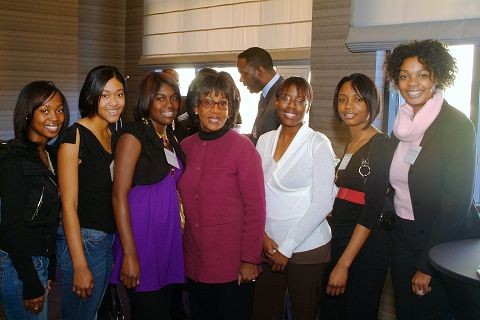
MINNEAPOLIS – The wife of Democratic presidential aspirant Barack Obama urged a group of community organizers in Minneapolis Wednesday to step up their campaign to educate people on the importance of participating in the political process.

Michelle Obama spoke during a tour of Hope Community, a 112-unit low-income housing complex located in the Phillips West neighborhood of Minneapolis.

“The biggest challenge is pushing people to understand the concepts of self interest and power,” Obama said.

Obama asked citizens not to give up on the political process because despair would only lead to more marginalization. She talked about the need to heed her husband’s call for an election system based on interaction with communities.

“When Barack talks, he talks about elections and campaigns as community organizing exercises,” she said. “You can’t talk in the abstract about change. Change doesn’t happen just because you wake up and you’re mad. Change happens because you understand the issues, you’re investing, you’re holding people accountable, and you understand what you’re holding them accountable for.”

Obama expressed concerns about people who had decided that the political system made on difference in their lives and had stopped voting.

“They have given up their seats at the table,” she said. “The problem with that is that the game doesn’t stop just because you aren’t sitting at the table. Someone else takes your chair, and then they take three chairs.”

Obama was in Minneapolis for a fundraiser at the Hilton Hotel, where officials said an estimated 500 people raised about $160,000 for her husband’s campaign.

Milele: Musicians with a Cause

0

Gospel Singing Group Milele does more than sing worship praises. They use their international fame as musicians to work on humanitarian projects.

While at a Christian retreat, in Kenya in 1988, Christian Mungai, Harry Mwaura Kiiru, Kanjii Mbugua and Kaima Mwiti met and struck a friendship. Unbeknownst to them, ten years later in California, this friendship would lead to the birth of "Milele" (Swahili for Forever), a gospel singing group and set them on a journey of performing and ministering around the world.

When they met in Los Angeles ten years later, the quartet reestablished their friendship through their love of music. They got their break when Limit X, a popular gospel group, decided to produce Milele’s first album, Forever. This eclectic album introduced Milele into the market with songs like Refuge, Open your Heart, "Tucheze Ngoma" and the ever popular, "Sanjolama". On their return to Kenya in 2000, the group was surprised at the over thirty thousand fans that received them. The success of the Kenyan tour opened up new opportunities for them, but instead of focusing on the money, the group decided to go in a different direction.

Milele Homes Project
On a trip to Kenya in 2004, Milele realized how urgent the HIV/AIDS crisis had become. They put their careers on hold and traveled around Kenya on a fact finding mission. They visited AIDS orphanages such as SOS and Nyumbani Children’s Home, and realized the crucial role they played in providing basic and medical needs for these children.

Back in the States, despite a busy school and work schedule, the members of Milele continued to tour for a cause. They worked with organizations like World Vision, which helps eradicate poverty and ensure child safety, and Union Rescue Mission, which serves the poor and homeless, in a hope to create awareness and encourage people to get involved with these organizations.

Further research showed that at least 2.7 million kids were orphaned by AIDS. Milele hoped to provide homes and families for some of these kids generating the idea of Milele Homes Project. The gist of the project was to build homes, and provide these homes for free to couples willing and able to adopt the orphaned kids.

Milele Homes Project recently completed their first three bedroom house. More so, a few couples are going through a ten week period of vigorous screening processes conducted by Oasis Counseling Centre, at the end of which couples fit to adopt will be matched with children in need of a family.

Change Africa Campaign
As the Milele Homes Project grew, the group realized the potential that Africa had to rise above the recipient-donor relationship associated between Africa and the West. Milele came up with the campaign in the hopes of empowering the African to change Africa.

It was during this time, when one of the Milele members was introduced to Ken Mwarabu, a young man from Kibera slums, who was among the first to propel the fruits of the Change Africa Campaign.

With only fifty dollars, Ken and four other men provided enough food for a week to a hundred widows living in Kibera Slums. Moved by the selflessness of Ken’s actions, Milele has for the past two years raised money in Los Angeles that they have sent to Kibera. These funds are for both food and investment initiatives such as sewing machines.

Milele’s gospel tour in 2005 coincided with Kenya’s hunger crisis. A resulting Milele benefit concert in Nairobi at the beginning of 2006 raised over four tons of food. Shortly after this concert, artists in Kenya came together and with a project called "Jaza" Lorry that had the same concept, they raised twenty truck loads of food.

Even without Milele’s immediate involvement, the Change Africa Campaign was a movement in the right direction.

Music
Milele is currently on tour and they recently performed in Minnesota at Club 3 Degrees in downtown Minneapolis and at North Heights Lutheran Church in Arden Hills.

Milele has two new additions: Carol and Nimo retaining Milele’s status in the international gospel music scene.

Milele group members have continued to venture into other fields in their personal career. Kanjii, a worship pastor, has a recording studio, Kijiji Records and has produced Milele’s fourth album "Monday". The album, also produced by Kaima, is a reflection of the group as a whole, and hopes to pass the message; change now and not later.  Mwaura is also a worship pastor, while Christian and Kaima handle most of the day to day running of Milele’s initiatives.

Milele’s other albums are Level Up with songs like Turn it Around, "Faya" and "Open Your Eyes" and "Afrique", a compilation of African songs in Lingala, Kwaito, Zouk and Soukouss.

Visit Milele’s website here for tour dates and information on their humanitarian activities. You can also visit Mavuno Church here.

Sand From the Desert: Prodigy Journey from Addis Ababa to Minneapolis

0
1629
Sand From the Desert: Prodigy Journey from Addis Ababa to Minneapolis

Yohannes “Johnny” Tona was born into a musical family in Ethiopia. In November, his band – The Yohannes Tona Ban – released his first CD making a name for himself in the Minneapolis Jazz scene.

MINNEAPOLIS – It is obvious when listening to Yohannes Tona’s compositions that he draws his music from everywhere. Born into a gospel musical family in Shashamane, 150 miles from Addis Ababa, Yohannes has wanted to play the guitar for as long as he can remember. His late father was an organist, while his mother was a renowned gospel vocalist. Apart from gospel music, his other influences growing up were traditional Ethiopian music, reggae and beats from West Africa.

Humble Beginnings

“I would watch the church guitarist play as the choir rehearsed in my mother’s living room,” he recalls. “Every chord he struck, I learnt.”

When his mother was at work, Johnny would practice on the guitar. One day when he was eight he played several songs to his shocked mother. A single mother, with limited earnings, she recognized his passion and talent and did everything to make her son realize his musical dream including getting Tona his first guitar. Thus began his musical career. A few years later, he was playing in the church choir. As soon as he was old enough, he traveled all over Ethiopia accompanying his mother in her gospel tours.

He laughs and shakes his head when he thinks of his first guitar.

“It was a terrible Russian guitar, but it allowed me to practice every musical album, every recording that I could lay my hands on,” he says.

He did graduate from the Russian guitar when he was sixteen. Renowned German evangelist, Reinhardt Bonke, was visiting Ethiopia when, a few days before the conference, Tona was asked to play the acoustic bass guitar for the conference. Although Tona did not own or know how to play the bass, he promised the organizers that he would be ready in time for the conference. With just a few days to spare, he rushed to a carpenter and attempted to convert his six-string guitar to a four-string bass guitar.

“I asked the carpenter to adjust the number of strings and to curve a hole on the base of the guitar. It was a big risk I knew, but I looked forward to the challenge,” he says.

That weekend, he played to thousands of people from different parts of East Africa earning him local fame.

So far, Tona had not had any formal musical training. But after high school he was admitted to the only music school in Ethiopia, Yared Music School where he excelled earning him a scholarship to Boston’s Berklee College of Music.

On a visit to Minneapolis, he was recruited to become the music director for the Ethiopian Church. Over the past five years, Tona has slowly established himself on the local jazz and gospel scenes. He has played with Grammy-nominated Excelsior Choir, Dr. Mambo’s Combo, Darnell Davis and the Remnant Gospel Group, and with top area vocalists including T. Mychal Rambo, Bruce Henry, and Debbie Duncan. 

While in Ethiopia, Tona made a crossover into jazz when he played in coffee shops and high profile venues with a band known as the Afro Sound playing what Tona calls Ethio Jazz. He has continued to play with many Ethiopian artists including Teddy Afro, Danny Wolde and Addis Demelew.   

It is with this experience and exposure that in late 2004 Tona formed his band.

Sand from the Desert
In November, Tona and his band, the Yohannes Tona Band, played at the Dakota Jazz Club where guest heard a sampling of music from “Sand from the Desert,” Tona’s first CD.

While not exactly Afrofunk, the composition is as eclectic as Tona’s influences. Of his music, Tona says, “I play different styles fusing African, old classical and contemporary jazz sounds to make an authentic sound— an Afrofunkjazz sound.”

His band includes: Brian Kendrick (drums), Peter Vricks (sax), Brian Ziemniak (keyboards) and Patrice Delemos (percussion).

The album includes an Afrofunkjazz remake of Miles Davis’ “Saw What” and John Coltranes’s “Naima.” The rest of the album comprises ten of Tona’s original compositions. “Ride Around Addis Ababa,” with vocalist Hana Shenkute is a traditional Ethiopian wedding song with definite influences from the first music that Tona played. Tona collaborates with local Neo Soul artist Aimee Bryant on a soulful composition, “The Kerims.” A local Cameroonian, Kenn Wannaku, Damel Davis and the Remnants collaborate with Tona on “World Praize,” an upbeat worship song heavy on percussions with a West African influence. Other collaborations on the CD include Stokey Williams of Mint Condition and Nachito Herrera.

————————————————————————————
You can sample Yohannes Tona’s music on his MySpace profile here. You can also hear him play every Wednesday at T’s Place (formerly known as Dashen), Sunday and Monday at the Bunker’s Music Bar and Grill and Tuesdays at the Blue Nile.

Togolese Musician Yawo a Master of Surprises

0
1628

Yawo Attivor is a name Minnesotans and, more importantly, Africans residing in Minnesota, should be familiar with. He has been based in our very own backyward for the better part of a decade, and has been known to pull off some of the most vivacious musical displays the Twin Cities has heard or seen. Therefore, it was with a heightened sense of anticpation that I entered The Cabooze on Thursday the Oct. 12.

The night’s bill included two opening acts, namely, The Lucas Cates Band from Madison, Wis., and Private Property from Iowa City, Iowa. The former, named after their lead singer, is a pop/adult alternative band, and, the latter, a reggae/ska act with a penchant for upbeat and melodic grooves. The music they put on display was excellent and went a long way in whipping the venue into a frenzy.

With a total of three albums in his locker, there was to be no shortage of inspired material for Yawo and his newly configured band to draw from. The setup had Yawo on the string guitar and vocals, supported by a rhthym section of Greg Schutte on drums and Patrice Delemos on percussions. Rounding off the group were Yohannes on electric bass,  Doug Little on saxophone and flute, and to the surprise of many, Ken Leiser from the Lucas Cates band, on the violin. Would this be transformed into wonderful synergy and a great performance? Well, we were soon to find that out.

The group immediately set out to get the crowd moving by dishing out a cocktail of high-tempoed drum-propelled tunes. There wasn’t a soul in the crowd that could resist moving some part of their anatomy to the rhythm. Once the band was at full throttle, they began to treat the crowd to a wonderful array of spontaneous improvisation by injecting solos from individual group members into each song.

Yawo, a master orchestrator, would draw the crowds attention to the next impending solo, and they would always deliver. These moments were made even more thrilling by an ingenious interplay of response solos among band members that often produced applause fom  the crowd, and was a definite hit with those with jazz sensibilities, myself included. A notable highlight was the playing of Ken Leiser on the violin. Needless to say, the incorporation of a violin in an afrobeat ensemble could prove difficult, however, he handled it deftly.

Yawo’s individual performance was a joy to behold. He sung each song with unbridled passion. His vocals never faltered even with all his physical exertions on stage. Here was a musician in his prime, intent on making positive and inspirational music. Typified by songs like ”Celebrate Life,” ”Blewu” (slowly) and ”We’ve come so far,” Yawo easily breaks down barriers with his own brand of conscious and uplifting music.

If you were like me, and thought there could be no more surprises for the night, you were soon to be proved wrong with the introduction of Whitney, a very talented dancer, to the fold. She immediately ignited the show and brought the crowd to its dancing feet with her vigorous yet graceful gyrations to the band’s music. If at this time, your attention had strayed, for some odd reason, it was surely back on track. Yawo was always quick to join her in her routine and, to our delight, she returned a number of times later in the show.

Every member of the audience had surely been moved by some aspect of this performance, and as the show came to an end, sales of his recent album, ”Celebrate life,” started making the rounds. I quickly got myself a copy and proceeded backstage to talk to the man himself.

His boundless energy was still evident as he spoke about his upcoming trip to his home country, Togo, for a series of performances, which have been ten years in the making. The release of his upcoming album by the year’s end was also high on his agenda. When asked to choose which song meant the most to him, he refused, but hinted that ”We’ve come so far” was special in the message it carried. I couldn’t hold him up for long though, as he was itching to go back out and mingle with the crowd.

My exit from The Cabooze was interrupted as I heard a burst of unbridled, hearty laughter. I turned around and caught sight of Yawo hugging two members of the audience, and I thought to myelf, ”Now that is how you take down the fences in this global village of ours.”

Dee Dee Bridgewater Links Mali to America

0
1627
Dee Dee Bridgewater Links Mali to America

MINNEAPOLIS – After the superlative introduction by Minneapolis’s Dakota Jazz Club’s owner, Lowell Pickett, I expected a rich, preeminent performance by Dee Dee Bridgewater, surpassing anything I’d experienced before.
 
Pickett reminded the audience of 135 people how Bridgewater had garnered two Grammy awards and a Tony from her work on Broadway and was honored by France with the Commandeur de L’Ordre des Artes et des Lettres. 

 “Dee Dee Bridgewater has put together a project that blends the music and rhythms of West African traditional music and pop with American jazz and blues,” Pickett said. “But anything I might say doesn’t scratch the surface of the experience you’ll have tonight…The music that’s going to take place on this stage in a few minutes is just incandescent.”

I wasn’t disappointed with Memphis-born Bridgewater and her entourage of ten musicians, seven of them direct from Mali in West Africa.  Her current tour, “Red Earth: A Malian Journey,” delivered all that Pickett promised. 

It’s not that Bridgewater wasn’t dynamic, pouring her heart and bountiful talents into the show, and it’s not that the musicians didn’t display a masterful sound, so in keeping with the polyrhythmic African music to which I am accustomed. And it’s not that the selections didn’t provide an energetic hybrid of African and American sound, but the show did not eclipse my expectations nor my previous experiences in African music. 

That I was not sitting in my seat at the Dakota on October 13th with quite the same agog look of admiration as Pickett’s says, to me, a couple of things. First, I wonder how often Pickett has patronized the Cedar Cultural Center just down the road and around the corner, a music venue that’s rich in world music, especially African music. One of my favorite shows at the Cedar from this past year was Cape Verdean Lura whose show was matchless, who could, without hesitation, compare to Bridgewater’s performance.

And secondly, because a music connoisseur such as Pickett was so profoundly impressed with Bridgewater’s musical offering, practically telling us that hers was a unique performance to the United States, it would seem that Bridgewater is succeeding in a grand way. Her objective in her latest tour is to “spread Malian music.” With her fame and celebrity clout, she’s able to immerse a segment of society whose familiarity with music may not be quite as hip to a world music format as the lesser-paid and paying crowd at the Cedar where African music is expected and frequent. 

Tuesday evening, the 9:30 show went on stage an hour late. With food and drink circulating on the floor, this didn’t pose a problem for most people. When the Bridgewater troupe takes stage, we discover that Dee Dee is a griot in her own right. She loves to tell a good story. With her beautiful hair shaved off, the focus becomes even less visual and more centered on her music and her message. 

On the slightly elevated platform, eight performers squeeze into the space along with a baby grand piano, snare-drum set, several congo drums, a chair for the kora player and room for the band’s squeeze-drum player, xylophone and string bass players, and the star performer, singer Bridgewater. 

She coaxes the audience, “If the music moves you, get up.  Do not be afraid; let the music speak to you.” 
They then launch into an Afro-blues number, starting off with the wild, yet intentional drumming of Baba Sissoko on the talking drum.

Their third number begins with a kora solo played by Habib ‘Dia’ Sangaré. The kora is Africa’s gift to string instruments. Amongst all the drumming that denotes African music, there is the enchanting kora. It seems impossible to play so beautifully. Imagine weaving a complicated tapestry with a handful of threads and a pair of needles, and yet, magically, the artwork spins out. That’s how it is when Sangaré plays his kora. He plucks steel strings stretched between two bracing sticks, resonating in a large, hollow gourd and out pours the sounds of bliss.

Bridgewater playfully demands audience participation with the fourth number. We now all know the words to say to a loved one, having repeated over and over the phase Djarabi (Oh my love). This song, sung in duet with Mamani Kéita, showcases an irresistible blend of both Malian and American cultures. The two women, Bridgewater and Kéita, complement one another. Bridgewater slips back and forth between musical continents seamlessly. She shines like gossamer when she’s closer to her American roots. And she gives us a gorgeous bridge between countries with her powerful vocals and sweeping dance moves. 

Minnesotan Somali Declares Candidacy for Somalia’s Premiership

0
1626
Minnesotan Somali Declares Candidacy for Somalia’s Premiership

Two days after Ali Mohamed Gedi resigned as Somali’s Prime Minister, Abdurahman Ali Osman says he is ready to take over.

Abdurahman Ali Osman, a peace-activist and businessman in Minnesota, has announced plans to go back to his native Somalia to vie for the vacant post of Prime Minister following the resignation of Ali Mohamed Gedi at the end of October.

“I believe I have the desire and the ability to regroup the people of Somalia and create a package that will work for the common good of Somalia,” Osman said. “I have what it takes to put that package in place as I have been involved in peace negotiations since 1993, the 1995 peace package and the 2004 peace plan that brought to power the Transitional Federal Government of Abdilah Yusuf.”

Speaking to his supporters and reporters at the Profile Music/Casablanca Restaurant in Minneapolis on Nov. 1, Osman said he enjoyed the support of Minnesota’s Somali community and told Mshale that he has been receiving calls from home to go and fill vacancy.

Osman, 49, holds a Bachelor’s degree in political science and a Master’s degree in economics from the University of California. He said he had friends in diplomatic circles of the United States, United Nations and neighboring countries who desired Somalia to be stable and peaceful.

Asked why Prime Minister Gedi had to step down, he replied: “Multiple things drove him out of office. He lost grip of things in Somalia and the security situation got worse. He has been accused of many shortcomings like not being able to work with the President or the Parliament. Due to the many unresolved internal crisis, he had to go.”

On the question of having Ethiopian forces on the ground to pacify Mogadishu, he said Somalis were divided on this matter.

Osman told Mshale that the Ethiopian forces were invited by the Transitional Federal Government and were there to ensure security in the Horn of Africa region.

“What we need is a man with a clean hand and heart to negotiate and settle differences as throwing stones on tanks will not solve anything,” He said. “I will conduct a conversation with all involved parties until we reach a common ground.”

Osman said he was certain that the estimated two million Somalis in the Diaspora are “a critical mass that sustained the lives of their relatives still in Somalia.” He said planned to create a favorable atmosphere for the return of the Somali Diaspora so that they can re-build their country, which has been shattered and ravaged by war. A stable political atmosphere in Somalia would encourage foreign investment thus growing jobs for the people, he said.

He said there was need to restructure the Somali national army, harmonize opposing warlords and their militia groups and integrate them into the national army under one commander-in-chief.

On Islamic Courts, Osman said they had a positive role to play as long as “they apply the Sharia (Islamic law) to work in the interest of the people in the true Islamic spirit.” The Islamic Courts have to agree to deal with Ethiopian forces now on the ground to prevent things “going out of hand again,” he said.

Osman conceded that Somaliland (northern Somalia) had created its own autonomous state, a reality he acknowledged, although he did not rule out the possibility of re-negotiating their return to a federal structure of government. Somaliland is a de facto independent republic whose 1991 independence from Somalia has not been recognized by the international community.

Osman’s pragmatism, he said, would allow him to improve Somalia’s foreign policy to strengthen ties with international organizations such as the Intergovernmental Authority on Development (IGAD), the Arab League, the Organization of Islamic Conference which started in Somalia in 1967, the African Union and the United Nations.

He noted with regret how Somalia has disintegrated over the years of war since conflict started in 1991. He was saddened that a broken infrastructure has displaced over 2 million people making Somalia almost non-existent.

“This is going to be an overwhelming burden on our shoulders,” he said, “but we have to provide leadership and work with our neighbors, regional groups and tap all help we can obtain from the United Nations. Our goal is to make Somalia a part of the global community instead of making the global community a part of Somalia.”

Osman has business contacts with Kenya, Malaysia, Ethiopia and the United Arab Emirates. If appointed Prime Minister, his first order of business would be to pacifying Mogadishu, strengthening the Transitional Federal Government so that it can function to re-unite the people and restore peace and stability in the country and co-operate with its neighbors, he said.

New Alliance Adds Twist to OLM Elections

0
1625

MINNEAPOLIS – A group aspiring to take up the leadership of the Organization of Liberians in Minnesota (OLM) in the forthcoming elections has called for the immediate amendment of the association’s constitution to allow it operate as a non-profit body.

Speaking during the launch of its campaign, the Dwanyeh-Tehmeh Team promised to change the present constitution and stop the elections of future presidents. Instead they proposed a system that will allow presidential nominations by the board of directors. Furthermore they announced their desire to expand the board from the current five to twelve members of which nine will be Liberians and three representatives from Professional Associations and the Business Community.

The team has Kerper Dwanyen vying for Presidency and Andrew Tehmeh as his running mate. In a colorful ceremony attended by a handful of supporters the two tore into the present OLM administration calling it “a disgrace’’ to the Liberian community in Minnesota.

“Many of us invested our hopes and aspirations in this current leadership, expecting reform, services and accountability but today we see ourselves no further ahead in these quests, our hopes have been dashed as financial scandal after scandal and unabated conflict have rocked our faith in this OLM administration,” Dwanyen said.

He said the community stood at the crossroads and its choice in the Dec. 2 election will decide whether Liberians opt to vote for change or remain stagnant in the cycle of underperformance. If elected Dwanyen promised to bring reform and ensure the community reclaimed its seat at what he termed as “the vibrant immigrant communities in the great state of Minnesota.”

Dwanyen pointed out despite ready support available for immigrant communities at both federal and state level the current leadership was incompetent to effectively lobby for funds thereby denying the community a chance to benefit from millions of dollars disbursed for social needs.

“Social service entities with no connection to our community and very little knowledge of our problems obtain funds for the purpose of serving us and since they don’t really know us they can’t really serve us,” he said. “The manner in which this administration has handled its promise of financial accountability is a disgrace and people will not trust us with money if we are not serious about integrity. That’s why OLM is broke today.”

Touching on the issue of uncertainty hanging on the heads of many Liberians, Dwanyen wondered why anyone would need to repatriate people who have managed to rebuild their lives from scratch for nearly two decades in the state and vowed to fight to the end to ensure Liberians under temporary status get permanent residence. He also challenged the community to get engaged in active politics by promoting Liberian born candidates for public office. And as a starting point he announced his administration would draft candidates for office in the elections for Brooklyn Park and Brooklyn Centre City positions. He also assured supporters that his group would work closely with other agencies to formulate projects to provide services such as youth mentoring, job searches, HIV/AIDS awareness, adult literacy and sports. Other than Dwanyen and Tehmeh the team has former U.S. Army lieutenant Kulah Parker running as treasurer and Thalia Cooper as secretary general.

Cervical Cancer: What you need to Know

0

Note from the editor:
As many of us immigrants devote large amounts of time toward understanding and surviving the maze that is the U.S. system, we might not have time to devote to our health. Breaking down, simplifying and summarizing that information is important. Every month Mshale will team up with Sara Chute of Minnesota Department of Health to provide educational health information to immigrant and refugee communities in the state.

Cervical cancer is cancer in the cervix. Each year an estimated 11,150 women in the United States will be diagnosed with cervical cancer and about 3,670 of the patients will die from it. Cervical cancer used to be one of the most common cancers, however in 1955, the number of deaths resulting from cervical cancer declined. This was due to a new procedure called the Pap test, which detects early cervical cancer cells. Statistics from the Minnesota Department of Health indicate that 168 new cases of cervical cancer were diagnosed in 2004 in the state, with 52 deaths that year.

Cervical cancer is caused by a virus called the Human Papillomas Virus (HPV). HPV is a very common virus and in fact, many women are infected with this virus. However, not all infected cases will turn into cervical cancer.

Cancer of the cervix occurs in the lower, narrow part of the uterus (womb) of a woman.  The uterus is the organ where a baby grows during a woman’s pregnancy.  The cervix forms a canal (opening) into the vagina (birth canal) leading to the outside of the body. The Human Papillomas Virus causes cells in the cervix to change, which sometimes can turn into cancer.  A Pap test and/or pelvic exam are tools that may help diagnose possible problems in the cervix and enable doctors to order additional tests, if needed.
 
“It is important that all women get screened regularly for cervical cancer.”

A Pap test is a procedure where a doctor scrapes the inside of the cervix and collects cells for testing. The cells are then analyzed for abnormalities and pre-cancerous characteristics. If the Pap test comes back abnormal, the doctor will recommend further test. Some of these tests include a culposcopy – a procedure where the doctors looks at the cervix through a binocular-like instrument – and biopsy, which is where the doctor takes a sample of the tissues in the cervix.

Every woman should begin having a Pap test when she becomes sexually active or if not, when the turns 21 years old. According to MDH, in 2004, more than 87% of women age 18 and older reported having a pap smear in the last 3 years. 
If cancerous cells are found in the cervix, your doctor can offer you several treatment options. The earlier the cancer cells are detected, the more successful the treatment. Because of this, it is important that all women get screened regularly for cervical cancer.

There are important factors for reducing your risk and ensuring early diagnosis. Risk factors that increase one’s likelihood of cervical cancer include smoking, Sexually Transmitted Diseases, multiple pregnancies, and family history of cancer. Some of these risks you can control, others you can’t. For instance, we can reduce our chances by adopting healthy habits like quitting smoking, having fewer sexual partners, and eating a balanced diet. But we cannot change our family history or genetics.  That is why getting a Pap test to screen for cervical cancer is so important – because you don’t know for sure if you’re at risk until you get tested.

If you would like to schedule your yearly physical or an appointment for your Pap test, call your clinic to set up an appointment. If you do not have health insurance, there are programs that will help you cover the cost for this very important appointment. If you would like information about these free programs or have questions about breast and cervical cancer screening, you can call the Minnesota Department of Health Sage Program at 651-556-0687, or visit http://www.cdc.gov/cancer/cervical/ to learn more.

Special thanks to Lillian Hang from the Department of Health in the Cancer Control Section for help with the writing this article.