Home Blog Page 235

Pastor Randy Urges Clerics to Take on Leadership Roles

0
Pastor Randy Urges Clerics to Take on Leadership Roles

Nairobi, Kenya– In June, world-renowned preacher, Pastor Randy Morrison visited Kenya where he spent most of his time inspiring the church and the business fraternity on leadership. The pastor who centered his activities on strengthening the capacity of church leadership delivered powerful sermons and teachings in the various churches that he visited.

Thirty years ago, Pastor Randy found Speak the World International Church which continues to grow towards being one of the largest megachurches in the world.

The pastor who was an East African tour addressed hundreds of Christians in Kenya’s largest cities– Nairobi and Mombasa.

He was heeding an invitation by Kenyan pastors to deliver his empowering message on leadership to their churches. East Africans who have only watched the pastor delivering his sermons via television broadcast thronged the local churches to get a glimpse of him. Many are loyal viewers of the pastors recorded teachings through a local Christian Television station, Family TV.

In Nairobi, the pastor preached to the congregation of the Redeemed Gospel church in Nairobi who got a rare opportunity to hear the words of the televangelist.

In Mombasa, flanked by pastors based in the city, he delivered sermons at the Jesus Celebration Center (JCC) and the Mombasa Pentecostal Church (MPC).

During a leaders’ seminar at MPC, the pastor dwelt on the importance of quality leadership in Christian and general life. The cleric who was on his first visit of the Kenyan Coastal city, urged the faithful to soul search and discover their purpose of existence. This, the pastor said would form a basis for good decision making especially to people who are in leadership positions.

His message to the people was that God has a purpose for everyone assigning duty through which his or her blessings will be channeled.

“God will only bless you if he assigned you that blessing”, he told the responsive congregation at he Jesus Celebration Center church.

Wilfred Lai, JCC’s pastor, maintained that good leaders should utilize their ability to influence the people they lead for a fulfilling life.

“Leaders have the ability to bring necessary change in the society”, he said amidst jubilation from the congregation.

The leaders’ seminar held on a Saturday drew people from all Christian denominations within Coast province, whose aim was to get teachings from the internationally recognized man of God.

Pastor Randy Morrison was accompanied by Mensah Otabi, a Christian motivational speaker from Ghana.

Currently, Pastor Randy’s television program, A Common Sense Approach (formerly called "The Exalted Word Broadcast”) is seen on television all over the world.

Read Moraa Gitaa’s Blog on the Mombasa event.

African immigration lawyer steps above the bar

1
African immigration lawyer steps above the bar

At a historic moment for immigration law in America, an African lawyer in Minnesota has made a little history of his own. 

In late May, the Minnesota and Dakotas chapter of the American Immigration Lawyers Association (AILA) elected immigration lawyer, Paschal Nwokocha, as their vice chair. Nwokocha, who will transition into the top chair position next year, has become the first African to sit on the executive board of AILA in Minnesota. 

“I cannot think of a professional organization in this country that has pushed for immigration reform as much as AILA,” said Nwokocha, who was born in Nigeria and graduated from William Mitchell College of Law in St. Paul. “AILA was in the heat of the immigration debate in Congress a few weeks ago and has been very proactive in advocating for immigration reform. You have excellent lawyers and activists all over the country.”

A national bar association established in 1946, AILA has over 10,000 members of lawyers and law professors who practice and teach immigration law. The local chapter comprises nearly 200 members in Minnesota, North and South Dakota, Iowa, and Wisconsin. AILA provides comprehensive up to date legal education to its members on the ever changing immigration laws and also works in advocacy. Nwokocha said that AILA led a call campaign urging citizens to voice their concerns about and support for the comprehensive immigration law reform bill with their legislators. He added that, while many immigration lawyers were disappointed in the bill’s failure in the Senate vote in June, he believes that ultimately a bill will pass the House and Senate.

“I do think something will pass through the Senate. In what shape or form, I do not know,” said Nwokocha. “You never know what it will mean for immigrants in this country until it is signed by the president.”

“There were some elements and amendments that were proposed by members in the Senate that were like a poison pill to the bill. We were letting our congress members know what things specifically to vote for in the bill.”

Nwokocha has also been at the forefront of working with legislators on the Liberian Adjustment and Relief Act, so that African immigrants who have Temporary Protective Status (TPS) are offered permanent residency in the US. The TPS status of some 15,000 Liberians expires in October, as they were not renewed by the Secretary of Homeland Security. Nwokocha explains that the legislation — similar bills have been introduced in both the House and Senate — could affect more than just Liberians, including immigrants from Sierra Leone, Sudan, Somalia, Rwanda, and Burundi.

“We are hoping something will happen before October. If it doesn’t, people will be in a state of panic,” he said. “It has been introduced in the Senate. It got lost in the shuffle of the comprehensive immigration reform. These people have been here legally for so long and nobody is talking about them, in part, because they are not from [Mexico].”

The 35-year-old Nwokocha has had his own practice, Paschal Nwokocha Law Offices, since 1999, which is when he first started becoming active in AILA. He previously worked as an assistant to the Attorney General of Minnesota. Based in St. Paul on University Avenue, Paschal Nwokocha Law Offices focuses on immigration law for individuals and businesses nationwide. Most recently, his office helped helped more than 100 African nurses, who were recruited by US companies from Africa, to immigrate legally into the US. While Nwokocha stressed that his practice serves many individuals of many ethnicities and many different businesses across the nation, he said that he looks forward to also highlighting some issues important to African immigrants.

“There are more Africans coming into America,” he said. “The issues that upset them are always in the backbone in this country. They are not as prominent as the issues Latinos and Asians are dealing with. This gives me another platform for me to advocate on behalf of my people.”

Outgoing Chair Supports Nwokocha 

After two years serving as vice chair and chair of AILA in Minnesota, Elizabeth Streefland knows the  critical importance and the demands of volunteering for the organization.
She appointed Nwokocha as an AILA liaison to the US Immigration and Customs Enforcement office and supported his election as vice chair. She said she often worked 5-20 hours a week for AILA as chair, hours that fell outside of her private practice, and she believes Nwokocha is up to the task. 

“He is extremely smart, impeccable in his manners, attitude, and language,” Streefland said. “He is on the ball. He is one of the impressive lawyers. He always knows what he is doing. He is always very polite.”

Streefland, who has practiced immigration law in the Twin Cities for 13 years, said that Paschal will also add much needed diversity to the AILA chairs.

“There was only one African American women in the group of chairs last year,” said Streefland. “I was surprised by the lack of racial diversity on the board of governors. [Diversity] is a very important issue to me. I tried to get more people involved. I very strongly wanted Paschal [Nwokocha] to be on the board.”

Streefland expressed confidence in Nwokocha fulfilling his position as vice chair now and taking over as chair of the local AILA chapter next year. She explained that beyond advocacy and consulting, AILA chapters keep each other up to date on the applications of changing immigration law.

“The main thing that our chapter does is that we work hard as a national organization to keep the chapter members updated on what is going nationally and locally,” she said. “The laws are in constant change. There is no way you can keep up with how the laws change and affect immigrants, so we need to work together.” 

Setting a High Bar for the Diaspora

As a lawyer, Nwokocha might be fond of fine suits and clothing, but his first dream occupation was to be a man of the cloth.

“I had always wanted to be a Catholic priest,” said Nwokocha, who lives with his wife and two children in Plymouth. In  Owerri, Nigeria, he had even attended seminary at the Seat of Wisdom Seminary. While studying at the University of St. Thomas, he soon realized that his life would take another direction, and, after graduating he became more and more drawn to going into law.

Now with his own practice and as a chair of AILA,  Nwokocha hopes to set an example not only for other lawyers but for Africans across the Diaspora.

“In whatever organization we belong to, we have to be active whether you are an accountant, a physician, or working in a nursing home, you have to do more than show up for work from 9 to 5 and go home,” he said. “You have to go beyond that and make a difference. We have to be involved in community organizations and being on boards. We have to write, speak, and do whatever we can to distinguish ourselves. We have an extra burden because of where we come from.”

Nwokocha noted that there are up to 30 African lawyers in Minnesota, whose countries of origin range from South Africa to Kenya to Cameroon. He added that many of them practice immigration law.

“For me, it is good to affect some systematic change and act as a mentor to other lawyers and African lawyers in the Diaspora who are trying to get into the system and practice law,” he said. “I could just say that I have made it. I can say I am a lawyer. So you are not just a lawyer. You are a lawyer with accent. A black lawyer with an accent from Africa. So you have to go beyond the call of duty in order to really excel.”

“I have seen that happen more and more. There a quite a few recent graduates and professionals stepping up into different roles and in social and community organizations. I see the momentum.”

Another challenge that Nwokocha pointed out was the fragmentation of African communities, a challenge, he hopes, more and more Africans in Minnesota will overcome.

“At the end of the day, we are all from Africa,” he said. “Some people are stepping up and saying, ‘Look, we can be from East or West, but we are Africa and we have to support each other so that we can succeed in whatever endeavor we are in.’”

Councilmember Montgomery Urges Strong Leadership in Women

0

Celebrating its fifth year, the Minnesota African Women Association (MAWA) treated guests to a taste of African food, music and dance. An all day event, the anniversary celebrated the African woman in Minnesota and her continued growth in her new home.

In an effort to link with the African American community, St. Paul Councilmember (Ward 1) Debbie Montgomery was invited as a keynote speaker. Her message: the importance of female empowerment in the community.

Montgomery who served the St. Paul Police Department for 28 years stresses the need for the city to include ethnic and racial minorities in daily decisions.

Montgomery’s passion was born during the civil rights movement in America. As a young girl, she worked towards voter registration rights for black people, job development youth programs and mobilizing support for an open housing ordinance which was later adopted by the City of St. Paul. At 17, while serving on the national board of directors of the National Association for the Advancement of Colored People (NAACP), Montgomery drew her inspiration from the valor of civil rights leaders such as Dr. Martin Luther King.

In telling her story, Montgomery hoped to “show other women that because I made it, you too, despite your challenges can also make inroads in your career and personal life.” As a woman who rose steadily in rank over the years, hers was no easy feat. At a time when many blacks and women were denied opportunities by society, Montgomery fought her way to a successful career.

Montgomery urged women to take on leadership and mentorship roles in an effort to empower the youth.

When Melissa Nambangi, a native of Cameroon, founded the MAWA her goal was to encourage leadership development and an attempt at cross-cultural interaction. Five years later, and MAWA has continued to grow in the programs that offer support refugee and immigrant African women in Minnesota.

With a continued increase in the African population there are more non-profit and state organizations catering to the needs of African women in the twin cities. However, Nambangi contends that there are many cultural needs that MAWA offers to these women.” Many of them need, not just any interpreters, but cultural ones working to overcome cultural barriers.

According to Nambangi MAWA’s biggest success has been its female youth program– African Girls’ Initiative for Leadership and Empowerment—AGILE. “Mothers thank me for giving direction to their daughters as many of them are caught up in the daily hassle of making a better living for their children.”

The changes observed in these young girls who participate in the program include: better perception of self, career orientation and community involvement. With young black girls in Minnesota having one of the highest high school dropout rates in the country, Nambangi is pleased that girls in the AGILE program have graduated from high school and are now enrolled in colleges and universities.

Three years ago MAWA began a breakfast series where African women gather to dialogue on issues of self empowerment in an attempt to create social change through advocacy. Out of this association the African Women’s Empowerment Program was born.

MAWA also runs a school navigator program that is open to both African women and men. This program allows immigrant parents to learn the American school system. It also gives an opportunity for children to bring up issues that they are facing at school without fear of being different.

A silent auction that included the sale of African artifacts went on throughout the day to raise monies for funds for the day to day running of M

Giving Students a Brighter Future Means Equal Access to Quality Education

0

Over fifty years ago when the decision from Brown v Board of Education was announced there was much optimism that it would help create an education system grounded in equal access to quality education for all students – no matter of color, economic status or geographic location. Although, as the years pass, it is disheartening to see the civil rights of our children get deferred and their dreams stymied by politics.

On the playgrounds in Miami, I can tell you that our future leaders – today’s school-aged children – still have dreams. But, as a community are we sticking to our convictions to ensure that all children have equal access to a quality education?

In recent month, there are been big debates about what needs to be fixed in the No Child Left Behind Act. What troubles me most is seeing politicians engage in dialogues that seem to only shift the blame for what hasn’t worked. What I think we need is to start investigating programs that are positively impacting students in thousands of schools around the country and working with leaders on the community levels to replicate these practices.

One new program created under the No Child Left Behind act is the supplemental educational services program (a.k.a. free tutoring). This program is designed to provide student most “left behind” in public education with extra support in reading and math. It is free to parents, focused on students in schools with the lowest performance records and with the greatest academic needs.

Seems like a perfect start to fixing our old, tired and broken education system. But sadly, out of an estimated 1.4 million children eligible to receive free tutoring last year, only 233,000, or 17% took advantage of the opportunity. Why are so few students taking advantage of this opportunity, especially when it targets the subset of the U.S. K-12 student population who are in dire need of both help and hope?

At a recent civil rights hearing in Washington, DC, Juan Granados, a parent from Dallas, Texas said, “school districts don’t give you information until the last minute so the parents didn’t have enough time to make a decision.” Another parent, Nytasha Lee, stated that school officials seemed to go out of their way to make it difficult for her to get her kids tutoring services and reported that information was hard to read “because they were not published in all the languages that were in the school.”

As Congress debates reauthorization activities, they might:
1) establish requirements about how parents are notified about the tutoring program to ensure districts are not causing unnecessary roadblock to limit access and participation in the tutoring program;
2) requiring school districts to use tutoring funds for tutoring services rather than allowing districts to roll tutoring funds into
the general budget for other uses;
3) enhancing and monitoring the implementation of the SES program to assure that equal access is being provided to all students; and,
4) encouraging more community-based organizations to participate in the program.

The NCLB free tutoring program is new. While there have been administrative challenges, I believe it offers hope to many families and students who still dream of brighter futures. Let’s not let free tutoring for poor kids fall by the wayside as a result of the political food fight.

A Part of America

0

How do you feel when you encounter a Muslim for the first time? Do you ever find yourself wondering why and how they got to the U.S.? What mental picture occurs in the back of your mind? Is it terrorism, suicide bombings, Iraq, Afghanistan, bin Laden, the Sept. 11 terrorist attacks, etc.?

I am writing this to break the mental stereotypical baggage many people carry during their daily lives.

Muslims have been an integral part in the development of communities, the advancement of education and have many other noteworthy achievements. Despite their integration, Muslims of all types – students, teachers, doctors, lawyers, etc. – continue to be discriminated against.

The Council on American-Islamic Relations, a prominent, national Islamic civil rights and advocacy group, released the annual report for 2007, which indicated 2,467 incidents and experiences of anti-Muslim hate crimes, discrimination and harassment in 2006 – the highest number of civil rights cases ever recorded by the group. This translates to a total of 25.1 percent increase of anti-Muslim bias.

While the discussion about when the first Muslims arrived in the U.S. is open to debate, what we all know for sure is more than 30 percent of the 10 million Africans sold into slavery and transported to the U.S. were Muslims, according to historians.

If Muslims have been around for so long, why do many people continue to think of them as foreigners?

Obviously, the biased media plays a large role in actively spreading negative images of Muslims in this country and abroad.

In this country, Muslims are estimated to be around 7-9 million people and are often described to be outstanding citizens. Our values are consistent with American values, focusing on family, faith, hard work, obeying laws and striving for betterment of self and society.

If a terrorist act happens somewhere, why is it Muslims are often the first group blamed? One example of such baseless bias was when many members of the media hypothesized the Oklahoma City bombing to be instigated by Muslims, which led to undeserved attacks on innocent Muslims and people of Arab descent.

Former president Bill Clinton once said, "Hundreds of millions of Muslims all over the world, including millions right here in the United States, oppose terrorism and deplore the twisting of their religious teachings into justification of inhumane, indeed ungodly, acts."

Clinton is right in that Islam and Muslims are not what you think. Our religion teaches us peaceful coexistence with everyone, just like any other religion out there. The name of our religion is Islam, and the root of the word is Salam, which means peace. Islam teaches peace with one’s self and peace with others.

The Library of Congress Manuscript Division Chief James Hutson wrote, "The Founders of this nation explicitly included Islam in their vision of the future of the republic. Freedom of religion, as they conceived it, encompassed it.

Adherents of the faith were, with some exceptions, regarded as men and women who would make law-abiding, productive citizens.

Far from fearing Islam, the Founders would have incorporated it into the fabric of American life."

Really, it is time for all of us to come into the open and understand each other. If there is no understanding between Muslims and non-Muslims, the cycle of hatred, suspicion, misunderstanding and intolerance will continue to exist. We have to be a proactive and productive society – an institution like Michigan State University (MSU) can make a difference by spreading peace and understanding on a local and international level.

I ask and encourage MSU to plan and create a dynamic Islamic studies program in the future, like the ones at University of Michigan and other Big Ten universities, to better equip the students with a better understanding of Islam and Muslims in this country and all over the world.

If MSU wants to move from landgrant to worldgrant, it is time for this institution to go beyond the current one or two courses about Islam or Muslims, to a whole program or a major on the subject of Islam and Muslims.

We have to go beyond the academic isolationism and include more Islamic specialties. I believe the young people who graduate from this university still lack an understanding of other cultures and countries, such as Muslim cultures, especially when our world is becoming increasingly more interconnected.

Abdulahi Ahmed Sufi is an MSU supply chain management senior and a State News columnist. Reach him at [email protected].

The iPhone Revealed

0
The iPhone Revealed

Apple’s long awaited iPhone has finally hit the market. It is one of the most hyped high-tech gadgets in history and after all the months of waiting that speculation has come to an end.

The iPhone is an internet-enabled and multi-media GSM (audio, graphics, animation, text, video etc) phone by Apple. It is a combination of a mobile phone with a digital personal assistant, a multimedia player and a camera phone all in one. In addition, the iPhones’ internet service capabilities range from full web browsing to email.

This new gadget has some captivating features for instance it has a feature that allows you to place a call on hold in order to answer an incoming call and it also enables you to swiftly access your contacts while you are on the phone.

Fantastic Features
•    It has a proximity sensor that turns the screen off when it gets close to your face
•    4 GB and 8 GB of storage
•    2 megapixel camera
•    Weight: 11.6 mm thick
•    3.5 480 by 320 touch screen
•    Bluetooth 2.0
•    Automatic Wi-Fi connection when in range
•    Battery life: 5 hours talking and 16 hours playing music
•    Full version of OS X

Benefits
•    You get to keep your existing phone number
•    Free calls to any iPhone
•    Free area code selection
•    Money back Guarantee
•    Support for viewing Microsoft Word and Excel documents sent via email

Availability
These 4 and 8 GB state-of-the-art multimedia camera cell phones were released on Friday June 29th, 2007 in the U.S at $499 and $599 respectively. For now the Apple store and AT&T Mobility (Formerly Cingular wireless) are the exclusive providers. The iPhone will be released in Europe in the 4th quarter and in Asia in 2008.

Is it worth buying?
For the most part, the iPhone surpasses many phones in that it has the capability to multitask i.e. you can browse the internet while downloading your email. The iPhone maximized on the advanced features it offers to its users. If you need to browse the web, you can do so very comfortably as a result of the 3.5 display screen.

“Use It or Lose it” Health Plan Alternatives

0

Employees often grumble about their "use it or lose it" health plans. In this article we’ll give you some alternatives to consider.

The amounts that are "lost" if not "used" are amounts set aside for health care in a cafeteria plan or other salary reduction arrangement. It’s a way to avoid tax on amounts an employee spends on medical care. If the employee paid the medical expenses directly out of salary, he or she would owe tax on the full salary, with little chance of deducting the expenses under today’s rule limiting deductions to amounts in excess of 7½% of adjusted gross income (AGI). But an employee in a cafeteria plan may set part of the year’s salary aside for medical bills, and not have to pay tax on the amount they set aside.

Example: Assume Janet’s salary (and AGI) are $60,000, and she has $4,000 of medical expenses. If she pays medical bills out of salary, she has no medical deduction and her tax is $11,665. But in a cafeteria plan, she could allocate $4,000 to those medical bills and pay tax on only $56,000, for a tax of $10,665 and a $1,000 after-tax saving.

The Problem

The amount you will set aside for medical expenses generally must be determined before the start of the year (or before you join the plan, if later). The choice can’t be changed later in the year, except upon changes in family size and the like. What you have set aside that you don’t use for medical care can’t come back to you, then or later. That’s the "use it or lose it" problem. If Janet in our example had spent $3,000 on medical bills instead of the $4,000 set aside, she would get no refund of the unspent $1,000.

"Use it or lose it" pushes some employees into a frenzy of year-end outlays, to spend their account balances on whatever might qualify as a medical expenditure, such as designer eyeglasses.

Note: Some employees wonder what happens to amounts they "lose". These amounts don’t go back to the employer-or not exactly. The employer can distribute forfeited amounts as "dividends" to participants generally (not based on the amount, if any, the dividend recipient forfeited) or use them in other ways for medical expenses of participants generally.

There’s a technical legal reason for "use it or lose it". The general tax rule is that if your employer gives you a choice to take either cash or a tax-free employee benefit, you are taxed on the cash whichever you actually choose. Cafeteria plans are an exception, but only if you make your choice of the tax-free benefit before the year (or your participation) begins.

Don’t blame IRS for "use it or lose it". Blame Congress, if anyone. It’s in the law and some lawmakers want to change it. (But not the Bush Administration, which instead is pushing health savings accounts, discussed later.)

What’s the solution? Many recognize that "use it or lose it" causes waste of medical care dollars, by provoking marginal medical expenditures at year-end. A recent IRS ruling refines the "health reimbursement arrangement" (HRA), which IRS designed as a partial cure. Here, an employer may offer employees a fixed sum or percentage of pay in a personal account, from which employees withdraw for medical expenses. Amounts they don’t use can carry over for medical expenses in later years, to add to whatever the employer may contribute in those years. Any balance left in the account at the employee’s retirement can be used for health care in retirement, including health care for a spouse, surviving spouse, and dependents.

Does the HRA solve the problem? Well, not for everyone. The "use it or lose it" rule applies to cafeteria plans, which may run entirely on the employee’s money (through salary reductions). HRAs must run on the employer’s money (employer contributions on top of employee pay), so some employers will stay away.

Note: The new IRS ruling okays the partial forfeiture (to the employer) of the unused balance and carryover of the rest. Their thinking must be that the partial forfeiture reduces the employer’s cost, but the partial carryover feature still encourages employees to be cost-conscious, since the more that’s unspent, the more that carries over for future use.

Health Savings Account (HSA)

Health Saving Accounts, which began in 2004, lets you make tax-deductible contributions to your own IRA-like savings account, if you have high-deductible health insurance (HDHI). Amounts you withdraw from the account for medical bills are tax-free, so in effect your medical expenses—apart from HDHI premiums — are fully deductible. With a HSA, you are paying the full cost of your health care (with tax relief), but your employer, if it wants to, can share your cost by contributing to your HSA or your HDHI premium.

For employees but even more for employers, health care plans can be a maze. Do you as employer want a cafeteria plan run through the company at (entirely or partly) the employee’s expense, as with the "use it or lose it" feature? Or as a HRA, running through the company at the company’s expense? Or as a HSA, running through the employee at the employee’s expense, but maybe with an employer contribution?

Tip: Health care plan design may be today’s most complex and costly employee benefit challenge. Please call us for professional guidance.

Pastor Randy Morrison of Minneapolis Comes to Mombasa

0

It’s Africa’s Time!

Just the theme alone made one not want to miss out.

The excitement was palpable.
Most of us had been following the two men’s teachings on several television channels.

Call these men Flamboyant, Charismatic, Prosperity or even Clairvoyant Preachers, they draw the crowds.

Put these two men of God together at one conference and you have a dynamic synergy.

The venue was the Five Star Sarova WhiteSands Beach Hotel – Mombasa’s finest. The event was the Business People and Professionals Dinner organized by the Mombasa Pastor’s Fellowship and host Doctor Wilfred Lai of JCC (Jesus Celebration Centre) as a welcome for the two visiting preachers.

Though the cards were going for two thousand Kenya Shillings, they were sold out by Thursday the 14th of June the day of the dinner.
Approximately two thousand people attended the dinner.

Pastors, Doctors, Professors, Bishops, Administrators, Business Men and Women, Teachers. Stay-at-Home moms. Marketers. Finance Officers.
The list was endless. Some had even arrived from neighboring countries which were not on the jet-setting globe-trotting Pastors three-city tour itinerary.

Pastor Randy Morrison and Doctor Mensa Otabil had just arrived from Nairobi to Mombasa and would head on to Dar Es Salaam.
A couple of weeks back they had been holding a joint empowerment conference in Minneasota, USA at Pastor Randy’s Church ‘Speak the Word Church International’.
Ten years ago the two men realizing they had a common burden for Africa’s empowerment, joined forces and the result is this motivational and spiritually formidable duo.

Most Pastors in Mombasa concurred that holding such a dinner would encourage those who would otherwise not attend church to at least come and listen at a dinner.
Mombasa has been witnessing a burgeoning middle class attracted to Pentecostal Churches for their lively praise and worship and the emphasis on the almost supernatural that chimes with indigenous religion and teaching that often more than not promises riches in exchange for piety.
We were told we were here this evening to learn to give sacrificially, both by using our talents, financially and spiritually and God will bless us.
 

Doctor Mensa Otabil: Educator, Statesman and motivator par excellence.
Some of his topics this year have included: ‘A touch from God will change your life forever,’ ‘Pathway to success,’ ‘God has invested in us,’ ‘Respect the rights of other people,’ ‘Why change is necessary for growth,’ ‘Fight the Good Fight – Life is not a destination, it’s a journey’.
Kenyans have been following his teachings on Nation TV on Saturdays and Sunday mornings back to back with Pastor Randy Morrison’s ‘Common Sense Approach’ that also airs on Family/TBN in the evenings as people do not want to miss out on this series (His book by the same title is a page-turner)

Strangely Doctos Otabil’s name to me almost sounds like the Swahili word Utabir or Utabiri, that is to “forecast.” Maybe a sign of things to come.
He has already authored a book ‘Buy the Future’ That is as gripping as the title suggests. Yet the finds time to supervise his youngest daughter’s (who is in primary school) homework everyday!

Fundamental Principles of Wealth Creation

We were reassured right from the onset that we were not here for a Business pep talk and we were not disappointed.
The Preachers shared on this sometimes albeit controversial topic among Christians.

Doctor Otabil was the first on the podium and his opening statement was that if one doesn’t have wealth, you need to know how to want it, and if it’s not yours, you have to find out how to get it.
On the other hand if you have it, you need to learn how to share it!

As he gave an example of how he started his Church in Ghana ‘International Central Gospel Church’ from a classroom with twenty people and today he is an overseer of a couple of hundred Churches, a Chancellor of Central University College the leading private university in Ghana, he runs his own Consultancy, an Advertising and Marketing firm, he is the Chairman of a Pharmaceutical company, he owns an IT company and has his fingers into Real Estate.

As an anecdote on wasted talent, tongue in cheek he gave the example of ‘Lion King’ the animated adaptation from Warner Bros that became a box office hit, yet it is based in Kenya featuring ‘Simba,’ ‘Rafiki’ the friendly lion and his friends. Our slogan Hakuna Matata used in the movie earned others millions of dollars. Just because we were busy telling folk tales (not that it is bad) and we let the West tell our stories yet again.

Though we had already had our five course dinner, this profound statement whetted our appetite for information and knowledge.

He based his teachings on Deuteronomy 8:18 “…It is the Lord our God who gives us power to get wealth…”
He posed the question that if wealth is evil then can God really give it to us?

We learnt that :

1)    Power: The skill and ability required to execute an assignment.

2)    Wealth: A great quantity or store of money, valuable possessions, property or other riches.

3)    Create: To cause to come into being as something unique that would not naturally evolve or that is not made by ordinary processes.

He challenged us that in the Bible right from the very beginning our first encounter with God, is that of a working God. He CREATED first.
He worked productively and was actively involved in getting things done.
In today’s world, God would be referred to as a workaholic!

To create wealth is to use one’s own thoughts or imagination to work in order to bring something unique into this world.
The following is the recipe for wealth creation.

To Create Wealth, One Must:

i.    Solve somebody’s problem.
ii.    Provide solutions that people are ready to pay you for.
iii.    Solve problems of as many people as possible.

His other statement was that there is an abundance of problems in this world and that we need to look for these problems and solve them, and that will be wealth creation.

Doctor Mensa Otabil’s line of thought was that there are two kinds of builders:
?    Those who build their lives on their strengths  (This kind operates on more giving of what they have)
?    Those who build their lives managing their weakness.

He said that in life he has learnt that when you become aware of your strength, you forget your weakness.
It is crucial that we live our lives on our strengths, and that if we are going to create wealth, we have to be aware/focus on our strengths.
Position yourself to be a master at what you do.
The two Preachers concurred that wealth is created on the basis of our strength.

We thus need to:

1)    Identify our unique talent:
    Talent is a recurring pattern of thought, feeling or behavior that can be     productively applied.
    Talent is not an action first and foremost, but a way of thinking.
     Our uniqueness is our strength.  Nobody can ignore you if you are unique.
    It is that difference that makes you strong.
2)    Acquire relevant Knowledge:
    Relevant to your unique talents (Get all the facts and lessons that can be     learnt)
3)    Develop Skill:
    Doctor Otabil defined skill as ‘Formalized steps of an activity. Consistency’
    Skill helps you to predict and repeat success.

His conclusion on skill was that once you have it, you can maneuver success under any circumstance.
   
    Talent Discovering and Development:

‘’When Land was the scarce resource, nations battled over it. The same is happening now for talented people.’’
Stan Davis & Christopher Meyer from ‘FutureWEALTH

Doctor Mensa Otabil referred to the above quote as he engaged us on talk of the brain drain affecting Africa.
He said that intellectual talent doesn’t need to physically move. You can package it and sell it all over the world, and that’s where we need to get.

Challenges of Talent Discovery and Development:

Matthew 25: 24-25 was his choice scripture.
You just need one unique talent and you can go very far.

?    Fear, failure and mistrust of society.
?    Conforming to the dominant attitudes of our society.
?    Intimidation by the achievement of others.
?    Over-dependence on other people or systems for help.

Four Key Factors Needed for Wealth Creation:

1)    Innovation – Ability to think and do new things.
2)    Depth – Ability to reach beyond surface and function on a larger scale.
3)    Maneuverability – Ability to move and change quickly with the times.
4)    Synergy – Ability to work with others for greater effect.
The more talented you are, the more challenges you have to face.
To create wealth, you must look within and discover your strength, look around you and use that strength creatively.
That way, you are able to release the wealth within you.
Develop your skills and the cash will begin to flow!

Pastor Randy Morrison later on took to the podium and as is usual his testimony of his life made others who may have been complacent with their talents want to reach for the stars.

He told us that we were looking at a person whom teachers told that he would amount to nothing.
His mother had him when she was sixteen and was kicked out by her family.
He never knew his father.
At one time they slept on the streets and lived in abject poverty.

He narrated on how he vowed to break the generational vicious cycle of poverty that afflicted his family. He moved to America more than thirty years ago and started his ‘Speak the Word Church’ with six people only.
Today he preaches to millions of viewers world-wide via TV daily.
Pastor Randy Morrison said that his friendship with Doctor Mensa Itabil started ten years ago on their deep concern for Africa and premise that they need to change our continent together for the better.

He told us that David only had a sling in his hand and a stone to fight Goliath with. Moses had a Rod in his hand to confront Pharaoh with.
In his simple, easy and laid back manner which endears him to the crowd he asked the professionals attending the dinner what they had.

He told them that this night was for us to talk about talent.
His enthusiasm, expectation and anticipation is contagious.
He reminded us of his motto ‘You don’t need money, you need a dream!’

What more than Proverbs 13:23 ‘’…a poor man’s field may produce abundant food, but injustice sweeps it away.’’ To motivate a person?
No matter what. Hold your head up high and soldier on.

Pastor Randy told us he has a favorite mantra ‘’If its gotta be, its gotta be me.’’
He reminded us that God introduced himself to us a working God and not a Spiritual Guru.

God will work with what you have.
Pastor Randy Morrison said that he didn’t do too well at school because he was constantly castigated for talking too much.
Little did his teachers know that it was his talent!
He says he can motivate anything!

He said “Kenyans! I know you export tea. I love your tea! But lets do more than that!’’

We need to have a concept of what wealth is all about.
God was a workaholic who worked for six days round the clock.
We need to release the power within us.

*************
The two visiting Pastors had sessions of Pastors and Church Leaders meetings at MPC (Mombasa Pentecostal Church) for two consecutive days on mornings of Friday 15th and Saturday 16th.
More than six hundred Pastors in attendance.
And the main topic was ‘Church Growth.’

Pastor Randy Morrison continued with his teachings when he shared at the evening revival meetings at JCC on Friday 15th and Saturday 16th.

‘’Today is the beginning of the rest of Your Life!’’
Thus he began in his characteristic flamboyant yet confident style.
Like a man who has experienced the touch of God and wants others to savor the experience too.
His empathizing attitude endears him to the congregation.
He attracts even the most diehard person who does not believe in God or Jesus.
The presence of the Holy Spirit was evident.

His first portion of scripture was 2nd Corinthians 4:16  ‘’…therefore we do not loose heart. Though outwardly we are wasting away, yet inwardly we are being renewed day by day.’’

His Empowerment and Prosperity message held special resonance for the faithful thirsting for encouragement.
 
Information brings transformation he told the congregation. 
The Bible is a blueprint. Once you know how to read it, you’ll be successful in life.
Most of us are obsessed with the natural world that’s why we have a daily struggle between the outward man and inward man.
We are unique individuals.
Pastor Randy said that when he talks of Spiritual, he’s not talking about one being religious.

God created man and told him ‘’be!’’
Religion is what is causing problems in the world today.
People who say they are religious are hurting one another.
That is why we need to get rid of religion and get a relationship with God.

We were reminded that any problem we have is temporary.
Everything in this world is subject to change.
The Eternal one is unchangeable.

Pastor Randy said that when God saw darkness, he did not just sit there and do nothing and live with the darkness.
He did something about it.
We need to quit agreeing with the industrial world that says we are the third world. Which is the first world? (He posed dramatically to a charged congregation)

We need to get rid of that stigma.
God put everything Adam would need in him. And so it is with you and me.

We need to rise and start using what God has put in us as a deposit.
Our senses keep us limited to our situations and we let them!
Many of us believers do not know our identity in Jesus Christ.

Once he knew his identity in Jesus, Pastor Randy Morrison went on to owning a TV station in his hometown and tongue in cheek hopes that the teacher who told him that he would amount to nothing watches that station.

We allow others to give the opinion on us.
Everything we need is already in us.
Pastor Morrision thanks God for natural knowledge, but says that we can’t rely only on natural knowledge.

To expound further, he used Mathew 16:13 ‘’…and lead us not into temptation, but deliver us from the evil one.’’

Some things one must know by themselves.
We need to remember that the outward man perishes, but the inward man is renewed day by day.

All we need is one revelation from God and our lives are changed and turned around.
If we read the Bible, it will transform our lives.
One can’t survive with the knowledge we get as a human being.

He went on to 1st Corinthians 2:9 ‘’…no eye has seen, no ear has heard, no mind has conceived what God has prepared for those who love him, but is revealed to us by his Spirit…’’

We need revelation knowledge.
It is knowledge you can’t get through human senses.
It is revealed by the Spirit of God.
Pastor Randy incessantly said that he was talking not on religion, but on a relationship with God, so that we may get the point!

“You don’t have to die in the place you were born.” He shouted.
He told us that when he was in stippled poverty with his momma, he asked himself a question.
“If it can work with salvation, why not with the rest of my life?’’

He told us that we changed our perceptions when we got saved.
Now we need to learn to tackle our problems!

Most of us react typically like the children of Israel in Numbers 14.
They had been released from bondage, but at the slightest sign of trouble, they wanted to turn back!

Pastor Randy Morrison who most people perceive not to preach down at them, but empathize with them, told us:
‘’You need to move from ‘’enough’’ to ‘’more than enough’’
Many a times God says that we can have something, but we allow the crisis of our lives many times to keep us from moving on.
Every problem we have is temporary.
Pastor Randy convinces you to believe. He preaches with a fervor that can only come from experiencing what he is talking about.

An example is doubt.
He said that we doubt because we have not experienced God in that particular area of our lives.

How to counter doubt:

?    Always remember what God did for you in the past.
?    Never let where you are to be your reference point.
?    Do not hold onto the past if you want to get hold of the possibility of the future.
?    You have outlived whatever might have happened to you in the past.
?    History repeats itself when we do not learn from it!
?    Your future is bright – all you need to do is move towards it.
?    God wants us to move towards revelation knowledge.
?    Change is the only constant.
?    To move from where you are you have to change. You have to move not only physically, but mentally.

We tie ourselves to our conditions.
You can be in trouble, but trouble doesn’t have to be in you!
Especially in conditions of poverty.
Whenever you want to move in life, you need to change your mentality.
Stop the consumer mentality mindset and start thinking of investments.

You will never conquer failure if you keep staring at it!
If we are not seeing changes in our lives it is because we are not moving.

He reminded Isaiah 43:18 ‘’….forget the former things; do not dwell on the past. See I am doing a new thing! Now it springs up; do you not perceive it?’’

The American Preacher said that he was here to tell us to stop being preoccupied with our pasts. You must discover what is ahead of you.
Refuse generational burdens. Though you may give reasons, you have no excuse to remain as you are.
Your excuses eliminate your responsibility.

He drove the congregation into a frenzy.
If you don’t get rid of your excuses, you will never attempt to face the future!
Failure to forget your past experiences can be the stumbling block towards your future.
He simply told us to empower ourselves by understanding our values and take responsibility and START TO READ! Get information and be empowered.
Rise on the inside and start rising mentally.
Embrace your dream and dare to step out.
We need to take responsibility and move towards our future.
It doesn’t matter what happens to us, but our response to it.
Mindsets create conditions – we need to change our mindsets.

You may be sitting on the outside and you are oppressed maybe due to conditions at your work places – stand up on the inside and do not let your self be intimidated.

Poverty is unnecessary!
God doesn’t want you to be poor and ashamed. He wants you driving your own new car and living in your own house.
He closed with the reminder that one’s perception is not the reality that God wants you to have.
 
The presence of the Holy Spirit was indescribable – even the non-believers were touched and on both days saw several people giving their lives to Christ.
Most people said they welcome back Pastor Randy Morrison too Mombasa because he has visionary leadership

I have not seen such an empowerment sermon since Bishop TD Jakes was in Nairobi a couple of years back and told Kenyans that some of us would continue to pray for rain as business opportunities passed us by.

Immigration Filing Fees to More Than Double

The U.S. Citizenship & Immigration Services (USCIS) announced recently that new filing fees will apply to most immigration benefit applications and petitions postmarked or received on or after July 30, 2007. Most filing fees will skyrocket by an average of 60 percent or more than double the current fees.
 
USCIS notes that “the new fee schedule will ensure that there’s sufficient funding to recover the cost of doing business, meet national security and public safety
 concerns, prevent and detect fraud, and invest in comprehensive transformation efforts – all leading to a more efficient and effective immigration system.” The USCIS expects the new fees to lead to a 20 percent reduction in processing times by the end of fiscal year 2009, and to cut processing times by end of fiscal year 2008 on four common applications: the I-90 (Application to Replace Permanent Resident Card), I-140 (Immigrant Petition for Alien Worker), I-485 (Adjustment of Status Application), and the N-400 (Naturalization Application).
 
Regardless of whether the new fee schedule is a genuine solution to the USCIS’ backlog problems and national security issues, it will take immediate effect on July 30. Individuals and companies should try to file their petitions and applications prior to that date, if possible.
 
The USCIS Filing Fee Schedule listed below applies if you file on or after July 30. The fees include both the filing fee and any required biometric fees
.
Form #
Purpose
Fee
I 90
Renew or replace your Permanent Resident Card (green card)
If filing to renew your card within 30 days of turning 14
No fee
All others where a fee is required: filing + biometric=
$ 370
I 102
Replace or receive an I-94 Nonimmigrant Arrival-Departure Record
$ 320
I 129
Petition for Nonimmigrant Worker
$ 320
Note: Petitions for H-1B, H2B and L-1 workers must also include the supplemental fees and fraud prevention fees described on the form. Those fee amounts are unchanged.
I 129F
Fianceé Petition
General fiancée petition:
$ 455
For K-3 status based on an immigrant petition filed by the same U.S. citizen husband or wife:
No fee
I 130
Relative Petition
$ 355
I 131
Reentry permit, refugee travel document or advance parole
Reentry permit or refugee travel document
$ 305
Advance Parole
$ 305
I 140
Petition for an Immigrant Worker
$ 475
I 191
Permission to return to an unrelinquished domicile
$ 545
I 192
Advance permission to enter as a Nonimmigrant
$ 545
I 193
Waive passport and/or visa requirement to enter the U.S.
$ 545
I 212
Permission to reapply for Admission to the U.S. after deportation or removal
$ 545
I 290B
Appeal; Motion to Reopen or Reconsider
$ 585
I 360
Petition for AmerAsian, Widow(er) of U.S.C. or Special Immigrant
For AmerAsian
No fee
Self-petitioning battered or abused spouse, parent or child of a U.S. citizen or Permanent Resident
No fee
Special Immigrant Juvenile
No fee
All others
$ 375
I 485
Adjust status and become a permanent resident while in the U.S.
Applying based on your having been admitted to the U.S. as a refugee
No fee
All other eligibility-
If under 14 and –
filing with the I-485 application of at least one parent:
$ 600
not filing with the I-485 application of at least one parent:
$ 930
If 79 or older
$ 930
All others: filing + biometric=
$ 1,010
Note: The penalty fee, where it applies, is in addition to the above fees, and is unchanged.
 
The new I-485 application fee is a package fee that includes associated I-765 (Employment Authorization Document) and I-131 (Advance Parole) applications. Applicants who file an I-485 application after July 30 will not have to pay the additional fees for the EAD and Advance Parole as these costs have been included in the new I-485 fee.
I 526
Investor Petition
$ 1,435
I 539
Extend stay as Nonimmigrant or change Nonimmigrant status
$ 300
I 589
Asylum
No fee
I 600A
Advance processing for Orphan Petition –
$750 (filing + biometric) for you + $ 80 biometric fee for each person 18 or older living with you
Note: If you already have an approved I-600A that is about to expire, and have not yet filed your I-600 petition, you can receive one free extension of your I-600A by filing a new I-600A without fee before the first expires.
I 600
Orphan Petition
If based on an approved I-600A
No fee
Otherwise
$750 (filing + biometric) for you + $ 80 biometric fee for each person 18 or older living with you
I 601
Waive grounds of excludability
$ 545
I 612
Waive foreign residence requirement
$ 545
I-730
Refugee/Asylee Relative Petition
No fee
I 751
Remove conditions on your Permanent Resident status
$ 545 (filing + biometric) for you + $80 biometric fee for each dependent you include in your application
I 765
Employment Authorization /Employment Authorization Document (EAD)
$ 340
I 821
Temporary Protected Status (TPS) Program
First time applicant
If under 14 and not applying for an EAD
$ 50
Otherwise: filing + biometric=
$ 130
Renewal or re-registration: biometric=
$ 80
I 824
Follow-up action on an approved application or petition
$ 340


USCIS Fee Schedule Effective: July 30, 2007
 
Form #
Purpose
Fee
I 829
Remove conditions on Permanent Resident status (investor)
$ 2,930 (filing + biometric) for you + $80 biometric fee for each dependent you include in your application
I 881
NACARA – suspension of deportation or special rule
Filed with USCIS – A base filing fee of $ 285 per person, with a base fee family cap of $ 570 for applications filed together by a husband, wife and unmarried children. Each applicant must also pay an $ 80 biometric fee.
Filed with the Immigration Court
$ 165
I 905
Authorization for organization to issue certification to health care workers
$ 230
I 907
Premium processing fee

3,000 Attend Obama Fundraising in Minneapolis

0

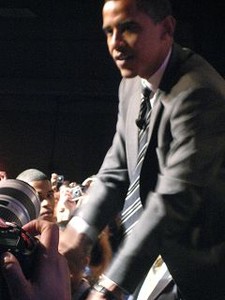
Democratic presidential candidate Barack Obama held a fundraising drive in Minneapolis on Friday June 29th at the International Market Square. Obama, the son of a Kenyan father and an American mother, was in town in an effort to raise money before the second quarter deadline of June 30th.

The junior Senator from Illinois, who is a former grassroots organizer and civil rights lawyer, has inspired a feverish grassroots campaign with his message of hope and his mantra calling for ‘a new kind of politics’.

About 3,000 people showed up with the crowd decidedly young, a characteristic of the demographic Obama appeals heaviest to. Entrance to the event cost $15-$25 as part of a campaign strategy to focus on small donors, emphasizing number of donors over amount donated.

“The young crowd shows that people want change,” said Isaac Oyaro a foreign student at Metropolitan State University who had brought his father visiting from Kenya to see Obama.

Susan Patton, a graduate student at St. Cloud State University said, “Obama is a great speaker and I’ve wanted to see one of his speeches for a while and find out more about him.”

By the afternoon of the Minneapolis fundraising, the Obama campaign announced that they had surpassed their goal of 250,000 donors to the campaign for the first two quarters. In an email message to supporters, campaign manager David Plouffe urged them to be part of ‘something historic’ by helping the campaign reach its target of 350,000 donations by the deadline. The campaign has tried to downplay expectations that it will beat the first quarter total of $25 million by a large margin.

Obama was introduced by Rep. Keith Ellison and Minneapolis mayor R.T. Rybak, who were the first mayor and congressman to endorse Obama.

Keith Ellison, the first Muslim elected to the US Congress, riled up the crowd with chants of ‘Obama’ and got loud cheers when he said, “Elections matter, leadership matters and right now we’ve got leadership in Barrack Obama.”

Mayor Rybak, who was excited by the crowd said, “This has been a people powered campaign from the start.”

Speaking on the turnout that saw people fill the square, pour over the hallways and lean over balconies on higher floors, Obama said, “Everywhere we go we have been seeing these great crowds.” He added, “It’s tempting to think it’s all about me,…but when I’m honest with myself I have to admit that’s not the reason people are coming out. The reason people are coming out is because all around the country people are ready for change. People want to see a different America."

Justin Simmons, a student from Jackson Mississippi doing research at the University of Minnesota on why he attended the rally said “I wanted to get a chance to find out more about Senator Obama. He has a lot of good ideas and I wanted to know more about his ideas on policy”

Yvette Davis an attendee who is yet undecided expressed admiration for the Senator as a role model for everyone and particularly men of color. “I wanted to hear more about his stance on issues like education, the war and poverty,” she said. “The country is so split maybe he can heal the divide.”

In his speech, the Senator highlighted the need to fix an education system that ‘left millions of children unable to compete’ and a health care system that is broke promising to have universal health care by the end of his first term. He talked about how the need for oil meant that America gave hostile countries millions of dollars and proposed an increase in fuel efficiency that would replace the equivalent of oil from the Persian Gulf.

On the environment, Obama conceded that reduced pollution might impose a heavier cost on businesses but said, “We can create a generation of businesses that will drive the economy for years to come”.

Obama got the loudest cheer when he spoke against ‘a war that should have never been authorized’. He vowed that as president, he would oversee a phased redeployment that would have all the troops out of Iraq by March 31st 2008.

“There was a moment after 9/11 where all of us understood the bonds we held as Americans,” he said. “Our politics has become selfish again”.

Obama resounded on his central theme of hope saying we have mutual responsibilities toward each other. He joked about people in Washington D.C. calling him a ‘hope monger’ but stated America has ‘been in tougher times before and each time we come out stronger and more prosperous’.

Ikram Mohamed and Fadumo Mohamud two high school students who volunteered for the event said they were inspired to do what they could to help support him as a black candidate.  “I feel he represents us,” said Ikram. “Maybe he could help our home Somalia once he becomes president”.

“I support him because I think he is intelligent and that he believes sincere politics is the way to go,” said Walles Agoye, a clinical nurse at Regions Hospital who also volunteered for the event. “As an African he gives everybody hope that you can achieve anything you set your mind to…even the highest office in the land.”

“I watched him in 2004 and he blew me away,” said Amos Samoite a supply manager at a nursing home and an ardent Obama fan. “He will have an impact [in the election] because most of his supporters are between the ages of 18 and 25; if they turn out he will win.”

“Crossroads” KSTC-TV Channel 45

0
“Crossroads” KSTC-TV Channel 45

Crossroads is a weekly program that highlights the issues in the minority community – whether they are good or bad.” Sheletta Brundidge, host, comedienne, and 5 Eyewitness News Assignment Editor, explains the idea behind her new 30-minute television show on Twin Cities’ KSTC.TV Channel 45. For the past three years, Brundidge has been pushing the station to consider her programming ideas. And all of her pushing has finally paid off.

“They [KSTC.TV] had a program where they allowed the NAACP and Urban League to talk about their issues” – but these issues only reached out to the African-American community and “we really could do more…Women have a story to tell. Africans have a story to tell. And the mainstream news doesn’t necessarily cover their issues.” Brundidge hopes that Crossroads will shed light on the issues that affect the local communities of color as well as women.

“It’s really a program for, by and about us – meaning people of color – people who need exposure.” Brundidge takes this further and points to the Liberian, American Indian and Hispanic communities to illustrate an area where voices are often not heard. From local crime to Boy Scout troops, Brundidge aims to cover the various issues in the local minority communities. Furthermore, she plans to be a voice for the immigrant demographic. “We’re going to have the immigrant perspective. A lot of times it’s the white perspective [of immigrants]. This show is going to bridge the gap where the mainstream media leaves off…”

Crossroads is already off to a jumpstart. One of Brundidge’s first guests was Minneapolis Mayor R. T. Rybak and the show topic was on local violence and crime. But as a disclaimer, Brundidge states, “The show isn’t serious all the time. We’d like to keep it light: How to be a better parent, how to be a better mom, etc” and then she mentions her 11-month old baby and throws in a joke by saying, “…the show is really to help me out.”

After pitching the selling points for her new show, Brundidge closes by thoughtfully declaring, “This show is going to be a voice for everyone.”

Crossroads airs Sunday mornings at 5:30am on KSTC.TV Channel 45. For more information on Crossroads, visit http://crossroads.eponym.com/ or contact Sheletta Brundidge at 651-647-2860 or [email protected]