Public Notice by MAK Community Enrichment Services
PAID ADVERTISING
Public Notice
MAK COMMUNITY ENRICHMENT SERVICES
Attention: Vended Meals Companies
The above institution is soliciting invitations for bid for vended child nutrition meals. The Vendor would provide meal services according to United States Department of Agriculture (USDA) regulations and guidelines as well as State of Minnesota Department of Education policies and guidelines.
Vendors and/or their representatives may submit bids to:
Name of Institution: MAK Community Enrichment Services
Institution’s mailing address: 3055 Old Highway 8, Suite 150 Minneapolis, MN 55418
The above institution reserves the right to accept or reject any and/or all proposals or to accept the proposal that it finds, in its sole discretion, to be in the best interest of the Sponsor.
A bid packet will be available by email at [email protected] to all potential bidders by Monday, April 24, 2023.
The institution will email its response to these questions by Monday, May 8, 2023.
All questions will be answered in writing only and sent to everyone by Monday, May 8, 2023. All bids must be submitted no later than 9:00 a.m. on Monday, May 22, 2023
The bid award/opening will be Monday, May 29, 2023.
All bids should be delivered in a sealed envelope and addressed to Ahmed Adam and be clearly marked: Vended Child Nutrition Meals Bid.
WASHINGTON (AP) — President Joe Biden rolled out the first ad of his 2024 reelection campaign on Wednesday, casting himself as a warrior in defense of freedom, but immediately found himself grappling with questions about his advanced age and droopy poll numbers.
At an afternoon news conference with South Korea’s president, Biden swatted away questions about his 42% job approval rating in part by arguing that most politicians running for reelection end up in roughly the same boat.
“I feel good, I feel excited about the prospects,” he said. “I think we’re on the verge of turning the corner in a way we haven’t in a long time.”
As for his age — the president would be 86 when he left office if reelected — Biden said such numbers don’t even compute with him.
“I can’t even guess how old I am,” he said. “I can’t even say the number, it doesn’t register with me. The only thing I can say is they’re going to see a race and they’re going to judge whether I have or don’t have it.”
He added: “Things are moving. And the reason I’m running again is there’s a job to finish.”
Biden spoke from the Rose Garden as he was hosting South Korean President Yoon Suk Yeol for a state visit.
The president, who announced his reelection campaign on Tuesday, offered a sharp comparison of his tenure with that of his predecessor, Donald Trump, who also is a candidate once again.
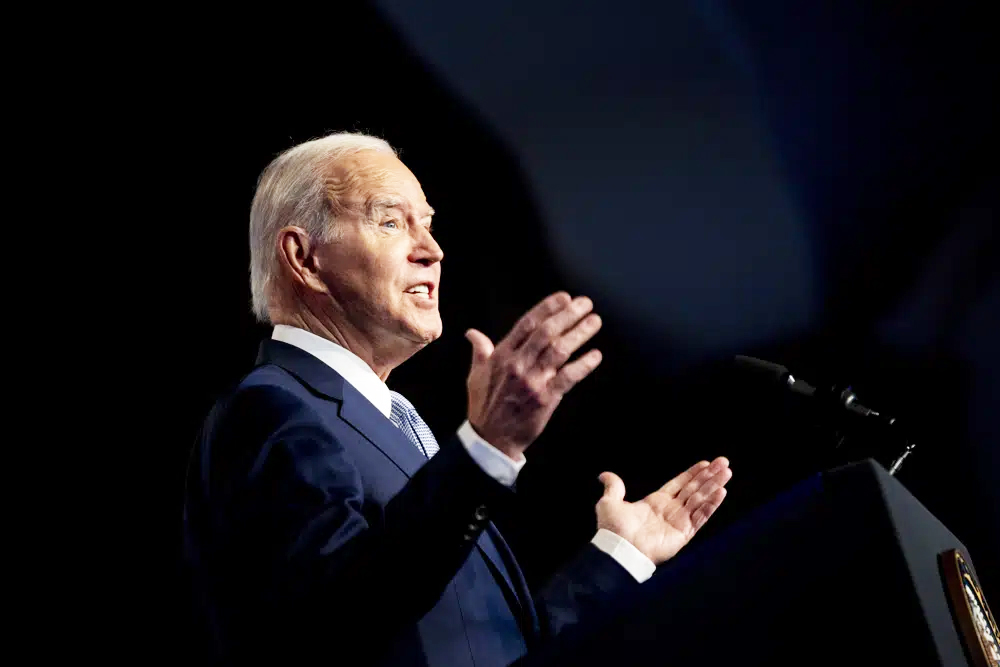
President Joe Biden speaks at the North America’s Building Trades Union National Legislative Conference at the Washington Hilton in Washington, Tuesday, April 25, 2023. Photo: Andrew Harnik/AP
“Think about what I inherited when I got elected. I inherited a nation in overwhelming debt, in the hole for the four years that he was president,” Biden said. “I inherited a nation that had a serious loss of credibility around the world.”
Biden’s first TV ad aims to flip the script on Republicans who have traditionally claimed the mantle of “freedom,” aiming to portray the GOP as part of an “extreme movement” bent on overturning elections, restricting access to abortion and undermining voters’ economic security. It will air in major markets in the six states the president carried in 2020 that are key to his path back to the White House.
Along with the ad push, his campaign has begun the process of reengaging a legion of small-dollar donors, with frequent messages urging their support. As an incumbent, Biden is also benefitting from existing joint fundraising relationships with a host of candidates and local parties. His campaign, though, does not plan to release its fundraising totals before the end of the quarter.
The ad offers a taste of what is set to be the core of the Democratic president’s campaign message to voters, as he seeks to paint all Republicans as embracing Trump and out of the step with popular opinion and the nation’s values.
“Courage, opportunity, democracy, freedom: They’re the values and beliefs that built this country and still beat in our hearts,” a narrator says. “But they’re under attack by an extreme movement that seeks to overturn elections, ban books and eliminate a woman’s right to choose.”
The ad goes on to say Biden “has made defending our basic freedoms the cause of his presidency: the freedom for women to make their own health care decisions, the freedom for our children to be safe from gun violence, the freedom to vote and have your vote counted, for seniors to live with dignity, and to give every American the freedom that comes with a fair shot at building a good life.”
The 90-second spot includes footage of the deadly Jan. 6, 2021, attack on the U.S. Capitol by a mob of Trump supporters trying to overturn the 2020 election and of children fleeing a school shooting as well as patriotic-themed images of flags being raised and Biden greeting supporters.
“For freedom, for democracy, for America — Joe Biden,” the ad concludes.
The Biden campaign said the ad is airing as part of a seven-figure, two-week media buy in Arizona, Georgia, Michigan, Nevada, Pennsylvania and Wisconsin. It said a second ad will be released next week.
“Freedom” is a common buzzword among Republicans who would challenge Biden for reelection, typically around the cultural issues that have defined the early stages of the 2024 GOP presidential nominating campaign. Republican figures, for instance, have attacked race and gender-affirming policy in schools as a threat to the liberty of those who object to them.
It was on the lips of several of the Republican presidential prospects who attended the first big GOP campaign event of the year in Iowa, where the 2024 caucuses are expected to begin the voting next year.
Former Vice President Mike Pence pointed to an eastern Iowa school district as an example of violating such freedoms. The Linn-Mar Community School District near Cedar Rapids allows students to request a gender transition plan for teachers, administrators and students to respect without the knowledge and permission of the students’ parents. A foundation Pence leads has been involved in supporting parents who are suing to overturn the school policy.
“Make no mistake about it, the battle against radical gender ideology is a battle for religious freedom,” Pence told about 1,000 Iowa conservatives in suburban Des Moines on Saturday. “And it’s a battle we must fight.”
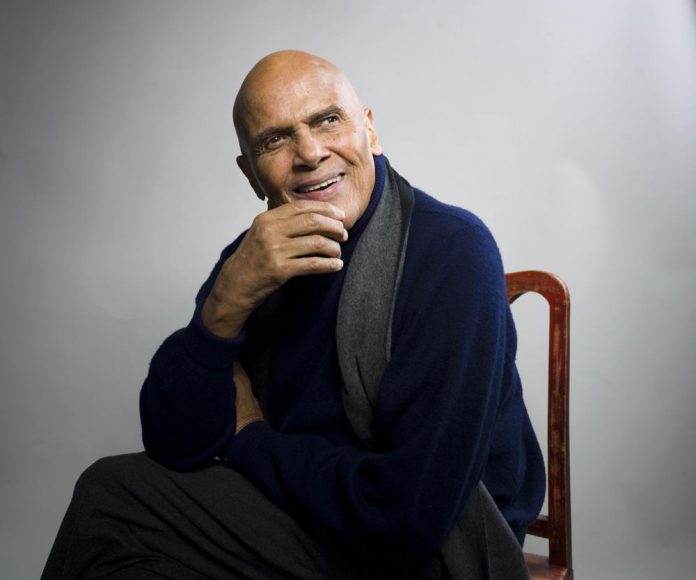
Actor, singer and activist Harry Belafonte from the documentary film "Sing Your Song," poses for a portrait during the Sundance Film Festival in Park City, Utah on Jan. 21, 2011. Belafonte died Tuesday of congestive heart failure at his New York home. He was 96. Photo: Victoria Will/AP FILE
NEW YORK (AP) — Harry Belafonte, the civil rights and entertainment giant who began as a groundbreaking actor and singer and became an activist, humanitarian and conscience of the world, has died. He was 96.
Belafonte died Tuesday of congestive heart failure at his New York home, his wife Pamela by his side, said publicist Ken Sunshine.
With his glowing, handsome face and silky-husky voice, Belafonte was one of the first Black performers to gain a wide following on film and to sell a million records as a singer; many still know him for his signature hit “Banana Boat Song (Day-O),” and its call of “Day-O! Daaaaay-O.” But he forged a greater legacy once he scaled back his performing career in the 1960s and lived out his hero Paul Robeson’s decree that artists are “gatekeepers of truth.”
Belafonte stands as the model and the epitome of the celebrity activist. Few kept up with his time and commitment and none his stature as a meeting point among Hollywood, Washington and the Civil Rights Movement.
Belafonte not only participated in protest marches and benefit concerts, but helped organize and raise support for them. He worked closely with his friend and generational peer the Rev. Martin Luther King Jr., often intervening on his behalf with both politicians and fellow entertainers and helping him financially. He risked his life and livelihood and set high standards for younger Black celebrities, scolding Jay-Z and Beyoncé for failing to meet their “social responsibilities,” and mentoring Usher, Common, Danny Glover and many others. In Spike Lee’s 2018 film “BlacKkKlansman,” he was fittingly cast as an elder statesman schooling young activists about the country’s past.
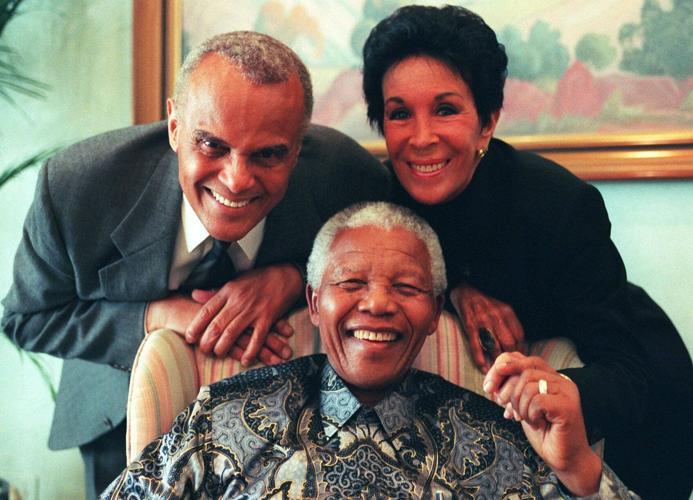
Harry Belafonte and wife Julie with President Nelson Mandela in Pretoria on June 15, 1999. Photo: AP FILE
Belafonte’s friend, civil rights leader Andrew Young, would note that Belafonte was the rare person to grow more radical with age. He was ever engaged and unyielding, willing to take on Southern segregationists, Northern liberals, the billionaire Koch brothers and the country’s first Black president, Barack Obama, whom Belafonte would remember asking to cut him “some slack.”
Belafonte responded, “What makes you think that’s not what I’ve been doing?”
Belafonte had been a major artist since the 1950s. He won a Tony Award in 1954 for his starring role in John Murray Anderson’s “Almanac” and five years later became the first Black performer to win an Emmy for the TV special “Tonight with Harry Belafonte.”
In 1954, he co-starred with Dorothy Dandridge in the Otto Preminger-directed musical “Carmen Jones,” a popular breakthrough for an all-Black cast. The 1957 movie “Island in the Sun” was banned in several Southern cities, where theater owners were threatened by the Ku Klux Klan because of the film’s interracial romance between Belafonte and Joan Fontaine.
His “Calypso,” released in 1955, became the first officially certified million-selling album by a solo performer, and started a national infatuation with Caribbean rhythms (Belafonte was nicknamed, reluctantly, the “King of Calypso″). Admirers of Belafonte included a young Bob Dylan, who debuted on record in the early ’60s by playing harmonica on Belafonte’s “Midnight Special.”
“Harry was the best balladeer in the land and everybody knew it,” Dylan later wrote. “Harry was that rare type of character that radiates greatness, and you hope that some of it rubs off on you.”
Belafonte befriended King in the spring of 1956 after the young civil rights leader called and asked for a meeting. They spoke for hours, and Belafonte would remember feeling King raised him to the “higher plane of social protest.” Then at the peak of his singing career, Belafonte was soon producing a benefit concert for the bus boycott in Montgomery, Alabama, that helped make King a national figure. By the early 1960s, he had decided to make civil rights his priority.
“I was having almost daily talks with Martin,” Belafonte wrote in his memoir “My Song,” published in 2011. “I realized that the movement was more important than anything else.”
The Kennedys were among the first politicians to seek his opinions, which he willingly shared. John F. Kennedy, at a time when Black voters were as likely to support Republicans as they would Democrats, was so anxious for his support that during the 1960 election he visited Belafonte at his Manhattan home. Belafonte explained King’s importance and arranged for King and Kennedy to meet.
“I was quite taken by the fact that he (Kennedy) knew so little about the Black community,” Belafonte told NBC in 2013. “He knew the headlines of the day, but he wasn’t really anywhere nuanced or detailed on the depth of Black anguish or what our struggle’s really about.”
Belafonte would often criticize the Kennedys for their reluctance to challenge the Southern segregationists who were then a substantial part of the Democratic Party. He argued with Attorney General Robert F. Kennedy, the president’s brother, over the government’s failure to protect the “Freedom Riders” trying to integrate bus stations. He was among the Black activists at a widely publicized meeting with the attorney general, when playwright Lorraine Hansberry and others stunned Kennedy by questioning whether the country even deserved Black allegiance.
“Bobby turned red at that. I had never seen him so shaken,” Belafonte later wrote.
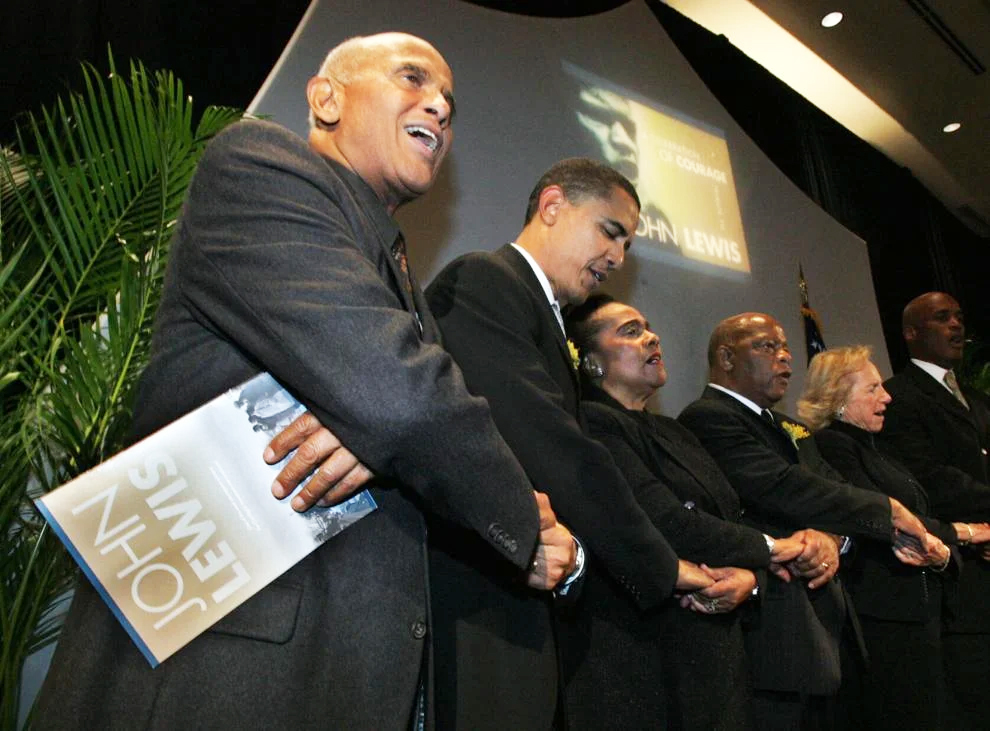
Harry Belafonte, from left; Sen. Barack Obama, D-Ill.; Coretta Scott King; civil rights pioneer Rep. John Lewis, D-Ga.; Ethel Kennedy; and Kenny Leon join hands on stage in Atlanta on Feb. 21, 2005, at the end of a tribute to Lewis on his 65th birthday. Photo: John Amis/AP FILE
In 1963, Belafonte was deeply involved with the historic March on Washington. He recruited his close friend Sidney Poitier, Paul Newman and other celebrities and persuaded the left-wing Marlon Brando to co-chair the Hollywood delegation with the more conservative Charlton Heston, a pairing designed to appeal to the broadest possible audience. In 1964, he and Poitier personally delivered tens of thousands of dollar to activists in Mississippi after three “Freedom Summer” volunteers were murdered — the two celebrities were chased by car at one point by members of the KKK. The following year, he brought in Tony Bennett, Joan Baez and other singers to perform for the marchers in Selma, Alabama.
When King was assassinated, in 1968, Belafonte helped pick out the suit he was buried in, sat next to his widow, Coretta, at the funeral, and continued to support his family, in part through an insurance policy he had taken out on King in his lifetime.
“Much of my political outlook was already in place when I encountered Dr. King,” Belafonte later wrote. “I was well on my way and utterly committed to the civil rights struggle. I came to him with expectations and he affirmed them.”
King’s death left Belafonte isolated from the civil rights community. He was turned off by the separatist beliefs of Stokely Carmichael and other “Black Power” activists and had little chemistry with King’s designated successor, the Rev. Ralph Abernathy. But the entertainer’s causes extended well beyond the U.S.
He helped introduce South African singer and activist Miriam Makeba to American audiences, the two winning a Grammy in 1964 for the concert record “An Evening With Belafonte/Makeba.” He coordinated Nelson Mandela’s first visit to the U.S. since being released from prison in 1990. A few years earlier, he had initiated the all-star, million-selling “We Are the World” recording, the Grammy-winning charity song for famine relief in Africa.
Belafonte’s early life and career paralleled those of Poitier, who died in 2022. Both spent part of their childhoods in the Caribbean and ended up in New York. Both served in the military during World War II, acted in the American Negro Theatre and then broke into film. Poitier shared his belief in civil rights, but still dedicated much of his time to acting, a source of some tension between them. While Poitier had a sustained and historic run in the 1960s as a leading man and box office success, Belafonte grew tired of acting and turned down parts he regarded as “neutered.″
“Sidney radiated a truly saintly dignity and calm. Not me,″ Belafonte wrote in his memoir. “I didn’t want to tone down my sexuality, either. Sidney did that in every role he took.″
Belafonte was very much a human being. He acknowledged extra-marital affairs, negligence as a parent and a frightening temper, driven by lifelong insecurity. “Woe to the musician who missed his cue, or the agent who fouled up a booking,″ he confided.
In his memoir, he chastised Poitier for a “radical breach″ by backing out on a commitment to star as Mandela in a TV miniseries Belafonte had conceived, then agreeing to play Mandela for a rival production. He became so estranged from King’s widow and children that he was not asked to speak at her funeral. He later sued three of King’s children over control of some of the civil rights leader’s personal papers, and would allege that the family was preoccupied with “selling trinkets and memorabilia.”
He made news years earlier when he compared Colin Powell, the first Black secretary of state, to a slave “permitted to come into the house of the master” for his service in the George W. Bush administration. He was in Washington in January 2009 as Obama was inaugurated, officiating along with Baez and others at a gala called the Inaugural Peace Ball. But Belafonte would later criticize Obama for failing to live up to his promise and lacking “fundamental empathy with the dispossessed, be they white or Black.”
Belafonte did occasionally serve in government, as cultural adviser for the Peace Corps during the Kennedy administration and decades later as goodwill ambassador for UNICEF. For his film and music career, he received the motion picture academy’s Jean Hersholt Humanitarian Award, a National Medal of Arts, a Grammy for lifetime achievement and numerous other honorary prizes. He found special pleasure in winning a New York Film Critics Award in 1996 for his work as a gangster in Robert Altman’s “Kansas City.”
“I’m as proud of that film critics’ award as I am of all my gold records,” he wrote in his memoir.
He was married three times, most recently to photographer Pamela Frank, and had four children. Three of them — Shari, David and Gina — became actors. He is also survived by two stepchildren and eight grandchildren.
Harry Belafonte was born Harold George Bellanfanti Jr. in 1927, in Harlem. His father was a seaman and cook with Dutch and Jamaican ancestry and his mother, part Scottish, worked as a domestic. Both parents were undocumented immigrants and Belafonte recalled living “an underground life, as criminals of a sort, on the run.″
The household was violent: Belafonte sustained brutal beatings from his father, and he was sent to live for several years with relatives in Jamaica. Belafonte was a poor reader — he was probably dyslexic, he later realized — and dropped out of high school, soon joining the Navy. While in the service, he read “Color and Democracy” by the Black scholar W.E.B. Du Bois and was deeply affected, calling it the start of his political education.
After the war, he found a job in New York as an assistant janitor for some apartment buildings. One tenant liked him enough to give him free tickets to a play at the American Negro Theatre, a community repertory for black performers. Belafonte was so impressed that he joined as a volunteer, then as an actor. Poitier was a peer, both of them “skinny, brooding and vulnerable within our hard shells of self-protection,″ Belafonte later wrote.
Belafonte met Brando, Walter Matthau and other future stars while taking acting classes at the New School for Social Research. Brando was an inspiration as an actor, and he and Belafonte became close, sometimes riding on Brando’s motorcycle or double dating or playing congas together at parties. Over the years, Belafonte’s political and artistic lives would lead to friendships with everyone from Frank Sinatra and Lester Young to Eleanor Roosevelt and Fidel Castro.
His early stage credits included “Days of Our Youth″ and Sean O’Casey’s “Juno and the Peacock,″ a play Belafonte remembered less because of his own performance than because of a backstage visitor, Robeson, the actor, singer and activist.
“What I remember more than anything Robeson said, was the love he radiated, and the profound responsibility he felt, as an actor, to use his platform as a bully pulpit,″ Belafonte wrote in his memoir. His friendship with Robeson and support for left-wing causes eventually brought trouble from the government. FBI agents visited him at home and allegations of Communism nearly cost him an appearance on “The Ed Sullivan Show.″ Leftists suspected, and Belafonte emphatically denied, that he had named names of suspected Communists so he could perform on Sullivan’s show.
By the 1950s, Belafonte was also singing, finding gigs at the Blue Note, the Vanguard and other clubs — he was backed for one performance by Charlie Parker and Max Roach — and becoming immersed in folk, blues, jazz and the calypso he had heard while living in Jamaica. Starting in 1954, he released such top 10 albums as “Mark Twain and Other Folk Favorites″ and “Belafonte,″ and his popular singles included “Mathilda,″ “Jamaica Farewell″ and “The Banana Boat Song,″ a reworked Caribbean ballad that was a late addition to his “Calypso″ record.
“We found ourselves one or two songs short, so we threw in `Day-O’ as filler,″ Belafonte wrote in his memoir.
He was a superstar, but one criticized, and occasionally sued, for taking traditional material and not sharing the profits. Belafonte expressed regret and also worried about being typecast as a calypso singer, declining for years to sing “Day-O″ live after he gave television performances against banana boat backdrops.
Belafonte was the rare young artist to think about the business side of show business. He started one of the first all-Black music publishing companies. He produced plays, movies and TV shows, including Off-Broadway’s “To Be Young, Gifted, and Black,” in 1969. He was the first Black person to produce for TV.
Belafonte made history in 1968 by filling in for Johnny Carson on the “Tonight” show for a full week. Later that year, a simple, spontaneous gesture led to another milestone. Appearing on a taped TV special starring Petula Clark, Belafonte joined the British singer on the anti-war song “On the Path of Glory.″ At one point, Clark placed a hand on Belafonte’s arm. The show’s sponsor, Chrysler, demanded the segment be reshot. Clark and Belafonte resisted, successfully, and for the first time a white woman touched a Black man’s arm on primetime television.
In the 1970s, he returned to movie acting, co-starring with Poitier in “Buck and the Preacher,″ a commercial flop, and the raucous and popular comedy “Uptown Saturday Night.” His other film credits include “Bobby,″ “White Man’s Burden,″ cameos in Altman’s “The Player″ and “Ready to Wear,″ and the Altman-directed TV series “Tanner on Tanner.″ In 2011, HBO aired a documentary about Belafonte, “Sing Your Song.”
Mindful to the end that he grew up in poverty, Belafonte did not think of himself as an artist who became an activist, but an activist who happened to be an artist.
“When you grow up, son,″ Belafonte remembered his mother telling him, “never go to bed at night knowing that there was something you could have done during the day to strike a blow against injustice and you didn’t do it.″
Smoke is seen in Khartoum, Sudan, Saturday, April 22, 2023. The fighting in the capital between the Sudanese Army and Rapid Support Forces resumed after an internationally brokered cease-fire failed. American special forces evacuated US diplomats on April 22, 2023 and the Khartoum embassy closed indefinitely. Photo: Marwan Ali/AP
Smoke is seen in Khartoum, Sudan, Saturday, April 22, 2023. The fighting in the capital between the Sudanese Army and Rapid Support Forces resumed after an internationally brokered cease-fire failed. American special forces evacuated US diplomats on April 22, 2023 and the Khartoum embassy closed indefinitely. Photo: Marwan Ali/AP
American special forces, numbering just over 100, flew into Sudan from Djibouti Saturday morning at 9 a.m. Eastern to evacuate American diplomats and their dependents, as fighting intensified between the two sides led by Gen. Abdel Fattah Burhan, head of the armed forces, and Gen. Mohammed Hamdan Dagalo, the leader of a paramilitary group known as the Rapid Support Forces.
The fighting has killed over 400 people as of Sunday.
Secretary of Defense Lloyd J. Austin III said the evacuation was under the command of U.S. Africa Command and conducted in close coordination with the U.S. State Department. “I’m proud of our extraordinary service members who executed and supported this operation with outstanding precision and professionalism,” he said.
The special operations personnel with their aircraft — including three MH-47 Chinooks spent less than an hour on the ground in Khartoum in their mission, the Pentagon said in a statement.
The evacuation came after the embassy posted Saturday on its twitter account that it has suspended operations due to “the continued threat from armed conflict in Sudan.”
But more than 16,000 Americans remain in Sudan, and that is just the number that is registered with the embassy as not every American takes time to do so, or indicate when they have left the country.
“In the coming days, we will continue to work with the State Department to help American citizens who may want to leave Sudan,” said Christopher Maier, the assistant secretary of defense for special operations and low-intensity warfare.
“One of those ways is to potentially make the overland routes out of Sudan potentially more viable. So, DOD is at present considering actions that may include use of intelligence, surveillance and reconnaissance capabilities to be able to observe routes and detect threats,” said Maier.
What Americans in Sudan can do following embassy closure
Following the closure of the US Embassy in Khartoum, the State Department in a pinned tweet on the shuttered embassy’s Twitter account, offered the following guidelines to Americans still in Sudan:
Security Alert: On April 22, 2023, the U.S. Embassy in Khartoum suspended its operations, and the Department of State ordered the departure of U.S. direct hire employees and their dependents due to the continued threat from armed conflict in Sudan. The U.S. government cannot…
A patient is being carried into a hospital in Khartoum, Sudan, Monday, April 17, 2023. Hospitals in the Sudanese capital are overwhelmed as the city turns into a war zone in fighting between the country’s two top generals. At least six of the around 20 hospitals in Khartoum and its neighboring city Omdurman have shut down, the Doctors’ Syndicate says. (AP Photo)
Fighting in Sudan between forces loyal to two top generals has put that nation at risk of collapse and could have consequences far beyond its borders.
Both sides have tens of thousands of fighters, foreign backers, mineral riches and other resources that could insulate them from sanctions. It’s a recipe for the kind of prolonged conflict that has devastated other countries in the Middle East and Africa, from Lebanon and Syria to Libya and Ethiopia.
The fighting, which began as Sudan attempted to transition to democracy, already has killed hundreds of people and left millions trapped in urban areas, sheltering from gunfire, explosions and looters.
A look at what is happening and the impact it could have outside Sudan.
WHO IS FIGHTING?
Gen. Abdel Fattah Burhan, head of the armed forces, and Gen. Mohammed Hamdan Dagalo, the leader of a paramilitary group known as the Rapid Support Forces that grew out of Darfur’s notorious Janjaweed militias, are each seeking to seize control of Sudan. It comes two years after they jointly carried out a military coup and derailed a transition to democracy that had begun after protesters in 2019 helped force the ouster of longtime autocrat Omar al-Bashir. In recent months, negotiations were underway for a return to the democratic transition.
The victor of the latest fighting is likely to be Sudan’s next president, with the loser facing exile, arrest or death. A long-running civil war or partition of the Arab and African country into rival fiefdoms are also possible.
Alex De Waal, a Sudan expert at Tufts University, wrote in a memo to colleagues this week that the conflict should be seen as “the first round of a civil war.”
“Unless it is swiftly ended, the conflict will become a multi-level game with regional and some international actors pursuing their interests, using money, arms supplies and possibly their own troops or proxies,” he wrote.
WHAT DOES THE FIGHING MEAN FOR SUDAN’S NEIGHBORS?
Sudan is Africa’s third-largest country by area and straddles the Nile River. It uneasily shares its waters with regional heavyweights Egypt and Ethiopia. Egypt relies on the Nile to support its population of over 100 million, and Ethiopia is working on a massive upstream dam that has alarmed both Cairo and Khartoum.
Egypt has close ties to Sudan’s military, which it sees as an ally against Ethiopia. Cairo has reached out to both sides in Sudan to press for a cease-fire but is unlikely to stand by if the military faces defeat.
Sudan borders five additional countries: Libya, Chad, the Central African Republic, Eritrea and South Sudan, which seceded in 2011 and took 75% of Khartoum’s oil resources with it. Nearly all are mired in their own internal conflicts, with various rebel groups operating along the porous borders.
“What happens in Sudan will not stay in Sudan,” said Alan Boswell of the International Crisis Group. “Chad and South Sudan look most immediately at risk of potential spillover. But the longer (the fighting) drags on the more likely it is we see major external intervention.”
WHAT EXTERNAL POWERS ARE INTERESTED IN SUDAN?
Arab Gulf countries have looked to the Horn of Africa in recent years as they have sought to project power across the region.
The United Arab Emirates, a rising military power that has expanded its presence across the Middle East and East Africa, has close ties to the Rapid Support Forces, which sent thousands of fighters to aid the UAE and Saudi Arabia in their war against Iran-backed Houthi rebels in Yemen.
Russia, meanwhile, has long harbored plans to build a naval base capable of hosting up to 300 troops and four ships in Port Sudan, on a crucial Red Sea trading route for energy shipments to Europe.
The Wagner Group, a Russian mercenary outfit with close ties to the Kremlin, has made inroads across Africa in recent years and has been operating in Sudan since 2017. The United State and the European Union have imposed sanctions on two Wagner-linked gold mining firms in Sudan accused of smuggling.
WHAT ROLE DO WESTERN COUNTRIES PLAY?
Sudan became an international pariah when it hosted Osama bin Laden and other militants in the 1990s, when al-Bashir had empowered a hard-line Islamist government.
Its isolation deepened over the conflict in the western Darfur region in the 2000s, when Sudanese forces and the Janjaweed were accused of carrying out atrocities while suppressing a local rebellion. The International Criminal Court eventually charged al-Bashir with genocide.
The U.S. removed Sudan from its list of state sponsors of terrorism after the government in Khartoum agreed to forge ties with Israel in 2020.
But billions of dollars in loans and aid were put on hold after the 2021 military coup. That, along with the war in Ukraine and global inflation, sent the economy into free-fall.
CAN EXTERNAL POWERS DO ANYTHING TO STOP THE FIGHTING?
Sudan’s economic woes would seem to provide an opening for Western nations to use economic sanctions to pressure both sides to stand down.
But in Sudan, as in other resource-rich African nations, armed groups have long enriched themselves through the shadowy trade in rare minerals and other natural resources.
Dagalo, a one-time camel herder from Darfur, has vast livestock holdings and gold mining operations. He’s also believed to have been well-paid by Gulf countries for the RSF’s service in Yemen battling Iran-aligned rebels.
The military controls much of the economy, and can also count on businessmen in Khartoum and along the banks of the Nile who grew rich during al-Bashir’s long rule and who view the RSF as crude warriors from the hinterlands.
“Control over political funds will be no less decisive than the battlefield,” De Waal said. “(The military) will want to take control of gold mines and smuggling routes. The RSF will want to interrupt major transport arteries including the road from Port Sudan to Khartoum.”
Meanwhile, the sheer number of would-be mediators — including the U.S., the U.N., the European Union, Egypt, Gulf countries, the African Union and the eight-nation eastern Africa bloc known as IGAD — could render any peace efforts more complicated than the war itself.
“The external mediators risk becoming a traffic jam with no policeman,” De Waal said.
___
Associated Press writers Jon Gambrell in Dubai, United Arab Emirates, Rodney Muhumuza in Kampala, Uganda, and Joseph Krauss in Ottawa, Ontario, contributed.
The Nasdaq stock exchnage buidling in New York is wrapped with a Nelson Mandela quote during South Africa Freedom Day on April 27, 2020. Minnesota-based Africa Classroom Connections will host a series of events on April 27-28, 2023 to celebrate this year's Freedom Day. Photo: Courtesy South Africa Department of International Relations and Cooperation (DIRCO)
The Nasdaq stock exchnage buidling in New York is wrapped with a Nelson Mandela quote during South Africa Freedom Day on April 27, 2020. Minnesota-based Africa Classroom Connections will host a series of events on April 27-28, 2023 to celebrate this year's Freedom Day. Photo: Courtesy South Africa Department of International Relations and Cooperation (DIRCO)
Africa Classroom Connection (ACC) will host a series of three events next week to mark South Africa Freedom Day. The first two, Celebrate South Africa Freedom Day, are identical, offered virtually on Thursday April 27th at 5:30 or 8:30 pm Central Time.
The evening will feature recorded performances by Ladysmith Black Mambazo, Jearlyn Steele and the Golden Bridge Choir. There is no cost for this 30-minute event, but reservations are required. Reservations are available here for 5:30 or here for 8:30.
The following day an in-person event aimed at both celebration and fund-raising will take place at 6:00 pm on Friday, April 28th.
Africa Classroom Connection hosts Freedom Day Celebration with an event that will offer South African food, wine, a marketplace, and live auction. Musical entertainment from Jearlyn Steele and Billy Steele will be included in the $65 ticket price. The evening will also include highlights of ACC’s mission and impact.
ACC has helped more than 42,000 kids by building more than 125 classrooms. ACC work with local communities in KwaZulu-Natal, South Africa, to build classrooms and help kids stay in school.
Africa Classroom Connection was founded in 2006 after a visit by one of their founders, Henry Bromelkamp, and a now-board officer, Jeff Nelson. After a visit to South Africa, they returned to the US and wanted to make change.
Bromelkamp and Nelson partnered with an organization already building classrooms in rural South Africa, the Eshowe Community Action Group (ECAG). ECAG was formed under the Eshowe Rotary umbrella in 1977 by late local farmer Guy Chennells and Prince Gideon Zulu. Together they formed the non-profit organization to raise funds to provide classrooms for rural children in Zululand.
Tickets for the live-event on April 28th are available at this link.
All of The Kanneh-Masons siblings to perform together for the first time in America
In celebration of its 140th year, Schubert Club, a non-profit arts organization that promotes the art of music, will present a special Anniversary concert by The Kanneh-Masons on Sunday, May 7, 2023, at the Ordway Music Theater, St. Paul.
The Kanneh-Mason family brings their sevenfold talents to the stage for a matinee performance. This concert marks the first time all seven siblings from Nottingham, England, will perform together in the United States. Isata Kanneh-Mason performed at the Ordway in March 2022 following her brother Sheku Kanneh-Mason who made his Minnesota debut in December 2019.
In celebration of its 140th year, Schubert Club of St. Paul, Minnesota will present a special Anniversary concert by The Kanneh-Masons on Sunday, May 7, 2023, at the Ordway Music Theater. The concert marks the first time all seven siblings from Nottingham, England, will perform together in the United States. Photo: Courtesy Jake Turney via The Kanneh-Masons
The Kanneh-Masons are seven brothers and sisters ranging in age from 26 to 13 years old, Isata will turn 27 in May, all of whom play either violin, piano or cello. All seven were born in Britain as was their father, Stuart Mason, a business executive. Their mother, Dr. Kadiatu Kanneh, a former university lecturer, was born in Sierra Leone, emigrating to the UK as a young child.
Mshale spoke to Jeneba, an accomplished pianist and cellist already at 20 years old. As a sibling with both older and younger siblings, she lands squarely in the middle of the line-up, number five of seven. She reflected on her similar position of being born and raised in Nottingham, England, but also having family scattered in both Africa and the West Indies, her father’s side from Antigua.
“I’d say that we’ve grown up here [in the UK] and that kind of thing. I wouldn’t say that we’re ambassadors [of Africa], but…I think it’s wonderful that we’re representing people that are African, Caribbean, British people in Classical music, which is quite rare, I think.”
So rare, in fact, that her brother, Sheku, four years older, was the first-ever Black musician to win the coveted BBC Young Musician, a competition running since 1978. Collectively, they have won many prizes and awards and appeared in numerous television shows; the five eldest performed at the Bafta awards in 2018 and all seven appeared in the December 2019 Royal Variety Show. In May 2021 they received the Global Award for Best Classical Artist. Sheku also played his cello at the wedding of Prince Harry and Meghan Markle.
Jeneba spoke of her maternal side of the family. “We’ve never been to Sierra Leone as a family, but my mother’s been back a few times and she’s told us many stories about the country. We have lots of family there. We strongly identify with Sierra Leone and we firmly identify with our African roots.”
Annual trips to Antigua and hearing the pan-Caribbean music helped influence some of the music they perform. Jeneba said, “We’ve arranged a few Bob Marley songs for our group of seven players, but,” she confessed, “mostly it’s Classical music.”
“But in terms of what we listen to, we listen to a lot of…a huge variety of music, like my parents would play lots of Black music around the house when we were younger.”
Their renown grows exponentially as one by one, each of the seven siblings takes off in solo careers as professional musicians while also continuing as a tight-knit septet.
Jeneba confirmed their progression individually as well as a unit. “I definitely want to perform music for the rest of my life. I love playing with my family, but I also really enjoy doing solo concerts,” she said,
“Having that balance is really helpful to me because having my identity as well as my identity within the family…it’s great to have that support network. We all play together and we go off and do our own thing as well.”
Credit cards as seen Thursday, July 1, 2021, in Orlando, Fla. Photo: John Raoux/AP File
Credit cards as seen Thursday, July 1, 2021, in Orlando, Fla. Photo: John Raoux/AP File
Credit cards are an essential tool for many households and businesses in today’s economy. They provide a convenient way to make purchases without the need for cash or checks and offer benefits such as rewards programs, fraud protection, and the ability to build credit history. They can also provide a lifeline for individuals in emergencies to pay for essential expenses. They have become an integral part of our financial system, and their importance cannot be overstated.
However, bills like the Credit Card Competition Act would damage the credit system as we know it. This bill was introduced just last year with the U.S. Congress to regulate interchange fees, which are the transaction fees issued by credit card companies to merchants every time a customer uses a credit card. The bill would have also forced banks to include multiple network options for transactions, rather than utilizing their preferred network option, which would lead to less transaction security.
While the intent is to lower interchange fees and reduce costs for merchants who could pass these savings down to consumers, it could have unintended consequences that would hurt small businesses, limit access to credit, and take away credit card reward programs. This would disproportionately affect the Black community, who is more likely to rely on credit cards and rewards programs to make ends meet. Many credit card rewards programs offer cash back or other benefits that can assist lower-income individuals and families pay for essential expenses like groceries and gas. If these rewards programs are reduced or eliminated, it could make it harder for low-income families to make ends meet.
Additionally, corporate retailers would benefit greatly from these changes. As interchange fees are reduced, large corporations can improve their bottom line by pocketing the savings rather than passing them down to consumers. When similar legislation was passed in 2012 under what was known as the Durbin amendment, the same type of regulation scheme was applied to debit card transactions and corporate retailers were able to grow their profits by an extra $90 billion, while most of their prices remained the same.
Furthermore, capping interchange fees would limit access to credit for individuals with low credit scores or no credit history. A bill like this would make it more difficult for credit card companies to offer credit to high-risk individuals, such as those with low credit scores or no credit history. This could lead to fewer people being able to access credit, which would make it harder for them to make necessary purchases or even build credit.
Moreover, credit card companies generate significant revenue from interchange fees. This revenue helps offset the cost of providing credit to consumers. If these fees are lowered, then credit card companies could be forced to either raise their interest rates or reduce rewards programs to maintain their profitability and ability to provide credit. This would lead to higher costs for consumers and potentially reduce their willingness to use credit cards, which would harm the overall economy.
Instead of enacting the Credit Card Competition Act, lawmakers should consider alternative solutions that address the underlying issues. Lawmakers could work to improve financial education and access to credit for low-income individuals and families. While bills like the Credit Card Competition Act may have good intentions, they could have unintended consequences that would harm small businesses and minority communities, limit access to credit, and take away credit card reward programs.
Qualifying households in the Twin Cities can get FREE internet under the Affordable Connectivity Program (ACP), which provides a $30 monthly credit ($75/month in Tribal lands) toward internet and mobile services. Photo: Courtesy Comcast
Qualifying households in the Twin Cities can get FREE internet under the Affordable Connectivity Program (ACP), which provides a $30 monthly credit ($75/month in Tribal lands) toward internet and mobile services. Photo: Courtesy Comcast
Sponsored Content from Comcast
Qualifying households in the Twin Cities can get FREE internet under the Affordable Connectivity Program (ACP), which provides a $30 monthly credit ($75/month in Tribal lands) toward internet and mobile services.
What started as emergency relief for Americans forced to work, learn and connect with loved ones remotely during the COVID-19 crisis, financial support to ensure broadband connectivity has gained more permanence under the Biden Administration’s infrastructure bill. The reason: 19 million Americans nationwide still do not subscribe to broadband with baseline speeds, according to the FCC. The greatest share comes from households earning less than $30,000 a year.
Who qualifies for ACP?
If your household income is less than twice the federal poverty level– approximately $55,000 a year for a family of four or $27,000 a year for an individual – you will qualify for the benefit. Additionally, if you receive SNAP/EBT, Medicaid, or free and reduced-price school lunch, or if you receive one of many of the other federal assistance benefits, you would also qualify.
What are the best ways to use the $30 benefit?
Xfinity, the country’s largest broadband provider, is participating in ACP. Odds are quite good there are qualified households among the 60 million homes and businesses with access to Xfinity services, which has already connected a cumulative total of 10 million people since 2011 to low-cost internet through its Internet Essentials program. But ACP is a complete game-changer, effectively making high-speed internet free to qualified individuals after the discount is applied. Here are two smart ways to use the $30 benefit for Xfinity services.
High-Speed Internet: At a cost of $29.95 a month – which is completely covered by ACP – Internet Essentials Plus offers twice the download speeds – up to 100 MBPS a month – as its standard Internet Essentials service. The higher speeds improve the performance of video and music streaming, video calls and gaming, and comes with a free cable modem and Wi-Fi router.
Internet + One Line of Mobile: Qualified individuals can also stretch their $30 credit to cover all but $25 of Internet Essentials and one line of Unlimited data on Xfinity Mobile. How? Standard Internet Essentials service costs just $9.95 a month. If you add one line of Unlimited data on Xfinity Mobile at $45 a month, the cost is just $24.95 after you apply the $30 ACP credit. Xfinity Mobile’s 5G service is also included for all of its mobile customers, in addition to automatic connectivity to 21 million Wi-Fi hotspots nationwide.
What’s the quickest way to sign up?
First, visit the National Verifier to check eligibility and obtain a National Verifier ID.
Once you have a National Verifier ID, there are three ways Comcast is making the ACP benefit easy to access and sign up for Xfinity Internet and mobile service:
Online: New and existing Xfinity Internet or Internet Essentials customers can visit xfinity.com/acp.
Call: Individuals can determine their eligibility and sign up for service by calling 1-844-963-0231. Individuals can also speak to a dedicated ACP Enrollment and Support Center that is available from 8 a.m. to 12 a.m. daily, with multi-lingual capabilities to assist anyone interested in the program.
Visit an Xfinity Store: People will be able to visit 500+ Xfinity Stores nationwide to sign up for Internet Essentials Plus, a service that includes 100 Mbps speed, a cable modem, access to millions of Wi-Fi hotspots, and unlimited data for $29.95 per month. During their visit, customers can also learn more about how to enroll in ACP to get Internet service for free.
“With the world becoming even more digital, it is crucial that everyone has the needed resources and opportunities to excel,” said Kalyn Hove, Regional Senior Vice President, Comcast Midwest. “The Affordable Connectivity Program is a once in a lifetime opportunity that Comcast is proud to be participating in and offer to any of our customers who qualify so they can benefit from the connectivity needed to function in today’s world.”
Evans Chebet, left, became the sixth man to win back-to-back titles in the open field, and Hellen Obiri finished first in the woman's field in just her second marathon on Monday, April 17, 2023 during the Boston Marathon. AP Photos by Winslow Townson and Charles Krupa
Evans Chebet, left, became the sixth man to win back-to-back titles in the open field, and Hellen Obiri finished first in the woman's field in just her second marathon on Monday, April 17, 2023 during the Boston Marathon. AP Photos by Winslow Townson and Charles Krupa
BOSTON (AP) — Defending champion Evans Chebet of Kenya won the Boston Marathon again on Monday, surging to the front at Heartbreak Hill to spoil the much-anticipated debut of world record holder Eliud Kipchoge and win in 2 hours, 5 minutes, 54 seconds.
Hellen Obiri, a two-time Olympic silver medalist in the 5,000 meters, won the women’s race in a sprint down Boylston Street to finish in an unofficial 2:21:38 and complete the Kenyan sweep.
Chebet, 2021 winner Benson Kipruto of Kenya and Gabriel Geay of Tanzania dropped Kipchoge from the lead pack around Mile 20 and then ran together for the last three miles. Geay won a footrace for second, 10 seconds behind the winner and 2 seconds ahead of Kipruto.
Kipchoge, a 12-time major marathon winner, was sixth. Scott Fauble was the top American, finishing seventh.
Eliud Kipchoge, of Kenya, warms up before the start of the 127th Boston Marathon, Monday, April 17, 2023, in Hopkinton, Mass. (AP Photo/Mary Schwalm)
Kipchoge had been hoping to add a Boston Marathon victory to his unprecedented running resume. The 38-year-old has won two Olympic gold medals and four of the six major marathons; Boston is the only one he has competed in and failed to win. (He has never run New York.) He also broke 2 hours in an exhibition in a Vienna park.
Fighting a trace of a headwind and rain that dampened the roads, Kipchoge ran in the lead pack from the start in Hopkinton until the series of climbs collectively known as Heartbreak Hill. But to the surprise of the fans lined up along Boylston Street for the final sprit, he wasn’t among the three leaders.
Marcel Hug of Switzerland won the men’s wheelchair race in a course record time – his sixth victory here – and American Susannah Scaroni won her first Boston title despite having to stop early in the race to tighten her wheel.
For the first time, the race also includes a nonbinary division, with 27 athletes registered.
A dozen former champions and participants from 120 countries and all 50 states were in the field of 30,000 running 10 years after the finish line bombing that killed three people and wounded hundreds more. The race also included 264 members of the One Fund community — those injured by the attack, their friends and family and charities associated with them.
The city marked the anniversary in a ceremony on Saturday.
A robotic dog named Stompy belonging to the Department of Homeland Security patrolled the start line before the race began, trailed by photographers capturing the peculiar sight. Officials said there were no known threats.
At 6 a.m., race director Dave McGillivray sent out a group of about 20 from the Massachusetts National Guard that hikes the course annually. Capt. Kanwar Singh, 33, of Malden, Massachusetts, said it’s a special day.
“Ten years ago, the city came to a halt. It’s an incredibly strong comeback, as a group together,” he said. “I tell people, never bet against Bostonians.”
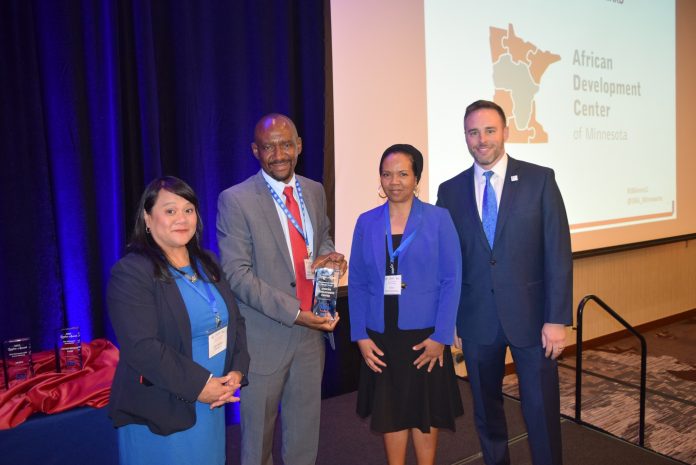
African Development Center (ADC) CEO Mr. Nasibu Sareva, second left, and ADC CFO Ms. Felicia Ravelomanantsoa, second right, receive the Small Business Administration (SBA) Minnesota District Director Award at the SBA Minnesota Lenders Conference on Thursday, September 15, 2022 in Brooklyn Park. St. Cloud-based Stearns Bank announced on Thursday, April 13, 2023 that it will give $10 million to ADC to expand lending to the underbanked. Photo: ADC Facebook
African Development Center (ADC) CEO Mr. Nasibu Sareva, second left, and ADC CFO Ms. Felicia Ravelomanantsoa, second right, receive the Small Business Administration (SBA) Minnesota District Director Award at the SBA Minnesota Lenders Conference on Thursday, September 15, 2022 in Brooklyn Park. St. Cloud-based Stearns Bank announced on Thursday, April 13, 2023 that it will give $10 million to ADC to expand lending to the underbanked. Photo: ADC Facebook
African Development Center (ADC) just got a $10 million boost from St. Cloud-based Stearns Bank to expand financing in underbanked communities in central Minnesota.
The bank is providing the $10 million to ADC so that it can work on providing more access to capital and banking services. ADC is a Minneapolis-based community development financial institution (CDFI) with offices in St. Cloud, Wilmar and Rochester that does microlending to African immigrant businesses. It also provides workshops and training to those businesses to ensure their success.
ADC will be responsible for identifying and disbursing the loans to qualified borrowers. The organization will also receive additional funding from the bank to assist with the cost of launching the program. The amount of additional funding for the launch was not disclosed.
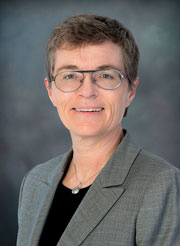
In a news release on Thursday, Ms. Kelly Skalicky, CEO and president of Stearns Bank explained the scope of her bank’s investment in ADC’s mission.
“We’re committed to the mission of ADC and pledge to continue expanding our financial and resource support as a partner to increase financial access and empowerment in our communities.” Ms. Skalicky said. “Creating dynamic, forward-thinking partnerships like ours with ADC multiplies the opportunities for so many more in our communities and benefits us all.”
Ms. Kelly Skalicky, Stearns Bank CEO. Photo: Courtesy Stearns Bank
Independent Community Bankers of America (ICBA), a trade group for the nation’s small banks, last year named Stearns Bank among its top ten performers out of its 5,000 members.
Last summer, ADC and Stearns Bank embarked on a new partnership to expand the bank’s community development programs through building collaborations with other non-profits and community-driven organizations across Minnesota and the two other states where the bank has locations, Arizona and Florida. Thursday’s announcement of the $10 million funding builds on that partnership, the news release said.
Mr. Nasibu Sareva, ADC’s CEO, said Stearns Bank’s latest move on their partnership is a clear demonstration that corporate social responsibility goes beyond managing, reducing or avoiding risk but also includes “creating opportunities.”
“The additional resources that Stearns Bank is providing will play an important role in helping us expand the valuable services we’re providing to African communities in our state,” Mr. Sareva said.