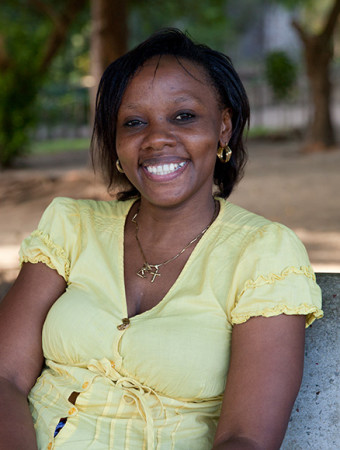
Phyllis Omido of Kenya will receive the Goldman Environmental Prize in Washington, DC on Earth Day, April 22, 2015. Photo: Courtesy Goldman Environmental Prize
Phyllis Omido of Kenya will receive the Goldman Environmental Prize in Washington, DC on Earth Day, April 22, 2015. Photo: Courtesy Goldman Environmental PrizePhyllis Omido of Kenya will receive the Goldman Environmental Prize in Washington, DC on Earth Day, April 22, 2015. Photo: Courtesy Goldman Environmental Prize
On Earth Day, Apr. 22, Kenyan activist Phyllis Omido will take the stage in Washington DC to receive the Goldman Environmental Prize for her efforts to defend her community from lead poisoning and force the closure of a lead smelting plant that was emitting fumes and spewing untreated acid wastewater into streams, poisoning the neighborhood – including her own baby.
“At first we thought he had malaria or typhoid, but doctors found he was suffering from lead poisoning,” Omido recalled. The lead was traced to a smelter where Phyllis had recently started work as a community liaison officer.
“The doctors said the lead reached my baby through my breast milk,” Phyllis said in London last week as she made the trip to the U.S. to receive the Africa award of the prestigious Goldman prize.
The smelter – built in the heart of Owino Uhuru, a densely-packed slum in Mombasa, Kenya’s second city – extracted lead from used car batteries. Lead is a potent neurotoxin. It damages the development of children, targeting the brain and nervous system.
The smelter began operations in 2009 without any environmental impact assessment (EIA). One of Phyllis’s first jobs was to commission one. The findings revealed that the smelter was poisoning the neighborhood, but the company was unwilling to move.
“I went to the company’s directors and the government’s environment agency, which had licensed the smelter. I showed them reports from lead experts. But nobody wanted to listen,” she says. Meanwhile, children were getting sick; women were having miscarriages; even the neighborhood chickens were dying.
She claims that the company routinely sacked workers after a few months because it knew their exposure to lead was unsafe. But after a worker died, the community held a demonstration. A local MP, who was also a minister for the environment, came. “We hoped he would help. But he said we should keep quiet because the company brought jobs. He accused me of being in league with his political opponents.”
After a long struggle, with help from Human Rights Watch and the UN special rapporteur on toxic waste, she was able to see the company close the plant in 2014.
Since then, she has set up a local NGO, the Center for Justice, Governance and Environmental Action, to fight other causes like salt miners who are damaging Kenya’s nearby coastal fisheries. And she has more work to do in Owino Uhuru.
Omido and the other prize recipients – from Myanmar, Canada, Haiti, Scotland and Honduras – will each receive $175,000 for their ongoing work. Dana King and conservation scientist Dr. M Sanjayan will be Masters of Ceremonies.
First genocide of 20th century was in Africa, says Nigerian writer, correcting Pope
An Anglo-Nigerian writer has respectfully urged Pope Francis to look beyond Armenia for the first genocide of the 20th century.
In an essay in the British Guardian, David Olusoga wrote: “When the media analysts at the Vatican scrutinize the social media traffic of the past seven days, their eyes might well be drawn away from Turkey and the Armenian diaspora towards a cluster of tweets, comments and Facebook posts that emanate from Africa.
“There, another debate raged last week,” he said. “The pope’s description of the Armenian massacre as “the first genocide of the 20th century” was simply incorrect. That grim distinction belongs to the genocide that imperial Germany unleashed a decade earlier against the Herero and Nama, two ethnic groups who lived in the former colony of South West Africa, modern Namibia.”
Olusoga pointed out that the Namibian genocide, 1904-1909, “seemed to prefigure the later horrors of that troubled century.” The systematic extermination of around 80 percent of the Herero people and 50 percent of the Nama was the work both of German soldiers and colonial administrators; “banal, desk-bound killers.” The most reliable figures estimate 90,000 people were killed, he said.
In the case of the Herero, he recalled, “an official, written order – the extermination order – was issued by the German commander, explicitly condemning the entire people to annihilation. After military attempts to bring this about had been thwarted, the liquidation of the surviving Herero, along with the Nama people, was continued in concentration camps, a term that was used at the time for the archipelago of facilities the Germans built across Namibia.”
“Some of the victims of the Namibian genocide were transported to those camps in cattle trucks and the bodies of some of the victims were subjected to pseudoscientific racial examinations and dissections.”
Recollection of this horror comes as a conference on reparations winds up in New York. However, unlike in the U.S. which apologized for slavery by resolutions in the House and Senate a decade ago, “All of this is now well known and widely accepted in Africa and even in Germany,” says Olusoga.
“In 2004, the German government apologized to the Herero and admitted that what Germany had done to their ancestors constituted a genocide,” he said. “As the co-author of one of the more recent histories of the genocide, I am regularly invited to attend conferences and give lectures on the subject in Germany and the word is spreading. A decade ago, my co-author and I described what took place in Namibia between 1904 and 1909 as “Germany’s forgotten genocide”. That phrase is now past its sell-by date, everywhere, it seems, other than in the Vatican.”
Olusoga wondered if the pope’s statement was made in ignorance or if the Vatican was guilty of the sin of deliberate omission. “Catholicism is growing faster in Africa than anywhere else,” he observed – “200 million Africans are followers of the faith. But awareness of history is also increasing in Africa and crimes such as the Namibian genocide can no longer be ignored, whether by accident or design.”
David Olusoga is the co-author, with Casper Erichsen, of The Kaiser’s Holocaust: Germany’s Forgotten Genocide and the Colonial Roots of Nazism
In a series of sustained and unrelenting attacks, the Minneapolis Star Tribune newspaper has declared an Open Season on Black Leaders.
Beginning with a series of articles appearing last fall (2014) against African American Senators Bobby Joe Champion and Jeff Hayden, the newspaper has engaged in a non-stop series of character attacks, questioning the integrity and credibility of long-established African American leaders, like Louis King, CEO of Summit Academy OIC, and now Scott Gray, CEO & President of the Minneapolis Urban League, Peter Hayden, CEO of Turning Point, Inc. and Al McFarlane, Editor in Chief of Insight News.
A recurrent theme in each of the articles, if read closely, is the undercurrent of references to Senators Champion and Hayden, and their role in either lobbying for or passing legislation to fund African American organizations or initiatives. Take your pick: Community Standards Initiative (CSI), Summit Academy OIC, and now the Minneapolis Urban League.
In an interesting paradox, all of the articles are about how the African American organizations haven’t fulfilled their promises – yet, in each and every instance, what these organizations have been called upon to do, is to repair the damage done by the failings of our public and private institutions. Whether it’s the failure of our public education system or failure of our public and private employment systems, Minnesota’s institutions have failed to educate African American children and failed to employ African American workers in the same manner as it has done for its White citizens.
It is beyond dispute that that Minnesota has one of the worst Black/White educational achievement gaps in the entire United States; and, it has been documented by the StarTribune itself that Minneapolis has the worst Black/White employment gap in the entire country. So, when African American organizations are metaphorically called upon to revive the dying patient, they take the blame when the patient dies!!
To date, in none of the articles published by the StarTribune, has there been any proof of wrongdoing or impropriety by any of these leaders. In the cases of Senators Champion and Hayden, there has been no proof of wrongdoing despite repeated Republican-led, politically motivated, legislative hearings, during which numerous witnesses have been called to testify. Despite the lack of evidence, the drum beat goes on, putting forth nothing more than a series of hearsay allegations and innuendos, all of which have the obvious intent of damaging the character and reputation of Senators Champion and Hayden. And, the real damage is that the general public believes the insinuations and innuendos, despite the lack of proof. They are being unilaterally condemned in the court of public opinion. And to whom do they submit their rebuttal? To the same (StarTribune) news media that is accusing them in the first place?
The most recent article appearing on Monday, April 13, 2015 is entitled, “Minneapolis Urban League accused of potential double billing,” casts aspersions upon the Minneapolis Urban League and its CEO & President Scott Gray concerning its educational programs the 13th Grade and Urban League Academy. If one simply examines the title, red flags should immediately be raised! How can an organization be accused of “potential” impropriety or wrongdoing – there is no such thing as “potential” wrongdoing. If there were, every human being on earth would be guilty!!
If one reads through the entire article concerning the Minneapolis Urban League, one will find a scarcity of actual facts. The implication is that the League got paid from two different sources, the Minneapolis Public Schools and the State of Minnesota, to provide the same services for the same children in two different programs. And, the point is what?
Since when has there been anything improper or illegal about a non-profit organization obtaining funding from multiple funding sources for same programming or for the same recipient of services. Every public school system that we’re aware of, not only obtains per pupil funding from the state, but also solicits and obtains funding from multiple other sources, including the federal government, private individuals and philanthropic organizations, to educate the same students. The same principle holds true for almost every non-profit organization. Why do they all do this? Because the funding received from one source is insufficient to meet all of their student or programming needs. Everyone involved in this conversation knows that it takes a disproportionate share of resources to address the needs of those most truly in need. It is an accepted truism that 80% of resources go to address the 20% of our population with the greatest need. Am I missing something here?
As Minneapolis Urban League CEO Scott Gray states, “the Urban League did not break any rules. It did not double bill, and it has not ‘been under fire,’” as the article claims. While the article declares in the first paragraph that a program “never lived up to its promise of graduating the city’s most troubled high school students.” Gray states in his Op-ed response that, “67% of the students eligible to graduate … received their diplomas.”
An analysis of this one allegation speaks volumes. In the first instance, the public schools system has failed to graduate any (0%) of these students, which is the reason they ended-up at the Urban League Academy in the first place. Second, even with the African American students the public school retained, in 2013, Minneapolis Public Schools had a graduate rate of 41% for African American students. So, the Minneapolis Urban League takes students that the public school system can’t handle at all, and graduates them at a rate that is 50% higher than the African American students the public schools can handle. We’re not here to bash Minneapolis Public Schools, because the StarTribune has already engaged in its fair share of bashing Minneapolis Public Schools and its school leaders!
The article then goes on to cast aspersions upon Turning Point, Inc., CEO Peter Hayden, simply because he is the board treasurer of the Minneapolis Urban League, and the father of Senator Jeff Hayden. There’s no suggestion that Peter Hayden did anything remotely inappropriate; but, his reputation is tarnished nonetheless because his son is a state senator who helped to pass legislation to benefit the Minneapolis Urban League. Maybe, again, I’m missing something here, but isn’t that what legislators are elected to do? Aren’t city councilmembers, county commissioners, state legislators and congressman supposed to lobby for and pass legislation that benefits their constituencies? Isn’t that part of the reason that they’re elected – as the saying goes, “To bring home the bacon.” The article also seeks to drag Insight News Editor in Chief Al McFarlane through its muck. Why? Ostensibly because he was serving as a “volunteer” board member of a community service organization and advocating on behalf of his community. Neither he nor his paper are accused of receiving any gifts or benefits. But, the damage has been done.
So, what’s really at the bottom here in all of these articles? Because all of the articles concern Senators Champion and Hayden, the best we’re able to ascertain is that Senators Champion and Hayden have been effective in lobbying for organizations that serve their African American constituencies, and that has incurred the ire of their political opponents and others. Same thing with Louis King, and now Scott Gray. The fact that they’ve been successful in obtaining funding for African American legacy organizations and the children and adults they have successfully served for decades, has now come under fire and become the source of front page news – no wrongdoing, no mismanagement, no waste of public funds – simply the fact that they haven’t been able to save the dying patient that our other institutions have left on the operating table!
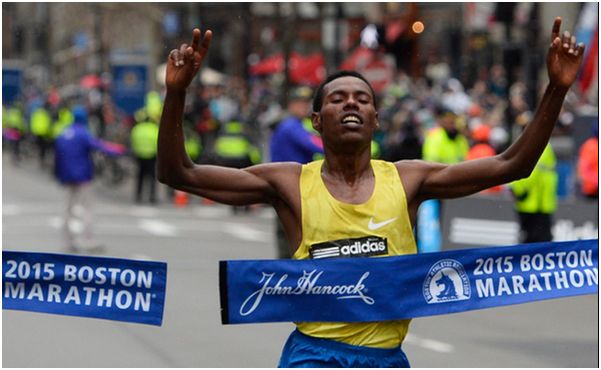
A happy Caroline Rotich of Kenya punches through the finish tape as she won the women's race in the 2015 Boston Marathon on Monday, April 20. Photo: Fox News Screenshot
A happy Caroline Rotich of Kenya punches through the finish tape as she won the women's race in the 2015 Boston Marathon on Monday, April 20. Photo: Fox News ScreenshotA happy Caroline Rotich of Kenya punches through the finish tape as she won the women’s race in the 2015 Boston Marathon on Monday, April 20. Photo: Fox News ScreenshotLelisa Desisa of Ethiopia won the Boston Marathon again on Monday, April 20 2015. The last time he won in 2013 it was during the marathon bombings and he gave that medal to the City of Boston. Photo: Fox News Screenshot
Lelisa Desisa of Ethiopia has won the Boston marathon men’s race again with an unofficial time of 2:09:17 improving on his win in 2013 which was marred by the marathon bombing that happened then. He gave his 2013 medal he won to the City of Boston. In 2013 he won with a time of 2:10:22.
In the women’s race, Caroline Rotich won a close race by outkicking her closest competitor at the last 500 metres. She won with a time of 2:24:55. This is her first Boston marathon win. She said at the finish line “I have been waiting for this and training and training.”
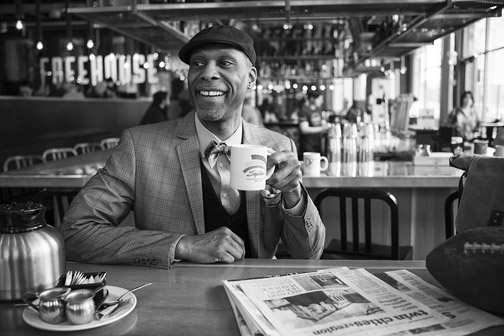
Geoff Jones, a marketing communications professional and creative director, is one of the featured Dandies in this year's book. Jones also performs with the Grammy winning Sounds of Blackness. Photo: Courtesy Nick Gallop/Gallop Studios
Geoff Jones, a marketing communications professional and creative director, is one of the featured Dandies in this year's book. Jones also performs with the Grammy winning Sounds of Blackness. Photo: Courtesy Nick Gallop/Gallop StudiosGeoff Jones, a marketing communications professional and creative director, is one of the featured Dandies in this year’s book. Jones also performs with the Grammy winning Sounds of Blackness. Photo: Courtesy Nick Gallop/Gallop Studios
“(dan.dy) a dandy is a gentleman who places particular importance upon physical aesthetics, refined in language and enjoys leisured hobbies. His life is pursued with the importance of individuality while having a driven purpose and self awareness.”
Ladies and gents, gather around and listen up, The Dandies Project is coming to a coffee table near you; in a hardback, full-color photo book filled with Twin Cities men of color who exemplify class, style and sophistication. The Dandies Project’s mission is to change the common narrative of men of color in media and culture. It gives self-defined ‘dandies’ an opportunity to portray positive, stylish images, while hoping to inspire other men of color, and supporting a local charity with each print book.
Now in its second year and started by event producer Richard Moody of IAmMoody, “The Project began with a portfolio of photos which highlight the positive impact men of color have brought to their own community, not only doing it with a sense of purpose but a sense of style.” While applications to be part of the book are open, each man featured in it is carefully selected for their community contributions and life long goals and determination. This years group of Dandies, much like last year’s gives a nod to the African community, featuring African men of color.
This year’s selected Dandies that will be featured in the book include Dan Michael Batista, Cesar Conde, Charles Dennis, Adetomiwa Gbadebo, Darren Hayes, Ryan Hoag, Michael Hullum, Geoff Jones, Patwin Lawrence, Brandon McCray, Larry McKenzie, McKinley Breeze Maxwell West, Francelino Henrique Zau and Babatunde Shonoiki.
The book will sell for $30 with proceeds from its sale going to Harvest Preparatory Academy of Minneapolis, whose mission is to “instruct, empower, enable and guide African American children to achieve superior academic, social and moral development.” Don’t miss the book launch and benefit next Tuesday the 21st at Coup d’état in Uptown. There is a $5 suggested donation to the event, which will also feature a signature cocktail. Door donations and proceeds from the signature cocktail go towards supporting Harvest Preparatory Academy. So don’t miss your chance to show off your style, mingle with the 2015 Dandies and find out more about the project.
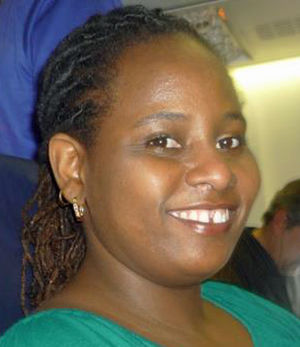
Esther Nyambura Muchina-Dobie and Rodney Terrell Dobie during happier times. Their bodies were found inside their home in Savage, Minnesota by police on March 30 2015. Photo: Facebook
Esther Nyambura Muchina-Dobie and Rodney Terrell Dobie during happier times. Their bodies were found inside their home in Savage, Minnesota by police on March 30 2015. Photo: Facebook Esther Nyambura Muchina-Dobie and Rodney Terrell Dobie during happier times. Their bodies were found inside their home in Savage, Minnesota by police on March 30 2015. Photo: FacebookA fundraiser for Esther Nyambura Muchina-Dobie will be held on Saturday, April 11, 2015 to send her body to Kenya. Her husband shot her and then turned the gun on himself. Photo: Courtesy of Facebook.
Minnesota Kenyans and friends will gather tomorrow, April 11, to raise funds to send the body of one of their own, Esther Nyambura Muchina-Dobie, to Kenya for burial.
Nyambura was a victim of a murder-suicide. Savage Police believe her husband, Rodney Terrell Dobie, 41, used a 9mm Glock handgun to shoot her once in the head, and then fatally shot himself in the head as well.
According to the authorities, police on March 30 went to the couple’s home after Nyambura’s employer requested them to check up on her as she had not shown up for work, which the workplace described as unusual. She was last seen leaving work on March 28.
According to police, when they arrived at the couple’s home, they found one garage door of a three-stall garage was open, and the service door between the garage and the home was unsecured. Police entered the home and found the couples’ bodies in a bedroom.
Savage Police Sgt. Michael Schiltz said neighbors said they did not know the couple well as “they mostly kept to themselves.” They had lived at the residence for fifteen months. There has been one police call to the residence while the Dobies were living there for a barking dog complaint, according to Savage police.
Government records show the two were married on September 26, 2009. The two did not have any offspring together, according to friends.
Nyambura’s death has shocked the Minnesota Kenya community which has fresh memories of another death last year, when young Brian Okemwa Gitenya, who had just graduated from college, was assaulted in Dallas and died. He was in Dallas to celebrate his graduation from Nursing school.
It can cost upwards of $15,000 to send a deceased’s body home.
Nyambura’s fundraiser will be held at Brooklyn Junior High School, 7377 Noble Avenue N., Brooklyn Park, MN 55443 starting at 4pm. Donations can also be deposited at Wellsfargo Bank.
Photo: Courtesy of Mayo ClinicPhoto: Courtesy of Mayo Clinic
Maria is the mom of a 12-month-old who is due for her next well child check-up with the doctor. Like any other parent, she wants what is best for her child. She knows that getting her daughter vaccinated is an important thing to do to protect her from dangerous diseases.
Unfortunately, Maria does not have medical insurance for her daughter, and she knows vaccines can be expensive. She’s worried her daughter won’t be able to get the vaccines she needs to stay healthy. Then, a family member tells her about the Minnesota Vaccines for Children program.
Through the Minnesota Vaccines for Children program, children 18 years old and younger who do not have medical insurance, are enrolled in Medicaid, are Native American or Alaska Native, or whose insurance doesn’t cover the cost of the vaccine can receive all recommended vaccines free of cost.
If you are worried about how much shots cost, ask your clinic about the Minnesota Vaccines for Children program. Find out if your child can get free or low cost shots by going to this website: www.health.state.mn.us/divs/idepc/immunize/howpay.html.
Almost all clinics that see children in Minnesota participate in the Minnesota Vaccines for Children program. Ask your clinic if they participate in the Minnesota Vaccines for Children program and if your child can get vaccines free of cost. There may be some other fees you still have to pay when you go to the doctor for the vaccines. You can call your clinic to ask if there are other fees before your visit.
Immunizing your child is one of the most loving things you can do. Getting all recommended shots protects your child and others in the community so disease does not spread. Diseases that used to be common in the United States are rarely seen. That is because vaccines work.
If you are looking for more information about vaccines and the diseases they prevent, look at the Vaccine Information Sheets on this website: www.immunize.org/VIS. They are available in many languages.
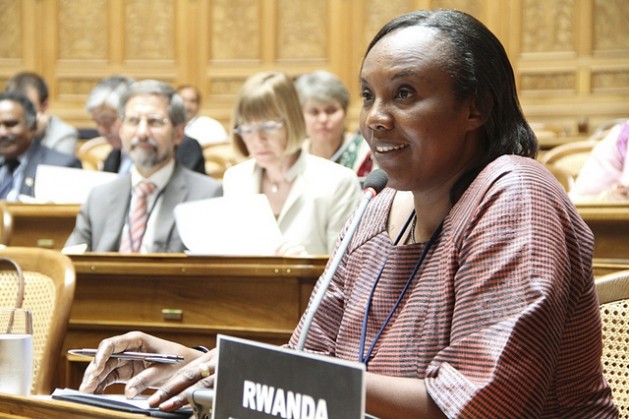
Rose Mukantabana served as Rwanda’s first Speaker of the Chamber of Deputies. The countries that achieved the greatest gender progress, between 1995 and 2015, in their single or lower houses of parliament are Rwanda, Andorra and Bolivia. Photo: Courtesy of Third World Conference of Speakers of Parliament
Rose Mukantabana served as Rwanda’s first Speaker of the Chamber of Deputies. The countries that achieved the greatest gender progress, between 1995 and 2015, in their single or lower houses of parliament are Rwanda, Andorra and Bolivia. Photo: Courtesy of Third World Conference of Speakers of ParliamentRose Mukantabana served as Rwanda’s first Speaker of the Chamber of Deputies. The countries that achieved the greatest gender progress, between 1995 and 2015, in their single or lower houses of parliament are Rwanda, Andorra and Bolivia. Photo: Courtesy of Third World Conference of Speakers of Parliament
Secretary-General Ban Ki-moon, a creature of the U.N.’s 193 member states and who serves at their will and pleasure, did not hesitate to fault 13 countries that kept women out of their national parliaments and governments in power.
“There are five countries in the world where not a single woman is represented in Parliament,” he complained before hundreds of women delegates gathered at the United Nations, “and there are eight countries in the world where not a single woman is a cabinet member.”
And then he went soft – refusing to name and shame them.
“I would not disclose the names here of those countries. I would strongly urge the leaders of those countries to change this unacceptable situation,” he said, speaking Monday at the opening session of the Commission on the Status of Women (CSW), the primary intergovernmental body mandated to promote gender empowerment.
But the Geneva-based Inter-Parliamentary Union (IPU), a global organisation of national parliaments, did not hesitate in singling out the 13 countries by name.
As of January 2015, the five countries without a single woman in their national parliaments include the Federated States of Micronesia, Palau, Qatar, Tonga and Vanuatu.
And the eight countries with no women in ministerial positions include Bosnia and Herzegovina, Brunei, Hungary, Pakistan, Saudi Arabia, Slovakia, Tonga and Vanuatu.
John Hyde, acting executive director of the Asian Forum of Parliamentarians on Population and Development, told IPS the United Nations and parliaments have to be open about failures to bring about equal opportunity and gender parity in parliament and the political process.
The Women’s Standing Committee of the Asian Forum of Parliamentarians on Population and Development, he pointed out, has backed moves to introduce quotas for parliaments as a proven intervention to lift female participation initially.
“In our Asia-Pacific region, we have to honestly acknowledge that we have two parliaments, Tonga and Vanuatu, without any women members of parliaments (MPs),” Hyde said.
Yet, he noted, Timor-Leste, one of the least developed nations in Asia-Pacific, has 38 per cent women MPs, assisted by a quota, exceeding developed democracies like Australia, New Zealand and Japan.
According to the IPU, all regions registered some increase in their share of women in parliament, the greatest strides being made in the Americas.
The countries that achieved the greatest progress, between 1995 and 2015, in their single or lower houses of parliament are Rwanda, Andorra and Bolivia.
In 1995, eight of the top 10 countries were European and five of those were Nordic, leading the IPU to create a separate category for this sub-region.
In 2015, IPU said, there is greater regional balance: four of the best performing countries are in Africa (Rwanda, Seychelles, Senegal and South Africa) and three are in the Americas (Bolivia, Cuba and Ecuador).
Only three states – – Sweden, Finland and Seychelles — made the top 10 in both 1995 and 2015.
In a 20-year review of ‘Women in Parliament”, IPU said over the last 20 years, countries around the world have made substantial progress towards a 30-percent goal set by the 1995 Beijing Women’s Conference.
The global average of women in national parliaments has nearly doubled, from 11.3 percent in 1995 to 22.1 percent in 2015.
Still, “2014 saw little progress in the percentage of women in national parliaments worldwide, with the global average rising only by 0.3 points, begging the question: have we reached the glass ceiling?”
According to IPU, there are only 19 women heads of state (HS) and heads of government (HG) out of the 193 member states: Argentina (HS/HG), Bangladesh (HG), Brazil (HS/HG), Central African Republic (HS), Chile (HS/HG), Croatia (HS), Denmark (HG), Germany (HG), Jamaica (HG), Latvia (HG), Liberia (HS/HG), Lithuania (HS), Malta (HS), Norway (HG), Peru (HG), Poland (HG), Republic of Korea (HS), Switzerland (HS/HG) and Trinidad and Tobago (HG).
Yifat Susskind, executive director at MADRE, an international women’s human rights organisation working with activists in Asia, Africa, the Middle East and Latin America and the Caribbean, told IPS it’s time to move beyond pretty rhetoric.
“We must compel our political leaders to answer harder questions,” she said.
Just how are they opening the political space for women to bring solutions to the table? How are they measuring progress for women? How are they implementing gender legislation, so that it moves from paper to practice? asked Susskind.
“To answer these questions, we can’t gloss over hard realities, as he did when he refrained from naming countries falling short on women’s political participation. To reach the goal of 50:50 by 2030, as the secretary-general stated, we need to shed light on what is working and what is not, learn those lessons quickly, and move to action,” she declared.
The secretary-general told women delegates that empowered women and girls are the best drivers of growth, the best hope for reconciliation, and the best buffer against radicalisation of youth and the repetition of cycles of violence.
“There have been important advances since the Beijing Conference. More girls have attained more access to more education than ever before. Maternal mortality has been almost halved. More women are leading businesses, governments and global organisations,” he said.
“At the same time, progress remains unacceptably [slow], and our gains are not irreversible,” he noted.
“We must build on the Beijing foundation and complete our work. I challenge all stakeholders to work together to achieve gender equality during the timeframe set by the new development agenda. Our goal must be 50:50 by 2030,” Ban said calling for parity between men and women.
MADRE’S Susskind told IPS the global women’s movement has succeeded in altering the terms of conversation.
“Now, world leaders are more ready to acknowledge that gender equality must be a priority. Some, like the secretary-general, are willing to say that women hold valuable solutions,” she added.
African Paradise Restaurant Opens in South Minneapolis
All week long, tantalizing aromas have been wafting from the doors of African Paradise Restaurant as they’ve rehearsed for their grand opening, Friday, March 20. The freshly painted walls and ceiling finished from earthy ocher pigments and ample seating split between the sunny front window and the shadowy, more intimate back section provided a choice for dine-in customers.
I had the luxury of a sneak-peek sampling from their Mediterranean platter. A large rectangular dish arrived at my table filled with grilled beef and chicken cubes seasoned mildly. Mixed in with the meats were bell peppers and onions. Complementing the meat dish, a vegetarian entrée appeared with spiced peppers and black beans. Gingered rice finished the trio of food. African Paradise Restaurant chef took care to come out from the kitchen and describe the foods I was served. Pitchers of mango lassi accompanied the diners’ fare and rich cappuccinos capped the evening’s meal.
Idris Jumale, one of the partners and co-owners, still dressed in business attire from his day job was quick to roll up his sleeves and plunge in to serve customers and meet their needs. I look forward to my next visit with my family. I’m sure we’ll find something for everyone. While the menu’s relatively small, it caters to a wide cross-section of tastes and food-sensitivities.
Co-owner, Rashid Omar, pointed out the sidewalk space that will be used as another dining area when the weather warms. “It’s one of the few African restaurants with outdoor seating,” he said, which will be a welcome addition to the neighborhood.
African Paradise Restaurant is located at 2700 East Lake Street in Minneapolis across from the Lake Street Library. Dine-in or take-out are available with both indoor and outdoor seating as weather allows. Open daily 6 am – 11 pm.
Hugh Masekela and Vusi Mahlasela perform at Carnegie Hall last Fall as part of the 20 Years of Freedom tour. The tour made a stop at the Ordway Center's new concert hall in Saint Paul on Saturday, March 7, 2015 and Mshale's Kari Mugo was there to review the show. Photo: Courtesy of Hugh Masekela
Hugh Masekela and Vusi Mahlasela perform at Carnegie Hall last Fall as part of the 20 Years of Freedom tour. The tour made a stop at the Ordway Center's new concert hall in Saint Paul on Saturday, March 7, 2015 and Mshale's Kari Mugo was there to review the show. Photo: Courtesy of Hugh MasekelaHugh Masekela and Vusi Mahlasela perform at Carnegie Hall last Fall as part of the 20 Years of Freedom tour. The tour made a stop at the Ordway Center’s new concert hall in Saint Paul on Saturday, March 7, 2015 and Mshale’s Kari Mugo was there to review the show. Photo: Courtesy of Hugh Masekela
It goes without saying that Hugh Masekela and Vusi Mahlasela delivered an outstanding performance as part of the Ordway’s celebration of its new concert hall, dubbed ‘Rock the Ordway’. We would expect nothing less from the two individually, but as a duo they are quite simply exhilarating; complementing each other in that way great partnerships do. But even before Mahlasela had uttered a single tone, or Masekela had given breath to his trumpet, the show had began much earlier in a stroll through Rice Park and into the renovated Ordway Center for the Performing Arts.
St. Paul does not get all the love it should, and that’s not because it’s lacking but because it’s got a rowdier bigger sister who hoards all the attention- Minneapolis. So whenever I find myself in downtown St. Paul, it’s a pleasant remembrance of just how charming the city is. The Ordway’s guest entrance sits facing Rice Park, which is surrounded on all four sides by old world architectural charm. The real treat though is the thousands of lights that drape the trees in the winter and are a beautiful sight both from outside and inside the large glass windows occupying the front wall of the Ordway. As we walked into the foyer, there was buzzing energy and plenty of attendants on hand, as people milled around for the two scheduled performances for the night.
With tickets on the second floor of the brand new hall, we had an impressive view of the stage and its signature rolling wood ceiling. The ceiling designed to amplify sound was complemented by upholstered audience seats, and unassuming white walls, giving the hall a light, clean, and open feel. I can also happily report that there indeed is no bad seat to be found. With each seat no more than 100ft from the main stage, and an acoustician employed in the designing process, the space was created with utmost consideration for the guest experience.
As the crowd settled in for the show, Mahlasela appeared on stage with his guitar, opening the show with a song on the beauty of Africa’s land, sang in Zulu and Xhosa. He was soon joined on stage by Masekela, who was warmly received by the crowd, as the bigger of the two stars. The rest of the band poured out to take their positions- composed of all Africans and an impressionable mastery of their instruments that sounded as natural as Mahlasela and Masekela’s talents. The two artists dedicated the show to the “grandfathers of humanity who taught forgiveness” such as Desmond Tutu, Nelson Mandela and Mahatma Ghandi, as they talked about the 20 + years since the end of apartheid.
Setting the tone for most of the night, they joked about their 20 Years of Freedom tour, which Masekela said felt more like “The Great Arctic Tour,” drawing laughter from the audience. Masekela and Mahlasela then embarked on a musical and storytelling journey through the depths of apartheid, and its political and creative oppression. In song and impassioned messages they spoke of the freedom fighters and ordinary citizens who had protested aparthaid, the heroes and dreams that were realized, and the continued commitment to ensure that “never again” would South Africa have a society in which others were oppressed by one group.
In song and instrument, Masekela and Mahlasela were dedicated performers, covering their hits as well as songs that had been part of the anti-apartheid struggle, and that spoke to issues that still faced Africans. Speaking to the dangers the mining industry still poses in “Stimela” (“Coal Train”), Masekela spoke in English about the trains carrying African laborers to backbreaking jobs in the mines. As the song drew to an end, Masekela who had mimicked the movement of a train with his body, released screeching like brakes and train whistles that signaled the trains movment and left chills on my arms.
He played his signature fluegelhorn and various instruments throughout the performance, while Mahlasela alternated between his guitar and his hearty voice that carried into every corner of the room. Mahlasela opened his song, “Sing Now Africa” with a reflection on Africa’s fate being decided by people outside of Africa and invited the audience to consider whether Africa should receive aid. His conclusion, “We deserve that aid because Africa has been given aid to others for centuries.” The song, telling Africans to rise up had lyrics in Kiswahili and proved why Mahlasela had earned the name “The Voice.”
The show was filled with jabbing phrases, jokes, and singalongs, and grooves that made you want to move. On stage, the two artists were not shy about moving to the music. In synchronized and solo dances, they entertained the crowd, with Masekela inspiring great whoops as he repeatedly twisted himself on stage. All around the hall, solo and duo dancers in the audience who could not resist the urge to move either, could be spotted. Sensing the energy in the room the two artists invited the audience to dance with them, moving everyone to their feet for the last 3 songs of the night. The mixed crowd gladly moved their bodies to the beat of the music, working up a sweat and demanding an encore when the artists left the stage, which they gladly provided.
The performance and the Ordway delivered beyond expectations and for this young African, it felt like an evening with a distant uncle and a grandfather who were in town visiting. From the song Ubuntu, this lyric sums it up, “I might be walking in a city called London, but the dust on my feet and the rhythm of my boots say Africa.”
The African Awards Gala will be held at the Minneapolis Convention Center on Saturday, October 10 2015.
The African Awards Gala will be held at the Minneapolis Convention Center on Saturday, October 10 2015.The African Awards Gala will be held at the Minneapolis Convention Center on Saturday, October 10 2015.
Mshale, organizer of the African Awards announced today that they have reached agreement with the Minneapolis Convention Center to hold this year’s Awards gala at the venerated space on Saturday, October 10.
This will be the fifth anniversary of the highly esteemed Awards which has seen attendance grow from the original 150 when CNN personality of American Morning, Lola Ogunnaike, keynoted, to the 400 that attended the third edition three years ago when former White House Social Secretary, Desiree Rogers was the keynote. The fourth edition was held in conjunction with Books for Africa’s 25th anniversary gala. Mshale founder, Tom Gitaa, a former Books for Africa board president said at the time holding the African Awards in conjunction with Books for Africa’s gala was in deference to the revered organization. He was also the 25th anniversary BFA planning committee co-chair with Doris Pagelkopf, a retired United Way executive. Popular Ghanaian actor and winner of the 2012 African
Academy Movie Awards Best Actor, Majid Michel, keynoted the last African Awards.
The African Awards are designed to honor excellence and community service in the US African immigrant community. The public nominates honorees, who then are narrowed down to three per category in the seven eligible categories by a panel of judges. The public then votes for the eventual winner of each category.
“We have moved to a larger venue since we have sold out so far in previous years and this year being a milestone with five editions of the Awards, we expect heightened interest from the community especially once we reveal this year’s keynote speaker,” said Gitaa. “It will be hosted at the Minneapolis Convention Center to create a celebratory but equally formal atmosphere.”
Dahil Republic of Couture, which returns to New York Fashion Week this year, will be the main feature of the fashion show at the 5th edition of the African Awards. The full entertainment lineup is still being finalized.
Judges Panel Complete
The all important Judges’ Panel for the African Awards is also complete. South African-born, Leon Rodrigues, Chief Diversity Officer for the Minnesota State Colleges and Universities (MNSCU) System, has joined the panel. He takes the place of Joash Omandhi, whose increased transatlantic business travel will impede his ability to fully participate.
Rodrigues will join the other two judges to complete the panel. The other two are Ghana-born Godson Sowah, a CPA and manager in the Advisory practice at Ernst & Young, LLP. Sowah is also president of the National Association of Black Accountants, Minnesota Chapter. Fatima Mohamed, is the co-founder of Egart Foundation and a board member of the Minnesota Somali Chamber of Commerce.
“We are very lucky to have this calibre of judges during this important fifth anniversary milestone and welcome Leon to the African Awards community,” said Gitaa.