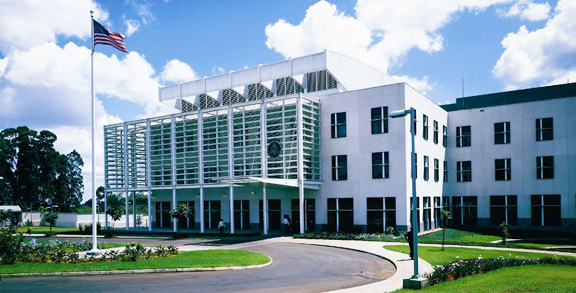
This US Embassy in Nairobi, the largest in Sub Sahara Africa, was one of the gateways for the 18,000 Africans who won the Green Card visa lottery in 2012. Congress is debating phasing out the program in 2014. Photo: Courtesy US State Dept.
This US Embassy in Nairobi, the largest in Sub Sahara Africa, was one of the gateways for the 18,000 Africans who won the Green Card visa lottery in 2012. Congress is debating phasing out the program in 2014. Photo: Courtesy US State Dept.This US Embassy in Nairobi, the largest in Sub Sahara Africa, was one of the gateways for the 18,000 Africans who won the Green Card visa lottery in 2012. Congress is debating phasing out the program in 2014. Photo: Courtesy US State Dept.
Around 100,000 people will be chosen from several million hopefuls to get a US Green Card on Wednesday, in what could be the last year of the annual lottery, slated to vanish under proposed reforms.
Each year, 50,000 permanent residency permits are allocated to people from countries that see relatively few emigrants depart for the United States.
Created in 1995, the lottery system aims to diversify the range of places from which people migrate to the United States.
It’s a wildly popular program, prompting millions of applicants — a figure that has only grown in recent years.
But it has long been in the crosshairs of US Republican lawmakers, who control the House of Representatives and say it adds no value to the economy.
Now, they have included a plan to scrap it in the comprehensive immigration reform plan currently being debated in Congress.
A final vote on the reforms is not expected before this summer, but if it passes, the diversity visas would vanish from next year.
Not that this year’s crop of hopefuls knew, when they applied, that this might be their last chance.
To enter the draw for 2014, would-be immigrants needed to file a free online application in October 2012.
From 1600 GMT on Wednesday, the candidates will finally be able to check their status on the government website www.dvlottery.state.gov, using their personal confirmation number.
Some 100,000 names will be selected in a first round, because not everyone will complete the process for a visa, and a maximum of 50,000 green cards will ultimately be given out.
In the 2013 lottery, 7.9 million people, with 4.6 million spouses and children, submitted applications.
More than 18,000 Africans, more than from any other continent, got Green Cards through the lottery in 2012. Half of the lottery is reserved for applicants from the continent, which could now lose out.
Countries that sent more than 50,000 immigrants to the US in the past five years are excluded from the lottery.
This year, that includes a range of countries, including Bangladesh, Brazil, Canada, mainland-born China, Mexico, Pakistan, South Korea, and Britain (except Northern Ireland).
The 2014 winners will be given interviews from October, where they will have to show proof of a high school diploma or at least two years of work experience, as required under the program.
Aging undocumented Immigrants - a burden or a boon?
As the debate over immigration reform tugs predictably back in Washington, an undercurrent of ageism and disability bias has been flowing beneath more obvious racial and class implications.
Take, for instance, the recent USA Today op-ed co-authored by former U.S. Sen. Jim DeMint, R-S.C., now president of the conservative Heritage Foundation, which warned, “The truly enormous costs come when unauthorized immigrants start collecting retirement benefits.”
DeMint and his colleague continued, “Social Security, Medicare, food stamps and other entitlement programs already impose huge, unfunded liabilities on taxpayers.” The op-ed goes on to declare that “an amnesty” proposed for 11 million unauthorized immigrants will add significant taxpayer costs because unauthorized immigrants average only a 10th-grade education.
Doing the Right Thing
Rather than being a burden, however, according to the Social Security Administration’s chief actuary, those presumed drains on the system have been a boon. They add $15 billion a year to Social Security in payroll taxes, only taking out $1billion annually in benefits. In the long term, immigration reform would modestly cut Social Security’s deficit, not worsen it.
According to Pew Research, that’s partly because of future rising income and home ownership levels for those immigrants’ children.
“Those opposed to immigration reform have attempted to use vital programs, like Social Security, as an economic excuse to avoid doing the right thing,” said Max Richtman, president and CEO of the National Committee to Preserve Social Security and Medicare (NCPSSM).
In a policy brief last week, NCPSSM cited Edward Alden of the Council on Foreign Relations, who has said that immigration reform would actually lead to higher wages and allow immigrants to pay more towards Social Security.
“They’re going to pay more into the Social Security system. The CBO has run these numbers in the past, in the short-run there’s a big boost for the Social Security system,” Alden said
White House and Senate ‘Roadmaps’
According to a new policy analysis by the National Hispanic Council on Aging (NHCOA) and National Council on Aging (NCOA), today’s approximately 11 million unauthorized immigrants include 1.3 million individuals ages 45-54, and another half million who are 55 and older.
NHCOA’s Jason Coates and NCOA policy analyst Joe Caldwell examined “roadmaps” to citizenship outlined so far by the White House and the Senate’s bipartisan “Gang of Eight,” with legislation to come in a few months.
Both proposals signal long waits before eligible immigrants could even apply for lawful permanent resident status (green cards) and citizenship. And their access to health care and economic security benefits, especially important to elders and those with disabilities, is in doubt.
Under the current proposals, unauthorized immigrants could end up waiting a decade or more to qualify for health care and other safety-net programs.
While the Senate plan would link the waiting period for being able to apply for green cards to some assurance of border security, the White House has proposed allowing undocumented immigrants provisional status for six-to-eight years before they could become permanent residents. (Both the administration and Senate frameworks would expedite the process for “DREAMers,” agricultural workers, and highly skilled immigrants with advanced degrees in such areas as science and technology.)
Once an immigrant waited through those years on provisional, or temporary status and qualified for a permanent status (the green card), he or she would begin the five-year process toward naturalization. During that time, the White House and Senate proposals would deny them access to federal benefits, such as Medicaid, Supplemental Security Income and the Supplemental Nutrition Assistance Program (food stamps). President Obama’s proposal would deny access to subsidies under the Affordable Care Act. People could have to wait more than a decade for assistance.
Older adults would also have to wait that long to access Medicaid, which is the primary payer of long-term care in the U.S. States can waive the five-year waiting period normally required once someone becomes a permanent resident, but only for pregnant women and children, not for individuals with disabilities or seniors.
Statistics show that six-in-ten undocumented Hispanics is without health insurance.
They would also have to wait another five years — that is about a decade after starting on the path to citizenship — to qualify for federal Medicare.
Many of those 11 million undocumented people are overrepresented in low-paying and often physically demanding occupations, frequently incurring high rates of work-related injuries, and contributing to high rates of disability and chronic conditions over time.
Looming Shortage of Care Workers
The NHCOA-NCOA report also calls on the government to strengthen and stabilize the shrinking direct-care workforce, such as the nursing aides who assist patients with such crucial daily activities as getting dressed, taking medication, preparing meals and managing money.
The advocacy groups say reforms should afford these workers the same streamlined and expedited visa process as those proposed for scientists, engineers and workers in other high-need areas, because the nation is facing a looming shortage of care workers.
The paper explains that as the U.S. population ages, U.S. demand for long-term care will leap from today’s 12 million to 27 million by 2050. The country will need 1.6 million additional direct-care workers by 2020 and 3 million by 2030.
Immigration reform is vital for meeting that projected need, say NHCOA and NCOA, because almost one in four current direct-care workers is foreign born. About half today are naturalized citizens and others have legal status, “but a significant portion is estimated to be unauthorized.”
Policy changes offering these workers authorized immigration status would improve the quality of care, says the paper, by allowing for improved background checks, providing workers opportunities for training and career advancement, building registries to assist individuals and find workers, and enabling workers to legally drive.
“Comprehensive immigration reform will help millions come out of the shadows. Many of the half million older adult immigrants [among them] have worked for decades and contributed millions to Social Security,” said NHCOA’s Jason Coates. Rather than begrudging them income and health security protections they have earned, he added, “We should reward their contributions to the to the United States.”
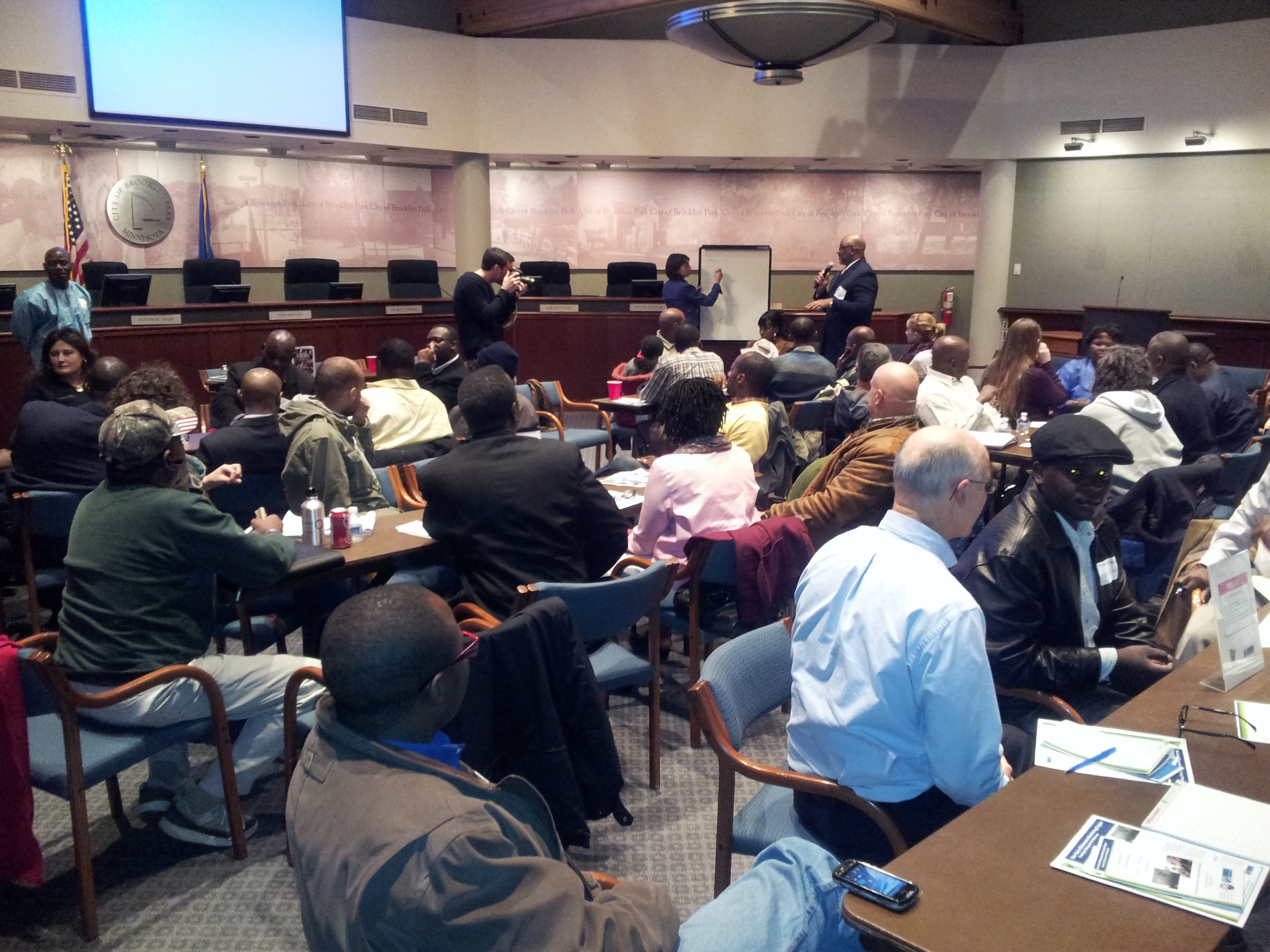
Participants at a November 15, 2012 event organized by African Immigrant Services (AIS) and The Advocates for Human Rights for the Voice Minnesota Monitoring Project at the Brooklyn Park City Council chambers. Photo: Tom Gitaa/Mshale
Participants at a November 15, 2012 event organized by African Immigrant Services (AIS) and The Advocates for Human Rights for the Voice Minnesota Monitoring Project at the Brooklyn Park City Council chambers. Photo: Tom Gitaa/MshaleParticipants at a November 15, 2012 event organized by African Immigrant Services (AIS) and The Advocates for Human Rights for the Voice Minnesota Monitoring Project at the Brooklyn Park City Council chambers. Photo: Tom Gitaa/Mshale
The African Immigrant Services (AIS), in collaboration with the Diversity and Equity Department of North Hennepin Community College (NHCC ), Brooklyn Park’s Diversity Team, and the Northwest Civic Engagement Coalition, will host and facilitate a community civic engagement conversation on Thursday May 9, 2013, at Brooklyn Park’s City Council Chambers, in Brooklyn Park, Minn.
The conversation will begin at 5:45 p.m. to 7:45 p.m.
Rescheduled from April 11 to May 9, due to inclement weather conditions, the event will provide an opportunity for the community to sustain an on-going conversation on how best to increase the quality of civic participation among African immigrants and other underrepresented groups in the Northwest suburbs of Hennepin County. Designed to help shift the roles of participants from observers to active leaders, the conversation will also involve an action session, allowing for participants to match their interests to existing civic opportunities and community causes.
“We are excited to work with a diverse group of stakeholders to create new possibilities for increased civic engagement within our communities of color in the Northwest suburbs,” said Abdullah Kiatamba, executive director of AIS. “This is a great opportunity to identify and motivate new leaders, to help address some shared challenges and to make our communities more inclusive.”
The conversation, employing the Art of Hosting, as well as other culturally competent participatory methods, will seek to create an environment that facilitates a collective exploration of diverse knowledge and wisdom inherent in community engagement.
“This community conversation forum is an excellent opportunity to develop and support diverse leaders, as well as work with our community to achieve our goals of providing solutions to real and perceived barriers to opportunities,” said Elizabeth Tolzmann, Brooklyn Park Community Engagement Coordinator. “This collaborative effort among various organizations is a significant stepping stone in the community’s desire and commitment to make Brooklyn Park a thriving community inspiring pride where opportunities exist for all.”
The planning team, comprising community leaders and activists, will use the outcomes of the event to help inform and strengthen a pathway from disengagement to sustained community engagement in the Northwest suburbs.
Funded by a modest grant from the Bush Foundation, the event also enjoys the support of a diverse group of community sponsors, including The Advocates for Human Rights, Pro-USA, Inc., Organization of Liberians in Minnesota (OLM), and the Guinean Association in Minnesota.
African Community Civic Engagement Conversation Thursday, May 9, 2013 5:45 p.m. – 7:45 p.m. Brooklyn Park Council Chambers 5200 85th Avenue North, Brooklyn Park, MN 55443
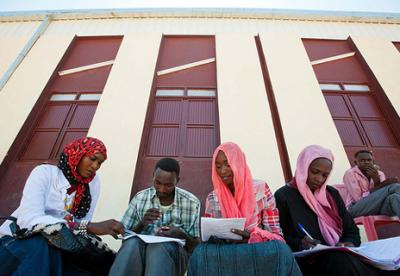
Students hang out outside a lecture room of the University of El Geneina, West Darfur. Photo: Albert González Farran/UNAMID.
Students hang out outside a lecture room of the University of El Geneina, West Darfur. Photo: Albert González Farran/UNAMID.Students hang out outside a lecture room of the University of El Geneina, West Darfur. Photo: Albert González Farran/UNAMID.
Casual readers of optimistic headlines about Africa’s high growth rates and record levels of foreign investment might be forgiven for thinking all is well on the continent – or at least that, with ‘Africa Rising’, all will be well before too long. But many of the perspectives and figures underlying these simplistic narratives obscure the complex reality of rising inequality, success in only certain specific sectors, and – crucially – jobless growth.
Indeed, on the continent itself, there is a rising sense that Africa’s growth isn’t creating enough jobs for the millions entering the labour market each year. By some estimates, 50% of young people in South Africa, and 40% in Kenya and the DRC, are unemployed. In Nigeria, approximately 30 million youths are jobless. And the International Labour Organisation estimates that in 2012, 247 million workers in sub-Saharan Africa were in vulnerable employment. Also worrying is the fact that having an education does not seem to help. In response to an advert for 100 drivers in Nigeria last year, the Dangote Group received 13,000 applicants including 8,460 with bachelor degrees, 704 with masters and 6 with PhDs. With Africa’s youth population expected to double by 2045, this could prove to be a ticking time bomb; one only needs to look at the likes of Tunisia and Egypt for a forewarning of what a growing numbers of highly-educated unemployed young people can lead to.
Broadly-speaking, there are two ways of looking at the problem: 1) the economy’s demand for labour isn’t sufficiently strong to generate enough jobs because growth isn’t fast enough and/or the sectors which are growing are not labour intensive enough; or 2) the supply of potential workers isn’t appropriately educated and skilled for the jobs that could be available.
In reality, both are true. However, the latter can influence the former, and it is the latter to which we will now turn.
Seeking studies overseas
As high levels of unemployment amongst graduates suggests, African universities are churning out armies of job seekers rather than job creators. Higher education does not even appear to be correlated with higher employment in a number of places. In Uganda, for example, 19% of Ugandan graduates are unemployed, compared to 7% of secondary school leavers. And in Nigeria, graduates are 5% less likely to be employed than those with just a basic education.
Cape Town played host to the Breathe Sunshine African Music Conference, a new venture into the development of music produced on the continent.
Held in the centre of Cape Town at City Hall, the two-day symposium sought to facilitate the transfer knowledge between artists while fostering a strong spirit of collaboration.
The primary aim of the conference was the promotion of information between members of the African music industry through workshops, panel discussions, presentations, networking and live music nights showcasing African talent.
According to conference founder Trenton Birch of Black Mango, the event attracted a diverse audience from the local community, national visitors, other African countries as well as European and American delegates working with African music in their respective territories.
Networking was actively encouraged and attendees were well-catered to.Newcomers could attend workshops that would help them navigate the early stages of entering the music industry while executives seeking to hold high level discussions could retreat to a private lounge.
Upcoming and professional artists held three to two-hour workshops per day titled Urban Music (hip-hop, kwaito, house); Technical Master Class (music production); Marketing for Artists; Event Production (planning events; AV, visuals and live performance) Contracts and Publishing; Making a Music Video.
Local and international industry leaders pioneered discussion panels pertaining to the future of the African music industry, the role played by the media and the development of digital technologies.
The steering committee included representatives from Ghana, Kenya, Mozambique and Senegal, as well as local talent like Roach Roth of African Dope, Mthokozisi Khathi aka DJ Tira of Afrotainment and Suga from Heart FM radio station.
Among the noteworthy panels, Ready D, a South African hip-hop DJ best known for the breakthrough hip-hop group Prophets of the City in the 1990s, discussed aspects of hip-hop culture. He shared the stage with some other big names in local hip-hop like Azuhl, Adam Haupt, E20, Scratch Lab, Youngsta, Uno and Shameema.
Also spearheading the hip hop Master Class workshop was Emile YX?, a rapper, breakdancer and capoeira artist from Black Noise, one of South Africa’s premier hip hop groups. He gave lessons and guidelines on how to succeed in the music industry. Emile YX? founded and runs the Heal the Hood NGO who work to keep young people out of gangs and off the streets through B-Boying.
Also included in the workshops was Red Flag, a communications agency servicing the music industry. The agency offered delegates pointers on marketing and public relations.
The conference coincided with the renowned Cape Town International Jazz Festival, providing the perfect opportunity to engage and experience a week of the African entertainment industry through these two world-class events.
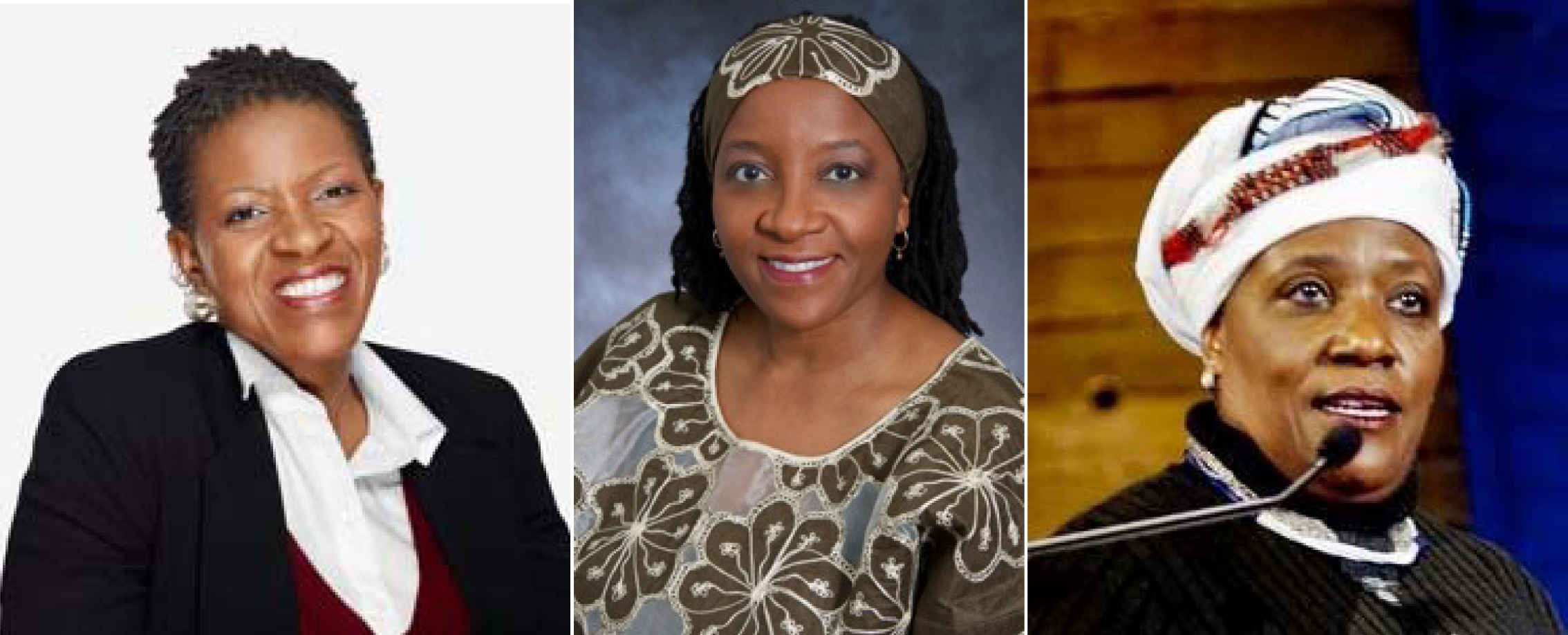
The Tutu Sisters, Rev. Mpho Tutu, Nontombi Naomi Tutu and Thandeka Tutu-Gxashe will appear on one stage for the first time in Minneapolis on April 23 and 24 as part of UROC's Critical Conversation series.
The Tutu Sisters, Rev. Mpho Tutu, Nontombi Naomi Tutu and Thandeka Tutu-Gxashe will appear on one stage for the first time in Minneapolis on April 23 and 24 as part of UROC's Critical Conversation series.
The Tutu Sisters, Rev. Mpho Tutu, Nontombi Naomi Tutu and Thandeka Tutu-Gxashe will appear on one stage for the first time in Minneapolis on April 23 and 24 as part of UROC's Critical Conversation series.
Three daughters of renowned South African social rights activist Archbishop Desmond Tutu will come together on one stage to discuss, enrich and debate in a dialogue for hope as part of the university’s Urban Research and Outreach-Engagement Center (UROC) Critical Conversation series.
The Rev. Mpho Tutu, race and gender activist Nontombi Naomi Tutu, and researcher Thandeka Tutu-Gxashe will be at Shiloh Temple International Ministries in Minneapolis on Tuesday April 23 at 6pm and at the University of Minnesota Coffman Union, Great Hall on Wednesday, April 24 at 2pm.
According to statement from the university, UROC is investing the next two years exploring the crucial topic of Trauma, Faith and Healing and how faith, consensus-building, and reconciliation play a role in healing a community spirit that has been wounded by violence, natural disaster or catastrophe.
Nontombi Naomi Tutu is a staple of important conferences in the twin Cities but this will be the first time all three sisters will be on one stage.
Both events are free and open to the public but online registration is required. Follow the links below to reserve your space.
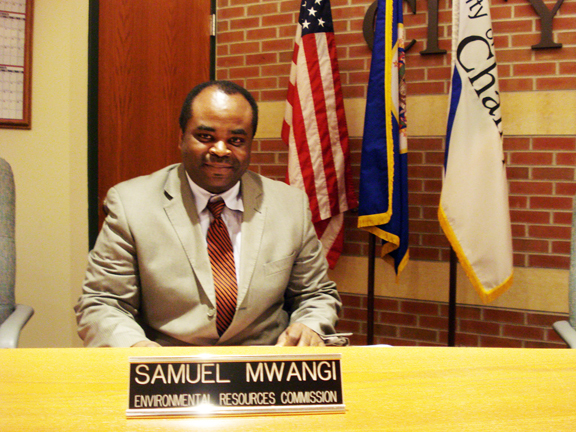
Samuel Mwangi, a hospitality industry veteran, has joined the City of Champlin's Environmental Resources Commission for a two year term.
Samuel Mwangi, a hospitality industry veteran, has joined the City of Champlin's Environmental Resources Commission for a two year term.Samuel Mwangi, a hospitality industry veteran, has joined the City of Champlin's Environmental Resources Commission for a two year term.
Samuel Mwangi, a hospitality industry veteran, has been admitted to the City of Champlin’s Environmental Resources Commission (ERC) as a commissioner representing the city’s Ward 4.The commission represents the citizens of City of Champlin, in addressing issues such as biodiversity, renewable energy, conservation, recycling, waste management, energy saving, environmental pollution and waste water treatment etc.
A suburb of Minneapolis, Champlin is one of the wealthiest cities in the state with a median household income of $80,000 according to the 2010 US census and a young population to boot with a median age of 36. 86% of the residents in the city own their homes.
“I look forward to representing the residents of Champlin in making sure we continue to have a high quality city to call home,” he told Mshale in a statement. He said the ERC is one of the important commissions the city has, given its quality of life focus. His interest in the commission was influenced by his background. In his home city of Nairobi he founded a garbage and recycling collection company serving suburban homes, schools and corporate business.
He attended Kenya’s prestigious Strathmore University and the Kenya Institute of Management. He holds a Bachelor of Science Degree from Metropolitan State University in the Twin Cities.
Beyond serving the residents of Champlin, Mwangi is also the executive director of Global Fatherhood Foundation which he said has a goal “to empathize, and create a personal involvement, and a positive influence of an involved father.”The foundation is also active in Anonymous Support Programs, Financial Counseling, and has a signature program of encouraging young male adults to stay in school and steer clear of drugs while instilling the spirit of volunteerism in them.
The Environmental Resources Commission consists of seven commissioners and the Town Clerk. Mwangi will serve for two years.
He is married to Anne Mwangi and they have three children.
Is your Non-profit status current or has it been revoked?
It has been a few years now since the Internal Revenue Service’s ruling that all non-profits must file their taxes. Those non-profits that failed to file their taxes for three consecutive years have had their status automatically revoked. Although the regulation that engendered this reaction was not enacted this year, the impact is now being felt in the broader community.
Non-profits are typically run very leanly, by volunteers or staffs who have to juggle so many activities. Little wonder why and how so many critical functions to their continued existence are left undone or forgotten. It is not surprising too that the wave of revocations of non-profit status is hitting the non-profit community and many non-profit organizations do not even know that status and that they may be operating out-of-status. Aside from the obvious implication of holding out as an IRS exempt organization when such status has been revoked, other negative consequences are attendant to this scenario, such as:
Failure to get support from grantor agencies and other benefactors – no one wants to donate to an organization that is out of status.
Impression provided to stakeholders that the non-profit organization is ineptly operated.
Lack of capacity to provide the tax-exempt benefits to current and potential donors.
The work of the organization may be forced to be curtailed; consequence of revenue loss.
More!
If your organization is facing this challenge, and understanding that your mission is important, a review is important and work towards regaining the tax-exempt status should be undertaken. The tax filing requirement by the IRS has also revealed that most non-profit organizations are not properly structured which might contribute to the lax approach to required regulations.
Non-profit organizations looking to regain their status need to ensure that their past due tax returns are filed and updated, especially if they need a retroactive continuation of their exempt status. While each circumstance is different, every non-profit organization needing to regain their exempt status must file a new application for such and pay the necessary fees. It is important to have your accountant review your books and contact your attorney to ensure that your documentation and process are properly done.
In our practice, we provide our clients an assessment of their organization in light of the processes they need to stay in compliance and effective as well as advise whether their structure is best for them to achieve their mission. Contact us if you do not know your status or to help get your organization back on track if your status has been revoked.
In the wake of the November 2012 election, this year is an ideal time for Congress and the President to agree on a specific plan to fix the nation’s broken immigration system. For the first time since 2007 (when the last comprehensive immigration bill stalled and failed to pass), the Senate is set to introduce legislation that provides a pathway for undocumented immigrants living in the U.S. to become citizens or permanent residents.
Proposals for Immigration Reform
There are now at least three different proposals for immigration reform:
1) The Senate Gang of Eight’s proposal includes a 10-year waiting period in provisional status before undocumented immigrants could apply for lawful permanent resident status (green cards), but allows them to apply for citizenship after only three years.
2) The House’s proposal permits undocumented immigrants to apply for green cards after 10 years, with naturalization possible 5 years after that.
3) President Obama has prepared a plan that permits a five-year path to citizenship to begin after eight years of provisional status.
All proposals require the applicants to meet certain requirements such as paying fines and back taxes, passing criminal backgrounds checks, and learning English and American civics to qualify for lawful permanent resident status. All proposals also seem to agree that DREAMers –individuals who qualified for Deferred Action for Childhood Arrivals (DACA) – should not be punished and should have a shorter path to citizenship.
To qualify for provisional status, the applicants will likely need to meet the following requirements:
Have arrived in the United States at least 5 to 8 years before the legislation becomes law.
Have continuously resided in the United States for at least five years preceding the date of the legislation.
Have not been convicted of a felony offense, a significant misdemeanor offense, or multiple misdemeanor offenses, or do not otherwise pose a threat to national security or public safety.
Pay a fine.
Pay back taxes through current year.
Possess good moral character.
Provisional status would allow immigrants to legally work in the United States with a work permit or a similar document, which they could use to further obtain a driver’s license and a social security number. With provisional status, immigrants would be able to emerge from the shadows and lead a normal life in the U.S.
Qualifying applicants should apply for DACA because this could put them on the fast track or allow them to bypass certain other requirements for citizenship. Furthermore, DACA currently provides various benefits for young undocumented immigrants, such as a work permit, driver’s license and social security number.
While there is bipartisan effort to achieve immigration reform, there is disagreement between the parties on a few divisive issues. For example, 73% of Democrats support a path to citizenship for undocumented workers, while only 35% of Republicans do. President Obama and most Democrats want to approve immigration reform this year, but Republicans seem to want more restrictions and modifications that could delay the process.
Senate Leads the Charge for Immigration Reform
Although it is uncertain when immigration reform would take effect, the Senate plans to introduce its bill next week. Senator Marco Rubio (R. FLA) stated that the Gang of Eight’s legislation “will only be a starting point” that will be considered and modified by Senate as a whole. The bill would likely be voted on by the fall of 2013 and take effect by the end of the year.
The Senate’s bill includes a new “W visa” program that would permit businesses to hire low-skilled workers. In particular, it would allow 200,000 foreign national workers a year into the country to fill jobs in construction, hospitality, nursing homes, and other areas where employers generally find it difficult to hire Americans.
The bill calls for monitoring 100% of the U.S.-Mexico border and stopping 90% of those attempting to cross in certain high-risk areas. It requires employers to use E-verify to check employees’ immigration status after a five-year phase in period. It proposes the installment of a new electronic system to monitor everyone who departs the U.S. through airports and seaports, in an effort to identity those who overstay their visas.
The Obama administration and Congress seem to be heading in the right direction for comprehensive immigration reform. There are still, however, hurdles to overcome and details to be ironed out. In the meantime, individuals who qualify for DACA should apply as soon as possible. And those who are likely to benefit from immigration reform should watch out for changes in the law and plan accordingly.
Nothing in this article should be taken as legal advice for an individual case or situation. The information is intended to be general and should not be relied upon for any specific situation. For legal advice, consult an attorney experienced in immigration law.
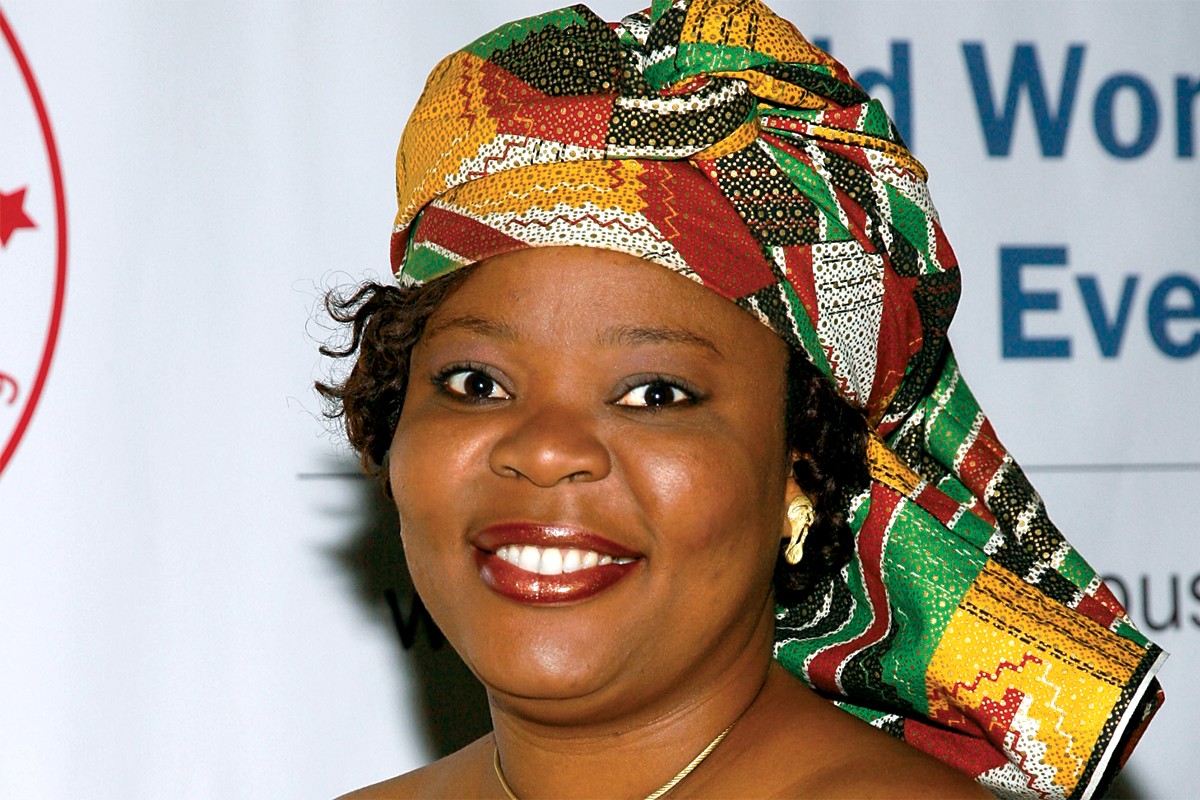
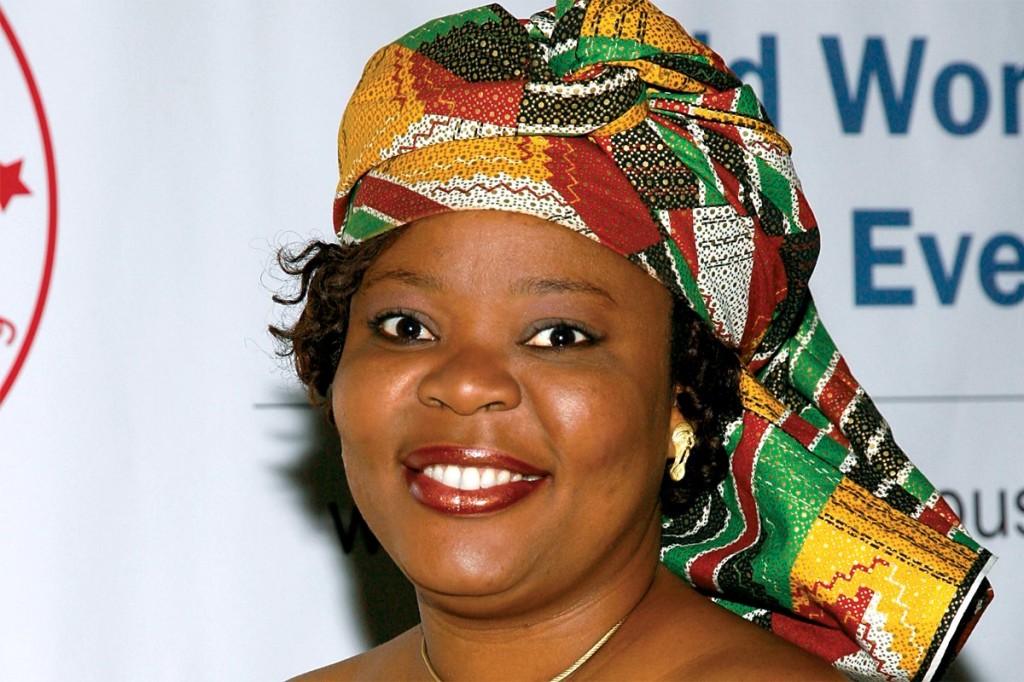
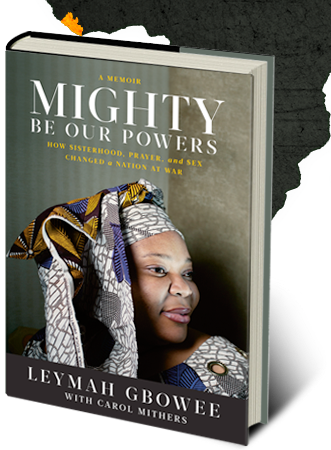
Liberian Nobelist, Leymah Gbowee will speak in Brooklyn Park, Minnesota on Saturday, April 27 2013
Liberian Nobelist, Leymah Gbowee will speak in Brooklyn Park, Minnesota on Saturday, April 27 2013Liberian Nobelist, Leymah Gbowee will speak in Brooklyn Park, Minnesota on Saturday, April 27 2013
Nobel Peace Prize recipient Leymah Gbowee of Liberia will speak at at the Prince of Peace Lutheran Church in Brooklyn Park as part of an annual two-day youth conference, PeaceJam, sponsored by the Minneapolis-based nonprofit youthrive.
Gbowee, an activist and social worker, was awarded the prize in 2011 alongside two other female peace-makers, Liberian President Ellen Sirleaf Johnson and Yemeni activist Tawakkul Karman, for their non-violent struggle for the safety of women and for women’s rights to full participation in peace-building work.
She is known for having united Christian and Muslim Liberian women in the quest for peace.
At her Nobel acceptance speech, she said“We used our pains, broken bodies and scarred emotions to confront the injustices and terror of our nation. We were aware that the end of the war will only come through non–violence, as we had all seen that the use of violence was taking us and our beloved country deeper into the abyss of pain, death, and destruction.” A peace agreement was reached in 2003.
Tickets for the event are available on the Youthrive website.
Liberian Nobelist Leymah Gbowee Talk Saturday, April 27 2013 7:00 PM – 8:00PM Prince of Peace Lutheran Church 7217 West Broadway Ave, Brooklyn Park, MN
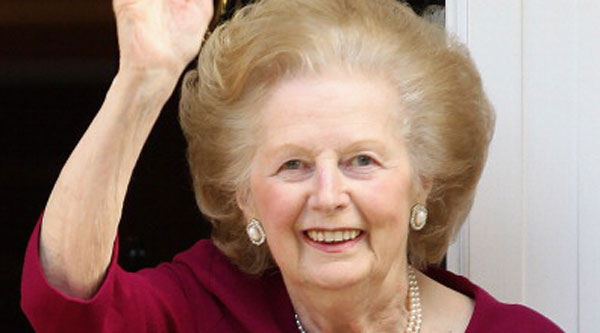
For Margaret Thatcher, few tears shed in South Africa
The late British prime minister once labeled Nelson Mandela’s political group a terrorist organization. Three years after Thatcher left office, Mandela became South Africa’s first black president.
JOHANNESBURG, South Africa — To Margaret Thatcher, the African National Congress under jailed leader Nelson Mandela was a “typical terrorist organization.”
When much of the world enforced sanctions on apartheid South Africa in the 1980s, Thatcher refused, instead pursuing a policy of “constructive engagement” with the country’s white minority government.
Now, after her death at age 87, the three-term British prime minister’s legacy is as polarizing in South Africa as it is in Britain, where the Manchester United soccer team decided not to hold a minute of silence before a Monday night game fearing the crowd response.
Thatcher’s rule began in 1979 and encompassed critical years before the release of Mandela and the collapse of the racist apartheid regime. While she always said she opposed apartheid, Thatcher has been dogged by criticism that her government’s efforts to counter it weren’t enough.
David Cameron, the current British prime minister, apologized for Thatcher’s policies on apartheid when he visited South Africa in 2006. Cameron said his Conservative party had made “mistakes” by failing to introduce sanctions against South Africa, and that Thatcher was wrong to have called the ANC “terrorists.”
Following news of her death, some South Africans on Twitter branded Thatcher an apartheid supporter, and took delight in the fact that Mandela, who is 94 and in poor health, has outlived her. Mandela was released from prison during Thatcher’s last year in office, and four years later became South Africa’s first black president.
“Mandela outlived Thatcher. 1-0 to FREEDOM! History is the ULTIMATE judge!” one tweet said.