Faces of the African Forest opens at the Minnesota Zoo
‘I love working in Africa,” Tara Harris said. “It’s an amazing place. You’d have at least one species of monkey in your front yard, and another in the back. In the morning you’d hear this 75-decibel ‘WHA! WHA!’ like a motorcycle engine revving, and they’d wake you up. But I’m so in love with them. They make me happy.”
She wasn’t working in Africa this week, but for the first time in her job as a conservation biologist at the Minnesota Zoo, the 32-year-old scientist at least has a reasonable replica: the “Faces of the African Forest” exhibit opening today, which features the charismatic black-and-white colobus monkey she studied in the African tropics.
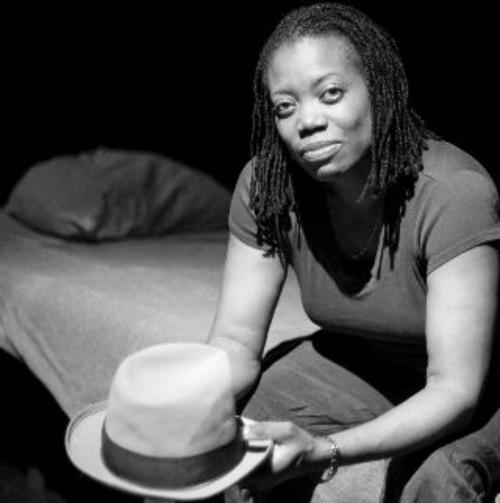
In 1902, playwright Cori Thomas’ grandparents emigrated from the United States to Liberia. There they built and founded a school – The Lott Carey Mission, where my mother and countless other Liberians have been educated and is in operation to this day. Cori’s father, David M. Thomas, Sr., joined the Liberian foreign-service. He spent over 30 years serving as a Liberian diplomat around the world.
On April 12, 1980, a violent military coup brought the country to a screeching halt. Many people were executed, including President William R. Tolbert and 13 members of his cabinet. Cori’s uncle was arrested and killed while in prison.
Ambassador Thomas, who was in the U.S. at the time, was ordered to return to stand trial. He refused and instead applied for political asylum in the U.S. He was named an enemy of Liberia and a traitor. He lost all his life savings which were held in Liberian banks. He was also forced to turn over the deeds to land he had bought. Life as he and his family knew it, and all privileges, vanished in an instant.
People sometime say that when something bad happens, you can’t go home again, but sometimes you must. So, 20 years later in 2000, Thomas, Sr., now 83, insisted on visiting Liberia, which was now in the midst of a devastating civil war. His daughter Cori accompanied him, where they found themselves detained and imprisoned by a machine-gun-toting14-year old ‘commander’ of the Armed Forces of Liberia.
This play was inspired by that trip:
Pillsbury House Theatre presents the World Premiere of PA’S HAT: LIBERIAN LEGACY by Cori Thomas and directed by Marion McClinton. The cast features Ansa Akyea, Namir Smallwood, Regina Marie Williams, and Bruce A. Young.
Family legacy, national pride and the violent civil unrest of war-torn Liberia set the backdrop for this moving new play. Performances run Wednesdays through Sundays, May 28, 2010 through June 27, 2010. Tickets are $10 – $20. Performances take place on the Pillsbury House Theatre Main-stage at 3501 Chicago Avenue South in Minneapolis.
TICKET PRICES Wednesdays @ the House – Pay What You Can Thursdays & Sundays – $15 Adults / $10 Seniors & Students Fridays & Saturdays – $20 Adults / $15 Seniors & Students
Tickets are available by calling 612-825-0459 or online at www.pillsburyhousetheatre.org. Pillsbury House Theatre does not charge additional fees for online ordering.
Mshale Editor’s note: this story is courtesy of the UK’s Daily
Telegraph
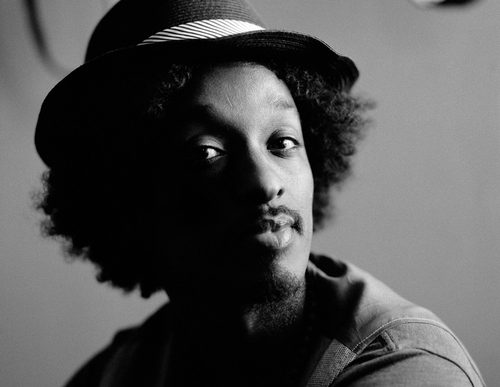
His own team have yet again failed to qualify, thanks to defeats that fans blame variously on poor midfielding, questionable refereeing and the small matter of gun battles disrupting pre-tournament training. But, when the World Cup gets underway next month, the voice of Somali-born Keinan Warsame will be echoing around the stadium at every single match during the four-week contest.
A song by the 31-year-old rapper is the unlikely choice of tournament sponsors Coca Cola as their official World Cup anthem for South Africa 2010, even though his war-torn home nation has never once made it to the finals.
Wavin’ Flag, an upbeat rap that urges fans around the world to “rejoice in the beautiful game”, hopes to do for hip hop on the terraces what Pavarotti’s Nessun Dorma did for opera.
On a brief visit to London, its composer admits that, in the absence of a home team to root for, he will not be shifting his allegiances to Fabio Capello’s men.
“I do admire Chelsea as a team, but, when it comes to the tournament itself, I will be supporting the Ivory Coast,” said the singer, who styles himself K’Naan (Somali for “traveller”).
“Whoever you support, though, the World Cup is a great occasion for Africa. It is so often a place that is seen as a backdrop to negative things, but this will hopefully balance it out and allow the world to see Africa in a more positive way.”
The negative side of African life is something K’Naan knows well, having fled Somalia with his family in 1991 after seeing several friends killed during the outbreak of civil war. He has spent his adult life in Canada and the US, where his tales of life and death on the mean streets of Mogadishu have put the macho bombast of some North American gangsta-rappers into perspective.
A non-drinking, non-smoking Muslim who is somewhat more cerebral than many of his hip-hop peers, his acclaimed album, The Dusty Foot Philosopher, won a BBC Radio 3 world-music award in 2007. In Britain, he counts Damon Albarn among his admirers, and he guested on Keane’s number-one, Night Train.
Yet his choice as Coca Cola’s official artist for the event has attracted controversy, and not just because his song was picked ahead of offerings from singers in South Africa, the host nation.
In comments somewhat at odds with the global drink’s firm’s corporate script, he has been highly outspoken about his home country’s other famous export – the pirate gangs who sail out hundreds of miles into the Indian Ocean to hijack ships. Writing for the influential Huffington Post website last year, he claimed that the pirates were simply exacting revenge for decades of illegal fishing and the dumping of toxic waste in Somalia’s unpoliced waters.
“Our pirates were the only deterrent we had from an externally imposed environmental disaster,” he said. “The truth is, if you ask any Somali, if getting rid of the pirates only means the continuous rape of our coast by unmonitored Western vessels, and the producing of a new cancerous generation, we would all fly our pirate flags high…One man’s pirate is another man’s coast guard.”
K’Naan disclosed that he had clan relatives living in Harardhere, one of the most notorious pirate ports; two of them were killed recently during a gunfight over ransom money. “The pirates are not justified in what they are doing,” he said, qualifying his earlier comments slightly. “But Somalia is in such a sad state that nothing that goes on there is justified.”
K’Naan’s own family background is proof of how his native land, which has now been a failed state for nearly 20 years, once nurtured much higher hopes. His father was an intellectual, while his mother was an accomplished singer, and his early memories were of a happy life in a well-off Mogadishu suburb overlooking the Indian Ocean. By 1991, though, as the collapse of dictator Siad Barre’s regime threw the country into an intractable civil war, nobody was safe.
“I remember tanks being lined up along the street of the neighbourhood that I came from, and seeing people from my neighbourhood armed and tyres burning in the street,” he said. “A lot of people around us were fighting. One day, a group of us were hanging around and someone threw a rock at a passing technical [an open-topped car with an anti-aircraft gun mounted on it]. The technical opened fire and killed three of my friends.”
By pleading with officials at the US embassy nearly every morning for six months, his mother eventually persuaded an official to grant them leaving papers the day before the embassy was finally evacuated. The family flew out of Mogadishu on what K’Naan believes was the last ever scheduled Somali Airlines flight.
However, on moving first to the US and then Canada, he fell into clan violence of a different sort, this time involving street gangs in the black neighbourhoods where many Somali émigrés lived.
“We Somalis weren’t treated well because we didn’t know how to dress cool. We didn’t have Nike trainers; instead, we had stuff from Walmart and kids would be laughing,” he said. “There was always conflict there, as though we were from a different world.”
He ended up in a Somali gang and was arrested on numerous occasions. With most of his close friends either dead or in jail, and facing an arrest warrant for violence and firearms offences, he fled back to the US for six years and began building a music career, finding a natural follow-on from Somalia’s own tradition of oral poetry in the form of rap music.
His songs point out that, while life in the US ghettoes can be tough, it is a far cry from the hardships of life in African cities such as Mogadishu. “I don’t want to be disrespectful to anybody else’s kind of struggle; I have lived in places in the US where a lot of people get killed,” he said. “But there are scales of violence and not many places are comparable to Mogadishu. My frustration is how some people are making it into beautiful cinematic violence. A lot of these kids have not seen real violence, and they have no concept of it. Real violence is ugly, people crumble when they get shot, it is not beautiful at all.”
Coca Cola’s selected K’naan’s song after a search involving hundreds of artists. The quality of his music and his personality and life story were more important than whether he was South African or not, said Joe Belliotti, the firm’s global entertainment marketing chief.
“We went through hundreds of demos and recommendations for songs and artists that fitted the bill, and K’Naan ticked a whole laundry list of things,” he said. “He has the connection to Africa, he is not a fly-by-night pop star, and his song is very indicative of celebration.”
As the tournament approaches, K’Naan will be heading to South Africa to headline a number of promotional events throughout the country, having already travelled much of the world as part of the 225-day official FIFA World Cup tour, in which the solid-gold trophy was put on display in 86 countries. One of the few nations that did not get a glimpse was Somalia: the organisers deemed it too risky to take the trophy there.
Meanwhile, the chances of Somalia ever qualifying for the contest remain bleak. Earlier this year, the team were forced to flee their former training base in Mogadishu because of daily armed confrontations between the Somali government and gunmen from the al-Shebab militant group, who want to impose a Taliban-style Islamic system in Somalia.
The group wants to ban both televised football matches and pop music, although K’Naan noticed recently that he has acquired something of a following even in Shabab-controlled areas. “Somebody showed me a photo of my old neighbourhood recently, which showed some masked gunmen walking down a street that had been completely destroyed by artillery fire. But on one wall behind them you could see a ripped-up poster, showing my face. I don’t know who put it up there, but nobody had taken it down yet.”
The World Cup mix of ‘Wavin’ Flag’ is out on June 21. The album ‘Troubadour (Champion Edition)’ is out on June 28.
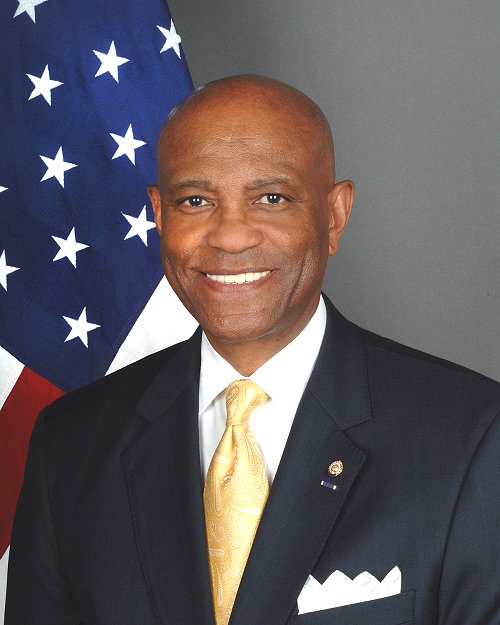
United States Ambassador to Tanzania Alfonso E. Lenhardt has been accredited as the US representative to the East African Community (EAC), becoming the first envoy to the regional bloc.
Mr Lenhardt presented his credentials to EAC Secretary General Juma Mwapachu at the bloc?s headquarters in Arusha, Tanzania. The United States was the first nation to nominate an Ambassador to the organization, having submitted an accreditation request on 20 April. Ambassador Lenhardt’s accreditation to the EAC, endorsed by the Government of the United Republic of Tanzania, expands U.S. engagement with the regional organisation comprised of Burundi, Kenya, Rwanda, Tanzania, and Uganda.
Mr Lenhardt said the United States supports the East African Community’s goals and lauded the organization for a focus on pragmatic policies aimed at improving the well-being of its citizens: “We consider regional integration to be a highly effective means of promoting prosperity through increased trade and investment. In fact, we have pursued similar policies ourselves. With our two neighbours, Canada and Mexico, we entered into the North American Free Trade Agreement (NAFTA), which shares key aspects with the East Africa Common Market.”
The United States and EAC have already undertaken several joint projects in the areas of defense, aviation security and trade development. Mr Lenhardt said the United States will support EAC efforts to institute a Customs Union and establish a Common Market. The areas of collaboration include opening East African markets, harmonising tariff structures, and improved revenue collection.
Regional economic integration will also stimulate greater U.S. trade and investment in the region: “One of the major barriers to trade between EAC members and the United States is the high cost of doing business in the region. These high costs are in part due to unreliable transportation infrastructure, redundant bureaucracy, and the small size of most domestic markets. Implementation of the Customs Union and an increase of One-Stop Crossings will lower the cost of transit and enable firms operating in East Africa to benefit from economies of scale.”
Under the “Safe Skies for Africa” programme, the United States is working to improve the effectiveness of the EAC’s Civil Aviation Safety and Security Oversight Agency (CASSOA) to enhance and maintain international aviation standards for airlines that carry businessmen, investors and tourists to, from, and within Africa.
Regional integration can also enhance East African security. “We note that EAC member states are considering seriously the potential benefits of a formal Mutual Defense Protocol to promote collective security. A regional approach to security has worked well for my own country. The North Atlantic Treaty Organisation has long provided collective security for the nations of North America and Europe.”
Mr Lenhardt spoke of a potential role for the EAC in the international effort to free the shipping lanes of the Western Indian Ocean from piracy. He noted that, “It is a vital interest of all East African nations, including those in the interior, that the region’s trade is secure from threats posed by armed gangs operating in the waters off this region’s coast.”
Delta Air Lines will launch new service between Atlanta and Monrovia, Liberia come September 4, expanding the airline’s position as the leading U.S. carrier operating flights to Africa.
The new service will connect Delta’s hub at Hartsfield-Jackson Atlanta International Airport and Roberts International Airport in Monrovia with a stop in Accra, Ghana. The flight will be operated on 215-seat Boeing 767-300ER aircraft, equipped with 34 BusinessElite seats and 181 seats in economy.
Initial service will be once a week. Flights from Atlanta are scheduled to depart for Liberia on Saturdays at 2:25 p.m. and arrive in Monrovia at 7 p.m. the next day. Service back to the U.S. takes off from Liberia at 5:30 p.m. and arrives in Atlanta at 5:30 a.m. the next day.
Delta has received approval from the Liberian Civil Aviation Authority, and preliminary approval from the U.S. government, to sell seats for the new flight for the planned launch in September. Final U.S. government approvals are expected before the flight begins.
The carrier had previously intended to begin service to Monrovia in June 2009, but was delayed while Roberts International Airport implemented measures to ensure its compliance with the standards of the International Civil Aviation Organization.
Delta, which has operated in Africa since 2006, has also announced its intention to serve up to 10 African destinations from the U.S., with aircraft ready to begin service pending U.S. and foreign government approvals. This includes new year-round service between Atlanta and Accra, which begins June 1 with three weekly flights and expands to four weekly flights on June 14 while complementing existing five-times weekly service between New York-JFK and Accra.
On June 2, Delta will also begin nonstop seasonal service between New York-JFK and Abjua, Nigeria. In June and July, the carrier will add two additional weekly nonstop flights between Atlanta and Johannesburg to support travel to and from the 2010 World Cup.
This summer, Delta will operate flights to seven African destinations. In addition to Monrovia, Abjua, Accra and Johannesburg, Delta will offer service to Cairo, Egypt; Dakar, Senegal; and Lagos, Nigeria. Delta also intends to serve Malabo, Equatorial Guinea; Nairobi, Kenya; and Luanda, Angola once government approvals are received.
Liberian president hails 'Feed the Future' program
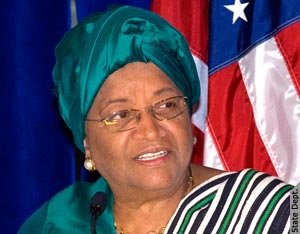
WASHINGTON – The Feed the Future initiative — which seeks to enhance food security and reduce hunger, poverty and malnutrition — is exactly the right program at the right time for Liberia, Liberian President Ellen Johnson Sirleaf said May 20, while also applauding the Obama administration’s strong support for the Global Agriculture Development Initiative.
“What is most appealing from the Liberian perspective about these initiatives is that they encourage the participation of key groups, including farmers, civil society organizations, women, and they also promote strong regulatory policies such as governance and accountability,” she told the Symposium on Global Agriculture and Food Security in Washington.
“We see this new [Feed the Future] initiative as a complement to the Millennium Challenge Corporation,” she said. The Millennium Challenge Corporation recently qualified Liberia for its Threshold Development Program, which supports home-grown strategies and rewards governments that invest in their own people and govern responsibly.
Sirleaf said Liberia is pleased to have been selected as one of Feed the Future’s 20 potential target countries and that it “will strive hard to achieve status as an investment plan country.” The other potential Feed the Future target countries are Ethiopia, Ghana, Kenya, Mali, Malawi, Mozambique, Rwanda, Senegal, Tanzania, Uganda and Zambia in Africa; Bangladesh, Cambodia, Nepal and Tajikistan in Asia; and Guatemala, Haiti, Honduras and Nicaragua in Latin America.
Sirleaf commended the U.S. Embassy and the U.S. Agency for International Development (USAID) teams in Liberia “who support our goals in the development of Liberia’s agriculture and rural sector in promoting sustainable peace.”
“We strongly believe that with our commitments, with our hard work, together with your continued support, we can indeed bring stability” to Liberia, she said. “We can bring prosperity to a nation once characterized as a ‘failed state.’ We can become a post-conflict success story, building upon our agriculture potential.”
Sirleaf, a former banker, chronicled the important role agriculture is playing in the development process in Liberia, a country that has been traumatized by years of civil war.
The Liberian leader told her audience she was dressed in bright green to denote the great agricultural potential of her nation.
“In 2006, Liberia started the long road back from a civil conflict that decimated the country’s infrastructure and institutions,” she said. The country’s development potential has also been hobbled, she said, by a population that fled to the urban areas during the unrest — leaving the land unproductive.
In the past four years, Sirleaf said, her government has made progress: restored economic growth to an average annual rate of 7 percent; tackled a $4.9 billion external debt; made strong advances in consolidating peace and national security; reactivated the country’s mining, agriculture and forestry sectors; promoted the institutions of good governance, including the rule of law; and rehabilitated infrastructure to extend basic services to the Liberian people.
Despite such progress, the “challenges remain awesome,” she said, and the nation remains “fragile in the face of raised expectations and the several stumbling blocks” in its path, such as the global financial crisis, which “has slowed the pace of recovery and reform.”
Poverty in Liberia, she said, continues to be the most significant determination of food access, even though some 70 percent of all Liberians depend on agriculture for their livelihoods. “Recognizing that agriculture growth is more effective in reducing poverty than any other effort in any sector, our government is placing emphasis on this strategic sector both in terms of exports and food security at home,” she said.
The immediate goal, she told her audience, is to revitalize operations and activities that contribute to sustainable economic growth and development to provide food security and nutrition and to increase farmer employment and income — all aimed as well at measurably reducing poverty.
Sirleaf said while her government’s commitment to agriculture is “unequivocal,” public financing of the sector is still “woefully inadequate,” with the share of the national budget allocated to agriculture still at only 2 percent.
The Liberian people are still “highly vulnerable” to chronic food insecurity stemming from physical and human capital constraints, poor natural resource and farm management practices and poor health and nutrition practices, she said.
“We are, nevertheless, intensifying our efforts to achieve the desired results,” she said. Her government, she added, has embarked on a “back-to-the-soil campaign” that has resulted in significant increases in food production, particularly in staples such as rice and cassava.
Rice production has increased from 85,000 metric tons in 2006 to more than 200,000 metric tons in 2009, a 43 percent increase. That increase, she said, has led the World Food Programme for the first time to purchase locally produced rice for use in the school feeding program. Additionally, Sirleaf said, more than 30,000 farmers have now been trained in new farming methods and some 15,000 vulnerable farmers and more than 100 farmer groups have been provided with seed rice.
Success in the agricultural sector will be even greater, she said, if farmers are able to make greater use of fertile lowlands to grow rice where yields are the highest and where up to three crops can be harvested annually.
At present, farmers are not able to make full use of the lowlands because of health concerns brought on by schistosomiasis and other waterborne diseases, which multiplied during the country’s long civil war, she said.
“It is very clear to us that agriculture has the potential to become a major source of employment — most especially for thousands of our citizens, women and youth, who as casualties of the war lack essential skills but who can learn to farm the land.”
Her government’s objective, she said, is to “consolidate them into a productive and dynamic entity for national development.” Creating jobs in the farming sector, she added, is one way to accomplish that aim.
The Liberian agriculture sector, she said, is transitioning from emergency status to that of a key development sector, which will include sustainability and improved livelihoods that are well integrated into private sector markets.
The private sector is playing a pre-eminent role in developing Liberia’s agricultural sector she said, while the government is charged with creating the enabling environment in which private sector–based agricultural development can flourish.
Feed the Future is a U.S. government development initiative based on partnership, not patronage, and seeks to coordinate the efforts of many U.S. government agencies to contribute to global food security efforts.
The Global Agriculture and Food Security Initiative is administered by the World Bank. The United States has donated $475 million to that program in concert with a host of other international donor nations.
At the Group of Eight meeting of major industrialized nations in L’Aquila, Italy, in July 2009, President Obama pledged at least $3.5 billion for food security. More than 1 billion people, or one-sixth of the world’s population, suffer from chronic hunger.
Arizona's immigration law: A concern for all minorities
Who counts as “us” and who counts as “them” has shifted throughout modern American history. For decades, African-Americans were “them,” judged to be members of an inferior race and denied basic rights. In the aftermath of 9/11, “us” and “them” were reshuffled as Muslims and those perceived to be Muslim were targeted and labeled “the other.” Now, with the passage of Arizona’s new immigration law, which enables police to demand papers of anyone “reasonably suspected” to be an illegal immigrant, Hispanics face significant ostracism.
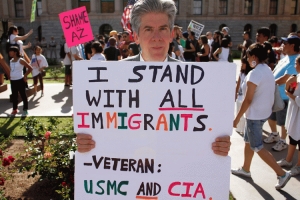
Members belonging to “them” groups are profiled, harassed and subjected to discrimination, all on account of their appearance. Despite these common experiences, meaningful solidarity among the groups has not always followed. For example, while black organizations have criticized the Arizona law, it appears that African-Americans on the ground approve of or are ambivalent about the law. These attitudes not only compound Hispanics’ isolation, they also undermine social justice more generally.
Arguments that illegal immigrants compromise public safety by engaging in criminal behavior, “take” scarce jobs from legal residents, and impose enhanced burdens on public services without contributing to tax revenues can resonate with non-white Americans. And the Arizona law undoubtedly advances the goals of addressing illegal immigration and its attendant externalities. But for minorities who might be tempted to embrace the new law, this cure is worse than the disease. Here are some specific reasons why all minorities in America — an African-American in Baltimore or Muslim in Detroit, for example — should care about and speak out against the immigration law facing their Hispanic brethren in Arizona:
It codifies discriminatory thinking: A necessary prerequisite for discriminatory treatment is the stereotypical viewpoint that someone who possesses certain characteristics, such as a specific skin tone, either inherently or presumptively possesses negative traits. For example, an African-American may be considered dangerous or a Muslim disloyal or suspicious. A fundamental problem with the Arizona immigration statute is that it validates a discriminatory viewpoint — that if you appear Hispanic, you may be here illegally — elevating it to an established norm and giving it the force and effect of law.
It encourages and sanitizes profiling: It is true that Arizona’s law, as amended, would require an individual to be lawfully stopped before immigration papers can be demanded. But an officer may simply use minor, technical infractions as a pretext for a robust immigration search that may result in an individual’s arrest, detention or deportation. Moreover, there is little reason to be confident that officers will seek out these infractions in a race-neutral fashion. Instead of applying the law equally to all, officers may focus specifically on “brown” people as part of the enhanced governmental interest in illegal immigration. Evenhandedness is even less of a prospect when one considers that officers may be even incentivized, through quotas, to apply the law and round up illegal immigrants. The legal stop prerequisite therefore may be but a modest formality or inconvenience to the officer, rather than a reliable safeguard for Hispanics.
It is a contagion of discriminatory law: In objecting to the internment of 120,000 individuals of Japanese ancestry, which itself was predicated on the notion that all Japanese were subversive, Justice Robert H. Jackson understood in 1944 that when “racial discrimination” becomes part of the law, it “lies about like a loaded weapon” available to be used by the government and ready to be expanded “to new purposes.” The Arizona law, left unchallenged and on the books, may spawn other policies and practices in which those looking a certain way will be subject to heightened, different treatment under the cover of law.
It will provoke copycat legislation: At a minimum, the law will serve as a blueprint for immigration laws that will leave anyone of color (not just Hispanics) or with an accent susceptible to police scrutiny and social marginalization. Indeed, at least 10 other states — Colorado, Georgia, Ohio, Oklahoma, Missouri, Maryland, North Carolina, South Carolina, Texas and Utah — are reportedly contemplating similar measures. For non-Hispanic minorities to praise the Arizona law or sit idly by would be to be complicit in its expansion and in the possibility that they themselves will be covered by its permeations.
It triggers a moral imperative to defend Hispanics: Assuming that the law in question affects only Hispanics in Arizona, the law nonetheless exists as an injustice that triggers a moral duty to stand behind the maltreated. The civil rights movement, for example, was not only about advancement of African-Americans, but was an attempt to uplift all Americans. As Dr. King noted, “We are not struggling merely for the rights of Negroes … We are determined to make America a better place for all people.” The goal of the movement, he explained, was the creation of a “beloved community” characterized by mutual love, respect and trust of all Americans. The government targeting of Hispanics in Arizona threatens this vision of universal brotherhood.
It generates goodwill that can be banked: In assisting Hispanics, other minority groups will demonstrate their willingness to join forces with Hispanics in their hour of need. When and if those non-Hispanic groups are themselves in a situation requiring support, they will have good reason to call upon Hispanics to reciprocate and expend human, political and financial capital on their behalf. There is thus strategic value to side with Hispanics, even to the extent that the law does not affect other groups.
These points reflect the need for minority groups to recognize their shared experiences and come together when any one is in peril. The fact that 51 percent of Americans support the Arizona immigration law underscores the need for insular minority groups to stick together if they are to have any chance of undoing injurious legislation implicating any individual group. Arizona’s immigration law should activate not only Dr. King’s call to action, but a different American refrain: United we stand, divided we fall.
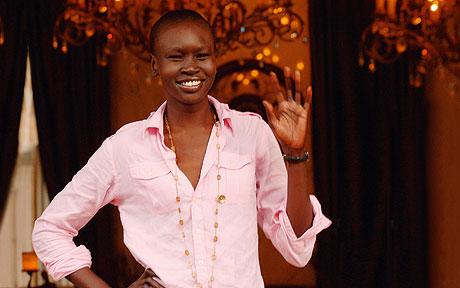
Fashion model Alek Wek, 33, came to London as a refugee from Sudan at the age of 14. The seventh of nine children, she studied at the London College of Fashion before being spotted by a model agency in 1995. Within two years, she was working for Alexander McQueen, Chanel, Ralph Lauren and Vivienne Westwood and had been voted MTV’s Model of the Year and i-D magazine’s Model of the Decade. She started a children’s educational charity, WEK, from her home in New York, and is a member of the US Refugees’ Advisory Committee.
How often do you fly?
Often once or twice a week, for work.
Where did you last go on holiday?
Puerto Rico. I stayed at The Horned Dorset Primavera, a Relais & Chateaux hotel right on the beach; when you go to sleep you can hear the waves. I went riding, which was so much fun. I’d been on camels before, but never on a horse.
Where next?
The Dominican Republic. I hate long flights, and from New York, where I live, it’s only a few hours to the sunshine and beaches of the Caribbean. Favourite place for a city break?
Mexico City. The architecture is great: a bit like Milan, with old buildings and courtyards but some cool and modern parts, too.
Any particular highlights?
Walking round Frida Kahlo’s house, which felt like her spirit was still there. The Hotel Brick, which is small and very cool. Eating grilled fish and spinach or lobsters on ice with hollandaise sauce – and having hot habañero sauce on everything. It reminded me of the chillies we ate in Sudan.
Do you go back to Sudan?
I went a few years ago and was very moved. So much has changed and been destroyed, and so many people have been killed: friends and family. Hopefully, the recent election will bring peace. People don’t want war. They want a normal life.
The most remote place you have been?
Sudan. Sometimes we were in the middle of nowhere. I’ve been to parts of Morocco that are pretty remote, too. I had a small part in the film Four Feathers with Heath Ledger, shot in the desert seven hours’ drive from Casablanca, out in the dunes. We ate couscous under the stars.
Most hardcore experiences?
Living in a tent in Niger. There were terrible sandstorms, so we had to wrap our faces in scarves. Going on safari in South Africa was hardcore but a lot of fun – though my friend Maura was absolutely freaking out about all the bugs in her hair and having to pee in the sand.
Your favourite luggage?
My own, of course! The largest of my WEK 1933 range (named for the date of my father’s birth) is good for a weekend or a week. Diane von Furstenberg’s bags are good, too: they’re cute, with lovely prints, and you can roll them up. What do you always pack?
Jeans. The best are by Diesel, who make them for people with 38in legs. I also like Ernest Swan ’s made-to-measure jeans, in black, blue and white.
Travel tips?
Be comfortable. Wear comfy boots or shoes on the plane. Take a shawl sprayed with a favourite scent, in which to wrap yourself. Moisturise. I use La Prairie for my face, cocoa butter for my body, Juicy Tubes for my lips, and Aromatherapy Associates lavender or jasmine oils. I love rubbing on their De-Stress oil after a shower; so soothing.
Travel rituals?
I always light a candle in my hotel room, so it doesn’t feel so foreign: a Diptyque (RED) Vanilla and Rooibos, because a percentage of the money from each candle sold goes to fight Aids in Africa. I’ve seen how just two pills can save someone’s life, so if I can buy anything that supports (RED), I do. I also read wherever I am. It might be the Dalai Lama, or something inspiring like Lighting the Way: Nine Women Who Changed Modern America, or Say You are One of Them by Uwem Akpan. The beauty of reading is that it lets you travel in a way you could never know. My iPod is always with me, too: I might play Alicia Keys, or Santana, or Norah Jones if I want something soothing, or Zairean music, such as Koffi [Olomide] , who does amazing dance music and videos. Wow, those girls can dance! Full on!
Favourite New York haunts?
Atlantic Avenue in Brooklyn, where there’s a great deli called Sahadi’s, with food from all over the world: big beans with feta and onions, falafel, chickpeas with chilli. Delicious. Also Layla, a boutique on Hoyt Street, where everything is hand-picked or handmade in India and Afghanistan, to help women feed their families. Best places to eat in New York?
For brunch, Schiller’s on Rivington Street or Pastis on 9th Avenue in the Meatpacking District, for its sandwiches, its salad niçoise and the best crème brûlée in town. For dinner, I go to Japonais, on 18th Street, which serves little portions of Asian food to share with friends, and a hot pepper to sprinkle on it. And, obviously, Nobu in Tribeca.
The most romantic hotel?
The Horned Dorset because it is so private. When you walk off your balcony, you are surrounded by birds and butterflies.The Delano in Miami is pretty amazing, too: especially those deep bathtubs made of beautiful grey marble.
Best hotel rooms?
I like unique little boutique hotels, such as Blakes in London. If you’re going to stay in a big hotel, though, the Mandarin Oriental Hong Kong has one of the best spas and pools. After a swim, a herbal tea and a massage, you disappear into la-la-land.
Favourite shops abroad?
The souks of Marrakesh, for mirrors and old swords. Frette in Milan for sheets. Colette in Paris, for things you don’t get anywhere else – and great European music. I bought Cadenza Classics last time I was there, and I play it all the time.
The best airline?
Virgin, because when you walk on, it doesn’t feel like you are on a plane. The crew are friendly – and you can get a massage in the air. British Airways is good, too. The seats are comfortable and I like that shutter you pull up for privacy. Do you offset your carbon?
What’s that? Oh, planting trees. Yes, I agree with that. We survived on natural resources, so we should take care of the earth. When I leave home, I do things like switching off the heat and lights.
Like President Obama, I completed my 2010 U.S. Census form. Unlike the president, I did not answer “Question 5 – Race,” by checking “Black, African American, or Negro,” even though, like the chief executive’s, my mother was “White.”
I didn’t answer Question 5 because, flummoxed, I’d dropped my pen at Question 4 – “Hispanic, Latino or Spanish origin?”
These queries were so illogical I’d let the Census form gather dust. I hoped it would spontaneously combust and take “IRS 2009 – 1040 Instructions: Including Instructions for Schedules A, B, C, D, E, F, J, and SE” with it.
Finally, inspired by Mr. Obama’s example – despite being ill-prepared at Harvard Law School and the U.S. Senate he is doing his best – I began. After all, the form advised that “Census results are used to decide the number of representatives each state has in the U.S. Congress.” I wanted to help make sure Virginia was not slighted.
I gave my name, birth date, address and number of Homo sapiens dwelling with me. I also answered that I owned rather than rented, there being no “Unsecured Collateralized Debt Obligation” box to check.
I even wanted to inform the government about Bella. However, though pets are as important as human roommates to many Americans, the Census Bureau appeared completely unconcerned about them as vital statistics.
Then came Question 4. I could have answered “No” in response to the “Hispanic, Latino or Spanish origin?” query but the undefined and overlapping sub-choices under “Yes” caused my temples to throb.
They included not only “Mexican, Mexican-American, Chicano, Puerto Rican and Cuban” but also “another Hispanic, Latino or Spanish origin, for example: Argentinian, Colombian, Dominican, Nicaraguan, Salvadoran, Spaniard, and so on.”
“And so on?” That’s a Census category?
Why Dominican but not Haitian? Because the Haitian half of the island of Santo Domingo is largely French-Creole, not Spanish-speaking and of “Black” or “Negro” but not “African American” origin? Maybe Haitians fall under “and so on”? “Hello, I’m from Port-au-Prince. I’m an and so on.”
And why are we counting Spaniards? Aren’t they citizens of Spain, and therefore Europeans, not Latinos? By the way, shouldn’t it be “Argentine,” not “Argentinian”?
Beyond grammar, what is Question 4 about – nationality, language, culture or citizenship? If not the last, what’s it doing on the Census, the only constitutional (Article I, Section 2) purpose of which is to determine population for apportioning seats in the U.S. House of Representatives?
Having given up at Question 4, I couldn’t very well answer 5. The Census Bureau’s prompt on race — “Black, African American, African,” “White,” “Other” – said to include, for example, “American Indian or Alaska Native (print name of enrolled or principal tribe), Native Hawaiian, Other Pacific Islander, Filipino, Korean, Vietnamese, Pakistani, Samoan” – was maddening. Samoan is a race? Distinct from also-listed Fijian and Tongan? Who knew?
When I was a child, there were said to be four races. Politely, these were described as Caucasian, Negroid, Oriental and Indian (American, not Asian); impolitely as white, black, yellow and red.
But even as children, we realized these categories weren’t precise, that some dark-skinned whites appeared about the same color as light-complected blacks and Indians were not at all red, let alone Chinese yellow.
Years later, when a neighbor – an amiable if non-shaving feminist graduate student (human sexuality was her field, I was a passing experiment) – insisted that “race is a social construct,” I knew just what she meant: Race was highly cosmetic and deeply political. Like feminism.
I’d no sooner mailed my incomplete Census Form than newspapers headlined “Great-grandma was a Neanderthal.” Turns out DNA tests indicate that modern human beings and Neanderthals interbred between 100,000 and 80,000 years ago.
This was before Homo sapiens – originally Africans all – diversified through chance and natural selection into today’s ethnic (sub-racial) groups. Many women insist otherwise, but science says Neanderthals died out around 30,000 years ago. Regardless, the study shows they bequeathed to non-Africans one to four percent of their genes.
When the 2020 Census Form arrives, I’ll be ready. Race? “Other: Principal tribe, homo sapiens; minor tribe, Neanderthal.” I believe this means I will qualify to vote in both Virginia and Maryland.
U.S. Special Envoy Scott Gration acknowledged at a congressional hearing that the challenges facing Sudan and the Darfur region are daunting, with a referendum on the future of southern Sudan less than eight months away and work needed on a long-term peace agreement.
The time need to resolve these issues is limited, and the various factions must work together, engaging in open talks and building trust, Gration said in remarks prepared for a May 12 Senate Foreign Relations Committee hearing.
Secretary of State Hillary Rodham Clinton unveiled a comprehensive U.S. policy for resolving the conflicts in Sudan in October 2009 that focused on ending human rights abuses and genocide in Darfur and fully implementing the 2005 Comprehensive Peace Agreement (CPA) between the government and the Sudanese People’s Liberation Movement (SPLM). January 9 marked the fifth anniversary of the peace agreement.
In January 2011 the people of southern Sudan are expected to vote on whether to remain a part of Sudan or secede and form a new government with full independence by July 2011. And a referendum is planned on the status of the oil-rich region of Abyei.
Gration recently completed another round of meetings with the Sudanese government of President Omar Hassan al-Bashir, who won a multi-party election in April with 68 percent of the vote, the first in 24 years. Bashir faces charges by the International Criminal Court for crimes against humanity that stem from the violence and conflict in the western Darfur region. Gration also met with officials from southern Sudan and the SPLM during his most recent travel and with officials of the African Union.
“The scenario we’d like to see is outlined in the CPA: Credible and peaceful referenda are undertaken during which southern Sudanese choose unity or secession and the people of Abyei choose whether to remain with the North or join the South,” Gration said.
“In this scenario the outcomes are respected by the National Congress Party, the Sudan People’s Liberation Movement, other political parties and Sudanese citizens, as well as the international community, including those who signed on to the CPA as witnesses and supporters of the implementation of the CPA in 2005,” he said. “We must also be prepared to respond to less favorable scenarios.”
Gration, a retired Air Force major general, testified that regardless of whether southern Sudan becomes independent next year and regardless of whether it includes Abyei, the government of southern Sudan requires effective leadership as well as strengthened capacity to govern and take care of its citizens.
“In the long term, it is imperative to address the underlying causes of conflict, including disputes over land and water resources,” Gration told the senators.
Senate Foreign Relations Chairman John Kerry said at the outset of the hearing that his concern was whether everything is in place to support Sudan in accomplishing these two referendums, and whether the violence and civil strife will continue.
“We all understand the stakes,” Kerry said. “The implications of Sudan’s instability do not end at its borders.”
SITUATION IN SUDAN
The situation in Sudan has emerged as one of the largest and most devastating humanitarian crises of the 21st century. More than 20 years of fighting between the government and the SPLM killed more than 2 million people, and portions of the 2005 CPA remain unfulfilled and represent “a dangerous flashpoint” for future armed conflict, Gration said. In addition, Sudan’s ruling National Congress Party and government-supported militia launched a genocidal campaign in 2003 against ethnic groups affiliated with a potential rebellion in the Darfur region, killing hundreds of thousands, displacing 2.7 million people and creating more than 250,000 refugees.
Gration said the United States’ strategy for Sudan has three major goals: saving lives and ensuring a durable peace, implementing a long-term peace agreement, and preventing Sudan from becoming a terrorist safe haven.
Gration said the United States continues to work closely with the African Union and the United Nations, meeting frequently with envoys from China, France, Russia and the United Kingdom (the permanent members of the U.N. Security Council along with the United States) and the European Union to coordinate efforts.
The Comprehensive Peace Agreement, which is sometimes called the Naivasha Agreement for the place where it was signed, set a series of agreements between the SPLM and the Sudanese government. It was intended to end the two-decade civil war between the north and the south, help establish a democratic government and provide for sharing oil revenues. It also set a timetable for southern Sudan to hold a referendum on its independence. The current coalition government ends in 18 months with the southern referendum.
Kelly Rowland is out and supermodel Iman is in as the new co-host of “The Fashion Show.”
According to The Hollywood Reporter, Iman has signed for a gig on the second season of Bravo’s couture competition, which returns to air later this year.
She’ll be joining designer Izaac Mizrahi as they challenge and critique up-and-coming designers on “The Fashion Show.” For the network, Iman just seemed to be natural fit for the gig.
“Breaking barriers in the fashion industry,” said Bravo Executive VP Frances Berwick. “Iman is a true pioneer and her unparalleled credibility will inspire the contestants and be a perfect match to the always exciting, Isaac.”
Iman – whose real name is Iman Mohamed Abdulmajid – will be 65 in July. Born in Mogadishu, Somalia to a high-ranking diplomat family Iman was discovered while in college by photographer Peter Beard.
“I am so excited to be joining the Bravo team and to be working again with Isaac Mizrahi, my close friend of many, many years,” Iman added. “I am also looking forward to all of the behind-the-scenes excitement and drama that is generated through the creative process of these undiscovered fashion designers. This will certainly be a show any follower of fashion will want to see.”
The supermodel is CEO of IMAN Cosmetics, Skincare & Fragrances, a line of female products. Iman also serves as host of ‘Project Runway Canada.’
Iman replaces Kelly as Isaac’s stylish sidekick. Bravo didn’t say why they decided to re-accessorize the show for the new season.