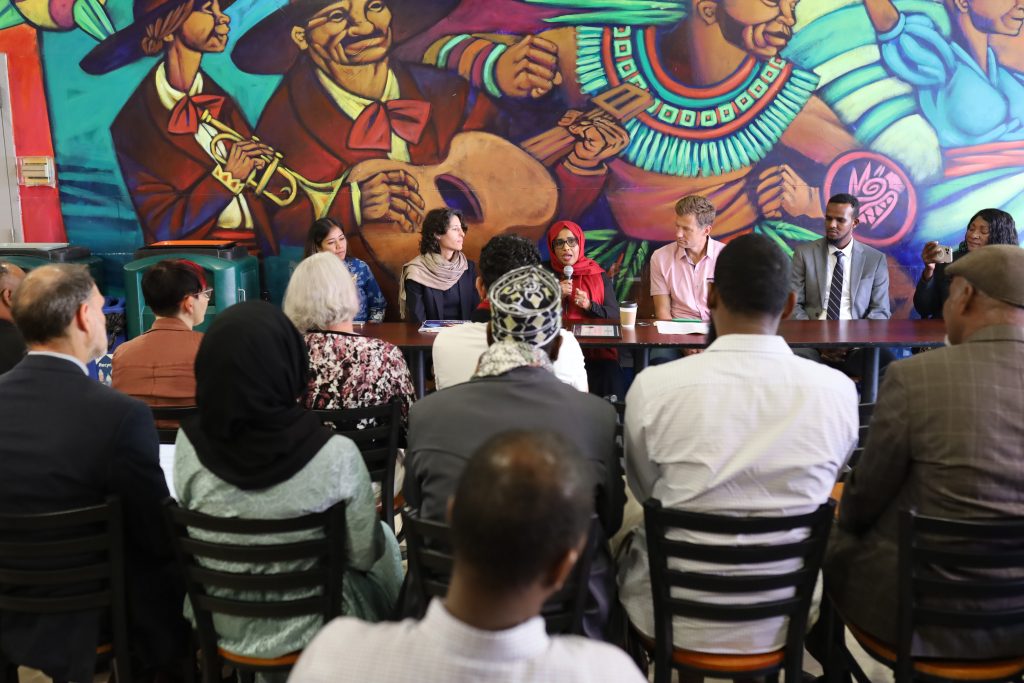
Algerian-born Pierre Bensusan takes the stage at the Cedar Cultural Center the evening of Sunday, September 25, 2022. Photo: Courtesy of Pierre Bensusa
Algerian-born Pierre Bensusan takes the stage at the Cedar Cultural Center the evening of Sunday, September 25, 2022. Photo: Courtesy of Pierre Bensusa
As riotous summer surrenders to autumn, so too exuberant music festivals give way to intimate music performed indoors.
Acoustic guitar player, Pierre Bensusan, takes the stage at the Cedar Cultural Center in Minneapolis on Sunday evening, September 25th, working through the second half of his North American tour 2022.
Born in Colonial Algeria, Pierre Bensusan migrated to Paris, France with his parents as a very young child. Mshale spoke via Zoom earlier this month with the award-winning artist. Bensusan elaborated on his multi-ethnic heritage.
“It’s not like I did research on the genealogy, but I know [Jews have] been in Algeria and Morocco for several generations,” Bensusan said offering an abbreviated history lesson as he expanded on the migration of the Jewish diaspora of which he is a part.
“So I don’t really identify as [solely] Algerian, I just know that in my DNA, it’s all there. I can see when I play music, I can see when I’m among African people, I feel at home. I feel normal. I don’t see a difference in me. I don’t see myself different from them. We are just normal. I think music is definitely another huge link between people and it makes me feel even closer to other people. What we share is that we are all migrants,” he said.
Bensusan recalled what migration looked and felt like when he went through it in 1962. “My parents lost everything they owned, everything they had. They lost all their history, all their ancestors are buried [in Algeria]. When we arrived in France, it was a country we didn’t know. So I feel a lot of sympathy and resonate with all the people who are migrating.”
This winner of Ards Guitar Festival Lifetime Achievement Award from Northern Ireland has lived in Oran, Suresnes, France and Nice, France, with an annual trip to the United States as well.
“When you go through your own story, you think, because it’s passed, it’s in your past. You think, Oh, that’s no longer [pertinent], but in fact, what’s amazing is that 64 years later, it’s still an actuality. People migrate all the time, people need to move and it’s…what I know is that people do not move out of where they live and out of where they were born by pleasure. It’s a necessity.”
Bensusan’s life experiences are reflected in his music. But, he said, “It’s not a like a recipe where you have proportions. I just know I grew up with many influences culturally and linguistically. I grew up with my mother singing me Arabic lullabies. My great-grandmother didn’t know a word of French, all she spoke was Ladino, which was the Jewish equivalent of Yiddish for the Sephardic Jewish people.”
But as Henry Wadsworth Longfellow said, “Music is the universal language of mankind.”
In addition to the self-improvement he made musically, the pandemic highlighted for Bensusan an essential belief, “People need live music, not only the music, they need to be together, to come out and experience something together. there is nothing to replace that.”
Concert at The Cedar Cultural Center on September 25th, 7:30 pm show.
Tickets to Pierre Bensusan’s show are available on the Cedar website.
A plate of jollof rice with fried plantain and fish. The Jollof Festival is coming to the Twin Cities on Saturday, Sept. 24, 2022. Photo: Courtesy Rosalind Reed Instagram
A plate of jollof rice with fried plantain and fish. The Jollof Festival is coming to the Twin Cities on Saturday, Sept. 24, 2022. Photo: Courtesy Rosalind Reed Instagram
If you think trying to figure out whether the chicken or the chicken egg came first is the most difficult task, you have not heard of the Jollof Wars. West Africans from every country between Senegal and Cameroon have gone to war with each other because they can’t agree on whose jollof rice, a staple in the region, is the best. Okay, it’s an online war of words, but you get the idea.
Come to the Gold Room Restaurant and Lounge in Minneapolis on Saturday Sept. 24 for the Jollof Festival and a chance to pick a side in the war, if you haven’t already. The event will feature vendors from various west African countries, as each nation vies for the honor of “Best Jollof Rice.” Voting will be done by public.
“This festival celebrates jollof rice, which appears on tables from Senegal to Cameroon, by inviting chefs to come together and contest for whose jollof rules,” the organizers say on the festival’s website.
The Jollof Festival, which began in 2017, is a chance for cities to participate in the ranking in jollof competitions, and also experience some of the shared culture and cuisine of west Africa. In addition to sample tasting and voting, attendees can participate in other events like live musical performances.
Jollof rice is a one-pot dish believed to have originated in the 1300s in what is now Senegal. It was prepared with rice, fish, shellfish and vegetables. As the region is geographically ideal for crops, rice farming flourished there, and soon the dish became popular in neighboring countries. Modern jollof rice is often comprised of a tomato paste base and served with soups or stews.
Most west African countries have developed their own version of the dish over time leading to arguments about whose jollof rice is the best. Today, the beloved staple is the center of a never-ending lighthearted online banter dubbed the Jollof Wars.
Tickets to the Jollof Festival can be purchased here.
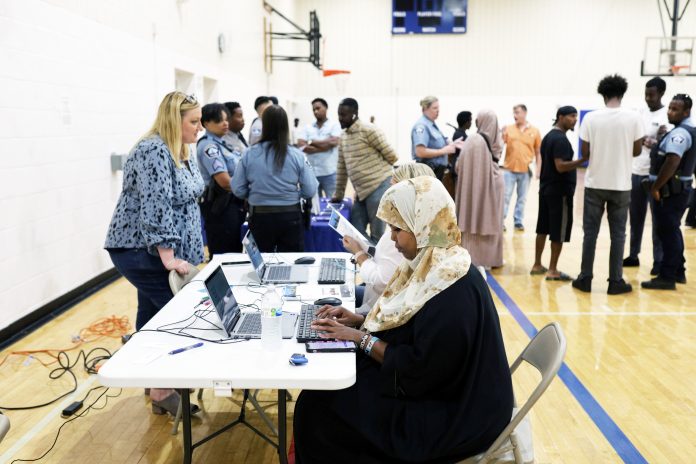
A woman applies for a position during a Minneapolis Police Department and 911 Department career fair at the Brian Coyle Center in the Cedar-Riverside neighborhood on Thursday, September 8, 2022. Photo: Panashe Matemba-Mutasa/Mshale
A woman applies for a position during a Minneapolis Police Department and 911 Department career fair at the Brian Coyle Center in the Cedar-Riverside neighborhood on Thursday, September 8, 2022. Photo: Panashe Matemba-Mutasa/Mshale
Minneapolis Police Department (MPD) held an informational event Thursday in the Cedar-Riverside neighborhood for immigrants from East Africa, as it looks to increase the diversity of its law enforcement officers.
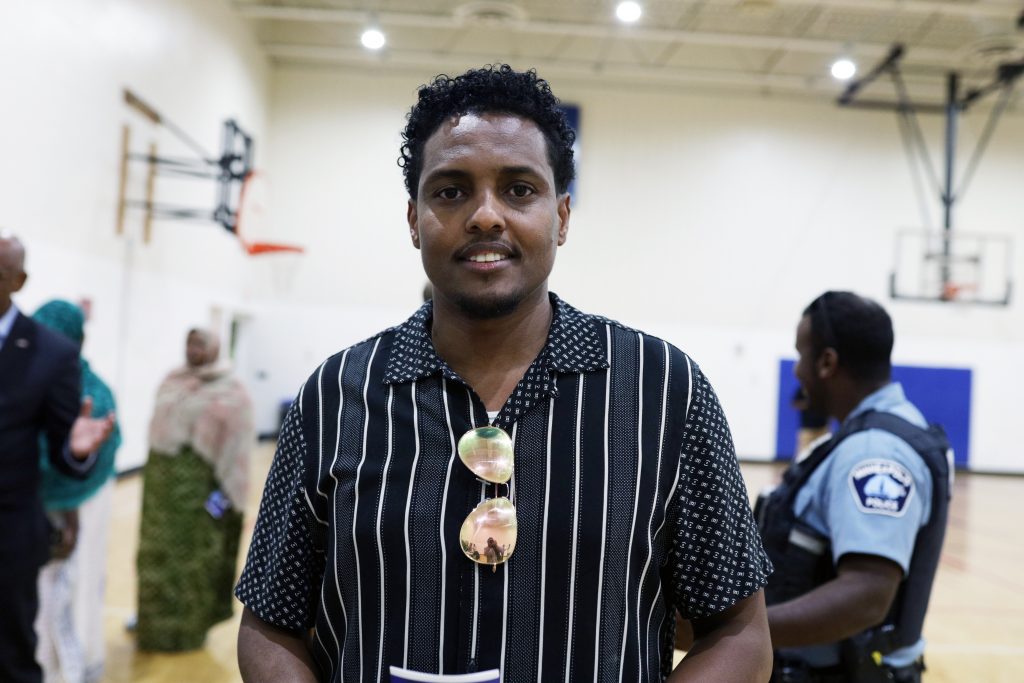
Jamal Osman, City Councilmember for Ward 6, hosted the event at Brian Coyle Center as part of his attempt to connect Somali residents to job opportunities in law enforcement.
“It was important for me to bring this event into the community, because historically, we’ve never really had a diverse police force that reflects those living in our neighborhood,” Osman said.
The opportunities available include non-officer positions such as community service officers (CSOs) and recruits, and officer positions such as cadets and laterals. Also available are positions at the 911 call center, which is separate from the MPD but works closely with the department as it dispatches calls from residents.
Frank Einsman, a former high school history teacher who is pursuing a career as a 911 operator, said that the job offered a lot of benefits that accommodate his new lifestyle.
“It’s a job that doesn’t require me to drive, which is good for my physical condition,” Einsman said. “There’s so much flexibility in the opportunities here. I think there is a job for everyone.”
Minneapolis City Council Member Jamal Osman at Minneapolis Police Department and 911 Department career fair held at the Brian Coyle Center in the Cedar-Riverside neighborhood on Thursday, September 8, 2022. Cedar-Riverside is in Councilmember Osman’s Ward 6. Photo: Panashe Matemba-Mutasa/Mshale
In the last decade, MPD has been continuously under scrutiny for officer malpractice in their encounters with residents of color. Officials hope that recruiting from immigrant communities, the city’s public safety department can address the problem of lack of diversity and reduce the bias that often leads to conflicts between police and people of color.
An investigative report from the Minnesota Department of Human Rights published in April found that 13 out of 14 individuals killed in the hands of MPD officers since 2010 were people of color. Cops were also more likely to search vehicles during traffic stops, issue unjustified citations, and use excessive force during arrest when the person was Black, according to the report.
Following the May 2020 murder of George Floyd by officer Derek Chauvin in May of 2020, protesters in Minneapolis called for the abolition of MPD, with many claiming that the current policing system is corrupt beyond reform. In response, community activist group TakeAction Minnesota launched the Yes 4 Minneapolis campaign, a Black-led sociopolitical movement that supports reallocation of police funding toward alternative forms of public safety. As part of their plan to establish a new public safety department, Yes 4 Minneapolis proposed amending the City Charter to require MPD to meet a minimum police staffing quota.
As a result of the growing distrust and feelings of rage toward police in Minneapolis, MPD saw a precipitous decline in staffing, dropping from around 900 officers to just 550 in the past two years. Yet, what seemed like impending doom for the future of the MPD would soon prove to be an illusion. In the November 2021 elections, Minneapolis voters resoundingly rejected a proposal to replace the MPD with alternative policing methods. The department also saw a $3 million budget increase in the last two years, suggesting that citizens think conventional policing is still the most effective. The budget increase accounts for pay raises, legal insurance, and other retention efforts.
As they seek to replace the cops who have left, Minneapolis officials are looking to diversify the police force to reflect the city’s changing demographics. Research has shown that diverse police departments can improve relations with the communities they serve. For example, researchers on police behavior in Chicago found that Black officers used excessive force 32% fewer times than their white counterparts, both during encounters with Black and white civilians. Black officers were also significantly less likely to conduct traffic stops and make arrests on Black civilians.
Dr. Cedric Alexander, an African American who in July was sworn in as Minneapolis’ first ever commissioner of community safety, said representation is essential to inclusion. When asked how feelings of distrust might interfere with recruitment, Alexander said those challenges provided opportunities for growth.
“Any time you are able to diversify your organization, it’s not always easy, but it is a chance for us to grow, learn, and minimize bias,” Alexander said.
Unfortunately, many large police departments are struggling to recruit and retain diverse hires. According to the Atlantic, historically strained relationships between communities of color and the police coupled with high retirement rates for Black officers contribute to the problem.
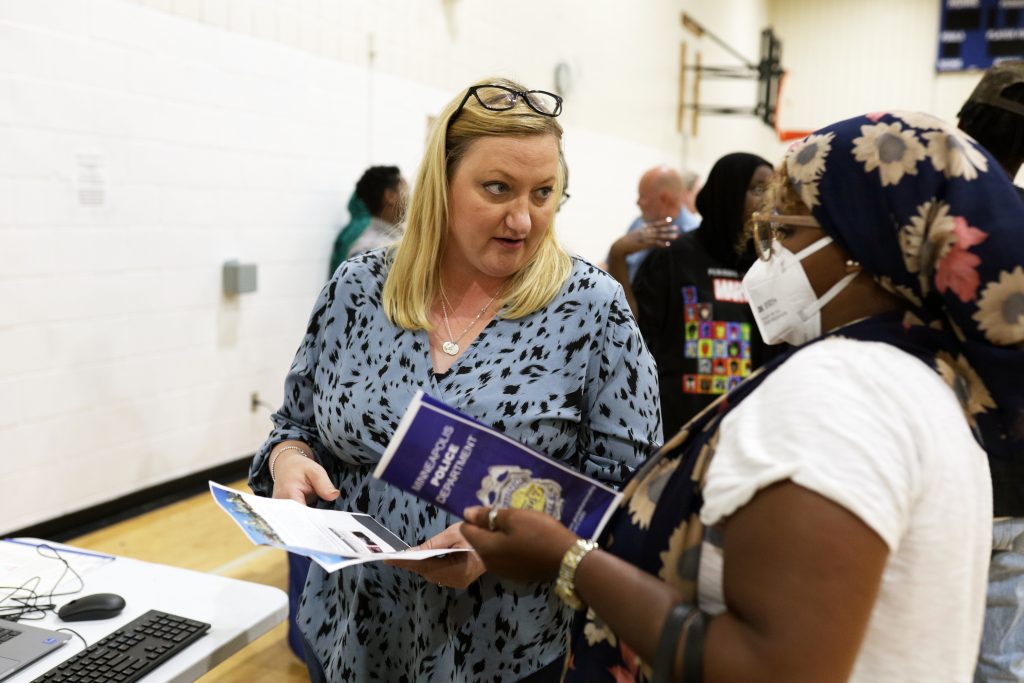
Jennifer Geiselhart, the 911 operations manager for Minneapolis assists a woman applying for a position during a Minneapolis Police Department and 911 Department career fair at the Brian Coyle Center in the Cedar-Riverside neighborhood on Thursday, September 8, 2022. Photo: Panashe Matemba-Mutasa/Mshale
Jennifer Geiselhart, the 911 operations manager for Minneapolis, said it was important for law enforcement to be more representative of the city. Geiselhart, whose department hosted two previous recruitment events in the summer, said the turnout made her hopeful.
“We never expect this many people to be interested in these positions,” she said. “We’re confident their passion is what will drive change.”
Sean Broom, Osman’s policy aide, said there were limited employment opportunities available for people in the Somali immigrant community. Broom said that the MPD career fair was a chance for him and Osman to introduce new career pathways to the community.
“We’re really trying to hone in on the East African community and present them with opportunities they may not have thought about or considered,” Broom said.
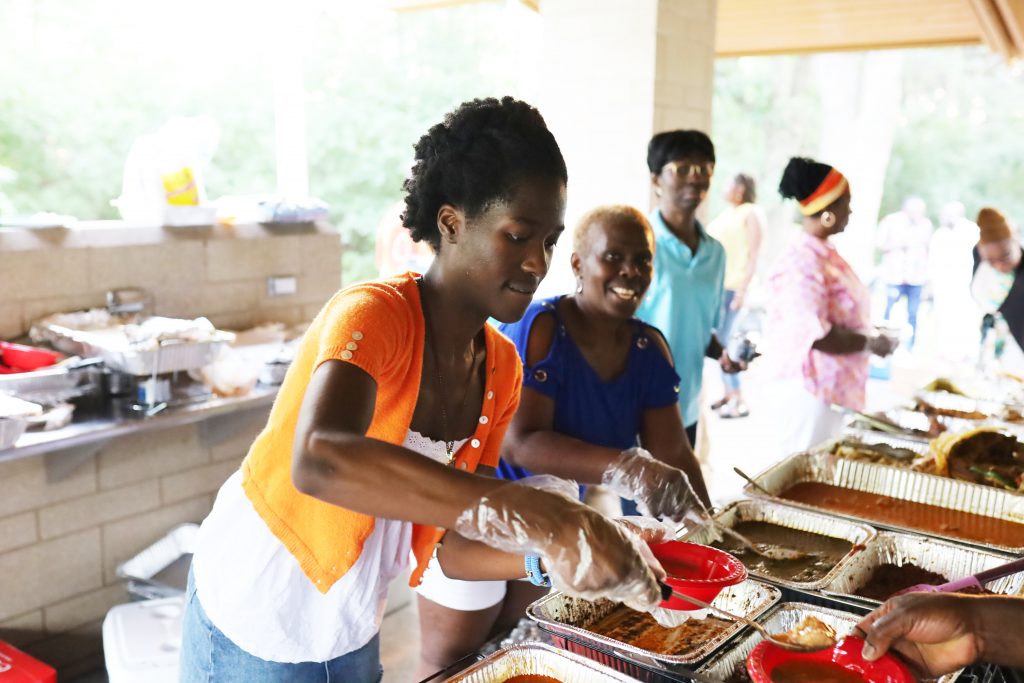
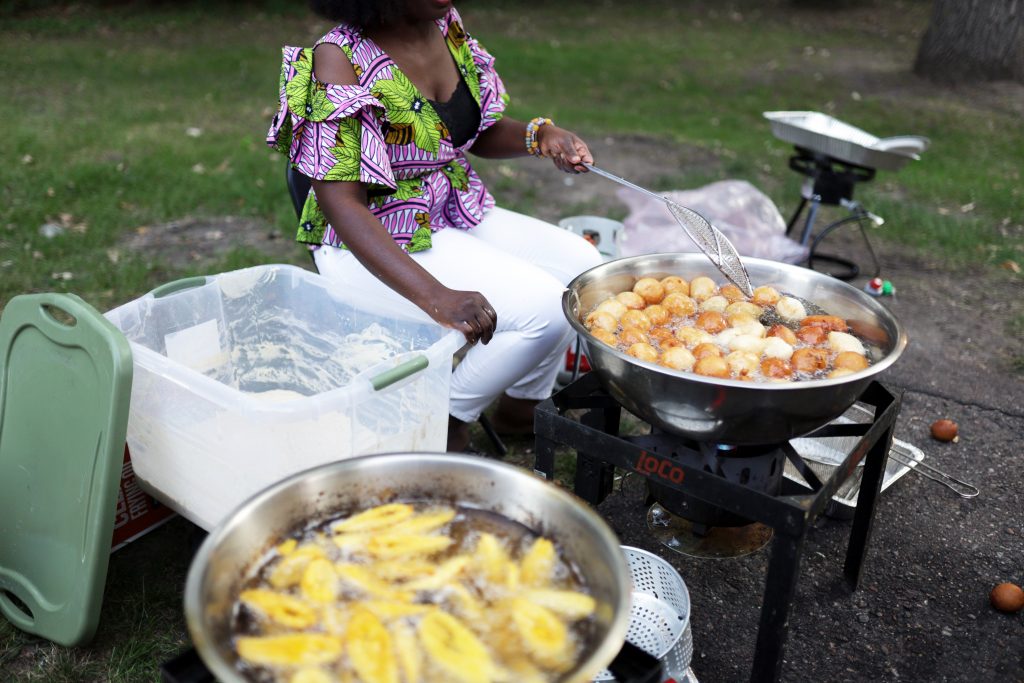
A woman makes fried plantain during the Taste of Ghana in Brooklyn Park, Minnesota on Monday, September 5, 2022. Photo: Panashe Matemba-Mutasa/Mshale
A woman makes fried plantain during the Taste of Ghana in Brooklyn Park, Minnesota on Monday, September 5, 2022. Photo: Panashe Matemba-Mutasa/Mshale
For Ghanaians in the Twin Cities metro area, a Labor Day filled with jollof rice, puff-puff, and okra soup was the ideal way to end the summer.
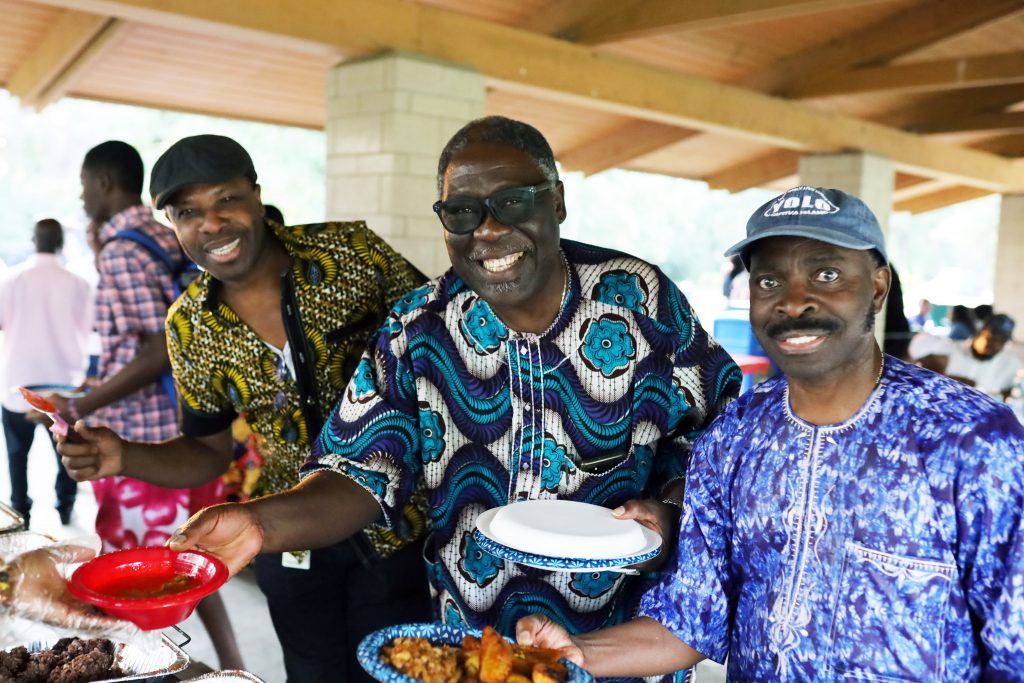
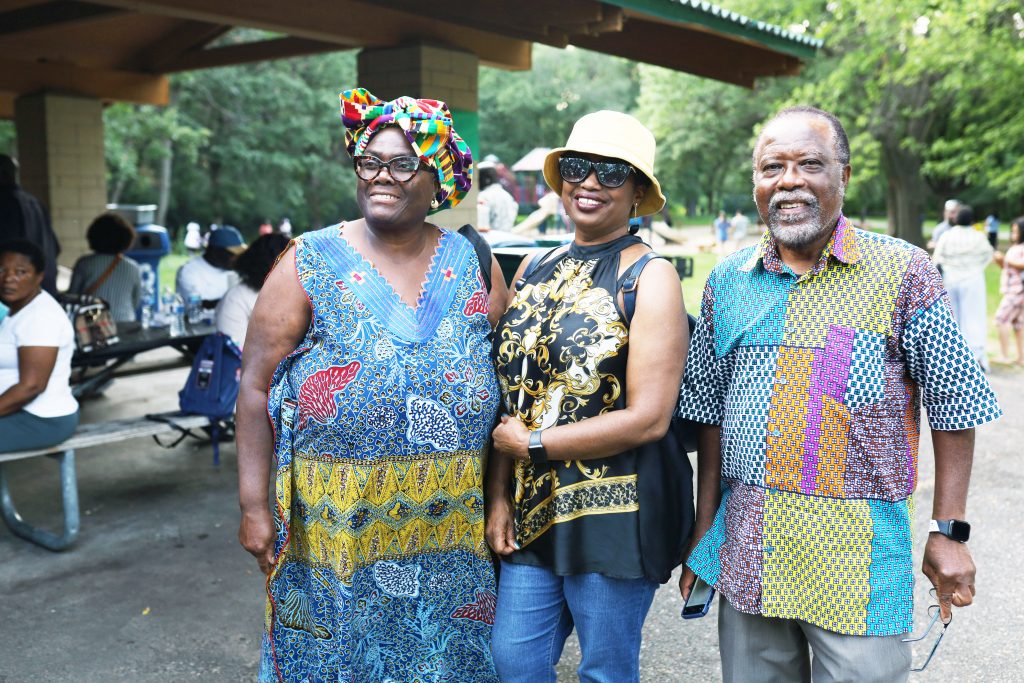
Dozens of immigrants from the west African country and their friends gathered on Monday for the annual Taste of Ghana event at Oak Grove Park in the suburban Minneapolis city of Brooklyn Park. The event was an opportunity for the Ghanaian community to share their food and culture with other Minnesotans.
“Taste of Ghana is a tradition for us to open our culture to the community and connect as summer comes to an end,” said Isaac Owens, the president of Ghanaian Association of Minnesota (GhanAM).
GhanAM, which according to Owens was founded in the 1950s by two students at the University of Minnesota students, has evolved into a community organization hosting various events including concerts, townhall meetings, and networking events to preserve and promote Ghanaian culture across Minnesota.
Attendees enjoying themselves at the Taste of Ghana event in Brooklyn Park, Minnesota on Monday, September 5, 2022. Photo: Panashe Matemba-Mutasa/Mshale
Unlike Somalis, Kenyans, Ethiopians, Nigerians, and Liberians – who are known as the Big Five of Minnesota’s African immigrant community – Ghanaians do not make up a significant portion of the population of immigrants from the continent. Events such as Taste of Ghana are an important way for Ghanaians to socialize, strengthen the cultural connection, and introduce to their rich culture to other Africans and Minnesotans. Each year, Taste of Ghana features games, live music, and a selection of authentic foods.
A woman serves peanut soap during the Taste of Ghana event in Brooklyn Park, Minnesota on Monday, September 5, 2022. Photo: Panashe Matemba-Mutasa/Mshale
Dr. Grace Totoe, Ghanaian-born physician at Minneapolis Health Clinic in Golden Valley, said she attends Taste of Ghana every year, and brings along her children as a way to connect them with their heritage and interact with other kids of a similar cultural background. Totoe, who was recently honored for her service to the community during the peak of the coronavirus pandemic, said Taste of Ghana was an opportunity to check in on the health of members of her community.
“I try to stay in touch with my community in any capacity I can, and this is a perfect time to do that,” Totoe said.
A woman makes Ghanaian Bofrot also known as Puff Puff during the Taste of Ghana event in Brooklyn Park, Minnesota on Monday, September 5, 2022. Photo: Panashe Matemba-Mutasa/Mshale
Edmund Ocansey, the former president of GhanAM and current general secretary of the Ghana Council of Minnesota, said Taste of Ghana was a great opportunity to meet new people as well as catch up with old friends. The event was also a great way for others to learn about Ghana without leaving Minnesota, he said.
“It’s a unique opportunity for us to share our culture with people of all backgrounds,” Ocansey said.
West African Collaborative (WAC), a Minnesota-based coalition of local leaders of communities of immigrants from the western region of the continent, sent Dr. Richard Oni. Oni, the executive director of Progressive Individual Resources, a St Paul-based social and behavioral health organization, and founder of the African Mental Health Summit, was said it was important for west Africans to transcend nuanced cultural differences to support each other.
Isaac Owens, left, president of Ghanaian Association of Minnesota and Dr. Richard Oni, right, representing the West African Collaborative, join the food line at the Taste of Ghana in Brooklyn Park, Minnesota on Monday, September 5, 2022. Photo: Panashe Matemba-Mutasa/Mshale
“We are here to support the picnic because we believe there is power in unity,” Oni said.
Anne Wood, a United Kingdom-born Ghanaian, said that Taste of Ghana was a rare opportunity for her to connect with people of a shared background. She said going to Ghana wasn’t always easy, and so each year she enjoyed connecting with old and new friends over dishes like banku and okra soup.
“I look forward to this event each year,” she said. “The food, the people, and the atmosphere make it such a good way to stay connected.”
Percy Botchway, who has lived in the United States since 2004, said the last time he was in Ghana was right before the pandemic in 2019. Botchway said that made him appreciate more the opportunity to meet others in the diaspora, both from Ghana and other African countries.
Attendees at the Taste of Ghana event in Brooklyn Park, Minnesota on Monday, September 5, 2022. Photo: Panashe Matemba-Mutasa/Mshale
“It’s such a great way to connect with old friends as well as meet new people,” Botchway said.
Kofi Berkoh said that although he was born in New York and came to Minnesota as a 6-month-old when his family moved to the state, he considers himself integrated into the local Ghanaian community. He visited Ghana once when he was 10 years old. Though he wished to go more in the future, he said events like Taste of Ghana helped him to stay in touch with his roots.
“I’ve been in Ghana for a total of two weeks in my entire life, so I have almost no exposure,” Berkoh says, “but I love that I get to indulge in the culture a little bit here.”
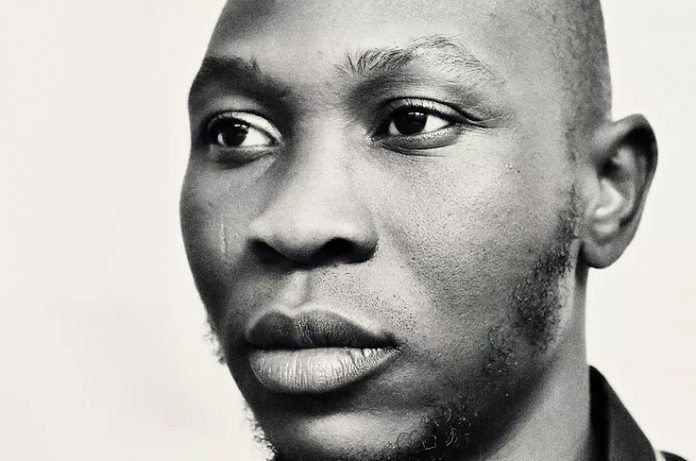
Seun Kuti and Egypt 80 will perform on September 21, 2022 at the Dakota in Minneapolis. Photo: Courtesy of Seun Kuti
Seun Kuti and Egypt 80 will perform on September 21, 2022 at the Dakota in Minneapolis. Photo: Courtesy of Seun Kuti
If you are looking for a relaxing evening out with friends, a bit of indulgence as soft music plays in the background and and you escape from the issues of the day, you won’t find it on the night of September 21st at The Dakota.
Seun Kuti & Egypt 80 take the stage that night in downtown Minneapolis at a jazz venue that’s been strengthening its repertoire to embrace world music as well as other traditional musicians.
The Kuti surname evokes a history of activism through protest music. Mshale spoke to Seun Kuti this week, frontman for the band and youngest son of Fela Kuti, Nigeria’s pioneer of Afrobeat, and grandson of Nigerian women’s rights activist Funmilayo Ransome-Kuti.
Seun Kuti described the political activism he summons up in his music as activism that’s a world-wide concern. “These issues of climate and environmental destruction do not only affect Nigeria, but are global. The treatment of men and women is something that people around the world face. The politics are universal,” he said.
Along with its powerful messaging, Seun Kuti & Egypt 80 fill the halls with joyful, exuberant music and dance and costuming. This week, a brand new single with USian rapper Black Thought, called “KuKu Kee Me” (remix) was released. KuKu Kee Me translates as “just kill me,” used when you are really cracked up about a joke or deeply satisfying amusement.
Another single track recently released is Emi Aluta, which is a song calling for “the spirit of the struggle to possess our people,” Kuti said. “It is also a jab at organized religion in Africa.”
I asked Seun Kuti if his US audiences might see a cameo appearance by any of the musicians with whom they’ve recently collaborated, but he declined to confirm. Hearing the new tracks, like Love and Revolution, recorded live at Clout Studios in Lagos, Nigeria, will be enough.
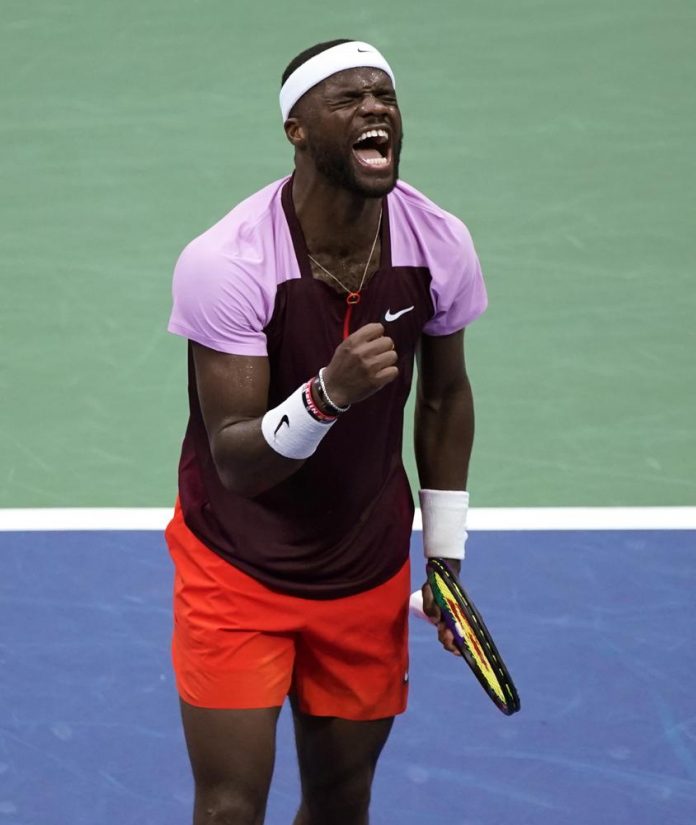
Frances Tiafoe, of the United States, reacts after defeating Andrey Rublev, of Russia, during the quarterfinals of the U.S. Open tennis championships, Wednesday, Sept. 7, 2022, in New York. Photo: Seth Wenig/AP
Frances Tiafoe, of the United States, reacts after defeating Andrey Rublev, of Russia, during the quarterfinals of the U.S. Open tennis championships, Wednesday, Sept. 7, 2022, in New York. Photo: Seth Wenig/AP
NEW YORK (AP) — Frances Tiafoe’s run to the U.S. Open semifinals is, first and foremost, about Tiafoe himself, a 24-year-old from Maryland who took up tennis because his father was a janitor at a junior training center, a player who never won a match past the fourth round at a Grand Slam tournament until now, who owns one career ATP title and a sub-.500 career record, and whose ranking ranged from 24 to 74 over the past two seasons.
“A Cinderella story,” to use his phrase.
Tiafoe’s tale — which already includes a victory over 22-time Grand Slam champion Rafael Nadal along the way to Friday’s matchup against No. 3 Carlos Alcaraz of Spain with a berth in the final at stake — is about so much more, too.
It is a significant step forward for American men’s tennis right now and could help grow the sport in the future, too.
Tiafoe is the first man from the United States to reach the semifinals at Flushing Meadows since Andy Roddick, 16 years ago. He has a shot at giving the country its first male champion at any Slam since Roddick in New York, 19 years ago.
If he can get past Alcaraz on Friday — the other men’s semifinal is No. 5 Casper Ruud of Norway against No. 27 Karen Khachanov of Russia — Tiafoe would become the first Black man from the U.S. in a major final since MaliVai Washington was the runner-up at Wimbledon in 1996.
“American men’s tennis has been struggling for a couple of decades. Struggling with a standard that we set for ourselves: Grand Slam champions and Grand Slam finals,” Washington said in a telephone interview Thursday. “That has not happened on the men’s side in years.”
A high bar was set by the success of the likes of Pete Sampras, Andre Agassi, John McEnroe, Jimmy Connors and Arthur Ashe — the last African American man in the U.S. Open semifinals, in 1972, and the person for whom the event’s main stadium is named — and, before that, Don Budge and Bill Tilden. Thanks to the Williams sisters, and other players who were major champs or runners-up more recently, such as Sloane Stephens, Madison Keys, Sofia Kenin and Danielle Collins, American women’s tennis has stayed relevant long past the days of Chris Evert and Billie Jean King.
“It absolutely helps the U.S. Open to have male and female champions from the U.S. Absolutely,” tournament director Stacey Allaster said. “We had the greatest of all time for decades on the women’s side. And obviously we’ve had amazing American champions on the men’s side, from Pete and Andre to Andy. But it’s been a while.”
As Serena Williams prepared to walk away from her playing days, current athletes such as Tiafoe, 18-year-old Coco Gauff and others spoke during the U.S. Open about the influence she and her sister, Venus, had on their careers.
Gauff has said she plays what she called “a predominantly white sport” because she “saw somebody who looked like me dominating the game.”
The importance of representation can’t be overstated.
“What Frances is doing now is inspiring me,” Washington said. “And I hope he inspires young players — not just Black, but white, Hispanic, Asian. Certainly, because of his background, and the the color of his skin, it’s going to have a certain impact on young Black players and especially young Black boys. And I hope it makes them think, ‘OK, I’ve been playing tennis for a bunch of years. This inspires me to keep going.’ Or: ‘I’ve never played tennis before. This inspires me to try.’”
Tiafoe’s on-court enthusiasm — “which you might see more readily in basketball,” Washington said — and off-court personality could help draw youngsters to tennis.
So could the sorts of social media that didn’t exist in Washington’s playing days.
“I don’t know if you can ever truly know what type of impact you’re having on the next generation until maybe years later, when someone says, ‘Hey, I started playing tennis because I remember watching you at Wimbledon,’” said Washington, whose youth foundation in Jacksonville, Florida, offers after-school and summer programs. “We’re always trying to look for a diverse group of players, trying to find that next player and maybe looking for that next player in unconventional places.”
Martin Blackman, head of the U.S. Tennis Association’s player development program, thinks Tiafoe “resonates and is relevant in the culture. He represents a huge opportunity to make tennis ‘cooler.’”
Tiafoe does not shy from the notion that he can lead the way for others.
“He wants to be a role model,” said his coach, Wayne Ferreira. “I always tell him, ‘If you want to be a role model, you have to win tennis matches.’ … If he can win this tournament, he can be an inspiration for a lot of kids.”
Tiafoe was 6 when he first crossed paths with Blackman, who at the time was a coach at the Junior Tennis Champions Center in College Park, Maryland, where little Francis and his twin brother, stayed while Dad worked.
“He would watch the group lessons, he would watch the private lessons, he would hit on the wall,” Blackman said.
Blackman sees what Tiafoe is doing as the result of a process started more than a dozen years ago to try to develop future champions.
Blackman sees a “healthy peer pressure” in the group of American men around Tiafoe’s age who have come through the ranks — and rankings — together, including Taylor Fritz, Reilly Opelka and Tommy Paul.
“We want that same dynamic we had back in the early ’90s, with Pete, Andre, Jim Courier and Michael Chang,” Blackman said. “That’s another part of why Frances’ breakthrough is so significant.”
Frances Tiafoe, of the United States, celebrates after winning a point against Rafael Nadal, of Spain, during the fourth round of the U.S. Open tennis championships, Monday, Sept. 5, 2022, in New York. Photo: Eduardo Munoz Alvarez/AP
Frances Tiafoe, of the United States, celebrates after winning a point against Rafael Nadal, of Spain, during the fourth round of the U.S. Open tennis championships, Monday, Sept. 5, 2022, in New York. Photo: Eduardo Munoz Alvarez/AP
NEW YORK (AP) — Frances Tiafoe’s vision was blurry from the tears. He was thrilled — overwhelmed, even — when the last point was over and it hit him that, yes, he had ended Rafael Nadal’s 22-match Grand Slam winning streak Monday and reached the U.S. Open quarterfinals for the first time.
“I felt like the world stopped,” Tiafoe said. “I couldn’t hear anything for a minute.”
Then Tiafoe found himself “losing it in the locker room” when he saw that NBA superstar LeBron James gave him a Twitter shoutout.
“Bro,” Tiafoe said, “I was going crazy.”
What meant the most to Tiafoe about his 6-4, 4-6, 6-4, 6-3 victory over 22-time major champion Nadal in the fourth round at Flushing Meadows, though, was looking up in his Arthur Ashe Stadium guest box and knowing his parents, Constant and Alphina, were there.
“To see them experience me beat Rafa Nadal — they’ve seen me have big wins, but to beat those ‘Mount Rushmore’ guys? For them, I can’t imagine what was going through their heads,” said Tiafoe, a 24-year-old American seeded 22nd at the U.S. Open. “I mean, they’re going to remember today for the rest of their lives.”
His parents both emigrated to the United States from Sierra Leone in West Africa amid its civil war in the 1990s. They ended up in Maryland, where Constant helped construct a tennis training center for juniors, then became a maintenance man there; Alphina, Frances said, was “a nurse, working two jobs, working overtime through the nights.” Frances and his twin brother, Franklin, were born in 1998, and soon would be spending hour upon hour where Dad’s job was, rackets in hand.
Frances Tiafoe, of the United States, celebrates after defeating Rafael Nadal, of Spain, during the fourth round of the U.S. Open tennis championships, Monday, Sept. 5, 2022, in New York. Photo: Eduardo Munoz Alvarez/AP
Maybe one day, went the dream, a college scholarship would come of it.
“It wasn’t anything supposed to be like this,” Tiafoe said Monday evening, hours after by far his biggest victory.
He is the youngest American man to get this far at the U.S. Open since Andy Roddick in 2006, but this was not a case of a one-sided crowd backing one of its own. Nadal is about as popular as it gets in tennis and heard plenty of support as the volume raised after the retractable roof was shut in the fourth set.
“It’s something to tell the kids, the grandkids: ‘Yeah, I beat Rafa,’” Tiafoe said with a big smile.
He served better than No. 2 seed Nadal. More surprisingly, he returned better, too. And he kept his cool, remained in the moment and never let the stakes or the opponent get to him. Nadal, a 36-year-old from Spain, had won both of their previous matches, and every set they played, too.
“Well, the difference is easy: I played a bad match and he played a good match,” Nadal said. “At the end that’s it.”
This surprise came a day after Tiafoe followed along on TV as his pal Nick Kyrgios “put on a show” and eliminated No. 1 seed and defending champion Daniil Medvedev. That makes this the first U.S. Open without either of the top two seeded men reaching the quarterfinals since 2000, when No. 1 Andre Agassi exited in the second round and No. 2 Gustavo Kuerten in the first.
That was before Nadal, Novak Djokovic, who has 21 Grand Slam titles, and Roger Federer, who has 20, began dominating men’s tennis. Djokovic, 35, did not enter this U.S. Open because he is not vaccinated against COVID-19 and was not allowed to enter the United States; Federer, 41, has undergone a series of operations on his right knee and last played at Wimbledon last year.
Frances Tiafoe, of the United States, celebrates after winning a point against Rafael Nadal, of Spain, during the fourth round of the U.S. Open tennis championships, Monday, Sept. 5, 2022, in New York. Photo:Julia Nikhinson/AP
Now come the inevitable questions about whether their era of excellence is wrapping up.
“It signifies that the years go by,” Nadal said. “It’s the circle of life.”
Tiafoe now meets No. 9 Andrey Rublev, who beat No. 7 Cam Norrie 6-4, 6-4, 6-4 earlier Monday.
Late Monday turned into early Tuesday when third-seeded Carlos Alcaraz beat No. 15 seed Marin Cilic 6-4, 3-6, 6-4, 4-6, 6-3 in a match that lasted 3 hours, 54 minutes and ended at 2:23 a.m.
No. 11 Jannik Sinner rallied from two games down in the fifth set to beat Ilya Ivashka 6-1, 5-7, 6-2, 4-6, 6-3.
The No. 1 woman, Iga Swiatek, moved into her first quarterfinal at Flushing Meadows by coming back to beat Jule Neiemeier 2-6, 6-4, 6-0.
“I’m just proud,” Swiatek said, “that I didn’t lose hope.”
The 21-year-old from Poland will face another first-time U.S. Open quarterfinalist: No. 8 Jessica Pegula, the highest-ranked American woman, who advanced with a 6-3, 6-2 victory over two-time Wimbledon winner Petra Kvitova.
Another women’s quarterfinal will be two-time major finalist Karolina Pliskova against No. 6 Aryna Sabalenka.
Nadal won the Australian Open in January and the French Open in June. Then he made it to the semifinals at Wimbledon in July before withdrawing from that tournament because of a torn abdominal muscle.
Nadal competed only once in the 1 1/2 months between leaving the All England Club and arriving in New York, where he has won four trophies.
He tweaked his service motion, tossing the ball lower than he normally does so as not to put as much strain on his midsection. There were plenty of signs Monday that his serve was not in tip-top shape: nine double-faults, a first-serve percentage hovering around 50%, five breaks by Tiafoe.
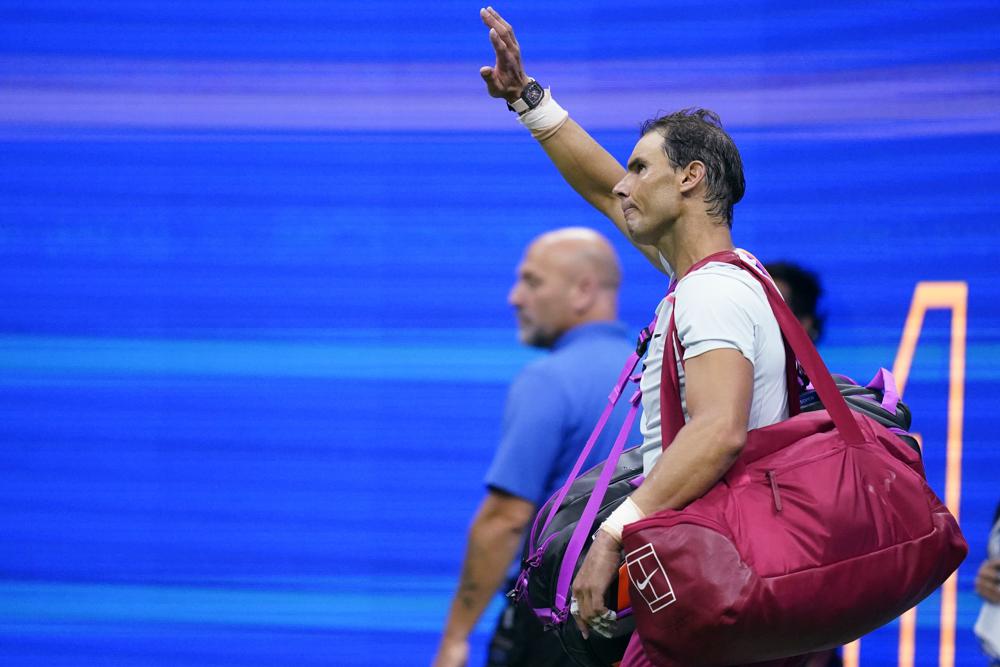
Rafael Nadal, of Spain, waves to fans after his loss to Frances Tiafoe, of the United States, during the fourth round of the U.S. Open tennis championships, Monday, Sept. 5, 2022, in New York. Photo:Julia Nikhinson/AP
Earlier in the tournament, he lost the first set of his first-round match. Did the same in the second round, when he also accidentally cut the bridge of his nose and made himself dizzy when the edge of his racket frame bounced off the court and caught him in the face.
Still, on Monday, Nadal appeared on the verge of turning things around when he broke early in the fourth set and went ahead 3-1.
Tiafoe told himself: “Stay in it. Stay with him.”
That’s tied to two key areas Tiafoe credits with helping make him a stronger player of late: an improved in-match mindset and a commitment to fitness.
“Rafa is there every point. I’ve been known to have some dips in my game at times, where it’s like you’re watching (and thinking), ‘What’s that?!’” Tiafoe said. “That was my thing, match intensity.”
No concern now: He grabbed the last five games. The next-to-last break came for a 4-3 edge in the fourth set, when Nadal put a backhand into the net, and Tiafoe skipped backward toward the sideline for the ensuing changeover, his fist raised.
Fifteen minutes later, Tiafoe broke again, and it was over. This represents the latest significant step forward for Tiafoe, whose only previous trip to a Grand Slam quarterfinal came at the 2019 Australian Open — and ended with a loss to Nadal.
When one last backhand by Nadal found the net, Tiafoe chucked his racket and put his hands on his head. He glanced into the stands — Mom, Dad, brother, girlfriend, Washington Wizards All-Star Bradley Beal, others — then sat in his sideline chair and buried his face in a towel.
“It was just wild. My heart is going a thousand miles an hour. I was so excited. I was like: Let me sit down,” Tiafoe said. “Yeah, I’ve never felt something like that in my life, honestly.”
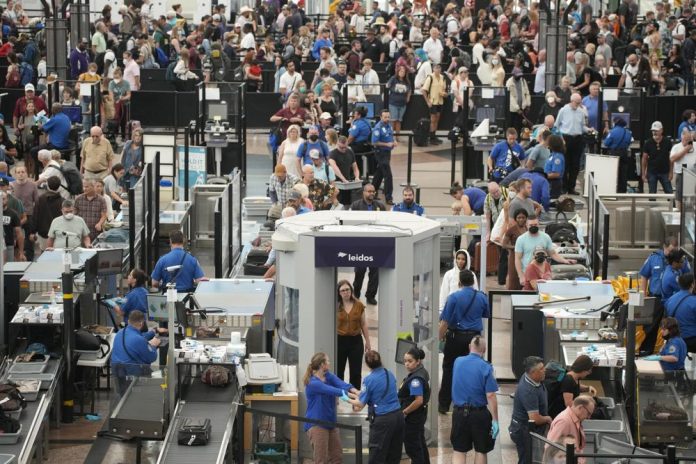
Travelers queue up at the south security checkpoint in Denver International Airport as the Labor Day holiday approaches Tuesday, Aug. 30, 2022, in Denver. Photo:David Zalubowski/AP
Travelers queue up at the south security checkpoint in Denver International Airport as the Labor Day holiday approaches Tuesday, Aug. 30, 2022, in Denver. Photo:David Zalubowski/AP
For the first time since COVID-19 brought air travel to a standstill, the number of people streaming through U.S. airport-security checkpoints over a holiday weekend exceeded pre-pandemic levels.
The summer travel season ended on a busy note as more than 8.7 million people passed through security in the last four days, topping the Labor Day weekend of 2019.
That is a first for a holiday weekend, the Transportation Security Administration said Tuesday.
The busiest day was Friday, when TSA screened 2.48 million travelers.
After a problem-plagued start to the summer, travelers encountered relatively few disruptions.
Airlines canceled about 640 U.S. flights between Friday and Monday, 0.6% of the total, according to tracking service FlightAware. That’s less than one-third the cancellation rate between June 1 and Labor Day. Delays were down too.
TSA said screeners found 67 guns in passenger bags between Friday and Monday – very close to the average of 17.3 per day this year. The agency said if that rate continues, 2022 will break last year’s record of 5,972 guns discovered at checkpoints.
Malawian street-busking duo Madalitso Band will make their U.S. debut at the Cedar Cultural Center's Global Roots Festival in Minneapolis which runs Sept. 26 -28, 2022. Photo: Courtesy Madalisto Band
Malawian street-busking duo Madalitso Band will make their U.S. debut at the Cedar Cultural Center's Global Roots Festival in Minneapolis which runs Sept. 26 -28, 2022. Photo: Courtesy Madalisto Band
Returning with a full hand after a three-year lull, The Cedar Cultural Center’s Global Roots Festival 2022 brings music from three continents and five countries to the stage in Minneapolis.
The Festival will fill the evenings of September 26th through 28th and is free to attend.
While some Minneapolis venues have fall line-ups predominately filled with local domestic talent, The Cedar made a choice to continue with their mission, “to promote intercultural appreciation and understanding through the presentation of global music and dance.” Their summer and fall line-up represents a broad swath of countries.
The first night of the Global Roots Festival features a duo, Puuluup, who produce their sound with talharpas, the traditional Estonian horsehair bowed lyre. Representing both Scandinavian and Baltic countries, the pair entertain through music and their signature comedic dance and banter.
To close opening night, QWANQWA brings together traditional string players from Ethiopia to share their improvisations and experimentations. QWANQWA draws inspiration from East Africa regions of Ethiopia and beyond. Delving deep into regional beats and moods, the repertoire ranges from a trance-like song of the Eritrean tribe of Blen to a Somali rock number to Mahmoud Ahmed sing-a-longs.
Night two of Global Roots Festival continues with Heart of Afghanistan featuring four Afghan musicians. Unable to perform inside Afghanistan today, where the only musical activity permitted by the Taliban is the singing of certain types of religious song and Taliban “chants,” Heart of Afghanistan has reached outward to share their music. Only recently reunited in the U.S., the ensemble will give a 360-degree view of Afghan culture through traditional ghazals, Afghan folk music, iconic hits of Ahmad Zahir, and poetry.
The final night of Global Roots Festival again highlights music inspired by both Asia and Africa. Roopa in Flux springs from New York City, but draws upon the music of India. Led by classical vocalist Roopa Mahadevan, she and the other instrumentalists dig into classical, soul, and jazz motifs. The final band, Madalitso Band, hails from Malawi. Their celebratory and energetic sound complements the Festival with a joyful note of return.
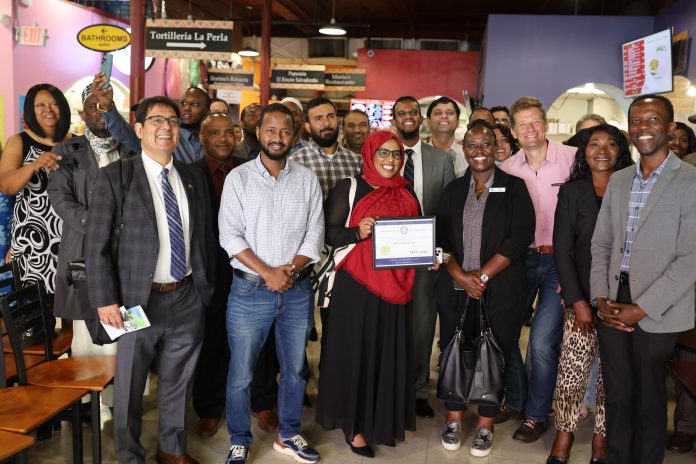
Anisa Hajimumin, who pioneered Minnesota’s Office of New Americans, holds a certificate of recognition presented to her by Minnesota Governor Tim Walz on Tuesday, August 30, 2022 during a community discussion on the persisting economic roadblocks immigrants face. Hajimumin is relocating to Pennsylvania with her family and will be replaced temporarily by Abdiwahab Mohamed. Photo: Panashe Matemba-Mutasa/Mshale
Anisa Hajimumin, who pioneered Minnesota’s Office of New Americans, holds a certificate of recognition presented to her by Minnesota Governor Tim Walz on Tuesday, August 30, 2022 during a community discussion on the persisting economic roadblocks immigrants face. Hajimumin is relocating to Pennsylvania with her family and will be replaced temporarily by Abdiwahab Mohamed. Photo: Panashe Matemba-Mutasa/Mshale
New research from the Minnesota Department of Employment and Economic Development (DEED) suggests a swift economic recovery from the early days of the pandemic, but the state’s immigrants bear a grimmer reality.
At a community discussion Tuesday in Mercado Central, the Latino business mall in the East Lake district of Minneapolis, DEED’s officials addressed the persisting economic roadblocks that immigrants run into. As a part of their Summer of Jobs Campaign, the state agency celebrated the work of the Office of New Americans (ONA) a novel interagency initiative that connects new immigrants to resources and training designed to help them navigate barriers they face in the workforce.
“We fought collectively for this office,” said DEED Commissioner Steve Grove. “We all said that either it would be in the budget, or we would walk away, and we felt that the establishment of this office was the one thing we were not going to compromise on.”
In July, Minnesota’s unemployment rate was 1.8%, the lowest in the state’s history, according to a DEED. The data illustrates a relatively quick bounce back from pandemic-induced layoffs. Nevertheless, Minnesotan immigrants continue to grapple with economic hardship. The Twin Cities host some of the widest racial disparities in economic achievement in the country, according to the United States Census Bureau. Minnesota has the second largest income inequality gap between blacks and whites in the nation, second only to the District of Columbia. People immigrating to Minnesota lack the necessary resources and connections to close these gaps, such as knowledge of language and culture and financial stability.
Anisa Hajimumin, who pioneered Minnesota’s Office of New Americans, reiterated the value of listening to voices from every community during a community discussion on the persisting economic roadblocks immigrants face on Tuesday, August 30, 2022. Hajimumin is relocating to Pennsylvania with her family and will be replaced temporarily by Abdiwahab Mohamed. Photo: Panashe Matemba-Mutasa/Mshale
ONAs are increasingly becoming important as state and municipal governments across the country seek to help the newest community members integrate smoothly into the workforce. They cater to various immigrant needs specific to where in the country they are located. For example, the New York Department of State’s ONA focuses on refugee aid, whereas the one in Miami-Dade County places an emphasis on citizenship and naturalization, according to their respective websites. DEED’s Office for New Americans primarily focuses on creating career pathways for new immigrants.
Minnesota’s ONA initiative was pioneered by Anisa Hajimumin, a Somali immigrant who until recently was the assistant commissioner for immigrant and refugee affairs at DEED. Hajimumin began her role in 2020. In her farewell speech, Hajimumin reiterated the value of listening to voices from every community.
“The Office of New Americans is transformative, but we can’t stop there,” Hajimumin said. “When the community is part of the conversation, state legislators are pushed to do their job.”
The ONA arrived at a critical time, according to Jennifer Byers, the executive director of Minnesota Chamber of Commerce, who said that the state saw a net loss in its workforce due to more people leaving than coming in. She attributed much of the decline to layoffs stemming from the coronavirus pandemic shutdowns .
Immigrants in Minnesota make up 10% of the population, according to the American Immigration Council. The top country of origin for newcomers in the state is Mexico, with 12% of the total immigrant population hailing from there, followed by Somalia (8%), India (6%), Laos (5%), and Ethiopia (5%). More than one in ten workers in Minnesota is an immigrant, a figure comprising a significant portion of the state’s labor force. The top industries for immigrants in Minnesota are healthcare and social assistance, manufacturing, retail trade, educational services, and accommodation and food services.
A 2021 collaborative report by the research firm New American Economy, and The Minneapolis Regional Chamber found that in 2019, immigrants and refugees had a $1.2 billion in spending power, and paid more than $443 million in taxes.
Abdiwahab Mohamed, who will take over from Hajimumin temporarily as ONA assistant commissioner, said that he was excited to embark on his new journey. Mohamed said everyone deserved a chance at a good quality of life, and that he believed ONA was a critical step toward prosperity for immigrants in the state.
“I have the honor of being able to do this work, and I believe every immigrant and refugee has a place here,” Mohamed said.
Ian Oundo, a Ugandan American businessman, said he admired the work that had been done to transform lives through ONA. The survival of the office, he said, was critical for the advancement of Minnesota’s immigrants.
Ose Sesay, a Nigerian American consulting firm founder and strategist, at a community discussion on the persisting economic roadblocks immigrants face held at Mercado Central in Minneapolis on Tuesday, August 30, 2022. Photo: Panashe Matemba-Mutasa/Mshale
“As Anisa [Hajimumin] leaves, we are going to make sure that we continue the work that she has started,” Oundo said.
Ekta Prakash, the CEO at CAPI USA, a Brooklyn-Park based family services organization that aids refugees and immigrants in adjusting to their new environments, said that immigrants have been essential in shaping American society.
“We need to be persistent and resilient,” Prakash said. “We play a very important role. This country was built by refugees and immigrants. I feel like there’s a great opportunity that we have to maximize our skills and continue to drive the state’s economy.”
Ose Sesay, a Nigerian American consulting firm founder and strategist, urged members of immigrant communities to get involved whenever they could to push for change.
“I came here today as a small business that serves immigrants and refugees,” Sesay said. “I want to make sure I’m a part of this conversation.”
Lisa Perez, a local business owner, said supporting immigrants is so critical, and their recruitment was necessary to diversify the skills in the workforce.
“Supporting immigrants is so crucial because it helps us optimize our economy by utilizing everyone’s skills,” Perez said.
This August 2022 photo provided by Pfizer shows vials of the company's updated COVID-19 vaccine during production in Kalamazoo, Mich. U.S. regulators have authorized updated COVID-19 boosters, the first to directly target today's most common omicron strain. The move on Wednesday, Aug. 13, 2022, by the Food and Drug Administration tweaks the recipe of shots made by Pfizer and rival Moderna that already have saved millions of lives. Photo: Pfizer via AP
This August 2022 photo provided by Pfizer shows vials of the company's updated COVID-19 vaccine during production in Kalamazoo, Mich. U.S. regulators have authorized updated COVID-19 boosters, the first to directly target today's most common omicron strain. The move on Wednesday, Aug. 13, 2022, by the Food and Drug Administration tweaks the recipe of shots made by Pfizer and rival Moderna that already have saved millions of lives. Photo: Pfizer via AP
GENEVA (AP) — The number of new coronavirus cases and deaths reported globally continued to fall nearly everywhere in the world in what the World Health Organization described as a “welcome decline” at a media briefing on Wednesday.
The U.N. health agency said there were 4.5 million new COVID-19 cases reported last week, a 16% drop from the previous week. Deaths were also down by 13%, with about 13,500 fatalities. WHO said COVID-19 infections dropped everywhere in the world while deaths decreased everywhere except for Southeast Asia, where they climbed by 15% and in the Western Pacific, where they rose by 3%.
WHO Director-General Tedros Adhanom Ghebreyesus warned that with the coming onset of winter in the Northern Hemisphere and the possible emergence of a more dangerous new COVID-19 variant, experts expect to see a spike in hospitalizations and deaths. Tedros said vaccination rates, even in rich countries, were still too low, noting that 30% of health workers and 20% of older people remain unimmunized.
“These vaccination gaps pose a risk to all of us,” he said. “Please get vaccinated if you are not and a booster if it’s recommended that you have one.”
In the U.S., the Food and Drug Administration cleared its first update to COVID-19 vaccines on Wednesday, booster doses that target today’s most common omicron strain. Authorities said shots could begin within days.
Until now, COVID-19 vaccines have targeted the original coronavirus strain, even as wildly different mutants emerged. The new U.S. boosters are combination, or “bivalent,” shots. They contain half that original vaccine recipe and half protection against the newest omicron versions, called BA.4 and BA.5, which are considered the most contagious yet.
Earlier this month, Britain decided it would offer adults 50 and over a different booster option from Moderna, a combo shot targeting that initial BA.1 omicron strain.
On Friday, the European Medicines Agency will consider whether to authorize the combination COVID-19 vaccine including BA.1 made by Pfizer-BioNTech and Moderna. Another version of the Pfizer-BioNTech vaccine incorporating the BA.5 subvariant of omicron is also under review by the EU regulator.