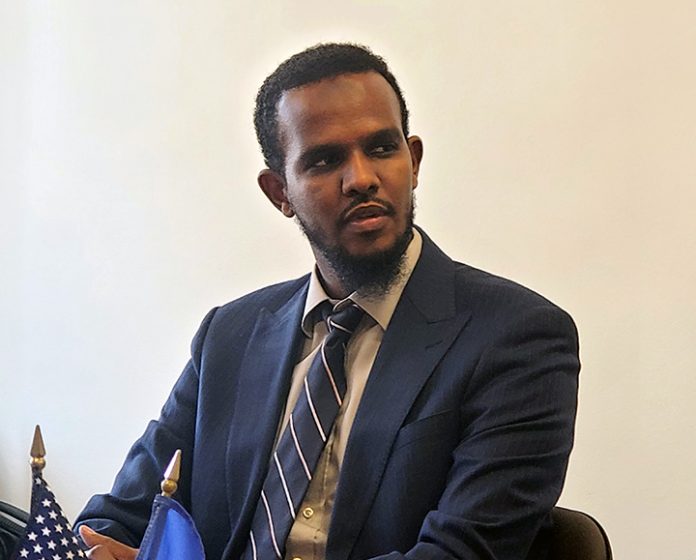
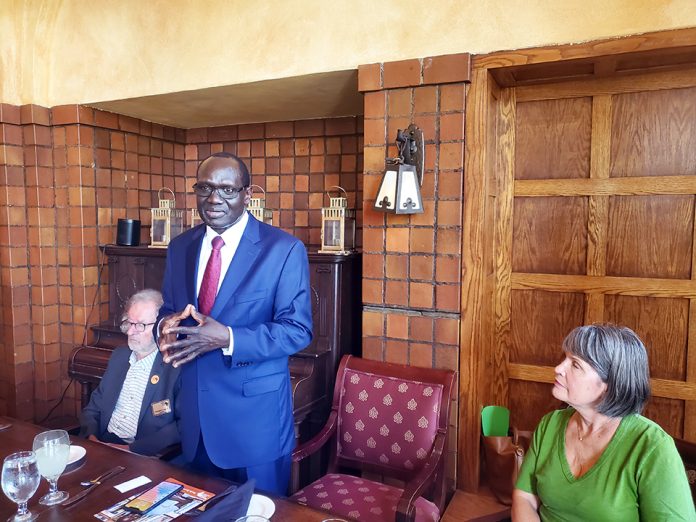
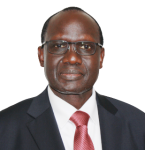
Minnesota Department of Employment and Economic Development has appointed Abdiwahab Mohamed, an immigrant from Kenya, as its temporary Assistant Commissioner for Immigrant and Refugee Affairs. Photo: Tom Gitaa/Mshale
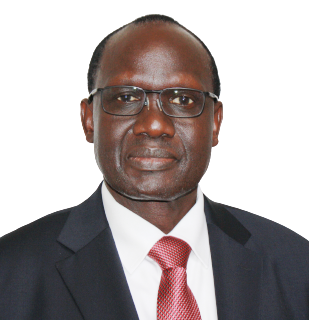
Minnesota Department of Employment and Economic Development has appointed Abdiwahab Mohamed, an immigrant from Kenya, as its temporary Assistant Commissioner for Immigrant and Refugee Affairs. Photo: Tom Gitaa/Mshale
The Minnesota Department of Employment and Economic Development (DEED) has appointed Abdiwahab Mohamed as its temporary Assistant Commissioner for Immigrant and Refugee Affairs. Mohamed, who is currently the agency’s regional trade manager for Africa, Middle East, and India, said that for the last five years, he had had the honor of working with the larger Minnesota business community at the Trade Office. Shifting into his new role would allow him to focus on expanding access and support for immigrants and refugees in communities across the state, he said.
“I am excited to continue the critical work underway and look forward to working with the community and leaders across state government to provide ongoing support and resources,” Mohamed said in a statement released after his appointment.
Mohamed, who was born in Kenya, will replace Assistant Commissioner Anisa Hajimumin, who will be leaving at the end of August to move with her family to Pennsylvania, according to a statement from the agency. For the last two years, Hajimumin, who is originally from Somalia, has been leading Minnesota’s Office of New Americans (ONA), a privately-funded initiative that works with new immigrants in the state to help them maximize their potential in the economy.
DEED Commissioner Steve Grove thanked Hajimumin for “her extraordinary efforts to serve immigrants and refugees, particularly through “the darkest days of the COVID-19 pandemic,” adding that her legacy would be safe in Mohamed’s hands.
“I’m grateful to Abdiwahab for stepping into the assistant commissioner role so there’s no interruption in our services to immigrants and refugees – services that are more important now than ever before,” Grove said.
Hajimumin said it had been an honor to have the opportunity to serve immigrants and refugees, and that she would be cheering on the continuation of ONA’s efforts into the future.
“Immigrants and refugees have long been a source of strength for Minnesota, both culturally and economically,” she said. “We are blessed with many immigrant communities in our state – and know they face unique challenges navigating new lives in Minnesota.
In the last decade, Minnesota has added 81,400 new immigrants into the workforce, according to DEED. Immigrants in Minnesota make up 10% of the population, according to the American Immigration Council. The top country of origin for newcomers in the state is Mexico, with 12% of the total immigrant population hailing from there, followed by Somalia (8%), India (6%), Laos (5%), and Ethiopia (5%). More than one in ten workers in Minnesota is an immigrant, a figure comprising a significant portion of the state’s labor force. The top industries for immigrants in Minnesota are healthcare and social assistance, manufacturing, retail trade, educational services, and accommodation and food services.
During the last legislative session, DEED secured state funding to extend the ONA beyond the grant funding, which concludes in July 2023. Most recently, the ONA has been heavily focused in helping Afghan refugees to transition smoothly into life in Minnesota and find opportunities for their families. Over the past two years the ONA has extended its reach to launch programs such as the Internationally-trained Health Care Workers, which helps them land stronger roles in Minnesota’s health care sector.
Mohamed will begin his new role Sept. 1 and will serve through the end of Gov. Tim Walz’s first term.
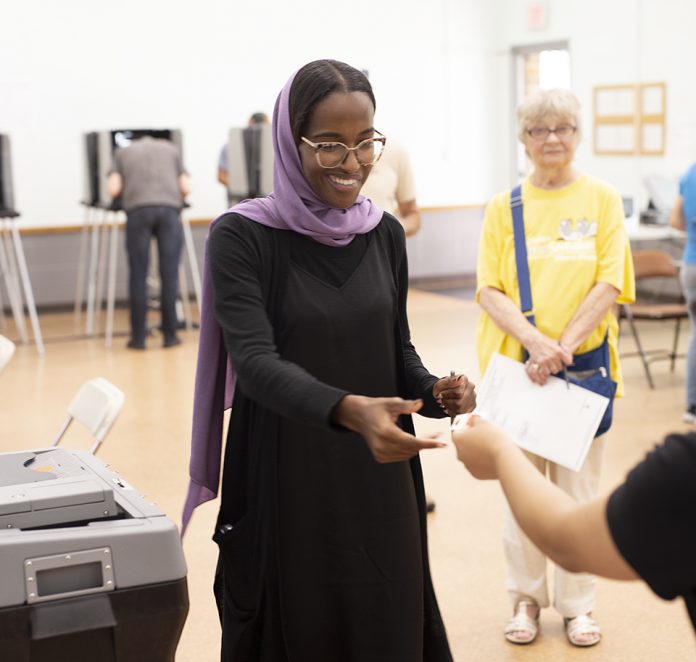
Zaynab Mohamed, 24, receives her ‘I Voted’ sticker after voting at the Corcoran Park Recreation Center in Minneapolis on Tuesday, August 9, 2022. She handily won her primary to be the DFL flagbearer in the November election to represent Senate District 63. Photo: Jerusa Nyakundi/Mshale
Zaynab Mohamed, 24, receives her ‘I Voted’ sticker after voting at the Corcoran Park Recreation Center in Minneapolis on Tuesday, August 9, 2022. She handily won her primary to be the DFL flagbearer in the November election to represent Senate District 63. Photo: Jerusa Nyakundi/Mshale
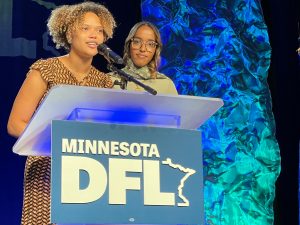
Zaynab Mohamed, a 24-year-old Somali immigrant who in December announced her candidacy to represent District 63 in the Minnesota state senate, will be the Democratic Farmer-Labor Party’s (DFL) flagbearer in the 2022 midterm elections.
Mohamed handily defeated her challenger, Todd Scott, by garnering more than 67% of the vote in the primaries held on August 9. She will now go on to fight it out in November with Shawn Holster, the Republican Party candidate. The winner will replace Patricia Torres Ray, a Colombian immigrant who made history in 2006 by becoming the first Latina to be elected to Minnesota state senate.
“I’m thankful for the partnership and support I’ve received from others who are running to break this glass ceiling, and I hope that we will make history together in November,” Mohamed said after the primary.
Since it joined the union in 1858, Minnesota has never elected a Black woman to the upper house of its legislature, despite being one of the most progressive states in the Midwest. But with Mohamed’s victory, the state moves a step closer to electing two Black women – and African immigrant women – ever elected to the state senate.
Clare Verbeten speaks at the June 10, 2022 Humphrey-Mondale Dinner. Verbeten did not have a primary challenger on Tuesday and will be the DFL flagbearer in the November election to represent Senate District 66. She will face GOP candidate Mikki Murray and Jeremy Peichel of the Libertarian Party in the overwhelmingly Democratic district. Photo: Courtesy of Clare Verbeten Facebook Page
The other candidate is Clare Oumou Verbeten, a daughter of Senegalese and Dutch-American immigrants, who in February announced her candidacy for the District 66 state senate seat. But Verbeten was confirmed to be the Democratic candidate long before the primaries because she did not have a challenger in her party. She will proceed to run against Republican Mikki Murray, and Jeremy Peichel, the libertarian candidate in November.
Verbeten said she believed there was strength in numbers to see her through, and that she proudly supported the campaigns of her fellow Black female candidates in their respective districts.
“I look forward to celebrating the historic victories of my sisters running across the state,” she said.
Both Mohamed and Verbeten are running districts that heavily vote for Democrats, so their victories are all but certain. But one candidate who did not qualify for November is Huldah Momanyi-Hiltsley, a Kenyan immigrant who was running for the state senate seat in District 38. Momanyi-Hiltsley, who is the president of a Kenyan immigrant organization known as Mwanyagetinge, had a more uphill task, compared to the other two. She managed just over 38% of the vote, in a contest that pitted her against the more experienced Susan Pha, a Hmong American who has been a city councilwoman in Brooklyn Park since 2016.
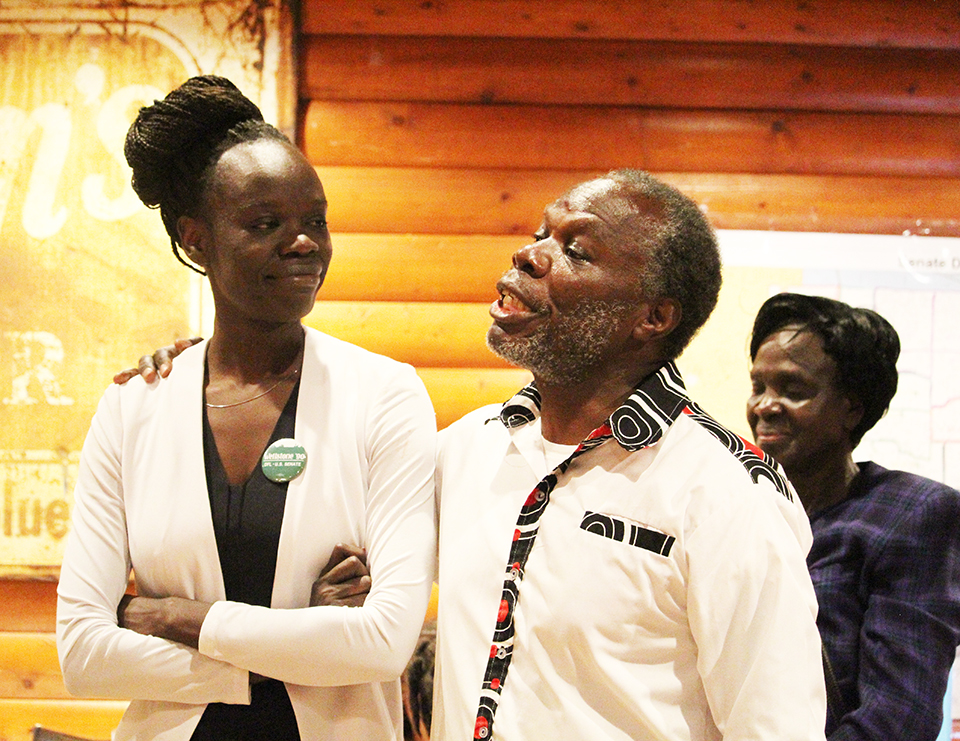
A disappointed Huldah Momanyi Hiltsley listens to her parents’ comforting words at her election watch event in Brooklyn Park after results showed her losing the DFL primary election to represent Senate District 38. Photo: Jasmine Webber/Mshale
“Team Huldah put in every ounce of their lives, and I am proud of all of you, and whatever happens tonight, we are going to celebrate,” Hiltsley said after the election. “It’s a blessing that someone like me, an immigrant from Kenya, even had this opportunity to run for office.”
Since Mohamed launched her campaign, she has received a series of endorsements from several leaders, including Rep. Ilhan Omar, who herself overcame a tough primary challenge from Don Samuels, winning by just over 50% of the vote. Mohamed was also been endorsed by every elected member in her district. Her campaign is centered around affordable housing, education, criminal justice reform, healthcare, labor rights and economic justice, and environmental justice.
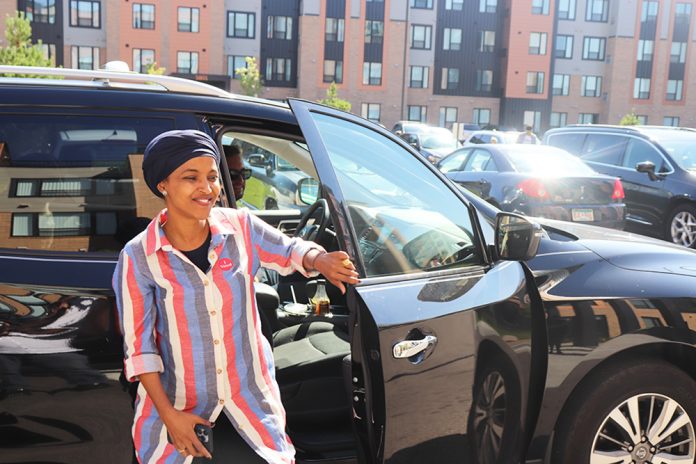
Rep. Ilhan Omar arrives for a door knocking event on Primary Election Day on Tuesday, August 9, 2022 to encourage residents of Sonder Point Apartments in Brooklyn Center to go out and vote. Omar beat Don Samuels in the DFL primary. Samuels is the second Black man in two election cycles to challenge and out raise her and still go down in defeat. Photo: Tom Gitaa/Mshale
Rep. Ilhan Omar arrives for a door knocking event on Primary Election Day on Tuesday, August 9, 2022 to encourage residents of Sonder Point Apartments in Brooklyn Center to go out and vote. Omar beat Don Samuels in the DFL primary. Samuels is the second Black man in two election cycles to challenge and out raise her and still go down in defeat. Photo: Tom Gitaa/Mshale
U.S. Rep. Ilhan Omar has won the DFL primary in her district against strong competition from Don Samuels, essentially ensuring a third term in Congress in the slightly redrawn Minnesota’s Fifth District that includes all of Minneapolis and some inner ring suburbs.
Omar garnered 50.35 percent or 57,683 votes to Samuel’s 48.20 percent or 55,217 votes with all 217 precincts reporting as of 10:30 pm. Three other candidates trailed with less than one percent of the vote each.
Omar will face GOP candidate Cicely Davis, who is Black, in the general election. Davis hauled in 4,765 votes or 47.99 percent of the Republican vote against NBA star Royce White’s 3,689 votes or 37.15 percent. A third candidate, Guy Gaskin, trailed with 1,476 votes or 14.86 percent.
As can be seen from the GOP vote totals, the district is overwhelmingly Democratic and Omar’s triumph over Samuels virtually guarantees her a third term.
This is the second time a Black man has primaried Omar and they have both gone down in defeat after outspending her. In 2020, political newcomer Antone Melton-Meaux raised more than $4 million, largely from outside Minnesota, in his bid to dislodge Omar who was then a first term incumbent.
August campaign finance reports showed Samuels outraising Omar by over $200,000.
Rep. Omar is the first Somali American and one of the first two Muslim women elected to Congress in 2018.
“Millions of dollars have been spent to unseat us. Republicans and conservative Democrats have worked in lockstep to vote us out. Corporations and special interest groups have spent hundreds of thousands of dollars on ads against us. Pundits and news agencies have tried to smear us and undermine our work,” Omar said in a written statement after her win.
“Tonight’s victory is a testament to how much our district believes in the collective values we are fighting for and how much they’re willing to do to help us overcome defeat. This win is for them and everyone who still believes that hate, division and regression will not be the legacy of the Fifth,” Omar said.
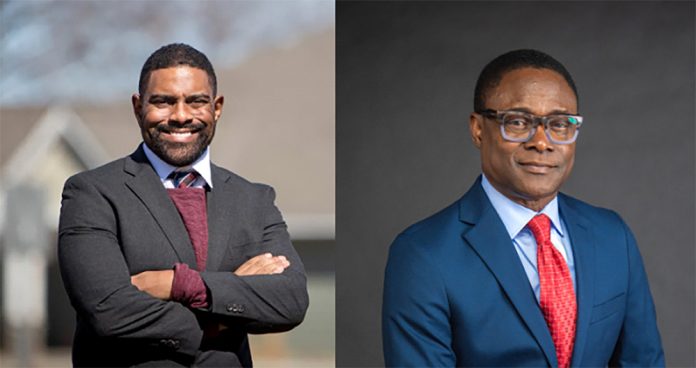
Hollies Winston (left) and Wynfred Russell have advanced to the November 2022 general election for Mayor of Brooklyn Park. The two emerged out of a three way race in the August 9, 2022 primary election. Photo: Courtesy of the candidates.
Hollies Winston (left) and Wynfred Russell have advanced to the November 2022 general election for Mayor of Brooklyn Park. The two emerged out of a three way race in the August 9, 2022 primary election. Photo: Courtesy of the candidates.
Central District Councilmember Wynfred Russell and Hollies Winston, who lost by two votes to outgoing Mayor Lisa Jacobson last year, are advancing to the general election.
Whomever of the two men that triumphs in November will have historical significance for Brooklyn Park with the election of its first elected Black mayor and most significantly the first African immigrant mayor for the city were Russell to prevail. Both understand the pain of losing an election by a handful of votes with Russell losing by five votes in his first run for the City Council and Hollies losing by two votes in special election for mayor last year.
Hollies received 55.37percent of the vote with 4,144 votes, and Russell received 27.85 percent of the vote with 2,084 votes — with 25 of 25 precincts reporting just before 10:00 p.m., according to the Minnesota Secretary of State.
Hollies did not have an election night party but instead joined state Senate candidate Huldah Hiltsley at her watch party at Mad Jacks in Brooklyn Park.
“We’re grateful for the support of those who voted for us during this primary,” Winston said in a statement to Mshale. “I am humbled by the chance to move forward to the general election. We look forward to engaging Brooklyn Park residents in our vision of a safe and prosperous Brooklyn Park.”
Eliminated on Tuesday from contention in November was Councilmember Boyd Morson who represents the Central District in the Brooklyn Park City Council. He came in third in the three-way race with 16.78 percent of the vote, receiving 1,256 votes. He will remain in the council as in November he will still have two years remaining on his term.
Also, worth watching is what happens if Mayor Elliott in neighboring Brooklyn Center wins in November. Both Brooklyns have the potential to have Liberian-born immigrants as their mayor. Elliott advanced to the November election alongside April Graves, a sitting council member.
Brooklyn Park City Council races
Two Brooklyn Park City Council Districts, Central and West, had races in Tuesday’s primary. In the Central District, four candidates were vying for a spot in the November general election. The two that emerged victorious were Teshite Wako who garnered 35.48 percent of the vote with 930 votes. He will compete in November against Nicole Klonowksi who came in second with 30.71 percent of the votes receiving 805 votes.
In the West District where a crowded field of five candidates were vying to be among the top two, Tonja West-Hafner, who currently represents the Central District but was redistricted into the West, emerged the top vote getter. West-Hafner received 519 votes (30.30 percent). She will compete in the general election against Maria Tran who came in second with 406 votes or 23.70 percent. Coming in third was Henry Momanyi, a Kenyan-American that many had expected to be among the top two.
Ambassador Lazarus Amayo of Kenya speaking during a luncheon in his honor by Books for Africa in St. Paul, Minnesota on Friday, August 5, 2022 as Congresswoman Betty McCollum of the Fourth Congressional District, which includes St. Paul, listens. On the left is the Books for Africa founder Tom Warth. Ambassador Amayo was in Minnesota with his staff to provide pop-up consular services to his nationals in Minnesota and surrounding states. Over 500 were served. Photo: Tom Gitaa/Mshale
Ambassador Lazarus Amayo of Kenya speaking during a luncheon in his honor by Books for Africa in St. Paul, Minnesota on Friday, August 5, 2022 as Congresswoman Betty McCollum of the Fourth Congressional District, which includes St. Paul, listens. On the left is the Books for Africa founder Tom Warth. Ambassador Amayo was in Minnesota with his staff to provide pop-up consular services to his nationals in Minnesota and surrounding states. Over 500 were served. Photo: Tom Gitaa/Mshale
The Ambassador of the Republic of Kenya to the United States, Lazarus Amayo, was in Minnesota Friday to launch a three-day initiative to offer consular services to citizens of the east African country residing it the state.
The outreach campaign to Kenyans seeking to apply for passports, birth certificates, and dual citizenship declarations began on Friday morning at the Kenyan Community Church in the Minneapolis suburban city of Brooklyn Center. It was followed up by a townhall-style meeting at the Maple Grove Community Center in nearby Maple Grove, with the ambassador.
“We want to be able to serve you, and that is why we are working on reducing the distance for Kenyans to get these services,” Amayo said.
Amayo said the embassy had plans to expand the outreach to citizens living in other major U.S. cities like Dallas, Atlanta, Chicago, and Boston, which have the highest concentrations of Kenyans.
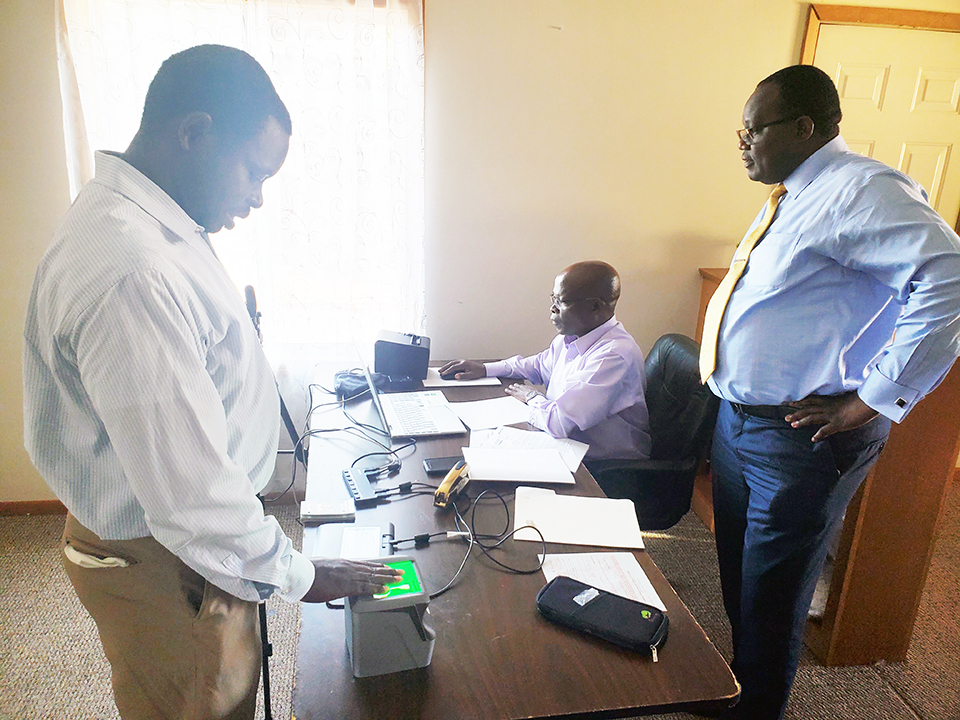
Pastor Simeon Momanyi of Kenyan Community Church has his fingerprints taken when he was the first one to be processed during a three-day exercise by Kenyan embassy staff in Minnesota on Friday, August 5, 2022. Looking on is Moses Omwago of the Kenya Embassy as his boss (seated) Wilfred Wamela processes the paperwork. Photo: Tom Gitaa/Mshale
Before the initiative, Kenyans had to travel to either Embassy of Kenya in Washington D.C., or to the two consulate offices in Los Angeles and New York to get the services. The location of the diplomatic offices in coastal states has posed many challenges for Kenyans residing in the middle of the country. In Minnesota alone, there are more than 14,500 Kenyans, according to Minnesota Compass, an organization that does population research in the state. For those Kenyans, appointments require expensive travel, time off from work, and for many, interim childcare. With the new initiative, the embassy hopes to make consular services more accessible to all Kenyan citizens in the United States.
Tom Gitaa, the founder and publisher of Mshale, coordinated the embassy’s outreach efforts in Minnesota through the Minnesota Kenyan Association, a consortium of Kenyan groups in the state. Gitaa said the three-day satellite operation attracted Kenyans from across the Midwest, and as far as Nebraska and Kansas.
“More than 500 were able to successfully submit their applications and have their biometrics captured by the consular officers,” said Gitaa.
Lillian Otieno, the president of the Association of Kenyans in America, lauded the embassy for the new efforts to take services to the people.
“It is in unity as a Diaspora that we can orchestrate events and programs to ensure our people are assisted,” Otieno said.
Kenyans from across the Midwest wait their turn during a pop-up consular service operation by the Kenya Embassy that took place at the Kenya Community Church in Brooklyn Center and Destiny Hill Church in Hopkins on August 5-7, 2022. Photo: Tom Gitaa/Mshale
Henry Momanyi, a candidate running for the West District city council seat in neighboring Brooklyn Park, said he had been working at the embassy’s pop-up office since the event began earlier that day. He urged audience members to serve and help embassy staff with coordinating the service.
“Mothers with kids wait all day to be served because there are some technical aspects that prevent the process from running smoothly, so we need more volunteers,” Momanyi said.
Onesmus Mutio, another Minnesota Kenyan, asked Kenyans to use their numbers to create awareness in their communities, and unite to advocate for increased consular representation.
“We can give so much strength to the embassy and fuel this initiative just by spreading the word and telling our relatives about it,” Mutio said.
University of Minnesota Board of Regents member Mike Kenyanya said that as efforts are being made to improve U.S.-Kenya diplomatic relations, it was important not to forget the younger generations of U.S.-born Kenyans, who tend to be primary candidates for services like dual citizenship and birth certificates of children born abroad.
Veronica Rotich (right) of the Minnesota Kenyan Association assists Wilfred Wamela of the Kenya Embassy as he processed one of the hundreds of Kenyans that turned up at Kenya Community Church and Destiny Hill Church in Minnesota to submit passport applications during a pop-up three-day consular service exercise that drew participation from across the Midwest. Photo: Tom Gitaa/Mshale
“A trend I am noticing amongst my peers is that they are becoming more passionate about their home,” Kenyanya said. “I think we need to capitalize on that.”
Amayo also addressed the long wait times for passport appointments. In the early days of the pandemic, people saw delays in scheduling, and a person booking an appointment may have seen that the earliest slot was a year or more out on the calendar.
“The system has since improved, and we are able to serve you much faster now that pandemic delays have been reduced,” Amayo said. “We are here for you.”
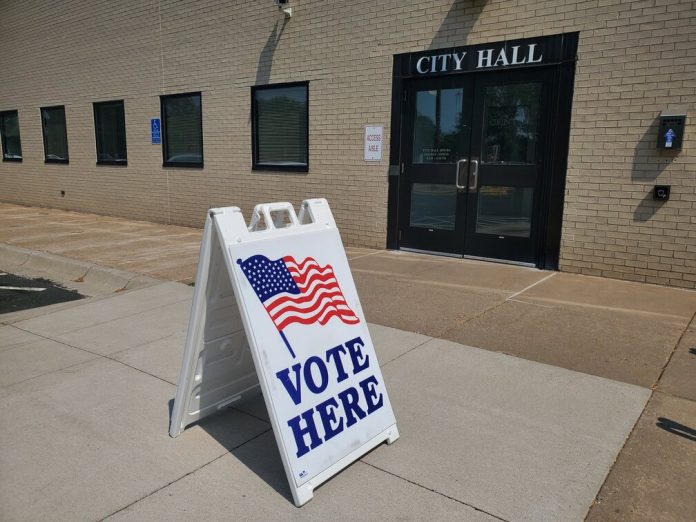
A sign directs voters where to vote early in person at the Brooklyn Center City Hall in Brooklyn Center, Minnesota on August 2, 2022. Photo: Tom Gitaa/Mshale
A sign directs voters where to vote early in person at the Brooklyn Center City Hall in Brooklyn Center, Minnesota on August 2, 2022. Photo: Tom Gitaa/Mshale
More than 107,000 absentee ballots have been received as of Friday, August 5 for tomorrow’s Minnesota primary election, according to the Secretary of State’s Office. There is no presidential race this year and the numbers show. The 2020 state primary election, a presidential election year, had over 544,00 absentee ballots accepted by the Friday before the primary.
How and where to vote
The Secretary of State website is the best place to start to find your polling location as it might not be the same as the last time you voted, due to redistricting as required by law after the 2020 census.
If not already registered to vote, Minnesota law allows you to vote on Election Day and vote on the spot.
For partisan races like for Congress, State Senate, House of Representatives and constitutional offices like for Governor and Attorney General, you can only vote for candidates from the same party.
Municipal election like the races for Brooklyn Park Mayor and City Council are nonpartisan and you will be voting to choose the top two candidates to advance to the November election.
Races Mshale is watching
Race for Brooklyn Mayor – This is a three-way race involving two sitting City Council members, Wynfred Russell, Boyd Morson and Hollies Winston who lost by two votes to current mayor Lisa Jacobson who will not be seeking reelection. One of three will be Brooklyn Park’s first Black Mayor.
Black women running for Minnesota State Senate
Senate District 38 – The race between Huldah Hiltsley and Susan Pha is between two women of color but Hiltsley’s candidacy is one of three races for state Senate being watched by the Black community in the state as one of history in the making. Minnesota has never elected a Black woman to the state Senate and now it has three chances to do so in one election cycle.
Senate District 63 – Zaynab Mohamed is one of three women likely to be elected as the first Black women elected to the state Senate.
Senate District 66 – DFLer Clare Verbeten running in Senate District 66 has no primary challenger and is virtually assured of victory in November in the largely Democratic district.
If Hiltsley and Mohamed prevail on Tuesday they will join Verbeten as the likely trio of first Black women elected to the Minnesota Senate in November.
Ambassador Lazarus Amayo of Kenya will visit Minnesota August 5-7, 2022. Photo: Courtesy of Kenya Embassy Washington
Ambassador Lazarus Amayo of Kenya will visit Minnesota August 5-7, 2022. Photo: Courtesy of Kenya Embassy Washington
Ambassador Lazarus Amayo of Kenya began a three-day visit to Minnesota on Thursday to meet with the large Kenyan diaspora. A series of meetings with Minnesota state officials is also on schedule.
According to a statement from the embassy, staff accompanying the ambassador will also offer consular services most notably the acceptance of e-passport applications. Kenya, along with members of the East African Community (Uganda, Tanzania, Rwanda, Burundi, South Sudan and DRC) has been phasing out the old-generation passports and there is a deadline of November 2022 to complete the process.
Congresswoman Betty McCollum who represents Minnesota’s Fourth District, in a news release Thursday said Rep. McCollum will join a special luncheon Friday hosted by Books for Africa to welcome the ambassador. Rep. McCollum who chairs the House Appropriations Subcommittee on Defense has been working on a partnership between the St. Paul based non-profit and the Department of Defense.
Consular Services
Kenyans in Minnesota interested in obtaining the new generation East African passport on August 5-7 should visit: https://kenyaembassydc.org/minnesota/
Ambassador Amayo Townhall Meeting – August 5 @ 5:30 p.m.
The ambassador will hold a townhall meeting at the Maple Grove Community Center: 12951 Weaver Lake Rd., Maple Grove, MN 55369
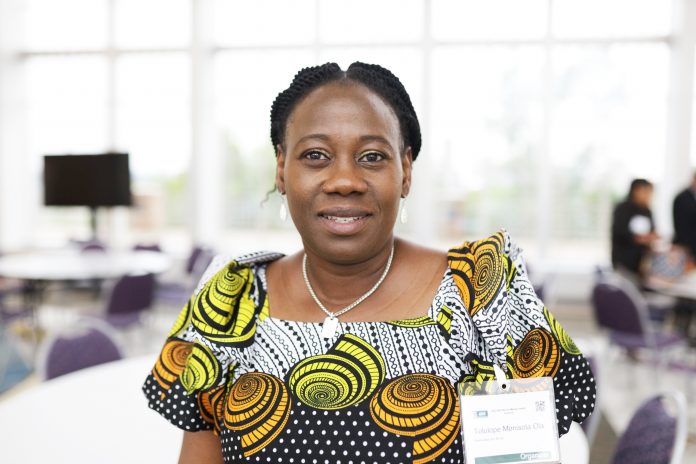
Dr. Tolulope Monisola Ola is cohost of the annual African mental Health Summit in St. Paul, Minnesota. Photo: Panashe Matemba-Mutasa/Mshale
Dr. Tolulope Monisola Ola is cohost of the annual African mental Health Summit in St. Paul, Minnesota. Photo: Panashe Matemba-Mutasa/Mshale
The annual African Mental Health Summit returned to St. Paul, Minnesota, during the weekend of July 22, with a special focus on the mental health of Africans living in the Diaspora.
The two-day conference, which took place at Metropolitan State University, featured presentations and discussions emphasizing the importance of unity and understanding regarding mental health in the African community. Dr. Tolulope Monisola Ola, the cohost of the event, who is also the founder of Restoration for All Inc., a St. Paul-based nonprofit that offers multiple services to African immigrants, said it was time to act.
“This summit is a way of putting our ideas into action, because it’s not enough to simply talk about these issues,” she said.
Although mental health issues are prevalent in many communities, but there is less acknowledgement among African communities. To make matters worse, people dealing with mental illnesses are often ostracized. Most African countries allocate less than 1% of their annual budges toward mental health care, according to a study by the United Nations Office of Public Information. Due to this lack of investment, over 80% of Africans struggling with mental health issues like depression do not receive treatment. The summit is part of renewed efforts to raise awareness.
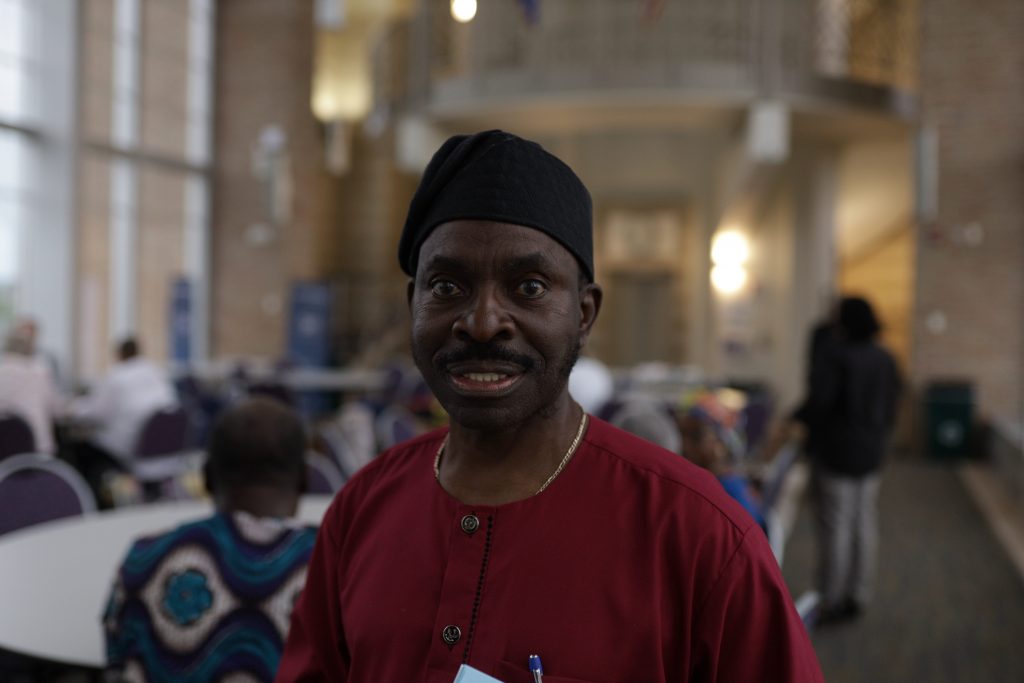
Dr. Richard Oni, a Nigerian immigrant, is the brainchild behind the annual African Mental Health Summit in St. Paul, Minnesota. Photo: Panashe Matemba-Mutasa/Mshale
The African Mental Health Summit was the brainchild of Dr. Richard Oni, a Nigerian immigrant and executive director of Progressive Individual Resources, a St Paul-based social and behavioral health organization. Eight years ago, Oni was inspired to launch the initiative after reflecting on the problematic attitudes many in the African community possess towards mental health.
“People are so quick to call you crazy, but mental health is more than just ‘craziness,’” Oni said.
Dr. Alvin Killough, an associate professor at the University of Minnesota, Crookston, said that mental health is an issue that affects the Diaspora through racism and trauma, and that centuries of enslavement and colonization have left Black people vulnerable to maladaptive mental health conditions.
“As we continue to endure racialized trauma, it is critical that we address how race plays a part in the mental health conversation,” Killough said.
Susan O’Nell, a director at the Institute on Community Integration at the University of Minnesota, said that voices of the community can be the most powerful force in addressing the racial disparities that exist in mental health care.
“You can have two children with the exact same substance use disorder, but the Black child will be put in the system while the white child receives resources,” O’Nell said.
Jessica Holt-Woehl, a social worker at Park Nicollet Clinics, said that as a white healthcare provider working at a predominately white practice, the summit provided her with a rare chance to have the “vulnerability” to expose herself to conversations pertaining to racial equity in healthcare.
“I don’t get many opportunities to engage in equity work on the job, so I take as much value as I can from this Summit,” Woehl said.
Judy Brown, a mental health supports manager at Minneapolis Public Schools said healthy communities start with healthy children, and so it is important to address the plight of the youth in mental health discussions.
“Our kids are out here killing themselves because of mental health issues,” she said. “We cannot wait to address this any longer.”
Brown also talked about therapists and the critical role they can play in a child’s life. Black parents are increasingly searching for therapists who share their identities and experiences because non-Black therapists are significantly more likely to hold harmful stereotypes about Black patients, according to a study by the Center for Health Journalism at the University of Southern California.
“Representation matters,” Brown said. “Just like teachers can change a child’s life, so can a therapist, so we need more therapists who look like us.”
In the United States, white professionals make up 86% of the workforce in areas of psychology, with Black providers accounting for only 4%, according to the American Psychological Association’s Center for Workforce Studies. The disparity makes it extremely difficult for many Black people to find a provider they feel can fully understand their struggles.
Sara Washington, a member of the Special Education Advisory Council at Minneapolis Public Schools, expressed frustrations dealing with white therapists.
“It becomes exhausting having to tell your story in a way that they can understand,” Washington said.
But Washington said that it was not enough for Black people to “settle for Black therapists” but rather, they should also look for quality providers.
“There are Black mental healthcare professionals who become complacent because they know their Black clientele will stick around, so the service is less than ideal,” Washington said. “We need to promote excellence.”
Alan Ige, a community member who attended the summit, reiterated the importance of sharing knowledge with the community. He said that even though the conversations might be important to share with non-Black coworkers and friends, it is essential to do so in order to yield change.
“How can we produce effective action when what’s said in here does not leave the room?” Ige asked.
Oni, the founder of the summit, expressed his gratitude by reiterating the value of community voices in creating unity around not just issue of mental health, but in others that are important to the community.
“Your contributions are all so important, so whenever you get the chance to use your voice, go out and do it,” Oni said.
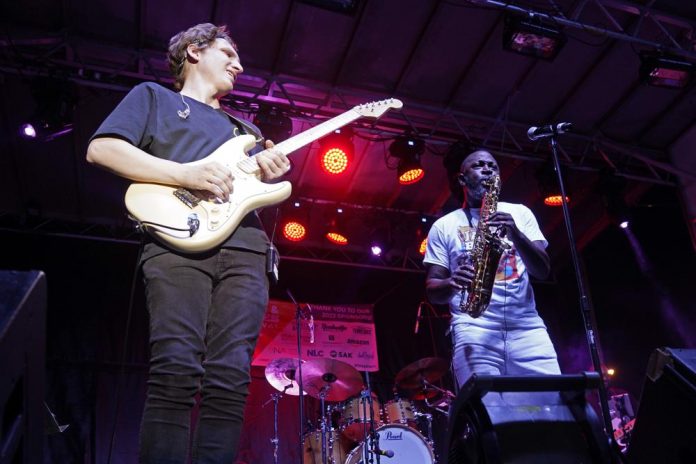
Mike Phillips, right, performs at the Jefferson Street Jazz & Blues Festival July 23, 2022, in Nashville, Tenn. Hundreds of tourism-related projects nationwide, including the festival, collectively are getting about $2.4 billion from the American Rescue Plan, according to an Associated Press analysis of funds flowing from last year's wide-ranging coronavirus relief law. Photo: Mark Humphrey/AP
Mike Phillips, right, performs at the Jefferson Street Jazz & Blues Festival July 23, 2022, in Nashville, Tenn. Hundreds of tourism-related projects nationwide, including the festival, collectively are getting about $2.4 billion from the American Rescue Plan, according to an Associated Press analysis of funds flowing from last year's wide-ranging coronavirus relief law. Photo: Mark Humphrey/AP
Located along a remote stretch of Highway 395, the Fort Independence Travel Plaza touts a dozen gas pumps, clean restrooms and made-to-order meals for travelers visiting California’s Eastern Sierra.
The facility, which provides revenue for a Paiute Indian tribe, is about to quadruple in size thanks to an $8 million federal grant that will help build a new gas station with room for cultural displays and locally made products.
It’s one of hundreds of tourism-related projects nationwide that are collectively getting about $2.4 billion from the American Rescue Plan, according to an Associated Press analysis of funds flowing from last year’s wide-ranging coronavirus relief law.
The money is paying for graffiti-resistant trash cans in Portland, Oregon, culturally diverse music festivals in Nashville, Tennessee, sports facilities in various cities and new marketing campaigns to attract tourists to particular states — sometimes in direct competition with one another.
“Our goal is to get people traveling again. Period,” said Dave Lorenz, chairman of the National Council of State Tourism Directors and the Michigan travel director.
Despite high fuel prices, Americans do seem to be hitting the road. After a plunge at the onset of the COVID-19 outbreak, U.S. travel spending this year is projected to top $1 trillion — up 45% from its 2020 low point, according to the U.S. Travel Association.
That corresponds with a similar increase in state tourism office budgets, which have rebounded to pre-pandemic levels thanks to the federal aid.
A coronavirus relief law signed by former President Donald Trump opened the potential for federal money to be used for local tourism projects.
The subsequent pandemic relief law signed by President Joe Biden expanded that. The American Rescue Plan contained $750 million for grants for tourism, travel and outdoor recreation through the federal Economic Development Authority. It also included the tourism, travel and hospitality sector among dozens of eligible uses — alongside health care, housing and unemployment programs — for a $350 billion pool of flexible aid sent to state, local, territorial and tribal governments.
Those governments had budgeted more than $1.6 billion from those flexible funds for about 550 tourism, travel and hospitality projects as of the end of March, according to an Associated Press analysis of recently released data from the U.S. Treasury.
Those tourism projects include $425,000 in Portland to replace 200 trash cans with ones that have larger openings and harder-to-deface surfaces made of such things as metal slats or wire mesh. The city cited ″a substantial increase in the amount of trash, graffiti, and vandalism” during the pandemic, asserting that new garbage cans will “create a safer, more welcoming environment for visitors to our parks,” according to a description in the Treasury Department data.
Nashville, known for its country music scene, allotted $750,000 to reach “culturally diverse visitors.” That’s helping fund renovations at a once-prominent Black music venue, subsidize choir concerts at Fisk University and pay for an annual jazz and blues festival occurring in July, among other things.
The goal is to “build up the other genres without pushing country music down,” said Butch Spyridon, CEO of the Nashville Convention & Visitors Corp.
Of the tourism grants awarded through the Economic Development Authority, $510 million was divided among states and territories according to a formula that took into account job losses in their leisure and hospitality sectors. An additional $240 million was set aside for competitive grants, which are still being doled out.
One of those grants went to the Fort Independence Indian Reservation, a 220-member tribe that plans to add more than 60 jobs at its enlarged travel center.
“Part of tourism is getting from A to B, and one of the stops along the way is our reservation,” explained tribal vice chair Alisa Lee. “When we have been able to educate people about our community, our tribe and our culture, that is a form of tourism.”
Other competitive grants included $2.2 million to help replace old snowmaking equipment at Frost Fire Park ski resort in North Dakota, $1.6 million to help build a new Mardi Gras museum in Louisiana and $1.2 million to build locker rooms, concession facilities and a pavilion for a cross-country course at Middle Georgia State University.
University President Christopher Blake said in a statement that the project has the potential “to transform it into a recreational dynamo” that generates nearly $1 million a year in economic activity.
Several states also projected big returns on their federal tourism dollars, according to grant plans obtained by the AP through an open-records request.
Alabama plans to spend nearly $2.7 million to build three boat piers at reservoirs along the Coosa River. The state said regional fishing tournaments can lure $200,000 into an economy and national tournaments up to $1 million.
Tourism projects generally seem like an appropriate use of the federal pandemic relief funds because the industry initially was one of the hardest hit, said Sean Moulton, a senior policy analyst at the nonprofit Project on Government Oversight.
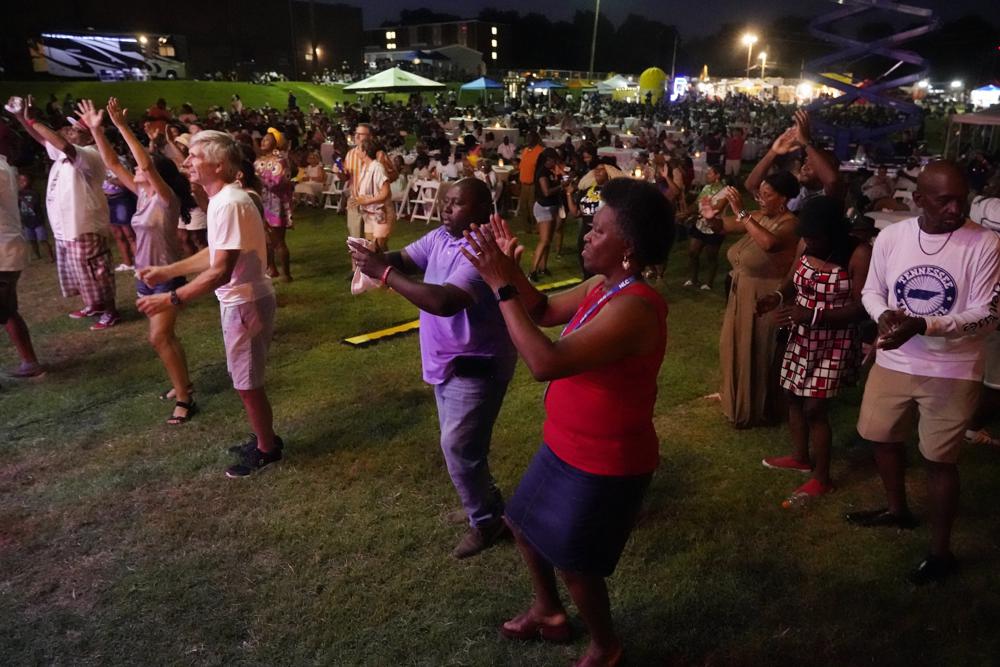
People dance as they listen to music at the Jefferson Street Jazz & Blues Festival July 23, 2022, in Nashville, Tenn. Hundreds of tourism-related projects nationwide, including the festival, collectively are getting about $2.4 billion from the American Rescue Plan, according to an Associated Press analysis of funds flowing from last year’s wide-ranging coronavirus relief law. Photo: Mark Humphrey/AP
But “as you give more flexibility,” Moulton said, “you run the risk of the money being used in ways that in retrospect you say that wasn’t the most effective.”
The city of Fort Worth, Texas, has directed $52 million of its flexible American Rescue Plan money for an expansion of its convention center. Of that, $40 million was categorized as tourism aid in a 2021 year-end report submitted to the Treasury Department.
The Treasury revised its rules in January to discourage big spending on convention centers and stadiums, stating that large capital expenditures to aid the travel and tourism industries are “not reasonably proportional to addressing the negative economic impacts of the pandemic.”
Fort Worth is moving ahead with the project anyway. The city reclassified the aid as a replacement for revenue lost during the pandemic — a category with the broadest flexibility under Treasury rules.
California got the largest tourism grant allocation, about $46 million. The state directed all of that — plus an additional $95 million of flexible federal pandemic aid — to its nonprofit tourism entity, which conducts national and international marketing.
Other states also have used the federal aid to try to draw visitors to their parks, shopping areas, restaurants and resorts.
While Michigan targets tourists in the neighboring Great Lakes region, Ohio is countering by expanding advertising into 11 new markets, including additional Michigan cities.
Missouri, meanwhile, is casting a broader net into the upper Midwest and the South. Thanks to a two-thirds increase in its tourism budget, Missouri is planning to expand advertising beyond its bordering states to reach potential travelers from Alabama, Louisiana, Minnesota, Mississippi, Ohio, South Dakota, Texas and Wisconsin.
“In order to stay competitive with the states that we consider competition, it was going to be important for us to up our game,” Missouri Tourism Director Stephen Foutes said.
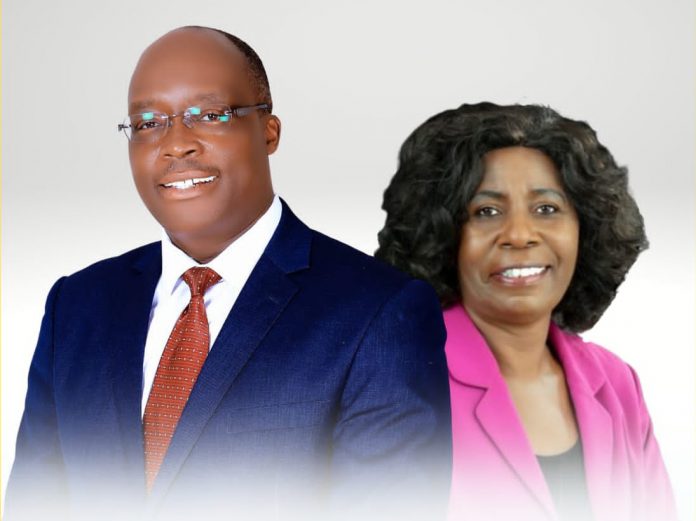
Henry Ongeri and Josephine Buruchara are candidates for Governor and Deputy Governor of Nyamira County in August 9, 2022 General Election in Kenya on a Democratic Congress Party under the Azimio Coalition. Photo: Courtesy of Bwakire Se! Facebook Page
Henry Ongeri and Josephine Buruchara are candidates for Governor and Deputy Governor of Nyamira County in August 9, 2022 General Election in Kenya on a Democratic Congress Party under the Azimio Coalition. Photo: Courtesy of Bwakire Se! Facebook Page
Honorable Citizens of Nyamira County,
With due respect to you as the ultimate Sovereign in accordance to Article 1, Constitution of Kenya, 2020, we the members of Bwakire Se! Nyamira 2022 and candidates for the Governorship hereby submit as follows:
Introduction/Background
We began the improbable journey as a campaign for a better, brighter Nyamira County. We acknowledged that Nyamira faces a plethora of problems, most of which we viewed as man-made and preventable. From impassable roads and virtually no modern infrastructure, endemic public corruption, growing poverty, a collapsed healthcare system, visionless leadership to unremarkable status on the local and international stage, the list goes on. In our view, it was total darkness -literal and figurative. In December 2018, we launched Bwakire Se! (a New Dawn!) with the sole objective to bring light to Nyamira. Our gubernatorial bid was an inseparable cog in this wheel. Even back then, we considered the August, 2022 election as a binary choice: between a darkness (read the Status Quo) and light (a new dawn in fundamental ways).
Barely a week to the all-important August 9, 2022 election day, we believe that we have prosecuted a convincing case.
Opening Statement
Upon launching of Bwakire Se! as a movement, we were under no illusions that change would come easily or without cost. Nonetheless, we outlined an agenda for a brighter Nyamira as having these irreducible core pillars:
New Ideas
A Bold Vision
Fresh Faces
Our argument then as is today, remains: we must engineer and midwife the total transformation of Nyamira County in fundamental ways. That the status quo was not only unacceptable but also that another 10 years thereof would amount to total dismantling of the County as an entity.
For nearly two years now, we have engaged the people of Nyamira in intentional and often difficult conversations around the agenda for change as captured in the above pillars. In Bwakire Se!, we believe that all the above pillars must be in place in order for the transformation of Nyamira to even begin.
Case-In-Chief
Throughout the campaign, we have endeavored to offer solution-based and tested leadership with the sole objective of improving the conditions of our people. For this reason, our unique campaign style felt more like a classroom environment than the despicable circuses that our opponents often engage in.
New Ideas: we cannot continue to do the same things over and over again but expect different results. In Ekegusii we say, keria giasirerie inchera rogoro kerigerie inchera maate. (If an item is lost in the north, you must try to find it in the south). Embracing new ideas would enable our County to boldly step into the 21st Century in key areas of agriculture, internet connectivity, healthcare, education, investment, gender and youth empowerment among others. For instance, building strategic public, private partnerships gave birth to such groundbreaking ideas such as the Global Connections Center at Nyanchonori, Rigoma Ward. Upon completion in 2024, the Center will serve as the technological and industrial hub for the region with capacity for remote learning, gainful employment and center for creative arts and sports.
A Bold Vision: we must build legacies that will outlive us: meaning, we need leaders with a plan for 10, 20, 50 or even 100 years. Under this pillar, we have pledged the long-awaited Nyamira International University and world-class healthcare system. Our deep global connections and relationships would serve our County well as we lay the foundation for a rapid jump into modern civilization, a thing that seems to elude our competitors and predecessors. As we criss-cross Nyamira in search for votes, there is unanimous agreement that the current state of the County is unacceptable and requires fundamental change. No wonder even incumbent leaders are loudly proclaiming their desire for change too!
Fresh Faces: we insist that in order for our County to change for the better, we must bring in fresh faces into the political space. Both Hon. Josephine Nyanchama Buruchara and I are undoubtedly Fresh Faces in Nyamira politics. Neither of us has sought public office in the country nor have we served in any. We are therefore, the breath of fresh air that our County is desperately gasping for. With the nomination of Hon. Buruchara as Nyamira’s sole female Deputy Governor, we join Azimio Coalition Party Leader Rt. Hon. Raila Amolo Odinga who tapped SC Martha W. Karua as the Deputy President of Kenya. It is humbling privilege to lead the people of Nyamira as we write a chapter in that history too.
Closing Argument
As Kenyans approach August 9, 2022, we trust that the voters of Nyamira County have heard our loud and persuasive case for change. Hopefully, we have shown the urgency of immediate action at the ballot booth to avoid any deeper regression. Our youth can ill-afford another lost decade; our people cannot bear more pangs of poverty; demoralized, underpaid but overworked public servants deserve a break; Nyamirans are entitled to live in dignity and with a modicum of decency across the County. Briefly put, it is time for Bwakire Se!, Hon. Wakili Henry Ongeri as Governor and Hon. Josephine N. Buruchara as Deputy Governor. The alternatives are unthinkable.
The authors are candidates for Governor and Deputy Governor of Nyamira County in the August 9, 2022 Kenyan general elections.
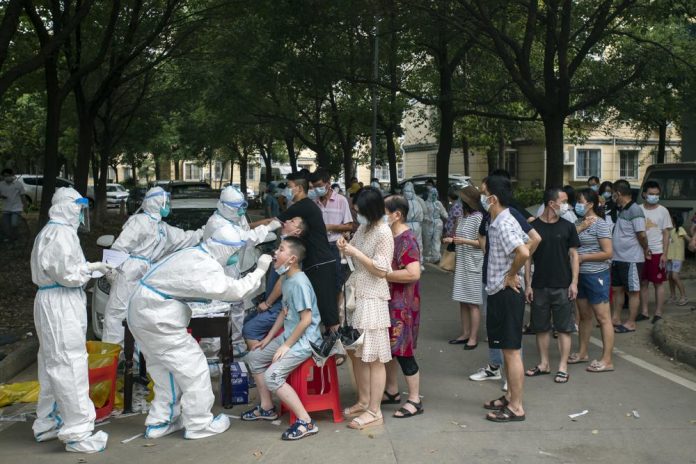
Residents line up to be tested for COVID-19 in Wuhan, central China's Hubei province on Aug. 3, 2021. Two new studies provide more evidence that the coronavirus pandemic originated in a Wuhan, China market where live animals were sold – further bolstering the theory that the virus emerged in the wild rather than escaping from a Chinese lab. The research was published online Tuesday, July 26, 2022, by the journal Science. Photo: Chinatopix via AP/File
Residents line up to be tested for COVID-19 in Wuhan, central China's Hubei province on Aug. 3, 2021. Two new studies provide more evidence that the coronavirus pandemic originated in a Wuhan, China market where live animals were sold – further bolstering the theory that the virus emerged in the wild rather than escaping from a Chinese lab. The research was published online Tuesday, July 26, 2022, by the journal Science. Photo: Chinatopix via AP/File
Two new studies provide more evidence that the coronavirus pandemic originated in a Wuhan, China market where live animals were sold – further bolstering the theory that the virus emerged in the wild rather than escaping from a Chinese lab.
The research, published online Tuesday by the journal Science, shows that the Huanan Seafood Wholesale Market was likely the early epicenter of the scourge that has now killed nearly 6.4 million people around the world. Scientists conclude that the virus that causes COVID-19, SARS-CoV-2, likely spilled from animals into people two separate times.
“All this evidence tells us the same thing: It points right to this particular market in the middle of Wuhan,” said Kristian Andersen a professor in the Department of Immunology and Microbiology at Scripps Research and coauthor of one of the studies. “I was quite convinced of the lab leak myself until we dove into this very carefully and looked at it much closer.”
In one study, which incorporated data collected by Chinese scientists, University of Arizona evolutionary biologist Michael Worobey and his colleagues used mapping tools to estimate the locations of more than 150 of the earliest reported COVID-19 cases from December 2019. They also mapped cases from January and February 2020 using data from a social media app that had created a channel for people with COVID-19 to get help.
They asked, “Of all the locations that the early cases could have lived, where did they live? And it turned out when we were able to look at this, there was this extraordinary pattern where the highest density of cases was both extremely near to and very centered on this market,” Worobey said at a press briefing. “Crucially, this applies both to all cases in December and also to cases with no known link to the market … And this is an indication that the virus started spreading in people who worked at the market but then started to spread into the local community.”
Andersen said they found case clusters inside the market, too, “and that clustering is very, very specifically in the parts of the market” where they now know people were selling wildlife, such as raccoon dogs, that are susceptible to infection with the coronavirus.
In the other study, scientists analyzed the genomic diversity of the virus inside and outside of China starting with the earliest sample genomes in December 2019 and extending through mid-February 2020. They found that two lineages – A and B – marked the pandemic’s beginning in Wuhan. Study coauthor Joel Wertheim, a viral evolution expert at the University of California, San Diego, pointed out that lineage A is more genetically similar to bat coronaviruses, but lineage B appears to have begun spreading earlier in humans, particularly at the market.
“Now I realize it sounds like I just said that a once-in-a-generation event happened twice in short succession,” Wertheim said. But certain conditions were in place — such as people and animals in close proximity and a virus that can spread from animals to people and from person to person. So “barriers to spillover have been lowered such that multiple introductions, we believe, should actually be expected,” he said.
Many scientists believe the virus jumped from bats to humans, either directly or through another animal. But in June, the World Health Organization recommended a deeper probe into whether a lab accident may be to blame. Critics had said the WHO was too quick to dismiss the lab leak theory.
“Have we disproven the lab leak theory? No, we have not,” Andersen said. “But I think what’s really important here is there are possible scenarios and there are plausible scenarios and it’s really important to understand that possible does not mean equally likely.”
The pandemic’s origins remain controversial. Some scientists believe a lab leak is more likely and others remain open to both possibilities. But Matthew Aliota, a researcher in the college of veterinary medicine at the University of Minnesota, said in his mind the pair of studies “kind of puts to rest, hopefully, the lab leak hypothesis.”
“Both of these two studies really provide compelling evidence for the natural origin hypothesis,” said Aliota, who wasn’t involved in either study. Since sampling an animal that was at the market is impossible, “this is maybe as close to a smoking gun as you could get.”