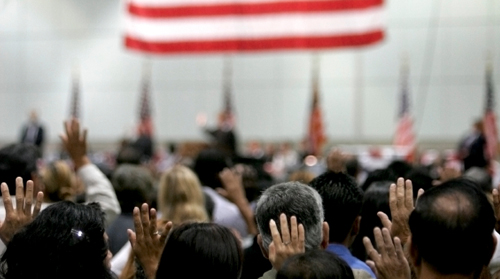
Tighter restrictions on family visas being considered
Senators are mulling making it harder for U.S. citizens to get visas for family members while easing the path for high-skilled foreign workers, a senator said.
“We’re going to change fundamentally the immigration system,” including tighter limits on family visas, Sen. Lindsey Graham, R-S.C., told The Washington Post.
“Right now you get green cards to adult children, to grandparents,” Graham said. “What I want to do is reserve green cards based on the economic needs of the country, and we’ll do something for families. But the goal for me is to replace a chained-migration immigration system with an economic-based immigration system.”
The plans being considered by four Democratic senators and four Republicans would reverse policies that have been in place for generations.
The bill the group plans to release in early April is expected to serve as the template for a comprehensive immigration-reform deal between Congress and the White House.
The Obama administration has expressed support for the senators’ general principles, the Post said.
About two-thirds of legal immigrants are currently admitted for family reasons and 14 percent for employment, the non-partisan Migration Policy Institute think tank says. The rest are humanitarian cases.
In the Senate discussions, Republicans would prefer to admit larger numbers of highly skilled workers, who would provide an immediate economic benefit and who business leaders say are in short supply, while Democrats generally want to give priority to family members of citizens and legal residents already in the country.
As the rules are now, spouses and minor children of citizens are given top priority. After this group, in order of priority, are unmarried children over age 21 and, lastly, married adult children and siblings.
The Senate proposal being discussed would eliminate the latter two categories, which account for about 90,000 visas a year, the Post said.
If those people wanted to apply for entry into the United States, they would need other qualifications, such as high-tech skills, to be approved for a green card, the senators involved in the negotiations say.
The senators stressed no final decision had been made.
Foreign-born Entrepreneurs push for a ‘Startup’ visa
A cocktail shaker full of whiskey and juice marks the start of happy hour. But we are not at a bar. This is The Hatchery, a sprawling office space in San Francisco and an incubator for startups. It’s non-stop work here, so a weekly in-house cocktail hour is one perk.
Two entrepreneurs, James Richards, 25, and Michael Smith, 29, take a break. They met in Indonesia, where Richards is from, and now work on their startup called Advisable, an online marketplace for lawyers.
Will it work? It might.
Richards is one of Columbia Law School’s youngest ever graduates. He passed the New York bar exam at age 20. Co-founder Michael Smith is a programming whiz from Belgium. But there’s the snag. While Richards’ legal residency is taken care of, Smith’s visa isn’t certain and it could force him out of the country soon.
“It’s that period in between,” worries Smith. “It’s hard to tell what happens because we work best when we physically work in the same place and because of this visa issue we’re going to be in different parts of the world.”
They know that a wobbly outlook in the startup world is not good.
“In a startup you have to be together,” says Richards. “There’s no way we’d be able to mimic this process remotely, especially in the early stages when every minute is a New York minute.”
Silicon Valley has long pressed for change, and this year could bring a fix. Support is growing for a new startup visa that would let foreign-born entrepreneurs work with fewer hurdles. Talks are on in Washington about safeguarding the visa against fraud and phony companies, and ensuring that it would go to startup founders that look solid and might create jobs.
“I think that the entrepreneur community is very much willing to put some hurdles around it so that this is not just a visa that you can pay a lot of money and get one,” says Emily Lam, with the Silicon Valley Leadership Group, is helping lead the push for the startup visa.
Right now, there is bipartisan support for it. But the startup visa would likely get rolled into comprehensive immigration reform, and that path is unclear.
“Even though the path is still littered with minefields, and at any point in time this whole immigration debate could get blown up by any number of issues, it is still the best opportunity to reform immigration in the last five or 10 years,” says Lam. “It’s going to be a fight to the death until at least August when we hope that before the recess, the bill gets passed.”
Opponents, including some immigrant rights groups, say it is not fair for entrepreneurs to jump ahead of others already in long visa lines. Others say more effort should be made to support US-born innovators.
But advocates for the visa say it creates jobs for immigrants and Americans.
Michelle Zatlyn co-founded CloudFlare, which does hardcore programming to bulletproof websites from hackers. Its clients range from small e-commerce companies to political groups around the world.
Zatlyn ticks off some of the countries where politicians have employed her company’s services. They include Colombia, Ecuador, Pakistan, Turkey, Israel. “In the Middle East, where there is a lot of unrest, where sometimes the fighting that is happening on the ground, you’ll see the fighting go to cyberwars,” she says.
All told, Zatlyn has helped grow the company from 3 to 40 employees, hiring a mix of foreign and US-born engineers. They have filed 25 patents.
But Zatlyn is from Canada. After driving out to California after earning a master’s in business from Harvard, she started to hit a visa wall.
“My first attempt was denied,” Zatlyn says. “At that point, I had three months left.”
First, Zatlyn’s company, like any startup, was judged too small, considered high risk. Plus, as one of the company’s founders she couldn’t sponsor herself for the H-1B skilled-worker visa, one way foreigners try to get around this obstacle. To stay here, Zatlyn actually had to become an employee of the company she founded, demoted to product manager.
“Right now, the United States is making it really hard for entrepreneurs to start companies in the United States and I think that’s a problem for the country,” Zatlyn says.
At the same time, she understands some of the reasoning behind the bureaucratic vetting process. “It’s hard to discern who’s legitimate and who’s not,” Zatlyn says. “I mean, the immigration service is not in the business of picking businesses that are going to win.”
But there is worry that, for the first time, the number of immigrant-founded startups is declining because of the bureaucratic costs and uncertain wait. Startups can’t afford visa limbo. So they’re heading elsewhere, to countries that do more to roll out the red carpet for innovators.
“So Chile, for instance, offers $40,000 per entrepreneur. They’ll actually give you money if you want to go there and start a business,” Lam says. “And Singapore has consistently said that they’ll offset salaries if, you know, want to start new jobs there.”
Yet, there is one workaround that might help keep foreign innovators in the United States, kind of. A company called Blueseed wants to create a floating startup community. It would be a vessel moored in international waters near California. No visa required.
Wesley Korir, the 2012 Bostin Marathon champ is now a Kenyan parliamentarian.
Wesley Korir, the 2012 Bostin Marathon champ is now a Kenyan parliamentarian.Wesley Korir, the 2012 Boston Marathon champ is now a Kenyan parliamentarian.
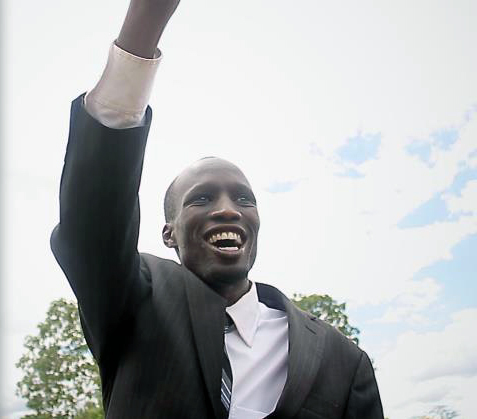
Wesley Korir, the Boston marathon champion, has been elected to the Kenya parliament, the polls’ overseeing body, IEBC confirmed.
The 30-year-old Korir, who ran as an independent candidate, defeated the incumbent Joshua Kutuny, a close ally of former education minister and Jubilee Alliance deputy president aspirant, Wiliam Ruto, to clinch the seat in the agricultural-rich district of Cherangany in Kenya’s Rift Valley province.
“It was a tough campaign running against seasoned opponents. As an athlete and an independepent candidate it was not easy for me,” Korir told AFP from his hometown of Kitale, some 326km (202 miles) north-west of Nairobi.
“It was a very expensive campaign. Kenyan elections are based on party politics, but the way I ran my campaign on development issues won over many of the voters,” added Korir, who holds a biology degree from the University of Louisville in the US.
The athlete runs a childrens’ charity foundation known as Kenya Kids Foundation, which offers educational support to many destitute children, and has also helped build an hospital clinic in the Cherangany constituency.
Korir says winning the seat, however, doesn’t mean he’s resting on his laurels.
He has already embarked on intensive training to prepare for the defence of his Boston marathon title on April 17.
Korir becomes the second Kenyan athlete to win an elective national political post after another former Boston marathon champion, Elijah Lagat, served a one four-term as member of Emgwen constituency, in the last legislative assembly.
Korir will be back in the United States shortly as he looks to defend his Boston crown on April 17 at the 117th running of the Boston Marathon.
A screen shot of a scene from the documentary “William and the Windmill.”
A screen shot of a scene from the documentary “William and the Windmill.”A screen shot of a scene from the documentary “William and the Windmill.”
A film about a young Malawian who builds a windmill from scrap metal to save his family from famine last night won the grand jury for best documentary at the just concluded South by Southwest Film Festival (SXSW) held in Austin, Texas.
“William and the Windmill” directed by Ben Nabors is about Malawi-born William Kamkwamba who has become something of a celebrity due largely to his book deal (The Boy Who Harnessed the Wind) and TED talk and movie.
Kamkwamba is now a junior at Dartmouth. He intends to go back to malawi after college to use his new knowledge to improve his village, he told audience emmebers during and event Monday at the SXSW event.
William and the Windmill was crowdfunded by Moving Windmills, a 501(c)3 nonprofit, and the proceeds will go directly to village projects. Already installed is the solar water pump that now provides one of the only resources for clean drinking water in the area.
The full list of winners as announced by SXSW:
Documentary Feature
Grand Jury Winner: “William and the Windmill”
Special Jury Prize (Cinematography): “Tuba”
Special Jury Prize for Directing: “We Always Lie to Stangers”
Narrative Feature
Grand Jury Winner: “Short Term 12”
Special Jury Prize (Ensemble Cast): “Burma”
Special Jury Prize (Acting): Tishuan Scott, “The Retrieval”
Short Film Jury Awards
NARRATIVE SHORT
Winner: “Ellen Is Leaving”
(Honorable Mentions: “Sequin Raze” and “Skin”)
DOCUMENTARY SHORTS
Winner: “SLOMO”
ANIMATED SHORTS
Winner: “Oh Willy”
MIDNIGHT SHORTS
Winner: “The Apocalypse”
MUSIC VIDEOS
Winner: Vitalic, “Stamina”
Texas High School Short Film Jury Award:
Winner: “The Benefactress”
SXSW Film Design Awards
EXCELLENCE IN POSTER DESIGN
Winner: “Kiss of the Damned”
EXCELLENCE IN TITLE DESIGN
Winner: “Joven Y Alocada”
SXSW Special Awards
SXSW WHOLPHIN AWARD
Winner:
SXSW CHICKEN & EGG EMERGENT NARRATIVE WOMAN DIRECTOR AWARD
Ballake Sisoko (left) and Vincent Segal perform at the Cedar in Minneapolis on Friday, March 8.
Ballake Sisoko (left) and Vincent Segal perform at the Cedar in Minneapolis on Friday, March 8.Ballake Sisoko (left) and Vincent Segal perform at the Cedar in Minneapolis on Friday, March 8.
Review from the Inquirer
The combination of the cello and the kora, the African 21-string harp, may seem unusual on paper, but it sounds perfectly natural coming from Vincent Segal and Ballaké Sissoko.
In 2009, the French cellist and Malian kora player collaborated on Chamber Music, an album of thoughtful duets, and Segal produces and plays on Sissoko’s new album At Peace. The duo will perform at Delaware’s Arden Gild Hall on Saturday night.
Chamber Music created its own world, balancing Segal’s plucked or bowed cello with Sissoko’s shimmering, cascading kora lines. It’s a somber but exploratory sound, often elegant, sometimes meditative. The music is composed but has an improvisational spontaneity, too. The musicians are friends who use their mastery in the service of gentle innovation.
“You know more important than the instruments or the styles is the human relationship between Vincent and I,” Sissoko wrote via e-mail (with the help of a translator). “I don’t think we do a blend of African and European styles; we do our music.”
Their music is something that takes traditional sources and transforms them. Malian music has no direct equivalent of the cello, so by definition the collaboration is something new. At Peace is an extension of Chamber Music: It is more deeply rooted in traditional African song, and it includes a wider variety of instrumentation, including guitars and balafon, as well as solo kora pieces.
“My music is clearly based on tradition, but I’ve always wanted to try to put my own touch into the tradition, trying to reinvent it my own way. At Peace contains compositions inspired from traditional songs, but the instrumentation, the way of playing them, is definitely new,” says Sissoko, who learned to play by watching his father, Djelimady Sissoko, and who has collaborated with Mali musicians Toumani Diabaté and Rokia Traore.
The title At Peace aptly refers to the feeling of the music – it’s beautiful and stately – but with Mali’s current political crisis, it can’t help but have social undertones.
“I cannot really speak well about political problems. But my music can do something. I can show another part of my country. I can show the HEART and the soul of Mali. I can show the richness of our culture. That’s what I try to do as a musician and I believe it can help reinforcing peace, solving tensions,” Sissoko writes.
“I hope the audience can at some point close their eyes and travel far away, in their mind without moving. I like thinking that if they may come with their everyday life stress, they leave the venue at peace.”
Ballaké Sissoko and Vincent Segal perform Friday, March 8 at 8 p.m. at the Cedar, 416 Cedar Ave S, Minneapolis MN 55454. Tickets: Advance $20 and $30 at the door. Information: Phone: 612-338-2674 ext 0 between 12 noon and 4pm ($2 fee per ticket), www.thecedar.org.
The Destiny Faith Ministries choir was one of the featured choirs at the Kenya Day of Prayer in Minnesota on March 2, 2013. Photo: Jared London/Mshale
The Destiny Faith Ministries choir was one of the featured choirs at the Kenya Day of Prayer in Minnesota on March 2, 2013. Photo: Jared London/MshaleThe Destiny Faith Ministries choir was one of the featured choirs at the Kenya Day of Prayer in Minnesota on March 2, 2013. Photo: Jared London/Mshale
OSSEO, Minn. – With two days to go before the March 4 general elections in Kenya, over 400 Kenyans of the Christian faith gathered at a local high school auditorium to pray for peace as Kenyans undertake what could be a defining election for the country. The bitter disappointment of not being able to vote from overseas as provided for in the new constitution did not seem to deter them in offering prayers.
The last general elections in December 2007 left over 1,000 Kenyans dead and thousands displaced in the disputed exercise that has haunted the country since.
Following the bloodshed of the 2007/2008 elections, Kenyans in Minnesota have held an annual prayer service to pray for the country and a variety of community concerns such as immigration and Diaspora unity. Pastor Zipporah Bogonko, an associate pastor at International Outreach Center first conceived of the idea and continues to be the coordinator. The ecumenical service is organized jointly by congregations that are predominantly Kenyan. Held usually in the warmer summer months, organizers pushed this year’s service up and dedicated it to the impending elections.
Pastor Peter King’oina of the Minnesota SDA Conference delivered the sermon at the Kenya Day of Prayer in Minnesota on Saturday, March 2 2013. Photo: Jared London/Mshale
Choirs from the participating congregations offered musical selections in between prayer messages from the pastors present.
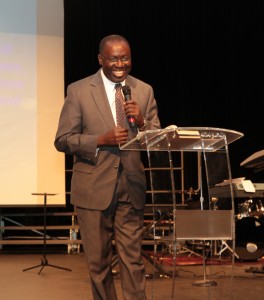
The day’s sermonette which the organizers called a “Message of Exaltation” was delivered by Pastor Peter King’oina of the Minnesota SDA Conference. Basing his message on the first book of Timothy chapter 2 which instructs on prayer and submission to authority, pastor King’oina urged fellow Kenyans to pray for the Independent Electoral and Boundaries Commission (IEBC) to resist all temptation to do evil.
He spoke passionately against the evils of tribalism saying we do not choose which tribe to be born into “so we should not take it out on others for belonging to other tribe”, he said, at one point jocularly asking one of the pastors in an attempt to illustrate a point if he chose to be born in Kirinyaga (home to the Kikuyu community in Kenya), to fits of laughter from the crowd.
He called for prayers for all those that might affect the elections in any manner “because as Christians we have an obligation to pray for everyone,” he said. He said major changes have happened in Kenya to guard against any mischief in the election that he is proud of including the installation of an independent judiciary and a reform of the police force but warned against complacence hence the need for prayers.
Ministers from the various churches also offered prayers and messages on spiritual vision, national peace and reconciliation. Among them Pastor Michael Ngeru Kamau, Rev. Dr Sammy Wanyonyi and Rev. Clement Momanyi Moturi.
Pastors Eric Mokua of Mount of Blessings Church and Stephen Ibabu of Jesus Celebration Center were the masters of ceremonies.
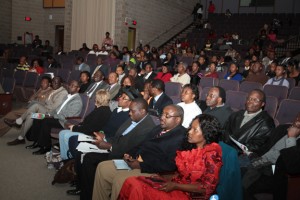
A cross section of Minnesota Kenyans who attended the Kenya Day of Prayer on Saturday, March 2 2013. Pastor Zipporah Bogonko is on the right (in red). Photo: Jared London/Mshale
A senior Kenyan who would only give her name as Susan laughed with a hint of guilt as she admitted coming in late for the event “ You know my shift did not end until 4pm and you know I had to go home get ready first but I am glad I made it, I was so tired I almost didn’t come.” She said.
A handout at the prayer event listed the following as participating churches International Outreach Church (IOC), Kenyan Christian Outreach Church, Jesus Celebration Center, Progressive Grace Church, Mzizi Church International, Shine in the World International Ministries (SWIM), Destiny Faith Ministries and United Seventh-Day Adventist Church.
Local restaurateur and entertainment promoter, George Ndege, praised the organizers and said in future he would like to see an interfaith service as “it will bring the Minnesota Kenyan community closer.”
Majority of immigrants turned over to ICE are non-criminals
By Reshma Shamasunder
This week, a new report dealt what may be the greatest blow yet to Immigration and Customs Enforcement (ICE)’s strained credibility over its deportation practices.
The report, authored by Syracuse University’s Transactional Records Access Clearinghouse (TRAC), determined that the overwhelming majority of people ICE has asked local jails to hold for deportation had no convictions. Researchers also found that ICE has asked local jails to hold hundreds of citizens, in flagrant violation of the Constitution.
The troubled agency has strenuously claimed it prioritizes its resources to focus deportations on the most “serious” cases.
But nothing could be further from the truth.
Hundreds of thousands of separated families know this all too well, and statistics from controversial deportation programs like “Secure” Communities have also highlighted the gap between ICE’s rhetoric and reality. But now, we have more extensive evidence of just how out of control ICE is.
What did TRAC find? From Fiscal Year 2008 up to the start of Fiscal Year 2012:
• 77 percent of all ICE “hold” requests were issued for people with no criminal convictions, despite ICE’s “Secure” Communities spin. We’re talking about 734,582 people here – more than the population of Detroit!
• Less than 9 percent of holds went to folks with convictions in ICE’s level one or “highest priority” category. But guess what – TRAC has also previously found “level one” isn’t what it’s cracked up to be and is mostly made up of people with traffic or immigration-related convictions.
• 834 U.S. citizens and 28,498 permanent residents had ICE holds placed on them. That’s a lot of potential lawsuits waiting to happen.
Readers might wonder: what exactly is an immigration “hold”?
Just ask Los Angeles day laborer Hector Nolasco, unjustly detained in the L.A. County Jail right now. He was falsely accused of assault by an employer who didn’t want to pay him.
Or ask survivors of domestic violence like Isaura and “Eva” who were wrongfully arrested along with the people actually committing the abuse, and then held for deportation.
An ICE hold kicks in at the moment you would otherwise be released from police custody. ICE asks the local jail to detain people for extra time, at local expense, just so they can be picked up for deportation. The hold should last only 48 hours, but in reality community members can languish in jail for weeks or months since many jurisdictions wrongfully deny bail.
But here’s the kicker: ICE holds are simply requests. Local governments are free to ignore them. And given that each “hold” is a potential lawsuit just waiting to happen, they should be ignored.
In fact, counties from Santa Clara, Calif. to Cook, Ill., have already stopped holding people for ICE entirely.
And now it’s time for California, which has been hit with more deportations than any other state, to step up.
A broadly supported California bill would do just that. The TRUST Act (AB 4 by Assemblymember Tom Ammiano) would substantially limit the unfair detention of aspiring citizens – and citizens, for that matter – in local jails. The bill recognizes we’re all safer when we build relationships of transparency and trust between all communities and local police.
The bill also recognizes we shouldn’t deport people today who could be on the path to citizenship tomorrow. Its passage could propel forward efforts to win meaningful immigration reform at the federal level.
While Gov. Jerry Brown vetoed a version of the bill last year, he promised to advance a new version of the bill forthwith.
For the more than a thousand Californians who are still torn from their families and deported each month, action can’t come soon enough.
Reshma Shamasunder is Executive Director of the California Immigrant Policy Center.
Ethiopia’s economy benefits from returning Diaspora
At a salon in Ethiopia’s capital, Addis Ababa, customer Erica Kanesa relaxes in a leather chair.
“I’m just doing manicure and pedicure,” she says, leaning her head back while a beautician works on her nails.
Spa businesses in Ethiopia are thriving because the country’s middle class is expanding, and also because of the efforts of one man.
Tadios Getaco Belete was born in Ethiopia, but – like many – he fled in the 1970s when an oppressive communist government took over. He settled in the United States and eventually opened a successful salon in an upscale part of Boston.
After a new Ethiopian government took power, Tadios decided to move home. He says the decision was partly sentimental, but it also made good business sense.
“Anyone with a good smell of business can feel and sense [that] there is an opportunity here,” Tadios says. So he decided to do something that no one in Ethiopia had yet done – open a luxury spa.
“I was the first one, and everyone was laughing at me, ‘You’ll not get any customers,’” he says. “But, surprisingly enough, we had an amazing turnout. Now we have about 89 spas.”
Today, his company employs more than 1,500 people.
“Foreign” Investment – by Ethiopians
African countries often talk about the importance of foreign investment, but Ethiopia is benefiting from a different kind of investment – money brought home from abroad by Ethiopia’s returning diaspora.
You can see the imprint of this investment in the names of businesses, says Ethiopian economist Bisrat Teshome. “For example, the Amsterdam Café – the person is coming from Amsterdam,” he says. He provides other examples: “New York Café, Oslo Café, and Le Parisien.” (And there is Tadios Getaco Belete’s salon company. It’s called Boston Day Spa.)
Bisrat says Ethiopians returning from these places have contributed more than a billion dollars to the economy and have opened more than 2,000 companies.
In some cases, these returning Ethiopians have also changed the local work ethic.
Mekonnen Kidanemariam, an Ethiopian businessman who lived in Canada for much of his life before opening the Addis Regency Hotel in Addis Ababa, says his employees used to avoid hard work. But once they saw him putting in long hours, their attitudes changed.
“When I see their motivation level, from where they were to where they are, it’s very encouraging,” Mekonnen says.
His employees have helped make his hotel very successful. Other hotels are flourishing, too.
But economist Bisrat Teshome says what Ethiopia really needs is for returning businesspeople to put their expertise and money into manufacturing.
“If that money was pumped into the industry sector, then it creates more jobs,” he says.
Bisrat says for the same investment it takes to open a high-end spa, a person could open a factory that would create 10 times as many jobs. He says a factory would also boost trade and create more long-term prosperity for Ethiopia.
Bisrat hopes more returning businesspeople will start turning to things like textiles and leather, not massages and manicures.
Musicians Eric Bibb (left) and Habib Koité will perform at the Dakota in downtown Minneapolis on Tuesday, February 26 at 7pm.
Musicians Eric Bibb (left) and Habib Koité will perform at the Dakota in downtown Minneapolis on Tuesday, February 26 at 7pm.Musicians Eric Bibb (left) and Habib Koité will perform at the Dakota in downtown Minneapolis on Tuesday, February 26 at 7pm.
Eric Bibb strongly believes that anytime you collaborate with a musician from another culture, you’ll be rewarded with a new lens to look through when it comes to music.
“It’s very inspiring, you’re forever changed,” the American bluesman says of the process, something he recommends any artist undertake who’s interested in another culture.
“It definitely broadens one’s horizons,” he adds. Not only is there much to learn through collaboration, but there are similarities to be explored.
“I think any musician can find common ground with another musician because that’s the beautiful universal quality of music is the language. To actually do it with another musician is an incredibly enriching experience and I recommend it highly,” he says.
Bibb is speaking from personal experience, having gained powerful new insight into his craft through his recent ongoing collaboration with Malian singer-songwriter Habib Koité.
The duo met more than 10 years ago, the result of both being included on a 1999 Putumayo compilation album entitled Mali to Memphis: An African-American Odyssey.
Long interested in West African music, Bibb was familiar with Koité and was thrilled when they were asked to join forces for a Californian promotional tour.
“He’s an amazingly versatile musician who has collected and studied the many, many diverse musical traditions that the large country of Mali encompasses. . . .” says Bibb. “In his own writing and recordings, he’s done something really unusual, and that is he’s brought together many of these traditions into his band’s repertoire and his compositions.”
As they got to know one another, Bibb and Koité realized their compatibility as guitarists and singers. Sharing a mutual respect for one another as well as their musical traditions, they agreed to one day record an album.
“He’s amazingly inventive and has managed to synthesize all of his influences, which include, as I said, many Malian traditions, but he also studied classical guitar. He’s very aware of Western popular music, English rock, American blues and all that stuff. So in that way, we’re similar. We’ve had quite an eclectic musical background, but we’re also very grounded in specific traditions,” says Bibb.
The two musicians kept in touch over the years, running into one another around the world at various concerts.
“Finally, the opportunity came along and the next thing I knew I was in Bamako recording with him,” says Bibb, referring to Mali’s capital and Koité’s current home.
Their resulting work, Brothers in Bamako, is a unique world, folk and blues music fusion that draws on both their cultures and wide-ranging musical perspectives. The album was released last year and Bibb and Koité are in the midst of an international tour, having played a number of dates in Europe before landing in North America earlier this month.
Mee Moua’s family came to the United States in 1978 after fleeing Laos four years earlier and relocating to a refugee camp in Thailand. Her father planned to bring his brother and father over as soon as he was economically secure, but he had trouble finding a steady job as a new immigrant. When he finally did get work, it was too late — his brother and father had already passed away.
Now the president and executive director of Asian American Justice Center, Moua sees her family experience as similar to that of many Asian families today who are separated for years, sometimes decades, as a result of backlogs in family-based visa applications.
Moua’s interest in the fight for comprehensive immigration reform, she says, is personal:
“It is for my family and my father and the people in my community because they are the ones who are directly affected,” said Moua, one of three speakers during an ethnic media telebriefing on immigration reform, organized by New America Media.
About 60 percent of the 17 million Asian Americans in the United States are foreign-born. Ninety percent of Asian immigrants come to the United States through family-based immigration visas, so backlogs in the system affect their everyday lives. In fact, nearly half of the 4.3 million people in the family backlog worldwide are in Asia.
“What people often…frame as a Latino issue, it’s just not true,” Moua said. One in 11 undocumented immigrants in the United States is Asian American; and one in 10 Dreamers is Asian American.
This year’s immigration reform debate, Moua said, is “a window of opportunity for our elected officials to exert some leadership, to finally create an opportunity for families to feel secure, for families to feel safe, families to be reunited, and really take advantage of the American dream….”
Advocates are optimistic that Congress could pass a comprehensive immigration reform law this year that would include a path to citizenship for the estimated 11 million undocumented immigrants living in the U.S., along with a strong family reunification program and targeted enforcement.
Frank Sharry, executive director and founder of America’s Voice, said this optimism comes from a confluence of factors: “The president promised it, the Democrats want it, the Republicans need it, the American people support it and the immigrant rights movement is strong enough to deliver it.”
The 2012 election was a “game changer,” Sharry explained, with record turnouts from Latino, Asian and immigrant voters who played “a huge role” in re-electing President Obama, helping Democrats hold the Senate, and winning a number of contested House seats. “And,” he added, “immigration played a huge role in mobilizing Latino, Asian and immigrant voters.”
In the Senate, the so-called “Gang of 8,” a bipartisan group of Senators, is working to develop an immigration bill. Advocates expect the Senate to begin debate and produce a bill in the month of March. Another bipartisan group is developing a bill in the House of Representatives, although the timeline of that bill is less certain.
The mood at the Senate Judiciary Committee hearing on immigration reform on Wednesday was notably different from 2006, the last time Congress took up immigration reform, noted Angela Kelley of the Center for American Progress.
“It was stunning,” observed Kelley. “The star of the hearing was José Antonio Vargas [the Filipino American Pulitzer prize-winning journalist who announced publicly in 2011 that he was undocumented]… I think [it was] the first time an undocumented person who has come out as an undocumented person is testifying before the Judicial Committee.”
Despite the optimism, many remain concerned about who might be included – and who might be left out – of a federal immigration reform bill.
Advocates will be waiting to see how several key issues play out in the immigration reform debate – beginning with what will happen to the 11 million undocumented immigrants already living in the country. Will there be a direct, achievable path for them to become legal permanent residents and eventually apply for citizenship after meeting certain requirements? Or will they be converted into a class of people who exist in a kind of legal limbo, protected from deportation yet unable to become citizens, like the recipients of deferred action?
Another concern for immigrant rights advocates is that border enforcement will be used to delay other aspects of reform. Will granting legal status to undocumented workers be contingent on first achieving a secure border? And if so, how will border security be measured? Some pro-reform advocates argue that the government has already met its obligations on enforcement and are now calling for a halt to all deportations.
Advocates are also watching how immigration reform will handle visas for workers, not only in agriculture and the high-skill technology fields, but also industries like restaurants and landscaping – where there aren’t enough visas to support sizeable undocumented immigrant workforces.
LGBT immigrants, say advocates, are another immigrant group facing a unique challenge: Unlike heterosexual couples, same-sex bi-national couples are currently unable to apply for a green card through marriage. Even if they were married in a state where same-sex marriage is legal, the federal Defense of Marriage Act (DOMA) prevents them from receiving certain benefits that other couples are entitled to, including applying for a green card through a spouse. The Supreme Court announced in January that it will review the constitutionality of DOMA this year; if the high court upholds the federal law, some advocates are hoping that this discrepancy will be addressed through a comprehensive immigration reform bill.
Finally, advocates are paying attention to another landmark piece of legislation that leaves out undocumented immigrants: the Affordable Care Act (ACA). Obama’s healthcare reform bill, signed into law in 2010, makes health care more accessible and affordable for most Americans – but the plan excludes undocumented immigrants. The White House has said undocumented immigrants would not be eligible for health insurance under its immigration reform plan. The Senate’s Gang of 8 has not specified whether the immigration reform plan they are working on would include them.
“As we know,” Kelley said, “undocumented people get sick like everyone else.”
The question, she said, will come down to how much it costs to include them in the ACA. But, she adds, while it will cost more to include them, that amount must be compared to how much is currently being spent on Emergency Room visits and other costly forms of health care for uninsured people who do not access preventive care and often wait until they have an emergency to seek treatment.
Meanwhile, Obama met Wednesday with four Democrats in the Senate’s “Gang of 8,” in what Kelley described as a “very positive meeting,” adding that the Senate is “on track to move forward [with immigration reform] in March.”
“We have an engaged White House,” noted Kelley, “and honestly a president that’s looking at his legacy and is very much carrying the reality of the record number of deportations that will be his legacy” if he doesn’t deliver on immigration reform, she said.
Starting on March 4, immediate relatives of U.S.citizens who meet specific requirements may apply for a waiver of unlawful presence while they are in the U.S. before they depart to process their immigrant visa at a U.S. Consulate abroad.
The new “stateside waiver” or “provisional waiver” program will reduce the amount of time that qualified applicants are separated from their loved ones while waiting abroad to receive their visa. It will also relieve the stress and anxiety that come with departing the U.S. before the waiver is granted.
Persons who entered the U.S. illegally may not apply for adjustment to lawful permanent resident status, but must travel abroad to a U.S. Consulate to apply for an immigrant visa. Departure from the U.S. triggers a 3-year bar from the county if the person was unlawfully present in the U.S. for more than 180 days. The bar increases to 10 years if the person was unlawfully present for one year or longer.
Many undocumented immigrants are unwilling to take the risk of departing the U.S.to legalize their status, especially when they do not know whether a waiver of the 3/10 year bar will be granted.
Under the current process, which is still available to those who do not qualify for the new process, immediate relatives may not apply for the waiver until after they have appeared for their immigrant visa interview at a U.S Consulate abroad and the U.S. Department of State has determined that they are inadmissible.
But once U.S. Citizenship & Immigration Services (USCIS) begins permitting stateside processing of unlawful presence waivers, the applicant will get a better sense, prior to departing the U.S., of whether he may return in a matter of days, instead of years. After the applicant receives a waiver approval, he can travel to the U.S. Consulate abroad and apply for an immigrant visa to return to his life and family in the U.S.
Who Qualifies?
To qualify for the stateside waiver of unlawful presence, the applicant must meet all of the following criteria at the time of filing:
Be physically present in the U.S.
Be at least 17 years old
Be an “immediate relative” of a U.S.citizen (i.e. the spouse of a U.S.citizen, the parent of a U.S.citizen age 21 or older, or the unmarried child under 21 of a U.S. citizen). NOTE: Some persons over age 21 may still be classified as a “child” under the Child Status Protection Act (CSPA).
Prove that a qualifying relative (U.S.citizen spouse or U.S. citizen parent) will suffer extreme hardship if the waiver is denied.
Be the beneficiary of an approved Form I-130 or approved Form I-360 petition.
Have an immigrant visa case pending with U.S. Department of State based on the approved petition.
Pay the immigrant visa processing fee.
Be inadmissible only on account of unlawful presence in the U.S. and no other grounds, such as fraud or criminal convictions.
Who Does Not Qualify?
Applicants who meet all of the above criteria still do not qualify for the stateside waiver if any of the following apply:
They have a Form I-485, Adjustment of Status application pending with USCIS.
They are in removal proceedings that have not been administratively closed.
They have been ordered removed, excluded, or deported from the U.S.
They are subject to reinstatement of a prior order of removal.
Their immigrant visa interview appointment notice was issued before January 3rd, 2013. NOTE: There is one exception, however. According to the U.S Department of Homeland Security, “An alien who is ineligible to apply for a provisional unlawful presence waiver because of a previously scheduled immigrant visa interview may still qualify for a provisional unlawful presence waiver if he or she has a new [U.S. Department of State] immigrant visa case because 1) [U.S. Department of State] terminated the immigrant visa registration associated with the previously scheduled interview, and they have a new immediate relative petition; or 2) the alien has a new immediate relative petition filed on his or her behalf by a different petitioner.”
The Application Process
As of March 4, USCIS will begin accepting the new Form I-601A application for provisional unlawful presence waiver. Applicants must submit a $585 filing fee for the waiver plus an additional $85 biometrics (fingerprinting) fee. The fees cannot be waived.
The stateside waiver is not limited to first-time filers. Therefore, a qualified applicant who previously filed a waiver application that was denied or withdrawn can re-file under the new program.
If the stateside waiver is denied, there is no appeals process. But the applicant may file a motion to reopen or reconsider or file the waiver anew with additional evidence and pay the fees again. The applicant may also apply for the waiver abroad after attending his immigrant visa interview.
The Stateside Waiver and Removal Proceedings
If the provisional waiver is denied or is withdrawn prior to adjudication, the applicant will be referred to U.S. Immigration and Customs Enforcement (ICE) for removal proceedings only if he is deemed to be a high priority for removal, such as having a criminal history, engaging in fraud, or otherwise posing a threat to national security or public safety.
Qualified applicants who are already in removal proceedings should request an administrative closure of these proceedings while they await a decision on their provisional waiver application.
If the provisional waiver is granted, the applicant must move to terminate or dismiss removal proceedings beforeleaving the U.S. to obtain the immigrant visa. If he fails to make such a motion or if the motion is denied before he departs the U.S., he could be barred from obtaining the immigrant visa and returning to the U.S.
Limits to the Stateside Waiver
The filing or the approval of a provisional unlawful presence waiver does NOT:
Entitle the applicant to employment authorization, advanced parole or other interim benefits.
Provide any lawful status in the U.S.
Stop the accrual of additional unlawful presence in the U.S.
Authorize the applicant to enter the U.S. without a visa or other appropriate entry document.
Protect the applicant from being placed in removal proceedings or from being removed from the U.S., in accordance with current DHS policies.
Remove the requirement to depart the U.S. to apply for an immigrant visa.
Guarantee the issuance of the immigrant visa or re-admission to the U.S.
Conclusion
The stateside waiver of unlawful presence is only one step in the process of obtaining lawful permanent residence in the U.S. Even if USCIS approves the Form I-601A provisional waiver request, the U.S. Consulate may still deny the immigrant visa if it finds other grounds of inadmissibility.
Furthermore, Form I-601A waiver applicants are not spared from proving, with ample documentary evidence, that their qualifying relatives will suffer “extreme hardship” if they are denied the waiver.
Due to the high risks involved, applicants should consult with an experienced immigration attorney for assistance with preparing their waiver application prior to departing the U.S. for their immigrant visa interview or for any other reason.
Nothing in this article should be taken as legal advice for an individual case or situation. The information is intended to be general and should not be relied upon for any specific situation. For legal advice, consult an attorney experienced in immigration law.


 Senators are mulling making it harder for U.S. citizens to get visas for family members while easing the path for high-skilled foreign workers, a senator said.