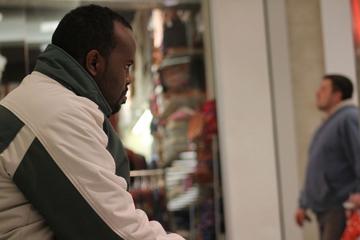
Questlove is pictured at the Macy’s Thanksgiving Day Parade in New York last year. (Photo: WSJ)
Questlove is pictured at the Macy’s Thanksgiving Day Parade in New York last year. (Photo: WSJ)Questlove is pictured at the Macy’s Thanksgiving Day Parade in New York last year. (Photo: WSJ)
On a recent trip to South Africa, Questlove, drummer and bandleader for The Roots, says he relearned a valuable lesson that he’d almost forgot – the reach of music across continents and cultures.
The artist, also a DJ and record producer, was asked by Oprah Winfrey to perform at at a graduating party for her South African Leadership Academy for Girls. He almost balked at the request, worried he would have to censor himself in front of dignitaries and the teenage students.
“I learned the biggest lesson of my life that night,” he said in a recent interview with Speakeasy. “Never underestimate the power of the absolutely potent substance that is hip hop.” The students knew more about his music than he expected, and he was reminded of how far music can travel.
Sharing hip hop with the world, and giving fans an opportunity to engage directly with artists, was one of the original aims of Okayplayer, a music site Questlove started in 1999. Conversation was promoted with community boards and the site provided valuable exposure for new audiences. Okayplayer’s offshoots include the Caribbean-lifestyle site LargeUp, jazz site The Revivalist and Okayafrica.
ICE agents arrest a man as part of "Operation Cross Check" in September 2011. "Operation Cross Check" targeted immigrant fugitives and those here illegally and have criminal records.
ICE agents arrest a man as part of "Operation Cross Check" in September 2011. "Operation Cross Check" targeted immigrant fugitives and those here illegally and have criminal records.
When Hassan was recently asked to come to the U.S. Citizenship and Immigration Services center in Bloomington, he thought immigration authorities needed the usual updates he had often given since he was freed from prison in 2010.
That didn’t happen, though, when Hassan reached the center on Tuesday morning Oct. 30, 2012. Officials from the local U.S. Immigration and Customs Enforcement (ICE) greeted and detained him in the same building. They told Hassan he was facing deportation to the strife-torn Somalia he had escaped at age 4.
Hassan spent the night at the center. The next day, he was transferred to the Basile Detention Center in Louisiana.
ICE Spokesman Shawn Neudauer confirmed Hassan’s detention and the wait for removal to Somalia.
“[Hassan] was served a Notice of Revocation of Release,” Neudauer said in an e-mail statement. “On the notice, it was explained that he is being taken back into custody because ICE has determined that there is a significant likelihood of removal in the reasonably foreseeable future. He was aware that ICE intended [to] remove him.”
“There was no chance for us to say our goodbyes,” said his younger brother, Mohamed. “The worst thing, he was not given a choice of where in Somalia he’d like to be deported.”
The violence that 26-year-old Hassan and his family escaped more than two decades ago still persists in the country, Mohamed said. He said the condition in Somalia is even worse right now than it was before.
“We’re concerned about his safety,” Mohamed said. “No one is in Somalia for him — no brother, no sister, no parents. No nothing.”
It’s a normal and legal procedure for the United States to expel immigrants who ware convicted of crimes, even if they’re lawful permanent residents. Some of the reasons for being subject to repatriation include sex and drug offenses, fraud and other white-collar felonies, as well as security and terrorism crimes.
Somalia has had its share of violence, poverty, and famine since the central government was ousted in 1991 by clan militias that later turned on each other. Since 2006, the fierce fighting between al-Shabaab and African Union forces has added to the country’s already flaming turmoil. A new clan-based government was established last August and still remains fragile and under the protection of foreign troops from the neighboring countries.
Hassan has been detained for more than two months now, awaiting expulsion to this chaotic country. No one from the immigration services has notified Hassan or his family about deportation details, including when exactly he will be deported, where in Somalia he will be taken or who will be responsible for his safety when he gets there.
The family members in Minneapolis have these questions roaring in their heads: Will he just be dropped on the streets? Will he be handed to the Somali government? Who will protect him from the people he and his family escaped from?
ICE was asked whether deportees chose the regions to which they prefer to be deported — since each region in Somalia has one major clan that controls the area, it’s significant for a deportee to chose the region run by his or her clan. ICE, however, didn’t answer questions on this concern.
Serving time in prison
Hassan arrived in the United States in 2004 from a refugee camp in Kenya. En route to Alabama, he settled in South Dakota where he found a job at a local store as a packer.
According to his family, in 2005, Hassan was convicted for sleeping with an underage girl when he was a teenager. His five-year term in South Dakota State Penitentiary ended in 2010.
“You could tell he was a changed man,” Mohamed said of his elder brother. “He wanted to find a job. He wanted to go to college. He was working so hard to get his life together. He wanted to become somebody.”
The U.S. government, however, didn’t give Hassan a second chance to become that somebody.
During his final months in Minneapolis, Hassan worked for a local restaurant as a waiter. Because Hassan didn’t get paid much, he frequently applied for other jobs — even though it’s hard for a felon to join in the labor force.
Hassan also used to volunteer at community events, especially the annual summer soccer tournaments, which are held in the Twin Cities by and for the Somali community of North America.
“That was his way to enjoy life after years in prison,” Mohamed said. “We were proud of him for doing that.”
Community reactions
Now, the Twin Cities Somali community circulates rumors of scores of their members who have been deported to Somalia and hundreds who wait their fate at detention centers. ICE officials have not confirmed the total number of Somalis who have been deported so far or kept in detention.
Many community members have expressed disappointment in the government’s decision to send people back to the dangerous country they’ve escaped.
“The only place that they know is the United States,” said community activist Sadik Warfa of the deportees. “They came here when they were kids. It’s a tragedy that the government is sending them back to Somalia.”
Warfa spoke with profound sadness of Qasim Bashir, a Minneapolis man with the Confederation of Somali Community in Minnesota at Brian Coyle Center, who was deported to Somalia on November 17, according to the ICE. Warfa described Bashir as a leader and “a decent man who empowered” the community’s young people through basketball training and tournaments.
“He was always trying to bring young people together,” Warfa said. “He was an instrumental in creating a better community.”
Bashi’s repatriation, Warfa said, touched him deeply both on a community and personal level. It’s not fair for someone with dreams and potential to be deported to a lawless country, he added.
Abdisalan Mohamed, who was Bashir’s friend since 2008, said he was shocked by the deportation news of the community members.
“Qasim used to help me fill my tax return forms,” Mohamud said. “He was my [go-to-guy] when I need help with community related things.”
“I’m sure he will be doing great things wherever in the world he is,” Warfa said. “We’ll miss him very much.”
Teen author Tori Odhiambo with her mother Nancy.Teen author Tori Odhiambo with her mother Nancy.
She is a junior high International Baccalaureate (IB) student. She is intelligent, elegant, passionate and filled with ambition. At 16 years of age, Tori Odhiambo has already published a book; Close to Home: The African Savannah. The children’s book, published in December 2012, enabled Ms. Odhiambo to achieve the goal of writing a book before the age of 17. In a nutshell, the book eloquently depicts the fascinating characteristics of Kenyan wildlife in their habitat through poetry as seen by the teenager. Readers will enjoy reading her poetry as well as learning about the wealth of
the Kenyan culture. “The book shows diversity of wildlife. It’s also a testament to humans that even though we are different from animals we can co-exist with them in the same environment” said Ms. Odhiambo.
The concept of writing the book was born in the summer of 2011 after Ms. Odhiambo and her family visited Kenya in December 2010. She has been writing poetry and keeping a journal since she was a little girl. This trip was no exception to her ritual of jotting down her experiences. Her documentation is meticulous and thorough to the extent that her 13 year old brother Kovic Odhiambo makes references to her class notes dating back to the 5th grade for his class work.
While in Kenya, Ms. Odhiambo and her extended family toured the famous Maasai Mara Game Reserve, which is 150 miles from Nairobi, the capital of Kenya. Surrounded by animals in the wild, Ms. Odhiambo was fascinated especially with the giraffe, her favorite wildlife, which she said symbolizes the ability to reach one’s goals. “The biggest surprise is that it was not planned that she would go home [Kenya] and come back and write the book” said Mr. Cleophas Omondi who is Ms. Odhiambo’s dad. He was impressed that his daughter had picked what she had seen in Kenya and translated into poetry. “She took aspects of nature and the co-existence of the ecosystem and was able to put together and make it convincing” he said.
The book also incorporates elements of family in the story as a way of evoking appreciation to them. It blends observation of wildlife and dedication to family through pictures and words. Although the book symbolizes the significance of her accomplishments, it also symbolizes the significance of family, love, loss, reflections and hope. In November 2011, her five year-old cousin, Tania Omondi, was kidnapped and has not been returned since. The family keeps hope alive by praying for her safe return and dedicating the book to her.
Ms. Odhiambo credits her loving family for supporting and cheering her on through the numerous drafts, edits and calls to the publishers. They encouraged her, helped review her work and connected her with a publisher. “Tori was highly determined. She took charge of the project and did all the work herself in addition to the advanced courses she takes as an IB student” said Mrs. Nancy Omondi, Ms. Odhiambo’s mother.
The teen author looks up to her parents who migrated to the United States when she was three years old. They have demonstrated the importance of hard work despite challenges faced by them and most immigrants. “My parents say you must work hard in everything and set SMART goals (Specific, Maintainable, Achievable, Realistic and Timely)”
Her father is an Engineer at 3M and mother Nancy is a Director at UnitedHealth Care. A family of high achievers and focused individuals, it is no wonder that the eleventh grader, who attends Champlin Park High School, loves biology and tutors math, sciences, French and social studies, aspires to become a medical doctor. Her brother Kovic would
like become a biomedical engineer. He noted that not many kids can publish a book before they go to college. “I am very proud of my sister”.
One virtue I found to be consistent in Ms. Odhiambo and her family is their desire to impart knowledge to others. In addition to the subjects that she is already mentoring, Ms. Odhiambo would like to mentor young writers aspiring to write or enhance their writing skills. Her parents couldn’t agree more with the importance of helping other
young writers improve their writing skills. She too stands to gain from this mentorship as the experience gained from mentoring and writing more books will help publish future medical books, articles and papers.
The book is currently available for online purchase at Barnes & Noble, Amazon and Xlibris.com. An e-version of the book is also available.
Abdullahi Elmi recently arrived in Minnesota through a harrowing journey. (Photo: Courtesy TC Daily Planet)
Abdullahi Elmi recently arrived in Minnesota through a harrowing journey. (Photo: Courtesy TC Daily Planet)Abdullahi Elmi recently arrived in Minnesota through a harrowing journey. (Photo: Courtesy TC Daily Planet)
Abdullahi Elmi recently sat quietly at a Minneapolis coffee shop with a bright smile on his face. His eyes ran over the chatty young Somalis around him.
It was a weekday, and he expected them to be at work or in school. “What are they doing here?” asked astonished Elmi, who recently arrived in Minnesota through harrowing journeys on the deserted African borders and stormy seas.
If they came here through my route, they wouldn’t have wasted a second,” he said with the big smile now transformed to a loud laugh. “I would have been doing something useful with my time right now.”
Because of the protracted civil war in Somalia, Elmi’s dream of attending university faded when he graduated from a Mogadishu high school in 2006. Like many young Somalis his age, Elmi vowed to migrate to Europe for education and a better life.
For the first time, Elmi left Somalia in 2008 with a group of strangers, trusting his life with a smuggler to whom he gave $15 to get him to Djibouti, an East African country that borders Eritrea, Ethiopia, and Somalia.
On top of an overcrowded pick-up truck, Elmi traveled for days on the dry and dusty land between Somalia and Djibouti with only a 5 kg container of water in his hand.
People were literally sitting on each other,” he said of the 25 passengers on the vehicle, which was supposed to hold 10 people. There was no space to breathe. And the driver was driving like he didn’t care about their safety.
If you’re weak, you could get thrown off from the car,” he added, “and the driver would keep driving.”
A car in which a friend of Elmi rode overturned on the way a month before Elmi’s trip, with 30 people killed, his friend told him. The rest didn’t get an emergency response for weeks.
They had no food or water,” Elmi said. “They had to drink their urine.”
Every year tens of thousands of people, mostly young, migrate through this route, drawn by the promise of a life of contentment in Europe, according to a recent study, “Boat Ride to Detention: Adult and Child Migrants in Malta,” by the Human Rights Watch.
Most of these migrants, like Elmi, travel with little or no information about what they will encounter during the trip as they go through the borders of Djibouti, Eritrea and Sudan, which then connect to rickety timber boats in Libya with a dream to reach Europe.
Often times, however, they end up in indefinite detention in Malta, a tiny island in the Mediterranean between Libya and Italy, even though they don’t plan Malta as their destination — but aim for European countries, especially Italy, the study said.
All I wanted to do was leave Somalia,” said Elmi, who would end up in a Maltese detention center. “I would never have taken the trip had I known what I know now.”
In Djibouti, Elmi was introduced to another smuggler, who took him on the top of a Jeep that sped fast on the irregular and dangerous deserted ground between Djibouti and Eritrea. He was dropped about 70 miles away from the Eritrea border.
There is the border,” Elmi said the smuggler told him. “He gave me names of men [smugglers] in Eritrea.” Elmi walked across the border with no map or navigation system. No person or home was in sight, and no food or drinks were in his possession.
Elmi finally arrived in Emkulu Camp Eritrea. The camp, which welcomed the first wave of Somali refugees 12 years ago, hosts about 4,000 Somalis, according to a 2008 report by the International Organization for Migration. He stayed in Emkulu for 10 days before he transitioned to a Sudan refugee camp, Shagarab, with the help of smugglers.
Obama posts special video message for Kenyans as they prepare for elections
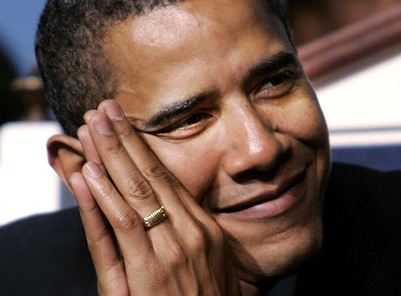
In a video message posted today on the White House website and YouTube, President Barack Obama tells the people of Kenya that the upcoming elections are a historic opportunity for them to stand together as a nation to ensure peace and progress, and for the rule of law.
Starting off with the Swahili greeting of “Habari yako” (how are you?), Obama said “Kenya has lifted people from poverty, built an emerging democracy and civil society, and sustained a spirit of hope in the face of great difficulty. Now, Kenya must take the next step in March, with the first national elections under your new constitution”.
Kenyans go to the polls on March 4 under the new constitution and all recent scientific opinion polls have current prime minister Raila Odinga in the lead followed closely by deputy prime minister Uhuru kenyatta. Odinga is the head of the ticked called CORD while Kenyatta is in the Jubilee coalition. Uhuru Kenyatta is currently facing charges at the International Court in the Hague for being a mastermind of the post election violence that rocked Kenya in the last election in 2007/8.
“Kenya must reject intimidation and violence, and allow a free and fair vote. Kenyans must resolve disputes in the courts, not in the streets. Above all, the people of Kenya must come together, before and after the election, to carry on the work of building your country.” president Obama said.
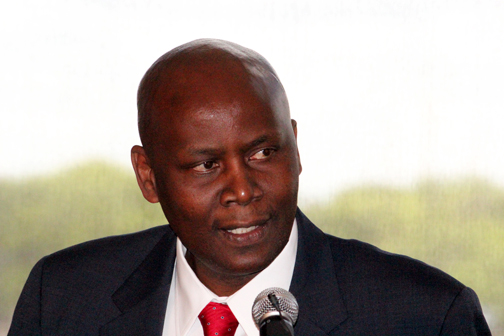
Kenya's Ambassador to the United States, Elkanah Odembo, seen here when he keynoted the 2012 Books for Africa annual luncheon in Saint Paul, Minnesota last May. (Photo: Siyad Salah/Mshale)
Kenya's Ambassador to the United States, Elkanah Odembo, seen here when he keynoted the 2012 Books for Africa annual luncheon in Saint Paul, Minnesota last May. (Photo: Siyad Salah/Mshale)Kenya's Ambassador to the United States, Elkanah Odembo, seen here when he keynoted the 2012 Books for Africa annual luncheon in Saint Paul, Minnesota last May. (Photo: Siyad Salah/Mshale)
The Board of Directors for Books for Africa on the recommendation of its executive board unanimously confirmed Kenya’s ambassador to the United States as its 2013 chair of the Summit Society. The Summit Society consists of top donors to Books for Africa in excess of $5,000 each year. The board action took place at its end of year December board of directors meeting.
Ambassador Odembo took over from his counterpart Ambassador Girma Birru Geda of Ethiopia. “We were honored to receive confirmation that ambassador Odembo will be serving as the Chairman of the Summit Society of Books for Africa,” said Patrick Plonski, executive director of Books for Africa.
“Ambassador Odembo is an articulate and passionate supporter of education in Kenya and across Africa. We are pleased that he has agreed to chair our Summit Society, which represents the top donors to Books for Africa.”
Ambassador Odembo impressed key Books for Africa supporters when he delivered the keynote address at the organization’s annual fundraiser luncheon in May 2012 held in St. Paul where Books for Africa is headquartered.
Books for Africa are the world’s largest shipper of donated school textbooks to Africa. It has shipped over 27 million textbooks to the continent since its inception in 1988. It will be marking its silver jubilee this year. Silver jubilee events will take place throughout 2013 and will culminate in a gala event in St. Paul on September 20.
Former UN Secretary General Kofi Annan and former US Vice President Walter Mondale (Jimmy Carter’s VP) are co-chairs of Books for Africa’s Law and Democracy Initiative which sends brand new law library books to Africa’s law schools through a program sponsored by Thomson Reuters – the world’s largest publisher of law books.
Ambassador Odembo will host a reception for Books for Africa and its key supporters at the Kenyan embassy in Washington, D.C. later this year as part of the yearlong events marking 25 years of Books for Africa and leading to the Silver Jubilee gala.
Mr. Plonski said that Ambassador Odembo’s reception is “in honor of the Summit Society members. We are grateful for the Ambassador’s support for our mission,” he added.
Editor’s note: Mshale founder and publisher, Tom Gitaa, is a member of the board of directors for Books for Africa and sits on its executive board.
Freshlyground lead singer Zolani MaholaFreshlyground lead singer Zolani Mahola
Cape Town – Their music is dubbed Afro-pop or Afro-fusion, it is original and incredibly enjoyable to listen to. The style combines certain elements of traditional South African music with blues, jazz and a spoonful of indie rock.
Freshlyground was formed in Cape Town in 2002 and members hail from South Africa, Mozambique and Zimbabwe and are a “Rainbow Nation” mix.
Lead vocalist is Zolani Mahola. She has a marvelous and extremely versatile singing voice, and listening to a range of the band’s music, one can really appreciate the quirkiness and great humor in her performances.
Other members include Simon Attwell, who is a flautist and plays the mbira (also known as a thumb piano), saxophone and harmonica. The drummer is Peter Cohen and on lead guitar (steel-string acoustic guitar) we have Julio “Gugs” Sigauque. Bassist and backing vocalist is Josh Hawks. On the keyboard, and also a backing vocalist and percussionist, is Seredeal “Shaggy” Scheepers. Kyla-Rose Smith is a violinist and also a backing vocalist.
Freshlyground has received a couple of awards too. In 2005 the band was nominated for three South African Music Awards for their 2004 album, Nomvula. The writer particularly loves the track “I’d Like” from this album.
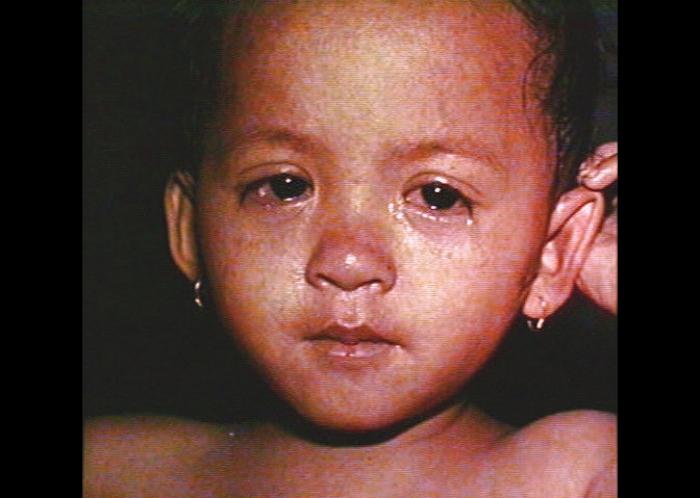
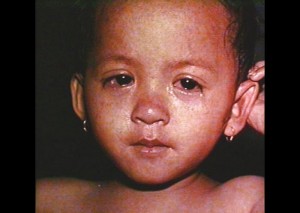
Eyes of a child with measles. (Photo: Courtesy of CDC/ Barbara Rice)
Eyes of a child with measles. (Photo: Courtesy of CDC/ Barbara Rice)
Eyes of a child with measles. (Photo: Courtesy of CDC/ Barbara Rice)
What is measles?
Measles is a very serious and contagious disease caused by a virus. Because so many people are vaccinated, measles is no longer common in the United States. But it is still common in many other countries and may be brought into the U.S. by unvaccinated travelers, which is what happened in Minneapolis in the spring of 2011. Making sure everyone is vaccinated helps prevent measles outbreaks.
What are the symptoms of measles?
Fever AND
Rash AND
Cough OR runny nose OR watery/mattering eyes
Symptoms appear about one to two weeks after a person is exposed to measles. The first symptom is usually fever. The rash usually appears two to three days after the fever begins and lasts five to six days.
The rash begins at the hairline, and moves down the body.
How serious is measles?
Many people with measles have complications like diarrhea, ear infections and pneumonia.
Sometimes measles causes a brain infection that can lead to permanent brain damage.
Complications are more common in children under 5 years of age and adults older than 20. It can be especially severe in persons whose immune systems are weak. Measles during pregnancy might cause a miscarriage or early labor which causes low birth weight babies. Measles can lead to hospitalization and even death.
How does measles spread?
Measles is spread through the air when people who have it breathe and cough. It is highly contagious. Fortunately, once you have had measles you cannot get it again.
How long is a person with measles contagious?
A person with measles can pass it to others from four days before and four days after their rash appears.
Is there a treatment for measles?
No, there is no specific treatment for measles. People with measles need bed rest, fluids and control of fever. They may also need treatment for complications such as diarrhea, ear infection or pneumonia.
If you or your child has symptoms of measles, what should you do?
Be sure to stay at home and avoid having visitors until you have talked with your doctor or clinic. Your doctor or clinic will tell you if you should come in for a visit.
Is there a vaccine for measles?
Yes. The measles vaccination is combined with mumps and rubella called MMR. Children should receive two doses of MMR vaccine: the first at 12 to 15 months of age and the second at 4 to 6 years of age.
All adults who have not had measles or a measles shot should receive MMR vaccine, particularly if they were born in 1957 or later. Certain adults (such as health care workers and travelers) should receive up to two doses of MMR vaccine to make sure they are protected. Children as young as 6 months old who are
traveling overseas should also get an MMR. Talk to your health care provider before you travel.
If you or your child has been exposed to measles, what should you do?
Call your doctor or clinic right away. They will let you know if you need to come in for a visit.
If you have not been vaccinated, getting an MMR shot within three days of being exposed may prevent you from getting measles.
Mayflower Early Childhood Center accepting applications
Mayflower Early Childhood Center in south Minneapolis is accepting applications for the 2013-14 school year. Deadline is March 1, 2013.
The school, located on Diamond Lake road just off the 35W exit has a top rating from Parent Aware of four stars. Parent Aware is a free service for Minnesota parents searching for child care and early education providers.
Leah Popova, the parent outreach coordinator at Mayflower said in a press release that the center is seeking a connection with “diverse families in need who live in our area.” She encouraged families that qualify for Child Care Assistance to apply.
The center provides a Montessori learning environment and is accrediatted Association Montessori Internationale (AMI).
Actress and HIV/AIDS campaigner Charlize Theron speaking on the eve of the opening of the 43rd Annual Meeting of the World Economic Forum, in Davos, Switzerland, Tuesday, Jan. 22, 2013 where she was honored with a Crystal Award for her work fighting HIV/AIDS.
Actress and HIV/AIDS campaigner Charlize Theron speaking on the eve of the opening of the 43rd Annual Meeting of the World Economic Forum, in Davos, Switzerland, Tuesday, Jan. 22, 2013 where she was honored with a Crystal Award for her work fighting HIV/AIDS.
Actress and HIV/AIDS campaigner Charlize Theron speaking on the eve of the opening of the 43rd Annual Meeting of the World Economic Forum, in Davos, Switzerland, Tuesday, Jan. 22, 2013 where she was honored with a Crystal Award for her work fighting HIV/AIDS.
DAVOS, Switzerland – The actress Charlize Theron and two documentary filmmakers received awards for their humanitarian work as the World Economic Forum opened in Davos Tuesday.
Ms. Theron, who won the best actress Oscar in 2004 for the film “Monster,” was honored Tuesday for her work fighting H.I.V. among impoverished young people in South Africa, where she was born.
Ms. Theron’s appearance was a bit of a departure for the World Economic Forum, which had dialed back the celebrity glamour after the appearance in 2006 by Brad Pitt and Angelina Jolie threatened to overshadow the rest of the annual meeting.
Ms. Theron was decidedly lowkey and humble as she accepted the Forum’s Crystal award from a stage in the Davos Congress Center.
“There is an incredible brain trust in this room,” she said, referring to the Davos participants. “I feel like I’m getting smarter just by osmosis.”
Wearing a simple blue dress and heels, Ms. Theron noted, with some understatement, that she was often in the spotlight. “I decided the best thing you can do with that spotlight is to stand in the shadow of something and shed some light,” she said.
The Charlize Theron Africa Outreach Project finances programs designed to prevent the spread of H.I.V. among young Africans, particularly in South Africa, which has 5.9 million infected people, Ms. Theron said. According to the organization’s Web site, charlizeafricaoutreach.org, the programs include mobile health services in an exceptionally impoverished region of South Africa.
The World Economic Forum also honored two other artists: Sharmeen Obaid-Chinoy, a Pakistani filmmaker; and Vik Muniz, a Brazilian artist.
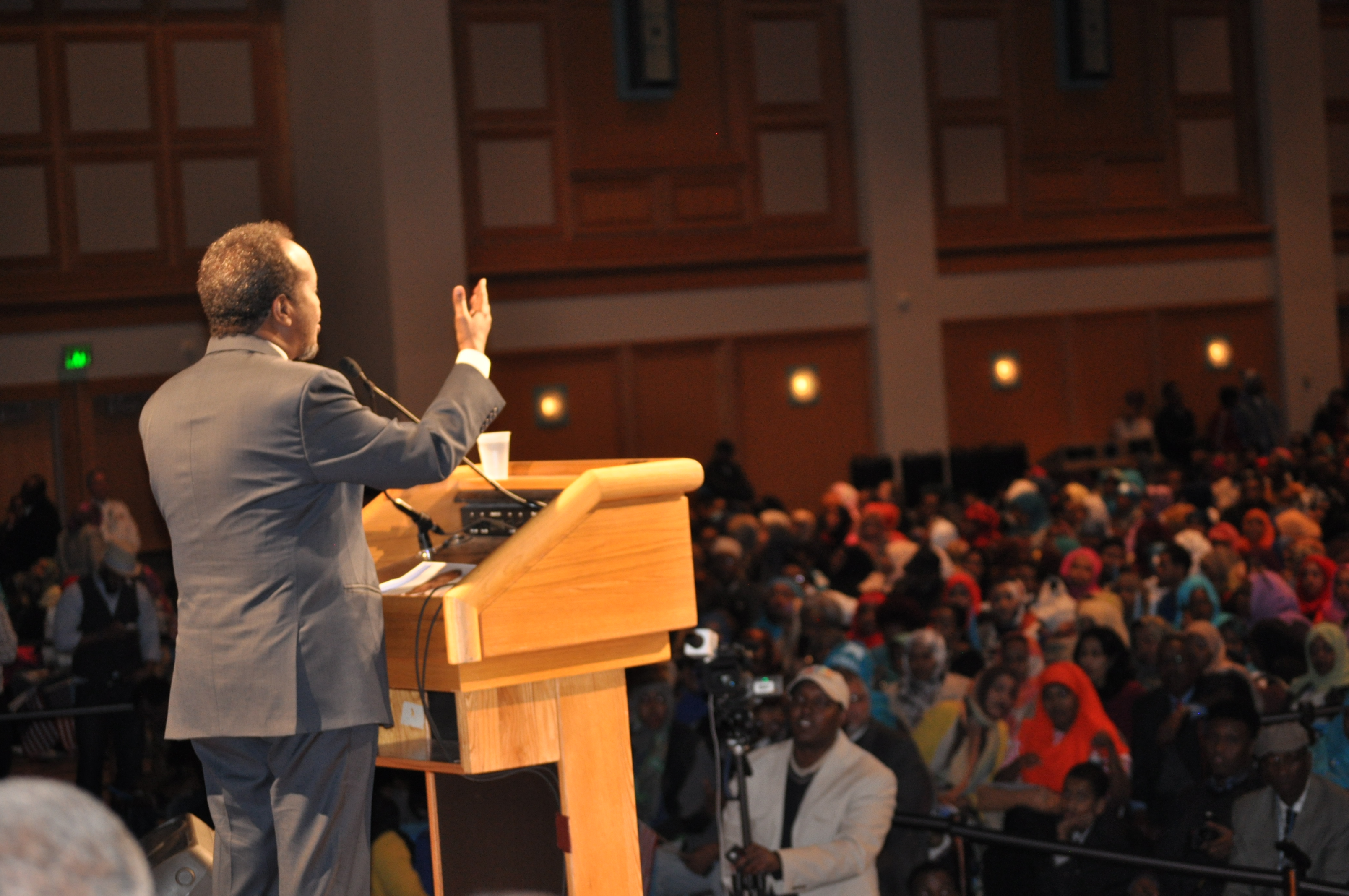
The new president of Somalia, Hassan Sheikh Mohamud, at the Minneapolis convention Center where he addressed over 4,000 Somali-Minnesotans on Friday, January 18, 2013. (Photo: Liban Hussein)
The new president of Somalia, Hassan Sheikh Mohamud, at the Minneapolis convention Center where he addressed over 4,000 Somali-Minnesotans on Friday, January 18, 2013. (Photo: Liban Hussein)
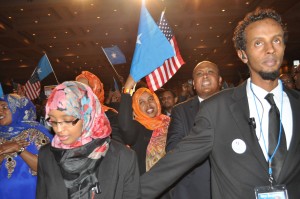
A day after meeting with President Obama and receiving recognition for his government, the new Somali president Hassan Sheikh Mohamud was greeted by a sea of waving flags in the hands of Somali-Minnesotans Friday evening at the Minneapolis Convention Center.
Somali-Minnesotans listen to the new president of Somalia, Hassan Sheikh Mohamud as he addressed them at the Minneapolis Convention Center on Friday, January 18, 2013. (Photo: Liban Hussein)
Speaking mostly in Somali, President Hassan Sheikh Mohamud addressed about 4,000 jubilant supporters and thanked the U.S. government for recognizing Somalia. Relations with the United States were cut off in 1991.
President Mohamud, accompanied by Deputy Prime Minister and Foreign Affairs Fowziya Haji Adam, Minister of Information and Telecommunication Abdullahi Elmoge Hersi and several senior advisors, talked about his mission to make Somalia a peaceful and stable country. “You can help us, but it is our job [Somali government] to fix the problems.”
Not all were delighted to see Somalia’s newly elected president. About 50 protestors stood outside the convention center chanting, “We don’t need tribalism” and carrying signs with slogans including “We need a president who will follow the Somali Constitution.”
The protestors demanded a federal government. “The president is confining Somalis,” said Abdirashid Ahmed, one of the protestors. “Sheikh Hassan Mohamud is not going by the constitution.”
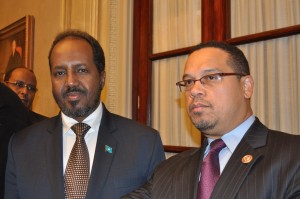
The new president of Somalia, Hassan Sheikh Mohamud with Congressman Keith Ellison of Minneapolis at the Minneapolis Convention Center where he addressed over 4,000 Somali-Minnesotans on Friday, January 18, 2013. (Photo: Liban Hussein)
U.S. Representative Keith Ellison, D-Minn., embraced Somalia’s president and reassured Somali-Minnesotans that the relationship between the U.S. and Somalia will continue. “I am as happy as anybody tonight. Somalia is not alone,” said Ellison.
The president advised Somalis to avoid holding on to the past. “There is a price to pay in order to get that good Somalia,” said Mohamud. He talked about love and patience as the key tools to rebuild Somalia. Mohamud shared with the crowd some of his experience with the U.S. president during his visit to Washington, D.C.
“President Obama has showed commitment and national recognition to Somalia,” he said. “I have also met with Secretary Hilary Clinton. She made some promises for us.”