Tanzania important to the Millenium Challenge Corporation, Diaspora convention told
MINNEAPOLIS – Tanzania continues to be among the top recipients of the Millennium Challenge Account (MCA), the bilateral development fund that is run by the Millennium Challenge Corporation (MCC), the U.S. agency created under the Bush administration “to reduce poverty through sustainable economic growth”.
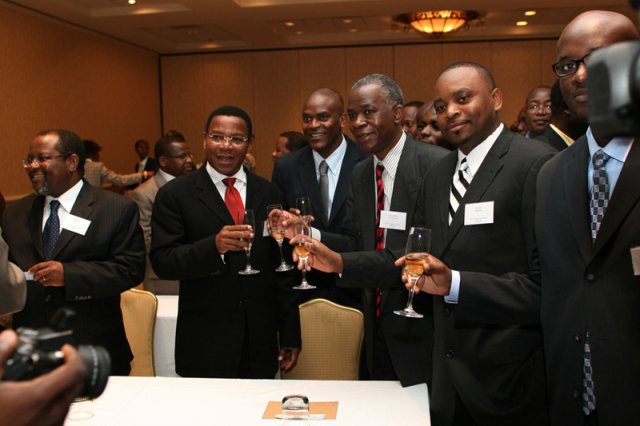
The announcement was made by Jonathan Bloom, MCC’s Deputy Vice President during a featured speech at the second annual Diaspora Council for Tanzanians in America convention that got underway this morning.
Compacts, as the large five-year grants that MCC provides to eligible countries, have been instrumental in important projects that have gotten underway in Tanzania. The current five year compact that Tanzania is taking advantage of consists of US$470 million out of the US$7.2 billion that MCC has provided to the 19 countries it is working with currently, easily making the country an important player.
With stringent government, good policies, country ownership, and result, MCC provides effective and deserved foreign assistance to selective countries. “What we support is to provide the basis of these types of opportunities,” Bloom said. He said the projects MCC has funded have acted as catalysts to a variety of other projects that Tanzanians have initiated.
Over 300 delegates are gathered in Minneapolis for the convention. Participants like Magabe Maasa came with obscure hope and questions ruminating in his mind. “These are all smart officials,” Maasa said. “I don’t know why Tanzania is poor.”
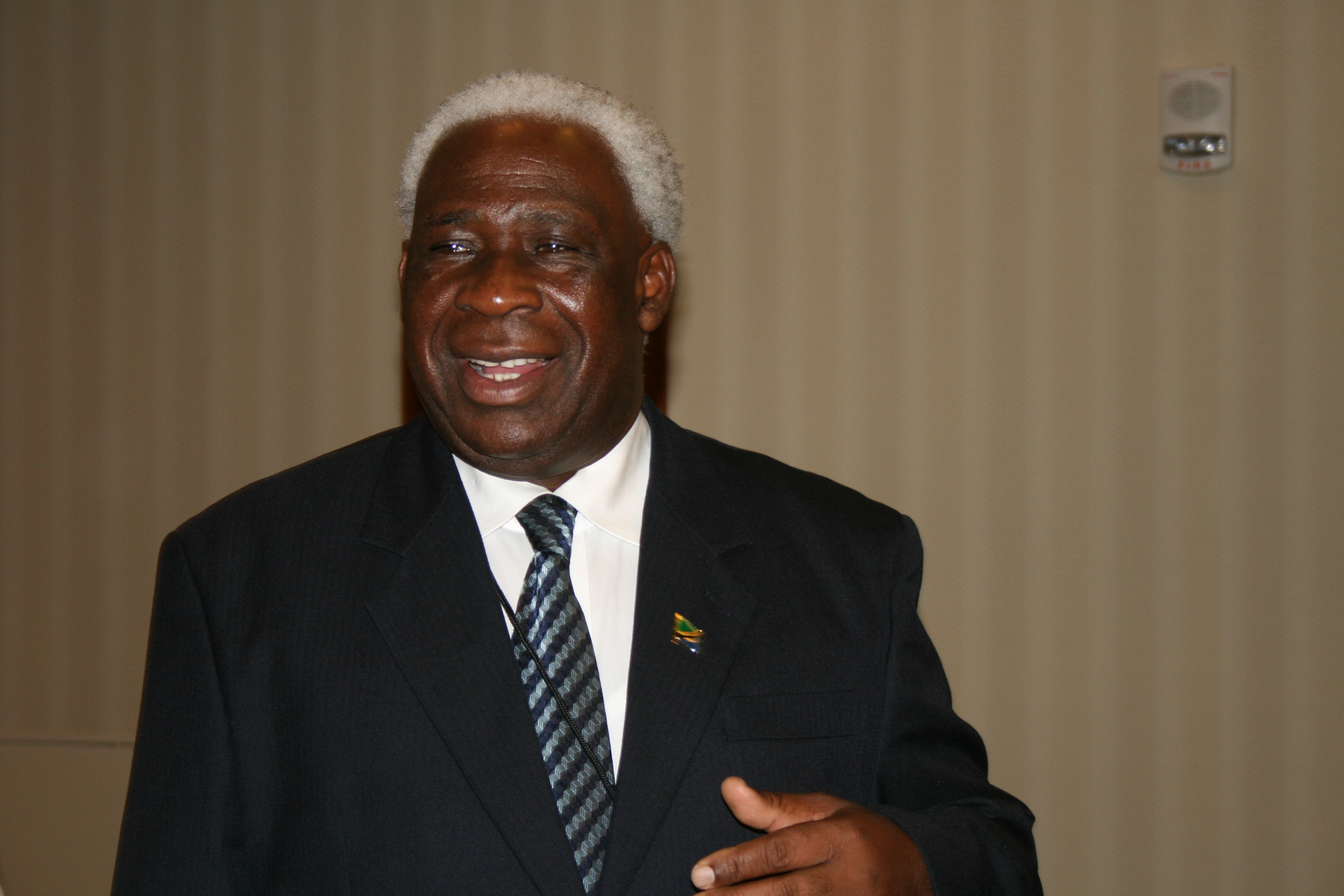
One of the first speakers this morning was Mr. Philemon L. Luhanjo, Chief Secretary and Secretary to the Tanzania cabinet. He delivered a speech on behalf of President Jakaya Kikwete who praised the objectives of DICOTA.
Luhanjo said, “His Excellency said, ‘My promise to you DICOTA, my government and I will give you all the necessary cooperation and support.’”
Editor’s note: Follow conference updates on Twitter.
Last April, the State of Arizona passed bill SB1070, probably the toughest immigration law targeting undocumented immigrants ever enacted in the nation. This law allows state officials to inquire into the immigration status of any person based upon “reasonable suspicion” that the person is undocumented. The bill literally reads: “For any lawful contact made by a law enforcement official or agency of this state or a county, city, town or other political subdivision of this state where reasonable suspicion exists that the person is an alien who is unlawfully present in the United States, a reasonable attempt shall be made, when practicable, to determine the immigration status of the person.” The new Arizona law revitalized the immigration reform debate, which was sidetracked by the economic downturn, health care overhaul and other priorities.
The major sponsor of the bill was Republican State Senator Russell Pearce, who has long been one of Arizona’s most vocal opponents of illegal immigration. Pearce claims that the SB1070 has been the law of the land for many, many years, just ignored by the feds and most local politicians. He says that the law simply allows law enforcement to do the job we hired them to do – enforce the law. He believes that the law protects Americans and jobs taken from Americans. Further, Pearce claims that the law would prevent home invasions, kidnappings, carjacking, molestations, rapes, drug smuggling, and human trafficking. He also believes that the law would save billions of dollars in education, health care and incarceration – services currently provided to undocumented immigrants.
Since the enactment of Arizona’s draconian immigration law, at least 10 states – including Minnesota – are considering the enactment of similar state immigration measures. Last May, Republican State Representative Steve Drazkowski introduced bill HF3830, which mirrors the Arizona law. Drazkowski’s legislation would make it mandatory for law enforcement officers to determine the immigration status of anyone who is stopped or arrested and could possibly be foreign-born. Drazkowski sponsored this bill because “the safety and security of the people is the first function of government.” He also supports the law because Minnesota taxpayers pay $200 million dollars per year to educate, incarcerate and medicate undocumented immigrants.
Opponents, however, point out that these kinds of laws are unconstitutional and are difficult to implement without resorting to racial profiling. They note that the Arizona law is unconstitutional because it is pre-empted by federal law and threatens equal protection. First, the law is pre-empted by federal law because the role of controlling immigration and enforcing immigration laws has fallen to the federal government, not the states. Second, the Constitution’s equal protection clause forbids the government from differentiating between anyone in the United States – including undocumented foreign-born people – on the basis of race. Although the new law on its face does not make racial distinctions, its supporters have not articulated any other grounds for suspecting that someone is an undocumented resident. The law essentially allows law enforcement officers to stop and question any Hispanic, African, Middle Eastern, Asian or foreign-looking person about his or her immigration status. Furthermore, the bill’s impact on crime rates is questionable because, as Arizona Republican State Representative Bill Konopnicki stated, there is little evidence that undocumented immigrants commit more crimes than the rest of the population.
Several lawsuits have been filed against Arizona’s immigration law SB1070 based on the mentioned constitutional grounds and civil rights protections such as due process by different civil rights organizations. Even the federal government is strongly opposed to the Arizona immigration law. Attorney General Eric Holder in an interview with NBC said, “We are considering all of our options. One possibility is filing a lawsuit.” Additionally, Holder told ABC “I think we could potentially get on a slippery slope where people will be picked on because of how they look as opposed to what they have done, and that is, I think, something that we have to try to avoid at all costs.”
Furthermore, there has been much opposition to the Arizona law locally and nationally. In the last two months, there have been numerous coast-to-coast protests. Locally, St. Paul Mayor Chris Coleman ordered that no city officials should travel to conferences in Arizona because of the SB1070 immigration bill. Coleman said, “It would be immoral to not stand up in the face of a piece of legislation that is rooted in hate and fear. We are a country of immigrants – and SB1070 is an affront to our constitution and the values we hold dear as Americans. It’s not worthy of who we are as a people, and it’s certainly not worthy of the investment of any city dollars being spent in Arizona.”
The biggest flaw of the Arizona law is the potential human rights violations, discrimination and xenophobia that could result from a requirement that officers act upon a perceived ethnicity or an accent. Simply “looking’ Latino, African, Middle Eastern, or Asian or speaking with an accent could be the sole reason someone is questioned and asked for “papers.’ Racial profiling is unjust, undemocratic, and discriminatory. These controversial laws should serve as a call to our congressional leaders that immigration reform is urgent. The nation’s immigration issues must be addressed at the federal level.
Local and federal laws should promote equal justice and reflect the true make-up of our community. In the United States, there are more than 12 million undocumented immigrants whose immigration status should be somehow regulated because they fuel our economy and have spouses, children, and parents who are United States citizens. There needs to be a workable solution that protects the nation’s borders, does not call for mass deportations, and allows undocumented immigrants to come out of the shadows and integrate into society within the bounds of the law.
On July 1, President Barack Obama gave his first speech on comprehensive immigration reform since he became president. He stated, “In sum, the system is broken. And everybody knows it. Unfortunately, reform has been held hostage to political posturing and special-interest wrangling – and to the pervasive sentiment in Washington that tackling such a thorny and emotional issue is inherently bad politics.” President Obama called for bipartisan support to bring about comprehensive immigration reform that cannot pass without Republican votes. He added, “The only way to reduce the risk that this effort will again falter because of politics is if members of both parties are willing to take responsibility for solving this problem once and for all.” With Arizona’s draconian new law gaining lawmaker’s attention, there is renewed hope for the federal government to fix our broken immigration system.
Nothing in this article should be taken as legal advice for an individual case or situation. The information is intended to be general and should not be relied upon for any specific situation. For legal advice, consult an attorney experienced in immigration law.
The two rest days in the World Cup are just what South Africa needs to catch its breath, take a step back and do some self examination. With three quarters of the 32 teams out of the country, including the big names of England, USA, Italy and France, it’s an ideal opportunity to see how the tourism industry has profited so far.
Somalis in Minnesota Celebrate 50 Years of Independence
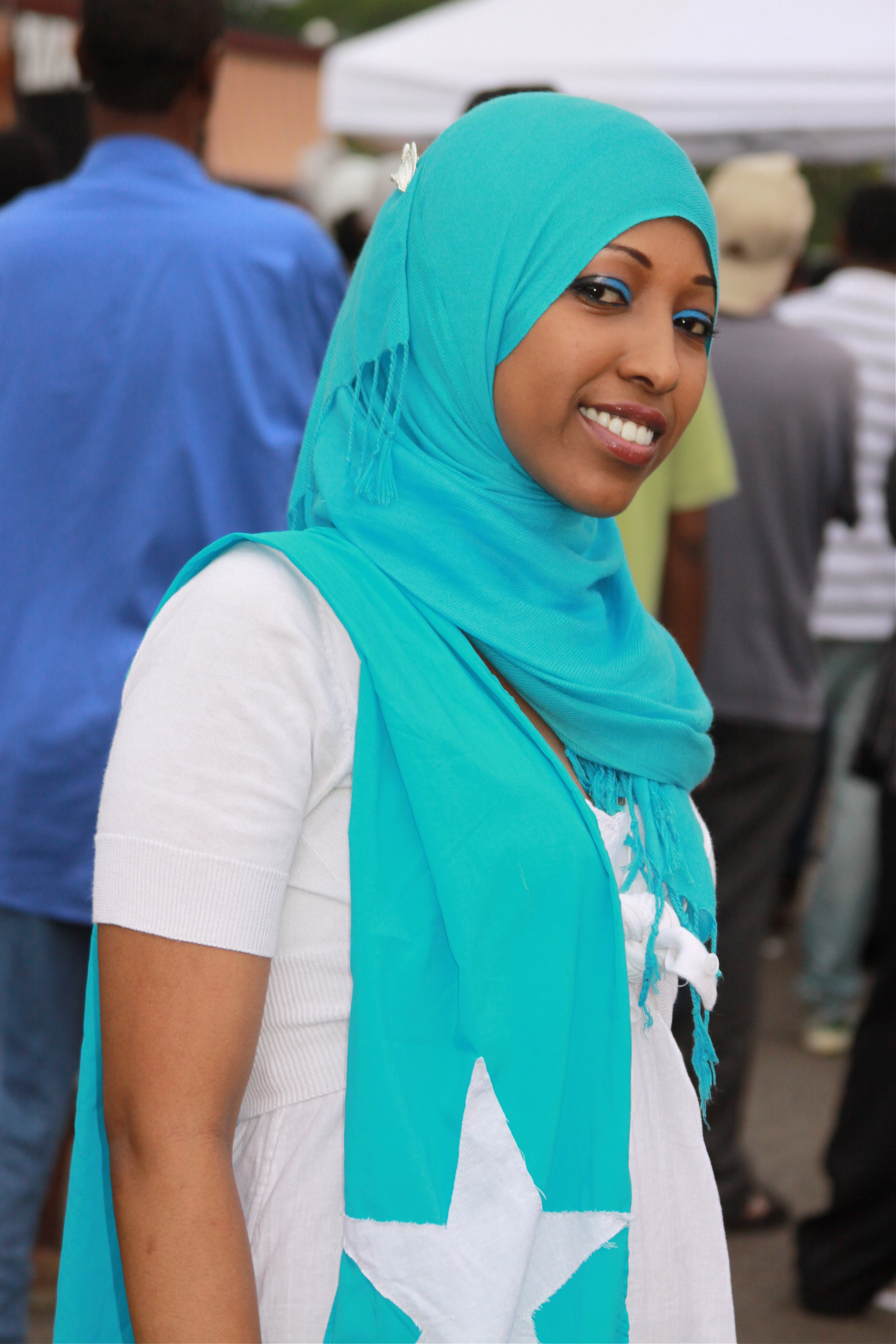
Somalis in Minnesota marked the 50th anniversary of the Somali Independence Day on Saturday. To accommodate the Independence Day celebrations, Lake Street in Minneapolis was closed from Pleasant to Blaisdell Avenue.
Hundreds of Somalis gathered in Minneapolis to commemorate Somalia’s 50th Independence Day marking. In 2007, Ghana became the first African country to celebrate 50 years of independence from European colonial rule. This year, sees several other African countries celebrating half a century of independence: the Democratic Republic of Congo, the Ivory Coast, Madagascar, Mali, Niger, Nigeria, Togo, Benin, Burkina Faso and the Chad.
Different parts of Somalia gained different independence from colonial powers. British Somaliland gained its independence from Great Britain in June 26th. On July 1, former Italian Somaliland got their independence from Italy and that same day the Somali Republic was formed when the north and south merged as one nation.
Raho Warsame, one of the main organizers and a property manager with the Project for Pride in Living in Minneapolis, says the celebration was a success.
“It was really beautiful to see everyone come out and celebrate this day,” said Warsame. “We were organizing this event for a long time and it went very well.”
The celebrations in Minneapolis were in the Whittier neighborhood where Somali singers, community activists, Imams and youth leaders entertained and addressed the crowd. Other guests included state, city officials and gubernatorial hopefuls who stopped by to say a few words. Senator Al Franklen were also in attendance. Minnesota is home to the largest Somali population outside of Mogadishu.
Fadousa Egal and her husband, Ali Egal joined in the celebration with their children. Ali said she felt that it was important that her children learned their history and to celebrate the day with other Somalis.??“It makes me very happy to see all of us Somalis gathering to celebrate this significant day,” said Egal. “My children are also benefiting from this because its good for them to get expose to these kind of events.”
Abdulkadir Addow, a social insurance specialist for the Social Security Administration, says that he remembers growing up in a peaceful Somalia. Addow was born and raised in Somalia. He attended school there and earned his first degree from the National University of Somalia’s Department of Agriculture.
“This is beautiful to me because we are celebrating the independence from colonialist power,” said Addow. “But my eyes are filled with tears whenever I think of Somalia,” says Addow.
Despite gaining independence from the British and the Italians fifty years ago, Somalia has only celebrated momentary “freedom.” For the last twenty years, Somalia has been without a central government. Over the years, Somalia has consistently qualified and topped the list of so-called “failed states”. However, many like Addow still have hope that Somalia will be stable and peaceful again.
“There are a lot of negative things occurring in Somalia and to the Somali people, but I have a lot of hope,” said Addow. “My hope is in the young generation.”
Technology adoption in Africa key to development, says US official
Hailing the spirit of entrepreneurship across Africa, U.S. Under Secretary of State for Public Diplomacy and Public Affairs Judith McHale called on all Africans to quickly embrace changing technology and a host of transparent reforms that can aid economic growth across the continent. She pledged continued U.S. support for that effort.
Speaking in Uganda at the Verizon Symposium on Internet connectivity June 28, McHale said, “East Africa cannot afford to be on the sidelines. The potential here is enormous.”
The June 28-29 symposium in Uganda was organized by U.S. telecom firm Verizon Communications and other partners to discuss the arrival of new broadband Internet access in East Africa. The connection will link it with the rest of the world and thus stimulate educational opportunities and economic growth and development across the region.
Referring to a recent report that looked at the economic potential in African markets, McHale said, “Those opportunities can only be realized if you have a well-educated work force, if all of your citizens are participating in that economic opportunity.”
McHale pledged to her audience of more than 120 government, business and educational representatives attending from Uganda, Kenya, Tanzania, Rwanda and Burundi that the United States government is willing to help in that effort.
“There are many things we can do to work together … (such as) connecting you with U.S. academic institutions that have already undertaken many of the programs” that are being attempted by African universities.
The under secretary cautioned her audience to take advantage of developments that have already taken place elsewhere. “You do not need to reinvent the wheel; there are a lot of lessons learned all over the world as people are looking at ways to bridge the gap to advance all of these initiatives much more rapidly.”
“We want to help you do it, but at the end of the day this needs to be an initiative owned by the countries and people of East Africa,” McHale said. “You are the ones best positioned to know what you need to do to achieve the objectives, what will really be appropriate for the communities in which your students live. The international community will follow your lead, but you need to provide the direction for us all. Only you can define your own paths.”
McHale provided what she called “guiding principles” for Africa to consider as it improves Internet connectivity and communications.
“Based on my own experience here and based on my interactions with young people throughout this region,” she told her audience, “I’m absolutely convinced if we provide the students of East Africa with the resources they need, deserve and will increasingly come to expect, there is simply no limit on what they can achieve.”
Guinean voters to use SMS text to monitor elections
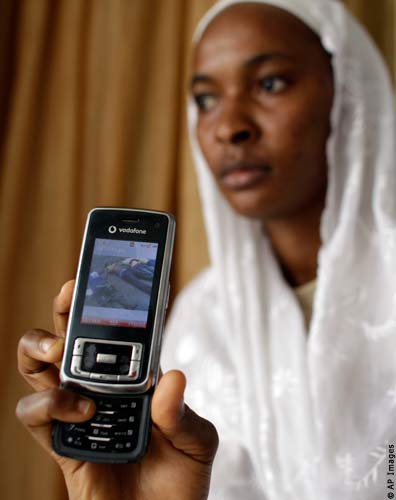
The citizens of Guinea are preparing for their country’s first-ever presidential elections on June 27. A new SMS texting campaign to allow Guineans to monitor their election and protect their votes is one of the ways the United States Embassy there is helping further that country’s democratic electoral process.
The U.S. ambassador to Guinea, Patricia N. Moller, said in a telephone interview June 21 that the SMS (short message service) campaign in Guinea “marks the first time a government’s election commission has actually agreed to use this tool as part of its election monitoring. I think that is pretty exciting.”
She said there are 24 candidates vying for the office of president in the election. If the SMS texting campaign is successful, she said, “we would imagine that it would be emulated in other presidential and nationwide elections or any other kind of election, for that matter. It takes advantage of the technology that is available.”
“The United States has been the largest bilateral contributor so far to the electoral process. The behavior of the political parties to date has been orderly and civil,” Ambassador Moller said, and added that Guinea’s National Independent Election Commission (CENI) has worked hard and impartially under tight deadlines to overcome logistical and procedural issues.
Commenting on the new SMS election campaign that the U.S. Embassy has launched, Moller said it provides an opportunity for citizens to text in during the election at a cost of less than 1 U.S. cent per text, to offer their feedback — both positive and negative — about how the election is being conducted throughout the country.
The texts will be reviewed by civil society observers and then forwarded to a website, which will be monitored by the public and CENI. The ambassador said that this will allow real time access to events throughout the country. The slogan for the campaign will be “Je vote, je vois, j’envois,” or “I vote, I see, I send.”
Moller said the texting program is available now in the days leading up to the election and features Miss Guinea as its spokeswoman.
SMS is the text communication service component of mobile communication systems, using standardized communications protocols that allow the exchange of short text messages between mobile phone devices. SMS text messaging is the most widely used data application in the world, with 2.4 billion active users, or 74 percent of all mobile phone subscribers.
The texting program, Moller explained, will be a useful tool that could also be used by citizens to “flag difficulties” if and when they might take place at polling places around the country.
“This whole election — in the history of Guinea — has been special,” the ambassador said. “It really is their first democratic election since they became independent from France in 1958. It is a big deal. The citizens of this country are very excited about its possibilities. We have helped, our international colleagues have helped. There have been a lot of spotlights that have been focused on Guinea, and we are trying to do what we can to assist this country to have an elected government that represents the will of the people.”
Moller termed it “hugely important” to Guinea’s future to have a transparent, democratic government as it moves to achieve a higher level of economic growth and development. Guinea is a country with huge natural resources that really have never been developed, she said.
“One of the things that a democratic government would do would be to put in place some transparency for the country’s future economic development, particularly in the mining and natural resource industries,” she said. “In this way they can equitably raise the standard of living for everyone in this country.” Exploration for offshore oil is beginning to take place, she said, and Guinea has the world’s largest bauxite reserves, plus large amounts of iron ore, gold and diamonds as well.
In addition to assisting with an SMS campaign, Moller said, the U.S. Embassy has also partnered with the French Embassy to open an election communications center, which will be a base for all journalists before, during and after the campaign and probably into the electoral campaigns that will follow. “If this is a successful presidential election, we will see parliamentary elections, we will see local elections. This is really a season of elections in the Republic of Guinea,” she said.
“We have provided the press center. We have done enormous numbers of radio and television interviews. Embassy officers have talked on the radio about democracy and democratic practice and elections.”
Moller said one of the embassy’s Guinean employees captured the challenge best: “‘America has done a lot to help the people of Guinea with this election. And America is going to work hard until the 27th of June, and then it is up to the citizens of Guinea to take over and to make the kind of future for themselves that they want.’”
Tanzanians to gather in Minneapolis for Diaspora convention
Tanzanians from around the world will gather in Minneapolis on July 1-4 to discuss how to go about ‘Unleashing the Diaspora Potential”.
“Unleashing the Diaspora potential” is the theme of the second annual convention of the Diaspora Council of Tanzanians in America (DICOTA). Representatives from the U.S. and Tanzanian governments are among those already confirmed as delegates. The nascent organization formally got off the ground last year in Houston where it held its first convention.
DICOTA’s stated mission is to ensure the unity of Tanzanian nationals in U.S. in order “to enhance the economic, health, and social well being of Tanzanians and Americans.”
Tapping into the potential and resources of their Diaspora nationals has become a major development strategy on the part of many African governments. Unlike in past years when there was little to no government representation at the various conventions organized by respective countries’ Diaspora associations, ensuring such representation by cabinet level members is becoming routine for some African governments.
The Tanzanian government will be dispatching its Chief Secretary and Secretary to the Cabinet, Mr. Philemon L. Luhanjo, to represent it at the Minneapolis convention. He will also officially open the convention.
“We are greatly honored that Mr. Luhanjo will be joining us in Minneapolis”, said Dr. Crispin Semakula, chairman of the local organizing committee. Dr. Semakula said that over 500 attendees from around the country are expected to attend the convention. He said the Diaspora’s response to this year’s convention has been a positive one “which demonstrates the great spirit of togetherness we have as Tanzanians.” Some of the convention’s activities are being done in conjunction with Umoja Society – the Tanzanian association in Minnesota.
Official Tanzanian government figures included in this year’s national budget indicate that its Diaspora nationals remitted an estimated US$14 million in 2009, not counting unofficial channels.
Minnesota Secretary of State, Mark Ritchie, is slated to welcome convention delegates to Minnesota when he addresses the convention following opening remarks by the Tanzania Honorary Consul in Minnesota, Mr. Kjell Bergh.
University of St. Thomas president, Father Dennis Dease, will deliver the convention’s keynote address. The university awarded an honorary doctorate in law degree in 2006 to the current president of Tanzania, Dr. Jakaya Kikwete, a year after he took office.
Dr. Semakula said while serious matters will be discussed at the convention including networking opportunities, fun activities have also been planned to showcase the beauty of Minnesota.
More about DICOTA and the 2010 convention can be found at its website.
Liberian-American launches campaign for Brooklyn Park City Council
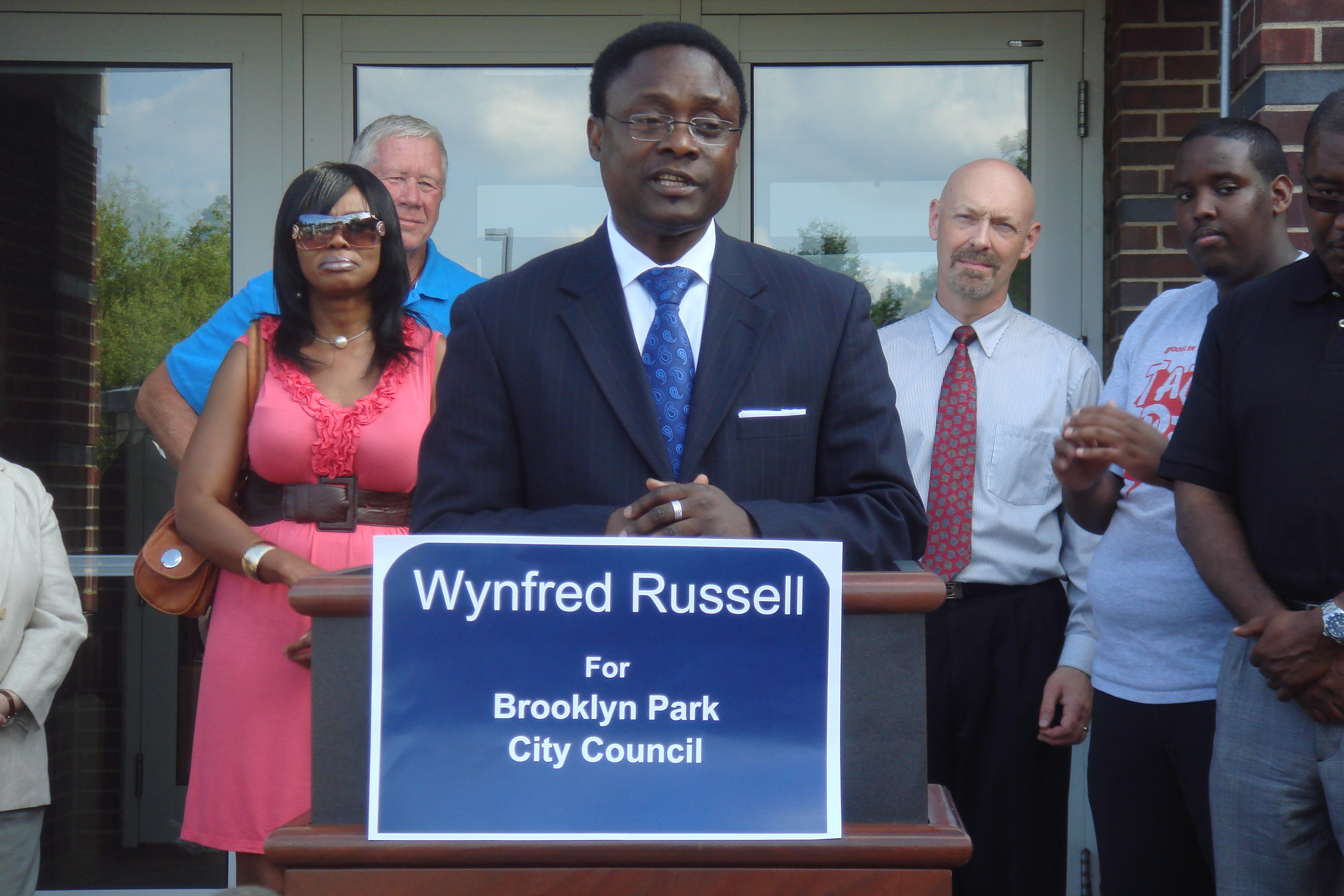
Wynfred Russell, a Liberian-American, is a candidate for City Council in the City of Brooklyn Park, Minnesota. He is running in the city’s Central District.
Brooklyn Park, also referred to as the Twin Cities African suburb is home to a large population of African immigrants and boasts the largest concentration of Liberians anywhere in the Minneapolis/St. Paul metro area.
This is Mr. Russell’s first run for public office and If elected he will become the first African immigrant to serve in the Council.
He launched his campaign on the steps of the Brooklyn Park City Hall flanked by supporters last week on June 16.
He is running on a platform of renewing pride in the city.
WASHINGTON — The African Growth and Opportunity Act (AGOA), now celebrating its 10 anniversary, has been an “unqualified success” in helping to stimulate and expand the U.S.-Africa trade relationship and still has much untapped potential, says Rosa Whitaker, who was the first assistant United States Trade Representative to sub-Saharan Africa.
Whitaker now is chief executive officer and president of the Whitaker Group, a trade and investment consulting organization. In a June 16, she assessed the past and future of the trade act.
“When you think about the fact that 10 years ago, prior to AGOA, American policy toward Africa was basically one of aid — it was not very comprehensive. When you think about it, 10 years ago before AGOA, it was very difficult for African ministers and heads of state even to get high-level attention in Washington and engage at the highest level. AGOA changed all of that. AGOA has expanded and diversified our trade, and it introduced a trade policy in addition to a policy of aid.”
“In 10 years, exports from Africa’s AGOA eligible countries have grown over 300 percent, from $21 billion in 2000 to $86 billion,” Whittaker said. While she acknowledged that much of that trade is in oil, Whittaker said it also includes $28 billion in non-oil exports from sub-Saharan Africa under AGOA. She called that “very impressive,” over the lifespan of AGOA.
“AGOA has helped to spur an automobile industry in South Africa,” she said. Prior to AGOA, South Africa’s automobile and transportation equipment exports to the United States totaled about $148 million annually. “Under AGOA in 2008, it was $1.9 billion.”
In apparel, she said, “When we started AGOA, apparel from sub-Saharan Africa was about $350 million. Now at the height of AGOA, it is about $1.3 billion. Prior to AGOA, Lesotho was exporting about $139 million of apparel to the United States. Now it is $339 million … and Kenya has gone from $30 million to more than $240 million, which represents a 800 percent increase in apparel exports.”
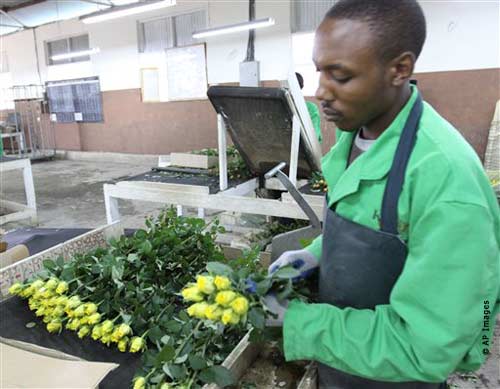
Jams and jellies from Swaziland are another example, she said, shooting from $85,000 prior to AGOA to $1.6 million today. Cut flower exports from Kenya to the United States were only about $700,000 before AGOA. “Now, that is up to $1.7 million, and that has grown an industry.” Ethiopia has also gone from exporting no cut flowers before AGOA to now exporting more than $4 million annually in that trade.
Coffee and tea from exports Tanzania have grown from $2.5 million before AGOA to nearly $16 million today. “So when you look behind the numbers, these numbers translate into people, they translate into farmers, they translate into jobs. And every person who is working in Africa is supporting from five to 10 people.”
Whitaker said she has found over the years that “people who don’t want to do anything or who don’t want to build on anything that is working will always say why AGOA is not working. AGOA does represent untapped potential.” But she stressed that “you cannot argue with this progress.”
The cost to the U.S. taxpayer for AGOA, excluding oil, is about $2 million annually in lost tariffs, she said. For that amount, she said, the United States has been able to create 300,000 jobs and get $28 billion in non-oil exports from Africa.
“This is powerful evidence” of AGOA’s success, she said, and that success “argues for having such a trade policy.”
Over the past 50 years, Organization for Economic Co-operation and Development (OECD) countries have provided more than $300 billion to Africa in aid, yet Africa is the only region of the world that is getting poorer. “Aid just cannot get you the results that trade can, and that is just a fact. If you look at any region of the world, there is not any region that has developed without entrepreneurs developing the private sector in those countries.”
The Marshall Plan for the reconstruction of post-World War II Europe, she said, worked because it provided technical and financial support to revitalize industries there. “That is the strategy that works. So I think as we look at AGOA 10 years later, we should be looking to build on what works.”
Looking to the future, Whitaker said she is optimistic that Africa will make even more progress because she sees a new breed of leader in Africa who knows the importance of democracy, transparency and private sector development.
Whitaker termed AGOA an “opportunity and not a guarantee.” In the end, she said, AGOA was not designed as a panacea but as one very effective tool in the U.S. policy arsenal to help stimulate U.S.-Africa trade and long-term economic growth and development. In that regard, she said, it has been a “phenomenal success” that needs to be built upon for the future.
The ninth annual U.S.-Sub-Saharan Africa Trade and Economic Cooperation Forum — better known as the AGOA Forum — will take place in two parts: August 2–3 in Washington and August 5–6 in Kansas City, Missouri. The conference will have as its theme “AGOA at 10, New Strategies for a Changing World.”
Algeria, Cameroon, Nigeria, Ivory Coast, Ghana along with hosts South Africa will represent the African nations in the 2010 World Cup.
Former Salgaokar coach Karim Bencherifa and noted football commentator Novy Kapadia analysed the six African countries on CNN-IBN’s World Cup special show A Beautiful Game.
South Africa
“For the hosts South Africa, the opening tie with Mexico is very important. They have tremendous team spirit and physical fitness, so if they can get a good result in the opening match. The key players Steve Pinnear, Shaballala and Modisse have to pull something out and then hope their team spirit will take them forward,” said Novy Kapadia.
Ivory Coast
“The opening match with Portugal is crucial ans sadly they will miss Drogba. The spine of the team is excellent, they have some of the hardest tacklers – Zakora. But everyone would miss the presence of Drogba. It is a very tough group to get through from,” said Kapadia
“Didier Drogba is the hope of African football and he was the only hope for Ivory Coast. It is disappointing to see star like him and Essien miss the event. But I still feel all the African teams still have enough depth and quality to shine in the World Cup,” said Bencherifa.
“Drogba is not just the great player he is also a great social activist. He tried to stop the Gorilla war in his country. He is a mixture of Mahatma Gandhi and Sachin Tendulkar in his country,” added Kapadia.
Nigeria
“They have wonderful attacking players. Obafemi Martins and Yakubu (Aiyegbeni ) have great pace. Nigeria against Argentina will be a thriller as far as opening round of the contest because Nigeria have the combativeness to upset Argentina’s rhythm. They have chance to progress to the round of sixteen,” observed Kapadia.
Algeria
“They have found the core of players that helped them make the finals after 24 years but these players play in lower division clubs and they are also in a very difficult group,” said Bencherifa.
Cameroon
“The most strong and complete African team in this World Cup is Cameroon and they are in a comparatively easy group. Samuel Eto’o has big chance to prove on the big stage,” opined Bencherfia.
Ghana
“If they had Michael Essien they would have done better. He is the dynamo in midfield, who links defence and attack and can bring a lot of caliber in the team. Since they are in a very tough group, I think Ghana will struggle and Germany and Serbia will go through,” said Kapadia.
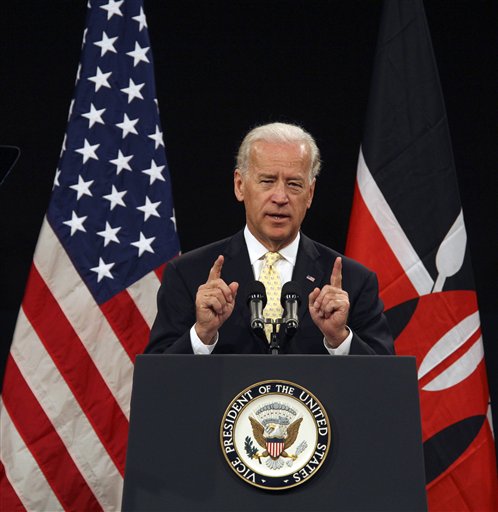
The full force of Kenya’s potential has yet to be released, Vice President Biden told university students in Nairobi, pledging to them the steadfast support of the United States as their country undertakes political reforms that will produce better governance and national unity.
Speaking at the Kenyatta International Conference Center June 9, Biden said the true wealth of a nation is not determined by its size, natural resources or military strength, but by “the skill, ingenuity and determination of its people.”
“By that measure,” Biden said, “Kenya is a very wealthy nation.”
Kenya has already become the financial capital of East Africa, building the largest non-oil, non-mineral-based economy in sub-Saharan Africa and serving as a hub for the transportation of goods and people in the region, he said. The country’s diplomats and military forces are playing positive roles on the African continent, and Kenya’s commitment to education has produced “world-renowned scientists, geneticists, environmentalists, writers and a Nobel Prize winner.”
“But the full force of your potential — as all of you young students know — has yet to be released,” the vice president said.
As the country is affected by regional instability, such as in Somalia and Sudan, and by global factors like the financial crisis and climate change, it is also confronting internal challenges such as corruption, ethnic tensions and lack of economic opportunity, he said.
“Change is within your grasp. And that change will be realized when government is transparent, accountable and participatory,” Biden said, urging that corrupt officials be held accountable, that the judiciary and police forces conduct themselves honestly, and that Kenya’s government reflects the country’s diversity.
Biden said a new constitution will establish a framework to accelerate political reforms, including placing a system of checks and balances on the branches of government, and it will provide a path toward lasting democratic stability in Kenya. Better governance is also “the best route to economic prosperity, sparking job creation, opening up opportunity and improving the way of life for Kenyans everywhere,” he said.
Better governance will also open the door to more American development programs such as the Millennium Challenge, he said. “There’s so much more we could do, and want to do, in partnership with you. It could provide millions of dollars in grant assistance to Kenya that you would know how to use well to build this great nation,” he said.
“If you make these changes, I promise you, new foreign private investment will come in like you’ve never seen and you will have a reinvigorated tourism industry that will exceed the billion dollars it was before the economic crisis,” Biden said.
The vice president said President Obama is committed, concerned and “deeply involved in the formation of our policy” toward Kenya. Kenya has “a steadfast supporter in the United States,” he said, and the Obama administration is supporting the constitutional reform process by providing assistance for voter registration and civic education that is designed to help Kenyans make informed decisions in the August 4 referendum on the draft constitution.
“I hope you will forgive me, but true friendship demands honesty. So if our words are sometimes blunt, it’s because our faith in the possibilities of Kenya [is] unlimited,” Biden said.
But President Obama has said that “Africa’s future is up to Africans,” the vice president said. “We can’t dictate it — nor should we — but you can.”
The ultimate responsibility and power rest with Kenya’s voters, rather than its political leaders, Biden said. “By your vote,” he said, “you have before you a singular opportunity to strengthen Kenya’s democratic institutions … [and] an opportunity to open up to opportunity to give a new generation new power to help Kenya realize its immense potential.”