FIFA has sold 90 percent of the nearly three million tickets available for the World Cup, which starts in South Africa in 30 days, organizers said on Tuesday.
“All tickets will be sold out. I am quite confident about that,” said Danny Jordaan, chief of the organising committee.
“About 300,000 tickets were sold in the last few weeks alone,” Jordaan told a press conference.
The majority of the tickets had been snatched up by South Africans, followed by Americans and British.
South Africa was allocated discounted tickets, in a bid to allow ordinary people to watch the tournament, which is being played in Africa for the first time.
Last month, FIFA opened over-the-counter ticket sales, following complaints that the previous Internet sales system was too difficult to access in a country with relatively little online access.
In the shadow of Arizona’s strict immigration law, a broad range of evangelical leaders are speaking in support of comprehensive immigration reform, with more specifics than some were able to embrace before.
At the same time, the No. 3 Democrat in the Senate, New York’s Charles Schumer, is hoping evangelicals will nudge their allies in the GOP to push an on-again, off-again immigration bill through Congress.
The renewed push came in the form of a full-page ad in the Capitol Hill newspaper Roll Call, paid for by the National Association of Evangelicals, and a three-page policy proposal from Liberty Counsel, a conservative Christian legal firm.
The NAE statement calls for keeping families intact, securing national borders, and establishing a path to legal citizenship for qualified people who want to become permanent residents.
“Initiatives to remedy this crisis have led to polarization and name calling in which opponents have misrepresented each others’ positions as open borders and amnesty versus deportations of millions,” the ad reads. “This false choice has led to an unacceptable political stalemate.”
The Liberty Counsel blueprint was even more specific, calling for a “just assimilation” of those seeking legal citizenship that includes lessons in English and U.S. history. It says temporary worker visas recognize the need for “field workers to engineers” in U.S. companies.
“America deserves a just immigration policy,” the statement said, “one that begins with securing, not closing, our borders, one that provides a temporary guest-worker program, and one that offers a pathway for earned legal citizenship or temporary residency.”
Mathew Staver, founder of Liberty Counsel and a signatory on both the ad and the statement, said there has long been consensus on the need to secure the nation’s southern border, but evangelicals are now focusing on the future of the nation’s estimated 12 million undocumented immigrants.
“I think that’s where the consensus is building,” he said.
Southern Baptist ethicist Richard Land said the Arizona law–which gives local authorities new powers to round up suspected illegal immigrants–has prompted evangelicals to feel more strongly about the need for federal reform and to speak up for their Hispanic “brethren.”
“I think evangelicals have said ‘Enough is enough is enough,”‘ he said Wednesday (May 12) in a teleconference call hosted by the group Conservatives for Comprehensive Immigration Reform.
Land included his name on both the ad and the policy proposal, as did the Rev. Samuel Rodriguez, president of the National Hispanic Christian Leadership Conference. Others signing the ad include NAE President Leith Anderson; megachurch pastors Bill Hybels and Joel Hunter; and civil rights veteran John Perkins. Bishop George McKinney, a leader in the predominantly black Church of God in Christ, also signed the proposal.
Even so, some of the most prominent umbrella groups for religious conservatives have not added their names to the new statements.
Focus on the Family spokeswoman Monica Schleicher said the Colorado ministry is “currently investigating the issue” but declined further comment. Family Research Council did not immediately respond to a request for comment.
Christian ethicist David Gushee said the new energy surrounding immigration reform by non-Hispanic conservatives reflects a reaction to the Arizona law and long-term friendships that some have cultivated with Hispanic Christian leaders.
“Relationships are maturing and so that provides a context for engagement together,” said Gushee, who teaches at Mercer University in Georgia and is a leader of the New Evangelical Partnership for the Common Good, which supports comprehensive immigration reform.
“When you’ve got a friend who’s screaming out in pain, who’s saying this is really dangerous, you pay attention to that.”
Gushee said a broad range of evangelical support–including the most conservative evangelicals – could be a “major force” in passage of immigration reform.
“There are certain issues that have the opportunity to break through our entrenched polarizations,” he said, “and I think immigration is one of them.”
African-born British Entrepreneur Calls on African Governments to Foster Business
WASHINGTON – Africans and the developing world can learn from the United States’ experience with entrepreneurship, according to Mohamed “Mo” Ibrahim, a Sudanese-born telecommunications magnate.
The United States was built by free-market entrepreneurs, and it is still a country where private-sector business and investment are nourished to stimulate long-term economic growth and development free from heavy government interference, Ibrahim said at the Fourth Annual U.S.-Africa Infrastructure Conference in Washington on April 29.
The April 27-29 conference was hosted by the Corporate Council on Africa and focused on sectors in need of U.S. investment, including information and communication technology, alternative energy, civil aviation, roads and ports.
“It is time for the developing countries … to learn from the American experience,” Ibrahim said. “American entrepreneurs are ready to go out and risk it, not afraid of failure and have a go” at starting a business.
“Yes, one in 10, two in 10 succeeds. Wonderful. Most of the new jobs in this country are created by small business, by companies who are four or five years old. That is wonderful. In a world where half the population is young … how are you going to get jobs for all of those young people? We really need to get moving and encourage the younger generation to take risk, go out there, build businesses and create the environment to do that.”
The telecom magnate, who is now president of the Mo Ibrahim Foundation, founded Celtel in 1998 to build and operate mobile networks in Africa. Celtel became one of Africa’s most successful companies, with operations in 16 countries. He sold Celtel to MTC Kuwait in 2005 for $3.4 billion.
Ibrahim called the Presidential Summit on Entrepreneurship, which he attended earlier in the week, “a wonderful conference, a great initiative.”
Ibrahim said Africa and the developing world can learn much from fellow entrepreneurs, but in the end, “the job is ours to get done.”
“It is our governments which need to look at ways to aid business instead of how to restrict business,” he said. “In many of our countries, our governments are obsessed with control. They love to control everything.”
“Whatever stage of [business] you want to do, there is always red tape, papers and then you have to sign [documents]. … People try to find a way to stop you doing anything. Honestly. I am not joking. It is terrible. It is very difficult to hire or fire people. … That is why many businesses shun the formal economy” in Africa and the developing world and turn to the informal sector, he said.
But, he said, that needs to change, and business needs to be brought into the formal economy. For that to happen, governments need to create conditions to foster and enhance private-sector businesses, “instead of pushing people out” into the shadows.
Access to capital is always a problem, he added, especially in the developing world. Most jobs are created by entrepreneurs at the $50,000 to $500,000 level of investment. But this segment is not well-served in the developing world even though there are often many investors willing to finance larger multimillion dollar projects.
Ibrahim said the use of angel investment networks (where entrepreneurs pool their capital and loan it to each other) and assistance from diaspora networks are also useful for entrepreneurs. “Our brothers and sisters, who come here [to the United States] and manage to build some small capital, can help people to start businesses … back in Africa.”
Speaking directly to the African diaspora, Ibrahim said, “Please do not forget about the African inside you. … Don’t forget your people.”
Ibrahim said entrepreneurs and infrastructure are both essential ingredients to move Africa forward. Regional integration is also important, he stressed.
Trade among African countries amounts to only 8 percent of all African trade, he told his audience. ”It seems we go out of our way in Africa not to trade with each other. That is just not sustainable,” he said. “We need to look at bigger markets.”
Ibrahim pointed to Germany as an example. Germany’s economy is 2.5 times the size of all of Africa’s economy — all 53 countries, he said. Germany decided long ago it needed to be in the European Union because that was the only way to compete with the United States and China.
There is a lesson here for Africa, Ibrahim said. “We are going to compete and beat the Chinese, Indians, Americans and beat the Europeans? How can we do it? We cannot do it! Economic integration is a must. We need to have freedom of movement of goods, capital and people across our borders.”
Pawlenty appoints two Africans to Council on Black Minnesotans
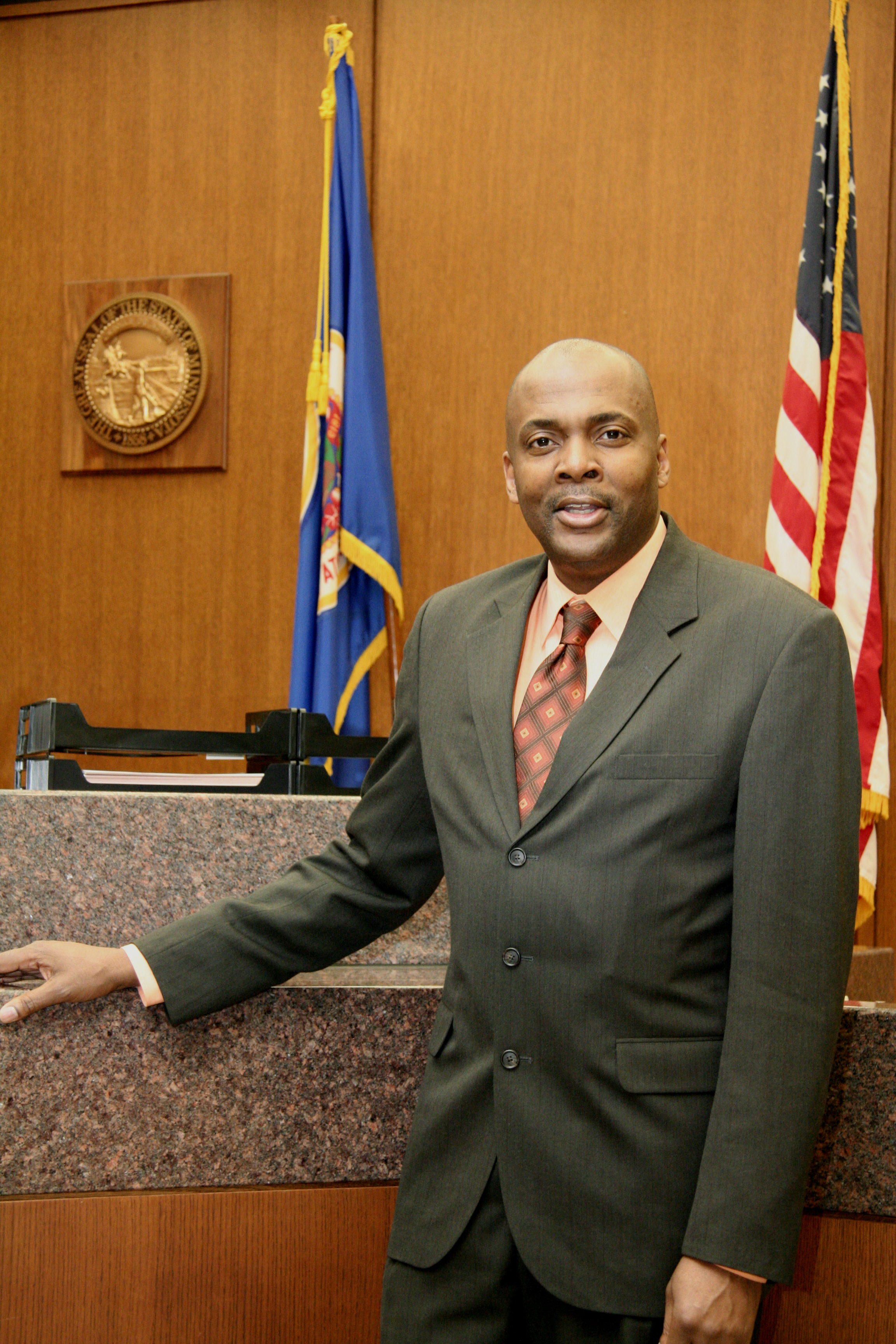
Governor Tim Pawlenty announced the appointments of Ayderus Ali and Nnamdi Okoronkwo to the Council on Black Minnesotans.
Ali and Okoronkwo were among six other appointees the Governor announced on April 16. Ali is an Ethiopian who is a Somali court interpreter. He serves in state, federal, U.S. Immigration courts, and a linguist with the U.S. Department of Justice. Ali attended the University of Minnesota and the Abassia Institute of Technical College in Cairo, Egypt.
Okoronkwo, an assistant city attorney with the City of Minneapolis, is a son of a Nigerian immigrant. In the past, Okoronkwo worked with Best Buy Company as a corporate attorney, and was a Hennepin County District Court law clerk. He has served in the Volunteer Lawyer Network as a pro bono attorney. Okoronkwo holds a law degree from William Mitchell College of Law and a bachelor of arts from Augsburg College.
The Council appoints two members whose ethnic heritages are from Eastern and Western Africa. Ali replaces Mohamud Noor as a member from East Africa while Okoronkwo will replace Gloria Lamphear as a member from West Africa.
The Council on Black Minnesotans was created by the Minnesota legislature to advise the Governor and legislature on issues that are confronting black Minnesotans. It consists of 17 members, 13 of which are appointed by the Governor.
Both Ali and Okoronkwo will serve for a four-year term that expires on January 6, 2014.
Immigration regulations and criminal law intersect when a non-citizen is charged with a crime and faces possible immigration consequences, including deportation, if he is convicted of the offense. Criminal defense counsels sometimes advise their clients to plead guilty to obtain a reduced sentence or to avoid the risk of going to trial. For non-citizens, however, the effects of the criminal charge on their immigration status and their ability to stay in the United States have the deepest and most lasting consequences.
Recognizing this fact, the U.S. Supreme Court recently held in its landmark 7-2 decision, Padilla v. Kentucky, that criminal defense counsels must advise their non-citizen clients of the immigration consequences of a guilty plea. The court acknowledged that deportation is an extreme penalty and that immigration laws have become much more draconian over the years, making even minor crimes – such as shoplifting or marijuana possession – a deportable offense in some cases. “The severity of deportation – the equivalent of banishment or exile – only underscores how critical it is for counsel to inform her noncitizen client that he faces a risk of deportation,” said Justice John Paul Stevens, who wrote the opinion for the court.
The appeal involved Jose Padilla, a lawful permanent resident of the U.S. for over 40 years, who pled guilty to transporting nearly 1,000 pounds of marijuana in Kentucky. Like many other drug trafficking crimes, his offense made him a deportable, aggravated felon under immigration law. The aggravated felony disqualified him from receiving nearly all forms of relief from deportation, including cancellation of removal. Padilla later moved to vacate the plea, claiming ineffective assistance of counsel because his defense attorney failed to warn him of the immigration consequences of the guilty plea and further assured him that it would not affect his immigration status because he had lived in the U.S. for so long.
The Supreme Court overruled the prior decision of the Supreme Court of Kentucky, which held that neither counsel’s failure to advise about the deportation risk nor misadvice about the consequences was a basis for vacating the plea. The lower court reasoned that the Sixth Amendment does not protect criminal defendants from their counsels’ misadvice about the immigration consequences of a guilty plea because they are merely “collateral” and not “direct” consequences – similar to losing a professional license or being denied access to public housing.
Disagreeing with the Kentucky court, the Supreme Court passed on deciding whether the risk of deportation is a direct or collateral consequence, finding that this distinction was unnecessary because counsel must, “at the very least,” advise a non-citizen defendant that there may be adverse immigration consequences. The Court pointed to various sources, including the American Bar Association, criminal defense and public defender organizations, and state and city bar associations, all agreeing that defense counsel should advise of the immigration consequences of a criminal conviction.
Justice Stevens wrote, “Deportation as a consequence of a criminal conviction is, because of its close connection to the criminal process, uniquely difficult to classify as either a direct or a collateral consequence.” He added that “when the deportation consequence is truly clear, as it was in this case, the duty to give correct advice is equally clear.” The Court found that defense counsel did not provide reasonable professional assistance because constitutionally competent counsel would have advised Padilla that a drug trafficking conviction made him deportable. The Court did not, however, rule on whether Padilla was entitled to postconviction relief. Instead, it remanded the matter to the Kentucky courts to decide whether Padilla actually suffered prejudice; that is, whether counsel’s deficient performance prejudiced him, resulting in a fundamentally unfair outcome.
The Padilla decision applies to all states, including those that have previously ruled differently. In Alanis v. State, the Minnesota Supreme Court rejected the defendant’s argument that counsel’s failure to inform him that his guilty plea might subject him to deportation constituted ineffective assistance of counsel. The Minnesota court reasoned that counsel was not required to advise him of the deportation risk because it was a collateral consequence. Under Padilla, however, criminal defense counsel’s failure to warn non-citizens about deportation consequences of a guilty plea can no longer simply be dismissed as just a “collateral consequence” of a conviction or plea.
Before non-citizens enter a guilty plea, it is important that they or their criminal defense counsel consult with experienced immigration counsel to assess the immigration consequences of the plea. Pleading guilty to a different charge and for a specific maximum sentence could spare the non-citizen from being deported or being denied entry into the U.S. after traveling abroad. And now more than ever, criminal defense counsel should inform non-citizens of the potential immigration consequences of a guilty plea in order to provide effective assistance under Padilla.
Nothing in this article should be taken as legal advice for an individual case or situation. The information is intended to be general and should not be relied upon for any specific situation. For legal advice, consult an attorney experienced in immigration law.
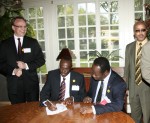
Books for Africa and the Ghana Library Board have signed a Memorandum of Understanding whereby Books for Africa will provide high quality new books free of charge to the Ghana Library System for the promotion of literacy.
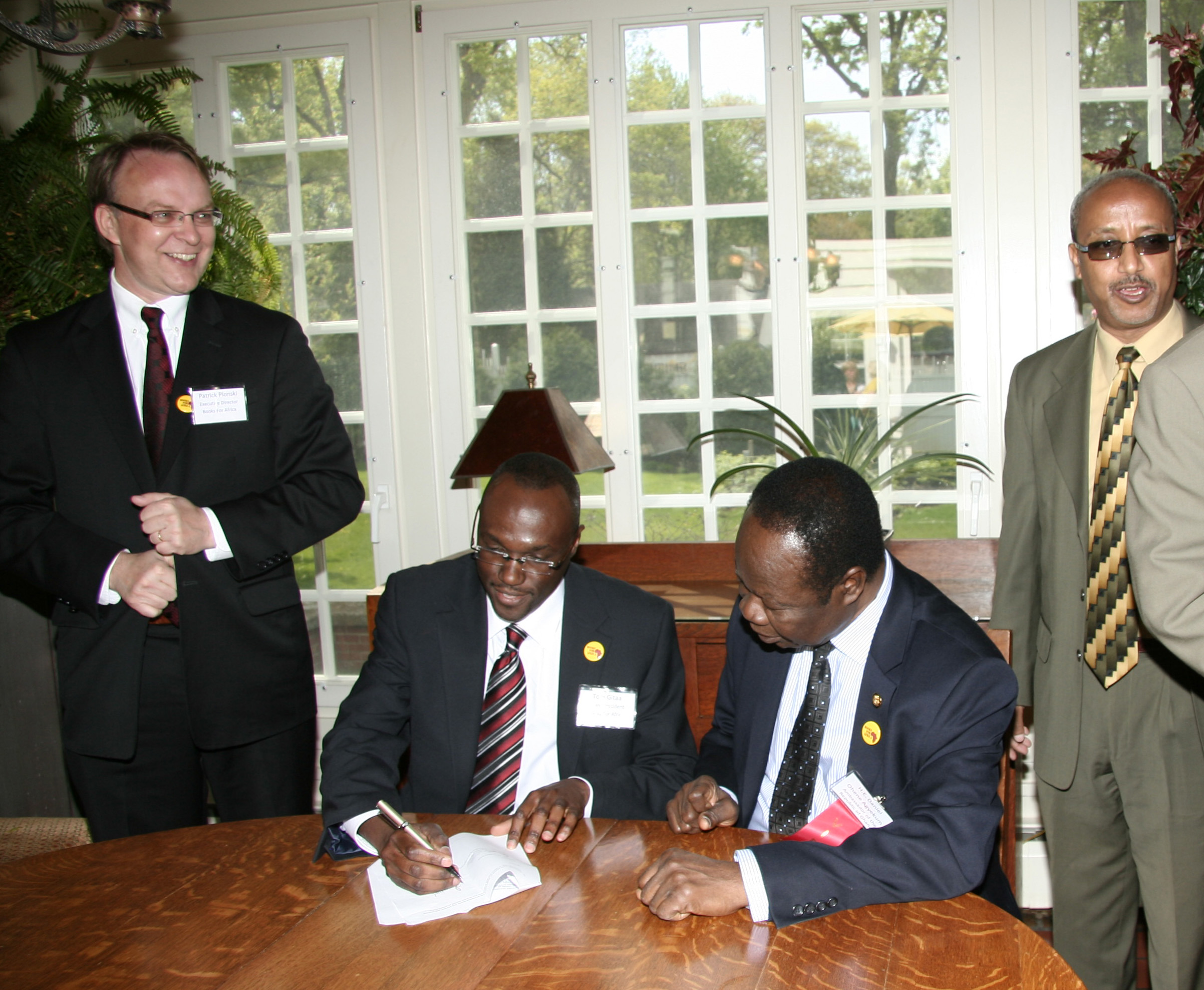
Ambassador Daniel Ohene Agyekum of the Ghana Embassy in the United States and Tom Gitaa, Books for Africa board president signed the memorandum of understanding formalizing the relationship during a ceremony at the official residence of the University of Minnesota president, Robert Bruininks. Ambassador Agyekum was in Minnesota to keynote the annual Books for Africa fundraiser luncheon in Saint Paul and signed the memorandum on behalf of the library board.
Books for Africa, based in Saint Paul, Minnesota is the largest shipper of donated books to the African continent. It has shipped over 22 million books to 45 African countries since its founding twenty years ago. Books donated by publishers, schools, libraries, individuals and organizations are sorted and packed by volunteers who carefully choose books that are age and subject appropriate. The organization’s second and now main warehouse was opened in Atlanta last May.
“I would like to express my government’s commitment to working with you (Books for Africa) on this,” the ambassador said during remarks at signing ceremony reception. The ambassador shared with those present the importance of books donated by BFA in lifting the literacy standards of his country.
“We at Books for Africa are ready to help Ghana in achieving the Millennium Development Goals,” said Tom Gitaa at the signing ceremony. Mr. Gitaa said that Ghana is already one of the top recipients of book donations from Books for Africa and the new partnership with the Ghana Library Board should accelerate the trend. The board president described the new partnership as a long term one.
The partnership with Ghana Library Board in addition to books being sent will also include encyclopedias and refurbished computers should GLB so request, according to the memorandum.
Later at the annual luncheon, Ambassador Agyekum while addressing Books for Africa supporters expressed his government’s appreciation for the books it receives and urged those present to continue with their material support of Books for Africa. The annual luncheon is Books for Africa’s single largest fundraising event.
While in the Twin Cities, the ambassador also held meetings with executives at Thomson Reuters. The company is a key partner of Books for Africa for its Law and Democracy Initiative which sends law books to African law schools.
With health care reform in the “done” column, the White House and Congress should tackle long-overdue immigration policy reform, say media, legal and community service leaders.
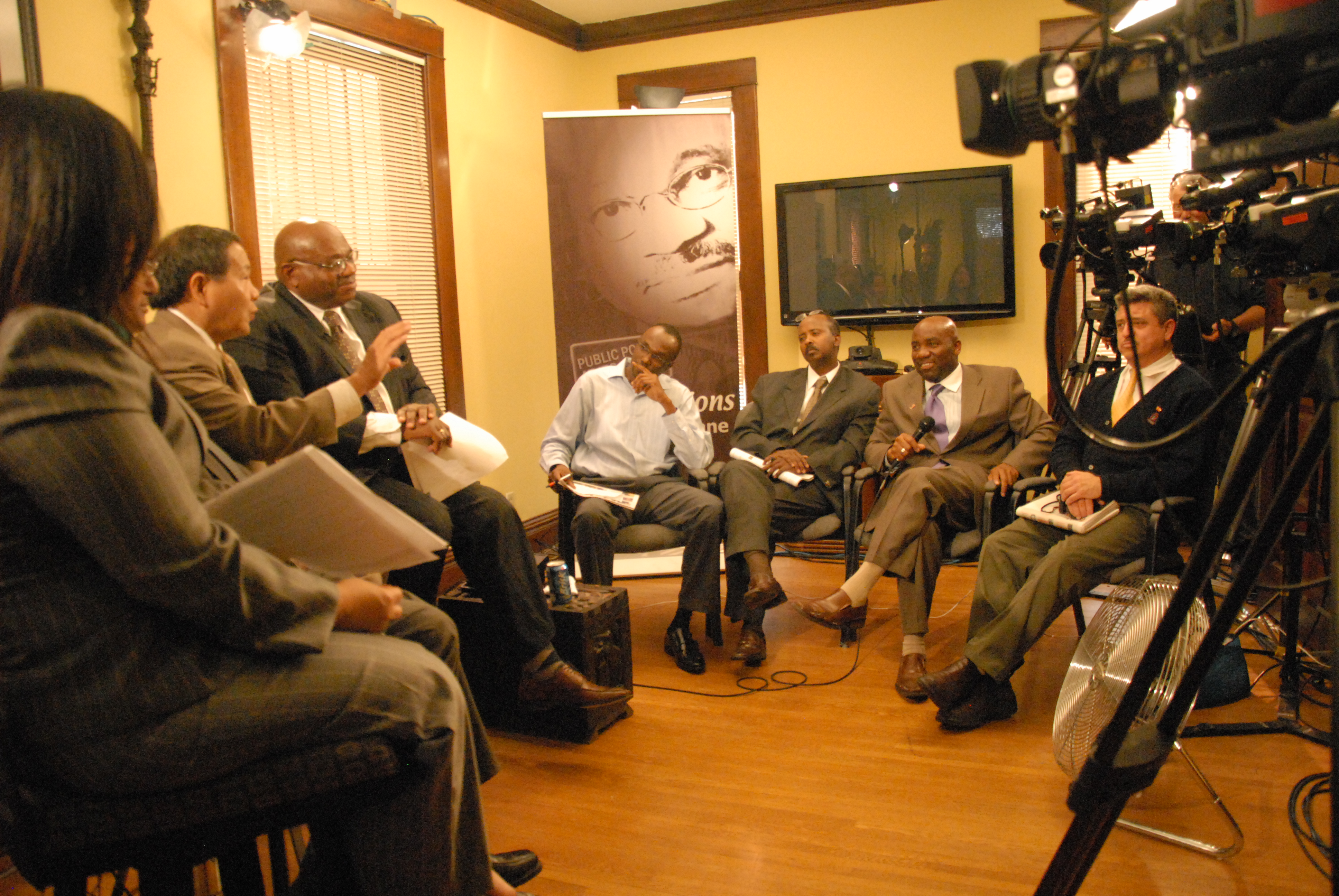
Joined by Cara Huang, the immigration issues expert on US Rep. Mike Honda’s (D-CA) Washington DC staff, editors and publishers of the Minnesota Multicultural Media Consortium engaged a leading immigration law expert, a successful naturalized immigrant businessman and a Somali elder whose community service organization provides support to immigrants from throughout Africa, in a broadcast forum on immigration policy.
Huang said Honda, who is chair of the bi-cameral, bi-partisan Asian Pacific Legislative Caucus, has offered two pieces of legislation with the support of the Hispanic Legislative Caucus and the Black Legislative Caucus, that seek to fix the nation’s immigration system, which many say has been broken for at least 20 years.
“The Reuniting Families Act deals with the problem of Asian immigrants who are citizens or legal residents facing longest family visa backlogs in the system. Why should they wait so long to be reunited with their families?” she said.
“He has also introduced The Strengthening Communities Through Education Integration Act which provides tax credits and which assists and incents employers to provide English-language training for their employees,” Huang said.
She said the Congressman “wants President Obama and the Democratic leadership in Congress to remember that immigration is important to our country and to our economy and consistent with the values of our nation.”
Traditionally, immigration has been a bi-partisan issue, and the Congressman believes it should remain so, Huang said. In March, Honda spoke to a rally on immigration where some 250,000 people attended, showing there is overwhelming support for immigration reform, she said.
Lawyer and human rights and immigration expert Loan Huynh, a member of the immigration law center at Fedrickson & Byron Law Firm, said there are many challenges facing immigrants. “We are hopeful that Congress, and the Senate in particular, will take leadership to implement comprehensive immigration reform this year. It is a bi-partisan issue. It’s about families, employment and the economy,” she said.
“Congress needs to address not only the needs of the employers, who want to be in compliance with the law, but also recognize that we have people who want to work, but who are not able to because of the visa backlog and other status issues. We have people who can contribute to our society, but now have to endure long waits to get the right to work.”
“Change will require courage,” Huynh said. “We saw it on health care, and it will be the same on immigration reform. The House is doing great, but the Senate needs to step up,” she said.
“Historically, when immigrants from Europe came to America, they too faced resistance and hostility. But we have to look at the difference in today’s anti-immigrant sentiment. As immigrants, we’re talking about families and work. But some of the dialog from the anti-immigrant arena is very dangerous because it is based on ethnicity and race. This is really a civil rights issue now,” she said.
Nghi Huynh, president of Minnesota Multicultural Media Consortium (MMMC), announced the Consortium is launching The Immigrant Information Center to help members of immigrant communities navigate the immigration and naturalization processes. “We are creating and assembling information about immigration, and about rights and resources. We can help them understand the process of becoming citizens. We will work with ethnic media including newspapers, radio and television programs to provide our communities with up to date information about immigration policy and law. We can help them understand Homeland Security and government, and we can support and promote non-profit organizations that help immigrants with citizenship, health, housing and jobs,” Nghi Huynh said.
“Immigrants face so many challenges,” said Abdullahi G. Nur, Executive Director of African Community Services, in Minneapolis. The big problem now is jobs and housing. Rents are going up. Immigrants don’t have the job skills so they are getting old jobs that cannot support the high rents.”
Another problem is use of DNA testing to confirm family ties. “DNA testing should be used for criminal apprehension cases, but not as part of the family reunification consideration,” Nur said. “What if a man works on the road and is away from the home for long periods of time. What if the wife has a relationship that produces a child. In my religion, that husband is the father of that child, regardless. So when the family seeks reunification in the US, DNA will deny the genetic kinship, but that is a family,” he said.
Businessman Peter Idusogie concurred. “You can’t say you value families when your policies break families apart,” he said. “Liberians here have a situation where they have to apply for status to stay here every 18 months. How can you plan and build a life with the threat of deportation hanging over your head? And we have to be concerned about the hundreds, and perhaps thousands, of children who are citizens because they were born in the US, but who will need foster care if their parents are deported.”
“What we are doing to the Liberians immigrants and refugees is unconscionable,” said Tom Gitaa, Publisher of Mshale, a monthly newspaper serving African and African American residents of Twin Cities. “The Immigration Information Center could help spur activity toward immigration policy reform. Our latest issue of Mshale said we were happy to see health care reform clear Congress and get signed into law. Now it is time to focus on immigration reform.”
“Our newspaper is serving as a clearing house for what is and what is not in the health reform legislation that affects immigrants. But if you ask immigrants what is more important, health care reform or immigration reform, you will find that immigrants feel immigration policy reform is more important. That is because we want to get our dad or our mom who may at home in Africa to join us here, and present immigration policy makes that cumbersome and difficult,” Gitaa said.
Adolfo Cardona, Publisher of Latino Midwest, said this issues point to the need for more information that is accessible and reliable. Our mission is to use information a tool to support immigrants. So the issue of trust is important. When each of our communities take the initiative to inform our respective communities about immigration challenges, issues and solutions, our people will learn to trust the resources and the processes,” Cardona said.
Idusogie, who has announced his candidacy for Minnesota governor, described himself as a first generation American, London-born of Nigerian parents. “Immigrants were left out of the health care bill,” he said. “But immigrants have contributed to the social and economic development of this country since its inception. This is all about the economy. During the Clinton era, there were not enough American workers to fulfill the labor requirements of industry so people looked the other way when it came to status. Now, with the economy in crisis people are pointing to illegal immigrants as the problem.”
Cardona said ethnic media can help the United States explore, debate and arrive at immigration policy solutions that are respectful, sensitive, and that reflect the greatest American values. Idusogie said America can decide that it can secure its boarders, then determine an orderly process that provides legal status for the more than 10 million who are currently undocumented. “People engaged in illegal and criminal activity are a minute minority. Let’s identify them, eject them and then fast track everybody else for citizenship or legal resident status. They are here. They are not going anywhere. It is in our own best interests to recognize that,” he said.
The program was taped this month at the Marcus Garvey House studios in North Minneapolis and airs in May on Conversations with Al McFarlane Public Policy Forum on KFAI 90.3 and 106.7, and on public access television in Twin Cities. It is part of a series of programs looking and business development and wealth creation, sponsored by Northwest Area Foundation, U Care Minnesota, and Hennepin County Medical Center.
As we settled at our table, with drinks in hand, I couldn’t help but wonder what route the conversation would take. There was a lot I needed to know about Messiah’s Men if I was going to be working with them. I mentally prepared the questions I wanted to ask as I sat down with Trokon Guar. I had known Trokon for about a month, even though I had seen him perform with the group many times at my church.
I had the opportunity to meet all of the members of Messiah’s Men only two weeks prior to this meeting with Trokon and though it hasn’t been long, I’m learning a lot about each of them as individuals and how they work together as a group. With half of the group’s members living outside of Minnesota, it is quite interesting how they manage to work together and get things done.
Trokon, the brain behind the formation of this group, has a quiet air about him, but today, as he talked about Messiah’s Men, he literally opened up. You could see the excitement all over his face. It was immediately obvious how passionate he was about music and this group.
There is something about Messiah’s Men, something about the way they perform – together. Their confidence could easily be mistaken for arrogance, but take this from me, if you get to know them on a personal level and hear some of the things that truly matter to them, you would be amazed. They love music. Not only can they sing, they can perform. They’re passionate about what they do and it shows, both on and off stage.
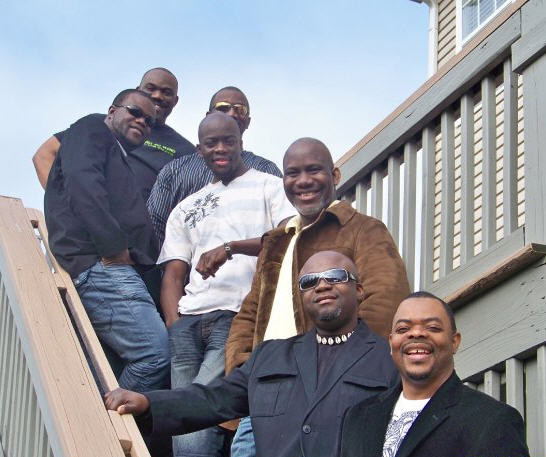
Trokon, Barchue, Samuel and Dehcontee are all brothers. What I thought was interesting was they did not sing together growing up even though they all loved music. At different times they sang, either alone or performed with other groups. During the war in Liberia, while in the Ivory Coast and Ghana, they sang together once in a while, when the opportunity came up. A huge grin broke across Trokon’s face as he talked about life in Ghana as refugees. He remembered there were days they did not have much to eat, but were happy to get together and sing. They would get up as early as five in the morning, go outside, and sing their hearts out.
All of the songs they sang together as a group were songs by Acappella great, Keith Lancaster. Little did they know that they would actually meet Keith, and his entire family, a number of years later in Nashville, TN. Little did they know that Keith Lancaster would stop an entire teaching session and give them the platform to perform in front of a room full of other Acappella groups from around the world!
As I sat there, sipping on a warm cup of apple cider and listened as Trokon told me stories of the group, I couldn’t help but smile myself. Over and over in my mind I’m thinking, people out there need to hear this story. Every story that comes out of Liberia is about the war and subsequent suffering of the Liberian people. This is understandable, but there is so much more to Liberia than what happened to our country during the war. We are a strong, beautiful, well rounded people in so many regards and music has always played a major part in what makes us so unique. We can not discount that. Messiah’s Men has a fresh, new perspective – a new story to tell.
As we discussed upcoming events, I was eager to hear how the Mother’s Day event got started, since this is the second year the group is actually doing this. Trokon paused for a second and then smiled as he started to tell me about his own mother, Nancy Beatrice Guar. This was a beautiful story of a strong and extremely supportive woman, who, for as long as her sons can remember, opened her home to everyone and would give selflessly to ensure that someone else would have a meal to eat or a place to stay. She was excited about her sons’ accomplishments with Messiah’s Men and would drive with her husband to see them perform.
Even though all the men in the group were not her biological sons, she treated them as though they were. She almost never took their first album out of her CD player, Trokon remembers. Beatrice would listen to it over and over again. In 2006, when she passed away, they placed a CD in her casket and made a promise to her that they would stick together no matter what. It was by God’s grace and this promise to their mom that they were able to survive one of their most challenging times, when the group was on the verge of calling it quits. To honor the memory of their mother, the guys decided to recognize and honor other mothers on Mother’s Day for all that they do for their families and communities.
The current members of Messiah’s Men, except for the brothers, are from varied backgrounds and all have one thing in common – they have loved music and sang all of their lives. David Wilson plays the keyboard and Directs the Music Ministry at Bethel World Outreach Church in Minnesota. Lester Manley, who is also a minister of the Gospel, plays the Saxophone. For the past 20 years, Claudel St. Jean has served as a Music Minister in several different ministries in the U.S. and Africa. Samuel Mappy, Jr., who serves as the group’s musical director, sang with the Ivorian National Mass Choir, NEMCOL. Matthew Benson, currently sings baritone, believes that music is a means of communication that helped him get through the trauma of the civil war in Liberia. Looking at the guys now, it is hard to tell that they haven’t all sang together for a long, long time.
Today, Messiah’s Men have been blessed in so many regards and one thing Trokon pointed out was that every time they made a donation to an organization or person in need, they have received from others in return. The opportunity to give back is a huge reason they do what they do.
This year Messiah’s Men have a lot on their plates, and they are excited. They have added a manager to their team. Becky Moore brings diversity, a wealth of knowledge and passion to the group. Also this year, on May 15th, they will be honoring mothers at their annual Mother’s Day celebration.
The event will be an evening to remember; an evening of honoring and showing appreciation to women who have given so much of themselves, not only to their families, but to their communities as well. The Men will not only be serenading mothers with songs, but they will also be serving them dinner – yes, decked out in aprons and all. Three special moms, nominated by the general public, will be honored during the event. (To nominate a mom, visit www.messiahsmen.com).
Later this summer, Messiah’s Men will be releasing their third album, Full Circle. They have poured a lot of who they are, where they have come from and their experiences into this project and are excited about sharing it with their fans.
In December, The Men along with Keith Lancaster and the original members of Acappella and Durant will be on the road! Destination: Ghana & Liberia. Proceeds from the concert in Ghana will go towards a well project they have undertaken. The Backpack Project in Liberia will benefit elementary and middle school children. Messiah’s Men is always excited about giving back because it reminds them of where they have come from and how blessed they are.
Indeed, by God’s grace, Messiah’s Men has come full circle. Their love for God, for humanity and for music keeps them grounded, dedicated and excited about what they do. It is love that keeps them harmonizing those voices to God’s glory!!
Secretary Carson Says United States, Africa Partnering on Infrastructure
Although the infrastructure problems facing Africa look “daunting,” they are “not insurmountable,” U.S. Assistant Secretary of State for African Affairs Johnnie Carson said April 28, adding that infrastructure needs can be addressed by public and private partners worldwide.
Speaking to the fourth annual Corporate Council on Africa (CCA) U.S.-Africa Infrastructure Conference in Washington, Carson said, “Africa … cannot hope to close its development gap or to achieve middle-income status without addressing infrastructure as a fundamental impediment to trade, investment and growth. Poor road, rail and harbor infrastructure adds 30 to 40 percent to the cost of goods traded among African countries.”
As an example, Carson cited a recent report estimating that transportation inefficiencies amount to an export tax of 80 percent on Ugandan textiles, making it difficult for Ugandan businessmen to compete on the global market.
He added that deficits in telecommunications, electricity and water also present serious challenges to both domestic and overseas investors.
Carson said American companies clearly are interested in investing in Africa, but “when faced with the realities of doing business in many African countries, they ultimately decide to invest elsewhere.”
Infrastructure is only one piece of the overall investment climate picture, he added. “High customs fees, corruption, the absence of reliable legal systems, and burdensome regulatory environments … can discourage potential investors” as well.
“Doing business requires partners,” he said, “good, reliable and predictable partners” and in that regard, both African governments and American companies have responsibilities.
African governments must create a welcoming climate for investors and create a level playing field where businesses can run their operations efficiently without interference. American companies, for their part, must seek a greater understanding of the local markets and conditions. They should also make use of the services offered by the United States government, he added.
“To achieve strong economic growth in Africa, it is critical that we combine and pool our efforts to address the infrastructure deficit that is on the continent. The United States government,” he said, “is trying to do its part” having invested millions of dollars in new infrastructure projects through the U.S. Millennium Challenge Corporation (MCC) in several African countries.
In Cape Verde alone, he said, the United States is providing more than $70 million for road and bridge investments that are helping improve transportation links to the port city of Praia. Airport construction there also has been assisted by the United States government, he said.
In Lesotho, the United States is providing more than $164 million to support efforts to clean up the country’s water supply. “These projects are important,” he said, but cautioned that “they are really just a small drop in the bucket.”
Africa still needs billions of dollars for infrastructure development, and funding at that level, he said, can be generated only through public-private partnerships that bring international financial institutions, donors and the private sector together.
Carson saluted the CCA conference, which has as one of its themes “Building Dynamic Growth in Africa,” a policy objective “which we in Washington support and a policy objective that is absolutely essential if Africa is to move forward and to take its rightful place as one of the world’s great economies.”
As the world moves into the second decade of the 21st century, he said, “Africa stands out as the world’s last, great emerging market with 1 billion people spread across 53 nations in an area that is two times the size of the United States. Africa’s great potential and enormous promise are as vast as the continent is itself,” with reserves of oil and gas, uranium, diamonds, platinum, gold, manganese and iron, to mention just a few. The continent is also blessed with large pockets of arable land, major forests and vast water resources, he said.
“Combined with Africa’s enormous potential and capital, the ingredients and mixtures for Africa’s success are there.”
Carson saluted those African governments that have made wise economic and policy decisions over the past decade and used their wealth to turn their economies around “to slowly steer their countries out of the grip of poverty.” But, he added, four decades of poor economic decisionmaking by many African governments is still hampering the continent’s progress.
Despite the global economic crisis, Africa as a whole, has still been able to achieve an annual economic growth rate of 6 percent, he told his audience.
“I remain optimistic about Africa’s future,” Carson said. “I believe in Africa’s people. I believe in their promise. I believe in their commitment to open their markets, liberalize their economies and seek out foreign investment and business that will help their economies grow. Together… we can begin to realize the continent’s enormous and innate potential.”
Carson also announced that the 2010 African Growth and Opportunity (AGOA) Forum, scheduled for the first week of August, will hold its plenary session in Washington, but will add a second segment in Kansas City, Missouri, to help African and U.S. businesses link up in a real business environment, especially in the area of agriculture.
Nigerian-Americans don’t want a magic wand, they want Goodluck to deliver
WASHINGTON–Nigerians in America have a message for Nigeria’s acting president: fix the electric power, end political corruption, get rid of the gigantic potholes in the roads, and distribute the money from oil revenues to the masses.
“You see some Nigerians have been here for 30 years, 20 years– they can’t go home, why?” asks Abiodun Ogunsanya. “Because the country is not good,” he answers.
Ogunsanya is one of the more than 150,000 Nigerians reported in the U.S. census in 2000. At his barbershop in Cheverly Md., Nigerians engage in passionate discussions about the affairs of their homeland. Many of them are simply fed up with the government and the lack of consistent electricity in Nigeria.
“I don’t know why we cannot have electricity in that country,” says Gbenga Ajayi, a music producer who has lived in Maryland for 5 years. Ajayi flails his arms when he speaks. His words are met with shouts of agreement from men huddled together in the small Lagos Barber shop.
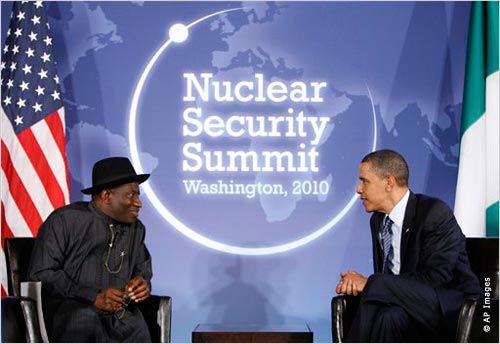
When Nigeria’s acting President Goodluck Jonathan traveled to the United States for the nuclear summit, Nigerians met him face to face to voice their concerns. It was his first visit since stepping in for Nigeria’s ailing head of state in February.
In a crowded room at the Hilton Washington Embassy Row Hotel, Jonathan answered several critical questions. One Nigerian-American stood and told the acting president what was on the minds of many.
“The first thing Nigeria needs to fix is light,” she said, “and every other development will follow.” After a round of clapping from the audience, Jonathan responded, paying homage to the high religiosity of Nigerian culture.
“In Genesis, they say God said let there be light,” Jonathan said. “How I wish we could have that kind of magic wand now to say let there be light and there was light.”
But Jonathan does not have a magic wand. And he doesn’t have much time either. Jonathan has about a year left as acting president and Nigerians are holding him accountable to make the most of it.
“He has very limited time,” said Paschal Agubuzo, manager at a restaurant adjacent to the barber shop.“We Nigerians know the need to create a better economy in Nigeria.”
Chii Akpori, head of Communications and Knowledge Management at the World Bank, attended the event Wednesday hosted by the Center for Global Development. She said she was impressed with Jonathan’s speech. But, she says the government of her homeland needs to reach out to the masses.
“The attitude amongst a majority of Nigerians is that nobody in the government cares for me,” she said. “And we need to turn that around.”
Jonathan has a lot of plans for change, and he needs more than good luck to implement them. In his speech, he emphasized the need for a fair, transparent electoral process and for job creation.
President of the Center for Global Development, Nancy Birdsall pointed out the irony facing Nigeria. As the most populous nation in Africa, Nigeria is among the world’s ten largest oil producing nations. She said though Nigeria has made $300 billion in oil revenues since 1970, average incomes have remained the same for the past three decades.
“Despite Nigeria’s great wealth, too many Nigerians are still living in poverty,” Birdsall said.
And it’s the stark contrast between the rich and the poor, the inadequate infrastructure and the political instability that concerns Nigerians around the United States.
Back in the barber shop, Ogunsanya doesn’t hide his frustration. “The president cannot do everything by himself but we need to let him know,” he says waving his clippers. . “Say, no– we’re tired.”
Ogunsanya may be tired, but after closing the barber shop, he works the night shift as security guard in a DC office. He says that Nigeria’s problems are always on his mind and that he plans to move back someday.
Maybe Goodluck Jonathan can give him peace of mind.
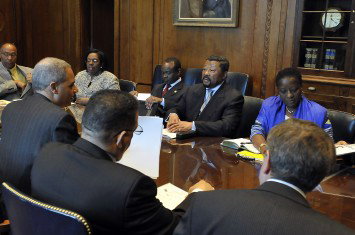
The first U.S.–African Union High Level Bilateral Meetings opened at the U.S. Department of State April 21 with the goal of broadening the U.S.–African Union (AU) relationship and deepening the level of engagement between both parties.
Deputy Secretary of State Jacob Lew welcomed the AU delegation, headed by the chairperson of the African Union Commission, Jean Ping. The three-day session will include visits by the delegation to other U.S. government departments and talks with Cabinet officials such as U.S. Attorney General Eric Holder, Health and Human Services Secretary Kathleen Sebelius and U.S. Trade Representative Ron Kirk. Plans call for the meeting to be held annually.
Welcoming the delegation, Lew said the United States is “excited” to host such a meeting with the AU to discuss common priorities for Africa and ways to strengthen the U.S.-AU relationship.
“The United States is a strong supporter of the African Union — an organization with 53 African states and over a billion citizens,” he said. The AU is “increasingly the institution that we turn to to help resolve some of Africa’s most intractable issues.” Lew said the United States is one of only two nations that have a dedicated ambassador to the African Union and is the largest supporter of the AU’s peace and security programs.
Lew called the African Union “an essential institution for defending our common principles of democracy and governance. The African Union’s courageous stance against unconstitutional changes in governments in Mauritania, Guinea, Niger and Madagascar deserve much praise. The members of the African Union have made a clear decision that the AU will not be a club for generals and dictators, and we applaud the strong steps the organization has taken in this regard.”
While cautioning that democracies are never perfect, Lew pledged that the United States stands ready to help any country striving to strengthen its own democratic institutions.
Lew praised the African Union for its “pre-eminent role” in African peacekeeping, particularly in Somalia and Sudan, and pledged that the AU has the full support of the United States for the African Union Mission in Somalia (AMISOM) and the African Union/United Nations Hybrid Operation in Darfur (UNAMID). “Achieving stability in Somalia and avoiding further bloodshed in Darfur is tremendously important for the region and for the United States,” he said.
In addition, Lew told the delegation that the United States is counting on the AU to support its global health and food security initiative. The United States is also committed to working with Africa to help boost agricultural productivity, he said.
Lew echoed President Obama’s remarks during the president’s visit to Accra, Ghana, noting that Africa is a fundamental part of the interconnected world. He reiterated the Obama administration’s deep commitment to Africa and to fostering the development of institutions like the AU.
“We believe the pursuit of peace and prosperity in Africa is very directly in the interest of the United States and the American people, and finding ways to better support our shared objective will be the focus of our discussions,” he said.
Commission Chairperson Ping said his organization is convinced that Africa and the United States can easily design and build a 21st-century relationship based on shared values, mutual respect, confidence, commitment and partnership.
“Africa and the United States have had a long history of cooperation and are bound together by strong economic, social and cultural ties, but “such cooperation has been mainly at the bilateral level,” he said.
“Now it is clear that the world has been marked by tremendous changes, particularly globalization, the arrival of new players such as civil society, the advent of a new era of empowerment and, above all, the visibility and surge of regional organizations and groupings such as the African Union, the European Union and Mercosur [the Latin American trading bloc of countries].”
New threats have emerged, Lew said. Terrorism, the global financial crisis, piracy, illicit drugs and related problems, organized crime, criminal trafficking and climate change are all assuming greater prominence on the global agenda, he said, and no longer can be addressed by one country alone. “All of our threats to global security call for global solidarity,” he said.
Africa has a “duty and responsibility” to address its challenges, he said, particularly in the areas of poverty, underdevelopment, democratic governance, health, food security and conflict management.
Ping said the African Union Commission — which he chairs — is the body charged with executing the objectives and mission of the African Union. That, he said, ends with the dream of an independent and strong Africa in a position of comparative advantage vis-à-vis the world and a continent whose concerns are seriously solicited and considered worldwide.
The AU is pursuing four major objectives in its strategy for the continent, Ping said: peace and security; development; shared values; and institutional and human capacity building. He said progress has been made in all four areas.