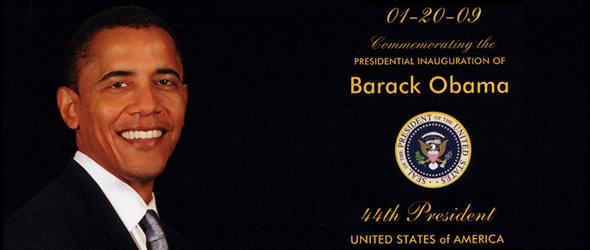
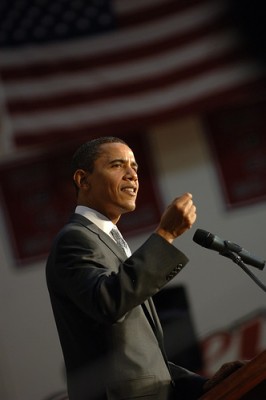
Tuesday evening, January 20th, 2009 the air was electric with national pride. Barack Obama had been sworn in as President of the United States earlier that day and now galas, dances and dinners were honoring the historic event across the country.
Over two hundred and fifty African immigrants and their friends and co-workers congregated at Casablanca Restaurant in Minneapolis, appropriately as Casablanca is Spanish for White House. The festive evening, hosted by Mshale and its partners Áccents Telecom and Casablanca Restaurant offered speakers, dinner, and music.
Mayor R.T. Rybak of Minneapolis, co-chair of the Obama campaign in Minnesota, spoke to the audience from Washington, D.C. via telephone and broadcast over the public address system. As people filled in their seats, prayers by a Somali Imam, Sheikh Saad Mussa were offered followed by prayers from a Reverend Joe Nelson of the Liberian Ministerial Association.
Projected on a large screen onstage, gatherers watched President Obama and his wife, Michelle, dance at one of several balls held in Washington, D.C. while footage simultaneously aired of Martin Luther King marching on the Washington streets.
Interspersed with the action was a replaying of Obama’s inauguration speech and King’s “I Have a Dream” declaration exhorting the nation to seek success and rise above its current conflicts and obstacles. Fatma Jibrell, founder of Horn Relief, an international humanitarian organization based in Nairobi, then took the stage and spoke with conviction as well.
Jibrell recounted her entry into the United States, telling of how, upon seeing placards at Ellis Island directing various groups of people to one location or another, she strode over to the sign that read “Negroe” and crossed it off, replacing the word with “African.” Her father, later trying to placate Jibrell, told her that Negroe was a Clan name in America.
Jibrell urged her audience to take advantage of opportunities. “Be literate! You can not be an illiterate parent in America,” she stated. She also warned against becoming comfortable with welfare, seeing such assistance as “poison.”
“Let’s put our children in the White House!” Jibrell proclaimed to a receptive and upbeat crowd.
After a dinner with entrée choices that included tilapia with mango salsa, music started up as the crowd continued celebrating.
Shock waves of the economic downturn have a global impact, with few countries escaping the effects on their formal economies. But in the developing world, the informal economy continues to chug along as a significant motor for producing wealth for people beyond the reach of traditional financial institutions and government regulation.
Journalist Robert Neuwirth spent a year and a half reporting on the informal economies of China, Brazil, Nigeria and Paraguay for his book, “The Stealth of Nations: The Global Reach of the Informal Economy,” to be published by Pantheon Books later this year.
Published below is an interview with Neuwirth on the scope, nature and ingenuity of the informal economy, which he notes is “the oldest economy in the world.”
In your first book, “Shadow Cities: A Billion Squatters, a New Urban World,” you spent months living in squatter cities in the developing world. How did that lead you to your current project?
When I was reporting on squatter communities, it popped into my head that there was a whole element of conscious rebellion in the developing world. The straight-forward economy we take for granted in the United States shuts people out. In the developing world, they have to fend for themselves. They start businesses without regulations, without paying taxes. It’s huge. In many countries its bigger than the formal economy. It makes no sense to differentiate. The reality is that when more than 50 percent of the economy is informal, those are the people who are important.
How do you define the informal economy?
Anything that is evading regulations and anyone working in that industry is informal. I’m trying to differentiate; there are gradations of illegal, too. Obviously, part is outright criminal—arms dealing, drugs, human trafficking—but that isn’t the majority. If you talk to academics, they’ll say that maybe 25 to 30 percent is criminal. It’s a lot but not the majority. The majority is legal or quasi-legal goods sold in a quasi-legal way. It involves intellectual property—movies, DVDs or operating systems—everything from that to medical necessities, like drugs that are way too expensive to manufacture. So they’re manufactured off-patent, without a license.
What were some of the commonalities in the informal economies you report on?
Everyone is shaving invoices to claim that goods cost less so they can pay less taxes. Also, there is a lot of dealing in pirating of DVDs, brand-name products, Microsoft operating systems, you name it.
I went to Paraguay to look at cross-border smuggling. There is a huge trade moving goods from Paraguay to Brazil. It’s highly organized and massive because Paraguay is a zero-tax, zero-customs land, and Brazil is the opposite.
Which country has the largest informal economy?
Nigeria, by far. The statistic for the whole country is 75 to 80 percent of people work in the informal economy. The money numbers are shady because nobody really knows. But the generally accepted number is that two-thirds of the GDP [gross domestic product] is produced in the informal economy. That means that the typical small hawker on the street is more important to the country than big companies.
What about the oil giant Chevron, which is in Nigeria?
Chevron and Shell are outside companies. Although oil makes up a huge percentage of the economy, from the standpoint of the GDP, people on the street are more important.
If the informal economy is so important, it must be impossible for it to be ignored by the formal economy.
Here’s an example of how the formal has recognized the importance of the informal: mobile phones. MTN, a South Africa-based company, came into Nigeria eight or nine years ago with the idea to do a very western, very British system of selling phones at stores. They crashed and burned. So they retooled their business concept. They now sell airtime. No one has a plan and everyone buys minutes and a sim card. The minutes are sold by a massive network of informal vendors. MTN sells minutes to distributors who resell them to people on the street. Most of the minutes are sold like that. MTN makes 90 percent of its income from selling through this huge, informal sales force.
That started me thinking about how formal companies deal regularly with the informal sector. If I am Proctor & Gamble and I want to sell toothpaste in India, I’ve got to get to where people shop. They go to informal kiosks in their neighborhoods. Colgate and Proctor & Gamble have to figure out how to get products into those kiosks. They hire distributors who get products into those places. If you talk to Proctor & Gamble, they will say they have close to zero growth in the United States and the developed world. Their growth is in countries where those stores are key.
What are the prospects of the informal economy given the economic downturn?
I would say the informal sector is poised to grow. In China, for November and December, exports went down compared to last year. Western demand will decrease and credit markets have dried up. In the first 11 months of 2008, almost half of toy exporters closed down. Some of that was in response to the lead paint scare, but some was in response to lower demand. So, people who can still buy are the merchants in the informal sector who buy with cash. When I went to Guangdong, China, I found there is an African community of traders—more than 100,000. They are middlemen and traders, shipping products back to Africa. They may pay some customs duties in China, although they work with their Chinese counterparts to fudge the invoices. But they pay mostly nothing on the African side. They aren’t counted in normal statistics. They exist purely with cash and their own initiative.
The informal economy depends on skirting regulations. Here in the United States, the talk is of more regulation to counter the too-free markets that caused the mortgage meltdown. Is it right that the informal sector avoid some regulations?
To be fair, informal traders did not create the market in derivatives. There is an actual product they sell. And I would argue that in the creation of derivatives, there is a need for more regulations. The rating agencies clearly didn’t know what they were rating.
But doesn’t the informal economy mean lost taxes that could be used to build schools? Or toys that contain toxic paint?
But let me point out that the toys in China were made by a contractor to Mattel. It isn’t the informal economy that is necessarily creating the problems. Tax evasion develops when the tax structure is unfair. In Nigeria, no one pays their fair share of taxes, including oil companies. It’s hilarious. There are huge signs that say, ‘Pay your Taxes.’ Government needs to show that there is a benefit to paying taxes. Government has been like a Ponzi scheme where most of the money goes in people’s pockets. I talked to one merchant who said, ‘I’m 40 years old and I never paid taxes, but I would if they showed me that money would be used appropriately.’
Bottom line is, when you have a high-duty, high-tax policy, you’re going to have smuggling. I’m not glorifying smuggling, but it’s understandable.
When gas prices were high here, there was an article that people put extra gas tanks on their trucks and went to Mexico to get gas where it was cheaper. That’s a form of smuggling. Everyone wants to avoid paying their fair share.
What is the status of the informal economy in the United States?
In the United States, compared to Nigeria and other countries in the world, the informal economy is tiny—eight or nine percent. But given the GDP, it’s the largest informal economy in the world at close to a trillion dollars. That’s a huge actual number. It includes some guy fixing cars in his home garage. It also includes formal businesses doing business informally. Here’s an example. The major daily newspapers in New York City—the New York Times, the New York Post, the Daily News and the Wall Street Journal—are sold at a discount in the afternoon hours near the major transportation hubs. They are sold by outdoor hawkers. These men and women don’t get a salary. They buy the papers for a lump sum and then keep as much money as they make. Do they declare this income? Doubtful. Is it an arms-length transaction? Yeah. They get the papers from distributors who buy from the papers themselves. But do the papers know about it and condone it? Absolutely. It’s the informal economy at work inside the formal economy.
The informal economy here is more of a small-scale, coping mechanism. The other aspect is people taking jobs for cash only, and not reporting their income, the day laboring based on economic necessity. But when you look at the formal economy and look at Walmart, and see that employees there don’t get the full spectrum of benefits, you have to say, ‘Well, maybe Walmart is an informal employer, too.’
What is the prognosis for the informal economy? Will it become more formal?
Governments have to figure out ways of interacting with the informal economy, from direct investments to making infrastructure improvements that make informal markets work better, to reducing customs’ duties and tariffs. There still will be some smuggling, but people will have less incentive. The solution isn’t to say, ‘Formal good, informal bad.’ The solution is to see what works in the informal economy and improve that and make it better.
The thrashing the Israelis are administrating the Palestinians makes confirmation hearings for Susan Rice to become United States Ambassador to the United Nations all the more notable. If mainstream media focuses on her becoming the first African-American woman to hold that post, they will be misleading and feckless gestures. When confirmed, Susan Elizabeth Rice will follow three African-American men who have served as America’s ambassador to the U.N.: Andrew Young from 1977-1979; Donald McHenry from 1979-1981; and Edward Perkins from 1992-1993.
America’s posture at the U.N. has been an unwavering tilt toward Israel. America’s first black UN ambassador got the boot for “controversial” statements about Israel and meeting with the Palestinians. Appointed in 1977 by President Jimmy Carter, Young’s tenure was short. In 1979 Young said on network news that Israel was “stubborn and intransigent.” He made the mistake of meeting with representatives of the Palestine Liberation Organization “in violation of American law,” and Carter sacked him.
Dr. Rice is unlikely to make Ambassador Young’s mistakes of seeking fairness and balance on the issue. President-Elect Barack Obama’s choice of Rice to represent the U.S. before the U.N. will make her one of his administration’s most visible faces to the international community. So, when Rice meets with the Congress for confirmation to the $150,000-a-year post, there’s unlikely to be new revelations about ways to overcome crisis situations such as occurring in Gaza and the Middle East.
Rice is required to be confirmed to the post by the Senate; subsequent to that proceeding she and Obama will likely continue American patterns of hegemony. America has tenuous relations with the UN body, particularly over issues such as the Palestinians plight, but Obama’s act of restoring the UN ambassador’s post to cabinet rank supposedly indicates he means to work with the world body. Obama says Rice will pursue goals of greater U.S. engagement with other countries and multilateral institutions: “She shares my belief that the U.N. is an indispensable and imperfect forum,” said Obama. “She will carry the message that our commitment to multilateral action must be coupled with a commitment to reform.”
How successful will Dr. Rice be mending America’s rocky diplomatic fences with the U.N.? There is some concern that Rice’s appointment sends the wrong signal. During the Clinton administration, Rice worked for the National Security Council and the State Department, primarily on issues related to Africa. Recently her specialty at the Brookings Institution think tank was on the global impact of weak and failed states. Rice greatest claim to fame has been criticizing what she calls Sudan’s genocide in Darfur. At a recent TransAfrica Forum, the group’s chairman of the board, actor/activist Danny Glover, said the organization is “conflicted” on Dr. Rice’s appointment and whether she’ll “focus to shape new policy directions that prioritize inclusive human security, multilateral approaches, and interdependence with other nations rather than focusing narrowly on bilateral and militaristic responses”.
If Rice continues U.S. imperial hubris coupled with practices toward Israeli interests, her role at the U.N. will be divisive. Israel is the top recipient of US foreign aid. Since its founding in 1948, America’s military and economic assistance totals over $100 billion. As the horrific conditions were occurring in Gaza and the U.N. Secretary General condemned the acts, the U.S. Senate (that will confirm Rice) passed a non-binding resolution “recognizing the right of Israel to defend itself against attacks from Gaza” and reaffirmed “the United States’ strong support for Israel in its battle with Hamas.”
Since President Carter brokered the Israeli-Egyptian peace treaty in 1979, Israel has received up to $3 billion in annual aid from the U.S. Egypt receives the U.S.’s second largest aid package — $1.3 billion in military and $415 million in civilian aid. Aid to the Palestinians was frozen when Hamas won elections there.
America is not even-handed in the Gaza crisis. It’s folly for Congress to have Rice go off to the U.N. mission parroting “humanitarian concern” for “genocide occurring in Africa,” while condoning U.S.-involvement in genocide being perpetrated on Palestinians.
Opinions expressed here are the author’s and do not represent those of Mshale.
Minneapolis was definitely the place most East Africans were a weekend ago to watch David Mathenge, famously known as Nameless, in concert. Performing at the Blue Nile restaurant, the artist showed up on stage dressed in shiny black pants, a white shirt and a sport coat.
The coat was quick to come off, and the shirt unbuttoned to the chest due to the heat brought about by the extensive crowd. Nameless began his concert with one of his high energy songs, Manner less that got the crowd wild and loud. Dj Kaydee, from Kenya matched up with the zealous performance presenting his skill amicably on the turntables.
Nameless whose popular songs include Sinzia, Ninanoki, Maisha, Furahiday, just to mention a few, has a knack to put down lyrics that are easy to remember, enjoyable and relatable. The large audience out to watch one of Kenya’s favorite performer sang along to the entertainers songs. The cheering and applauding to every word he spoke and dance gyration he made was deafening.
The front row next to the stage where I and other ladies were standing was a vantage point for me to watch the artist give a performance that was both interactive and very engaging. A few ladies got the opportunity to join Nameless on stage and dance with him. One catchy moment of the concert was when two ladies got on stage and performed a dance routine to Nameless’ song “Deadly”. The artist, though stunned by the sudden impromptu performance, joined in and the three seamlessly danced together, much to the audiences delight. His recently released song “Salary” which features a very well choreographed video has become a major hit with many. One fan who has mastered the choreography got on stage and excitedly danced to the song.
Nameless gave a performance that will well be remembered for long, just like his music. He took the opportunity to mention the late E-sir with whom he recorded the hit “Boomba Train”. It’s easy to see why he attracts so many to his shows. Nameless is an accommodating, stimulating and interactive entertainer.
Nameless, who is married to another popular Kenyan artist, Wahu, has won and been nominated for awards like the Kisima Awards and Tanzanian Music awards. He has been listed as one of Kenya’s most influential people. Nameless and Wahu have one child a girl, born a few years ago.
Mshale, along with its partners Accents Telecom and
Casablanca Restaurant is hosting a three course dinner on inauguration
day to mark this historic occasion.
The African Diaspora in Minnesota is very diverse: from refugees who have resettled in Minnesota to students like Obama’s father there are close to 70,000 Africans in the state. Thus, Obama’s ascent to the presidency of the US has been of particular pride to many African immigrants.
Across the country plans of festivities are underway. For those who will not make it to Washington for the inauguration, Mshale will host a dinner in Minneapolis on January 20th.
Mshale has engaged the services of award winning chef Keysee of Casablanca Restaurant who will whip up some of his finest delicacies including Tilapia fish, which is a staple in western Kenya where the president-elect’s father hails from.
Casablanca is located at the Profile Event Center in Minneapolis: 2630 University Ave SE, Minneapolis, MN 55414. (612) 331-5000
Dinner is $25/plate. To make reservations click here.
African Diasporans to Celebrate Obama's Inauguration in DC
For many Americans, the ascent of President-elect Barack Obama is symbolic of America’s improving race relations. Africans in the Diaspora find more to celebrate: Obama’s father’s African ancestry.
The African Diaspora for Change (ADC)—formerly African Diaspora for Obama, is a group of volunteers who have “formed alliances with prominent voices that have the ability to affect change in African Diaspora communities.”
ADC first started out campaigning for Obama. Following his winning the elections in the November 2006 elections, the group shifted its focus to “affect change through education, empowerment and engagement of the next generation of leaders.”
ADC’s members who live all over the US will convene in Washington DC for the historic Obama inauguration where they have planned a series of events.
The events planned include the African Diaspora Inaugural Ball on Sunday January 18, 2009 at the Harman Center for the Arts with the theme, “I Am the Change: Educating, Empowering and Engaging the Next Generation of Leaders.”
The theme of the event focuses on the importance of investing in the education and empowerment of America’s and Africa’s next generation of leaders—a key message of the Obama administration.
Congressman Donald Payne (D-NJ) chairs the Honorary Host Committee which also includes Baroness Valerie Amos, former leader of the House of Lords and the first Black woman cabinet secretary in the history of Great Britain; Dr. Witney Schneidman, Co-Chair, Africa Experts Group, Obama-Biden Campaign for the President; Ambassador Amina Salum Ali of the African Union Mission to the United States; Camilla Barungi, Ugandan supermodel and entrepreneur featured on Project Runway, and others. The Mistress of Ceremonies is none other than the illustrious Tracey Neale, nine-time Emmy award winning Washington DC. News Anchor.
This celebration marks the victory of President-Elect Barack Obama with the performance of Grammy-nominated artists, Les Nubians, a special guest appearance by Grammy Award-winning artist, Angelique Kidjo, and winner of the 2006 Radio France International Award, BELO.
The Inaugural Ball will benefit the Batonga Foundation, an organization founded by Angelique Kidjo which gives girls a secondary and higher education so they can take the lead in changing Africa; and First Book, a nonprofit which distributes new books to children in low-income communities throughout the United States and Canada. First Book will partner with ADC to donate and distribute 44,000 books (in honor of the 44th President of the United States) to support literacy in Africa and America.
To learn more about ADC visit their website here. And for additional information contact Adriane Alfred at 202.246.5749 or [email protected]
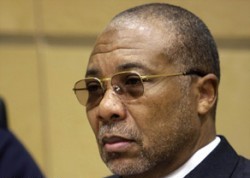
Liberian war criminal Charles Taylor's son sentenced in US Court
Liberian immigrants had mixed reactions to a ruling in a Miami court
that sentenced Chuckie” Taylor, the son of former President Charles
Taylor to 97 years in federal prison for his conviction last year on
charges of torture and human rights violations.
“The punishment doesn’t fit the crime, it is excessive and disproportionate,” said a Minnesota-based Liberian community leader, who sought anonymity for fear of repercussions from the community.
In a telephone interview, he said: “Chuckie was not a central figure in the war, his crimes pale in comparison to the egregious acts committed by many warlords and their foot soldiers that are running around scot free in Minnesota and Monrovia.”
“I am glad that the Liberian people have finally received some justice,” said Nyeah Ukatu, a Liberian immigrant living in Boston, Mass.
The case is the first of its kind in the United States, which is based on a 1994 law that makes it a crime for citizens, legal residents (Green Card holders), or visitors in the U.S. to commit torture overseas, regardless of nationality.
“It is hard to conceive of any more serious offense against the dignity and the lives of human beings,” said U.S. District Judge Cecilia Altonaga as she imposed the sentence. “The international community condemns torture.”
Charles McArthur Emmanuel Taylor, also known as “Chuckie”, was born in Boston in 1977 and therefore an American citizen. He was found guilty in October 2008 on charges that he headed a paramilitary ‘Anti-Terrorist Unit’, which became notorious for carrying out heinous acts of violence against civilians, while his father ruled Africa’s oldest republic from 1997 – 2003.
The younger Taylor was convicted on five counts of torture, one count of conspiracy to torture, one count of using a firearm during the commission of a violent crime and one count of conspiracy to use a firearm during the commission of a violent crime. Prosecutors had asked for a 147-year sentence.
“This case sends an important message that those who commit human rights violations will be held accountable and that the United States is not a safe haven for torturers,” said Robin Phillips, executive director of the Advocates for Human Rights in a prepared statement.
“It is a great precedent and we hope that the new administration [U.S.] will continue to enforce the law against all those who have perpetrated these human rights abuses,” she said.
Federal immigration authorities arrested Taylor in 2006 as he tried to slip into the U.S. from the Caribbean island of Trinidad & Tobago; a day after his father was arrested trying to flee Nigeria. He was initially charged with passport fraud and pleaded guilty. On the day before his sentencing, he was indicted on rights violations against seven men in Liberia.
During the trial, witnesses accused Taylor, 31, of summarily executing four men and playing a direct role in beatings and using burning plastic, hot water and electric shocks to torture his victims. One victim testified that he was placed naked in a pit as fire ants (red ants) were shoveled over his body. Many of the victims he allegedly tortured were among the witnesses who testified against him behind obscured screens to protect them from possible retaliation.
Taylor’s lead defense lawyer, Miguel Caridad, said many of the witnesses were not credible. He said witnesses lied and exaggerated their stories to win political asylum in the U.S., or to settle political scores.
Caridad argued that his client — who arrived in Liberia at age 17 – may have thought such atrocities were “standard operating procedure” in a violent civil war and that he was vulnerable to pressure from his powerful father.
“The defendant’s life has been destroyed by a perfect storm of circumstances not of his own making,” Caridad said.
But Assistant U.S. Attorney Caroline Heck Miller rejected that argument.
“The defendant argues that he should be excused because numerous other individuals have gotten away with torture, and because he was unfortunate in his parental origins, but he never accepts responsibility,” she said.
Chuckie Taylor is the only person to date who has been tried and convicted for crimes committed during the violent 14 year Liberian conflict that killed nearly 300 thousand people and displaced over a million.
The elder Taylor is on trial in The Hague, Netherlands for war crimes by the United Nations-backed Special Court for Sierra Leone.
The former president, whose trial began last year, is accused of supporting the infamous rebel group – Revolutionary United Front – that went on a diamond-fueled rampage, in neighboring Sierra Leone, of killing, chopping off limbs and rape during that country’s civil war. He denies 11 charges of war crimes and crimes against humanity.
The Alliance of Re-liberation of Somali (ARS), a Somali opposition group based in Djibouti, is now ready to give obeisance to the international community and unite with the backed Transitional Federal Government (TFG).
“We are ready to fulfill the Djibouti agreement … we don’t see any reason to postpone or further delay to establish the long awaited unity government”, Sharif Hassan Sh.Aden, ARS central committee chair told Mshale when he visited Minnesota in December
On June 9, 2008, representatives of the ARS-Djibouti faction and Somalia’s TFG signed a peace accord under the auspices of the United Nations where they agreed on a ceasefire and establishing a unity government.
“The majority of Somalis view the Djibouti agreement as an opportunity but incomplete and are willing to give a chance with the exception of few individual with personal interest”, says Sharif Hassan.
“Anyone that opposes these efforts is obviously not interested in giving Somalia and Somalis a chance and don’t want to see a stable, peaceful and prosperous Somalia … I am confident that Somalis will reject them”, Sharif Hassan said.
The ARS was found September 2007 in Asmara, Eritrea in opposition to the Ethiopian occupation. The following year the Alliance split into two factions: one continues to reside in Asmara where the other is now based in Djibouti. ARS is made up of the Diaspora Somalis, former MPs who left the parliament in protest after Ethiopian troops invaded Somalia, civil society and members of the Union Islamic Courts.
Somalis are skeptical of Ethiopia’s promise to withdraw its troops from Somalia.
Ahmed Farah, a Somali living in Minnesota is one of these skeptics: “ [Ethiopian Prime Minister Meles] Zenawi is buying time and wants to further manipulate the situation … contrary to his announcement, his troops are taking over more cities and killing more Somalis. “
However, Sharif Hassan is positive that Ethiopian troops will withdraw from Somalia sooner, rather than later, “Of course, I understand the frustrations. After number of deadlines for their withdrawals, we are all skeptical but we must be hopeful to stay on the course… the international community is now asking Ethiopia to withdraw its troops … we know if they leave, Somalis will come together and easily solve their problem.”
Since the first UN mission to Somalia failed in the early 1990s, the role of the United Nations has been constrained to limited humanitarian aid. However, in the recent past , the international community has began to actively engage in working towards a peaceful resolution to the decades-long crisis in Somalia. This international attention can widely be attributed to piracy off the coast of Somalia and Al-Shabab, a group that has recently designated as terrorist by the US state department.
The US, Great Britain and France, and other countries are directly involved in Somalia: international marines are now in Somalia in an attempt to fight piracy. The Huffintongpost reports that the “international naval force under American command will soon begin patrols to confront escalating attacks by Somali pirates after more than 100 ships came under siege in the past year”.
Sharif Hassan stressed the importance of the unity government, “For all that care, Somalis and the international community, this is an invaluable opportunity … should this pass, I am afraid that we will never see stability in Somalia”.
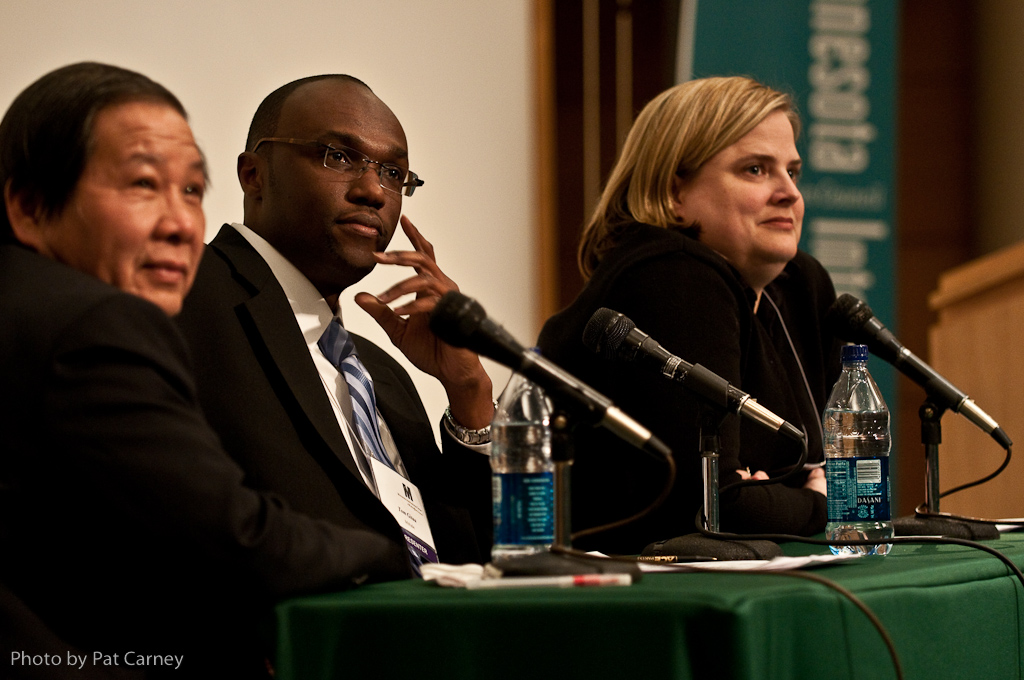
Panelists: Nghi Huyhn (Asian Business & Community Publishing, Inc), Tom
Gitaa (Mshale), and Alisa Miller (Public Radio International) discuss the need for
increased reporting on global issues. Photo: Pat Carney/Mshale
Panelists: Nghi Huyhn (Asian Business & Community Publishing, Inc), Tom
Gitaa (Mshale), and Alisa Miller (Public Radio International) discuss the need for
increased reporting on global issues. Photo: Pat Carney/Mshale
In February of 2007 newsworthy stories included the decision by North Korea to dismantle its nuclear facilities, devastating floods in Indonesia that killed over 80 people and displaced over half a million others, and Intergovernmental Panel on Climate Change (IPCC) released a study on global warming. However, something else eclipsed the headlines of many newspapers instead of the globally impacting events: the death of American celebrity Anna Nicole Smith.
Alisa Miller, CEO of Public Radio International (PRI) told a small, but avid audience assembled at Cowles Auditorium in the Humphrey Institute of Public Affairs highlighted these concerns during a power point presentation as she partook in a panel discussion on the future of global journalism.
Despite a nasty snowstorm Tuesday evening, December 16th , Miller, along with Tom Gitaa, founder and president of Mshale newspaper, and Nghi Huyhn, CEO and originator of Asian Business & Community Publishing, Inc informed their audience of the nature and direction of world news coverage and engaged an educated gathering in discussion.
Presented by Minnesota International Center (MIC), whose mission, simply stated, is to fire up community awareness and understanding on issues of global and cultural scope, their two-hour forum focused on bringing international news to our front door.
In advocating his newspaper Mshale, a Minnesota-based one that covers African immigrants in the US, as a viable alternative to St. Paul and Minneapolis’ larger publications, Gitaa suggested that “Whereas the mainstream media prefers to cover the exotic of the international community, Mshale can talk about the real struggles that our people are going through.”
Alisa Miller acknowledged the problem of insufficient world news coverage.
“I think part of why the broader media is only covering the exotic is a lack of understanding of the continent (Africa) itself,” said Miller.
She takes this lack of understanding as a reason for inadequate world news coverage even further and proposes that “Social entrepreneurship is a major focus. If a news organization doesn’t have that or doesn’t value that, they won’t be covering the bigger part of African life.”
A social entrepreneur, like a business entrepreneur, seeks to organize, manage, and assume the risks of a business venture. The difference between the two is that a social entrepreneur measures success based on the impact he or she has on society. In business, success is measured by the bottom financial line.
Huyhn described his paper, Asian American Press, typical of many free newspapers, as dependent on advertising. “Our revenue is 95% advertising. We are run like a business,” said Huyhn. Yet their paper’s focus remains on the dissemination of cultural information.
“We try to provide a bridge of understanding between the Asian community and others. Japanese, Chinese, Korean, Cambodian, Laos, Hmong, and Tibetan comprise some of our community,” he described. “The focus of the paper is to try to promote our business and offer the public events and information about our culture.”
Despite the fact that these media are businesses, they also serve their communities. Gitaa said, “As a community paper, local news must be covered, struggles must be highlighted.”
Gitaa has found that diversification in advertising revenue is crucial. “Part of the mission of the paper is to be the voice of the community. Some times we’ve had to let an advertiser go because they aren’t aligned with our mission,” admitted Gitaa.
Likewise, PRI, which relies on a much smaller percentage of advertising dollars to fund their organization, takes a similar attitude as Gitaa. “If an advertiser is unhappy with the kind of coverage that we provide, they can leave,” proclaimed Miller.
Understandably, Huyhn summed up the perspective of these alternative broadcasters of global journalism. “It’s not about money,” he said. “(Our) mission is to build greater understanding.”
Miller maintained that, “It is really about service regardless if you’re working for a profit or non-profit.”
The impact of a single, individual journalist, said Miller, has never been greater.
Michael Norman, owner at Workplace Skills, LLC, raised his concerns, “I personally believe that fewer and fewer journalists have a good understanding of what is going on in the world. How do journalists learn about the world in order to talk about it?” asked Norman.
Miller responded. “People end up in such tight beats that are so constricted they don’t have a chance to develop depth,” she said. “When I was in journalism school, I took classes across the board to further my understanding of world events. Now the world is more complex and new journalism students have to learn more about more,” she observed.
Miller wryly concluded, “The biggest challenge now for PRI is to have enough information to get listed (on the Web) as frequently as a pop culture icon like Britney Spears.”
Every new year presents the opportunity for considered renewal, shedding our old coats, sporting new ones. This one should be no different even if it starts with particular difficulties.
The continuing recession has left few unaffected, from large industries with global reach to our families and friends. Mshale will walk with you through the trying times, over the next several months, comforting our readership in the knowledge that you are not alone in your struggles and documenting your stories of courage and resilience.
We begin this month, with a small business in Minneapolis whose owner is seeking creative ways to save money and attract customers to its tables—Tam Tam Restaurant. (Read story here)
In the months to come, we will continue profiling other such businesses and talking to professionals under immense pressure. We will talk to nurses and nursing assistants; people in professions that are traditionally considered recession-free, but whose jobs are now under threat.
In addition, as malls across the country are struggling to make sales, in Brooklyn Center, an increasingly diverse city, many African immigrants working in the malls are losing their jobs.
Last year, this country declared in a historic election that a man of mixed race (encompassing all that is American) with “an exotic” name should be its President. In a few weeks he will be sworn into office as the 44th president of the US, his long-awaited presidency the fulfillment of the hope of millions in this and several countries around the world. Anxiously they wait, hoping that the promises he made during the two-year-long campaign will come to fruit.
This wait is however tempered with reality. The world has changed much since Barack Obama stood up to declare he was running for office. Turmoil in the Middle East, a global crisis of confidence in the financial markets and a drastic slowdown in economic growth have lit up fires so great it will take great resources and political will to deal with them.
Still there is hope. The spirits of our readers, many of whom have already conquered the greatest obstacles, as immigrants, to achieve what you have in your lives thus far remains alive. The collective will, so visible in the organization and mobilization for the campaigns earlier this year and in our efforts at solving community-specific problems across America will be called upon for a united defense of our families, our hopes and dreams.
Stubbornly, in the face of all these, the spirit that rang across the country declaring its refusal to bow down and submit to the old, to the fears, faces the challenges of this year head on, and declares Yes We Can.
Mshale promises to walk with you, and help bring you together for a Happy New Year.
Open Door Strategies: Tam Tam’s Strives to Survive Recession
Editor’s Note: The National Bureau of Economic Research has
reported that the US Economy is in recession. The end of 2008 has seen
thousands of Americans lose their jobs, and millions of dollars lost on
Wall Street. This is a first of recession-related articles from Mshale
Newspaper that will cover the impact of the economy on the African
community.
This is a scary time for businesses; especially small businesses. All are feeling the squeeze of the economic downturn.
Many had hoped for a holiday redemption but weak sales triggered business closings from online stores to the malls and to the streets.
Some experts believe that the small business sector will survive because it has always been the most resilient in the economy, benefiting from the lack of cumbersome fixed cost base that burdens large businesses and with little or no debt to service. In fact, it is widely believed that the recession will result in a larger number of business startup in the coming years as individuals stricken by the downturn resort to embarking on their postponed hidden desires to branch out on their own.
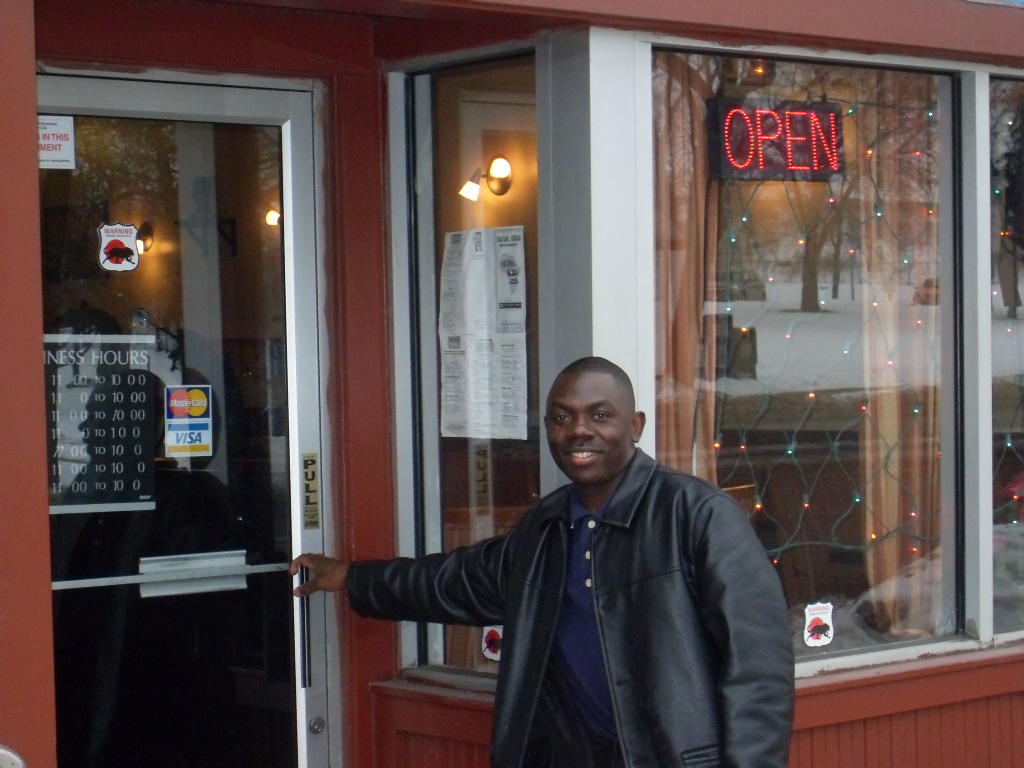
Over two years ago restaurateur Stephen Kaggwa embarked on his own journey of entrepreneurship. With the right ingredients on hand—a background in business education, industry experience, a cooking hobby turn vocation, a willingness to take risk and the guidance of a nonprofit businesses development center—Kaggwa started as co-owner of Tam Tam’s African Restaurant in the Cedar Riverside neighborhood. It has definitely been rewarding but not without its challenges.
Knocking the table in front of him, Kaggwa says, “We’re doing fine so far. If things don’t start to look up come spring, early summer then I’ll start to get nervous. For now, we’re okay.”
As the only Pan-African restaurant in the Twin Cities (serving dishes from East, West, Central and South Africa), Tam Tam’s is still being discovered by people in the metro and surrounding areas. You can say that they are still coming into their own, which is not a bad place to be in an economy such as this. The steady flow of traffic from the East African population in the neighborhood, students from the University of Minnesota and Augsburg College, surrounding institutions like the Fairview University Medical facilities and other downtown area businesses is keeping Kaggwa and his team busy.
In addition to the growing requests of catered private and corporate events, Tam Tam’s is starting to participate in signature events in and around the cities like the Annual Taste of Many Cultures held in December 2008, which is a multicultural evening of food music, dance and fun, sponsored by the Multicultural Development Center (MCDC) and Cub Foods. Kaggwa is pleased to be able to share a part of the African culture through food with Minnesota’s growing multicultural community.
Like many small businesses, Kaggwa is incorporating strategies to improve business and help carry him through the economic downturn:
Cost-saving measures
Kaggwa has not had to layoff his staff, however, they he has to cut back on their hours. That means that Kaggwa is spending more time at work and, at times, wearing twice as many hats during the day—greeter, waiter, cook, cashier, janitor, etc.
“It gets tough but that’s what it takes to keep the doors open sometimes,” Kaggwa said.
Customer service and satisfaction a high priority – this is an area where many immigrant and minority businesses struggle with but Tam Tam’s doing a great job at it. Kaggwa’s big smile, big heart, sociable personality and passion for what he does come through Tam Tam’s service and atmosphere as well. Customers rave about the experience.
One satisfied customer wrote on Chowhound, an online post for food lovers, “…the service was among the best I’ve ever gotten, extremely attentive, and this guy [Kaggwa] really seemed to enjoy this restaurant operation.”
Kaggwa recognizes that customers show their appreciation by coming back again and by referrals.
Time-saving measures
“When you’re cooking African food, you have to start from scratch and it takes more time than most American food preparation. When you’re out spending leisure time with friends over dinner, that’s no problem but when you have only a few minutes to spare on a lunch break, waiting is out of the question,” Kaggwa said.
To tackle that challenge, Tam Tam’s launched its lunch buffet in November 2008. “The buffet works well for people who want to enjoy the food but would like to get in and out as fast as possible.
“The cost is reasonable and comparable to other buffets, the items are visible and they also get a chance to try items that they might not have tested otherwise.”
Tune in to Customer Concerns
Ingredients and spices used in African cooking are not enticing to everyone. Stories are sometimes told of individuals unintentionally transferring not-so-pleasant food smells to places where it’s not very welcome or of outfits that had to be thrown out because even professional cleaners failed to do the trick. There are also stories of apartment managers having the “smell talk” because other tenants had complained about the African who wanted nothing more than the comfort of some “back home” cooking.
Laughing, Kaggwa says, “We’ve had to modify some of our recipes to avoid such incidences.” In addition, spice is served on the side and spicy dishes are clearly labeled to ensure that there are no surprises.
Diversify customer base
“Going into this business I knew one thing for sure—that Africans have not fully embraced the American culture of eating out. Their first preference is to cook at home, not to mention the fact that many African households fall into the low income category. I understand that they have to stretch their money so when they come to Tam Tam’s I want it to be a real treat for them. I also rely on them for feedback on my cooking,” Kaggwa said with a smile.
Tam Tam’s goal has always been to serve food that everyone enjoys – authentic enough for Africans looking for food that reminds them of “home” and tasty and enjoyable for non Africans who are looking to try something different or share in the culture.
New Business Opportunities
The chance to cater for private and corporate events have been a great way to add to the bottom line and get their name out in the community. Signature events like the Tastes of Cultures and others help Tam Tam’s to share, learn, expand and grow.
Provide work opportunities
Many of Kaggwa employees are students from the neighborhood. He is glad that he is able to provide employment for people in the community. He says it makes the business operation even more meaningful.
Good standing with bank and investors
Kaggwa is proud of the financial standing of his business. He keeps in touch with his financial partners, keeping them apprise of company developments and opportunities he’s considering. A plan to move to a larger location was put on hold because of the dire business climate.
The strategies Kaggwa has put into place is serving him well and keeping his doors open. In addition, his attention to the economy and customer preferences will help him make the adjustments needed to survive the downturn.
Kaggwa understands the challenges of doing business in a tough economy and acknowledges that there is more than could be done to help him get through, like marketing, advertising and perhaps creative strategies to engage customers. However, with running a lean operation and his having to wear multiple hats most of the time, there is a limit to what can be done.
The economic downturn is adding more steam to the heat in Kaggwa’s kitchen but he hopes that his survival strategies will be sufficient to put out any looming fires.
SIDE BAR
At the recent 20/20 Community Development Expo held in November 2008, Hussein Farrah, Business Program Director at the African Development Center (ADC), speaking on a panel at Impact of Immigrant Entrepreneurs the breakout session called, said that one of the main challenges faced by immigrant entrepreneurs is cultural barrier.
Farrah said that many understand that the ups and downs of a business is a given; it is part of the playing field. However, sometimes they fail to attribute the shortfall to the overall market or the current business environment. Therefore many fail to look for changes in customer psychology and behavior in order to plan appropriately to better meet those challenges.
Farrah said that ADC works with immigrant business owners to help them understand the differences in doing business in America compared to in their home country. ADC was instrumental in Tam Tam’s startup and in 2007 awarded Kaggwa Small Business of the Year in the African Community.
Tam Tam’s Restaurant is located on 605 Cedar Avenue South, Minneapolis, 612-339-0854. The lunchtime buffet is only $7.99. For a full menu listing click here.