The body of a missing Somali woman surfaced in the Mississippi River on Monday (5/29), authorities said.
Sudi Bashir Abdi, 26, went missing from her family’s apartment in the Riverside high rises on the night of May 8. Several hours later, Minneapolis Police received a call from a man on the Washington Avenue Bridge, who reported a woman diving into the river.
Using sonar-enabled boats and other high-tech equipment, authorities searched in vain for several days. Family and friends also have been helping the search along the shoreline. A pair of shoes thought to belong to her was discovered near the river.
At about 3 p.m. Monday, authorities spotted a body that surfaced near the St. Paul railroad bridge in the 800 block of W. Water Street. Autopsy results show that Abdi died of freshwater drowning, the Ramsey County medical examiner revealed Wednesday.
A spokeswoman for the Hennepin County Sheriff’s Office said no foul play is suspected at this time.
Abdi was an ambitious medical student at Hofstra University in New York. She had just recently arrived in Minneapolis. Family and friends say she was stressed with school.
The Togolese community in Minnesota with their invited guests celebrated their 46th independence anniversary at the Center for Families in North Minneapolis on April 27.
It was an evening of jubilation in which Togolese nationals appeared in their colorful traditional regalia, introduced their food to their guests and enjoyed traditional dances that attracted non-Togolese to experience the warm beat of West African music that combined drum beats, Zouk and High Life.
Traditional dances that triggered dancing from almost the entire revealers regardless of their cultural backgrounds included the hip-shaking, shoulder tremor Agbadja, Akpesse, Cantata, and Kamou with elegant scarf waving. Dancers had adornment of beads and musical leg pebbles.
Food that was served included Ablo (corn bread), Ayimolov (bean rice), an assortment of other traditional dishes such as Amadan and Tchitchinga. It was an evening of fan-fare that started at 5:00 pm to beyond midnight in what was a first experience for the people of Togo resident in Minnesota.
The master of ceremonies Gladstone Sabah explained the meaning of the country’s name, the origin of the country’s capitol Lome and the brief history of the people of Togo. He said the name Lome comes from the Togolese tradition of a farmer who grew trees that were used to cut toothbrush. Thus Lome means the territory of toothbrush made of tree branches. The name Togo comes from the word Togodo which means the land on the other side of the river.
Gladstone Sabah explained that Togo was a German colony and became a French protectorate state after Germany lost the war before they became independent in 1960.
Togo is a West African nation of 5.5 million people bordering Benin, Ghana, Burkina Farso and Bight of Benin. It has a tropical climate, hot and humid in the South and semi-arid in the North. It has a gently rolling savanna in the North, central hills, southern plateau; low coastal plain with extensive lagoons and marshes.
French is the official language and language of commerce while the people come from 37 tribes each with their own dialect. The largest tribes are the Ewe, Mina, Dagomba and Kabre. About 51 percent of the people uphold indigenous beliefs, and about 20 percent of the population is Muslim while Christians make up 29% of the population.
Agriculture provides 65% of the labor-force and the main cash crops are cocoa, coffee, and cotton. Food crops include yams, cassava, corn beans, rice, millet, sorghum, livestock and fish. Togo ranks as number 4 in the world’s leading producers of phosphates. The country has a GDP per capita income of US $ 1,700.
The current President is H.E. Faure Gnassingbe Eyadema, who took the reigns of power following the death of his father the late President Eyadema who died in February 2005. The late Eyadema’s party – Rally of the Togolese People (RPT) maintained power since 1967- going down on record as one of Africa’s longest serving Presidents. During the 38year reign of the late Eyadema, Togo did not celebrate the actual independence day of April 27 but observed it on January13, the day he seized power during a 1967 coup. Current present Eyadema has said reverting to the original date is part of his efforts at national reconciliation.
Ama Elli Sabah, a prominent Togolese community activist crowned the evening by thanking the invited guests who so lovingly took time to get “the Togolese experience” and danced the night away with the throbbing beats from an assortment of West African music.
The IRS says you can deduct expenses for taking a business trip or business convention. And there’s no reason the trip shouldn’t coincide with your vacation.
Pack a laptop with your bathing suit on your next vacation.
There is no law prohibiting you from combining a business trip with a vacation. And if you do mix and match, don’t forget to keep your receipts.
The Internal Revenue Service concedes that you’re entitled to deduct expenses for taking a business trip or attending a business convention.
While such trips must benefit or advance your business to qualify as a tax deduction, there’s no reason why the trip or convention couldn’t coincide with your vacation. Why do you think that most large conventions are held in cities like New York, Las Vegas and Miami?
What’s Involved
Convention and business travel expenses are deductible both to employees and the self-employed. Such expenses would include convention costs, hotels, meals and entertainment, and travel expenses to and from the convention. If a business purpose can be established, the expenses of your spouse may also be deductible. The business conventions or seminars must specifically relate to your business or profession. This rule could be called the "resort investment seminar" rule.
While you can deduct seminar and convention costs so long as they relate to your profession or business, the IRS doesn’t allow you to deduct the expenses for attending an investment or financial planning seminar in a resort area — or, say, a cruise ship. Likewise, you can’t deduct the costs of attending an annual meeting of stockholders if you’re a shareholder. These the IRS considers personal business.
Rules Vary On Domestic, Foreign Travel
The deductibility rules differ depending on whether the trip is within or outside the United States, and whether it’s a foreign convention or a cruise convention. Let’s have a look at each.
If your business-vacation trip is within the United States: Your transportation expenses will be deductible only if the trip is primarily for business. If the trip is primarily for pleasure, no transportation expenses can be deducted. This means that you have to establish a primary business motive for making the trip: for example, you’re going to attend a convention in that city, or visit a client or potential client who is based there.
I would recommend that if you’re going to visit a client, you should write to this person and receive in return a letter confirming the planned visit to discuss business matters. That letter validates the business purpose of your trip.
Chuck Chuckuemeka is managing partner of Chuckuemeka & Associates, a nationally focused CPA firm specializing in Accounting, Auditing, Consulting and Tax Advising.
The lieutenant Governor of the State of Maryland, Honorable Michael S. Steele in April launched the first ever flight operation into West Africa by a United States carrier, namely North American Airlines. The company commences its direct flights out of Baltimore Thurgood Marshall International Airport where April’s ceremony was held on June 3rd 2006 into Banjul International Airport and onward to Kotoko international Airport in Accra.
In his address to the exiting crowd of travel agents, airport officials and members of the West African communities in the area, Governor Steele extended gratitude on behalf of the state of Maryland for providing the new service from Baltimore to West Africa. The Lt. Governor emphasized that this new service will create new trade opportunities and also advances the movement of goods and services to and from West Africa. Mr. Steele said this service will also enhance and consolidate the steps the State of Maryland has taken by way of Business with West African countries.
Speaking on behalf of the Government of The Gambia, Ambassador Dodou Bammy Jagne, Gambia’s Ambassador to the United States highlighted the importance of this service. Mr. Jagne said the service will bring West Africa closer to the United states of America citing the numerous difficulties experienced during the past two years following the cancellation of Ghana Airways operation out of Baltimore. He said the service will also play a vital role in the bridge building between the United States and West Africa. He informed North American Airlines that the Gambia government is fully committed to support this venture and also ensure it comes to fruition. Dilating on the impact such venture can have on trade, Mr. Jagne said given the close proximity, West Africa must take advantage and utilize this service to the maximum. Ambassador Jagne also spoke of the close links between The Gambia and the State of Maryland. He thanked the Lt. Governor for the recently concluded agreement on Port cooperation between the Ports of Baltimore and The Gambia.
On his part, Mr. Jeff Mackinney, president of World Air Holdings,said that there was a significant demand in the Baltimore/Washington DC area for a direct flight into West Africa and his company was looking forward with great anticipation to providing this link.” Customers also will appreciate Business class service with all leather seating, 55 inch seat pitch, 135 degrees recline and 100 hours of on demand, in flight entertainment,” he was quoted as saying. Mr. Mackinney also paid tribute to the Governments of The Gambia and that of Ghana for the support and cooperation. He said both countries worked diligently to get the operations to take off.
By way of background information, North American Airlines is a charter company that operates 757s and 767s.The airline is known for flying troops to and from the United States. Most notably, North American Airlines was the Airline of preference by the Bush campaign.
The maiden flight out of Baltimore is 11.55p.m. on Sunday June 3rd. and it gets into Banjul at 12.15 p.m. on Monday before heading to Accra at 1.15p.m.
Amy Klobuchar believes that Americans are tired of the legend of lies from Washington and the policy fiasco on sensitive issues like Energy, Health Care and the Iraq War. She contends that Americans need change and real leadership to protect their core values and bring the interests of the many in front of those of a few.
She said the Republicans had let the American people down by promising that they would leave no child behind and yet many millions of children have. Their pledge for affordable health care has only delivered Medicare Part D; and the nation had been totally unprepared for national disasters like Katrina with images of desperate families on top of roofs for three days without help. Tuition in Minnesota has gone up in seven years by 81 percent making college education tough to get for hard working middle class American families.
As Chief Prosecutor of Minnesota’s largest county over the last seven years, Amy has worked with police and neighbors to reduce serious crime by 20%. She also served as Minnesota’s President of County Attorneys and was the chief advocate for new laws protecting seniors, pursuing identity thieves, tracking down child pornographers, and guaranteeing new moms and their babies a 48-hour hospital stay.
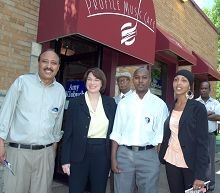
Speaking to community leaders at Profile Café along University Avenue in Minneapolis on Saturday May 27, Amy pledged that in the race for Minnesota U.S. Senate Seat following Mark Dayton’s decision not to seek re-election, she is sure of beating the Republican candidate Mark Kennedy. The Republican candidate is trailing 8 points behind her according to the latest poll of the Wall Street Journal.
She said in spite of Republican heavy weights supporting Kennedy’s campaign, her grass-root support that had only involved one national star Barack Obama, she believes that at the end of the day, Kennedy would be riding a “slow-moving zamboni.” She said she was appealing for support from Minnesotans because she was confident about winning the race. Her campaign had two energetic young ladies, Nimco Ahmed of Somali origin and Semonti Mustaphi whose parents hail from India.
As Minnesota’s Senator, Amy Klobuchar promised to deliver on the following issues: make social security a guarantee, return fiscal discipline to Washington, work for a secure country and safe communities, work for universal health care, strengthen economy with good paying jobs and reduce dependency on foreign oil.
Amy’s grandpa Mike worked as a miner in Ely’s Zenith Mine, her mother Rose was a second grade teacher, and her father Jim was a newspaperman. Amy grew up in the Twin-Cities suburb of Plymouth in a house where her mother still lives. She went to Yale College and the University of Chicago Law School and was elected Hennepin County Attorney in 1998 representing one quarter of the state’s population. In 2002, she became President of Minnesota’s County Attorneys. She believes in hard working American families and tax fairness.
Asked what she would do for Africa if elected Senator, she replied: “I believe that we have to have a very good relationship with Africa. Africa is part of our future and we are part of Africa’s future. That means we are giving aid to Africa to help combat disease, to modernize the countries and we have so many good relations now particularly in Minnesota where we have so many people from Africa who have settled and built their lives here. So I want to continue that good work that Bill Clinton started to have those good relations between our two continents.”
Bill Clinton is remembered for passing through Congress the Africa Growth Opportunity Act (AGOA) that allows sub-Sahara African countries to export their products to the U.S. market duty free and quota free.
Amy Klobuchar also took issue with the two Somali taxi drivers who were brutally murdered in Minnesota and she pursued the killers who were prosecuted and are now serving their prison terms.
She supports the Senate Bill on immigration reform but not the House Bill, maintaining that those immigrants who are hard working and paying taxes should be supported to achieve their American dreams.
On the controversial subject of same sex marriage, she said: “I favor some kind of civil union, but I do not favor same sex marriage. I believe that you should not discriminate against people, but if people have been in a relationship they can visit their loved ones in hospital, they can pass things on to them and you can do that legally by having civil union without having same sex marriage.”
Amy promised to fight to restore equity to our national tax policy by closing the corporate tax loophole that allows big business to set up “paper” headquarters overseas to avoid paying their fair share of taxes. She said she would fight for tax policies that help the middle class.
While acknowledging that in her campaign there are many unfixed problems and missions that are not accomplished under the current Bush administration, she does not intend to wage a negative campaign. Rather while making the case of what is going on in Washington, she will also make the case for her Democratic Party’s progressive agenda and “for me that means affordable universal health care, energy independence, changing course in Iraq and our foreign policy.”
Community leaders mainly from Africa who attended the meeting cheered her enthusiastically and even addressed her as their next Senator as they were sure she would receive the DFL endorsement and win this race against the Republican contender Mark Kennedy.
The chairman of the Independent Nigerian Elections Commission, Professor Maurice Iwu, defended the merits of the electronic voting system (EVS) his commission is in the process of implementing in preparation for next year’s presidential elections, considered crucial by the international community.
The commission that Mr. Iwu chairs has come under close scrutiny with opinions about the biometrics system he is implementing divided. Elections in Nigeria have been marred by allegations of rigging in the past and Mr. Iwu sees EVS as the solution to that. However it is his selling the solution as foolproof that has many concerned. Key to the system is the first ever usage of biometrics to thwart fraud that has marred Nigerian elections in the past.
Prof. Iwu was the chief guest at a symposium titled “Strengthening The Nigerian Democracy: The Challenges of 2007 Elections” held at the end of April in Newark, New Jersey organized by The Institute for Advancement of Democracy (TIAD) and the International Leadership Institute (ILI).
Prof. Iwu told the symposium that key to the use of EVS is the updating of the Electronics Voters Register. He said once updating of the register is complete, the commission will in the future only need to update it and not embark on a whole new registration of voters exercise. He said Nigeria will thus have a ‘permanent register” that will be “upgraded at relevant times”. Use of biometrics will thwart multiple registrations of voters.
The chairman pleaded for his commission to be given a chance and not to be dismissed outright. He said his commission will prove the cynics wrong and that “INEC will conduct a successful election, free of manipulations and fraud”. He said most of the concerns on EVS are driven in part by the Florida experience and the resulting debate on how the US can institute versions of EVS. He said as opposed to many of the solutions proposed by voting administrators in the US, among them not having a printout of who the voter voted for – hence a paper trail, INEC’s EVS solution will have a paper trail.
Prof. Iwu also put to rest fears from symposium participants that unreliable electricity supply in his country will hamper usage of EVS. He said the EVS machines will use cell batteries.
On why Nigerians abroad cannot vote, Mr. Iwu said that was a constitutional matter that his commission has no authority over. Was the constitution to be changed, his commission will then be ready to arrange for Nigerians in the Diaspora to vote. He said however, one has to be cognizant of the logistical challenges that voting abroad presents but can be accomplished.
Professor Attahiru Jega, the symposium’s keynote speaker, said contrary to what many think “there is no democracy in Nigeria” but rather the upcoming elections in 2007 is the process of strengthening the process of democracy. Professor Jega is the Vice-chancellor of Bayero University in Kano, Nigeria. He said Nigerian society has a highly militarized “psyche” because of many years of military rule. This psyche also affects the political class which makes them not to work hard enough to democratize. This is manifested by the lack of interest to make sure that INEC is not well funded as its success will affect the political class’s interests.
During an interview in the weekly “Talking Drum” current affairs program on African Broadcasting Network (ABN-America) hosted by this reporter, Professor Iwu also said he recently formed the Nigerian Electoral Institute in order to provide a more professional approach to elections management in his country. The institute will achieve this by providing courses in electoral studies and training to elections staff in an effort to professionalize them. The institute will also be equipped in the future to provide training to other Electoral Commissions in other countries in Africa.
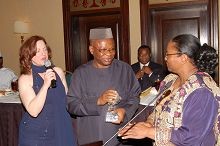
At an evening gala, TIAD and ILI bestowed the “2006 Honoree of The Year” award on Mr. Iwu. During an address, Mr. Iwu revealed that his commission will invite the International Leadership Institute as election monitors. ILI president, Judge (rtd.) LaJune Lange had earlier offered her organization’s expertise in election monitoring during a panel discussion when the question was put to her.
Also attending the symposium gala was the Honorable Wayne Smith, the mayor of Irvington, New Jersey who enthusiastically presented Mr. Iwu with the keys to Irvington City.
Republicans Endorse African Immigrant for Congress
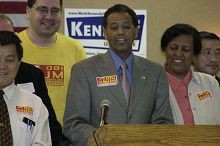
Republicans in Minnesota’s Fourth Congressional District made history on May 20 when they endorsed Obi Sium to run for the seat currently held by three-term Democrat Betty McCollum. Recently, Democrats in Minnesota’s Fifth Congressional District endorsed Keith Ellison to run for Congress. Like Mr. Sium, Mr. Ellison is Black. If they both get elected, they will be the first Black Congressmen to be elected in Minnesota history.
Mr. Sium is a hydrologist for the Minnesota Department of Natural Resources. He immigrated to the United States 32 years ago in search of a better life. He has held many positions with the state, including Floodplain Management Program, Water Resources Engineer and Research Assistant. He became a US citizen in 1982.
The endorsement took place during the 4th District convention held at the Kelly Inn Hotel in St. Paul. Campaign posters lavishly decorated the convention site. The delegates and alternates were in high spirit for the convention. Each one was wearing his/her candidate’s button or sticker. A few stickers read: “Obi for a Better Tomorrow!”, “Obi Sium for U.S. Congress”, “Dave Sina for Congress”. Dave Sina was the challenger to Mr. Sium for the delegate endorsement.
Prior to the election, the two candidates were given fifteen minutes to address the audience. The first to take the floor was Mr. Obi Sium, an emigrant from Eritrea Mr. Sium approached the podium with his wife, Abeba, and few of his supporters.
Obi said he wants “to keep America strong with secured borders, putting the safety of American families first!”
He promised to “say know to the growth and spending of big government, putting the economic safety net of American families first!”
He noted: “I will work hard to make health care insurance affordable, putting the welfare of American families first!”
Obi also said he will “champion to improve K-12 education which is of paramount importance in order to ensure our national security.”
He emphasized he would “help bring about change in the attitude of African nations toward the United States.”
Obi concluded: “I pledge to you and to the citizens of the 4th District in particular and the nation in general that I will work hard to defend the values that made America great and the ideals of freedom and individual liberties in the halls of Congress.”
Next to take the stage was Mr. Dave Sina, a former highway construction business owner who has lived in Shoreview for 47 years.
Mr. Sina said he would support Pro Life and Marriage Amendment – the union of 1 man and 1 woman. Mr. Sina said his platform included: Constitutional Principles upon which this nation was founded, Judicial Accountability and Judicial Reform, United States needs to remain a strong ally to Israel. Asking the delegates to endorse him, he said he would be committed to the people of his District and would send Betty McCollum, the incumbent Senator into retirement if endorsed.
After counting the ballots, the Search & Nominations Committee declared Obi Sium the winner. The delegates awarded Mr. Sium 72% of the votes.
Since deciding to run for the US Congress, Obi has held more than fifteen parades at various locations in St. Paul, including West Side St. Paul, Blooming, Oakdale, Prom Center, Concordia University, Como Park, Arden Hills and Martin Luther King, Jr. Center.
Other locations his parades took place are City of Mendota, City of Falcon Heights, Shoreview, St. Anthony Village, New Brighton, among others.
Obi has helped in the resettlement of Eritrean and Ethiopian immigrants in the Twin Cities for the past few years. He and his spouse of 35 years, Abeba, have three daughters and one son, all grown.
Obi Sium was born in Adengoda, Eritrea and earned a degree in Civil Engineering in 1968 at Haile Selassie I University in Ethiopia. He immigrated to the United States in 1973 and earned a Master’s degree in Hydraulic Engineering in 1975 at the University of Iowa.
The Convention approved the 2006 Platform Committee Report which included among other things, creating jobs and economic security, preserving civil rights and educating our children. Others are strengthening families and communities, protecting the public’s safety, strengthening the rule of law, enjoying and protecting our natural resources, making government better, not larger and defending America at home and abroad.
South Africa’s Consul General, the Honorable Yusuf Omar, was in the Twin Cities on April 26 as the keynote speaker at this year’s Twin Cities International Citizens Awards that is hosted annually by the Minneapolis based International leadership Institute (ILI). The Twin Cities International Citizen Awards honor Twin Citians whose work has contributed significantly to international understanding, cooperation, friendship and development. The awards ceremony was held at the Minneapolis Club.
The awards feature three categories: The Immigrant Achievement Award which is given to foreign-born Twin Citians that have worked towards the promotion of global understanding; The International Citizen Award which is similar to the Immigrant award but given to a US born resident. The third award, Corporate International Award, honors local corporations whose activities promote i9nternational understanding.
Dr. Hong Yang, Director of the China Center at the University of Minnesota was awarded this year’s Immigrant Achievement Award. Through his work at the China Center, he established the US-China Bridges lecture at the university which brings noted speakers from either country. He has also developed opportunities for US students to study in China by help establish the China Study-Abroad program for the University of Minnesota students. Charlie Weaver, the Executive Director of the Minnesota Business Partnership in nominating Dr. Yang for the award said “Dr. Yang has provided extensive leadership in the Twin Cities for the University of Minnesota and educators in China.”
The International Citizen Award was awarded to Gary L. Gandrud, an attorney at the law firm of Faegre & Benson in Minneapolis. He has worked to establish more current connections between the United States and Norway. He helped establish the Norwegian American Foundation which is dedicated to strengthening the business and cultural ties between the two countries. Mr. Gandrud also serves as the president of the New York-based Norwegian American Chamber of Commerce. Mr. Gandrud said international contacts are important and both sides have much to gain.
GE Commercial Finance Fleet Services, through its employees, Wendy Bell, Pamela Buchanan, Paul Kewitsch and Michael Peckenschnneider was awarded the Corporate International Award. Under the leadership of the four employees, a vocational training program has been in development for the last three years in Port Elizabeth in South Africa. The people in the township had no access to computer training and the four gathered software programs and 100 computers are being shipped to them via another GE subsidiary GE Water and Process Technologies.
The Honorable Yusuf Omar, who is based at the South African Consulate in Chicago, commended this year’s awardees for their international efforts to bring about global understanding. The Chicago Consulate serves the Upper Midwest. In his remarks during the gala event to honor the winners, he commended the International Leadership Institute for its work in the international arena. He also outlined some of the investment opportunities available in his country. He also said his government has continued to deliver critical social amenities such as housing and water to its citizenry since majority rule came about in South Africa. He argued that the progress Black majority rule has achieved is often underrated.
International leadership Institute (ILI) president, Judge LaJune Lange, who recently retired from the Hennepin County District Court, quipped that she now has more time on her hands to dedicate fully to ILI work and that “you will be hearing more from me”.
In America the followers of Islam, a faith under fire, abandoning the prevailing dual loyalty to native lands and America is the only path to repair their religion’s terrorism-entangled image.
At the center of an inner-struggle among Muslims is who deserves the first loyalty of the faithful: the native land, Islam or America?
During the third annual Muslim convention held in Minneapolis in mid-April, faith leaders say there’s no contradiction between being a patriotic American and being a good Muslim. The Minnesota chapter of Muslim American Society (MAS-MN), a Virginia-based nonprofit organization organized the event.
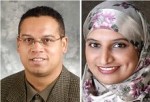
With more than 3,200 people in attendance, the three-day convention featured spiritual lectures, legal clinics, marriage counseling, sports and comedy activities, as well as not so-spiritual Islamic songs. Speakers included over 27 Muslim scholars from around the world and several Minnesota politicians. Chief among them was Democratic state Rep. Keith Ellison, the only Muslim in the state Legislature and a candidate for U.S. Congress.
Muslims vigorously support him because, if he wins, he will not only be the first Muslim elected to the Congress, but he will embody, they say, a desperately needed point of access to levers of power in America.
The ride to reach that goal, however, begins with “a love and loyalty for the new homeland – America,” says Asad Zaman, executive director of the Inver Grove Heights-based Tariq Ibn Ziyad academy, a K-6 charter school administered by MAS-MN.
‘Dual Loyalty’
Muslim leaders agree that, in order to repair Islam’s terrorism-entangled image in America – and in Minnesota, Muslims need to reach out beyond their faith, be more engaged in the larger community and indiscriminately contribute good deeds.
“Muslims should volunteer at non-Muslim charitable organizations such as Boy and Girl Scouts, food shelves and the Red Cross.” says Zaman who serves on the boards of the Minnesota Teaching and Minnesota News Council.
What deprives Muslims from social and political stake in America, Muslim leaders say, is that significant portions of the faithful have one leg in America and the other in the native land, thereby sacrificing much needed, unparalleled loyalty to America.
“Muslim Americans should abandon [such] dual loyalty,” said Abdul Wahid Sheikh-Osman, an Islamic Law scholar and an adjunct professor of law of the University of Minnesota. Instead, he says, Muslims should be stakeholders in the social and political process of America.
Muslims should challenge the system from within, not from outside, he says. He also suggests that Muslim annual conventions should invite non-Muslims to come and learn from Islam, especially families and friends of the American soldiers serving in Muslim countries including Iraq and Afghanistan.
“They need to feel and reflect the faith of the people in the countries where their sons and daughters are serving,” he said of the soldiers’ families. “That might give them a unique prospective of Islam.”
By reaching out to non-Muslim communities, Sheikh-Osman believes that Muslims are slowly, but steadily integrating to the American society, thereby reshaping their image.
Fear of participation
But fear of the government and its sometimes overreaching hand became prevalent among Muslims since Sept.11 terrorists attacks. “Many Muslims believe that no Muslim can accomplish anything in America after Sept. 11, and that’s simply not true,” says Hassan Mohamoud, vice president of MAS-MN and lead organizer of the convention. “We need to defeat that perception.”
To persuade young Muslims of full participation, MAS-MN has been organizing Muslim Day at the state Capitol to coincide with the annual convention. Mohamoud, a Red Cross board member, says the goal is to raise issues and awareness among legislators and to expose young Muslims to the process of democracy and rule of law.
One young Muslim woman appears to have broken the fear of participation. Farheen Hakeem, a spunky 30-year old was a former Minneapolis mayoral candidate who made what’s tantamount to a political earthquake by garnering 14 percent of the primary votes last year. She’s now running for a Hennepin County Commissioner from the Green Party.
Hakeem, who also leads at least half a dozen Muslim Girl Scouts, says her candidacy alone makes a loud statement that Muslims are loyal Americans whose interests could be as patriotic and local as everyone else. She says she’s discontented with how Muslims become synonymous with terrorism. “It’s also a slap on the face of those who assume that Muslim women are unintelligent and extension of their husbands and fathers,” she said.
Born and raised in the Midwest, Hakeem testified before a House Committee recently on the contentious stadium bill. “They stopped chatting and gave me an undivided attention as I started talking,” she said of the committee members, “To them, a head-covered Muslim woman is the unlikely person to talk about stadium bill.”
Hakeem’s identity and seriousness were called into question during the last race by local media. A Pakistani descent, she was conjectured a “Black woman,” and was asked “Is Minneapolis ready for a Muslim woman mayor?” Others derided her garb and her hijab (head scarf.)
Despite all of that, Hakeem says she’s upbeat about her new candidacy and continues to “represent a challenge for local media,” until Islam is no longer seen as an un-American religion, unfit to hold a high-powered political position.
Friendship with other faiths
As the number of Muslims in Minnesota swells to around 150,000 with over 25 mosques and at least two full-time schools, so does their connection with other faith-based groups.
Recently, the Islamic Center of Minnesota (ICM) joined officially the Joint Religious Legislative Council (JLRC), a 33 year-old, faith-based public policy lobby group comprising of Christian (Protestant and Catholic) and Jews.
The new coalition is already jointly lobbying to oppose a bill in the state Legislature requiring local police to enforce immigration violations.
Muslims have also courted a separate friendship with Minnesota Council of Churches. The two sides established a unique taskforce working on strengthening the relationship between them. In a remarkable step, they agreed to celebrate Thanksgiving and Eid-Alfitr, Islam’s second biggest holiday, together every year in November.
Future of a faith under fire
Though leaders at the convention seemed poised to pronounce social and political integration while abandoning the degenerative dual loyalty as the two most pragmatic visions of Muslims in America, they face a challenge from the liberal-leaning culture here, which’s not so conducive to the generally reserved Islamic teachings. A midway path is sought as a workable alternative, Muslim leaders say.
“Support the good; stay away from the bad,” said Zaman, executive director of Tariq Ibn Ziyad school. The nice thing about this country, he says, is that no one will force you to do the bad things, most of the time.
Other Muslim leaders share his view
“Clearly, some aspects of the cultural packages we hauled from our native countries are hindering our smooth integration into the American society as those aspects might no longer be relevant here,” says law professor Sheikh-Osman.
“Under Divine guidance,” says Mohamoud, MAS-MN vice president, “Muslim Americans can be American Muslims.”
"I think it’s more beneficial to be embraced by the audience of the Walker (Art Center) than it is to hang on the walls of the Walker," said photographer, Bill Cottman, responding to the idea of whether or not he’d like to see Africa, Daily Life art exhibit presented at a mainstream gallery. Competent and resourceful, multimedia artist, Mimi Girma adds, "I think the Walker would be lucky to have this exhibit in their gallery."
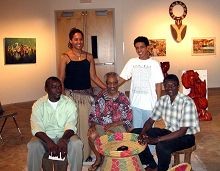
For the month of May, GOSSO displayed their collection at the Mira Gallery in Bloomington, Minnesota. GOSSO represents an assemblage of independent artists working together with the objective of exhibiting their work. The exhibit contemplated the life many Africans leave behind when they emigrate from their homelands to the United States.
Mira Gallery, located in a small, careworn, single-level building, El Colegio, provided a viewing for nine artists who created over 80 pieces of artwork ranging from oils painted on canvas to photography to three-dimensional work using wood or fabric or other natural elements.
On the afternoon of May 27th, half a dozen of the artists met with one another to talk to the public about their work. Usually, discussion centered on artistic expression and experience. Mankwe Ndosi, artistic and managing director at the Center for Independent Artists opened the dialogue. "I think this whole exhibit has very much been about improvisation," said Ndosi, allowing the artists to speak freely about their work.
Once Nigerian John Adesaji began talking, all eyes centered on him. He sat directly in front of some of his paintings, Life in the Village and Market Square. Being an artist in Africa differs from working as an artist in the United States. Adesaji recounted, "the environment is different. Back in Africa, when you look around, you see some drama. There is so little (material goods), people fight for what is available. There’s more time in Africa to produce art (because) there’s less work (for hire)," Adesaji said.
Painter, Aziz Osman who left Somalia first for Europe 20 years ago, then immigrated to the United States observed, "in Europe, you can find help. In the U.S. you can not find help. We never had a problem (in Europe) from lack of support. Gallery shows are very expensive."
These variable factors, that is, the economics of the community and the commitment of society toward sustaining fine arts, affect the artist’s output, so too, does the act of emigrating, itself. "At home, you have a history, an identity. Here, nobody knows your name," commented one artist.
Mimi Girma, one of the curators of the show, observed how the volatile climate of her home country changes even how she or others might view her, thereby regarding her work in a different light. "The very identity of being an Ethiopian is being questioned. I have a country that is falling apart," Girma lamented.
Yet Girma as well as the others recognize the strength in numbers. “One person can do nothing. When you have five or six people, then you can work together,” said Osman as he considered the importance of the GOSSO collective. Girma described how the collective took root at the Fringe Festival, a theatrical festival held in the Twin Cities every summer that includes other fine art endeavors. At the Festival, many artists had opportunity to meet and make connections.
"Most artists want to be seen, want to be exhibited and have their work recognized as having value," said Cottman, the sole African-American in the group. The opportunity to network as well as the desire to show the public their vast creative expression lead to the collaboration of artists who exhibited their work at the Mira Gallery.
Koffi Mbairamadji, native to Chad and the other curator of the show summed up the thoughts held by many others, "seeing this artwork here makes me feel good."
University of Minnesota Names Darlyne Bailey as First African-American Dean of CEHD
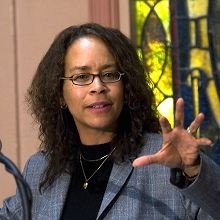
University of Minnesota President Robert Bruininks and Provost Thomas Sullivan today named Darlyne Bailey the dean of the new College of Education and Human Development (CEHD). Her hiring is subject to Board of Regents approval. Bailey becomes both the first female dean and the first African-American dean of CEHD. She currently serves as vice president for academic affairs and dean of Teachers College, Columbia University. Bailey, a nationally recognized education leader, will start on Oct. 1.
"Bringing in Dr. Bailey as the leader of the College of Education and Human Development is a significant step in the University of Minnesota’s journey to become one of the top three public research universities in the world," Bruininks said. "This is a historic moment at the university."
Bailey brings dynamic energy and a profound range of experience and expertise to this new college, Sullivan said. "She’s uniquely suited to lead a college dedicated to developing human potential across the lifespan and to addressing key issues such as educational disparities," Sullivan said. "We’re extremely excited to introduce her to the university community–and to the state of Minnesota, where she’ll be deeply engaged in partnerships with our schools and other institutions."
Bailey will come to lead CEHD as it continues a bold transformation. The college is joining together on July 1 with General College and the College of Human Ecology’s department of family social science and School of Social Work to form a new College of Education and Human Development. The new college is committed to being a world leader in creating and advancing knowledge in the fields of education, family systems, human welfare and human development across the lifespan by conducting rigorous research; identifying and applying creative solutions to the pressing problems of individuals, families, societies and countries in timely, relevant ways; and transmitting knowledge through quality publications and products, teaching and public engagement and the dissemination of research findings.
Bailey said she is thrilled and honored to lead this new college. "This is a once-in-a-lifetime opportunity to build a unique college that will truly make a difference for countless lives. I look forward to the opportunity to work together with such an extraordinary breadth and depth of talent within the college and across the university," she said. "The potential for this new multidisciplinary College of Education and Human development is simply enormous."
The University of Minnesota College of Education and Human Development long been considered among the top public education schools in the country, ranking fifth in the latest U.S. News and World Report survey. Columbia Teacher’s College was ranked second in the same survey among all U.S. colleges, just behind Harvard.
But the integration of CEHD with the university’s General College and the College of Human Ecology’s Department of Family Social Science and School of Social Work have raised expectations that the college can be an even bigger player on the national education stage.
In spring 2003, Bailey served as acting president of the Teachers College at Columbia. From 1994 until 2002, she was dean and professor at the Mandel School of Applied Social Sciences at Case Western Reserve University. She earned a master’s degree in psychiatric social work from Columbia University, and a doctorate in organizational behavior from Case Western Reserve University.
As vice president for academic affairs and dean of Teachers College, Bailey oversees all of the college’s academic departments and programs, the student ombudsperson, the Gottesman Libraries, the Teachers College Record and the Center for Educational Outreach and Innovation, as well as a number of college/community partnerships. She also chairs several collegewide committees and oversees the offices of Enrollment and Student Services, Faculty Policy and Research, Institutional Studies, Sponsored Programs, Teacher Education Support Services, and Doctoral Studies.
At Teachers College, Bailey initiated and oversees what is called the "Teachers College Education Partnership Zone." This partnership is a collaboration among the college, corporations and not-for-profit and faith-based organizations to address the educational needs of elementary school children, their teachers and their families in Harlem, N.Y.
In 2000, one Ohio magazine called Bailey a "rainmaker" for her ability to raise funds. Bailey worked to increase endowment and research funds at Case’s Mandel School of Applied Social Sciences. During her tenure at Teachers College, Bailey helped secure a $10.8 million investment in the college’s National Academy for Excellence in Teaching from the Leeds family to provide professional development for high school teachers in low-income communities throughout New York City.
Bailey has written numerous articles and her two recent books are "Managing Human Resources in the Human Services" and "Strategic Alliances Among Health and Human Services Organizations: From Affiliations to Consolidations."