A group exhibit including paintings, sculpture, photography and artifacts highlighting daily life in African countries is on display at the Mira Gallery of the Instituto de Cultura y Educación in Minneapolis.
Organized by curators Koffi Mbairamadji and Mimi Girma, Africa Daily Life depicts those moments of life that African immigrants fondly remember. The collection also informs the viewer of the rich traditions and varied cultures of such African countries as Nigeria, Ghana, Ethiopia, Somalia and Togo as well as other countries.
A closing public discussion will be held on Saturday, May 27th, 2006 from 3 to 5 p.m. This event will feature artists in dialogue with the public as they discuss their work.
The Gallery is located at 4137 Bloomington Avenue South in Minneapolis. Gallery hours: Monday – Friday 11 a.m. to 2 p.m. and Saturday 10 a.m. to 5 p.m. Admission is free. Some of the works on display are for purchase.
South African Woman in Quest to Bring Taste of Cape Town to U.S.A
Yumna McCann sat at home, missing her mother dearly. She wanted a taste of her mother’s cooking. She wanted something different than the American food she was trying to get accustomed to. She craved the cardamom-fried rice, she craved the fried salmon topped with lemon curry sauce and the spicy potatoes. But she ached for nothing more than the meat and veggie pies Mama used to bake. Then it occurred to her that she could attempt to bake them. After all since she was a 5-year-old girl growing up in Cape Town, South Africa, she had been watching her mother cook.
That was in 2001. She started baking pies.
“The thing with pies is that you can’t just bake one,” said McCann.
So she baked them by the dozen. The pies are filling. So satisfying are they that she couldn’t finish one, let alone a dozen. McCann decided to share her pies with her neighbors and friends. Soon, she was baking and baking and baking to cater to them.
More than five years later, McCann is still baking. Only this time she is baking for the San Francisco Bay Area. And, she wants to get paid for her labor.
McCann is one of the low-income immigrant women who have found a home at La Cocina — Spanish for “the kitchen,” — in the Mission District of San Francisco. The nonprofit organization provides low-rent commercial kitchen space for talented immigrant women and women of color who cannot afford to start their own businesses. The clients, mostly women, pay $15 for every hour at the kitchen. In turn they get a 2,200-square-foot sanitary and licensed place to prepare food, commercial standard equipment, and training on how to start and manage small businesses.
The idea arose out of a Women’s Foundation of California 1999 study that revealed that lack of capital was inhibiting the progress of low-income women, says Program Manager Laurie Mackenzie.
Mackenzie said many of the women La Cocina mentors were cooking food in their homes and selling to neighbors, churches, friends, construction sites and makeshift cuisines. In many areas, conducting such business is illegal. Mackenzie, a former chef herself, says low-income people attempting to launch their own businesses find themselves in competition with people who have more money and education than they.
“We’re trying to even the playing field for those [low in-come] people because it does take such a huge amount of money to invest in a commercial restaurant or food facility,” said Mackenzie. “We’re trying to provide them with access to facilities as well as helping them understand how to navigate the permitting process, the laws and all those things that they have to know to be in the food business.”
La Cocina is still a work in progress. The kitchen has been in operation since 2005. It’s too early to measure its success, said Mackenzie. But the fact that the women who cook there have been able to legitimize their businesses is good news, she said. Aside from mentoring chefs, Mackenzie said, La Cocina’s goal is to bring authentic foods to the Bay Area.
Indeed, there is authenticity. There are women from, Chile, China, Guatemala, Mexico, and a man from the Philippines, among others.
Like all the women at La Cocina, McCann has a strong sense of entrepreneurship and a drive to succeed. She has since started a catering business, Mystipies. Last year at an expo for food business owners who might be interested in buying food from La Cocina clients, San Francisco Mayor Gavin Newsom got a chance to taste McCann’s pies after she squeezed through a crowd, tray in one hand, to reach him. McCann’s husband took a picture of Newsom with the mayor’s hand over his mouth. It was the best pies he had ever tasted, he reportedly said.
“I told my husband, ‘If you don’t get the picture, don’t come home,’” McCann said, as she laughed recalling the incident.
McCann said the industry-standard equipment at the kitchen allow her to cook more than she can at home. She is able to bake up to 600 pies at a time, compared to 25 or so in her home oven.
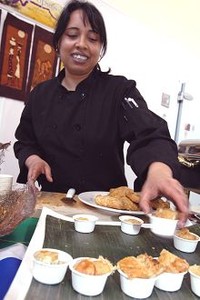
Her business is growing faster than she expected. During this year’s La Cocina expo held in March, McCann stood behind her table handing out samples of her pies. Her chef’s attire was black; the other chef’s wore the traditional white. She served veggie curry, chicken curry, beef curry and chicken and mushrooms pies.
The pies have a unique taste and a soft crust that does not crumble. Most of the people who tasted them said they had never tasted anything similar. Dave Haase for example, had been standing in front of McCann’s table for a while, tasting sample after sample.
“The best part is this crust,” he said pointing at one of two whole pies that are on display. “It’s so… so flaky and crispy, so delicious, which is why I have been standing here for 15 minutes.”
Out of the expo came more potential customers. The manager of Rainbow Grocery, a local independent store gave her an appointment for a possible contract to supply the pies. She has since been delivering 50 pies there every day and they have all sold out.
More businesses have also expressed interest. Gabriela Lozano, a local café owner, did not have to think twice about retailing McCann’s pies.
“More that anything [what’s impressive] is the flavor,” said Lozano. “The taste is amazing.”
If there is any doubt about how unique McCann’s pies are, ask Amy Sherman, a long time San Francisco food critic. Forbes.com voted Sherman’s blog one of the top five food blogs in the country.
“I haven’t tried something particularly like that,” Sherman said about the pies. “Anything that is new and different is going to be of interest. I thought the product was quite good.”
Is McCann prepared should the demand for her pies increase?
Two Films from Africa to Screen at Walker Art Center
The Walker Art Center in Minneapolis has announced its latest edition of Global Lens: Films from the Global Film Initiative. As part of the series, two films from Africa are included.
Challenged by economic hardships, emerging filmmakers from developing countries have found consistent support from the Global Film Initiative (GFI) through grants and distribution. A nationally touring program of GFI-funded projects, the Global Lens series showcases films that address such issues as the fight against patriarchy, class conflicts, and political struggles as well as universal concerns that help to provide cross-cultural understanding.
The series features evening and special daytime screenings for students, including both dramas and comedies with engaging characters telling stories of life in unsettled times.
Global Lens features films from places as far-reaching as Burkina Faso, Israel, Brazil, China, Iran, South Africa, and India, among others.
Acclaimed films in the series from Africa include The Night of Truth (La Nuit de la vérité) directed by Fanta Régina Narco from Burkina Faso, Max and Mona directed by Teddy Mattera from South Africa.
Ticket prices are $8 and $6 for Walker members. Call 612-375-7600 or visit their website at www.walkerart.org/tickets.
The Walker also has free Global Lens screenings for students to help “provide deeper student engagement with contemporary films, cultural perspectives, and world events,” according to the Walker. Teachers can schedule a preview by calling 612-375-7614. More information for educators is also available online at www.globalfilm.org/education.htm.
On June 30th, T&J Entertainment in conjunction with Kilimanjaro Entertainment will host Minnesota’s first Miss Africa beauty pageant at the Minneapolis Convention Centre.
JC of T&J states that an event of this kind has been long in the waiting, “We have a large immigrant community here and just as there is a Miss Hmong Minnesota and a Miss Latina Minnesota there should be a Miss Africa Minnesota”. Last year various African communities like Cameroon, Liberia and Uganda hosted beauty pageants, with T&J organizing the Liberian event.
Both T&J and Kilimanjaro are African entertainment promoters. T&J organizes events mostly for West African communities and Kilimanjaro’s specialty is the East African communities. Early this year they teamed up to bring African entertainment to downtown Minneapolis through “Klub Afrika”, a night of African dance music, every Sunday at the trendy Spirell Bar. Their collective backgrounds in hosting events have been a recipe for success with Klub Afrika and the duo has decided to move on to the next step.
“The Miss Africa Minnesota beauty pageant is part of our effort to promote a positive image of Africa and the African community by increasing our presence downtown,” says JC. “We are no longer an invisible community, we need to garner the attention of mainstream America,” he adds.
So do you have what it takes to be an African Queen? Interested candidates can contact JC at 763-442-945, George “Jojjo” Ndege at 612-382-1549. More information is also available at www.kilimajaroetertainment.com .
United States Spending on Global Democratization Inadequate, says NDI President
To hear Kenneth Wollack tell it, the United States is doing itself a disservice by not spending enough to spread democracy especially in Africa.
The demand for assistance by civil society in Africa “far outstrips the resources the United States has allocated for such undertakings,” he said.
That is not even to mention the critical need for assistance by nascent institutions that the United States has encouraged the formation of.
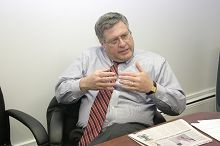
Wollack is the president of the National Democratic Institute based in Washington, DC. NDI is a nonprofit that works to spread and strengthen democracy around the world. Mr. Wollack was speaking at the Mshale editorial office when he visited for an interview with the editorial team. He joined NDI in 1986 as executive vice-president and was elected president by the institute’s board of directors in 1993.
Madeline Albright, former US Secretary of State is the current chairman of the NDI board of directors. In its twenty-two year history, the organization operates in 60 countries, 15 of those being in Africa.
Mr. Wollack said that when the United States has invested time and resources in Africa, it has paid off. One particular reward for NDI’s work in Africa that he readily recalls is South African influence on the North Ireland peace talks. Northern Ireland studied closely the South African experience of reconciliation and reaching accommodation.
Asked whether renewed US interest in Africa particularly in Nigeria had anything to do with oil, he paused and said it is natural for a country like the US to focus on some key countries but that should not be seen as disinterest in other countries. “There is a great appreciation of what happens in others (countries),” he said.
Mr. Wollack believes what happens in one country greatly influences its neighbors. When independence came to Namibia in 1990, the success achieved convinced the international community that black majority rule in South Africa will work.
NDI is currently active in a number of African countries. It is assisting Nigeria in a variety of ways as that country prepares to hold elections next year. Among the programs in place is the assistance his origination is providing to the Nigerian parliament in understanding the budget the government presents. The organization is also assisting Nigerian groups inside the country prepare to observe the upcoming elections. Key to this initiative is assisting them in using information technology to adequately monitor the elections.
Such capacity building strategies and the fact that NDI has an internationalized team has made his organization successful in its efforts, according to Mr. Wollack. Among the people who have worked with NDI in the past include the current president of Ghana, John Kufuor before he became his country’s leader.
Africa is a complex place that many people do not readily grasp, according to the NDI president. He believes however that knowledge of African issues is improving albeit at a slower pace than he would like.
“Humility goes a long way (in NDI’s work). We don’t come with all the answers”, he said. According to him, NDI goes only where they are welcome.
Minnesota immigrants, especially those from Africa, have come across Nimco Ahmed, the dynamic political activist who has dedicated her life to work for the improved welfare of people of color. Nimco who hails from war-ravaged Somalia has made her mark in Minnesota as a power-house in propagating positive civic education to encourage voters pick appropriate candidates who truly represent their specific political agenda.
She believes that without active involvement in politics, and especially during elections through casting their ballot to deserving candidates, the electorate will have abdicated its constitutional responsibility of supporting eligible candidates who truly represent their interests. When you have wrong guys assuming office and being a part of the legislature, she laments that they will pass laws that do not reflect the core values of the people.
The youthful Nimco is currently supporting the candidacy of Amy Klobuchar who is running for United States Senate. Amy Klobuchar is known for her resolve to address issues dearest to communities of color In line with this goal, she is scheduled to have an open dialogue with African community leaders in Minneapolis on May 27.
Nimco speaks very highly of the candidacy of Amy Klobuchar as a person who articulates beautifully those issues affecting people of color. She appeals to this constituency to step up their support for Amy Klobuchar by checking her track record of public service and pass the word around to others so that as a community “we can have strong leadership and representation”.
On the current debate about reforming the immigration law and how to handle “illegal immigrants”, she said her candidate supports hard working immigrants who pay their taxes and believes that they should be accommodated to achieve their American dream.
“Amy Klobuchar is highly qualified, she was able to keep crime down as Hennepin County Prosecutor and during her tenure in office, crime went down by 20 percent. She deserves to move to a higher office and when Senator Mark Dayton retires, she is the best candidate to replace him. Amy Klobuchar speaks from the heart, she speaks for the community, we should send her to Washington for best representation.”
Nimco Ahmed took her first shot in politics when she worked as an organizer during the campaign of a Minnesota Senator, the late Paul Wellstone. He was the source of inspiration for Nimco and when he died in a plane crush, Nimco was devastated. After Wellstone’s death, Nimco threw her energy into youth mobilization to get them involved in the political process. During that time, she co founded the Minnesota chapters of the Minnesota League of Pissed Off Voters and the League of Young Voters in the run up to the 2004 elections.
“I love my job. I work hard seven days a week. It is in my heart – you cannot pick it from books, if you care for people, working long hours for the community becomes a rewarding passion.” That passion has taken her around the country has she has become a high demand field organizer. Last year, she was involved in the mayoral primary race in Pittsburgh, Pennsylvania before being asked to join the campaign team of then candidate John Corzine, the current New Jersey governor. She was in high demand again after coming back to Minnesota as the current campaign season got underway. She got calls from the various campaigns of those running for Minnesota governor before deciding to join the Klobuchar team.
Nimco is well known among immigrants of color and especially her people of the Somali community who constitute one of the largest single ethnic groups among Minnesota immigrants. Coming from such a large constituency, she wields immense political power as a lobbyist. In the local political parlance, she is a political heavy weight of gigantic proportion in-spite of her small body size!
The second youngest of eleven siblings, Nimco resides in Minneapolis with mother, MaryAnn. Asked what her family thinks of her activism, she says “they think I am crazy, they actually call me crazy – but in a loving way.” She says the family does not understand her depth of passion for politics.
She plans to run for office in the future but does not know yet which one she will go for first.
Pastor Bill Heib, from Riverside Ministry Center in Somerset, Wisconsin says that the daughters of these Kenyan women are born with three strikes against them. “They’re born girls, they’re born poor, and they’re parentless.” He’s talking about baby girls born to HIV-positive, poverty-stricken women whose fathers have already died either from AIDS or by some other misfortune. These are the children Lighthouse Ministries International with a dual base in Kenya and Minnesota hopes to rescue.
The idea for LMI began a dozen years ago in the mind and heart of Sandy Karanja, even before she was married to her Kenyan-born husband, Boniface Karanja. During her growing up years, Sandy developed a compassion for the lost and hurting. Sandy tells me, “There is nothing more fulfilling to me, than to see a life that once seemed hopeless, be transformed into a life worth living, with a purpose for the future.”
Thursday evening, April 20th, LMI holds its fourth annual “Shine a Light of Hope to Kenya with Love” fundraiser. Minneapolis Marriott Southwest in Minnetonka provides LMI with a discounted room for the event, which includes a silent auction, dinner, and extensive program featuring keynote speaker, Dr. Mumbi Mwangi, professor of Women’s Studies at the University of St. Cloud.
Paulette Kutzler, known as PK Midday on KTIS Radio, volunteers her time to emcee the fundraiser. Elizabeth Hunnicutt, a professional musician, also performs gratis. Before singing one of her songs, the acoustic guitar players tells the audience, “I would sometimes think, ‘Well, I can’t save the world, so I won’t do anything.’ but Sandy and Boni are doing something…now it’s seven girls, then nine, then who knows.”
Friends, family, and co-workers make up the base of attendants this evening. A little over 100 people pay $50 per dinner seat. That, plus the auction, as well as an end-of-the-evening appeal for donations brings in several thousand dollars. A charity golf event, slated for July 21st, will bring in more needed funds.
Considering that LMI owns eight acres of land over in Kenya with a building that houses six young residents with hopes to increase their occupancy, they need every cent they’re offered. LMI also provides salary for two matrons, three teachers, and a caretaker and boards a pregnant donkey that fortunately works for hay.
Besides working as a program counselor in a group home, Sandy Karanja serves as LMI’s director and program administrator. She runs LMI out of her home office. Boniface Karanja who, when he’s not working full-time at SuperValu Corporation, chairs the board of directors and serves as co-director. The two of them have created a strong community of like-hearted people both here in the United States as well as in Kenya.
While passion for the project is ample, funding has proved difficult. “As far as government subsidies, we haven’t pursued anything for some time,” Boni tells me. “Margaret Bailey Foundation has given us a small amount, but it has been hard. People in Minnesota, they are so good. We are looking for somebody to come help write the grants. We try to get people involved, even Kenyans who live in the Twin Cities. These girls we are reaching in Kenya, they come from all over, including one of the biggest slums in Africa, Kibera,” Boniface adds.
“You don’t know who will be the mover and the shaker [in Kenya] ten years from now,” says Boni, describing the potential impact of LMI’s missionary success. “It could be one of them,” he says, referring to the girls who receive shelter, nourishment and education at LMI’s mission house. “We want to make a place of excellence for these girls.”
Money isn’t the only avenue supporters use to facilitate the work of LMI. Rochelle Kovac, who sits on the board of directors, has traveled to Kenya for short stints in the past. May 5th she’ll fly to Nairobi via Amsterdam to spend six months working on the property, serving as the program director. As such, she’ll be responsible for the spiritual training of the girls and staff members She’ll help manage building projects, interview new girls to join the orphanage, oversee the teachers for the education of the girls, and meet with potential volunteers in Kenya who are willing to assist in helping the orphanage get on it’s feet . Kovac provides the emotional resources, energy and time needed to further the goals of LMI, however, “all of my travel and living costs need to be funded through donations,” says Kovac, “I’ll still have my truck payment to make here in the States while I’m over there in Kenya.”
Cathy Fernjack, friend of the Karanjas for the past nine years, is also scheduled to travel with Kovac, but for a two and a half-week mission trip. “I love kids. God has placed on my heart a love for children and orphans. I’ll help however I’m needed,” Fernjack tells me over our catered dinner. Watching her interact with coos and inviting smiles for our tablemate, eight-month-old Natalie, confirms Fernjack’s passion for children. When not cuddling the children of Kenya, the short-term missionaries can also expect to do a little landscaping and work on the buildings.
In a country of almost 35 million people, the Karanja’s goals are modest—shelter 80 young girls, provide them with an education as well as a Christian foundation–but in light of the fact that they are doing it all on their own, through sheer willpower and the generosity of others, their present and future accomplishments take on great significance.
Read highlights of Dr. Mumbi Mwangi’s keynote address and a poem she read during the event here.
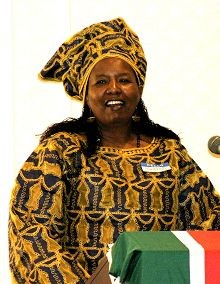
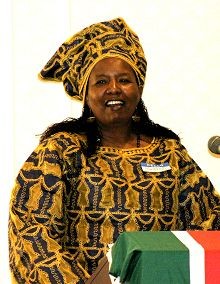
Dr. Mumbi Mwangi of St. Cloud State University speaking at the Light House Ministries International event. Photo: Susan Budig/Mshale
Dr. Mumbi Mwangi of St. Cloud State University speaking at the Light House Ministries International event. Photo: Susan Budig/Mshale
Dr. Mumbi Mwangi speaks of domesticity in Kenya as both encompassing motherhood as well as defining a woman’s place in the home. She doesn’t have a problem with that. The trouble begins, says Mwangi, with the idea that domesticity and motherhood are incompatible with education.
Even more dire, Mwangi inveighs the mind-set of African culture, which implies that one cannot be a woman without being a mother. Girls don’t have a way of aspiring to be anything different, that is, to be something other than a mother. Those few women who do reach for more are severely ostracized and punished, Mwangi tell her audience.
Mwangi provides us with a brief history of the image of women in post-colonial Africa. The prototype of the African woman remains strong today as in the past when girls dropped out of school and married young in order to begin a family. These girls performed domestic chores at the expense of education and self-betterment. Not much is different today, Mwangi laments. In fact, in Kenya, along with 22 other African countries, 45% of girls do not continue their education beyond primary school.
Change, the professor believes, would strike more rapidly if women’s issues became national issues for all of Africa. As it is now, women’s issues are not part of the national problem; they are insignificant. “The government does not consider women’s issues despite that the government is suppose to take care of all of it’s citizens,” Mwangi says. “Girls are considered not much more than property,” Mwangi bemoans.
Dr. Mumbi Mwangi emigrated to the United States in 1998, finishing her doctorate at Iowa State University in 2002. She currently serves as assistant professor at St. Cloud State University in the Women’s Studies Program.
She ends her keynote address with a poignant poem written by a young African girl.
AM NOT A TOY
Father I’m not a toy
Just because I’m not a boy
Brother I’m not a toy
Just because I’m not a boy
Mama I’m not a toy
Let me to be your joy
Father I’m your child
Trying to do my best
But heart heaves with pain
When I hear the clans’ cry
That nothing from me
Will they gain
Clouds swell with rain
But the future at my feet is slain
Why can’t I school with you?
Can’t I number woo?
Can’t I drive a trailer too?
Can’t I drive a Mercedes too?
To train a woman
You train a nation
A girl child is a GEM in waiting
To train a girl is not an option
To train a girl is an obligation
People listen to me
I want to see my dreams come true
To make decisions too
I desire to make a choice
Give me the chance to choose
After one small store of 500 square feet, Edoh Akakpo has quickly become a major player in the African grocery store business in the Twin Cities. The jovial Mr. Akakpo, the owner of the African Market on Nicollet avenue, five blocks from the southern tip of downtown Minneapolis recently opened a second store in Brooklyn Park, the northwest suburb with a large concentration of the African immigrant middle class.
He has prospered since opening his Nicollet avenue store but despite the second store’s opening, his real passion has been in running his own restaurant. Hence the opening of the new Akwaaba restaurant adjacent to his Nicollet Avenue store. He had a soft opening in March and is planning a grad opening on June 1 to coincide with the soccer world cup. Akwaaba means welcome in the Twi language of Ghana.
With four years running a retail store, Mr. Akakpo felt the time was right to realize his dream. He called Mshale a day after his unannounced soft opening wondering why we had not stopped in to see his new restaurant “given that you are just two blocks from me”, he asked.
His Nicollet Avenue store is a popular destination for the African professional class that works downtown. He has been able to win their loyalty by maintaining a clean environment. One is unlikely to find food that has that suspicious look of being past the sell by date or stork fish sitting in the open. “I run a professional operation here, man,” he proudly states.
He does not believe in being penny wise and pound foolish. When he recently opened the Brooklyn Park store, he did not hesitate to spend the money to put up a modern and expensive looking neon sign for the store. He would not reveal how much he spent on it but a quick check with area sign companies provides a range of 5,000 to $7,000 for a similar sized sign. He put up the sign a few weeks after opening the store and traffic quadrupled immediately after the sign went up. “People know when you are serious, and they will reward you with their patronage”, he says.
He says it has taken him a while to get into the restaurant business because of the capital outlay that is required. Banks are hesitant to give restaurant loans because of the high failure rate. Besides, he says he has been reluctant to get tied up in business loans anymore. When he opened his first store, he received a Minneapolis city loan around the time the city was encouraging new businesses to locate on what is now called “Eat Street”. The area had decayed over a number of years and new immigrants have helped revitalize it. Although he has since repaid that loan, he is not looking forward to any new loans. The new restaurant has been financed by earnings from his first store. The restaurant has the look of a work in progress. He is furnishing the store as the earnings come in from both the store and the restaurant.
Her hopes to replicate the success he has experienced with the store into his new venture. He says “I am not afraid to do whatever it takes, to make it work.” His success is rare in the African grocery business community. He moved from 500 square feet at his first store to a five fold expansion of 2,500 square feet in two years. Many store owners struggle for 3-5 years before they can afford to expand their space. He does benefit from the foot traffic given his prime location near downtown. At any given time, those coming through his store are there for convenience store type items.
Mr. Akakpo, an alumnus of Augsburg College in Minneapolis, is one businessperson that is not afraid of the big boys. He will gladly price match an item for you if you find it lower elsewhere. He says many customers are surprised with this approach given that it is not common with other African stores. “Some will take advantage of it, but in the end they respect us, I will even match Wal-Mart”, he states. On this particular day, a customer was in to buy an African DVD movie and was a bit taken a back that Mr. Akakpo’s store was $3 cheaper. The customer quickly bought two copies after verifying it was indeed the same product and was not a bootleg.
In his new restaurant, he hopes to capitalize on the foot traffic and his own customer base. He has slowly built a clientele of African-Americans who come to the soul food restaurant next to him. They come in to buy some of the food and spices and also to get a “connection to the homeland”. He says now they can also try the cooked food. Those who have stopped in since the restaurant soft opened “like the food and atmosphere, especially the decorations,” he states. Each wall is decorated with African masks and clothing. There is a space created where the big screen LCD TV will go he says “in time for the world cup”.
Akwaaba restaurant serves among other things on the menu, Fufu with goat meat stew, Fried plantain (aloko) with fried fish, Attieke (grated cassava) with fried fish, Rice mixed with beans (Watche), Kenkey with pepper soup and the ever popular jollof rice with beef.
“For as little as $8, they can eat a lot, please tell them to come”, Mr. Akakpo says as we say our goodbyes.
Akwaaba Restaurant is located at 1823 Nicollet Avenue in Minneapolis.
Annan Stresses Global Approach During Launch of Institute for Global Citizenship
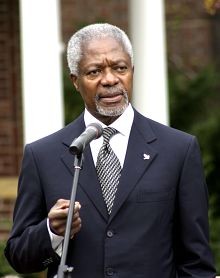
United Nations Secretary-General, Kofi Annan has cited the war in Iraq as his greatest disappointment during his tenure at the helm of the world body. Mr. Annan was speaking at Macalester College in Saint Paul, Minnesota when he addressed the convocation ceremony to launch the college’s new Institute for Global Citizenship. The Secretary-General graduated from the college in 1961.
"It was a very painful experience for me, personally, because I thought we should have been able to avoid the war," he said at the College’s Filed House where the convocation was held. He said the division preceding the war and the ensuing destructive debates made that period his greatest disappointment as Secretary-General. He will have served two terms for ten years when he retires at the end of this year. He is the seventh person to occupy the post.
He praised Macalester College for its formation of the new institute and recalled how even in 1959 when he first came to the college, the spirit of internationalism and global outlook was very much present.
“Its launch could hardly come at a more crucial time in the life of the international community in general, and the United Nations in particular. More than ever before, the human race faces global problems – from poverty and inequality to nuclear proliferation, from climate change to bird flu, from terrorism to HIV/AIDS, from ethnic cleansing and genocide to trafficking in the lives and bodies of human beings. We need to come together and work out global solutions,” he told the packed Filed House gymnasium. About 2,000 students and guests attended the convocation.
With the advent of globalization, Mr. Annan said now more than ever is important to understand other cultures. He said those going through the institute will help dispel some myths about America, “the perception of an insular America with no interest in or understanding of the world beyond these shores,” he said.
He reminded the audience that the UN consists “of your government and mine” and not to view it as some autonomous body that functions independent of the world community. He said calls for the UN to stop the Iraq war do not make sense because “we didn’t start it so we can’t stop it”; he said but added that the world body is working jointly with the rest of the world to bring peace to the region as the world cannot afford a destabilized Iraq.
He told the friendly and admiring crowd “I hope you will always look to the United Nations as a forum in which Americans, along with all the world’s other peoples, can work together for freedom, prosperity and peace.”
Mr. Annan started his day at Macalester by raising a new UN flag at the school which the college’s president, Brian Rosenberg said was a demonstration of the school’s commitment to internationalism. Five students from the college’s UN Model Club, Sheena Paul, Jess Hasken, Paul Bisca, Henrik Hakonsen and Momcil Jelev assisted him in the flag raising. A bag pipe player preceded the event. As the flag reached the top just under the US flag, the sun immediately cut through the cloudy morning.
Among the friendly faces there to hear Mr. Annan speak was Macalester sophomore, Kalii Massey of Peoria, Illinois. She said seeing Mr. Annan speaking was worth giving up a Saturday morning, “I have never heard him speak and the fact that Macalester is known around the world because of him is really great”, she said.
To start the convocation ceremony, students carrying their countries’ flags marched behind the bagpipe players. Prayers at the convocation were said in four world languages by students, Korean, Slovakian, English and Kofi Annan’s own native Ga by Edinam Agbenyeke.
Mr. Annan also held a press conference at Macalester. Answering questions, he defended the UN against what he called “politically motivated and orchestrated” campaigns against the world body. He was referring to among others the oil for food program in which the UN personnel were accused of corruption. Minnesota US Senator Norm Coleman as chair of the senate investigations subcommittee even called for Mr. Annan’s resignation in 2004.
Mr. Annan was asked at the press conference what his relationship is like with Senator Coleman to which he responded “I can’t say we have a relationship,” an indication that the differences are yet to be resolved. He said he has very good relationships with former Vice-president, Walter Mondale who is from Minnesota and the late Senator Paul Wellstone adding that “This is a state that produces outstanding politicians and senators”, when he referred to the two.
While admitting a few UN staffers may have benefited from the oil for food program, he asked the journalists to keep things in perspective, reminding them that out of the US$65 billion program, UN staffers are accused of having benefited to the tune of $150,000. He said that did not rise to the level of branding the UN as a den of thieves. Most of the blame he said should go to the private companies that manipulated the program.
Responding to a question from Mshale, Mr. Annan said the United States gets blamed for many things but it should not be blamed for the failure of the UN to expand to eight the number of permanent security council members. He said that the inability to achieve the expansion is due to differences among member countries. He however said the current composition of the five permanent Security Council members does not reflect the geopolitical realties of the present world. He described it as a “democracy deficit”.
The Institute for Global Citizenship will be under the leadership of Dean Ahmed I. Samatar, who Mr. Annan quipped during a student question and answer session at Field House, could decide whether he (Mr. Annan) comes to teach at Macalester as a visiting lecturer. He was responding to a question from a student about his post retirement plans. Mr. Samatar, a native of Somalia, is the Dean of International Studies and Programming at Macalester.
Also at Macalester, Mr. Annan attended an invitation only luncheon hosted by the Caux Round Table, an international network of business and political leaders advocating an ethical approach to capitalism. The organization awarded him its 2006 Award for Principled Leadership. Also attending the luncheon was Saint Paul mayor, Chris Coleman, who issued a proclamation declaring the day (April 22, 2006) as Kofi Annan Day in his city. The mayor, whose city has a big population of Hmong immigrants told Mr. Annan he will be seeking his help in pushing for an investigation into reports of Hmong graves desecration taking place at a refugee camp in Thailand.
Mayor Coleman, who is not related to Senator Norm Coleman jokingly made sure he reminded the Secretary-general that point. Senator Coleman is also a former Saint Paul mayor.
After concluding his visit to Macalester, Mr. Annan made his way across the Mississippi river on I-94, under heavy security by the Minnesota State Patrol and his security detail to the Walker Art Center. The State Department’s Diplomatic Security Service (DSS) is responsible for the UN Secretary General’s security while within the borders of the United States.
At the Walker, he was given a private tour by Director Kathy Halbreich.
Visit the Picture Gallery at Mshale.com for more images from Mr. Annan’s visit.
U.S. Bank received an appreciation award from the Lake Street Council in Minneapolis recently. The award was given to U.S. Bank during the council’s annual meeting at the Lyndale VFW.
“This award is an expression of thanks from the Lake Street Council to U.S. Bank and its commitment to Lake Street,” said Joyce Wisdom, executive director of the Lake Street Council. “U.S. Bank donated office space to our organization and provided much needed financial support in the form of equity equivalent investments for the corridor during road construction. During construction, the U.S. Bank team shared parking spaces with other local businesses. They also participated in the celebration to welcome Metro Transit Commission buses back to Lake Street when construction was complete.”
“The Lake Street community is a vibrant and vital part of Minneapolis,” said Christine Hobrough, regional market manager in the Twin Cities. “The U.S. Bank team in the Lake Street neighborhood has been led by Marty Shimko, branch manager at the 919 E. Lake Street location. U.S. Bank proudly supports the Lake Street Council and its efforts to make the neighborhood stronger.”
Accepting the award on behalf of U.S. Bank were Hobrough; Shimko; Vicki Shipley, vice president and community development manager; Rafael Quintero, community business banking officer; and Matt Thompson, metro district manager for retail banking.
U.S. Bancorp is the 6th largest financial holding company in the United States.
Picture Caption: Vicki Shipley, U.S. Bank Community Development; Joyce Widsom, executive driector, Lake Street Council (holding award); Marty Shimko, U.S. Bank branch manager at 919 E. Lake St., Minneapolis; Christine Hobrough, regional market manager for U.S. Bank in the Twin Citiesand Matt Thompson, metro west district manager for retail banking, U.S. Bank. Gary Schiff, Minneapolis City Councilmember, is in the background (left).