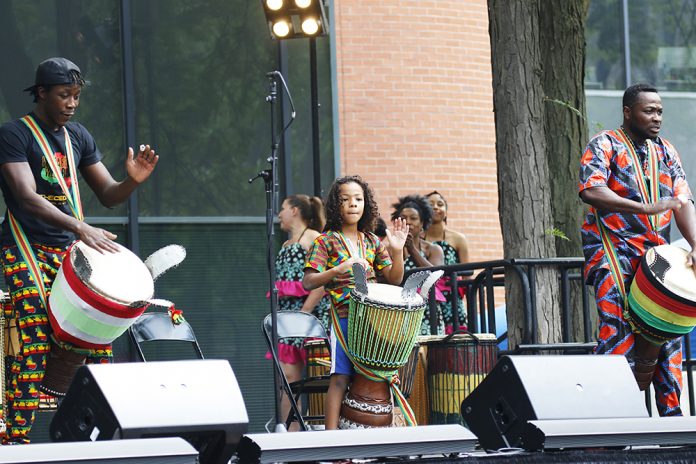
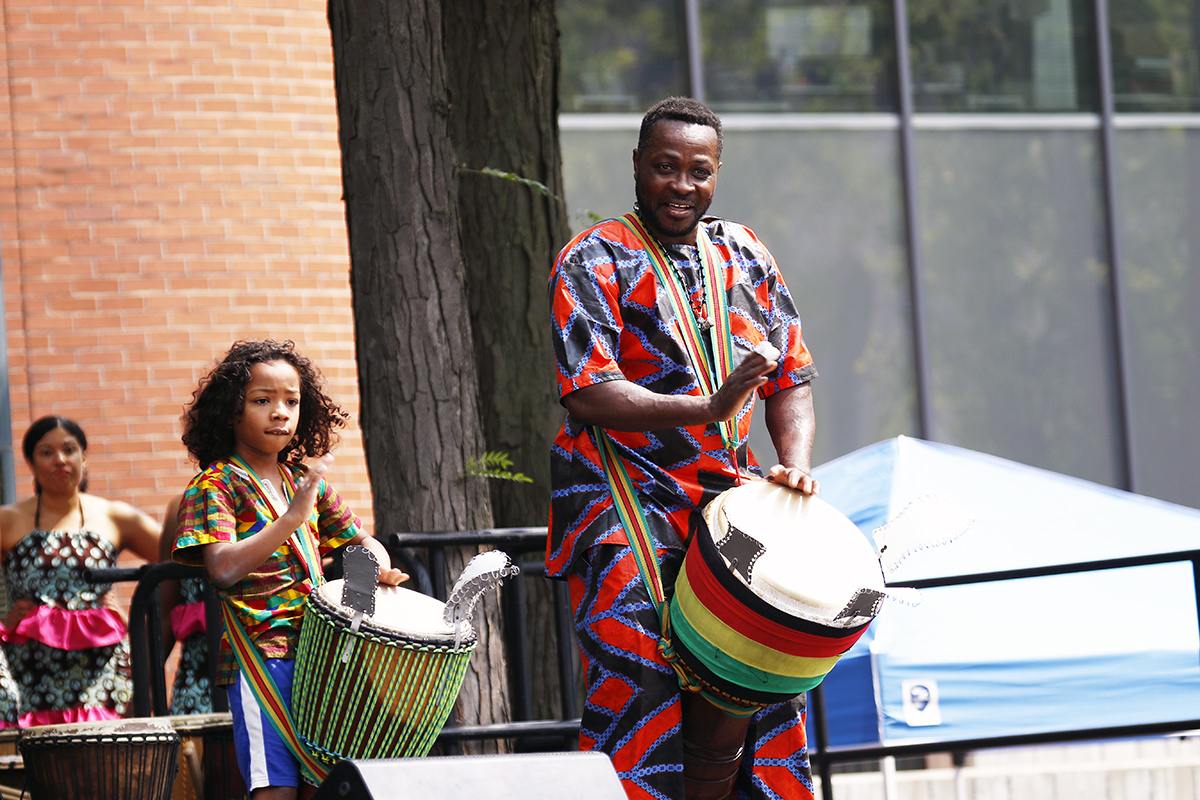
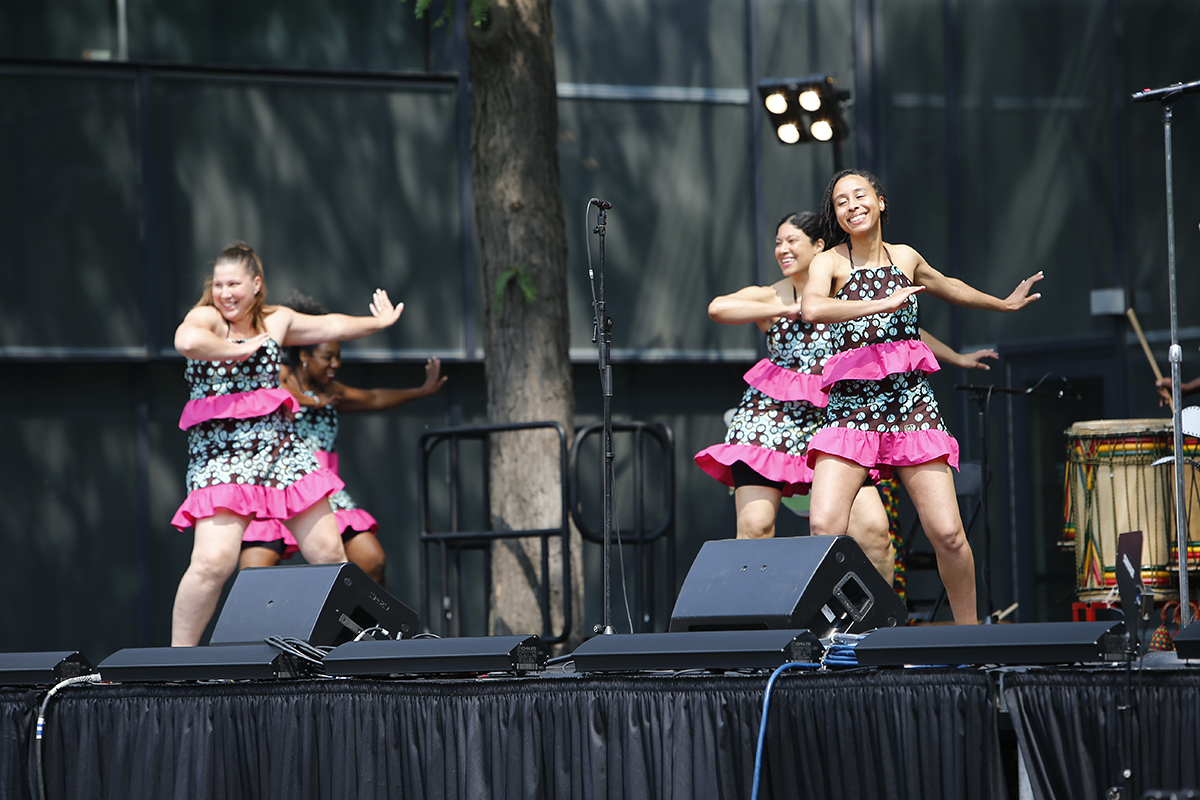
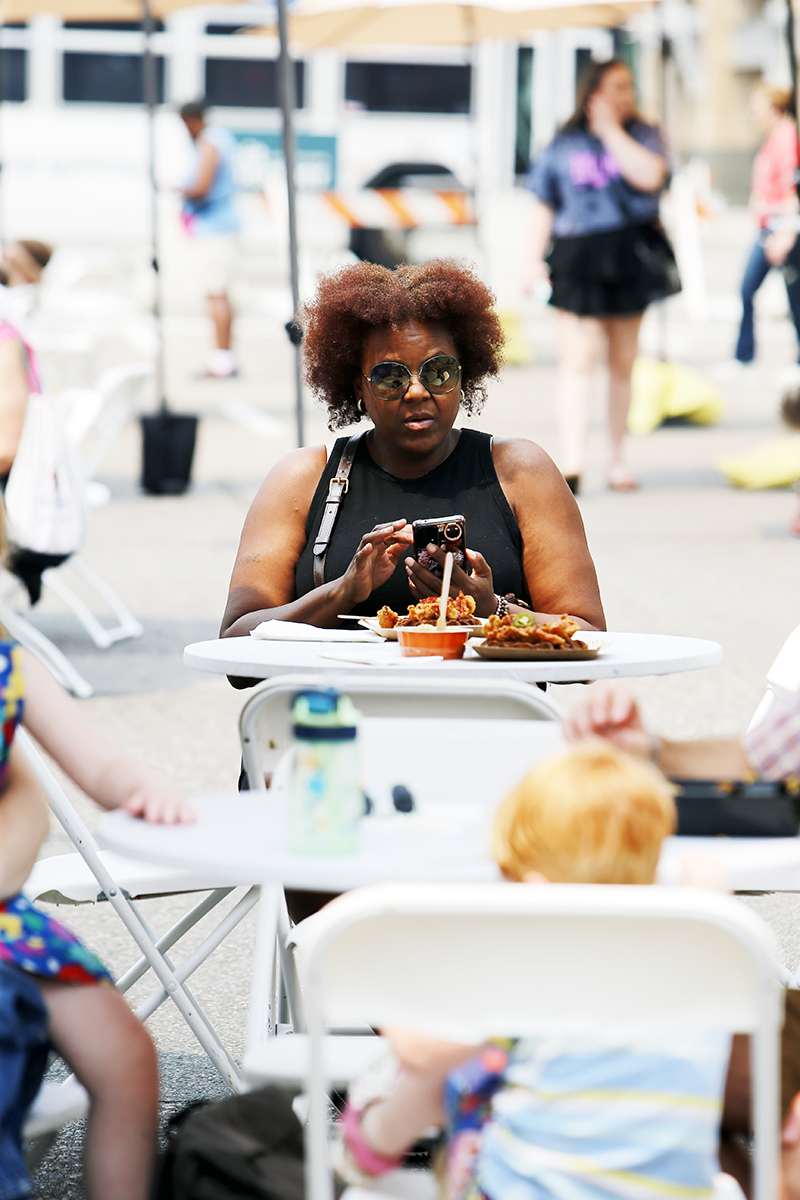
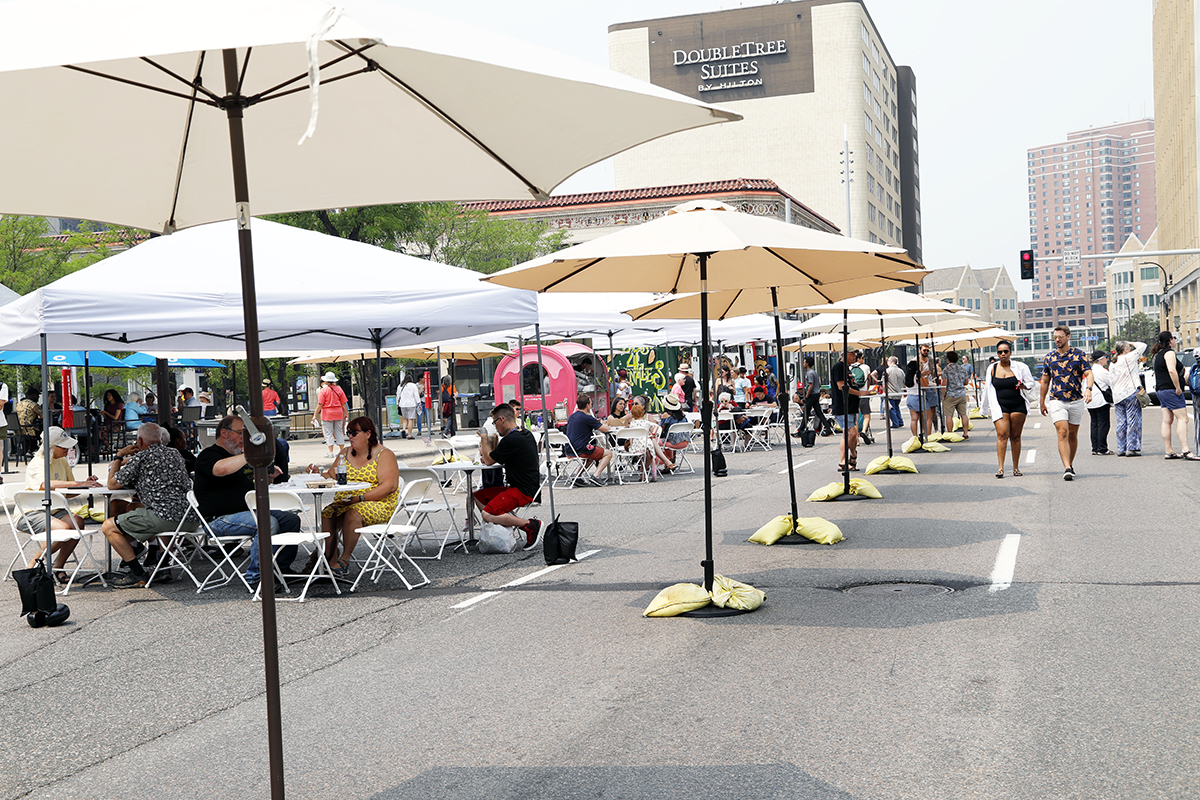
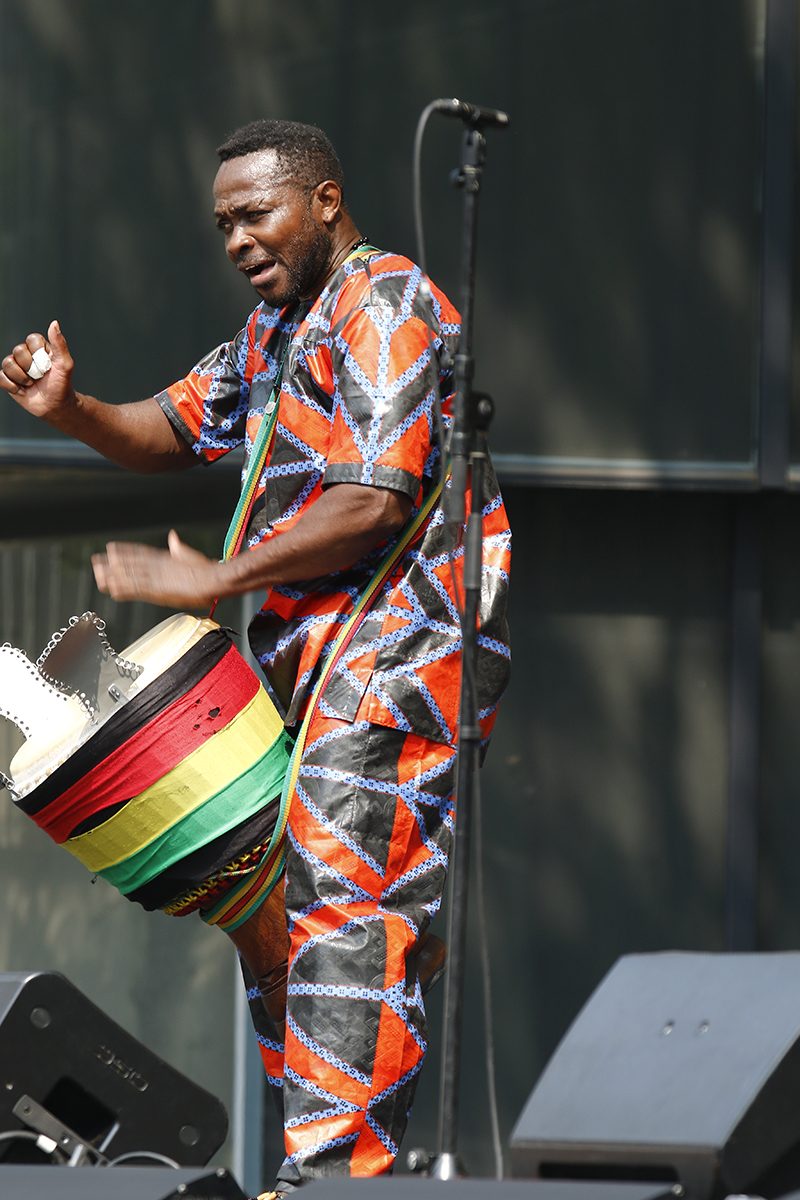
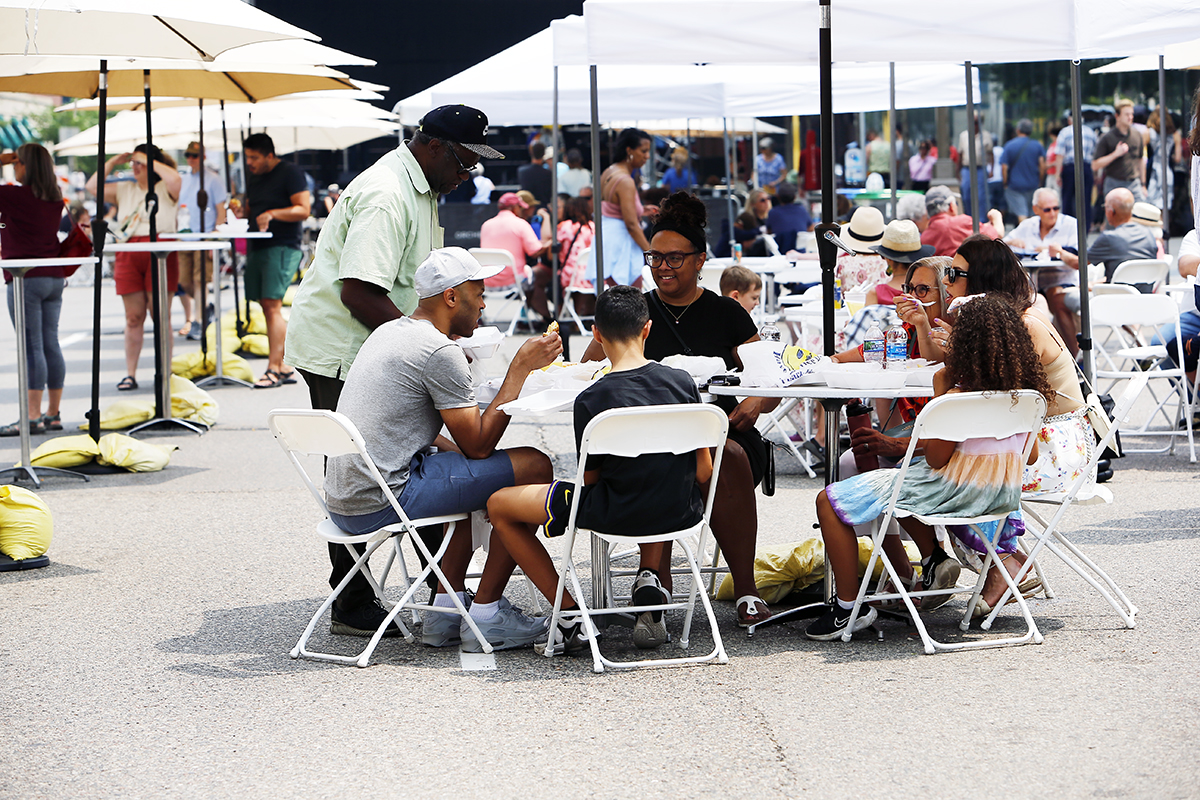
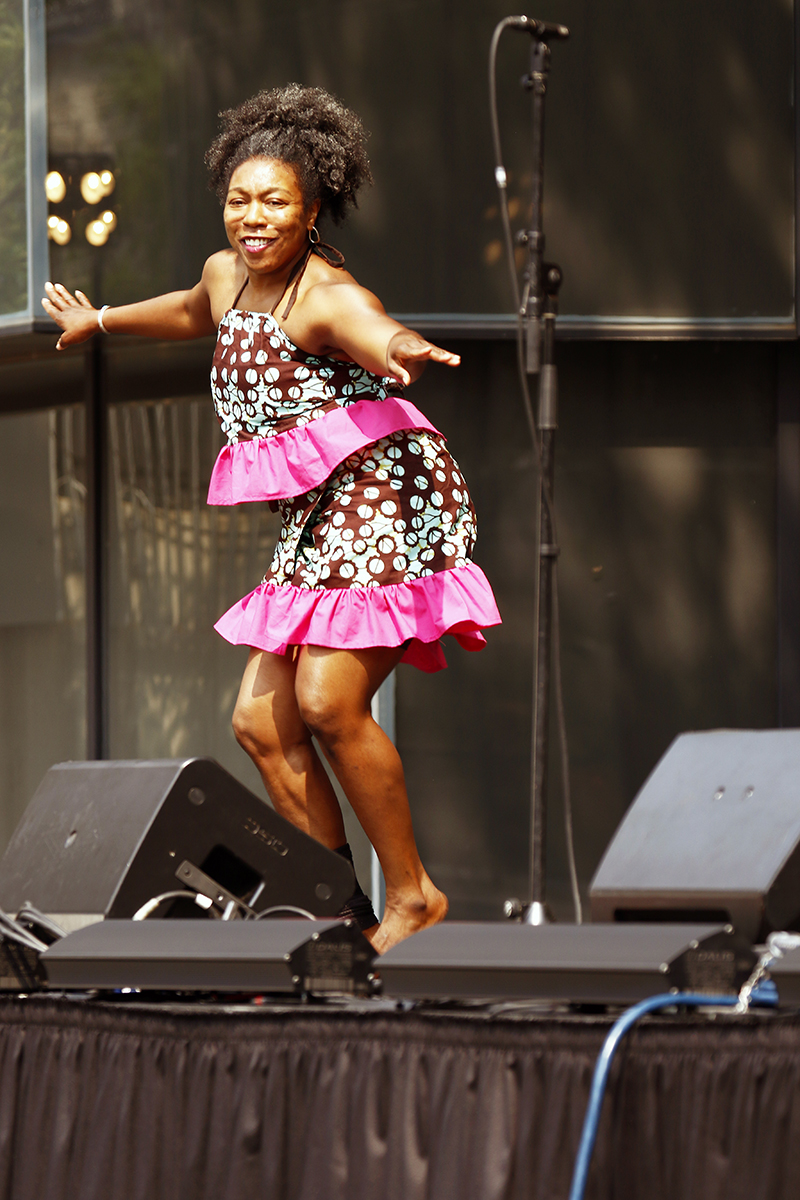
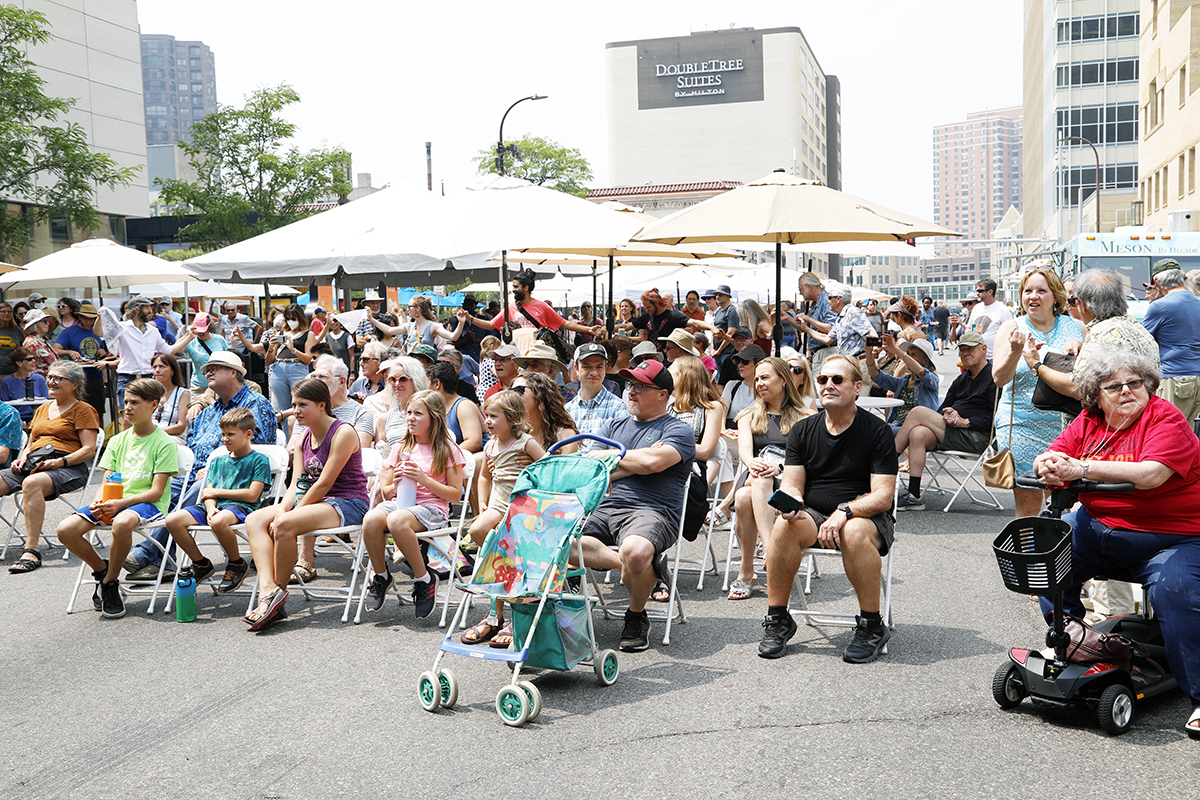
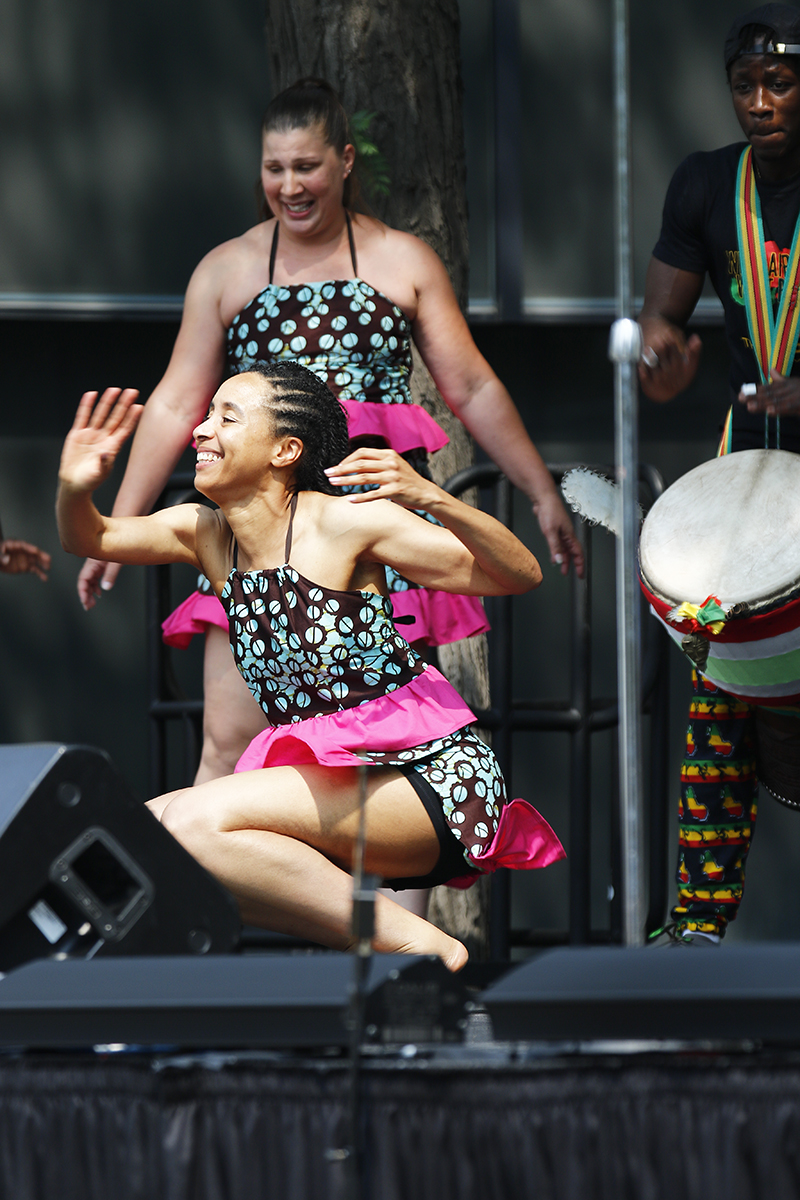
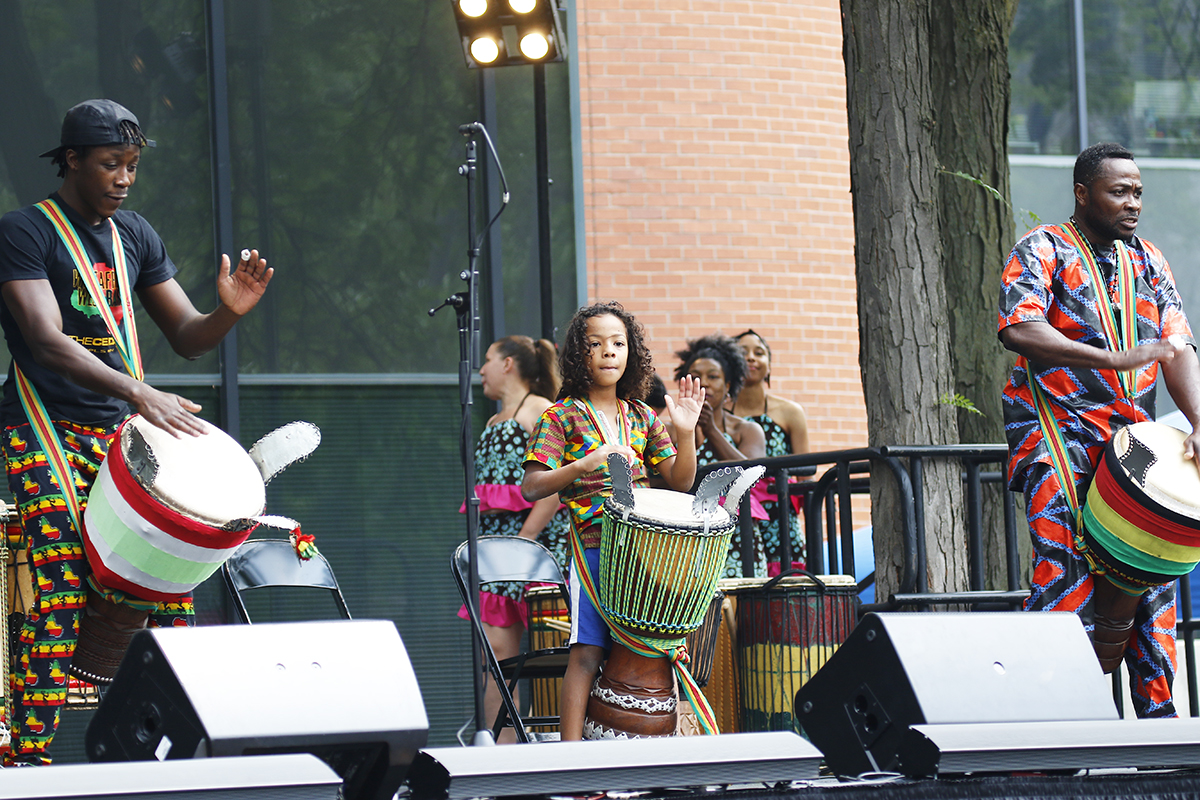
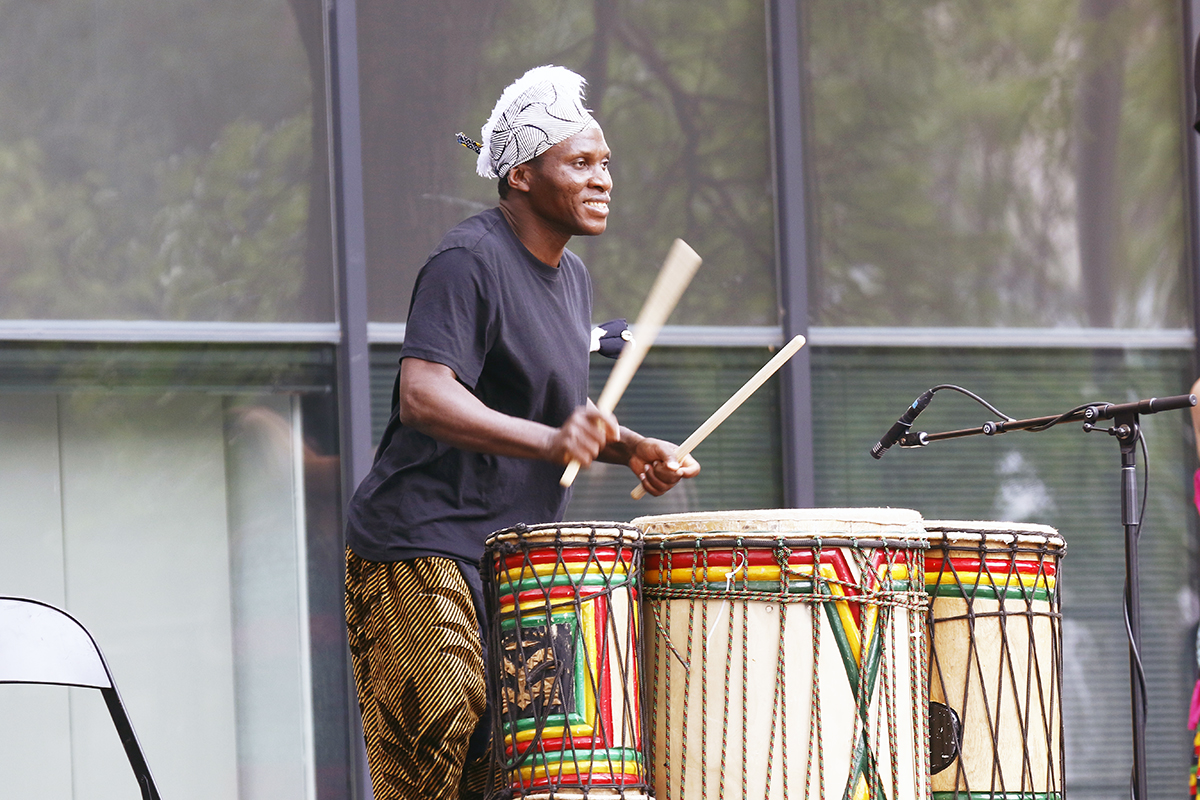
Duniya Drum and Dance Company drummers perform outside Peavey Plaza on Nicollet Mall in Minneapolis during International Day of Music on Saturday, July 15, 2023. The annual event marks the beginning of Orchestra Hall’s summer season. Photo: Richard Ooga/Mshale
Duniya Drum and Dance Company drummers perform outside Peavey Plaza on Nicollet Mall in Minneapolis during International Day of Music on Saturday, July 15, 2023. The annual event marks the beginning of Orchestra Hall’s summer season. Photo: Richard Ooga/Mshale
International Day of Music, hosted by Orchestra Hall with programming partners, BRKFST Dance Company, the Cedar Cultural Center, and City of Bells provided a platform for the rich diversity of artistic talent that exists here in Minneapolis and St. Paul.
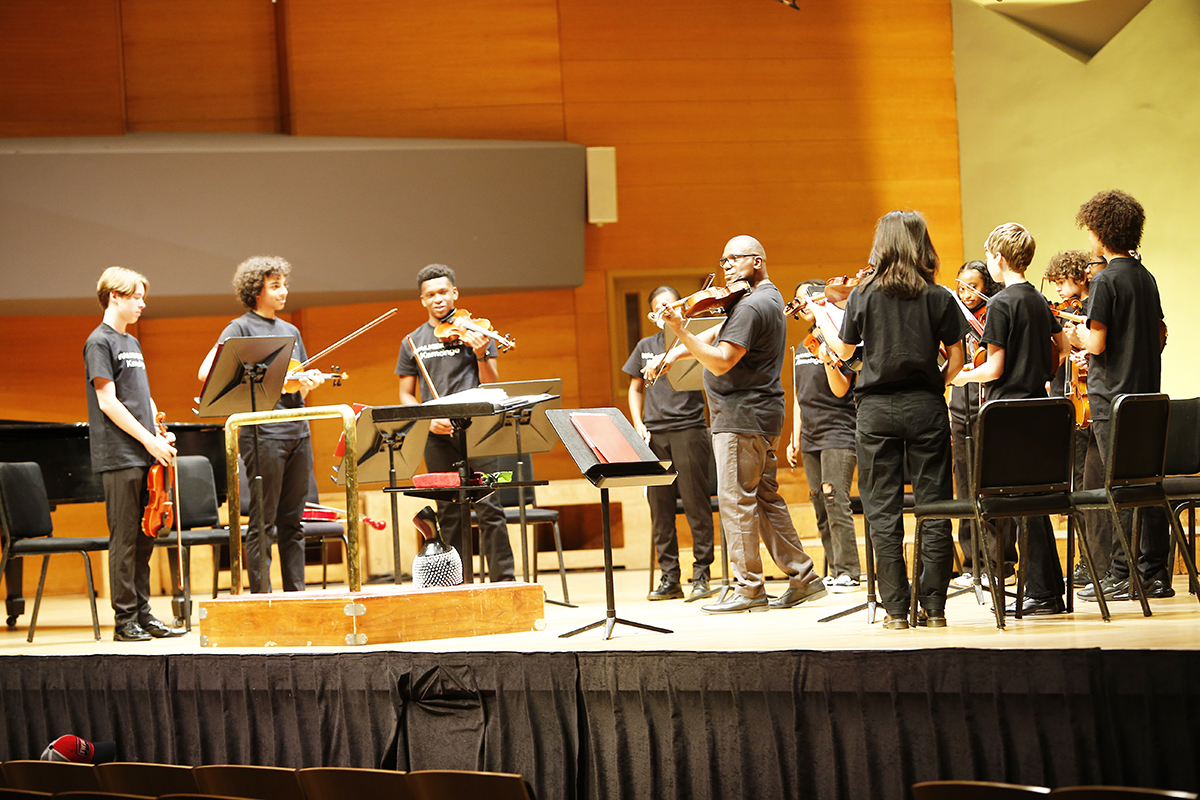
On Nicollet Mall and 11th Street Saturday, July 15th, in the same space as Orchestra Hall, music from the Democratic Republic of Congo and Ukraine, Chile, India, Guinea, England, and other countries could be heard.
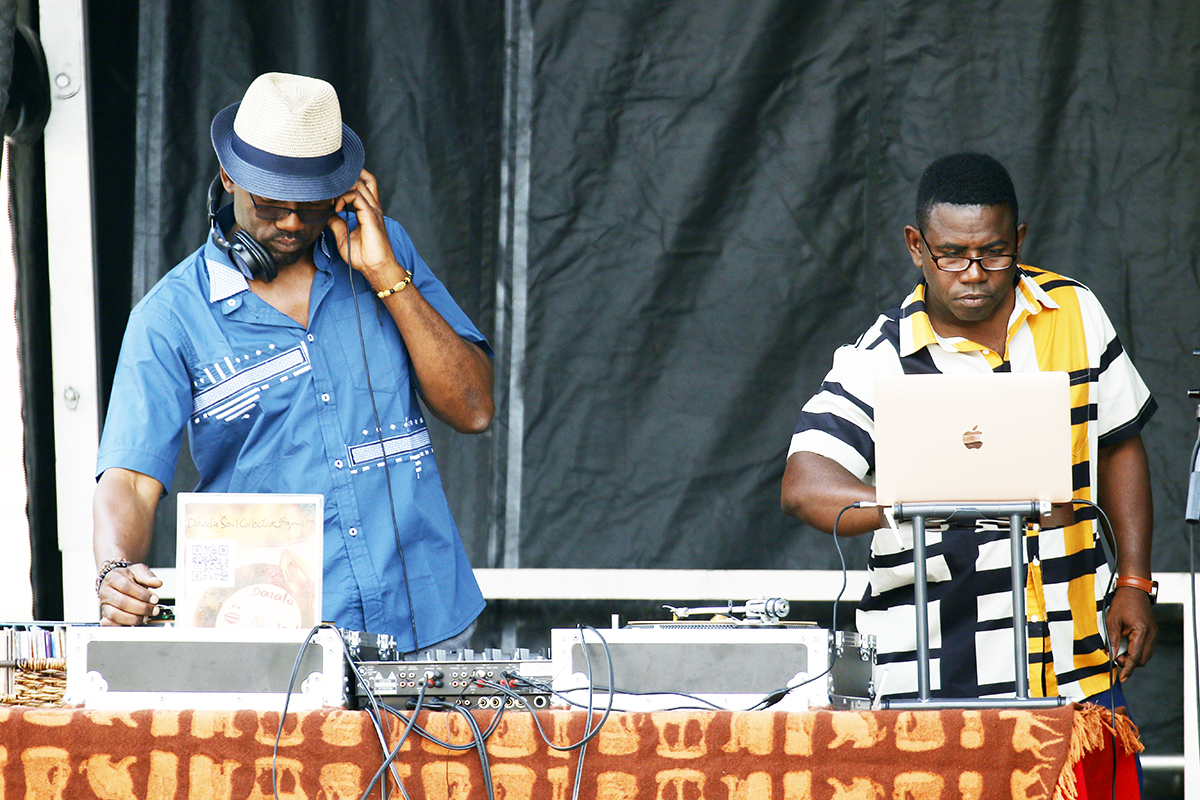
Instead of violins and double-basses carrying the tune, vinyl records spun, sound machines queued, and djembe beats bounced off all the surfaces at Peavey Plaza.
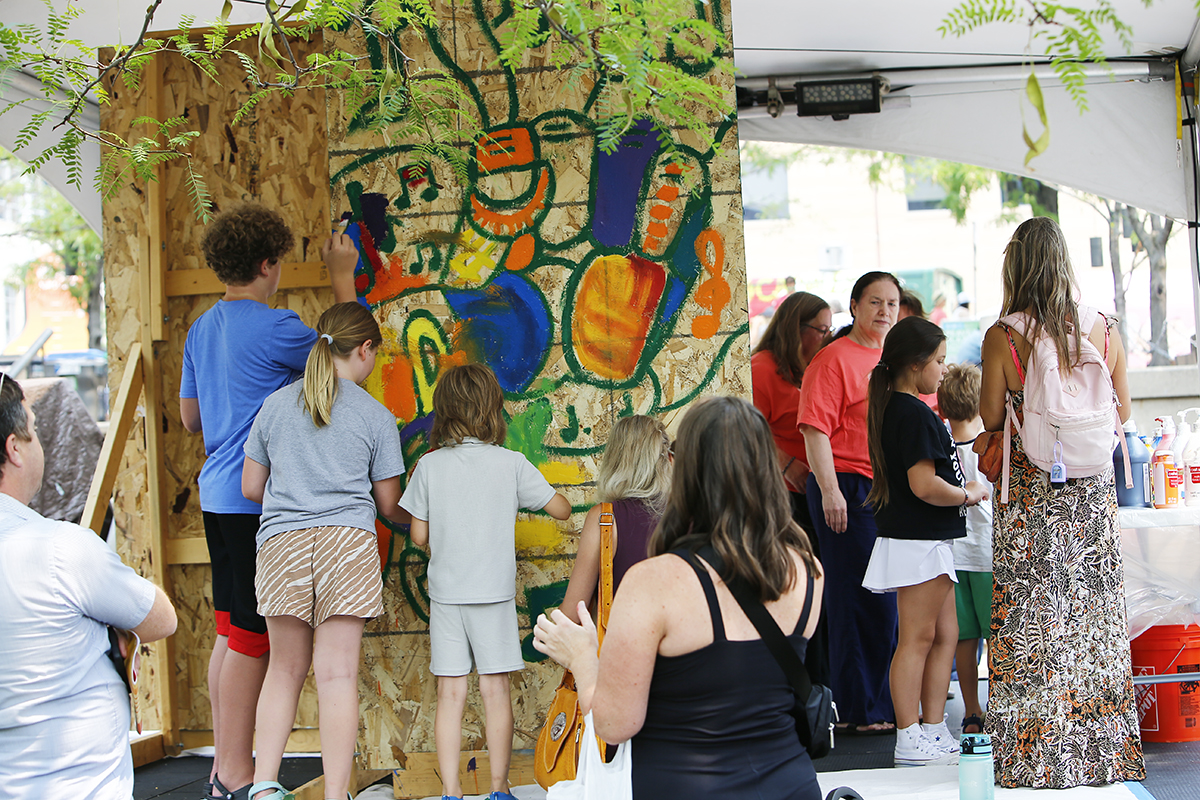
Through the power of music and dance performed by representatives of each of these countries, Minneapolis hummed with an International voice. People in the audience danced, swayed, clapped, shouted, whistled, and jumped as they listened to music and watched dancing and drumming from 25 different countries over a twelve-hour span.
Of a trio of grey-haired or no-haired music aficionados who arrived early, two of them had never heard of the scheduled acts at the Atrium stage, but they trusted the sound to be exciting as they’d been attending this event for many years.
Renamed several times, International Day of Music marks the beginning of Orchestra Hall’s summer season. As the Twin Cities has moved into a more cosmopolitan citizenry so has the festival’s output grown more diverse and inclusive.
Dumont Doumbe, one half of the duo that comprises Douala Soul Collective, said they spin according to the vibe they feel from the crowd. Slotted into the morning session, the crowd was still waking up, yet there were a few dancers who used their smiles to invite others to join them as they grooved to the DJs’ tunes.
While attendance was never shoulder-to-shoulder, it was up from previous years of the pandemic. This year, however, was hampered by air quality alerts, primarily impacted by the wildfires in Canada. Saturday’s rating was yellow indicating a moderate air quality with an AQI of 66. Some people wore masks out of caution against the pollution.
The skies were sunny with a haze and a strong breeze. In fact, an employee of Orchestra Hall sporting a coral-colored T-shirt as did most of the event workers and volunteers, deemed it windy enough to warrant the removal of the coveted umbrellas that offered scarce shade citing safety concerns.
Although this decision was not met with agreement from the audience, no one left especially since a miked voice suddenly called out, “Are you all ready to travel to Guinea West Africa?” Displaced people quickly found new spots to stand or sit and attention riveted to the Peavey Plaza stage where Duniya Drum and Dance Company began their performance.
“Music brings people together and music begins with the drum roll,” the same voice shouts.
The heat of the day taxed many of the audience members, but despite a twelve-plus hour shift, at 10:30 pm, Robert Lehmann, Community and Grant-Funded Programs Manager of the Cedar Cultural Center, remained present and applauding the many performances.
At least 70 people sat in cushy seats of Orchestra Hall taking in Miloe and the Kabeyas, a local phenomenon that rose up out of the pandemic. Bobby Kabeya, founder and lead singer in the band, emigrated from DR-Congo at a young age. Most of his family, including his dad, Mike, and mom, Sylvie, were on stage enamoring the audience with original work save for Sylvie’s captivating rendition of Miriam Makeba’s Malaika.
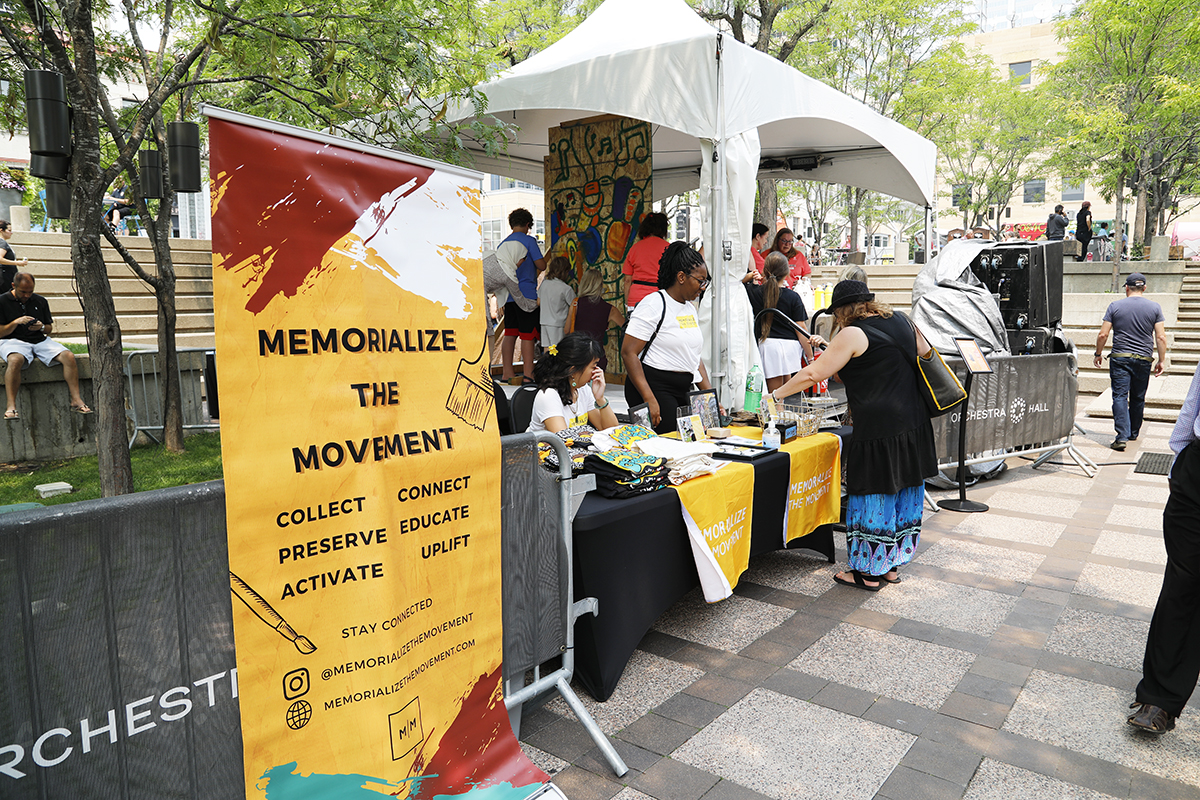
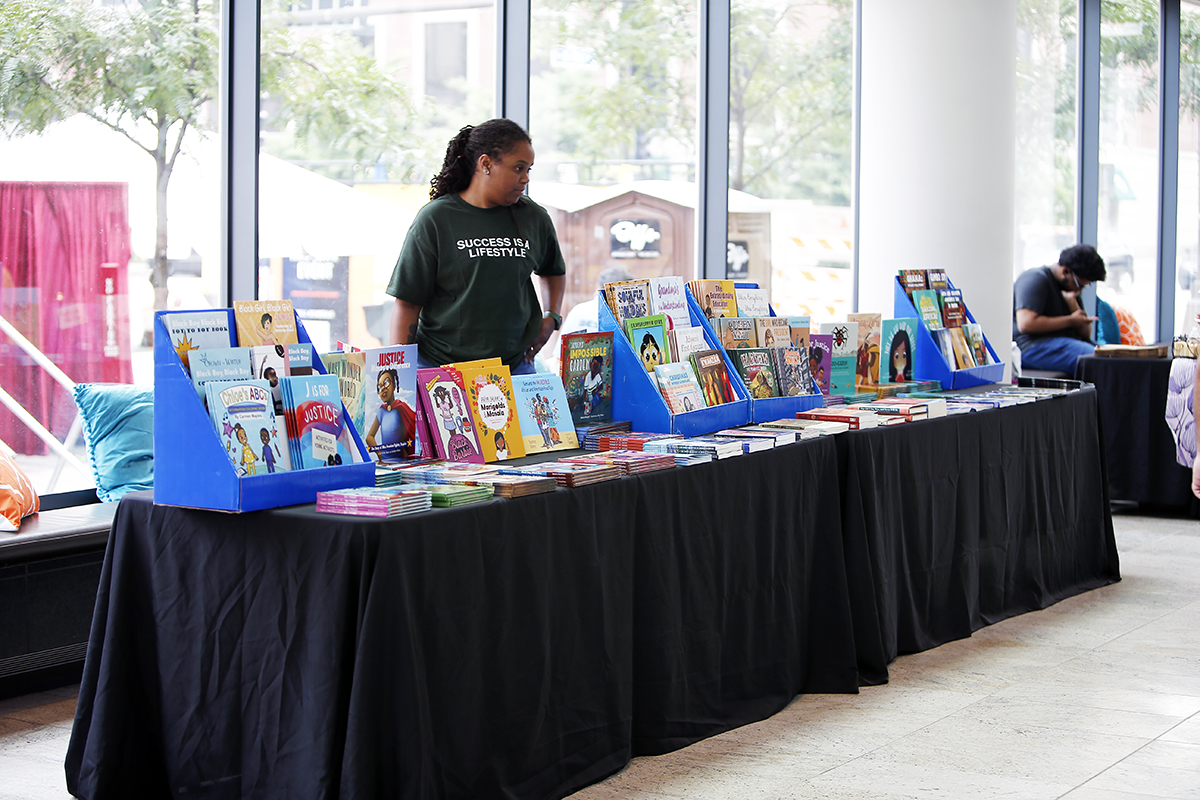
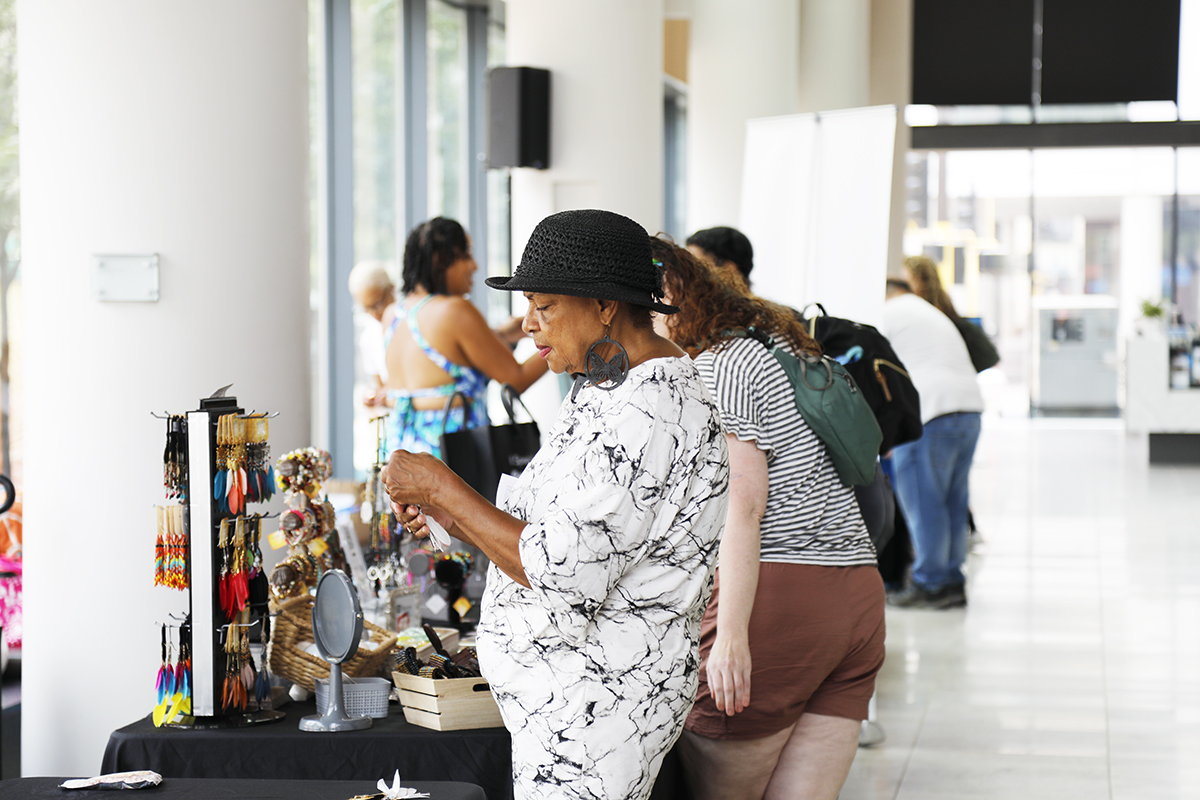
Peavey Plaza and the Global Groove Stage provided space for outdoor acts. Inside Orchestra Hall, both the auditorium and the Target Atrium served as performance halls. In addition to the performances, vendors and food trucks filled both inside and outside spaces. Most of the food trucks were of Latin American fare. Indoors, vendors sold jewelry, skin-care products, and books all produced locally.
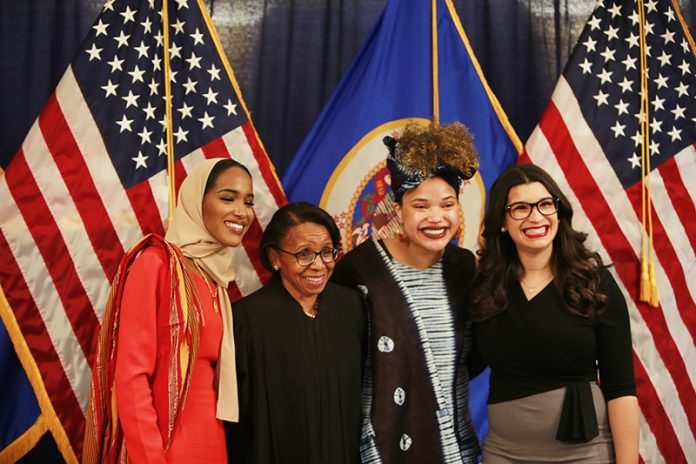
Sen. Zaynab Mohamed (D-Minneapolis), left, U.S. District Court Judge Wilhelmina M. Wright, left center, Sen. Clare Oumou Verbeten (D-St. Paul), right center, and Sen. Erin Maye Quade (D-Apple Valley), right, pose for a photo together prior to the opening day of the 2023 session Tuesday, January 3, 2023. The three senators are the first Black women to be sworn into the Senate in it’s 164-year history. Photo: Richard Ooga/Mshale
Sen. Zaynab Mohamed (D-Minneapolis), left, U.S. District Court Judge Wilhelmina M. Wright, left center, Sen. Clare Oumou Verbeten (D-St. Paul), right center, and Sen. Erin Maye Quade (D-Apple Valley), right, pose for a photo together prior to the opening day of the 2023 session Tuesday, January 3, 2023. The three senators are the first Black women to be sworn into the Senate in it’s 164-year history. Photo: Richard Ooga/Mshale
It’s been six months since Zaynab Mohamed, Clare Oumou Verbeten, and Erin Maye Quade sailed to victory in Minnesota’s state senatorial elections, jointly making history as the first Black women to do so in the state’s 165-year existence. Having concluded their first legislative session in May, Mshale asked the senators to reflect on their experiences as new lawmakers.
“We came out of those chambers [after the swearings-in at the Capitol] and saw hundreds of people who had been waiting many years for that moment,” Verbeten said.
The three senators all agreed that the new senate “looks more like Minnesota.” The state is home to around 400,000 residents who identify as Black or African American, 125,000 of whom were born in Africa, according to a study the Minnesota Department of Employment and Economic Development published in 2020. As their population grows, more Minnesotans of African descent are increasingly venturing into politics, many of them successfully.
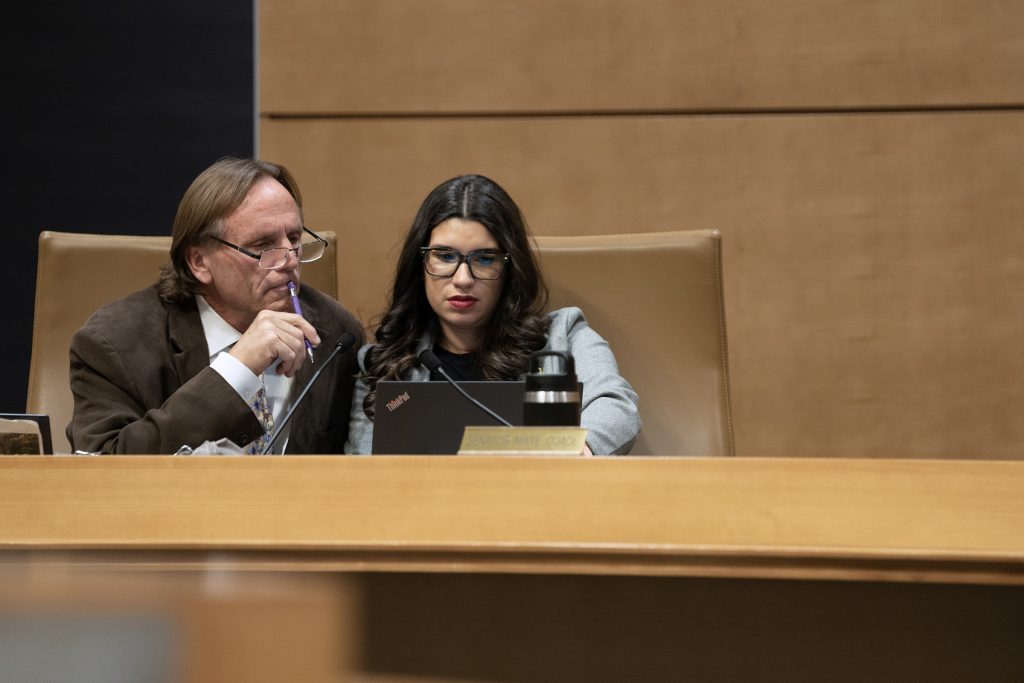
Sen. Erin Maye Quade (DFL-Apple Valley), right, and Sen. Jim Abeler (R-Anoka) consulted with each other during the first meeting of the Education Policy Committee Monday, January 9, 2023. Sen. Maye Quade, one of first three Black women elected to the Minnesota Senate, authored the READ Act which eventually became law to ensure grade-level reading for all Minnesota students. Photo: Michele Jokinen/ Minnesota Senate Media
Mohamed and Verbeten, who are respectively descended from Somali and Senegalese immigrants, are the only women senators in this legislative term with recent ties to Africa. Quade, while not from a family of immigrants, doubly made history as one of the first Black women, and the first openly lesbian senator in the state’s history.
Before they could even process the magnitude of their victories, the three senators had to hit the ground running, working on some of the most transformative pieces of legislation the state has ever seen. Notably, Mohamed, who represents District 63, was the chief sponsor of the “Driver’s License for All” bill, which allowed immigrants in Minnesota to obtain state-issued driver’s licenses. It was signed into law in March. In a session she described as “exciting, hopeful, and transformational,” the Somali American legislator said she has enjoyed watching the fruits of her labor manifest so far.
“Watching all the ideas I was able to present change lives has been one of my proudest moments [in the senate] thus far,” she said.
And Verbeten supported and advocated for Minnesota’s largest-ever infrastructure bill, which allocated $2.6 billion for the repair of roads and bridges across the state. The bill will funnel millions of dollars into her district, she said.
“It’s high time Minneapolis and St. Paul get the resources to build their communities,” Verbeten said.
As her colleagues pushed for their respective bills, Quade was making strides in education. One of the laws she fiercely defended was the “Minnesota Reading to Ensure Academic Development Act” (READ Act), which Gov. Tim Walz signed in May to ensure grade-level reading for all Minnesota students. She also pushed for reproductive rights and rights for pregnant and nursing mothers. As a mother, Quade said issues pertaining to children and families resonate with her. In the next legislative session, she said she would like to see a bill that guarantees insurance coverage for fertility services.
“It’s a huge family equity issue that I would like to address in my remaining time in office,” Quade said.
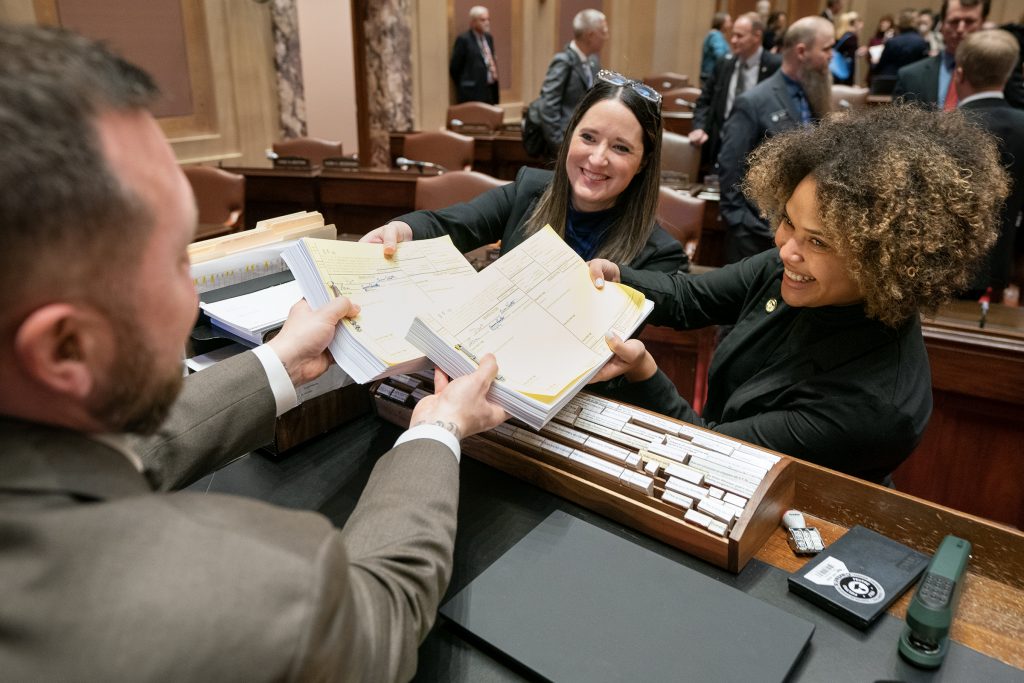
Sen. Lindsey Port (D-Burnsville), left, Sen. Oumou Verbeten (D-St. Paul), right, hand in S.F. 73 the cannabis provisions modification bill to Senate Desk staff Scott Radunzel, center, after session Thursday, January 5. The 243-page bill would legalize adult use cannabis for those 21 and older as well as include a robust expungement program. Photo by A.J. Olmscheid
But walking the halls of power hasn’t spared the three lawmakers from challenges. Being the first Black women in their positions has left them feeling like “the guinea pigs” and heaped on them the burden of representing their race. Minnesota’s senate has historically been predominantly white, so the senators said they must remember to advocate for themselves as they advocate for the people in their respective districts.
“The Capitol is not a space that’s designed for people who look like me, and that’s been a huge challenge for me,” Mohamed said.
Fortunately, the senators said they have each other, and therefore have not had to face the struggles alone. Mohamed said she had formed a sisterhood with her fellow Black women senators that helped her navigate hardships. Quade and Verbeten echoed her, with the former sharing that they all “talk every day,” and the latter adding that having her office adjacent to Mohamed’s made it easier for them to connect. Verbeten added that she has a group photo of herself with Mohamed, and Quade in her office.
“I can only imagine the Black legislators who came in here alone,” Verbeten said. “We’re so fortunate to have each other.”
The senators all said they learned more about themselves through the highs and lows of their new roles, with a common theme being that they were stronger than they initially thought they were. Quade, for instance, spoke about having to defend a bill while her daughter was in the pediatric intensive care unit. She said she became stronger as she simultaneously navigated her first session and first-time motherhood.
“There were so many times I missed my baby, but I learned to persevere and rely on my peers for support when I needed to,” Quade said.
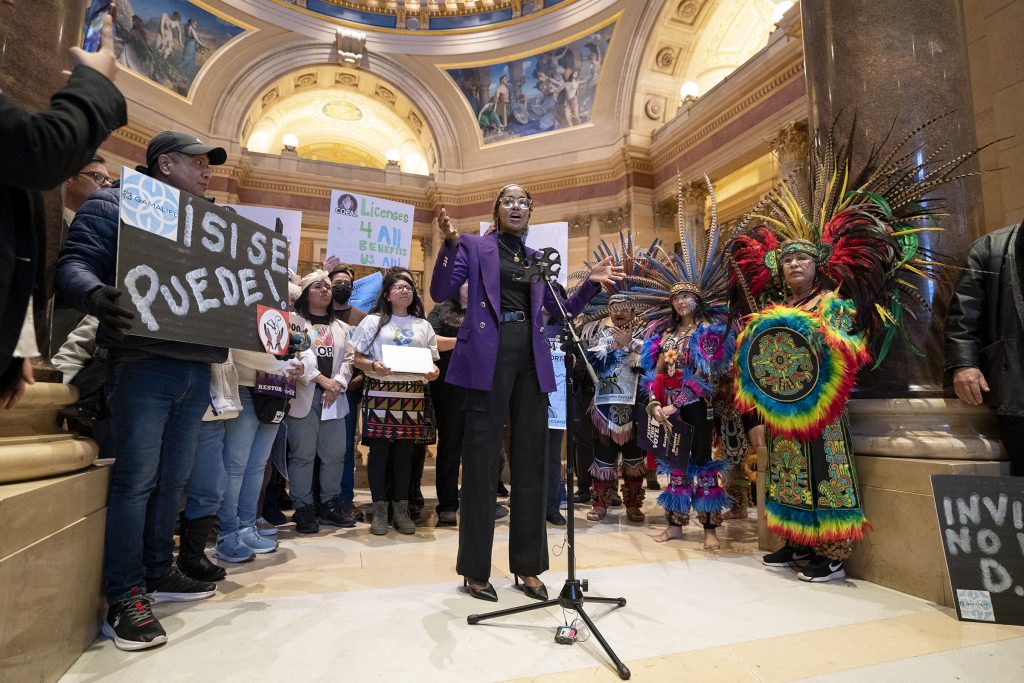
Sen. Zaynab Mohamed (D-Minneapolis), one of first three Black women elected to the Minnesota Senate, holds a press conference on HF 4, the “Driver’s License for All” bill, prior to the start of session Tuesday, February 21, 2023. Governor Walz signed the bill into law on March 7, 2023 allowing undocumenetd immigrants to obtain driver’s licenses. Photo: A.J. Olmscheid/Minnesota Senate Media
The trailblazing senators imparted words of wisdom for those in underrepresented communities who aspire to be in their positions in the future. Quade advised them not to fall into the trap of believing that one must wait for an arbitrary level of professional success before pursuing political dreams.
“We often tell ourselves we need to be credentialed in a certain way, and we don’t,” Quade said. “Our legislative body is made up of citizens. You don’t have to have experience being a lawyer, city council person, or mayor before you decide you want to create change.”
Mohamed and Verbeten agreed, adding that having unique identities can make campaigning an uphill battle. However, they said she believed the unique experience of belonging to an underrepresented group is one trait that prepared them for their success.
“People will always underestimate you, but never dim your light,” Mohamed said.
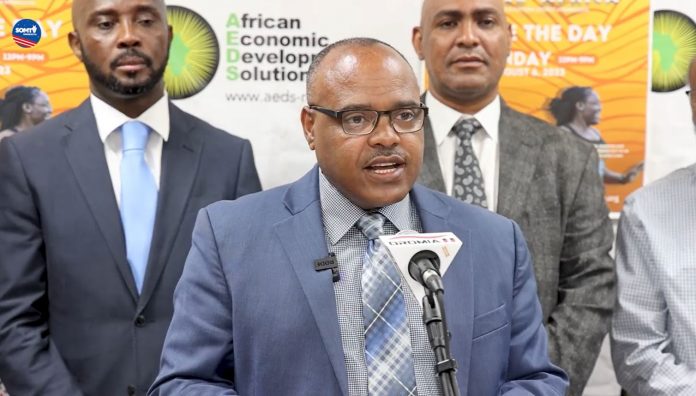
Dr. Gene Gelgelu, executive director of AEDS, during a press conference on Tuesday, July 18, 2023 announcing the 9th Annual Little Africa Festival that will be held on Sunday, August 6, 2023 at Hamline Park in St. Paul, Minnesota. Photo: Somali TV of Minnesota Screen Grab
Dr. Gene Gelgelu, executive director of AEDS, during a press conference on Tuesday, July 18, 2023 announcing the 9th Annual Little Africa Festival that will be held on Sunday, August 6, 2023 at Hamline Park in St. Paul, Minnesota. Photo: Somali TV of Minnesota Screen Grab
The Little Africa Festival is returning to Hamline Park in St. Paul on August 6th.
It’s the festival’s 9th anniversary celebrating African culture – including fashion, art, music, and economic empowerment under its core objective.
Dr. Gene Gelgelu, executive director of African Economic Development Solutions (AEDS) which organizes the annual event, told a press conference to expect a “bigger and better festival.”
“We will have more food and actors and more people coming out to celebrate our diversity, beauty and resilience of African people in Minnesota and around the world,” Dr. Gelgelu said, adding that the festival will be livestreamed for the first time so people around the world can also participate.
Dr. Gelgelu also revealed to the press that his organization will be announcing the construction of Little Africa Plaza at 678 Snelling Avenue which will serve as a cultural and entrepreneurial center and future headquarters of AEDS. The center will also house an African museum in addition to halal grocery stores and other businesses.
“Groundbreaking will be this year and construction will be completed in 2024,” Dr. Gelgelu said, adding that more information regarding Little Africa Plaza will be coming soon.
He told Finance & Commerce in February that AEDS has purchased the 100-year old building at 678 Snelling and it will involve a $5.5 million adaptive reuse that will be a “cultural center for entrepreneurship.” The building is just a few feet from where Little Africa was launched in 2013.
The Little Africa Festival will run from 12 pm-9 pm on August 6 at Hamline Park, located at 1564 Lafond Ave, in Saint Paul. Metro Transit’s Green Line train is a five-minute walk from the venue.
The Cedar announces Global Roots Festival lineup with rich African representation
The Cedar Cultural Center will favor Africa and the African diaspora when their Global Roots Festival rolls out September 25th – 27th this fall. The festival offers accessible, free, and family friendly opportunities to hear new music from across the globe.
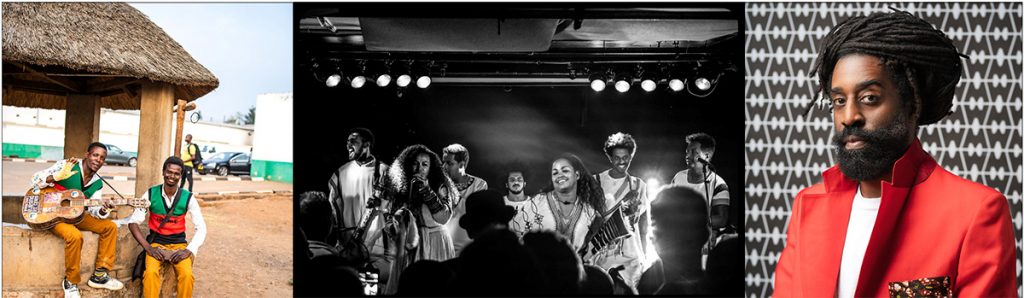
On Tuesday, the middle of the celebration, the Cedar features a double-hitter. As the sun sets the doors will open at 7 pm for Madalitso, a Malawian street-busking duo blending Chichewa and Ngoni ceremonial music into tempting danceable bliss. The duo’s setup comprises a homemade one-string slide bass (Babatone), a cowskin foot drum thumped with the heel, and a 4-string guitar.
Then under a waxing moon, Ethiocolor led by Melaku Belay takes the stage at 9 pm. With traditional Ethiopian Azmari instruments and dance, the band produces a high energy and rootsy sound. Melaku and his ensemble are also dedicated to traditional instruments and dance.
Malawi’s street-busking duo Madalisto, left, Ethiocolor of Ethiopia, center, and Waahli from Haiti are among the lineup revealed by the Cedar Cultural Center on July 12, 2023 for its fall Global Roots Festival which runs September 25-27, 2023. Photo: Courtesy of the Cedar
Flanking Tuesday night’s Africa-rich show, House of Waters performs Monday evening. Their once five-member band has distilled to two members who yet carry on the music of their former bandmates. Festival attendees will hear echos of AfroBeat, Senegalese, and even the whisper of Solo Cissokho’s kora from musicians Max ZT and Moto Fukushima. Monday also features Ana Everling, singer and visual artist from Republic of Moldova.
The Festival concludes Wednesday night with La Perla, a trio of women interpreting the musical tradition of the Colombian Caribbean.
They will be followed by quintessential musician, Waahli, now living in Montreal, raised by Haitian parents. Waahli’s musical licks truly represent the crossroads of rap and Afro-beat and are a tribute to Haitian culture.
Visit the Cedar website for more info at this link.
Justice Sikakane eyes the final hole before putting his last shot at the inaugural Beyond End of Season Golf Invitational at the Crystal Lake Golf Club in Lakeville, Minnesota last year.The tournament returns Saturday, August 26, 2023 at the same venue. Photo: Panashe Matemba-Mutasa/Mshale
Justice Sikakane eyes the final hole before putting his last shot at the inaugural Beyond End of Season Golf Invitational at the Crystal Lake Golf Club in Lakeville, Minnesota last year.The tournament returns Saturday, August 26, 2023 at the same venue. Photo: Panashe Matemba-Mutasa/Mshale
Looking for a fun way to unwind outdoors this summer? Look no further; the Beyond Season Golf Tournament, hosted by Collins Oppong and presented by Dependable Home Health Care, will be returning August 26th at Crystal Lake Golf Course in Lakeville, MN.
“This unique golf event is specifically designed to unite and celebrate a diverse community of golfers, with a primary focus on Black and immigrant individuals and their partners,” Oppong said.
Oppong, a Ghanaian entrepreneur and media development consultant, hosted the inaugural tournament in tandem with his birthday celebration last summer in the hopes of “getting more Africans playing golf.” Until 1961, the Professional Golfers’ Association (PGA) held a “whites only” policy. Although there are now more options to practice golf more cheaply, there are still private clubs that charge initiation fees upward of $50,000, which some see as a continuation of the sport’s segregationist history. Oppong hopes that by introducing the sport to his community, he can bridge the “golfing gap.”
“I am eager to establish connections with the community and various organizations to ensure greater representation of Black golfers,” Oppong said.
In addition to the 18-hole competition, Oppong said that this year’s tournament will feature a beginner’s golf clinic, putting contests, and various opportunities to win cash prizes. The funds raised at this year’s event will go toward Circle of Life, an organization that provides women and girls in Ghana with feminine hygiene products.
“This support enables [Ghanaian women and girls] to continue their education and lead fulfilling lives,” Oppong said.
The tournament will conclude with a prize ceremony featuring music, dinner, cocktails, and entertainment. More information on the event can be found here.
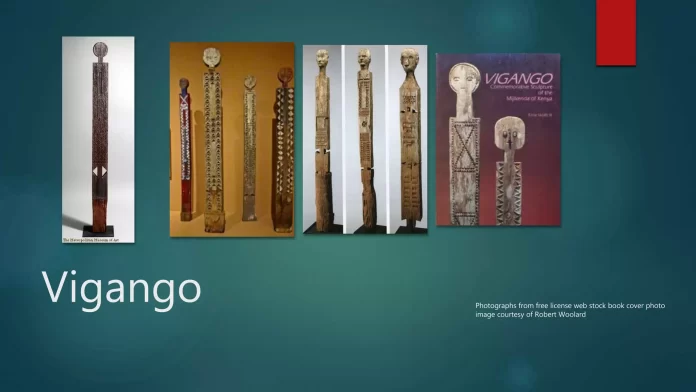
A photo showing vigango (singular kigango) from the Mijikenda communities in Kenya's coastal region. Photo: Courtesy of Anthony Kalume - The Vigango Resting Place Project
A photo showing vigango (singular kigango) from the Mijikenda communities in Kenya's coastal region. Photo: Courtesy of Anthony Kalume - The Vigango Resting Place Project
SPRINGFIELD, Ill. (AP) — The Illinois State Museum has returned nearly 40 sacred artifacts to Kenya so they can go back to their rightful owners.
Museum officials said in a statement Wednesday that they have completed transferring 37 wooden statues known as vigango to the National Museums of Kenya so they can be returned to Mijikenda communities. The statues are considered sacred and are believed to carry the spirits of deceased male Mijikenda elders.
The Illinois State Museum said the statues were removed from Mijikenda villages and sacred sites in the 1980s, acquired by art collectors and later transferred to the museum as part of its African collection. Museum staff discovered in 2006 that one of the statues had been stolen and returned it to its owner.
The Illinois State Museum’s curator of anthropology, Brooke Morgan, plans to visit Kenya this month and meet with Mijikenda elders to learn more about efforts to protect vigango statues and restore them to their communities.
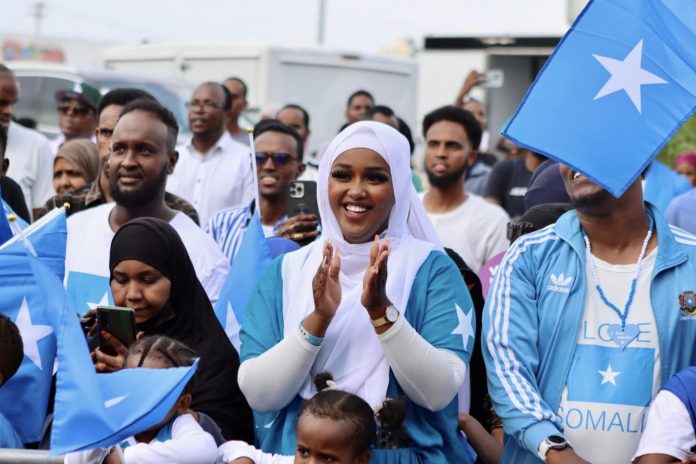
A section of the thousands of Somali Americans that gathered on Lake Street in Minneapolis on Saturday, July 1, 2023 to celebrate Somalia Independence Day cheer on some of the musicians on stage. The celebration was part of ‘Somali Week” a weeklong series of events to celebrate Somalia. Photo: Courtesy of Somalia N TV – Minnesota
A section of the thousands of Somali Americans that gathered on Lake Street in Minneapolis on Saturday, July 1, 2023 to celebrate Somalia Independence Day cheer on some of the musicians on stage. The celebration was part of ‘Somali Week” a weeklong series of events to celebrate Somalia. Photo: Courtesy of Somalia N TV – Minnesota
For the last three decades, Somalia has been one of the most unstable countries in the horn of Africa region. More than 1.5 million Somali citizens have been displaced and ended up in faraway lands since 1991, when a civil war broke out following a coup that ended two decades of Mohamed Siad Barre’s regime.
Most of the Somalis who call Minnesota home were among the first refugees to flee the east African country. Given that history of instability, it might seem strange to some that anyone would celebrate the independence of a country they had to flee.
But that’s exactly what members of the Somali American community during the weekend of July 1 to mark 63 years of the founding of the Republic of Somalia.
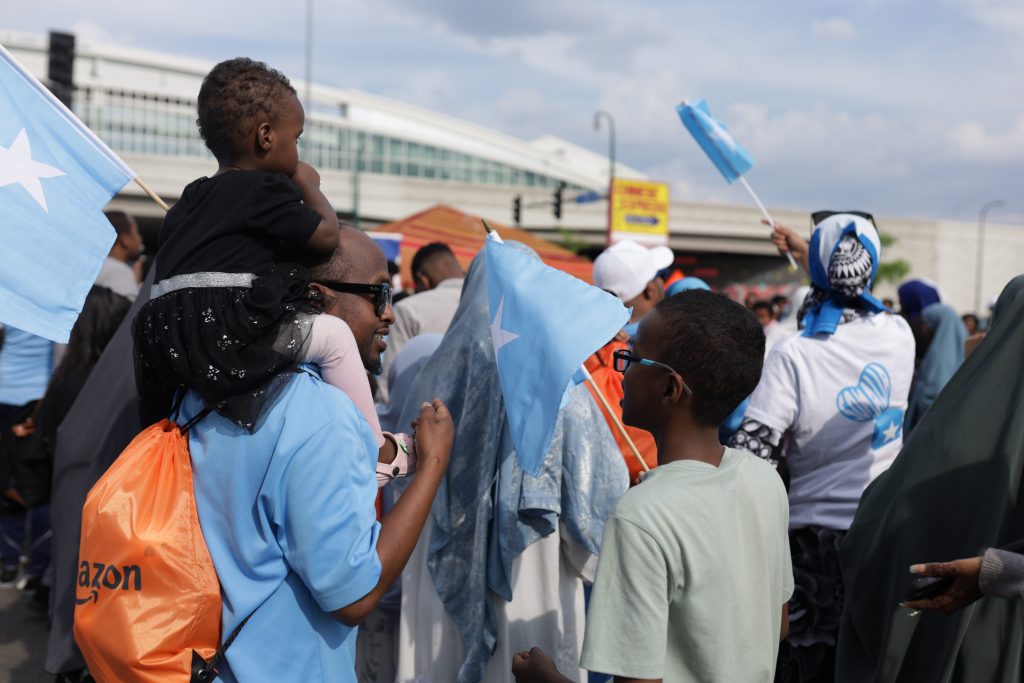
A child on the shoulders of the father has a vantage view of the proceedings at Somalia Independence Day celebrations on Lake Street in Minneapolis on Saturday, July 1, 2023. Photo: Panashe Matemba-Mutasa/Mshale
“I think it’s important that we have this [celebration] because, even though we are now in Minnesota, we need to remember our history,” said community member Khadar Bille.
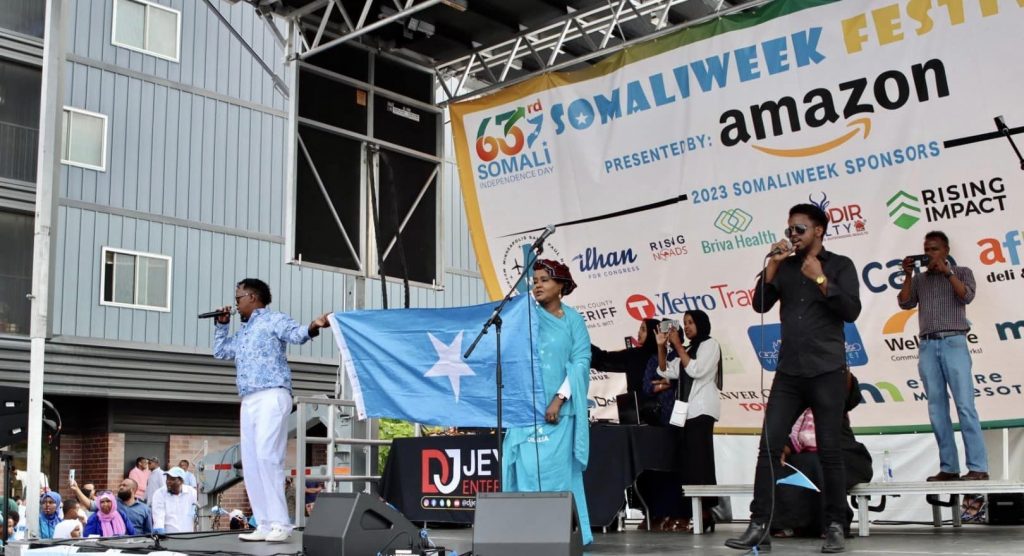
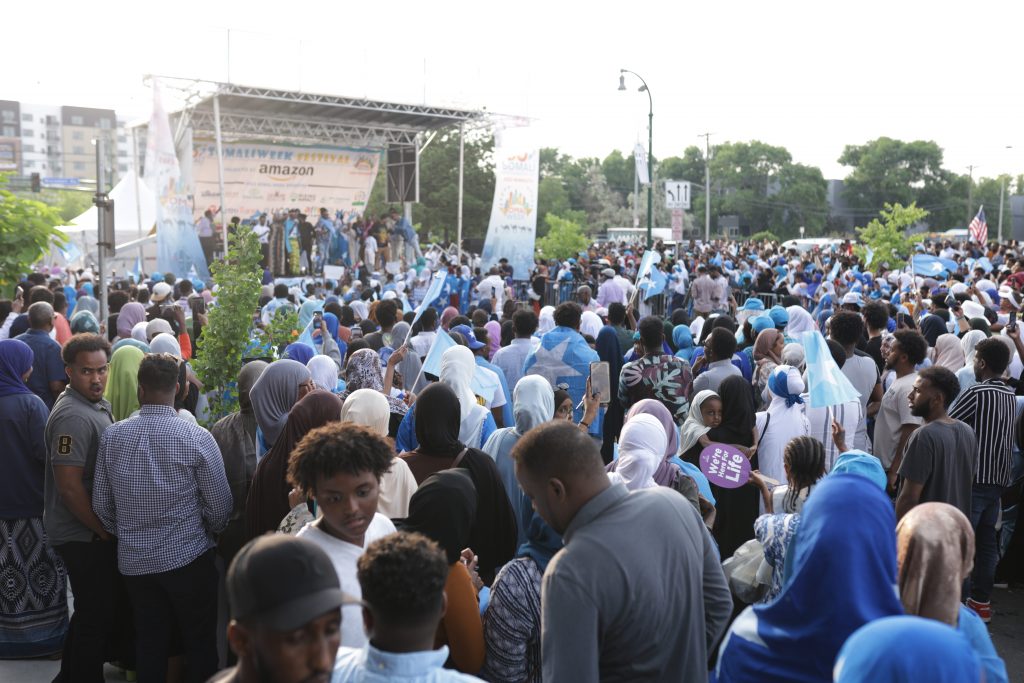
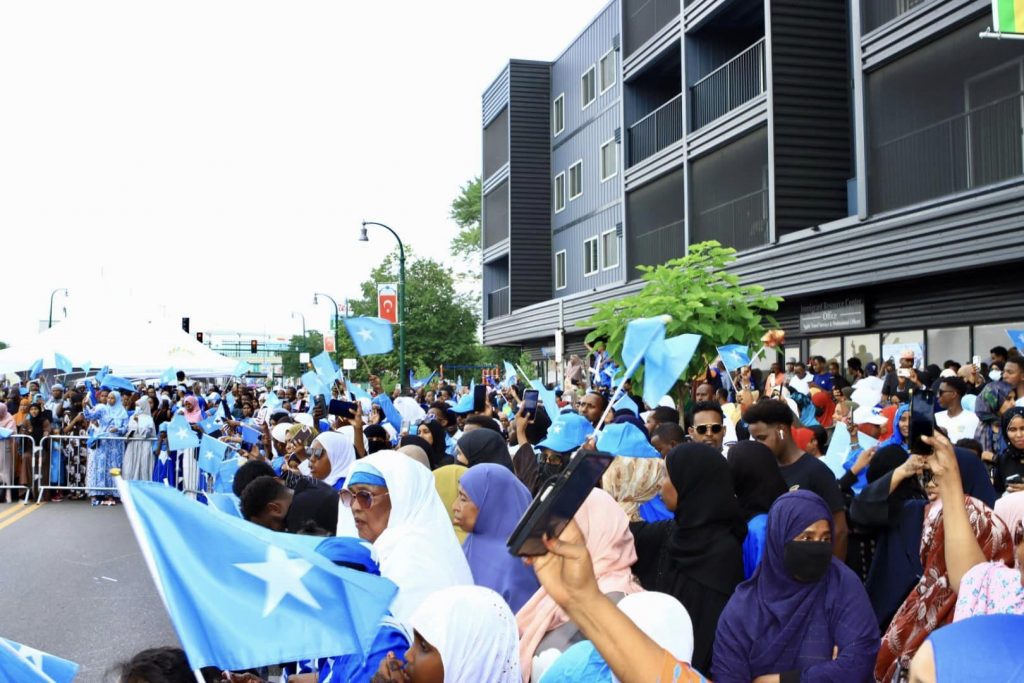
Bille was one of thousands of Somali Americans who came to Lake Street in Minneapolis to celebrate Somalia’s Independence Day. Waving a sea of sky-blue flags, people surrounded the stage on Lake Street, where a lineup of musical artists was scheduled to perform. Further from the stage were Somali business vendors, their tents sheltering them from the oppressive heat. Children’s laughter could be heard over the traditional Somali music playing on the speakers. Attendees enjoyed a range of activities including a petting zoo, face painting, and treats.
Children enjoy a petting zoo during Somalia Independence Day celebrations on Lake Street in Minneapolis on Saturday, July 1, 2023. Photo: Panashe Matemba-Mutasa/Mshale
The celebration on Lake Street was part of a weeklong series of events for Minnesota Somalis to celebrate their home country’s independence under the banner of “Somali Week”. Events included panel discussions, and cultural and sports events, hosted by Ka Joog, a Minnesota-based nonprofit that organizes annual celebrations of the east African country’s Independence Day.
Musicians on stage during Somalia Independence Day celebration on Lake Street in Minneapolis on Saturday, July 1, 2023. Photo: Courtesy of Somalia N TV – Minnesota
Many of the Somalis who fled the civil war ended up in Minnesota because of the state’s progressive politics and its robust refugee resettlement agencies. Today, Minnesota is home to more than 86,000 people of Somali descent, more than any other state in the nation, according to Minnesota Compass. As their population grows, they encounter challenges that come with being Black and Muslim. Festivals like the Independence Day celebration become important tool for combating stereotypes because they give Somalis opportunities to introduce positive aspects of their rich culture to Minnesotans of different backgrounds.
A section of the thousands of Somali Americans that gathered on Lake Street in Minneapolis on Saturday, July 1, 2023 to celebrate Somalia Independence Day. The celebration was part of ‘Somali Week” a week long series of events to celebrate Somalia. Photo: Panashe Matemba-Mutasa/Mshale
“[The festival] is good representation,” said Abdi Osman, a member of the Somali community. “I’m glad we get to enjoy it and showcase our beautiful culture.”
The origins of the modern Somali state date back to 1884, when European nations began the “Scramble for Africa,” a colloquialism for the imperial conquest of western powers over territories on the continent. Following the conference, Britain took over a large part of Somalia and established British Somaliland. By 1936, Italy had taken over the northeastern sultanates of the country and formed Italian Somaliland, according to Encyclopedia Britannica.
A section of the thousands of Somali Americans that gathered on Lake Street in Minneapolis on Saturday, July 1, 2023 to celebrate Somalia Independence Day take selfies and photos of the main stage performances. The celebration was part of ‘Somali Week” a weeklong series of events to celebrate Somalia. Photo: Courtesy of Somalia N TV – Minnesota
The colonial powers fought for many years over the ownership of their respective territories, with British forces defeating the Italians to add Italian Somaliland to its protectorates after the Second World War. On June 26, 1960, British Somaliland gained independence and became the State of Somaliland. Five days later, it merged with the Italian Somaliland to become the Republic of Somalia. Today, June 26 of every year is celebrated as Somalia Independence Day while July 1 is Republic Day. Every year, citizens of the country living in Minnesota spend celebrate the two important days in a series of events known as Somali Week.
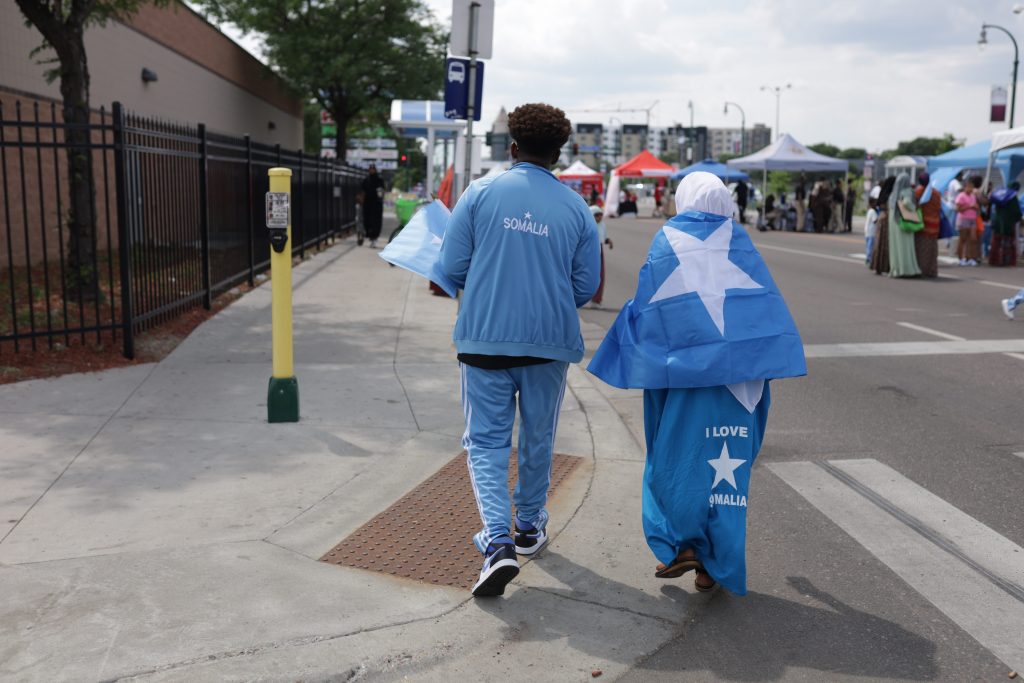
A woman with a “I Love Somalia” skirt and wrapped with the flag of Somalia walks towards the vendor section during Somalia Independence Day celebrations on Lake Street in Minneapolis on Saturday, July 1, 2023. Photo: Panashe Matemba-Mutasa/Mshale
Siham Mahamood, founder of real estate agency Amaana Realty, expressed enthusiasm about being able to have a table at the Somali Week festival for the first time ever. She said she decided to pursue a career in real estate after an unpleasant experience she had when purchasing a home in 2019. Her relator was full of prejudices that came from lack of understanding of Somali culture. The experience made her feel compelled to serve her community through real estate by providing a culturally inclusive experience.
“Being able to help my own people is inspiring,” Mahamood said. “I want my people to have a better experience than I did.”
Anwar Juba, a Graphic designer, and his son Abdi Shaur had a table for Juba Graphics, the father’s graphic design firm. Juba has been vending at the festival for many years, where he sells Somalia themed shirts, flags, and banners.
“It’s just fun seeing everyone enjoying themselves while supporting Somali-owned businesses,” Juba said.
Mohamed Ali chatted with a vendor as he indulged in doolsho, a type of Somali sponge cake. Besides his dessert, Ali said his favorite part of the festival was seeing individuals of different ethnicities come together and support Somalis in celebrating their culture and independence.
“I’m just here vibing [sic] with the community,” Ali said. “It’s refreshing to see this kind of unity.”
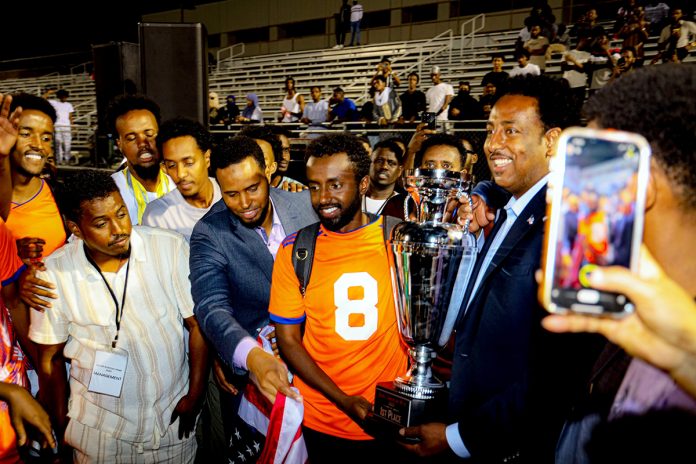
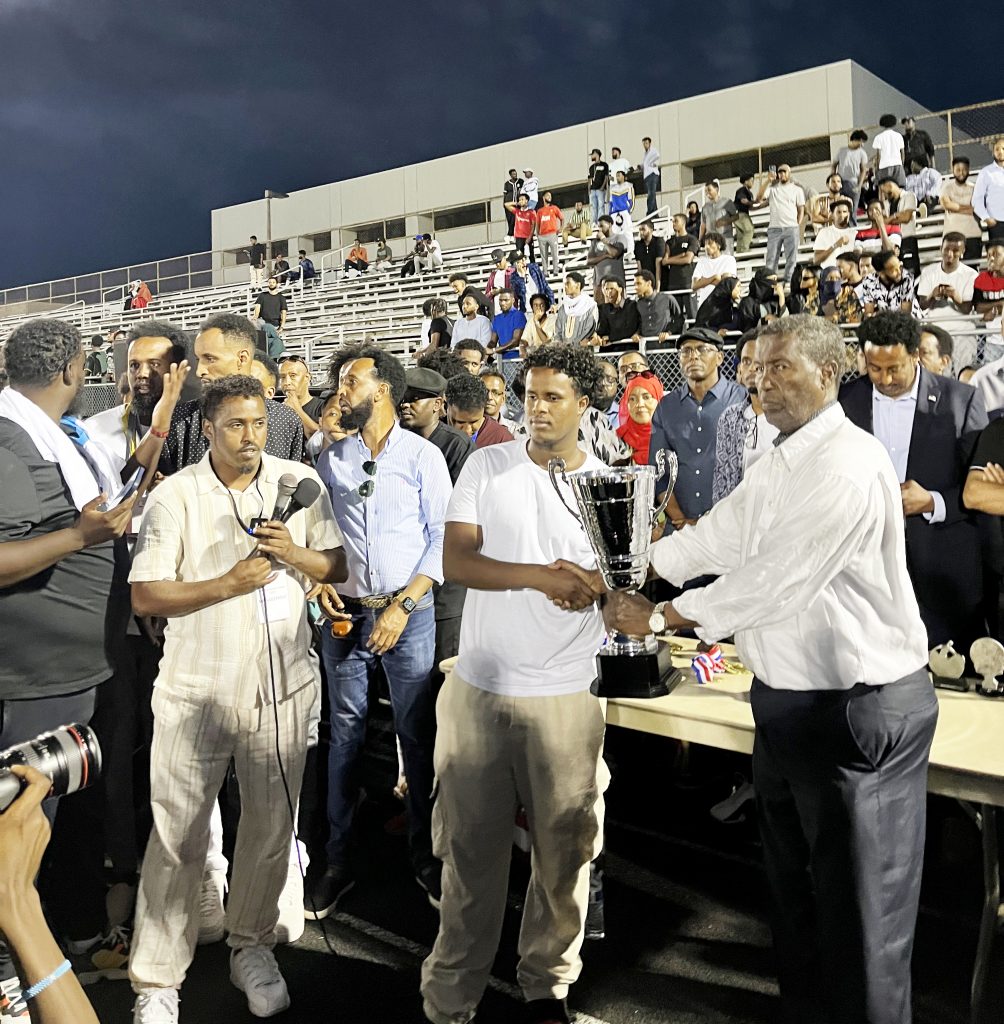
State Representative Samakab Hussein presents the trophy to the winner of the Somali Week soccer tournament on Monday, July 3, 2023 at James S. Griffin Stadium at Central High School in St. Paul on Monday, July 3, 2023. The tournament is held annually to celebrate Somalia’s Independence Day. Photo: Siyad Salah/Somali TV of Minnesota
State Representative Samakab Hussein presents the trophy to the winner of the Somali Week soccer tournament on Monday, July 3, 2023 at James S. Griffin Stadium at Central High School in St. Paul on Monday, July 3, 2023. The tournament is held annually to celebrate Somalia’s Independence Day. Photo: Siyad Salah/Somali TV of Minnesota
A week-long soccer tournament to celebrate Somalia’s Independence Day ended on July 3 with Saint Cloud-based GarGaar FC taking home the coveted trophy after defeating KB Stars FC of Minneapolis 4-3 in a tense penalty shootout.
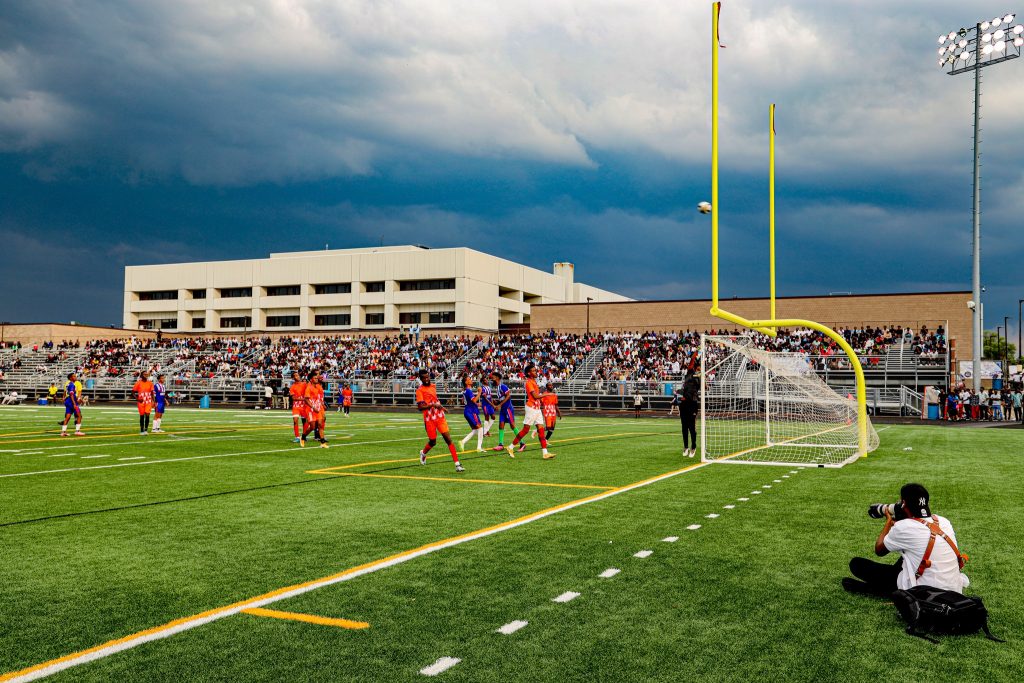
The championship final match, which was held at the James S. Griffin Stadium at Central High School in St. Paul, was the climax of a competitive soccer tournament pitting various teams from Somali communities in North America.
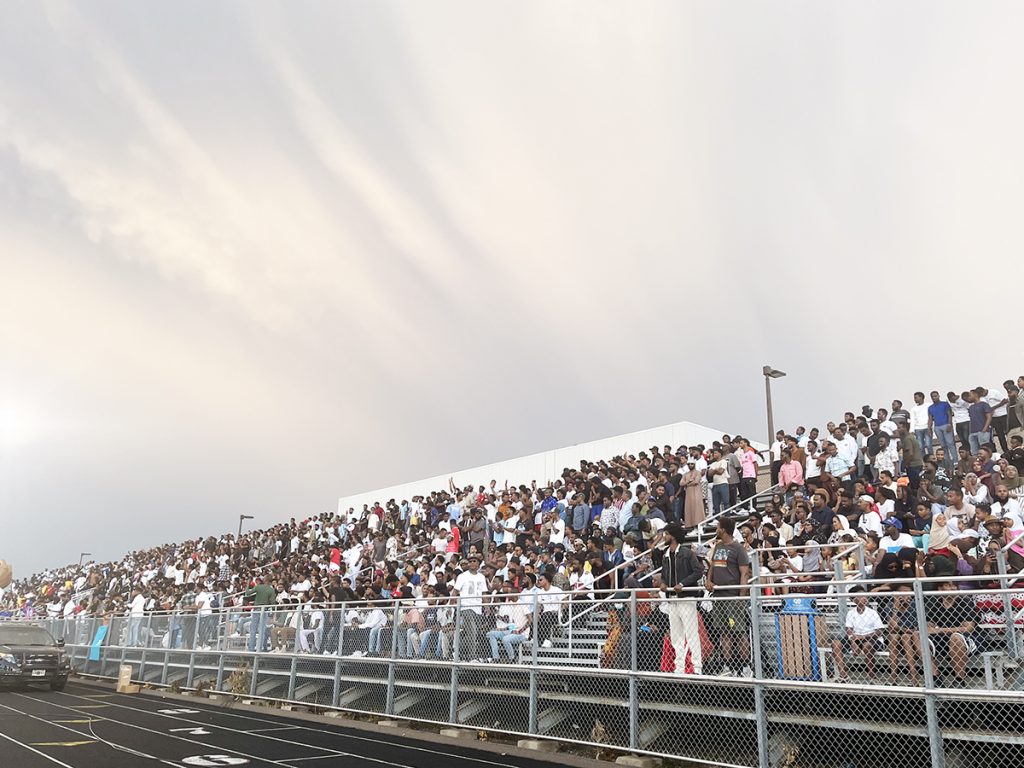
It was clear from the beginning that KB Stars had home field advantage as their supporters didn’t have to travel far from Minneapolis. But it was GarGaar who would strike first when Mohamed Abdi scored in the 58th minute. With their fans urging them on, KB Stars continued to attack in search of an equalizer, which finally came late by way of a Najib Omar goal in the 87th minute. Omar’s goal sent the stadium into a frenzy with the Minneapolis team’s fans rose from their seats chanting “KB, KB, KB!!”as they waved the Somali flag.
KB Stars FC receive the runners up trophy from legendary Somali soccer coach and player Mr. Abdiqadir Ali during the Somali Week soccer tournament held to celebrate Somalia’s Independence Day at James S. Griffin Stadium at Central High School in St. Paul on Monday, July 3, 2023. Photo: Milkee Bekele/Mshale
With two of the 90 minutes of regulation remaining, GarGaar substituted their goalkeeper, Mohamed Aden, for Siyad Shale, who is known for making quick saves. When the match ended in 1-1 tie, it went to a penalty shootout to decide who won the trophy. The tension was palpable as fans who had be rowdy for 90 minutes suddenly became silent. When the shootout commenced, GarGaar took the first penalty kick and converted. A KB Stars player followed but missed the goal completely. Although GarGaar did miss a penalty of their own, they converted three more. The last kick went to KB Stars for a chance to tie the shootout and keep chances of a trophy alive, but Shale, the substitute goalkeeper, made an excellent save to guarantee GarGaar win for the second consecutive year.
St. Cloud’s GarGaar FC hoist the trophy in celebration after winning the Somali Week soccer tournament following a 4-3 penalty shootout against FB Stars of Minneapolis on Monday, July 3, 2023 at James S. Griffin Stadium at Central High School in St. Paul, Minnesota. The tournament is held annually to celebrate Somalia’s Independence Day. Photo: Siyad Salah/Somali TV of Minnesota
The soccer tournament was one of many events planned during Somali Week, an annual celebration that takes place around July 1, the east African nation’s Independence Day. This year marked the 63rd anniversary of independence, a day known officially as Somalia National Day. Minneapolis kickstarted Somali Week with an Independence Day festival on July 1, and concluded with the end of a week-long Somali Week soccer tournament that began on June 24. Daoud Mohamed, one of the organizers of Somali Week, said education was this year’s theme.
“It’s about bringing people together to educate each other about our differences, but [also] to celebrate our similarities, as one community,” Mohamed said. “But most importantly, we wanted to create a platform, an opportunity for young people to connect on a positive level.”
Saint Cloud-based GarGaar FC and KB Stars FC of Minneapolis met for the final of Somali Week soccer tournament to celebrate Somalia’s Independence Day at James S. Griffin Stadium at Central High School in St. Paul on Monday, July 3, 2023. GarGaar won 4-3 in a penalty shootout. Photo: Siyad Salah/Somali TV of Minnesota
With an estimated population of 17 million, Somalia is home to various ethnic groups, languages, and cultures. The Republic of Somalia, as the country is known formally, was formed in 1960 following vicious colonial efforts by Italy and Britain. In 1969, Mohamed Siad Barre came into power and ruled the country until January 1991, when he was overthrown in a coup. Barre’s ouster led to a series of civil wars that have since displaced more than 1.5 million Somalis worldwide.
Thousands of displaced Somalis have sought refuge in Minnesota, where they began arriving in 1993. The population of people of Somali heritage in the state is estimated at 86,000, according to Minnesota Compass, a nonprofit group that analyzes U.S. Census Bureau data. Minnesota’s Somali population is the largest in the United States, making it a sort of unofficial capital of the diaspora, with neighborhoods like Minneapolis’s Cedar Riverside nicknamed “Little Mogadishu,” a nod to Somalia’s capital city.
The crowd celebrates after KB Stars FC of Minneapolis equalizer at the final game of Somali Week soccer tournament to celebrate Somalia’s Independence Day at James S. Griffin Stadium at Central High School in St. Paul on Monday, July 3, 2023. Photo: Milkee Bekele/Mshale
According to Mohamed, the Somali Week organizer, the tournament comprised of 16 teams, including two from Minnesota, 12 from other states like Maine and Washington, and one each from Canada and the United Kingdom.
Soccer is an integral part of Somali culture. Like in most of the world, soccer in East Africa has been a sport that brings people together, which is why preparations for the tournament are meticulous.
GarGaar FC’s goalkeeper gets ready for a save as a KB Stars FC striker approaches when the two teams met for the title game during the Somali Week soccer tournament held to celebrate Somalia’s Independence Day at James S. Griffin Stadium at Central High School in St. Paul on Monday, July 3, 2023. Photo: Siyad Salah/Somali TV of Minnesota
Hussein Mohamed, one of the coaches of KB Stars and an organizer of the tournament, said anticipation for the annual competition begins as soon as a new champion is crowned.
“Tomorrow, [July 4], we start preparing for next year,” he said. “The process of getting ready excites me. We love the game, because we were raised by playing dads. Family members – our oldest brothers, everybody just grew up playing it. [At this tournament] we celebrate good soccer and the independence of our country.”
A GarGaar FC takes a victory lap in a Ramsey County Sheriff’s cruiser at James S. Griffin Stadium at Central High School in St. Paul on Monday, July 3, 2023 after his team beat KB Stars FC 4-3 in a penalty shootout to win the Somali Week soccer tournament held annually to celebrate Somalia’s Independence Day. Photo: Siyad Salah/Somali TV of Minnesota
The match was attended by community elders and important figures, including Somalia’s most celebrated athlete, Abdi Bile, a middle-distance runner who represented his country in Olympics and was once a World Champion. Political leaders like Rep. Samakab Hussein, a Somali American who represents District 65A in the Minnesota assembly, were also present.
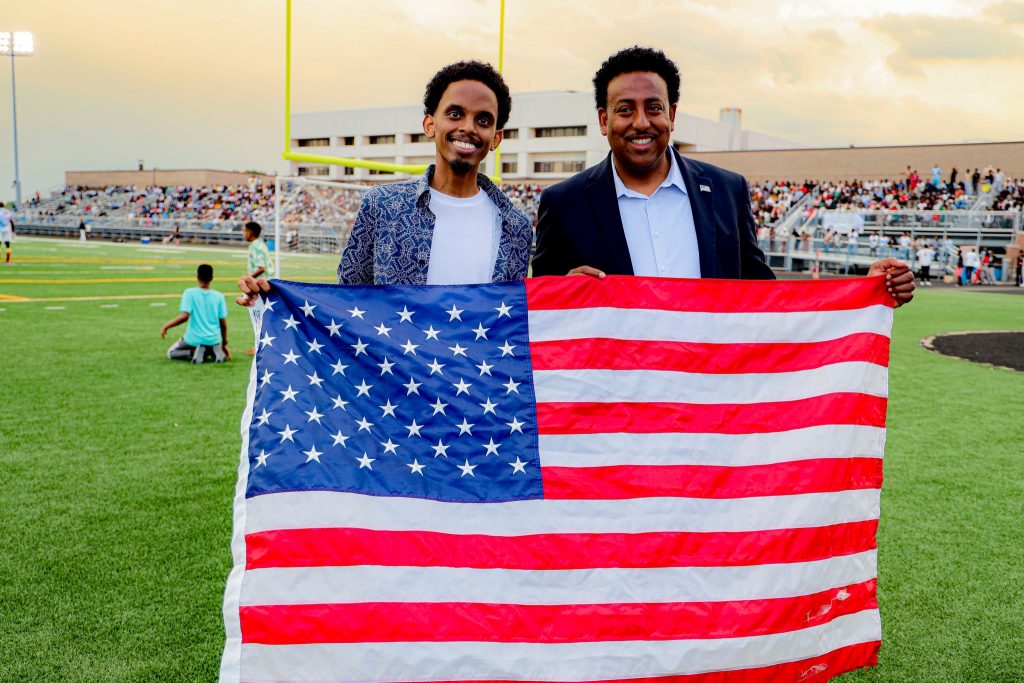
Two historical Somali American figures hold the American flag at James S. Griffin Stadium at Central High School in St. Paul on Monday, July 3, 2023 during the title game between St. Cloud’s GarGaar FC and Minneapolis’ KB Stars FC to conclude the Somali Week soccer tournament held to mark Somalia’s Independence Day. On the left is State Senator Omar Fateh, the first Somali elected to the Minnesota Senate. On the right is State Representative Samakab Hussein, the first Somali politician from St. Paul elected to the Minnesota Legislature. Photo: Siyad Salah/Somali TV of Minnesota
Hussein commended the community for raising funds from individual and private donors to pay for the cost of carrying out the Independence Day events.
“This wasn’t city money,” Hussein said. “It wasn’t county money. It was the donors, [and] individuals that came together and made this happen.”
Mr. Daoud Mohamed with his son after accepting a trophy of appreciation for his work in organizing the Somali Week soccer tournament. The tournament concluded on July 3, 2023 with St. Cloud’s GarGaar FC emerging victorious over Minneapolis’ KB Stars FC. Photo: Siyad Salah/Somali TV of Minnesota
Donnie Brooks, a Twin Cities community member, who is also the director of athletics at Macalester College, said the event was important because it gave Minnesotans insight into Somali community and its culture.
“They are not only unbelievable group of people who are organizing the event, but it’s just a really beautiful thing to see the culture and excitement” Brooks said.
After the match, officials and leaders congratulated both teams for their efforts and good sportsmanship. They presented KB Stars players with medals and a second-place trophy. The tournament officially ended when Hussein, the lawmaker, presented GarGaar with their championship trophy.
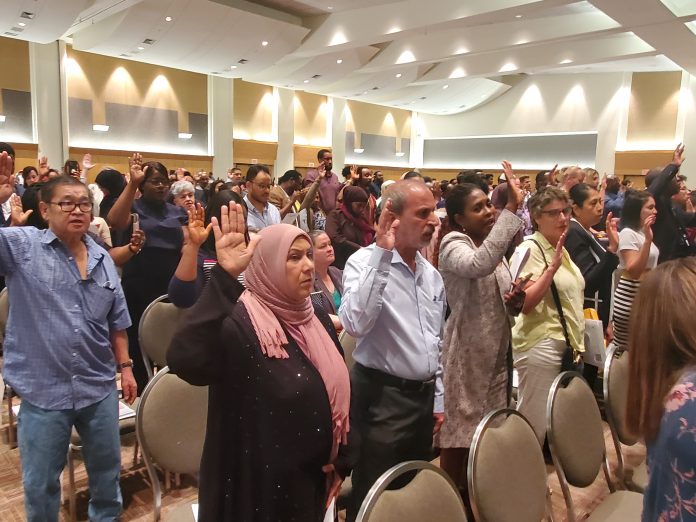
Over 950 people take part in a naturalization ceremony at the RiverCentre in St. Paul, Minnesota on Wednesday, June 14, 2023. Photo: Tom Gitaa/Mshale
Over 950 people take part in a naturalization ceremony at the RiverCentre in St. Paul, Minnesota on Wednesday, June 14, 2023. Photo: Tom Gitaa/Mshale
ST. PAUL, Minn. (AP) — The U.S. citizenship test is being updated, and some immigrants and advocates worry the changes will hurt test-takers with lower levels of English proficiency.
The naturalization test is one of the final steps toward citizenship — a monthslong process that requires legal permanent residency for years before applying.
Many are still shaken after former Republican President Donald Trump’s administration changed the test in 2020, making it longer and more difficult to pass. Within months, Democratic President Joe Biden took office and signed an executive order aimed at eliminating barriers to citizenship. In that spirit, the citizenship test was changed back to its previous version, which was last updated in 2008.
In December, U.S. authorities said the test was due for an update after 15 years. The new version is expected late next year.
U.S. Citizenship and Immigration Services proposes that the new test adds a speaking section to assess English skills. An officer would show photos of ordinary scenarios – like daily activities, weather or food – and ask the applicant to verbally describe the photos.
In the current test, an officer evaluates speaking ability during the naturalization interview by asking personal questions the applicant has already answered in the naturalization paperwork.
“For me, I think it would be harder to look at pictures and explain them,” said Heaven Mehreta, who immigrated from Ethiopia 10 years ago, passed the naturalization test in May and became a U.S. citizen in Minnesota in June.
Mehreta, 32, said she learned English as an adult after moving to the U.S. and found pronunciation to be very difficult. She worries that adding a new speaking section based on photos, rather than personal questions, will make the test harder for others like her.
Shai Avny, who immigrated from Israel five years ago and became a U.S. citizen last year, said the new speaking section could also increase the stress applicants already feel during the test.
“Sitting next to someone from the federal government, it can be intimidating to talk and speak with them. Some people have this fear anyway. When it’s not your first language, it can be even more difficult. Maybe you will be nervous and you won’t find the words to tell them what you need to describe,” Avny said. “It’s a test that will determine if you are going to be a citizen. So there is a lot to lose.”
Another proposed change would make the civics section on U.S. history and government multiple-choice instead of the current oral short-answer format.
Bill Bliss, a citizenship textbook author in Massachusetts, gave an example in a blog post of how the test would become more difficult because it would require a larger base of knowledge.
A current civics question has an officer asking the applicant to name a war fought by the U.S. in the 1900s. The applicant only needs to say one out of five acceptable answers – World War I, World War II, Korean War, Vietnam War or Gulf War – to get the question right.
But in the proposed multiple-choice format, the applicant would read that question and select the correct answer from the following choices:
A. Civil War
B. Mexican-American War
C. Korean War
D. Spanish-American War
The applicant must know all five of the wars fought by the U.S. in the 1900s in order to select the one correct answer, Bliss said, and that requires a “significantly higher level of language proficiency and test-taking skill.”
Currently, the applicant must answer six out of 10 civics questions correctly to pass. Those 10 questions are selected from a bank of 100 civics questions. The applicant is not told which questions will be selected but can see and study the 100 questions before taking the test.
Lynne Weintraub, a citizenship coordinator at Jones Library’s English as a Second Language Center in Massachusetts, said the proposed format for the civics section could make the citizenship test harder for people who struggle with English literacy. That includes refugees, elderly immigrants and people with disabilities that interfere with their test performance.
“We have a lot of students that are refugees, and they’re coming from war-torn countries where maybe they didn’t have a chance to complete school or even go to school,” said Mechelle Perrott, a citizenship coordinator at San Diego Community College District’s College of Continuing Education in California.
“It’s more difficult learning to read and write if you don’t know how to do that in your first language. That’s my main concern about the multiple-choice test; it’s a lot of reading,” Perrott said.
U.S. Citizenship and Immigration Services said in a December announcement that the proposed changes “reflect current best practices in test design” and would help standardize the citizenship test.
Under federal law, most applicants seeking citizenship must demonstrate an understanding of the English language – including an ability to speak, read and write words in ordinary usage – and demonstrate knowledge of U.S. history and government.
The agency said it will conduct a nationwide trial of the proposed changes in 2023 with opportunities for public feedback. Then, an external group of experts — in the fields of language acquisition, civics and test development — will review the results of the trial and recommend ways to best implement the proposed changes, which could take effect late next year.
The U.S. currently has the easiest citizenship test compared to other Western countries — including Germany, Canada and the United Kingdom — according to Sara Goodman, a political science professor at the University of California, Irvine.
Goodman said she uses the following metrics to determine the difficulty of a test: the number of questions required to pass and the number of questions overall, the percentage of applicants who pass the test, the language level of the test, and whether or not questions with answers are made available to study before taking the test.
In the U.S. test, applicants must answer six out of 10 questions correctly to pass. About 96% of applicants pass the test, according to recent estimates. The test is at a “high beginner” level of English, Goodman said, and a question bank with answers is made available to study beforehand.
But in the German test, Goodman said applicants must answer 17 out of 33 questions correctly to pass. About 90% of applicants pass the test, according to recent estimates. The test is at an “intermediate” level of German, according to Goodman. And a question bank with answers is made available.
The Canada and United Kingdom tests are even harder, and a question bank is not provided in the latter, Goodman said.
Elizabeth Jacobs, director of regulatory affairs and policy at the Center for Immigration Studies — a nonprofit research organization that advocates for less immigration — said the proposed changes would make the U.S. citizenship test even easier for many people.
“We think that’s in the wrong direction,” Jacobs said on behalf of the organization.
The proposed multiple-choice format for the civics section would put the answer to each question in front of applicants, Jacobs said, and would get rid of the memory challenge that’s in the current test.
Jacobs said her organization would prefer a test that includes more material and emphasizes American values, such as religious freedom and freedom of speech.
She added that most people who naturalize are not in the U.S. because of merit or refugee status, but because of family sponsorship, where someone in their family became a citizen before them and petitioned for them to naturalize.
Jacobs said having a stricter test would help ensure that new citizens integrate into American society — and the economy — with sufficient English language skills, as well as promote a healthy democracy with civics knowledge and engagement.
Not everyone agrees.
“Is it important for us to even have a civics test in the first place? I don’t know the answer to that question,” said Corleen Smith, director of immigration services at the International Institute of Minnesota, a nonprofit that connects immigrants to resources.
Smith said USCIS already evaluates whether applicants have past criminal histories, pay taxes and support their children financially.
“They’re already evaluating that portion of your background. Is it also important to know this information about history and government and be able to memorize it?” Smith said, adding: “People that were born in the U.S. and are natural-born citizens — a lot of those folks don’t know many of these answers to the history of government questions.”
More than 1 million people became U.S. citizens in fiscal year 2022 — one of the highest numbers on record since 1907, the earliest year with available data — and USCIS reduced the huge backlog of naturalization applications by over 60% compared to the year before, according to a USCIS report also released in December.
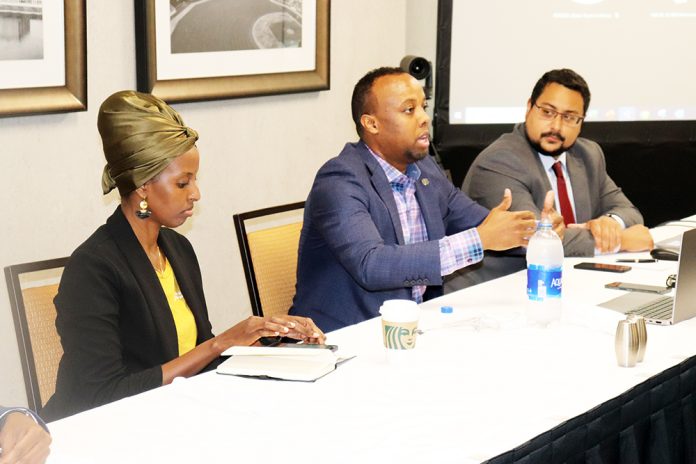
Mr. Kyle DeFreitas, right, of the World Health Organization (WHO) listens as Mr. Mohamed Farah, center, executive director of Ka Joog, organizer of Somali Week in Minnesota, speaks during a roundtable focusing on health in Somalia on Saturday, July 1, 2023. The roundtable was part of this year’s Somali Week activities. On the left is the roundtable moderator, Ms. Amira Adawe, an instructor at the University of Minnesota School of Public Health and executive director of the Beautywell Project. Photo: Tom Gitaa/Mshale
Mr. Kyle DeFreitas, right, of the World Health Organization (WHO) listens as Mr. Mohamed Farah, center, executive director of Ka Joog, organizer of Somali Week in Minnesota, speaks during a roundtable focusing on health in Somalia on Saturday, July 1, 2023. The roundtable was part of this year’s Somali Week activities. On the left is the roundtable moderator, Ms. Amira Adawe, an instructor at the University of Minnesota School of Public Health and executive director of the Beautywell Project. Photo: Tom Gitaa/Mshale
For Somali Americans in Minnesota, the week leading up to the July 4 is not only an opportunity to celebrate the Independence Day of their surrogate nation, but also that of the country they left behind.
This year, the Somali community celebrates 63 years of their country’s independence. Throughout the weekend, Somalis in Minnesota celebrated their country’s independence with a series of events under the banner of “Somali Week” which included panel discussions, and cultural and sports events, hosted by Ka Joog, a Minnesota-based nonprofit that organizes annual celebrations of the east African country’s Independence Day.
On Friday, business leaders, elected officials, and members of the community gathered at the Courtyard by Marriot Hotel in downtown Minneapolis for a town hall discussion themed “Progress and Partnership: Envisioning a Stronger Future for Somalia.”
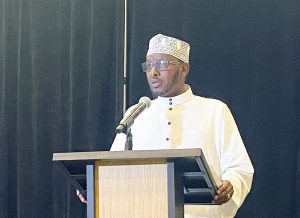
Sheikh Hassan Jama speaks during a Somali Week community townhall meeting in Minneapolis on Friday, June 30, 2023. Photo: Panashe Matemba-Mutasa/Mshale
Community leader Sheikh Hassan Jama said that the town hall was a call for unity for all Minnesotan Somalis to think about how they could advance the interests and wellbeing of the Somali diaspora. He explained why thousands of Somalis take part in the annual week-long festivities.
“[Somali Independence Day] is a day that calls for reflection and gratitude,” Jama said. “Our forefathers’ unwavering commitment inspired us to honor their legacy and uphold the values they showed in their struggle.”
Events like Somali Week present opportunities for the community to cast itself in positive light, in a state where people of Somali descent haven’t always been portrayed well.
Despite having a population of more than 86,000 – the most of any state in the United States, according to the nonprofit group Minnesota Compass’s analysis of U.S. Census Bureau data, Somalis in Minnesota have historically met challenges that come with being Black, immigrant, and Muslim.
According to the Somali Week website, the celebration has grown over the years from one block with around 5,000 people, to three blocks and more than 35,000 participants from various backgrounds. Ali Elmi, the board chair of Rising Impact, a nationally recognized Somali-wellbeing organization that coordinates Somali Week, said that leading the planning of the festivities had been rewarding for him.
“These past two weeks I’ve really come to understand all that goes into organizing this great event,” Elmi said.
At the town hall, Kyle DeFreitas, a representative from the World Health Organization (WHO), spoke about the recent COVID-19-imposed challenges that put pressure on Somalia’s health sector. The pandemic exacerbated pre-existing issues in the country, he said.
“The country continues to feel the impact of COVID, on top of other challenges like famine, floods, drought, and cyclones,” DeFreitas said.
Despite the difficulties, DeFreitas acknowledged that Somalia had made significant strides in getting back on track after the pandemic. They included technological advancements to increase access to oxygen and successful vaccination campaigns. A report from WHO detailed the international efforts to improve post-COVID conditions in Somalia, including partnerships with the United Nations Sustainable Development Cooperation Framework to rebuild the health care system and strengthen emergency preparedness.
Rep. Samakab Hussein, a Somali American who represents District 65A in the Minnesota state legislature, recalled fond childhood memories of Somali Independence Day in Minnesota. Each year, he would anticipate the lively cultural activities and parades in his neighborhood, he said. Hussein said the experience shaped his identity as a young Somali American, and believes the celebrations are important in instilling pride for future generations.
“We want to make sure our kids learn where they come from and who they are,” Hussein said.
Another member of the community, Dr. Mursal Khalif, spoke about the business potential of Somalia, highlighting the country’s natural resources as opportunities for trade and economic development. Khalif also mentioned the strides Somalia has made in the tech industry, particularly its ICT sector, according to World Economic Forum.
As more Somalis immigrate to states like Minnesota, the need for robust communications technology available to the diaspora has only increased. However, political instability has stifled progress. Khalif said the solution to the Somali economic standstill was more emphasis on diplomatic relations.
“When people do business together, relationships grow, and we can all benefit from that partnership,” Khalif said.
Mohamed Farah, executive director of Ka Joog, said town halls were necessary to both unite the community and pave a brighter future for Somalia. While a large portion of the discussion addressed Somalia and the ways people can support the country, Farah said it was just as important to discuss the livelihoods of Somalis living in Minnesota, as more continue to settle in the state every year.
“Minnesota is our home, and we aren’t going anywhere,” Farah said.
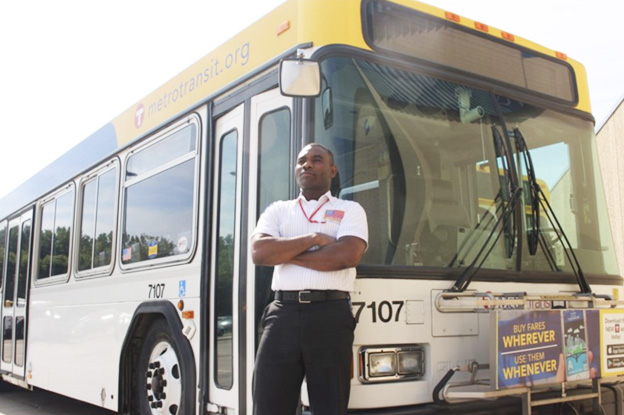
Kossivi Loki, originally from Togo, has worked for Metro Transit for 10 years. Photo: Courtesy of Metro Transit
Kossivi Loki, originally from Togo, has worked for Metro Transit for 10 years. Photo: Courtesy of Metro Transit
Sponsored Content from Metro Transit
Kossivi Loko is no stranger to patience, dedication, and community.
As an immigrant from the West African nation of Togo, it took a decade’s worth of patience, dedication, and a desire for community to successfully become a citizen of the United States, unite his family, and secure a job.
“I came here to find opportunity and to build a better life,” Loko said. “I was lucky. I won the immigration lottery.”
Even when he was accepted, however, he couldn’t bring his entire family. His eldest daughter would have to stay in Togo for years until she could be accepted into the country. Today, she is the first of his family to attend college.
“I am so very proud of her.” Loko said. “Her graduation is one of three days I’ve taken off in six years of working here.”
Loko chose Minnesota because a friend already lived here. As they both grew up in a tropical climate, his friend warned him about winter, but Loko looked forward to the change.
“I remember my first snow. It was so white. I was excited to shovel it.” Loko said. “Today, I still love snow, but I’d rather use a snowblower.”
He arrived in Minnesota on a green card in 2003. He initially found work as a truck driver. Eventually, he earned his citizenship in 2010. Two years later, a call went out for bus operators. In 2012, he put on his first Metro Transit uniform.
After years of driving trucks, the major change was the addition of passengers.
“I like to serve people, and in this job, people need you,” Loko said. “In my interview, I said exactly that: I wanted a job that would serve people and help me to become part of my community.”
Transit is a community, and like all communities, they require relationships, like the one between operators and riders.
“You have no idea what people have been through that day when they get on your bus.” Loko said. “I try to treat everyone nice. And when I’m not having a good day, I remember to take a breath and count.”
At his home base at the North Loop Garage, he’s found another community: his fellow operators.
“We support each other, and we help each other out.” Loko said. “People care about you. We do our part to make Metro Transit great.”
Loko looks forward to continuing his career at Metro Transit and to growing into new positions.
Operator at a Glance
Hired: Dec. 31, 2012
Hobbies: Working out, bicycling, traveling
Country of Origin: Togo
Fun Fact: Although he’s from a tropical African nation, he loves snow and the cold.
Best Advice: Be kind to people. You don’t know what they’re going through or where they just came from.
Metro Transit is Hiring
Looking for a rewarding career? As a bus driver with Metro Transit, you’ll have the chance to make a real difference in the community. With pay starting at $26.16 an hour, annual raises, great benefits and a hiring bonus of up to $5,000, now is the time to make Metro Transit your career destination! Visit metrotransit.org/drive to apply today!