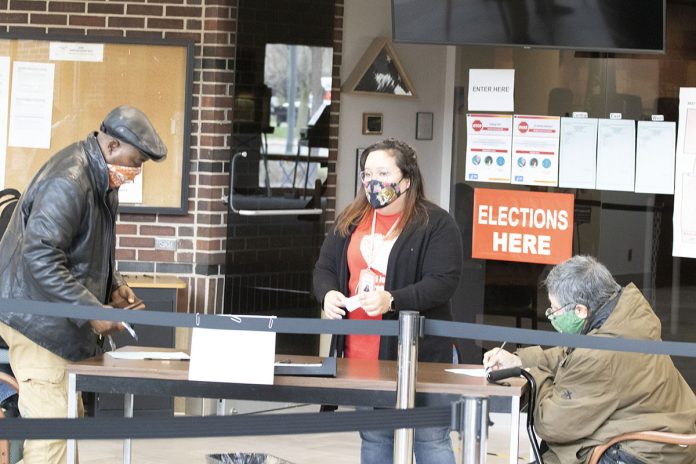
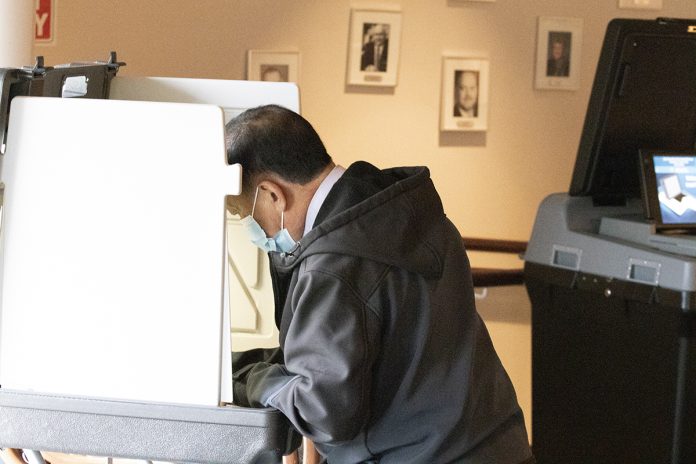
Voters fill out absentee ballot applications on Saturday, April 10, 2021 for the April 13, 2021 special primary election for mayor at the Brooklyn Park city hall. The special election for mayor is on August 10, 2021. Photo: Tom Gitaa/Mshale
Voters fill out absentee ballot applications on Saturday, April 10, 2021 for the April 13, 2021 special primary election for mayor at the Brooklyn Park city hall. The special election for mayor is on August 10, 2021. Photo: Tom Gitaa/Mshale
The Brooklyn Park City Hall will be open this Saturday, August 7, to allow the city’s voters to cast absentee ballots for the August 10 special election for mayor. Voters can vote between 10:00 a.m. and 3:00 p.m.
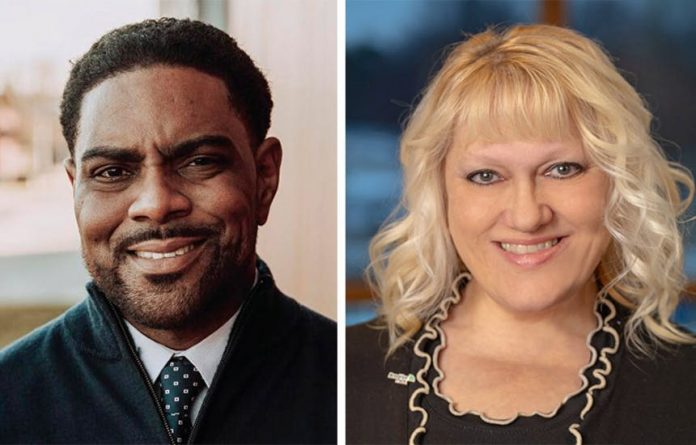
The Tuesday special election contest is between Hollies Winston and Lisa Jacobson, the top two candidates to emerge out of a field of seven candidates during the April 13 primary special election.
1,993 votes have already been cast as of today (Aug. 5) according to Devin Montero, the city clerk. On Saturday, if you are not already registered, you can do so at city hall on the same day and vote.
If you are not yet a registered voter but want to vote this Saturday, you can do so, but read this link at the Secretary of State website on what you might need before showing up at city hall.
Since the April 13 primary special election, the two candidates have engaged each other directly in one forum while Hollies Winston participated in a candidate interview that Lisa Jacobson declined.
The address to the Brooklyn Park City Hall is 5200 85th Ave. N.
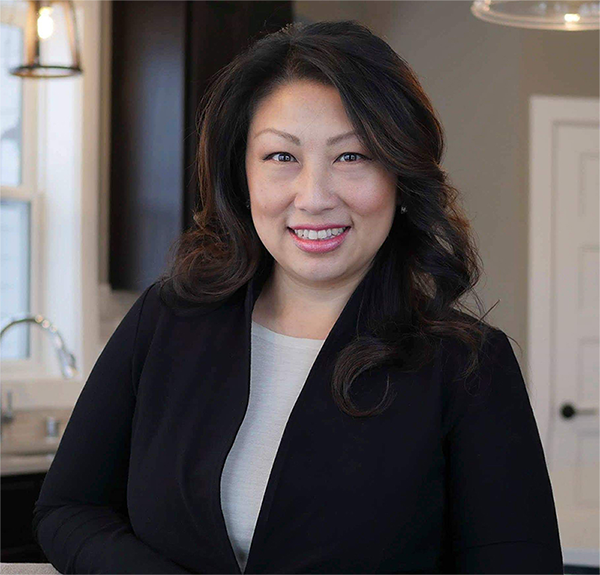
Brooklyn Park Councilwoman Susan Pha announced on August 4, 2021 that she will be running for the Minnesota State Senate representing District 40. Photo: Courtesy
Brooklyn Park Councilwoman Susan Pha announced on August 4, 2021 that she will be running for the Minnesota State Senate representing District 40. Photo: Courtesy
Brooklyn Park Councilwoman Susan Pha announced she’s running for the state Senate Wednesday, scoring a big endorsement from the seat’s incumbent, Democratic Sen. Chris Eaton who represents the heavily Democratic Senate District 40.
Pha was reelected to a second term in the Brooklyn Park City Council in last November’s general election. She was first elected to the council in 2016 when she made history by becoming the first elected council member of color. It was her first attempt to run for office, easily winning with 56 percent of the vote.
“It is an honor and privilege to serve the residents of Brooklyn Park these past 5 years on the City Council. I am so grateful for the trust you’ve placed in me. I look forward to the opportunity to continue to represent and serve the residents of Brooklyn Park and the residents of Brooklyn Center in the State Senate,” Pha, a Democrat, said in a news release. “I will continue to uplift your voices to the table and work hard toward innovative solutions that will create a place where we all can thrive, not just survive. We have to build a better tomorrow and that is why I am running.”
Sen. Eaton will not be seeking another term when her term is up in 2022, according to the news release from Pha’s office.
Pha’s announcement means there is a possibility for a special election to fill her West District seat in the city council. Her council term was to end in 2024.
All three districts in the Brooklyn Park City Council are represented by two council persons serving staggered terms. The other council representative for the West District is Councilman Wynfred Russell whose term ends next year and will be up for reelection in 2022 if he decides to seek reelection.
Blacks make up 33 percent of the residents of Senate District 40, Asians 17 percent while those who identify as white make up 35 percent.
Other races on the ballot in 2022 include that of the governor.
As our city starts to come back to life after the devastating impacts of the COVID-19 pandemic, there’s an issue that I hear about from constituents often – they are concerned about public safety. While overall crime is down, violent crime has increased leaving our residents unnerved.
I spoke with one woman who spent the night in her bathtub due to constant gunshots in her neighborhood, and another constituent sends me daily updates of the violence occurring in our city. It is evident that the status quo of governance in Brooklyn Park is not working.
In addition to the rise in violent crime in our city, we also are experiencing a disconcerting breakdown in trust between our police department and community members. I spoke with Brooklyn Park Police Chief Enevoldsen who shared concerns about officers’ ability to do their jobs properly given the tense environment in our city. Concerned citizens are overstepping the yellow tape to ensure that the police are not abusing their power. This distrust is a source of major concern – to create a more cohesive community and to allow our police officers to operate safely and effectively we must build trust between law enforcement and the community.
In order to build this trust, we must work toward community policing initiatives and invest more in community resources (e.g. mental health and drug addiction services for residents in need). Officers who walk the beat should know the constituents whom they have been entrusted to keep safe, and vice versa. Additionally, there must be continued dialogue between community members and law enforcement. Building relationships is the cornerstone to building trust.
Lastly, investing in youth programming that works in tandem with the police department is paramount. This investment creates relationships and trust between our youth and those sworn to protect them, and provides an opportunity for youth to learn vital life skills while limiting their free time to capitalize on teenage impulses (I am not so old, that I’ve forgotten what it’s like to be a teen).
Should I be fortunate enough to be elected Mayor of Brooklyn Park, I look forward to working in tandem with our community members and the BPPD. I will also look to Sheriff Hutchinson, who has endorsed our campaign, for insights as we navigate the months and years ahead. The status quo isn’t working right now – it’s time for a fresh voice dedicated to implementing evidence-based initiatives that will effectively reduce violent crime in our community and lead to a safer Brooklyn Park.
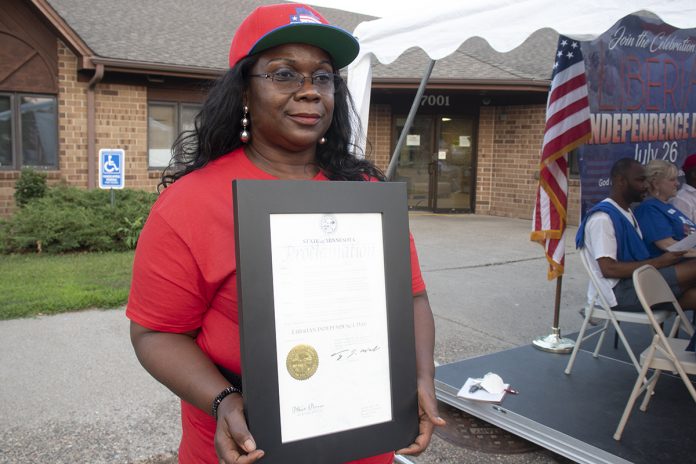
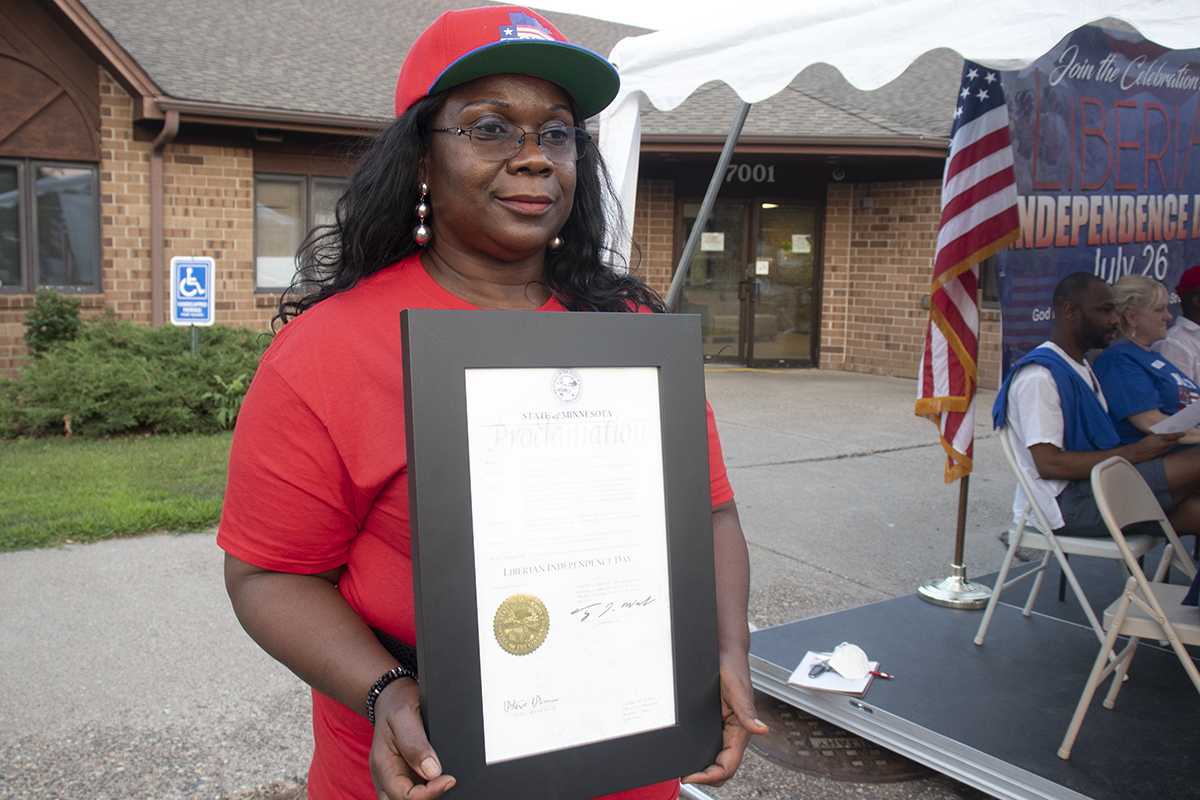
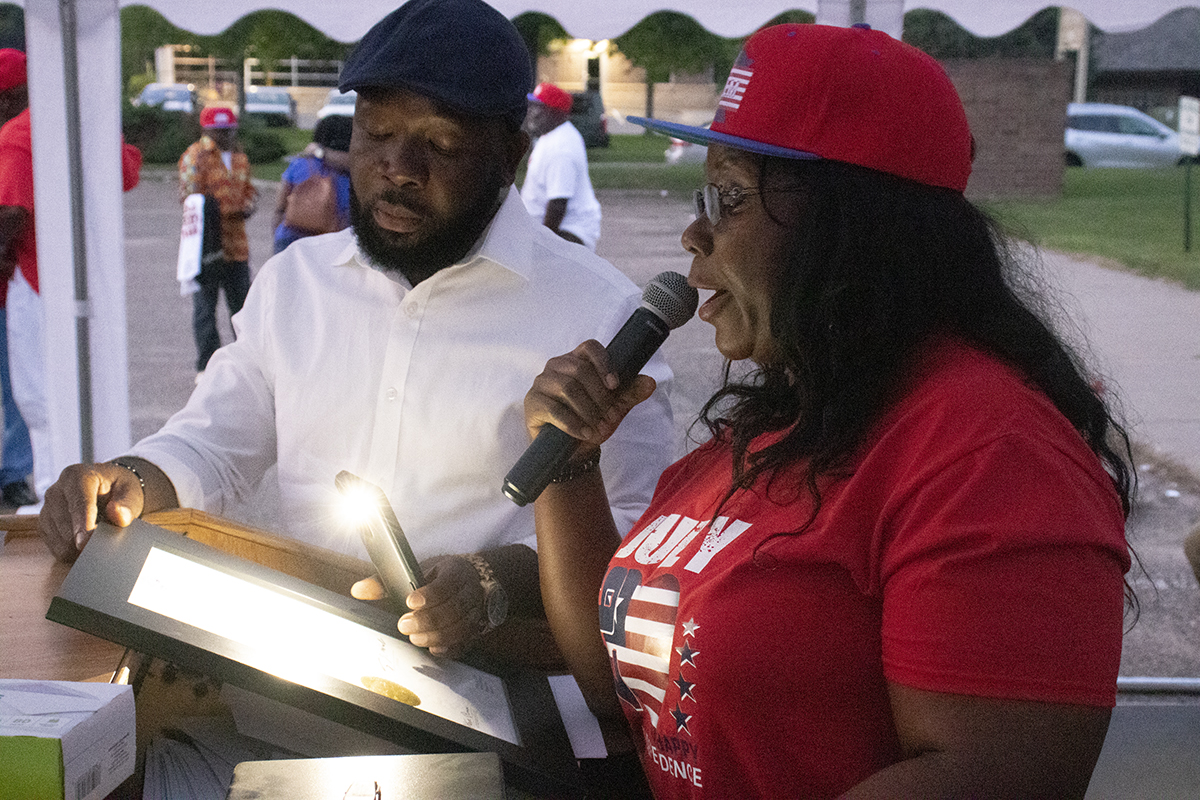
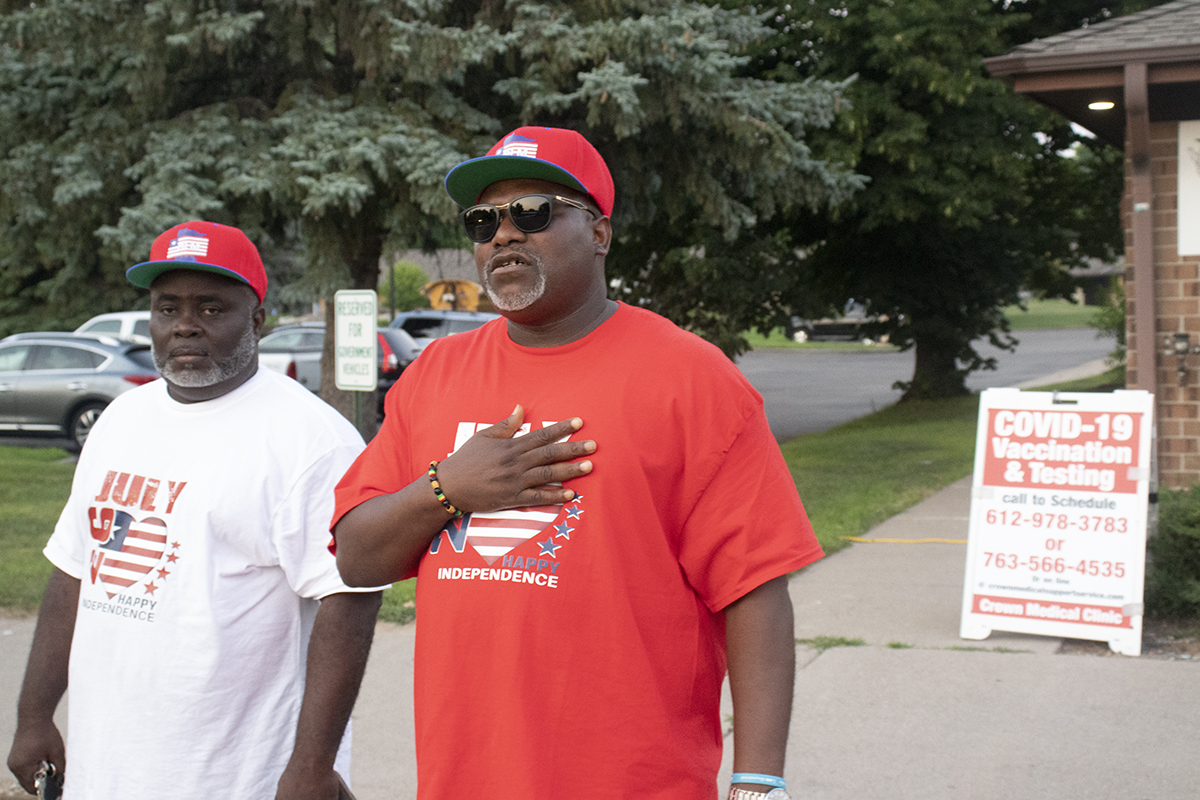
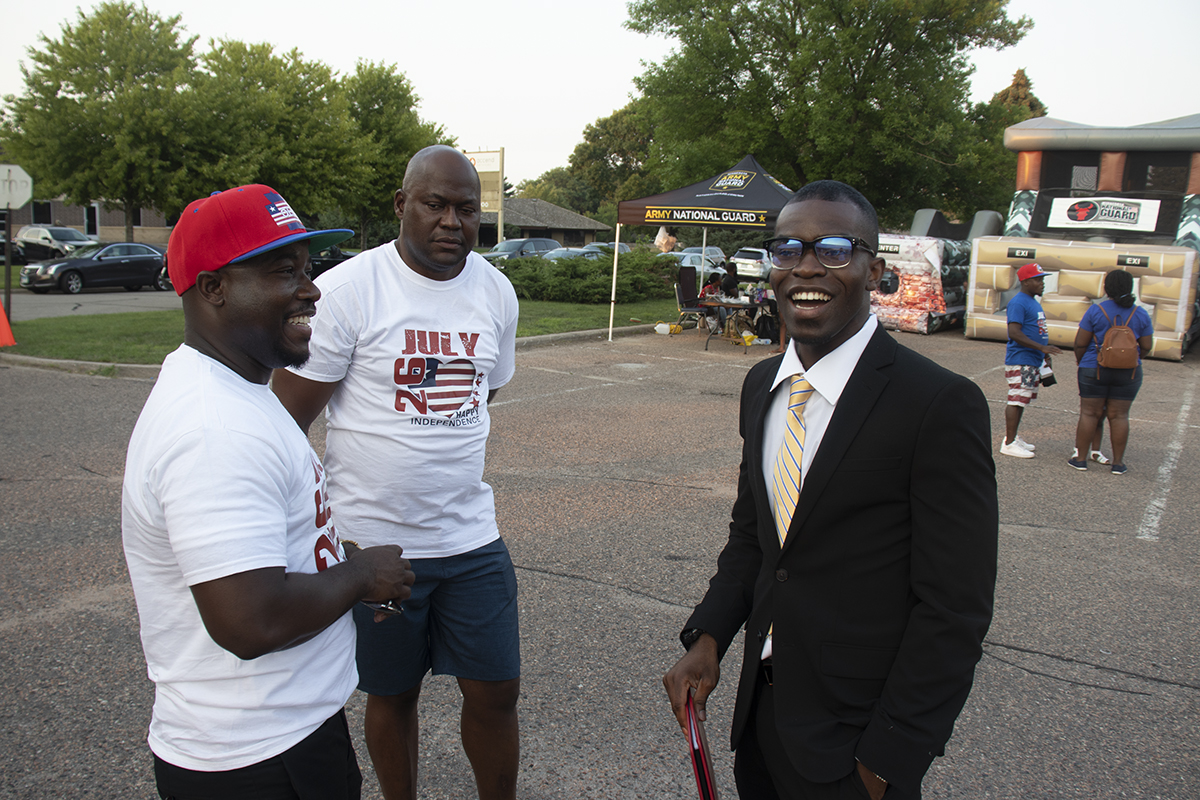
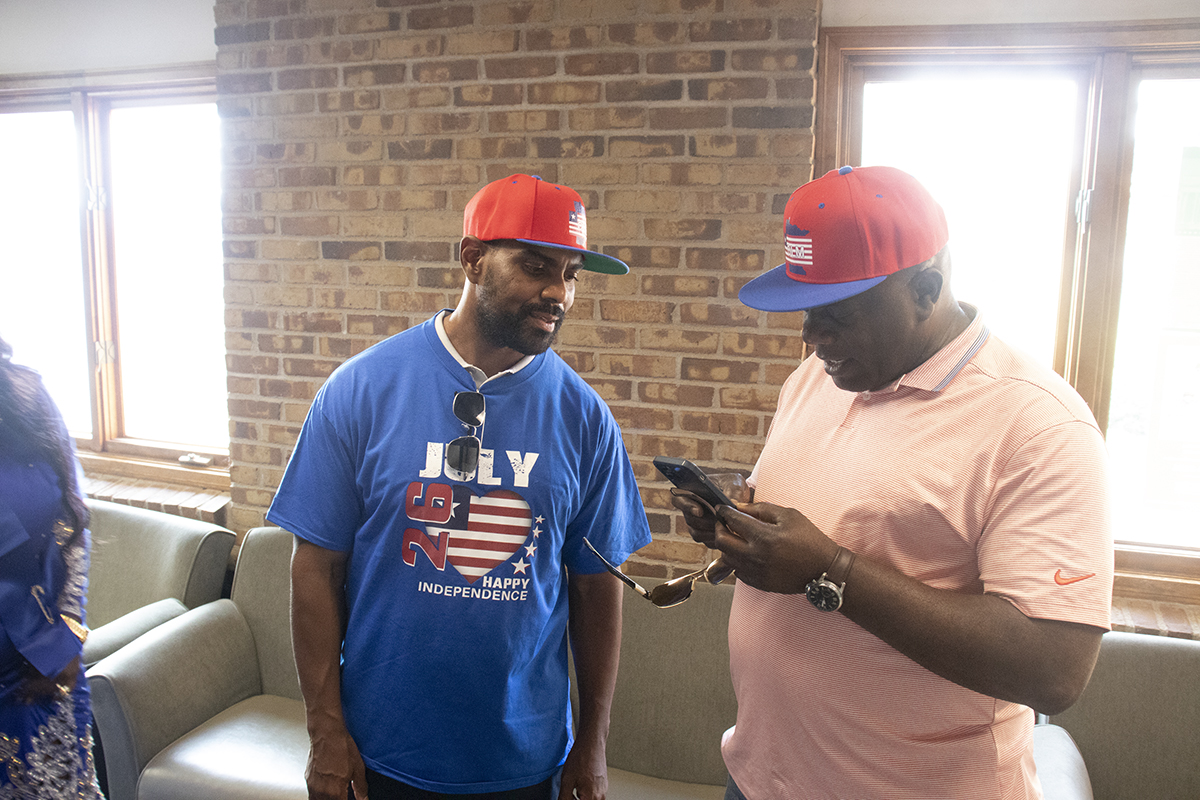
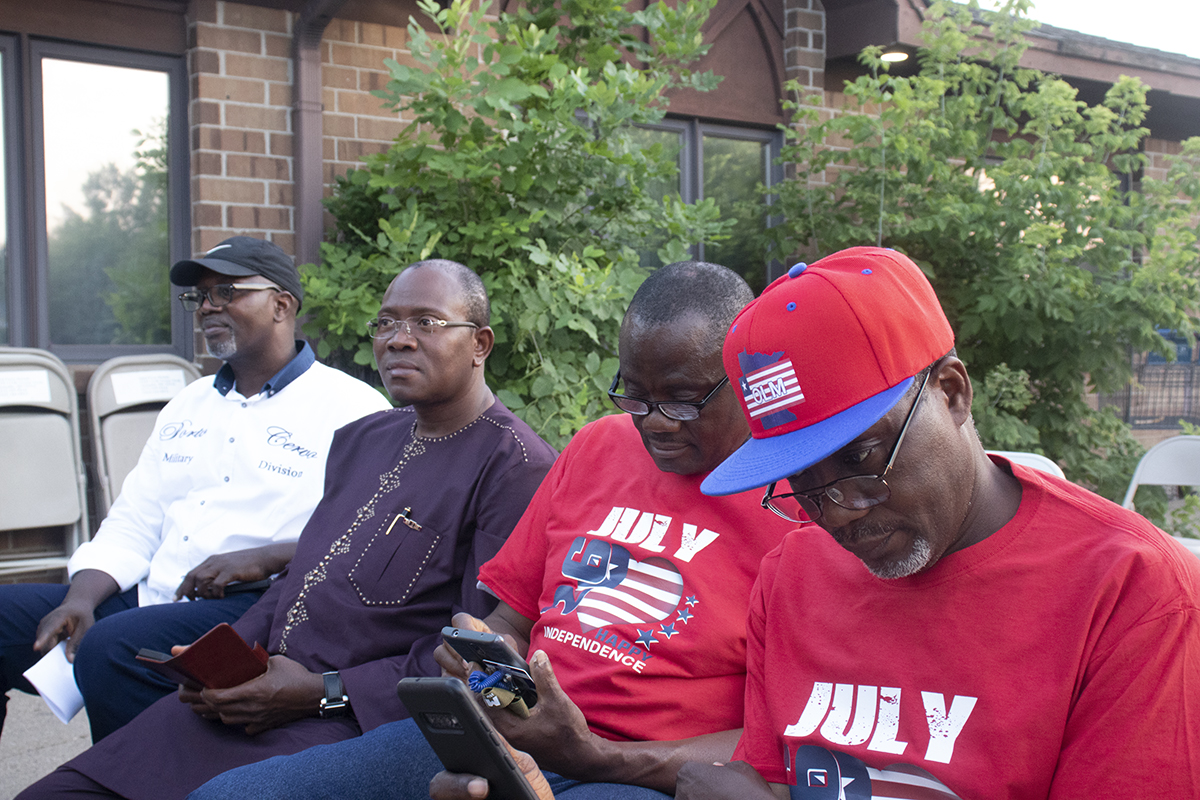
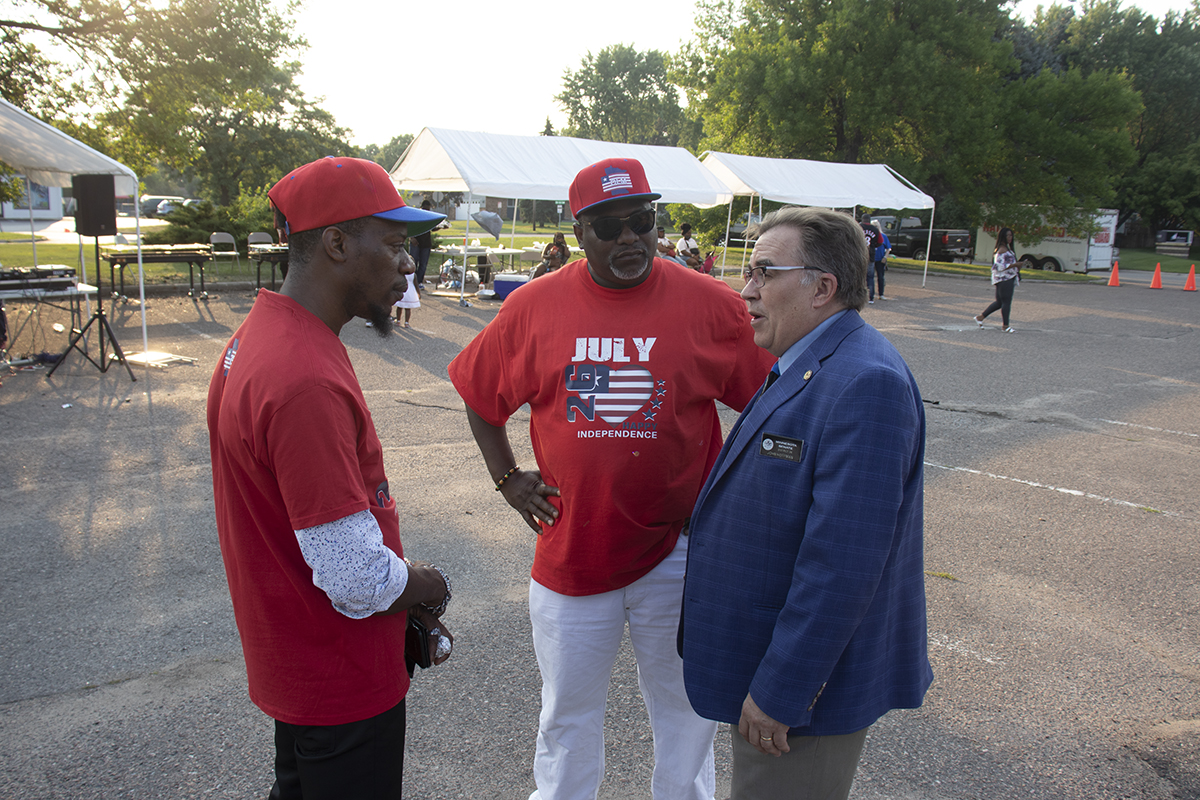
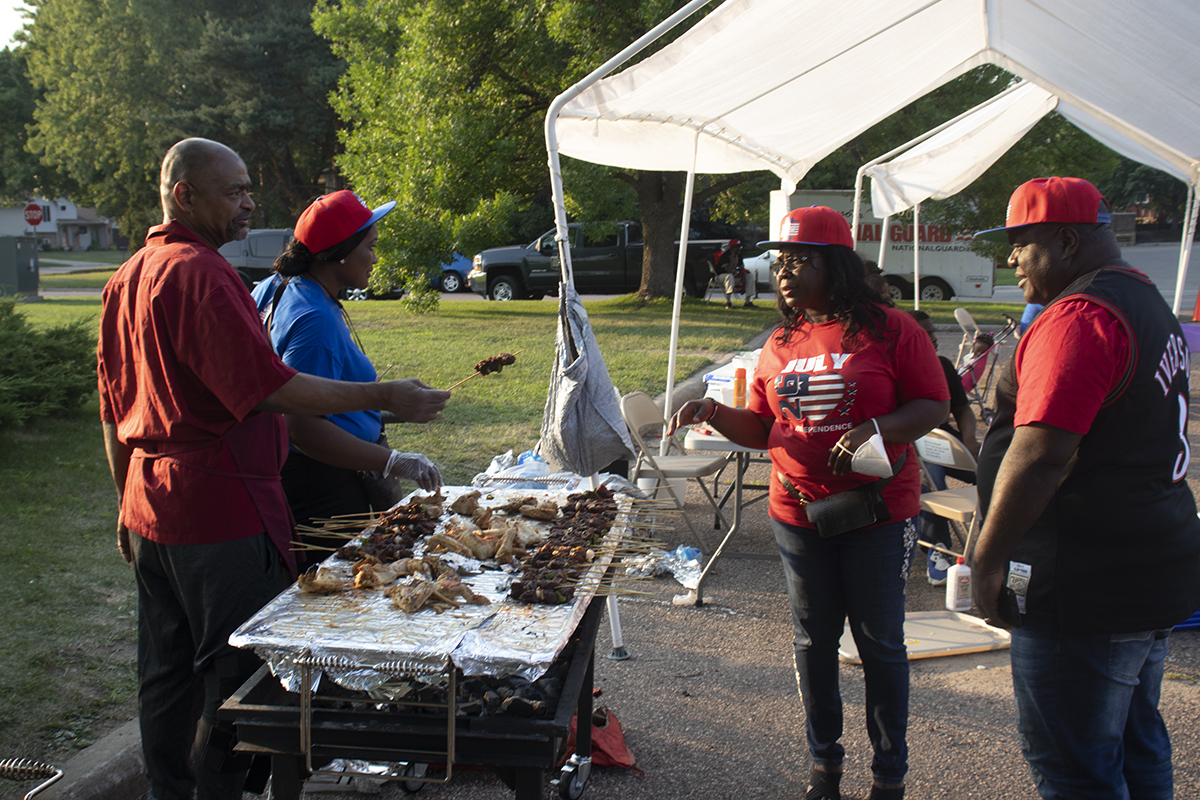
Organization of Liberians in Minnesota (OLM) board member Edwina Willie holds the proclamation from Minnesota Governor Tim Walz designating July 26, 2021 as Liberian Independence Day in Minnesota. The 174th Liberian Independence Day celebrations were held at the Liberian Community Center on July 24, 2021. Photo: Tom Gitaa/Mshale
Organization of Liberians in Minnesota (OLM) board member Edwina Willie holds the proclamation from Minnesota Governor Tim Walz designating July 26, 2021 as Liberian Independence Day in Minnesota. The 174th Liberian Independence Day celebrations were held at the Liberian Community Center on July 24, 2021. Photo: Tom Gitaa/Mshale
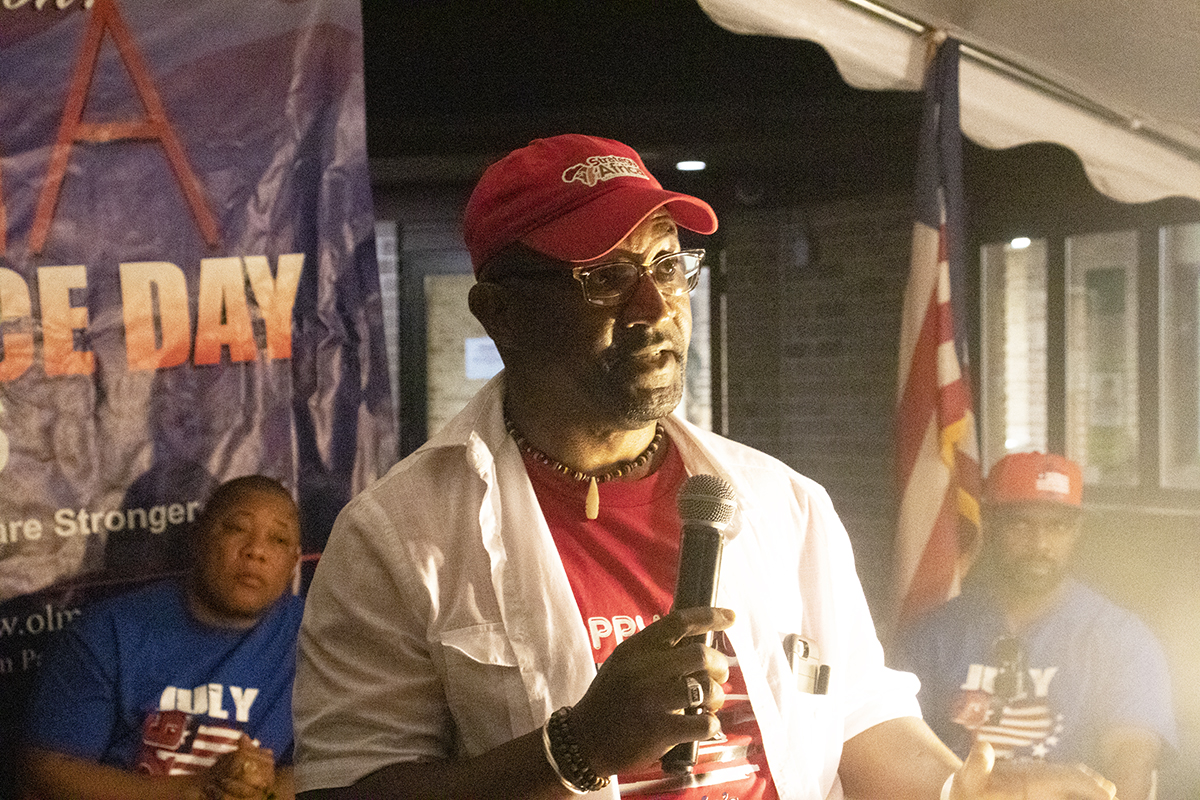
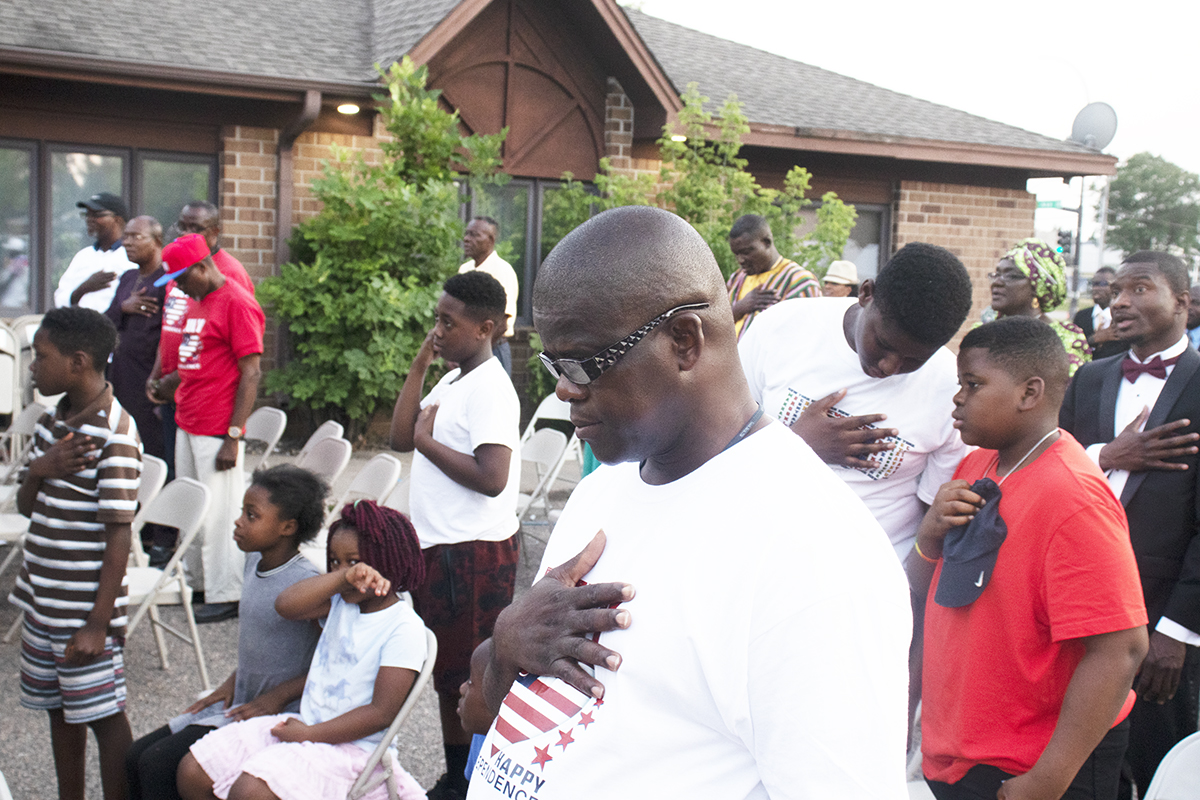
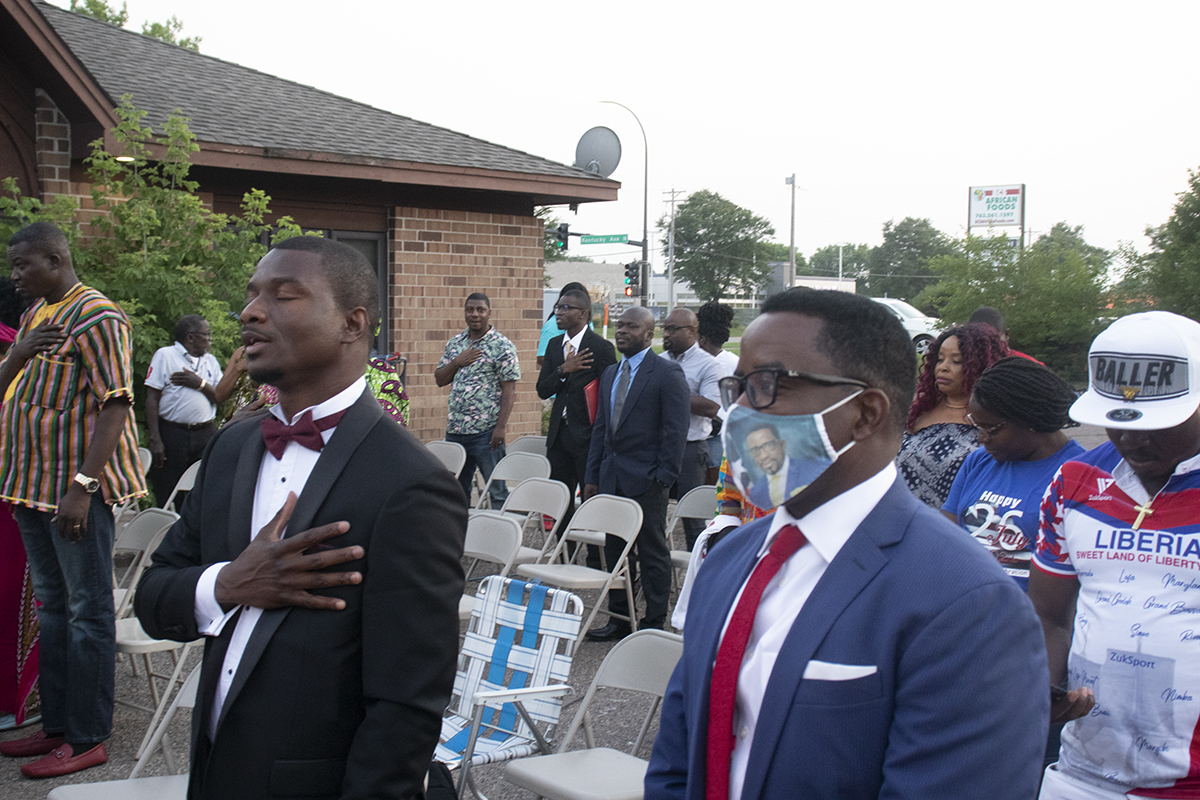
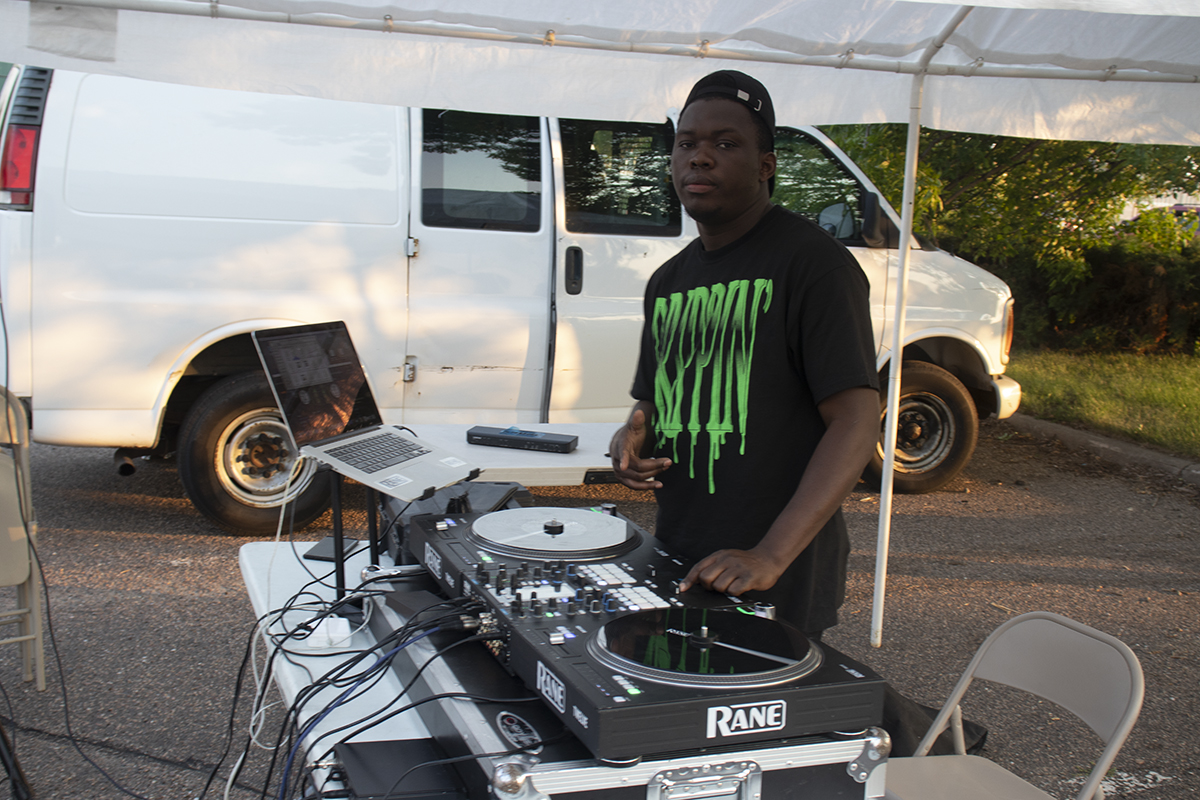
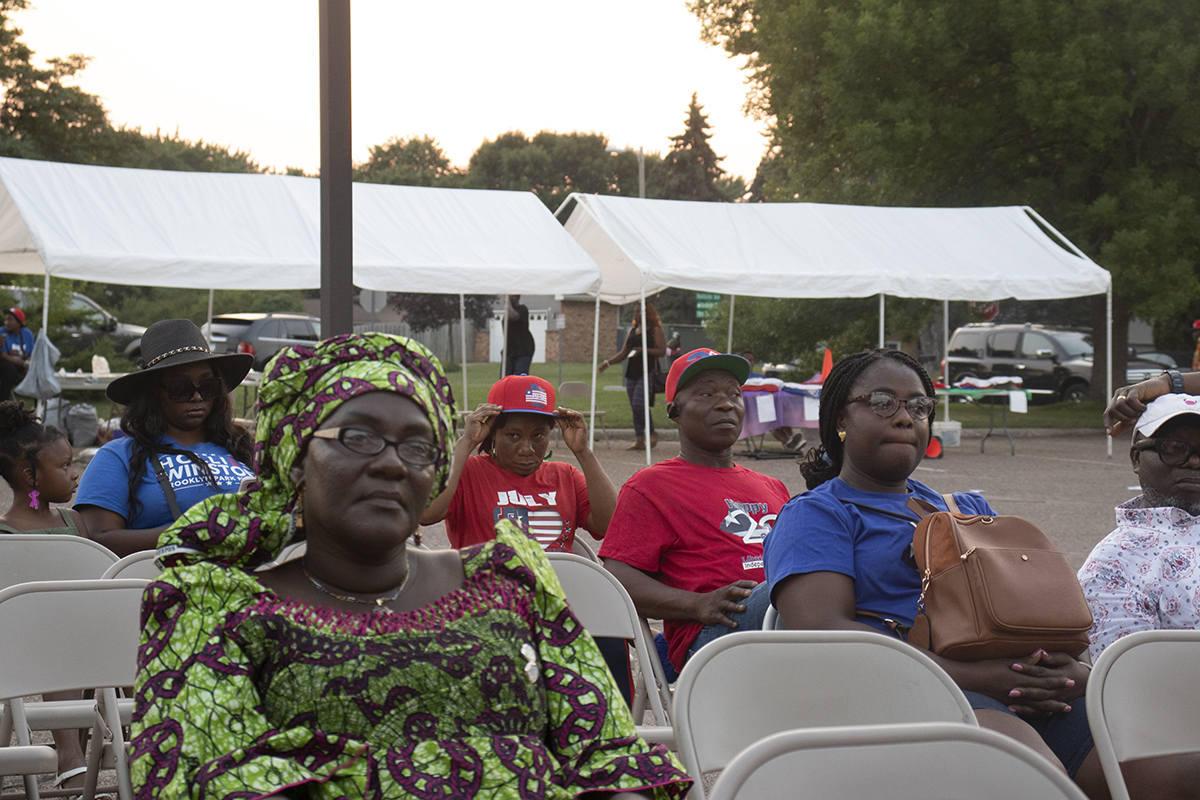
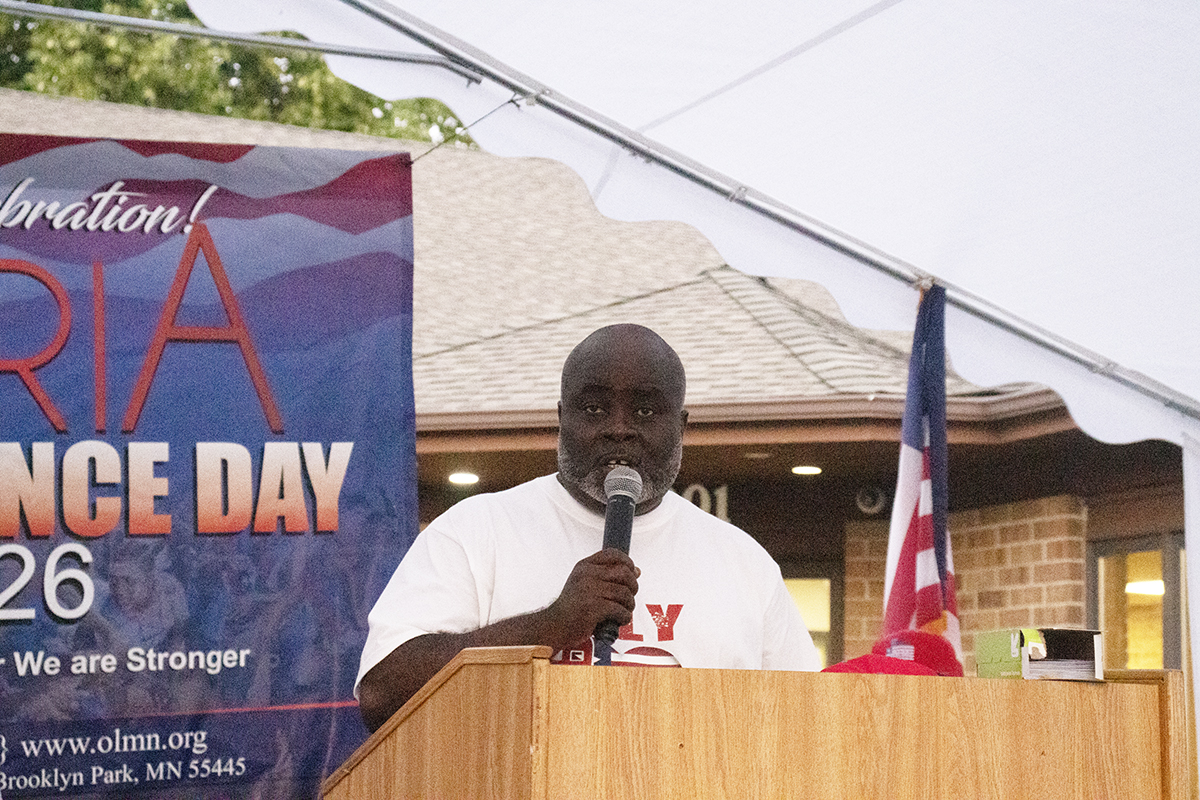
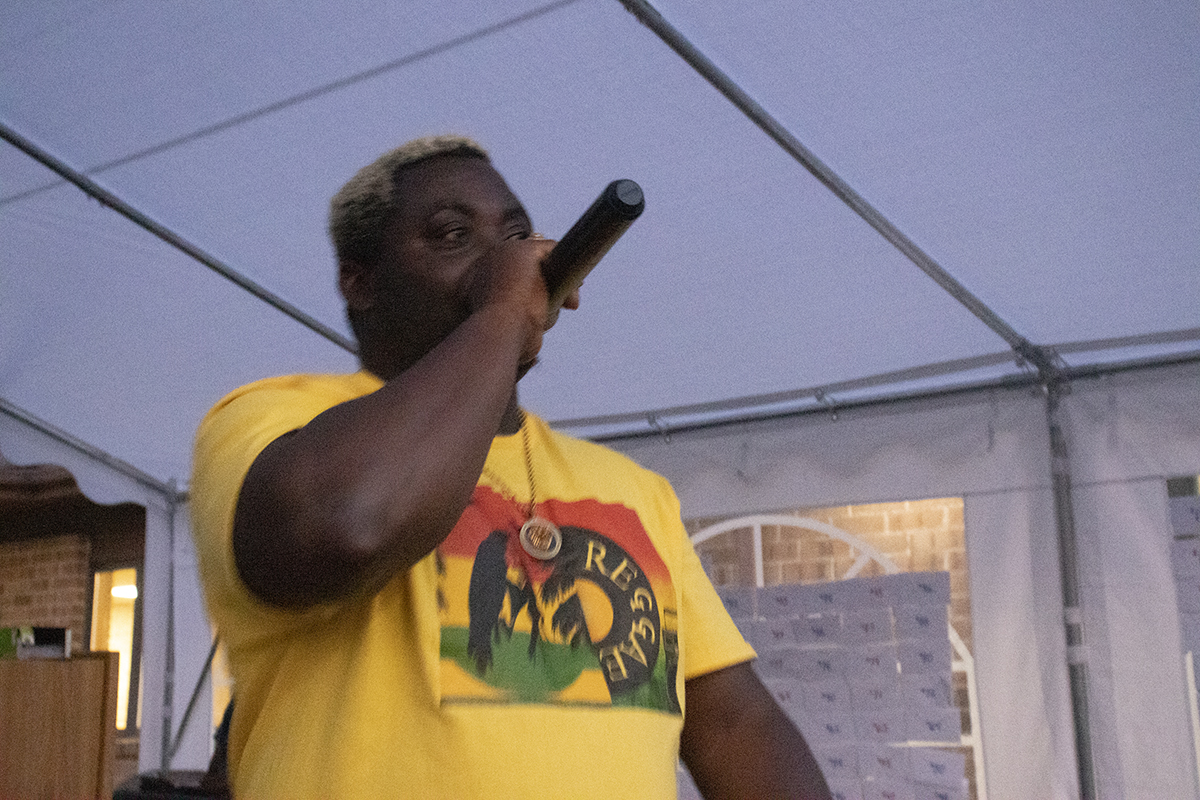
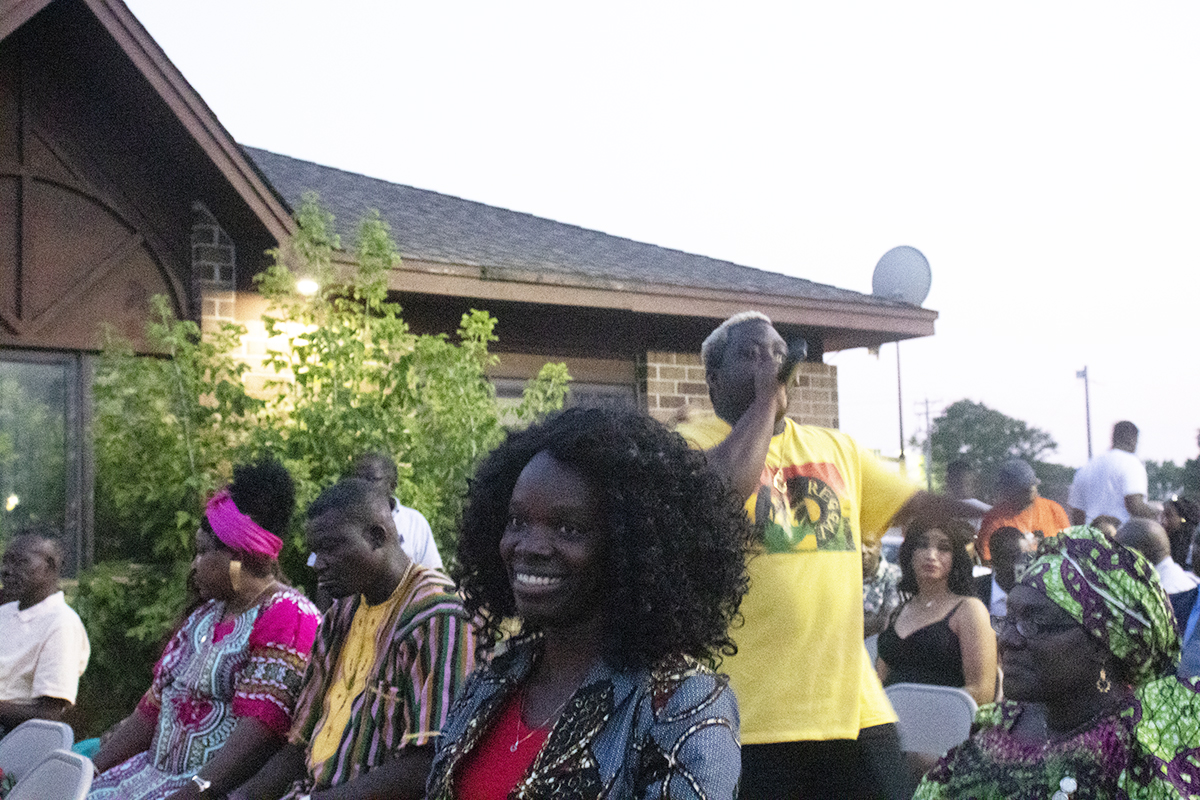
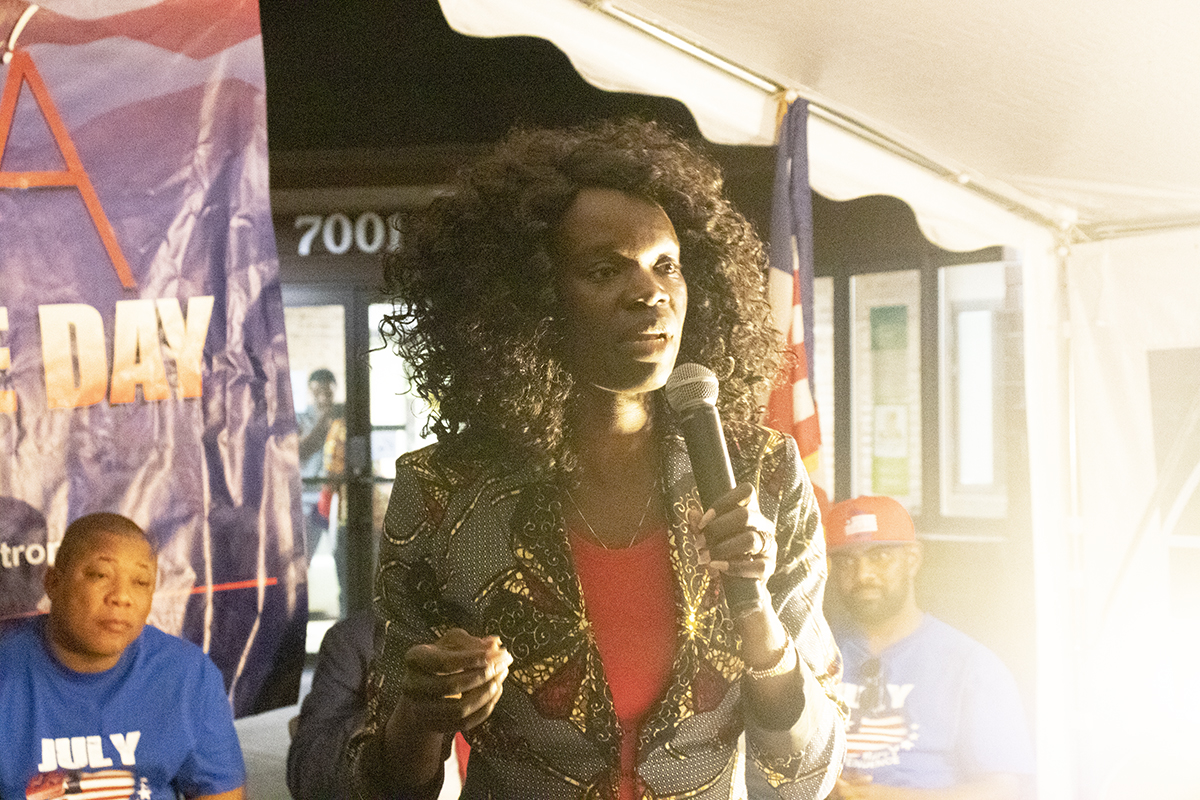
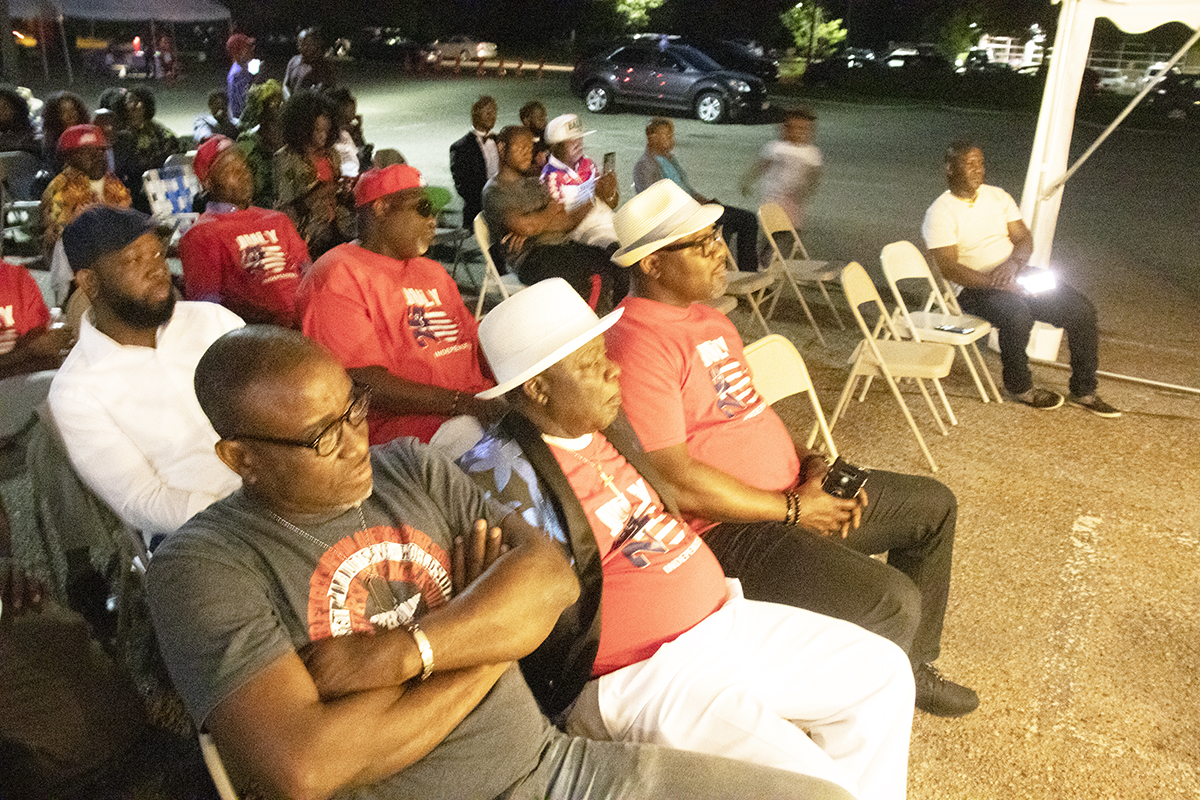
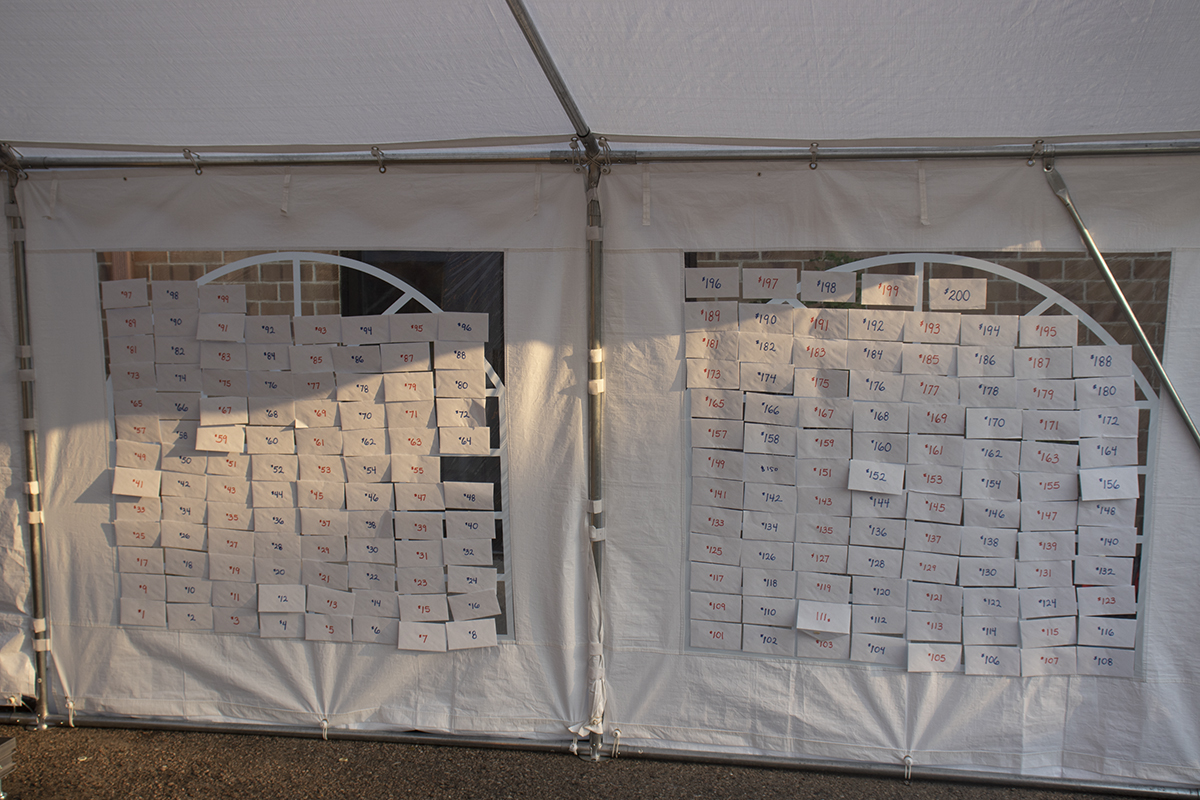
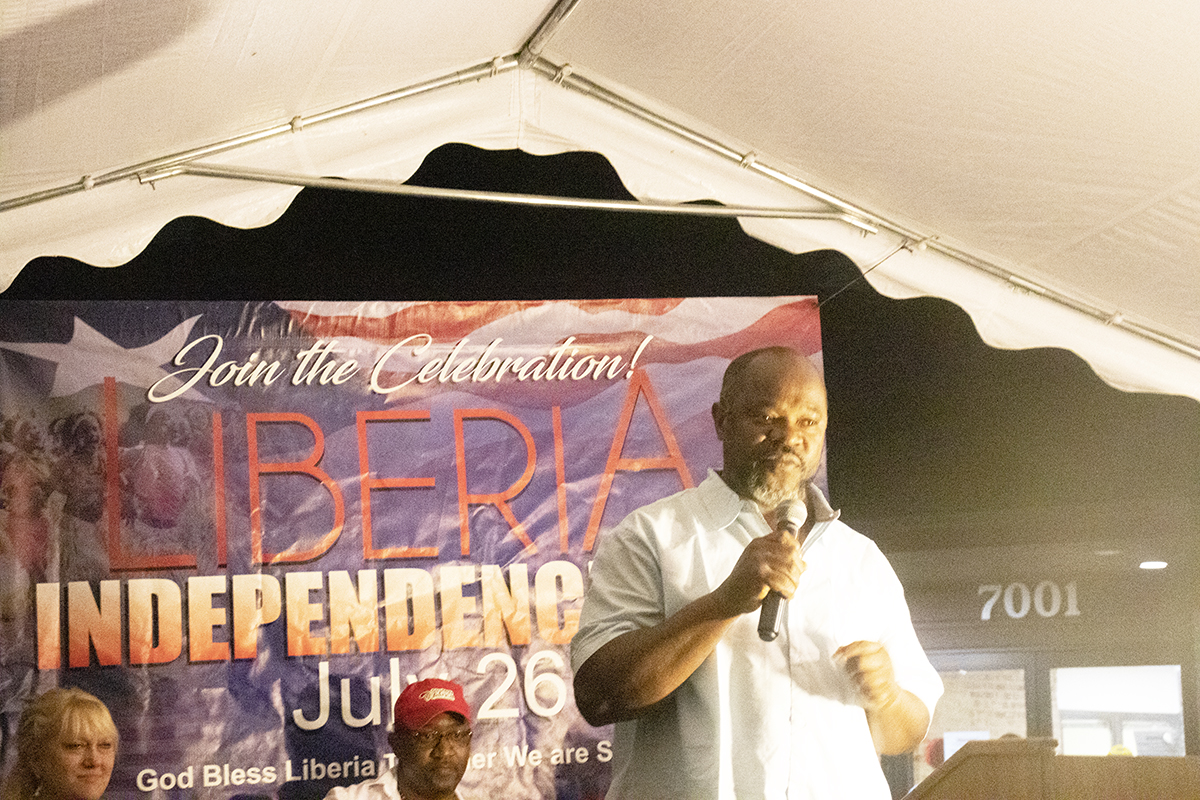
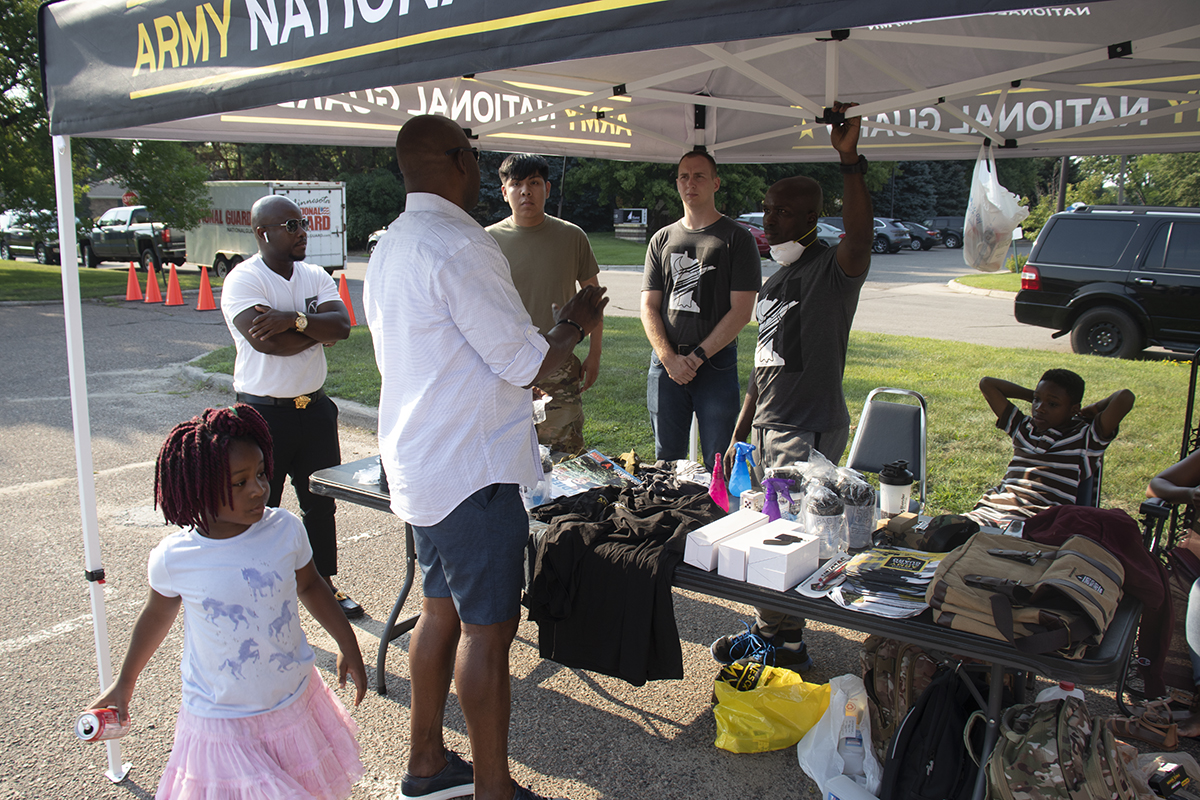
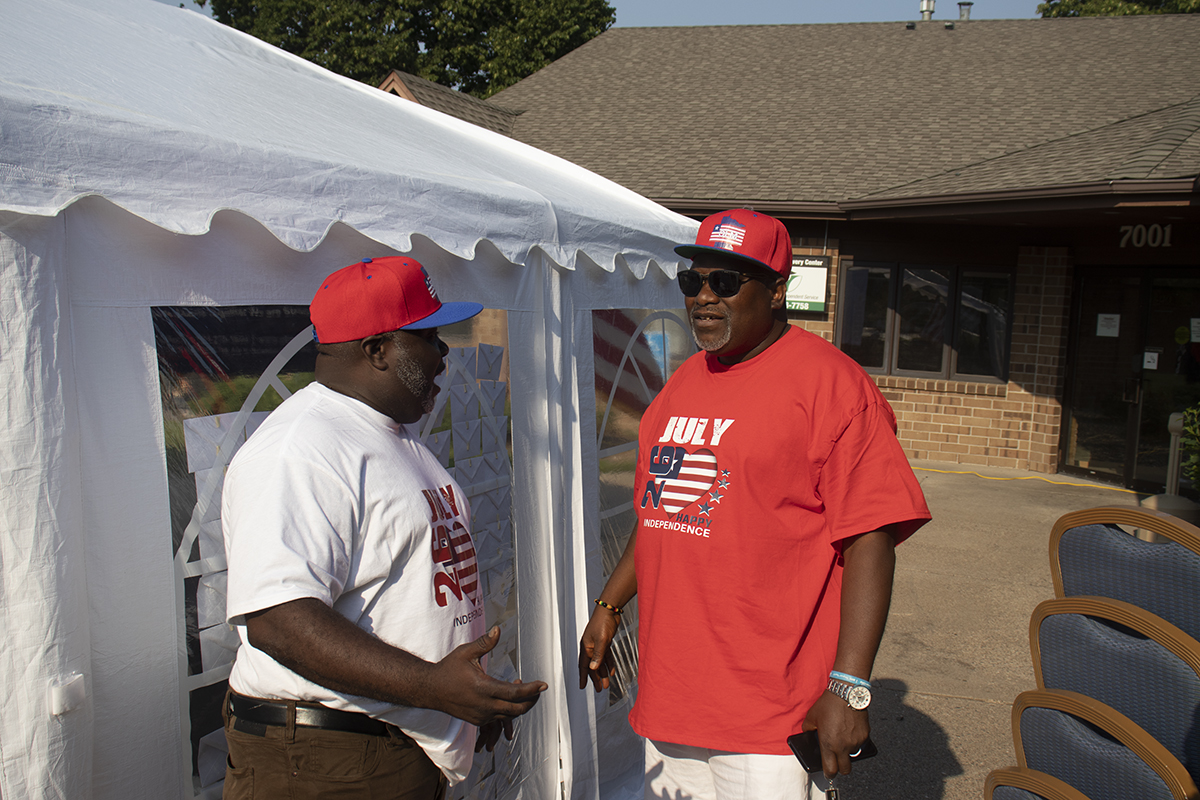
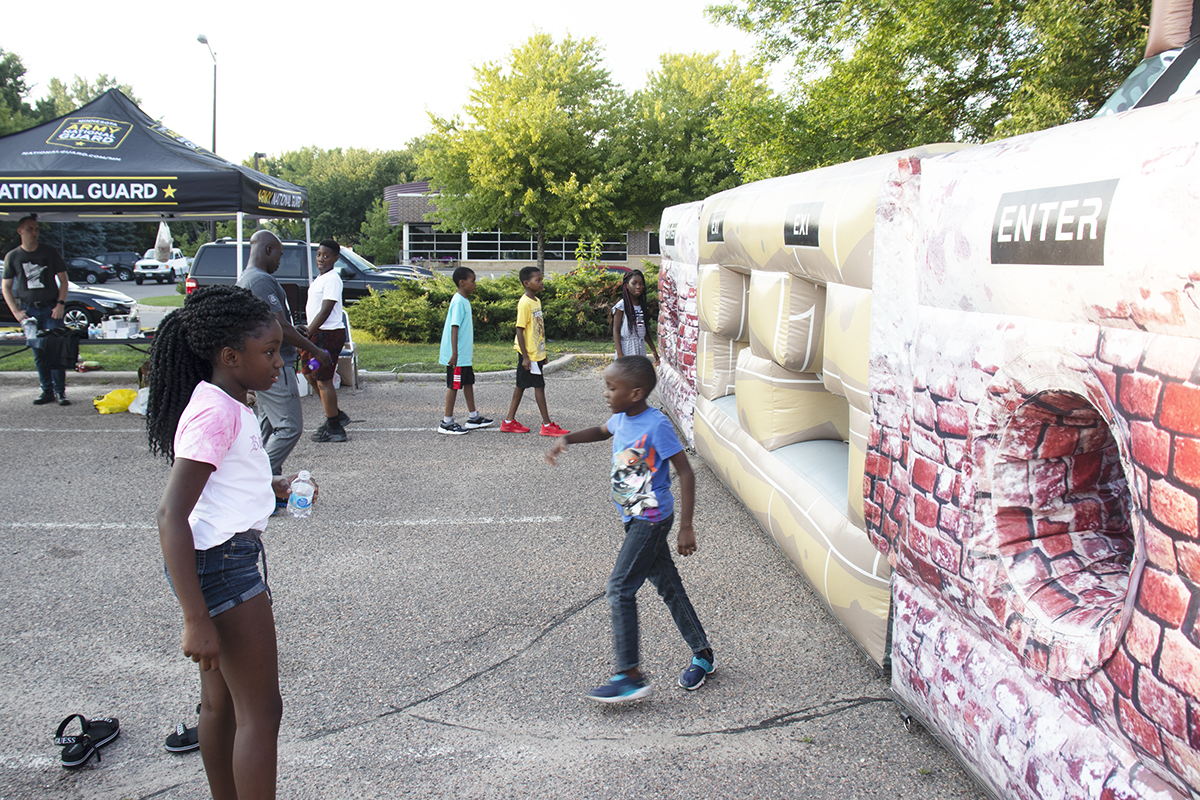
BROOKLYN PARK, Minn. – The Organization of Liberians in Minnesota (OLM) officially launched their Community Center Capital Campaign on the grounds of the community center on Saturday during their country’s Independence Day celebrations.
OLM board of directors’ chairman Abraham Brima Bah said the early fundraising effort has achieved some success with early pledges which started coming in on the day of the celebration.
The organization has set a goal of raising $60,000 which is the down payment required for a $280,000 purchase of additional adjacent space so they can expand their existing community center.
The organization purchased the community center in 2009 in part through the help of then US Senator Mark Dayton which he included in Congress’s FY2005 Omnibus Appropriations Bill. The center is now home to a burgeoning list of programs that the organization runs, including after school programs and a nursing assistant teaching program, and is one of only a handful of community centers owned and controlled by African immigrant organizations in the state.
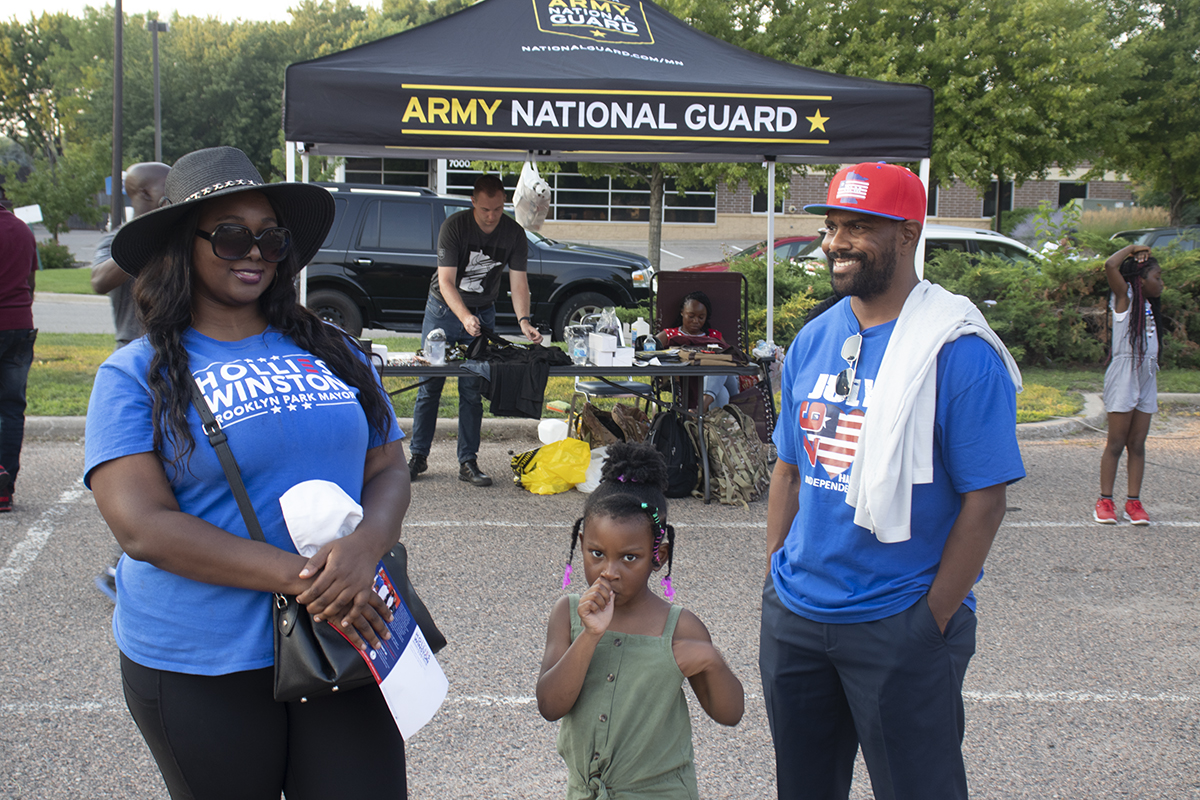
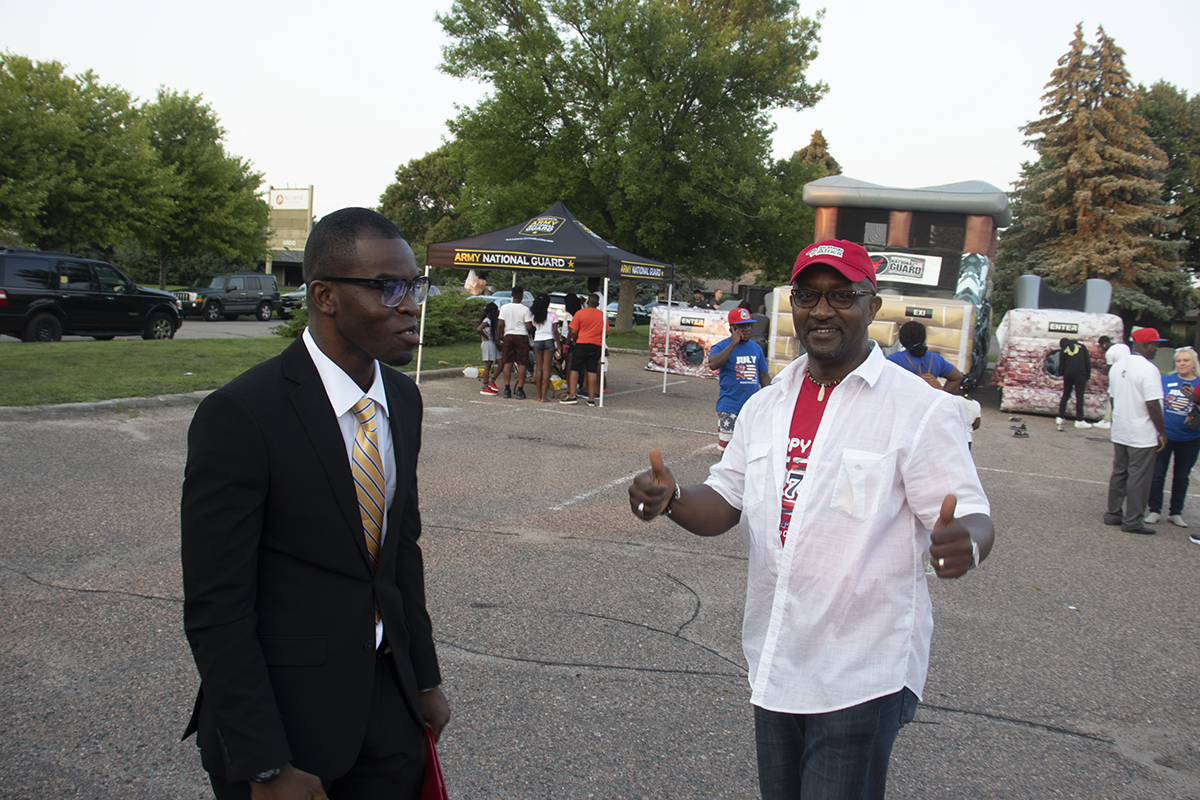
The center owns part of 1.15 acres almost 50,000 square feet alongside four other owners, including the Nigerian-owned Crown Medical Center. A National Guard recruiting center occupies an adjacent office.
Kamaty Diahn, the OLM executive director, said the capital campaign will allow the organization to purchase an additional 2,800 square feet of space which will more than double its current space of 2,200 square feet.
“We have so many programs here now that this space is just not enough,” Diahn said in a follow up phone conversation with Mshale.
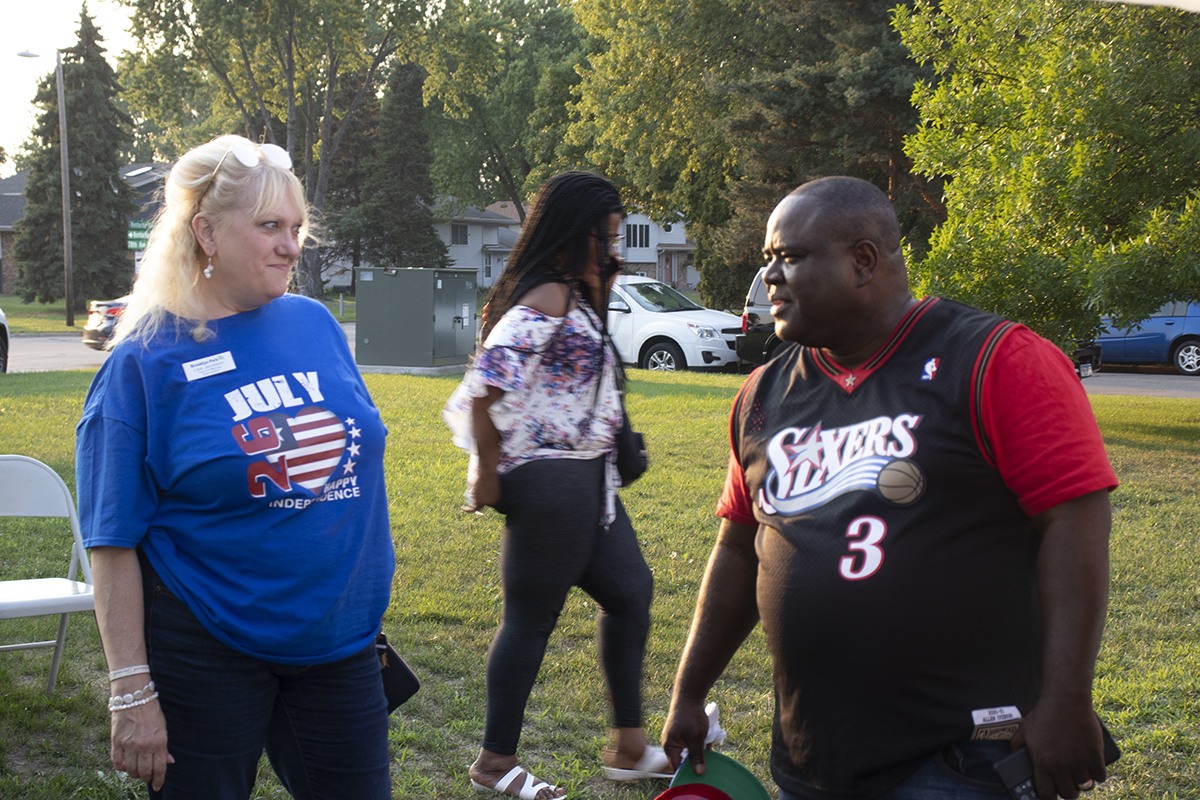
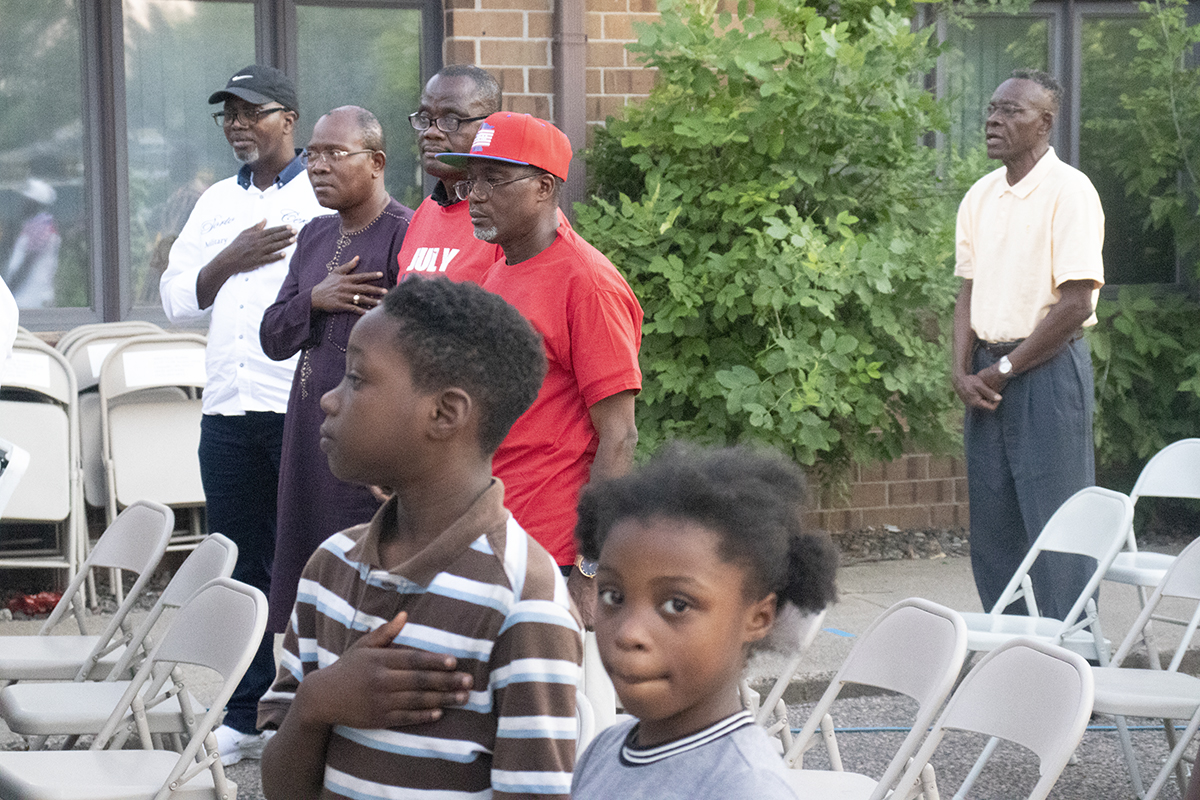
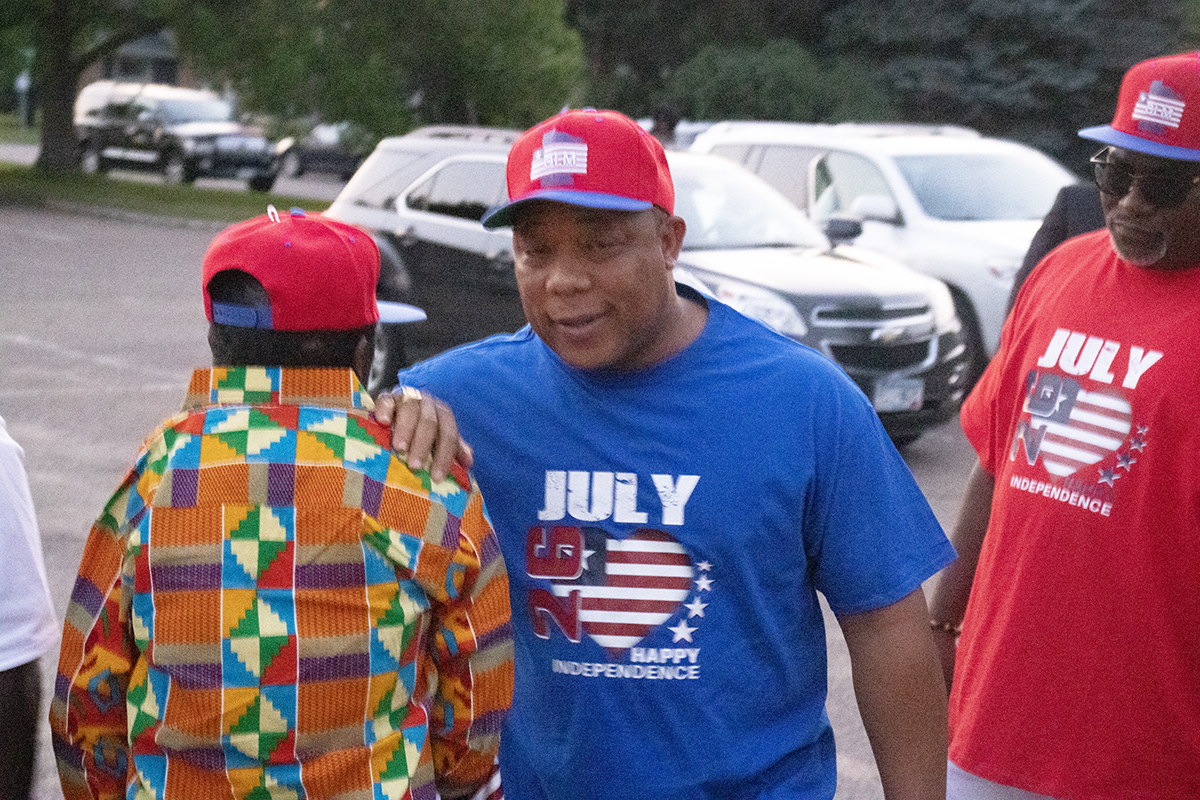
Liberians in Minnesota were marking 174 years of Liberia’s independence two days early on a weekend to ensure wider participation from the community.
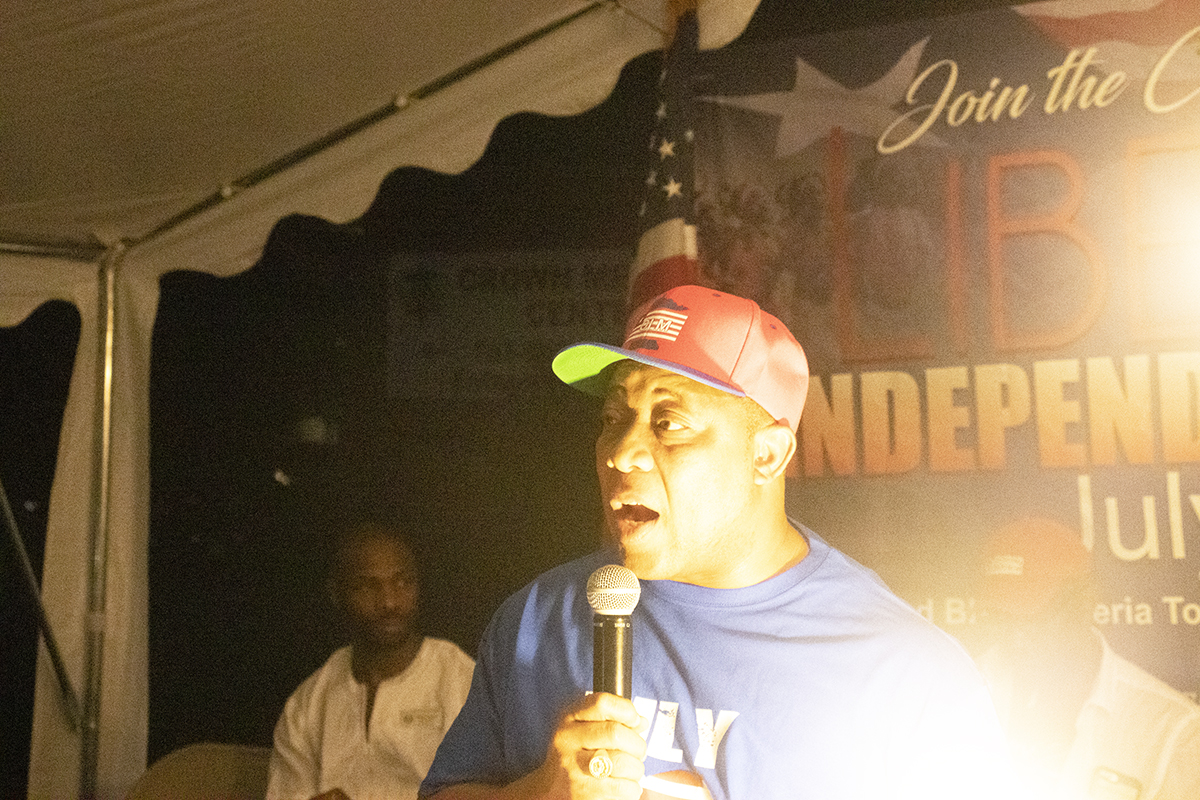
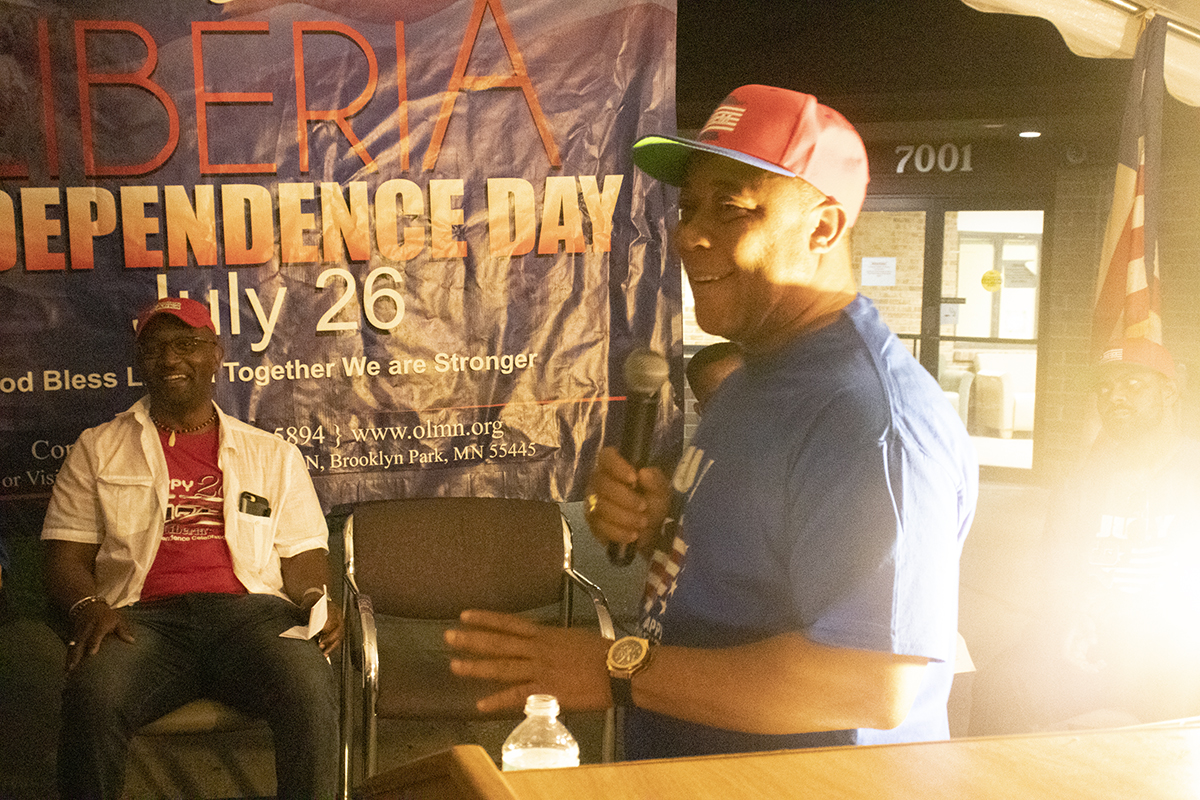
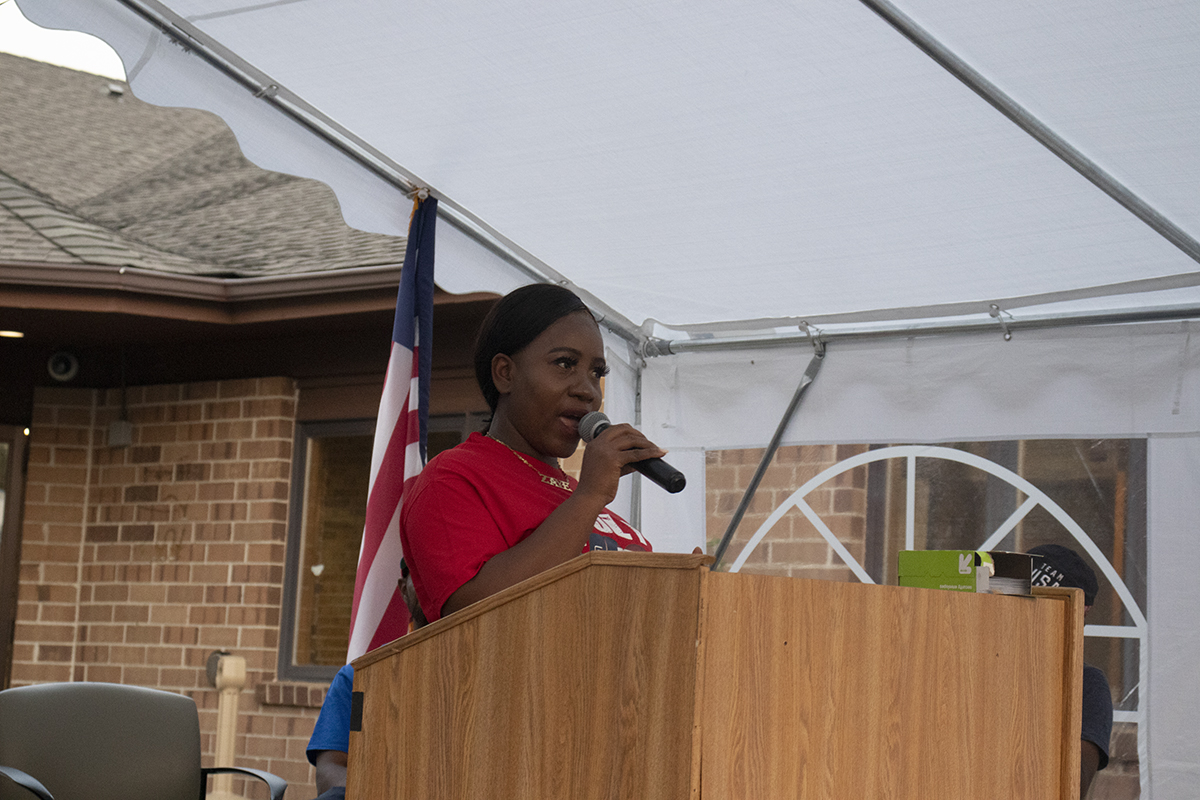
The chairman of Liberia’s ruling Coalition for Democratic Change (CDC) Mulbah Morlu delivered the keynote address as darkness fell outside the grounds of the community center. He brought greetings from the president of Liberia George Weah, whom Morlu said is “committed to maintaining unity in the country by promoting national reconciliation and respecting rights and privileges of all citizens.”
“I call upon all Liberians to demonstrate patriotism and nationalistic fervor. And so while I remain thrilled for the honor to speak here tonight I am not surprised by the level of organization of this program to celebrate the birth of our nation under the auspices of OLM,” said Morlu. “This is evident not only by the warm welcome you have accorded me and my team but also by the presence of these distinguished and accomplished statesmen and women of the state and city governments, and other citizens of the United States.”
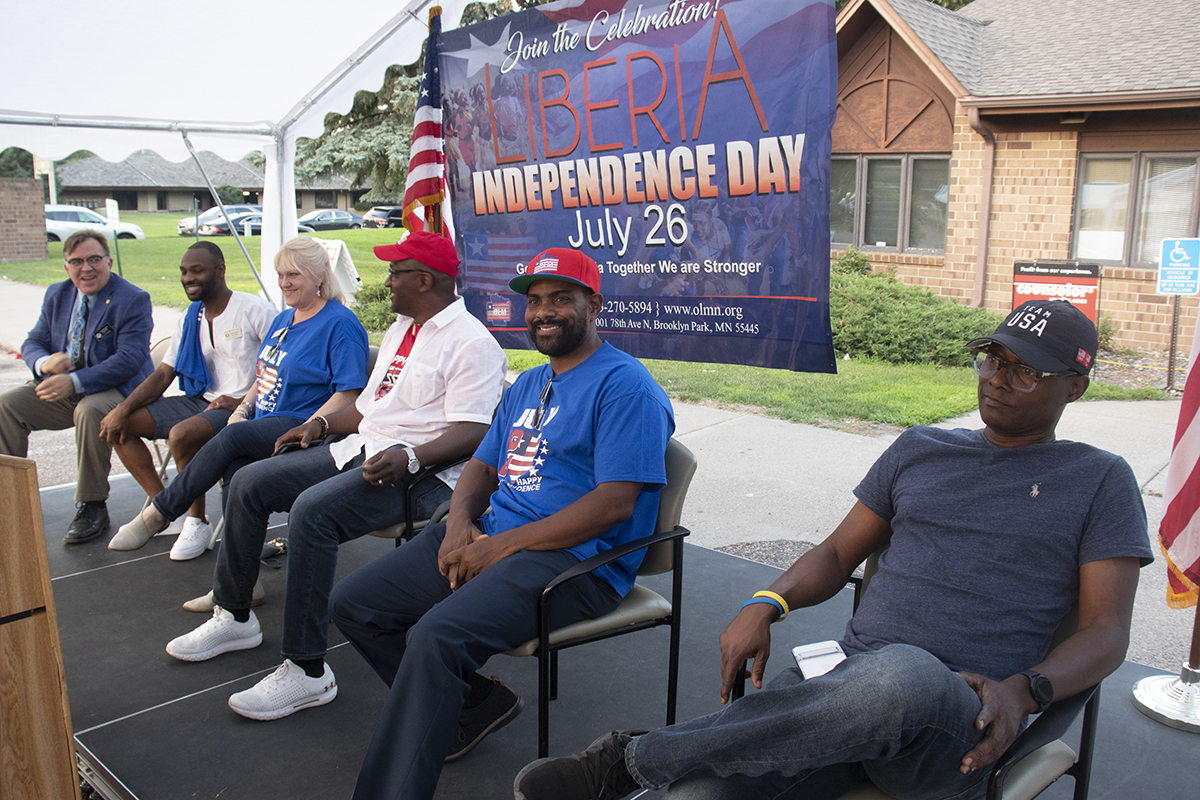
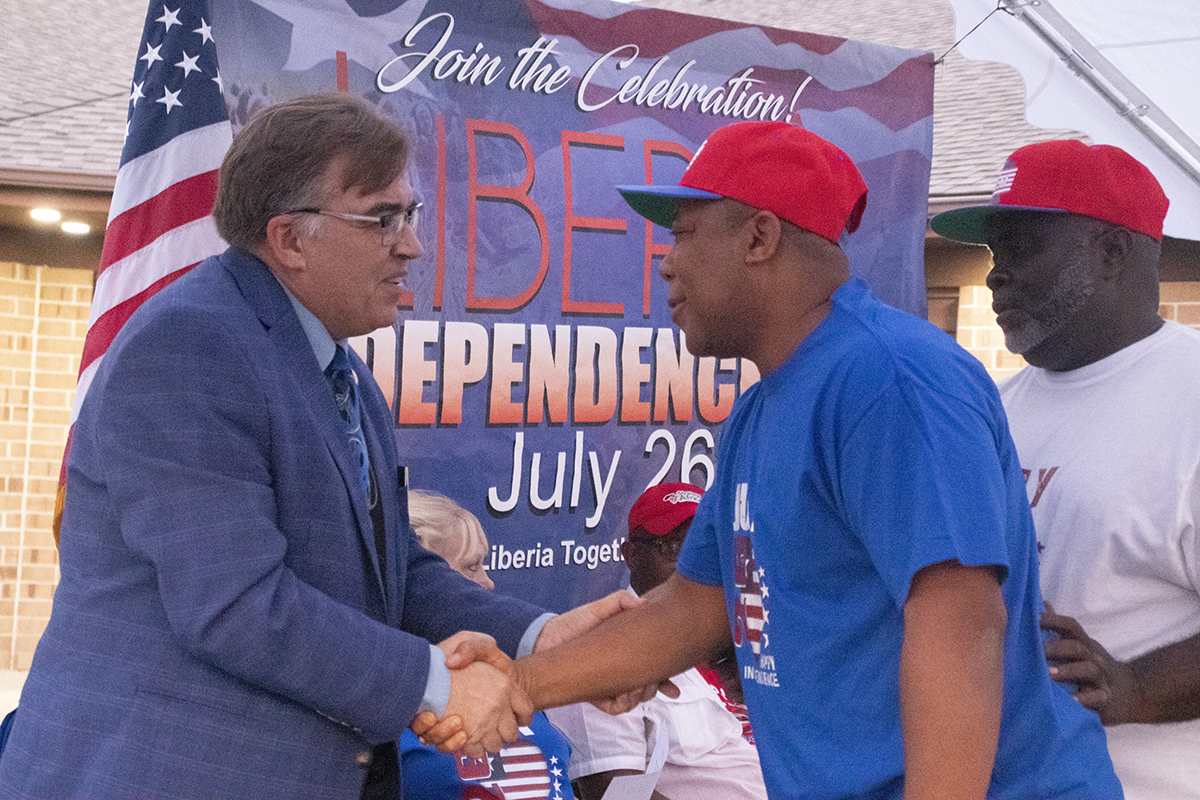
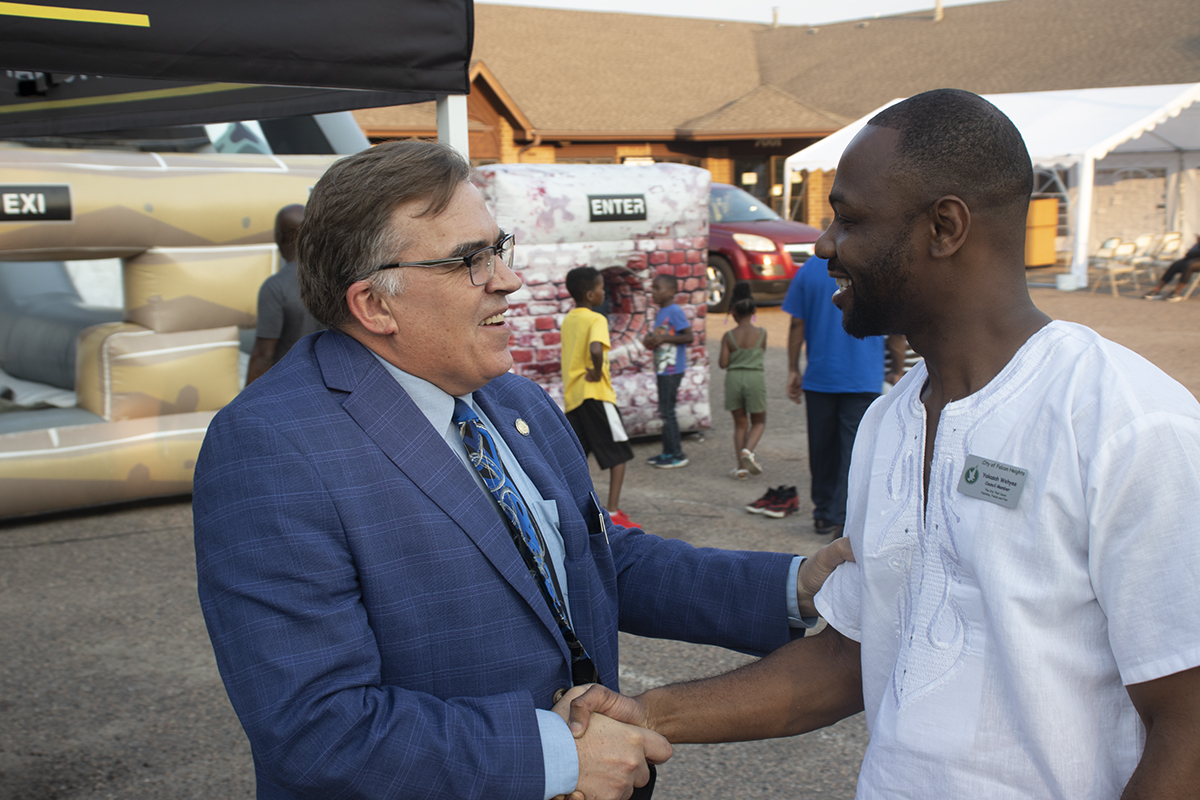
Chairman Morlu was joined on stage by the first Liberians to serve on the Brooklyn Park and Falcon Heights City Councils, Wynfred Russell and Yakasah Wehyee , as well as the two candidates on the ballot in the August 10 special election for Mayor of Brooklyn Park, Hollies Winston and Lisa Jacobson.
Morlu commended OLM on its desire to expand the community center saying it would be insensitive of him not to contribute towards the capital campaign. He gave $2,000 towards the campaign. The Minnesota chapter of the CDC matched his contribution.
The presidents of the Nigerian and Kenyan associations in Minnesota that spoke, Zee Nagberi and Huldah Momanyi, each pledged $500 from their respective organizations.
As of the writing this story Diahn said $8,500 had been raised towards the $60,000 goal.
The honorary consul general for the Republic of Liberia in Minnesota, Jackson George, Jr., was among the speakers. Hon. George urged his fellow Liberians to work with the consulate which is based in Brooklyn Park to coordinate their COVID-19 relief efforts for Liberia to ensure efficiency.
The consul general said that even as Liberians in the diaspora lament the shortcomings of various Liberian administrations “none of the governments have stopped you from helping your village back home.”
George said the consulate stands ready to work with Liberians in the Midwest in their efforts to uplift the wellbeing of those in Liberia.
To learn more about the capital campaign to expand the Liberian community center and how to donate, visit the OLM website at www.olmn.org.
Hollies Winston who is running to be Mayor of Brooklyn Park will be interviewed live on August 3, 2021 in a session hosted by Hmong TV, Insight News and Mshale. Photo: Courtesy
Hollies Winston who is running to be Mayor of Brooklyn Park will be interviewed live on August 3, 2021 in a session hosted by Hmong TV, Insight News and Mshale. Photo: Courtesy
Brooklyn Park voters will on August 10 pick a new mayor to lead their city as it recovers from the pandemic and faces the new challenges it has brought, such as the increasing crime rate.
Hmong TV, Insight News and Mshale will on August 3 at 6:30 p.m. host a live, one-hour interview with Hollies Winston, one of the two candidates on the ballot. Al McFarlane, the editor-in-chief at Insight News will conduct the interview which will be livestreamed on Facebook.
Livestream links are below.
The three media entities had originally envisioned a forum involving the two candidates but converted it into an interview after the other candidate, Lisa Jacobson, declined the invite.
How to watch
What: Brooklyn Park Mayoral Candidate Interview featuring Hollies Winston
A voter marks his ballot during the April 13 2021 special primary election for Mayor of Brooklyn Park. Photo: Tom Gitaa/Mshale
A voter marks his ballot during the April 13 2021 special primary election for Mayor of Brooklyn Park. Photo: Tom Gitaa/Mshale
Lisa Jacobson, one of two candidates in the Brooklyn Park mayoral race, said Tuesday she will not be participating in the candidates’ forum slated for August 3, one week before the special election.
The forum, organized by Hmong TV, Insight News and Mshale, will be held at CCX Studios and streamed live on the Facebook pages of the three respective media houses. Al McFarlane, the editor-in-chief at Insight News will be the moderator.
Jacobson cited unfavorable coverage by Mshale towards her candidacy as her reason for refusing to participate. She previously accused Mshale of practicing what she called “bad journalism” in its coverage of the race.
Lisa Jacobson, one of two candidates in the August 10, 2021 special election for Mayor of Brooklyn Park has declined an invitation to participate in a August 3 candidates forum hosted by a consortium of minority owned and operated media.
More than 55 percent of the residents of Brooklyn Park are people of color, according to the U. S. Census Bureau.
This will be the second time since she entered the race that she is opting out of a forum organized by media owned and operated by people of color. She was one of two candidates that declined to participate in a primary candidates’ forum on March 23 that was hosted by Mshale and Beyond Media Solutions.
Jacobson came in second in the April 13 special primary election, booking herself a ticket to the August 10 special election as one of the two top vote getters behind the DFL endorsed Hollies Winston.
Governor Walz and Lt. Governor Peggy Flanagan made a rare visit to Brooklyn Park on Saturday to campaign for Winston during a fundraiser at the home of a local Democratic volunteer Jerry Gale.
The three media houses have confirmed the forum will proceed and will only feature Winston following the Jacobson decline.
How to watch
What: Brooklyn Park Mayoral Forum featuring Candidate Hollies Winston
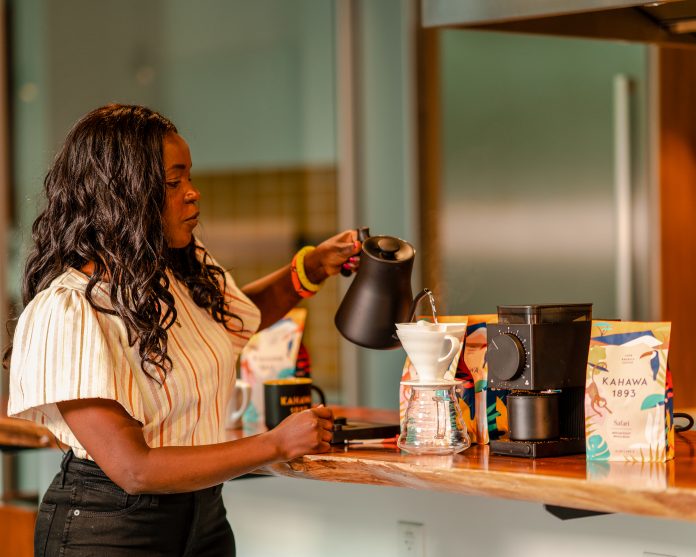
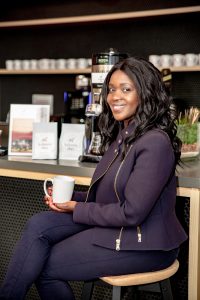
Margaret Nyamumbo, founder of Kahawa 1893, brews some of the coffee her company imports from the Gusii highlands of Kenya where it is farmed by women farmers. Photo: Provided
Margaret Nyamumbo, founder of Kahawa 1893, brews some of the coffee her company imports from the Gusii highlands of Kenya where it is farmed by women farmers. Photo: Provided
Margaret Nyamumbo wants the world to know that the story of coffee cannot be complete without acknowledging the role African women play in the farming of one of the world’s most famous crops.
It is a story she knows firsthand, but one that isn’t often told, she said. She is telling the story by introducing specialty Kenyan coffee to the world through her company, Kahawa 1893, which she founded in 2018. The idea occurred to her when she was living in New York. While exploring what she calls the “the vibrant specialty coffee scene” there she noticed something that troubled her: Although Kenya, her country of birth, is considered the best in the world for production of high-quality coffee, there wasn’t a brand that was recognized internationally as representative of the East African country.
“Imagine if France didn’t have a French wine brand,” Nyamumbo said.
At the time, Nyamumbo, a graduate of Harvard Business School, was working as an investment banker on Wall Street, retail companies. As she learned more about how the companies used supply chain to move products from origin to retail shelves, she became more convinced that she could make her idea of elevating Kenyan coffee to the prominence it deserves come to fruition.
Kenyan coffee is consistently rated among the top five best coffees in the world because it’s grown on high altitude, which allows beans to develop slowly with more nutrients than coffee grown in lower elevations, giving it a unique taste with “powerful wine-like acidity and sweet fruity notes,” according to Intercontinental Coffee Trading.
Today, Nyamumbo is one of only a handful Black entrepreneurs who have defied the odds to venture into the roasted and packaged coffee industry dominated by people of European descent. The main reason there aren’t many Black people in the trading of a crop that is inherently African is the lack of capital. It’s not clear how much capital Black entrepreneurs in the coffee sector have access to, but generally it’s difficult for ideas of businesspeople of African descent to get seed funding. Available data shows that in 2020, U.S. companies founded by Black people received a measly 3 percent of the nearly $150 billion in capital that was issued by investors. According to U.S. Census data, about 10 percent of American companies are Black-owned. Of those, only 21 percent are owned by Black women like Nyamumbo, who use their savings, and modest loans from family and friends to launch.
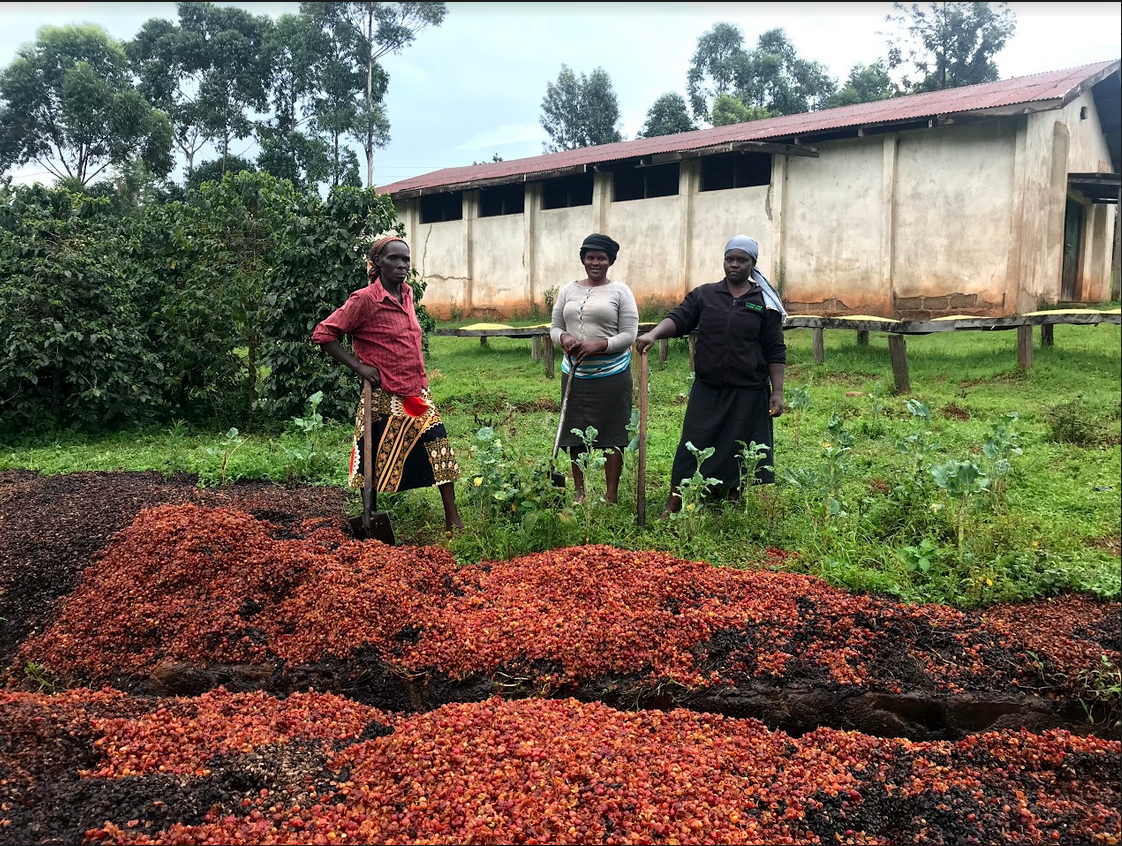
Coffee farmers in Kenya with coffee cherries before they’re processed and exported to the United States by Kahawa 1893 and eventually in grocery store like Trader Joe’s. Photo: Courtesy
“If you want to do it, you got to do it yourself first and prove yourself, especially if you’re a person of color,” Nyamumbo said.
Nyamumbo’s resilience is paying off. In May, she made history as the first Black woman to have her brand of coffee displayed for sale at all 200 California stores of Trader Joe’s, the trendy supermarket chain. She is currently close to making a deal with Target, which has stores in all 50 states.
“What Maggy has done, building a business, knowing how difficult it is in an industry that is male-dominated, is impressive,” said Karen Nyawera, who has known Nyamumbo since 2011.
But Nyawera, who was born in Zimbabwe and is also a graduate of Harvard Business School, said she wasn’t surprised because of how long she has known Nyamumbo.
“Maggy’s ideas around Kenyan coffee were always something she talked about,” Nyawera said. “We would be walking the down the street in New York and she’d stop and look at coffee shops, saying that she wanted to do something similar with Kenyan coffee.”
Nyamumbo began experimenting with roasting Kenyan coffee in her apartment and inviting friends over to sample it and give feedback. She found a commercial roasting and packaging place and started distributing small badges of coffee to cafés in Brooklyn. She also hosted tasting events, which Nyawera attended to help and cheer her friend on.
“Throughout the process, Maggy always said she wanted to do it to help farmers,” Nyawera said.
For Nyamumbo, the desire to help coffee farmers was personal. It was so strong that she left Wall Street to launch Kahawa 1893. The 1893 in her company’s name indicates the year commercial farming of coffee, which has its origins in Ethiopia, began in Kenya by British colonists who grew it for export to Europe. Because of coffee’s status as a top-earning commercial crop, the British used it as a political weapon, allowing only a select population of Black Kenyans to grow it for cash.
The decree against Africans growing coffee was easier to enforce in areas around Nairobi, and in the Rift Valley, which was easily accessible from the capital. But in rural areas far from Nairobi, it was difficult for the British to enforce the laws. One such a region was the Gusii highlands of southwestern of Kenya.
Home to the Gusii people, who make up about 6 percent of Kenya’s population of 52 million people, the region largely remained untouched by the colonialism. Except for a few outposts that later grew into larger towns, Gusii people did not lose their land to European settlers, perhaps because the area is mountainous and therefore unsuitable for the large-scale farming that attracted the British to places like the Rift Valley. But the British conducted regular raids and rounded up Gusii men and forced them to work in labor camps in other parts of the country, including in coffee farms. Some of the men escaped and brought with them crops like coffee. Many Gusii people took advantage of the highlands’ seclusion and began cultivating coffee illegally and smuggling it into areas where Black farmers were allowed to grow.
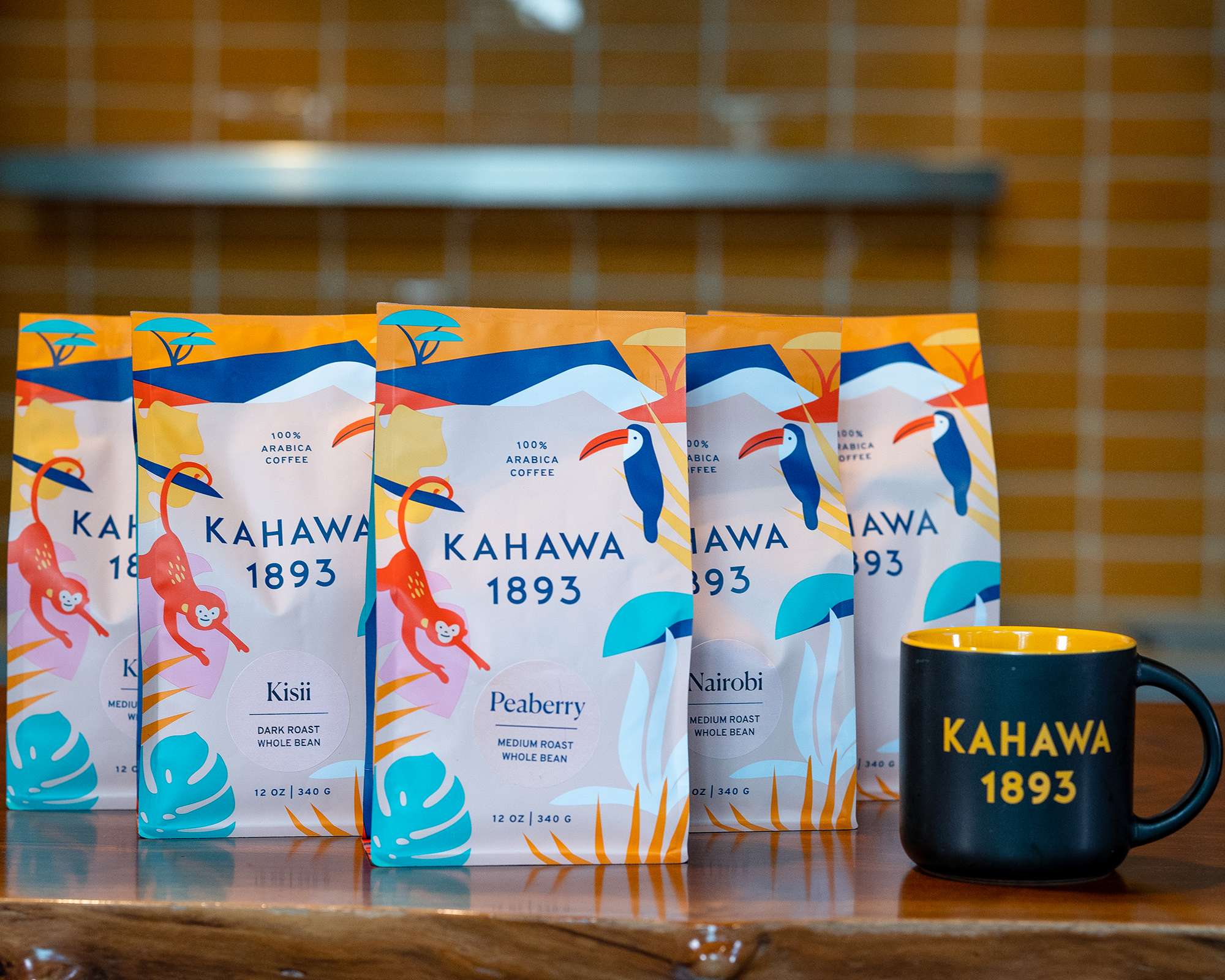
A display of different roasts of Kahawa 1893. The company was founded by Kenyan-American entrepreneur Margaret Nyamumbo. Photo: Courtesy
It was in those highlands that Nyamumbo was born, in 1987 in a village called Moromba. By then, Kenya had been independent for more than 20 years, and coffee had already been in her family for generations.
Speaking by phone from Kenya, her father, Daniel Nyamumbo, remembered his daughter being obsessed with helping out in the family’s coffee plantation, unusual in an area where many children hated farm work.
“Margaret was very passionate about picking coffee,” he said about the third-born of his six children.
Of all his children, Margaret was the one who had a natural knack for knowing the perfect coffee bean to pick.
“She just loved being in the fields,” he said.
Like his daughter, Daniel Nyamumbo enjoyed working in his family’s coffee plantation when he was a boy. But as he grew older, he learned that coffee farming was backbreaking work that did not pay well. It was even more difficult for women, who do most of the work, from tending to the young plants, to the harvesting and processing of the beans. He and his wife Hellen did not want their children to grow up and continue the peasantry life. They decided to break the cycle by ensuring that their children received university education and went into lucrative careers.
In the Gusii of those days, educating female children was not a priority. According to Gusii customs, a daughter must leave her home after marriage and move in with her husband’s family. For that reason, many families believed it didn’t make sense to educate a girl when the proceeds of her education would go to benefit her husband’s family. The Nyamumbos, however, decided to go against tradition and give equal access to education to all their three daughters.
Margaret Nyamumbo’s fascination with coffee did not end when she began her schooling at Ng’enyi Primary School. Christine Nyakerario Rangi, one of her teachers during those early years, remembered a young girl spending her recess time in the school’s coffee farm picking up red cherries that had fallen off trees because they were too ripe.
“She would come back to the classroom with her hands full of red cherries and tell me, ‘Teacher, the coffee needs to be picked, or it will go to waste,’” said Rangi, who is also a coffee farmer.
Margaret Nyamumbo would later change schools to Tabaka Girls Primary School, where she excelled, scoring 483 out of a possible 500 points in the Kenya Certificate of Primary Education exam that children must pass to qualify for high school. She was admitted to the prestigious [former President Daniel arap] Moi Girls High School, Eldoret, where she continued to shine. In her final year, she took the national college entrance exam. When the results were released, she was one of the top students in the country.
But in Kenya, most students don’t get to choose what to study in college. It is the Ministry of Education that uses examinations results to determine what major students should pursue. Margaret Nyamumbo, who scored a straight A, was sent to the School of Medicine at the University of Nairobi.
“I was supposed to be a doctor,” she said with a laugh.
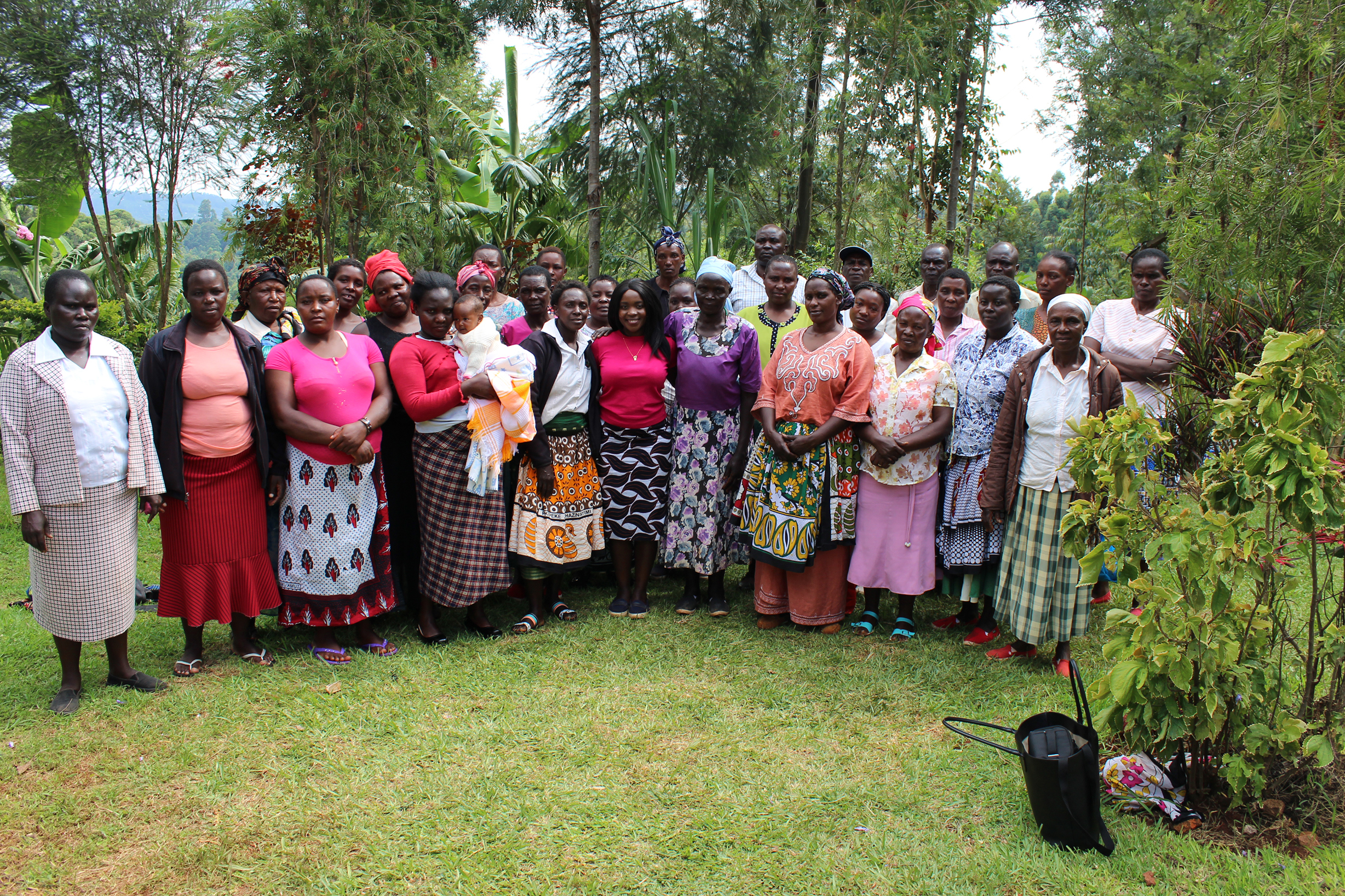
Margaret Nyamumbo, (center, in red top) founder of Kahawa 1893, alongside some of the Kenyan farmers who grow the coffee she roasts and sells in the United States. Photo: Courtesy
But Kenya has a waiting period for students who qualify for university. It could last up to two years. While she was waiting, she ran into American professors who were visiting Kenya. They encouraged her to consider studying in the United States. She applied and a received a scholarship to Smith College, a small liberal arts institution in Northampton, Mass., where she began her studies in 2007. After her undergraduate studies, she went back to Kenya to work for the World Bank.
“That’s, in a way, when I started seeing the forest from the trees,” she said. “I really started getting interested in development, how we can use policy, how we can used trade to make an impact in people’s lives.”
While working in Kenya, she did a lot of work in agribusiness, which strengthened her understanding of how the sector works. She got interested in learning how companies that packaged goods for retail to consumers procured the products.
But she left Kenya once again in 2014 to begin her graduate studies at Harvard Business School, after which she went to work in New York, covering Wall Street companies that retail consumer products.
In New York she began to think about coffee again. She noticed that people weren’t just drinking coffee; they were interested in where coffee was coming from and were ready to pay “premium price” for specialty coffee.
“What was surprising is that it’s actually really hard to find Kenyan coffee,” she said.
That’s when something clicked. Having grown up around coffee, and armed with her education and experience in business, Margaret Nyamumbo saw no one more qualified than her to introduce an authentic brand of Kenyan coffee to the world. But, there was one more challenge she had to overcome.
Her parents had sacrificed everything to make sure their children never had to rely on coffee. All six of them had either graduated from university, or were still enrolled. How would they react to hear that the one who had gone to Harvard and worked in prestigious places like the World Bank now wanted to quit and begin selling coffee?
“It nearly gave me a heart attack,” Daniel Nyamumbo said.
His wife Hellen was even more against the idea. But Daniel Nyamumbo, who has spent most of his life as an entrepreneur, gave his daughter a chance to present her business plan.
“After I understood it and explained to my wife that our daughter was not returning to pick coffee, but to help farmers get a better market for their coffee, she gave her blessings,” he said.
Margaret Nyamumbo said that although she was obsessed with coffee when she was a child, she did grow up to learn that it was not fun for the women who worked the fields. They worked long hours taking care of the crop. Many of them did not own the land they worked on because only male children and widows were allowed to inherit land.
All farmers sold their coffee cherries to a local cooperative society, which processed them and sent beans to Nairobi, where they would be sold at a government-run auction. Farmers got paid months later at a rate determined by the government. When the money came, men – who worked very little in the plantations – decided how it would be spent. Many became irresponsible and went on drinking sprees, leaving their wives with only a fraction. While Margaret Nyamumbo could not change men, she knew she could empower women by providing them with an alternative.
Margaret Nyamumbo, a former investment banker, left Wall Street to found Kahawa 1893. She now works with Kenyan women coffee farmers to bring their coffee to the United States. Photo: Courtesy
Margaret Nyamumbo’s father, who is also her company’s general manager in Kenya, buys coffee directly from farmers and ships it to Berkeley, Calif., where it is roasted and packaged for sale under the Kahawa 1893 brand. To make sure the women who supplied the coffee met their basic needs, the company began by sharing 25 percent of its profits with them. Later, Kahawa 1893 added a QR code on every package, which when scanned sends buyers to a page where they can use credit cards, PayPal, and even Bitcoin to tip the women who grow the coffee. It became an instant success, with some shoppers tipping many times more the cost of the coffee. The money arrives in the women’s M-Pesa mobile wallets, which gives them more control than they had before.
The money has revived enthusiasm for coffee farming, said Rangi, Margaret Nyamumbo’s primary school teacher. She explained that she and many women farmers in her village of Enamba had given up on coffee because the 20 shillings (about U.S. $0.20) they earned per kilo of fresh cherries was not worth it.
“There were women who had abandoned their coffee crop and let cherries fall and rot on the ground,” Rangi said.
It was during those desperate times, Rangi said, that Margaret Nyamumbo showed up. She visited dozens of farmers and began convincing them that she could find a better market for their coffee. Kahawa 1893 began working with agronomists and experts from the local coffee board to teach the farmers how to improve the quality of their coffee.
Rangi said the women began working together to apply the knowledge they had acquired. They formed small neighborhood groups and took turns to harvest coffee from each other’s farms. Gradually, the percentage of specialty-grade coffee they produced rose from 10 percent to 40 percent, according to Margaret Nyamumbo. The farmers’ earnings more than doubled and now range between $.50 and $0.80 per kilo. The extra money is already changing lives.
Susan Magoma Onsongo, a 44-year-old mother of three, said that with increased earnings, she is not only able to provide for herself and her children, but she can take care of her parents, who have poor health. She said she reinvested some of her earnings in chickens so that her family can have a reliable source of protein in their diet. She is also able to pay for her children’s education.
“Nowadays, I am so free of stress that if you looked at me you wouldn’t know I’m 44 years old,” Onsongo joked. “I look and feel like a 30-year-old girl.”
The women also pooled together the tips they received from Kahawa 1893 customers in the United States to buy a grain milling machine, which has created employment and become an additional source of income for members.
“Margaret has been a godsend,” Onsongo said. “We pray for her every day.”
African rising stars honored at Minnesota’s 'Outstanding Refugee Awards'
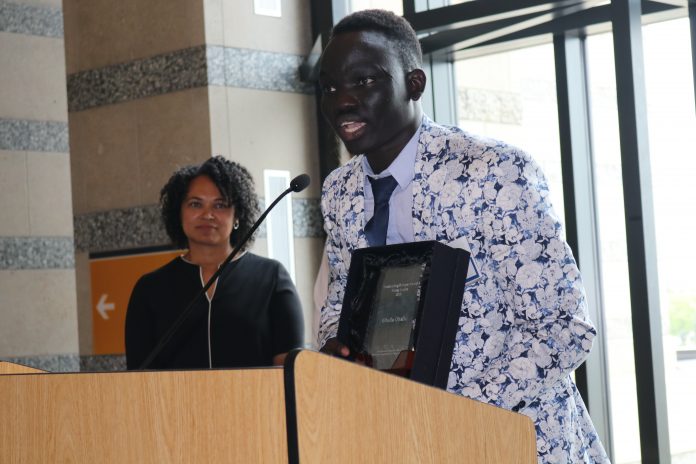
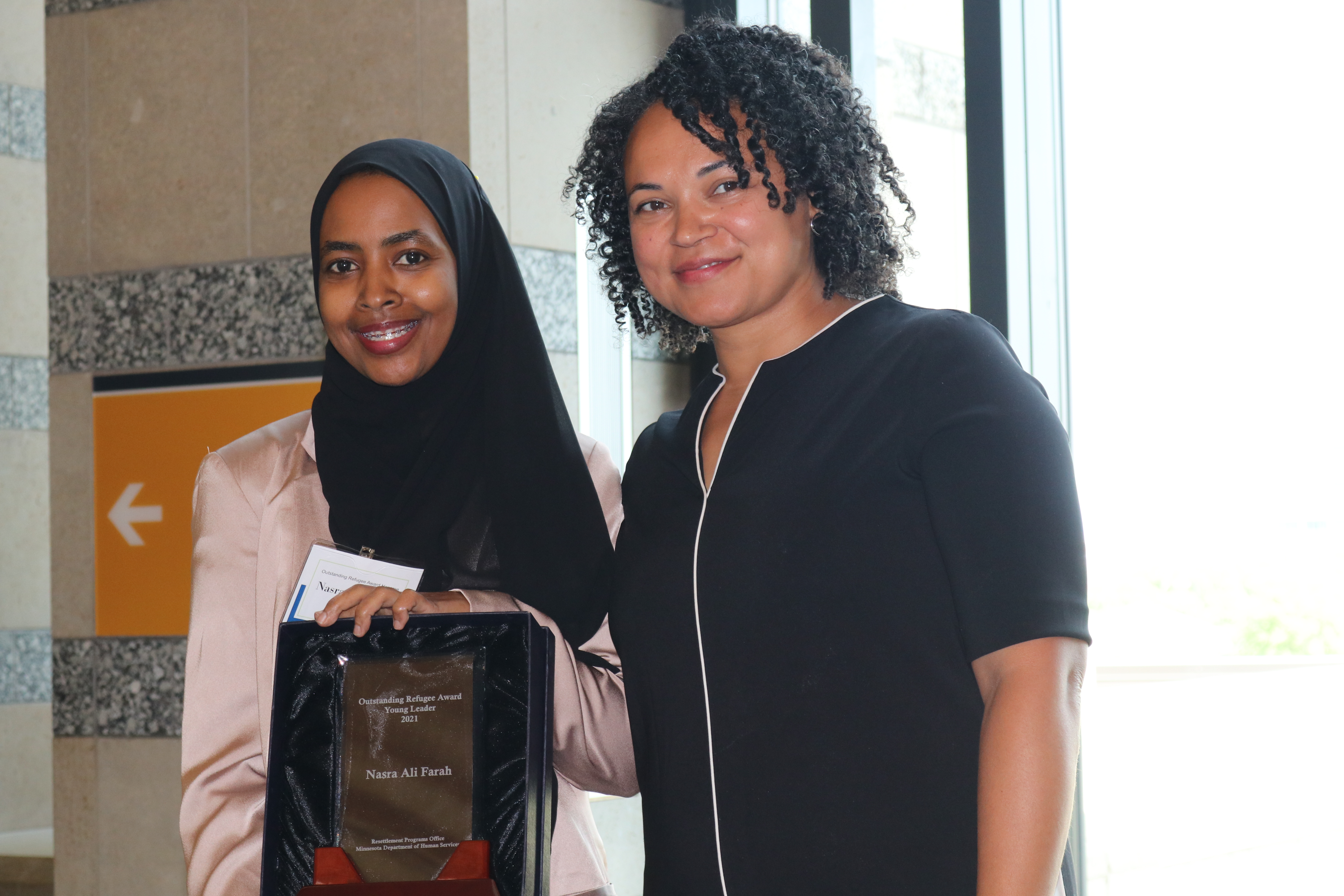
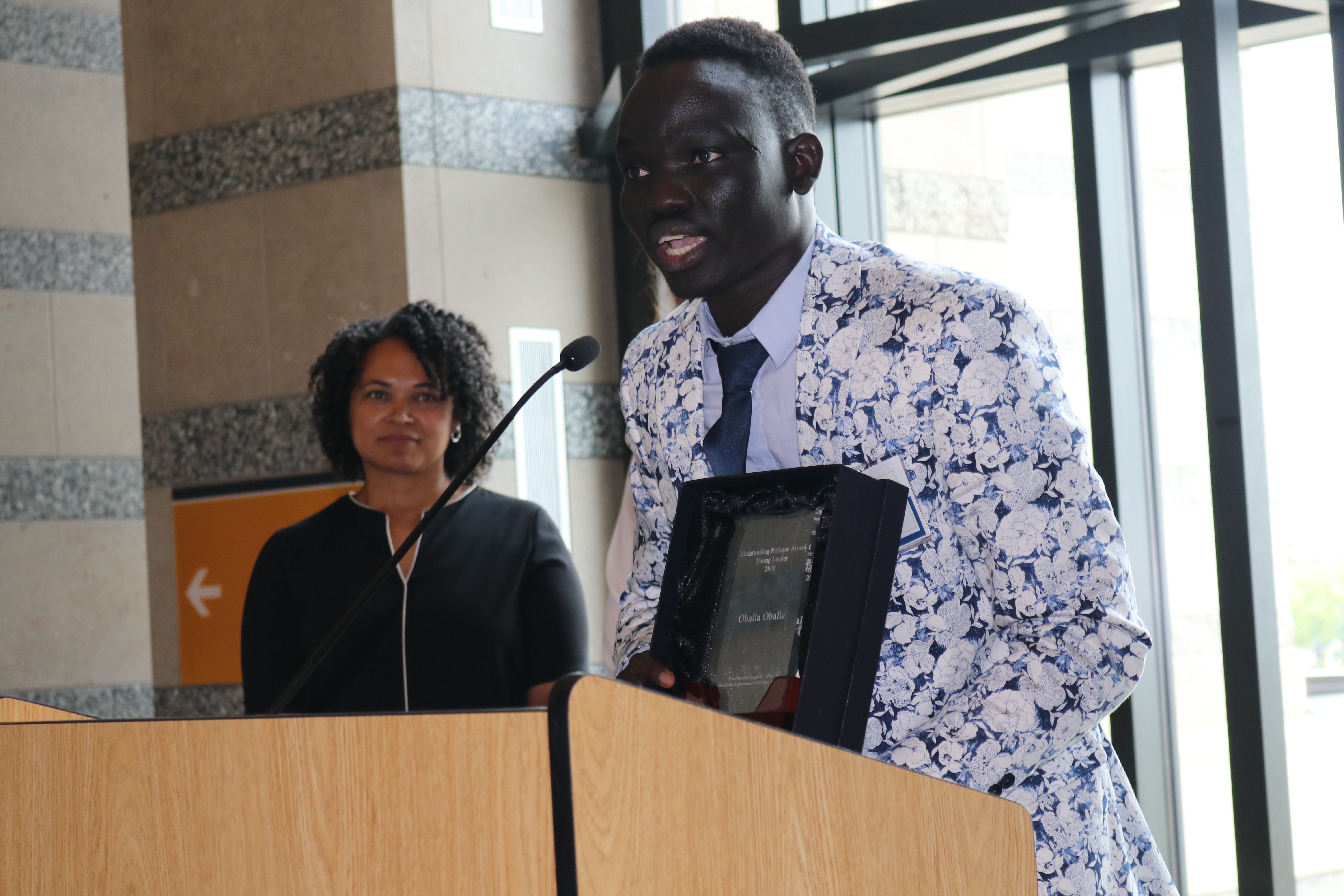
ST. PAUL, Minn. – African rising stars Oballa Oballa and Nasra Ali Farah were among 22 individuals honored Monday during the state’s “Outstanding Refugee Awards” ceremony at the Minnesota History Center.
The two received the Young Leader Award, which recognizes young people who have achieved great milestones and are making a difference in their communities.
The event, hosted annually by the Minnesota Department of Human Services, recognizes civic engagement, entrepreneurship, young leadership and resilience shown by the state’s refugees. This year’s awards ceremony included recipients from 2020 following last year’s awards ceremony cancellation due to the pandemic.
Farah is this year’s recipient of the Young Leader Award while Oballa was for 2020.
Farah and Oballa’ s rise to prominence in Minnesota has been nothing short of meteoric. Oballa was elected to the Austin City Council last November, less than eight years after coming to the United States.
“For someone like me whose last hope was America and find myself living the dream, I always tell my wife that if anyone cannot succeed in America, they cannot succeed anywhere,” Oballa said as he received his award.
Farah, a social worker, spoke to Mshale after receiving her award and recalled her first year in the United States when she had to walk four miles at night from work at a meat packing plant in Willmar.
“I was just 18 when I came by myself and it was very difficult then,” said Farah. She recalled how her college advisor invested time in making sure she enrolls at Saint Cloud State University by personally driving her there.
“Sometimes when you think there is no hope, someone like my former college advisor surprises you,” Farah added.
Governor Walz who spoke at the ceremony said the state has “been lucky to be the recipient of over 100,000 refugees in the last 42 years.”
Walz said the contributions refugees make to the state far outweighs “what we give (them),” pointing to their contributions in science, medicine and entrepreneurship.
The governor said those being honored on Monday embodied the spirit of Minnesotans and Americans at large that this the best place to get success.
‘We don’t expect you to leave the best of your cultures at home, we expect you to bring them here, practice your religion and culture as you see fit,” Walz said. “Keep those languages alive for your children so they understand where they came from and let us take part in that diversity.”
The Civic Engagement Award recognizes individuals who make their communities stronger through civic participation:
Dr. Obsa Abdulla Hassan of Spring Lake Park, a physician at Mercy Hospital in Coon Rapids, founder of the Axis Family Clinic in northeast Minneapolis, and a volunteer at Hadi Medical Clinic, a free community clinic in Brooklyn Center.
Hani Haybe of Minneapolis, a nurse at Hennepin Healthcare and the founder of Street Soccer Twin Cities.
Farhiya Iman of St. Cloud, a social worker for Stearns County and owner of Nori Cafe and Creamery.
Rufo Jiru of Shakopee, a chemist and humanitarian, founder of the Anole Sisters nonprofit in Minneapolis, an active member of the Disability Support International Advisory Working Group and the Minnesota Autism Council Working Group in St. Paul, and a board member of the Multicultural Autism Action Network and Minnesota International Non-governmental Organization Network in Minneapolis.
Novia Josiah-Isaac of Maplewood, a licensed social worker at the Center for Victims of Torture in St. Paul.
Entrepreneurship Award goes to individuals who contribute to their communities in business, the arts or education:
Amran Abukar of Willmar, a cultural liaison at Kennedy Elementary School and an author.
True Thao of Cottage Grove, a mental health advocate and founder of True Thao Counseling Services.
Young Leader Award acknowledges the contributions of young people who have achieved great milestones and are making a difference in their communities:
Ku Mo of St. Paul, a University of Minnesota student and community supporter.
Oballa Oballa of Austin, a student at Riverland Community College, an advocate and leader in the statewide LeadMN student organization, and an honorary member of the Austin City Council.
New Beginnings Award recognizes individuals who have been in the country two years or less and exemplify resilience and courage while rebuilding their well-being and making Minnesota home:
Bugondo (Blaise) Ntibonera of Minneapolis, a refugee resettlement case worker at Lutheran Social Service of Minnesota in Minneapolis.
2021 Outstanding Refugee Award recipients
Civic Engagement Award, which recognizes individuals who make their communities stronger through civic participation:
Michael Yang of St. Paul, Southeast Asian community specialist for City of Minneapolis Neighborhood and Community Relations
Mamady Konneh of Golden Valley, CEO for We Network Now
Fatima Molas of Columbia Heights, chairperson of Multicultural Autism Action Network
Mohamed Abdulkadir of St. Peter, refugee training specialist at MRCI
Maylary Apolo of Austin, legal assistant at the Immigrant Law Center of Minnesota
Armin Budimlic of Rochester, executive director for the Intercultural Mutual Assistance Association
Kahin Adam of St. Cloud, psychotherapist and community health specialist for CentraCare.
Entrepreneurship Award, which recognizes individuals who contribute to their communities in business, the arts or education:
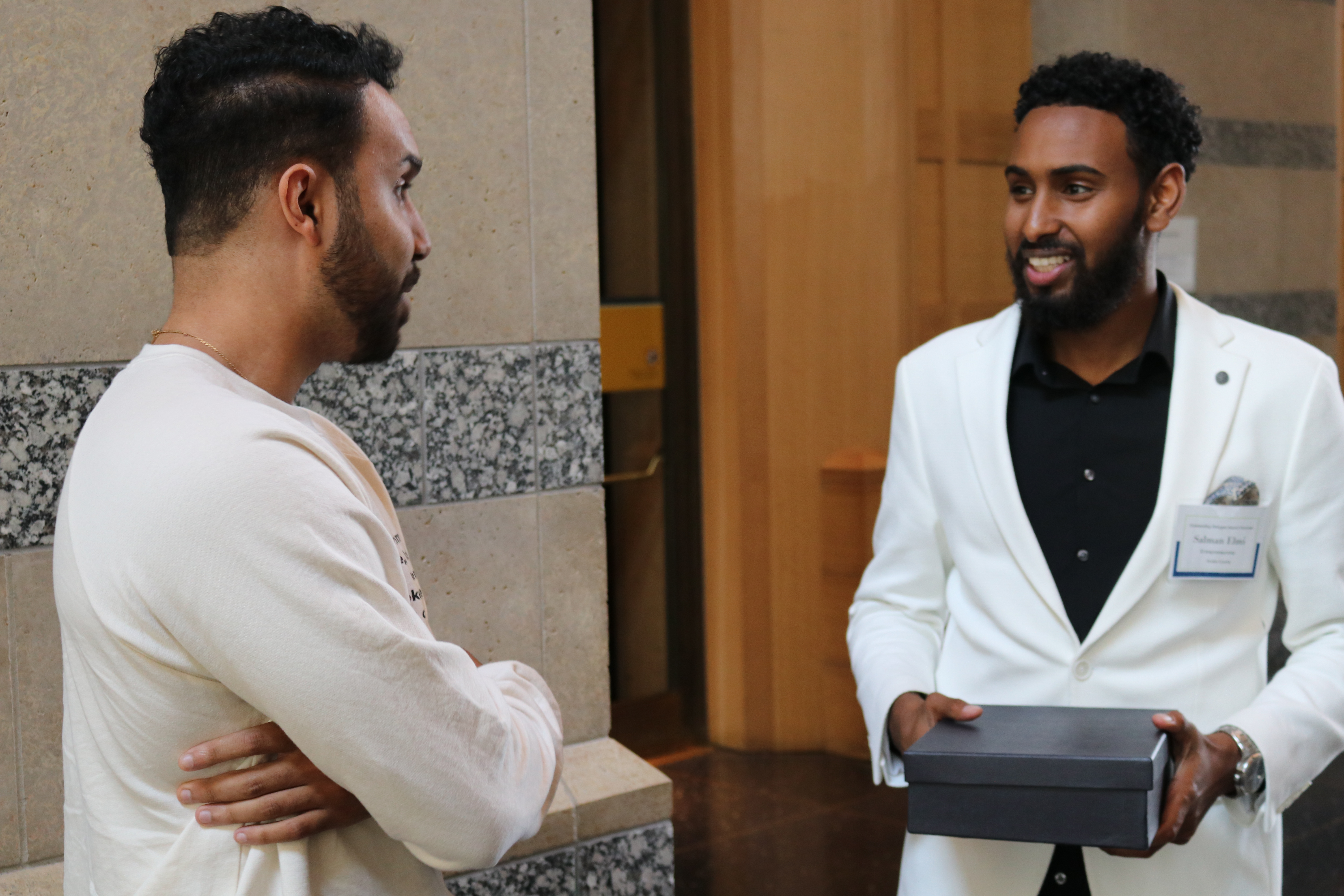
Salman Elmi of Blaine, president and founder of Tavolo and Top Figure
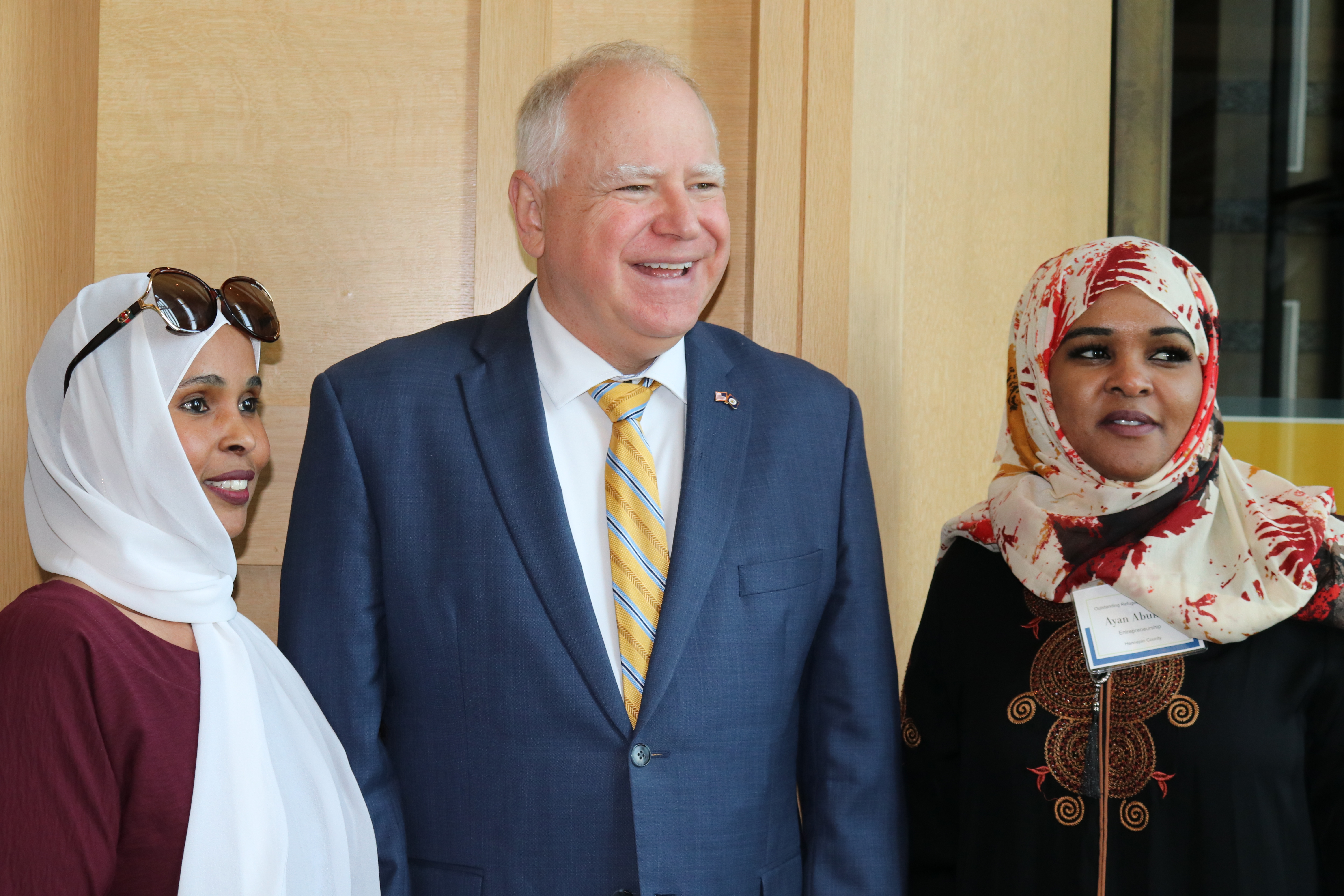
Ayan Abukar of Bloomington, executive director for Action for East African People.
Young Leader Award, which recognizes young people who have achieved great milestones and are making a difference in their communities
Nasra Farah of Waite Park, speaker, writer and board member for Unite Cloud.
New Beginnings Award, which recognizes individuals who have been in the United States for two years or fewer, and exemplifies the resilience and courage it takes to rebuild their well-being and make Minnesota their home:
Cani Adan of Moorhead, program manager for the Afro American Development Association
Abdikarim Hassen of Rochester, volunteer for Family Service Rochester.
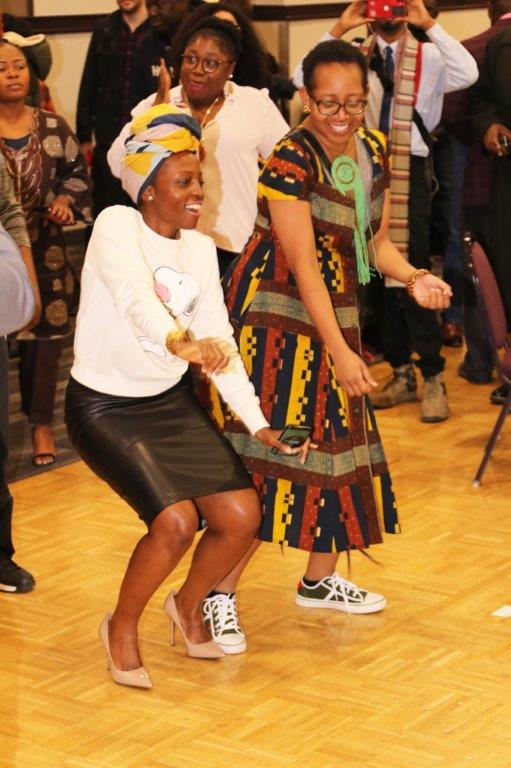
Denise Butler and Nekessa Opoti dance during a community celebration in Brooklyn Park, Minnesota following the signing into law by President Trump of a bill giving Liberians with temporary status a pathway to citizenship on January 2020. Photo: Richard Ooga/Mshale
Denise Butler and Nekessa Opoti dance during a community celebration in Brooklyn Park, Minnesota following the signing into law by President Trump of a bill giving Liberians with temporary status a pathway to citizenship on January 2020. Photo: Richard Ooga/Mshale
With just five months to go for Liberians living in the US who qualify for permanent residency to apply for a green card under the Liberian Refugee Immigration Fairness program or LRIF, the U.S. Citizenship and Immigration Services is hosting a webinar to engage Liberians on the LRIF.
The one-hour webinar is on July 21 at 12: 00 P.M. CST and will feature Andrew Parker, whom the agency gave his title as Branch Chief of Residence and Nationalization Division.
The RSVP link is at the bottom of this story.
The LRIF was attached to the 2019 defense spending bill which former President Donald Trump signed into law. The original deadline for Liberians to apply for green cards was December 2020 but was pushed to December 2021 due to the pandemic.
However, there have been reports of few taking advantage of the opportunity due to onerous paperwork and also backlogs at USCIS that the latter blamed on the pandemic.
LRIF National Stakeholder Webinar
U.S. Citizenship and Immigration Services national engagement on Liberian Refugee Immigration Fairness (LRIF).
Date: July 21, 12 p.m. CST
Location: Virtual
Participants:
Andrew Parker, Branch Chief of Residence and Nationalization Division, OP&S
Rachel Riti, Policy Analyst, Residence and Nationalization Division, OP&S
Hollies Winston and Lisa Jacobson, the two contenders to be the next mayor of Brooklyn Park participated in a forum on Tuesday, July 13, 2021. Photo: Courtesy
Hollies Winston and Lisa Jacobson, the two contenders to be the next mayor of Brooklyn Park participated in a forum on Tuesday, July 13, 2021. Photo: Courtesy
Hollies Winston and Lisa Jacobson, the two contenders in the race to be the next mayor of Brooklyn Park, offered their vision and solutions for the city on Tuesday during a televised forum hosted by the North Metro Mayors Association. The special election is on August 10 and early voting is already underway and will continue through August 9.
The forum was moderated by Maple Grove’s mayor, Mark Steffenson. You can watch the full forum at this link.
Here are some of the highlights of what each candidate said:
Diversity
Hollies Winston: “Putting together coalitions that deal with folks from all different communities, ethnicities, religions. And then when you look at my campaign itself, it represents Brooklyn Park.”
“I think when you say you support diversity, or when folks say they support diversity, it’s much more of an action, even when we’re uncomfortable, that we need to partake of.”
Lisa Jacobson: “Having a dedicated community engagement team on staff is a start. I have supported that work in the city budget, but we all have to be out building relationships and investing in high quality diverse communication vehicles, engaging people more through multicultural events and activities. We cannot rely on electronic means and the US Postal Service as we once could.”
Business & Employment
Lisa Jacobson: “I just voted to support a program with LIBA which is our Liberian Business Association, to assist businesses with QuickBooks and keeping accurate records. I also supported funding and program at the OLM to provide a new career track for certified nursing assistants and TMAs.”
“I also voted to eliminate license fees during the pandemic so that businesses could stay afloat while they had little to no income, and I will continue to be a voice for business. With employment, I have continually addressed every business that comes to our city and encouraged them to look at our residents first as their employees.”
Hollies Winston: “Brooklyn Park needs to be there front and center, so there’s $7 million at the state level that was allocated for technical assistance, and research has shown that technical assistance, giving it to small businesses, helps them become more effective. And then the American Rescue Plan, there’s a fair amount coming from the federal pipeline for that. Brooklyn Park needs to be active with our state electeds, as well as our federal electeds to make sure that we know how to access that funding, and we’re able to get that funding to the small businesses in Brooklyn Park.”
“We no longer have a chamber of commerce in the city, and businesses benefit by having a chamber with support at the legislature and in other ways. I recently supported a set aside fund to get something going again in our city.”
Public Safety
Hollies Winston: “Early in the process I reached out to (Hennepin County) Sheriff Dave Hutchinson and I said, ‘Hey, I want to learn some of the best practices in terms of dealing with this,’ from that conversation we were able to get his endorsement because he understood I understand what he’s talking about.”
“So, everyone says they support the police, but what does that really mean when you say, “I support the police.”? Well, for me it means, you’re not only keeping the police safe but you’re also making- helping them to be as effective as possible at their job.”
Lisa Jacobson: “Crime has gone down over the last 10 years and we did that by addressing the issues, looking at root cause, creating afterschool activities, increasing housing stability by investing in apartments, empowering the apartment community by holding opportunities for them to speak and to share during ownership transitions. But no one wants to hear that crime went down, because crime- violent crime is at an all-time high. So yes, investing in law enforcement and community policing, has been something that we have done.”
Hard Water
Lisa Jacobson: “So the question is, do our residents want to spend well over $30 million to soften our water and then an additional $5 million annually to remove the sediment. That’s half of the city budget. So about 10 years ago, the city did go out to the residents, surveyed and, and used other means to ask the question, did they want the city to spend that kind of money for softer water? And the overwhelming result was no. So, my plan to deal with the hard water is what I’ve already done. I’ve asked our city manager to put it on a work session for discussion and then let’s make a plan to ask the residents again through surveys and other means if they’re willing to invest that kind of money.”
Hollies Winston: “It is not the same priority as addressing the rise in violent crime, we’ve kind of taken our eye off the ball on that recently, and we see what- what’s occurring. But I do think when you look at some of the opportunities for the grants, and I also tell people, Brooklyn Park is represented by five state electives, right? So we have a little bit of sway at the capital. And so, I think we need to lean into that sway and say we gotta hard water problem, we’re the sixth largest city in the state, why don’t we throw our weight around a little bit so that we can get this fixed and there should be some funding or some ways to dissuade some of that cost we’re hearing from some of the options.”