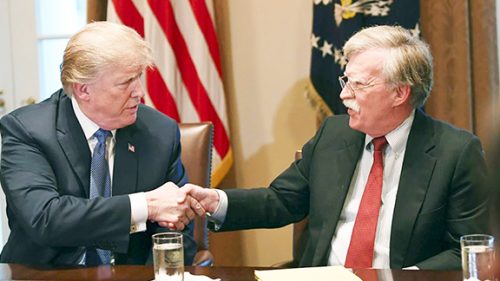
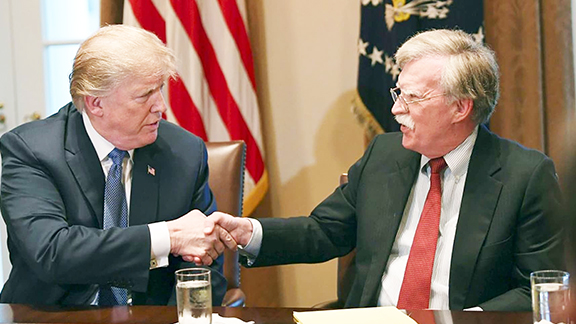
President Donald Trump, left, shakes hands with national security adviser John Bolton in the Cabinet Room of the White House at the start of a meeting. Bolton unveiled the administration's 'New Africa Strategy' on Thursday, December 13, 2018. Photo: AP
President Donald Trump, left, shakes hands with national security adviser John Bolton in the Cabinet Room of the White House at the start of a meeting. Bolton unveiled the administration's 'New Africa Strategy' on Thursday, December 13, 2018. Photo: APPresident Donald Trump, left, shakes hands with national security adviser John Bolton in the Cabinet Room of the White House at the start of a meeting. Bolton unveiled the administration’s ‘New Africa Strategy’ on Thursday, December 13, 2018. Photo: AP
Donald Trump’s administration has unveiled its policy towards Africa, which it says will counter the growing influence of its geopolitical rivals, China and Russia, on the continent. John Bolton, Trump’s assistant for National Security Affairs outlined the “New Africa Strategy” on Thursday December 13, in a speech to an audience of NGOs leaders, policy experts, business representatives and diplomats gathered at the Washington, D.C.-based conservative think tank, The Heritage Foundation.
“China is deliberately and aggressively targeting their investments in the region to gain competitive advantage over the United States,” Bolton said. “China uses bribes, opaque agreements, and the strategic use of debt to hold Africa captive to Beijing’s wishes and demands.”
Bolton said that the new policy’s goal was to ensure that African countries achieved economic and political independence, something he said China and Russia had no interest in.
“Lasting stability, prosperity, independence, and stability on the African continent are in the national security interests of the United States,” Bolton said. “We ask only of reciprocity. Never for subservience.”
Africa is so strategically important, Bolton said, that the administration prioritized the creation of the “New Africa Strategy” and finished it within the first two years of Trump’s presidency. He added that Trump’s Africa policy was unveiled two years earlier than the “previous administration’s”, another apparent dig at President Barack Obama’s administration, reminiscent of the many comparisons Trump has drawn to his predecessor.
Trump’s policy towards Africa will have American interests at its core, according to Bolton. He outlined three pillars of the policy, which include trade, combating terrorism, and U.N. peacekeeping missions.
Although the policy doesn’t seem deviated far from his predecessors’ in its rhetoric about trade and antiterrorism, it will be different when it comes to supporting U.N. peacekeeping missions in Africa. Bolton said America will no longer offer financial support to U.N. peacekeeping missions that are “unproductive, unsuccessful and unaccountable.”
“We want something to show for Americans’ hard-earned tax dollars,” he said. “The United States will no longer provide indiscriminate assistance across the continent without focus or prioritization.”
South Sudan was a good example of a country that had received U.S. funding but had failed to achieve the desired effect, according to Bolton. In 2016, the United States provided $3.6 billion in humanitarian aid to the country.
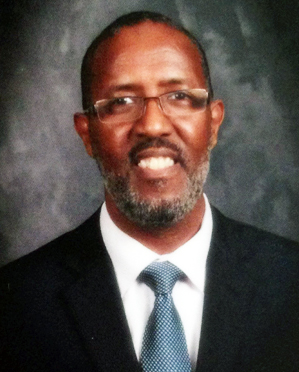
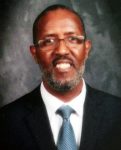
Abdisalam Adam, an assistant principal at Saint Public Schools and also a doctoral candidate has joined the Fridley Public Schools board.
Abdisalam Adam, an assistant principal at Saint Public Schools and also a doctoral candidate has joined the Fridley Public Schools board.Abdisalam Adam, an assistant principal at Saint Public Schools and also a doctoral candidate has joined the Fridley Public Schools board.
Abdisalam Adam, an assistant principal at Highland Park High School in the St. Paul Public Schools and a Doctor of Education candidate at Bethel University was on Wednesday unanimously voted in by the Fridley School Board to serve on its board. Adam will complete the remainder of another board member, Kim Sampson, who resigned effective December 31 due to increased commitments at her day job.
The district, which has a 93% graduation rate, has a student enrollment of over 2,800.
“It is an honor and privilege for me to be selected to serve on the Board of Fridley Public Schools and I am very grateful to the School Board members for giving me this opportunity,” Adam said in a statement. His youngest child graduated from the district’s Fridley High School.
The 52-year old Adam, born and raised in Somalia, brings an extensive resume to the first-ring suburb school district’s six-member board. With 23 years of experience in education, his work experience includes teaching English as a Second Language (ESL) at various schools including the St. Paul Public Schools. He has also been an interim principal and social studies teacher before his current position as assistant principal at the state’s second largest school district.
He is also a fixture at area non-profit boards where he serves. He has served on boards including Al-Amal School Board, Neighborhood House, the Islamic Civic Society of America, and the American Relief Agency for the Horn of Africa. He has also had stints on advisory committees, including those with the Minnesota Department of Education.
“Mr. Adam brings with him broad community involvement both in Fridley and beyond our borders,” said Fridley School Board Chair Mary Kay Delvo, adding that Adam’s previous school board experience adds to his wealth of knowledge on the collaborative role and function of school boards. “On top of his strong skills and experience, as a career educator, he will bring a valued lens to Board discussions on our priority work of supporting increased achievement and opportunities for all our students,” said Delvo.
Adam received his Master of Science in Curriculum and Instruction from St. Cloud State University, and his K-12 principal license from Bethel University where he is currently a doctoral candidate. His Bachelor of Education in Teaching English as a Second Language is from King Saud University in Riyadh, Saudi Arabia.
“As a member of the Fridley School Board, I will strive for equity in governance and work hard to ensure that the students of Fridley Public Schools receive a world-class education that meets the challenges of a global work place,” said Adam.
South African rapper Sho Madjozi's song 'Wakanda Forever' is among those that made Apple Music's 2018 'A-list' of African music released on December 10, 2018. Photo: SABC
South African rapper Sho Madjozi's song 'Wakanda Forever' is among those that made Apple Music's 2018 'A-list' of African music released on December 10, 2018. Photo: SABCSouth African rapper Sho Madjozi’s song ‘Wakanda Forever’ is among those that made Apple Music’s 2018 ‘A-list’ of African music released on December 10, 2018. Photo: SABC
Apple this week released its first ever A-list of African music. The 49-song list is a hit list of music popular in the continent with all of the songs collectively getting millions of views on YouTube.
The list includes Sho Madjozi’s Wakanda Forever.
The country with the most songs is Nigeria which collectively has 19, followed by Ghana at 13. South Africa is a distant third with seven songs. Outside of those three countries, only seven other countries are featured including Congo, Cameroon, DRC, Kenya, Mali, Tanzania, Togo
A proposed rule to ban the spouses of H-1B visa holders from working in the U.S. could now be released by the end of the year.
The rule targets H-4 visa holders, who were allowed to request authorization to work in 2015 under President Barack Obama. Federal officials initially estimated that a new rule preventing H-4 holders from working could be published as early as November. But that now appears unlikely.
“I would expect that before the end of the calendar year, the proposed rule will probably be out,” U.S. Citizenship and Immigration Services Director L. Francis Cissna told Bloomberg Law in an interview late last month.
That announcement will likely be followed by a comment period, according to a September letter Cissna sent to the Internet Association, which represents many major technology firms. According to the letter, “The public will be given an opportunity to provide feedback during a notice and comment period on any revisions to regulations that DHS determines are appropriate, including revisions relating to the H-4 Rule.”
The proposed change is the result of President Donald Trump’s “Buy American and Hire American” executive order, which in part required the Secretary of State, the Secretary of Homeland Security and others to “suggest reforms to help ensure that H-1B visas are awarded to the most-skilled or highest-paid petition beneficiaries.”
Many Silicon Valley tech firms, like Facebook and Google, rely on H-1B visas to hire foreign workers and have pushed to expand the 85,000 annual cap. The visas are intended for jobs requiring at least a bachelor’s degree and specialized knowledge. Critics argue the visas are used to hire cheaper foreign workers, at the expense of Americans.
The majority of H-4 visa recipients are women from India, because most H-1B visa recipients are from India. A rule change would affect an estimated 100,000 visa holders working in the U.S., some of whom have said they’ll be forced to return to their home countries if they are unable to work.
Between October and December 2017, the most recent data available, USCIS had approved 6,800 work authorizations for H-4 visa holders. Of those, 6,130 were Indian citizens.
UNESCO announced on November 29, 2018 the designation of reggae music as an intangible cultural heritage worthy of preservation. Photo: UN
UNESCO announced on November 29, 2018 the designation of reggae music as an intangible cultural heritage worthy of preservation. Photo: UNUNESCO announced on November 29, 2018 announced the designation of reggae music as an intangible cultural heritage worthy of preservation. Photo: UN
UNESCO, the United Nations Educational, Scientific and Cultural Organization, has added reggae to its list of cultural institutions worthy of protection and preservation.
Each year, UNESCO adds to its Representative List of the Intangible Cultural Heritage of Humanity, and Jamaica submitted reggae for consideration earlier this year. The genre now joins a list of over 300 cultural traditions, including numerous musical ones such as Dominican merengue, Slovakian bagpipe music and Vietnamese xoan singing.
In a statement on its website, UNESCO said of reggae, “Its contribution to international discourse on issues of injustice, resistance, love and humanity underscores the dynamics of the element as being at once cerebral, socio-political, sensual and spiritual. The basic social functions of the music – as a vehicle for social commentary, a cathartic practice, and a means of praising God – have not changed, and the music continues to act as a voice for all.”
To mark its inclusion on the list, UNESCO shared a short documentary that examines the history and distinct characteristics of reggae music.
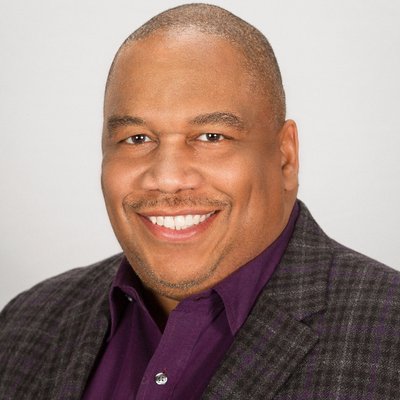
Governor Dayton of Minnesota announced on December 3, 2018 the reappointment of James Burroughs as chair of the Governor’s Council on the Martin Luther King, Jr. Holiday
Governor Dayton of Minnesota announced on December 3, 2018 the reappointment of James Burroughs as chair of the Governor’s Council on the Martin Luther King, Jr. HolidayGovernor Dayton of Minnesota announced on December 3, 2018 the reappointment of James Burroughs as chair of the Governor’s Council on the Martin Luther King, Jr. Holiday
Outgoing Minnesota governor Mark Dayton on Monday announced the reappointment of James Burroughs as chair of the Governor’s Council on the Martin Luther King, Jr. Holiday.
The Council helps plan, coordinate and execute observances of Rev. Dr. Martin Luther King Junior’s birthday at the state and local level in Minnesota. Next month will mark the 33rd time the council will host the holiday in Minnesota.
Burroughs, a Brooklyn Park resident, is the state’s Chief Inclusion Officer working at the governor’s office. The governor created the office in 2016 to address the state’s racial disparities, especially in the state government workforce which at the time of the office’s creation had less than 10 percent of minorities working in state government.
International student enrollment at US colleges and universities declined as schools opened for the fall 2018/2019 school year, new number show. Photo: Wikimedia
International student enrollment at US colleges and universities declined as schools opened for the fall 2018/2019 school year, new number show. Photo: WikimediaInternational student enrollment at US colleges and universities declined as schools opened for the fall 2018/2019 school year, new number show. Photo: Wikimedia
New enrollments of international students fell by 6.6 percent at American universities in academic year 2017-18 compared to the year before, marking the second straight year in declines in new enrollments, according to new data from the annual Open Doors survey.
New enrollments fell 6.3 percent at the undergraduate level, 5.5 percent at the graduate level and 9.7 percent at the nondegree level from 2016-17 to 2017-18.
A separate survey of institutions found that the decline in new international enrollments is continuing this fall, though the drop was less severe than that reported last year.
Institutions that responded to this fall’s enrollment survey reported on average a 1.5 percent continuing drop in new international enrollments, a drop that comes on top of last year’s declines. However, while about half (49 percent) of respondents reported declines in new international enrollments this fall, another 44 percent reported increases, and 7 percent said their numbers were stable.
“This is very much a mixed picture,” said Rajika Bhandari, a senior adviser for research and strategy and director of the Center for Academic Mobility Research & Impact at the Institute of International Education, which conducts the survey with funding from the Department of State. “We’re seeing those new enrollment numbers really vary based on institutional characteristics.”
Unlike in past years, IIE did not release the full findings of the current fall enrollment survey to reporters in advance along with the Open Doors data, but Bhandari and Peggy Blumenthal, a senior counselor to the president at IIE, shared several top-line findings in an interview last week with Inside Higher Ed. Among the findings, institutions in the center of the country — specifically the South Central region, which includes Texas, and the West North Central region — are seeing sharper declines than are institutions on the coasts. Less selective institutions are also seeing steeper declines.
“The large research institutions, many of them are seeing growth,” Blumenthal said. “The less well-known abroad schools and the schools giving associate degrees are seeing much sharper declines.”
Over all (as opposed to new) international enrollments did increase by 1.5 percent from 2016-17 to 2017-18, according to the Open Doors survey, which collected data from 2,075 institutions. But that growth is being driven by a boom in the number of students participating in the optional practical training program, OPT, which enables graduates of U.S. colleges to stay in the country and work for up to three years after graduating while remaining on their student visas. A change in 2016 to the duration of OPT for students studying STEM fields means that students are staying in the OPT pipeline for longer after they graduate from their program.
The increases in OPT participation by recent international graduates can mask declines in the number of international students who are currently enrolled in degree programs — the number that really matters to colleges when it comes both to their financial bottom lines and their goals of building diverse campuses. The total number of students participating in OPT grew by 15.8 percent from 2016-17 to 2017-18, while the total number of enrolled international students increased by 0.8 percent at the undergraduate level and decreased by 2.1 percent at the graduate level. The number of nondegree students — a category that includes students in intensive English programs — fell for the third year in a row, by 10.1 percent.
Among the big changes in the Open Doors data for academic year 2017-18 was an 8.8 percent drop from the prior year in the number of graduate and professional students from India, the second-largest country of origin for international students in the U.S. after China.
Another notable shift was a 6.4 percent drop in the number of international graduate students studying engineering, the most popular field of study for international students in the U.S.
Universities also saw a 15.5 percent overall decline in the number of students from the No. 4 sending country, Saudi Arabia. The number of Saudi students declined at all academic levels, a change that’s largely attributable to the Saudi government scaling back a foreign scholarship program that has sent thousands of Saudi students to study at U.S. universities.
At the undergraduate level, higher education institutions reported double-digit year-over-year increases in students from the No. 6 sending country, Vietnam, No. 10 Brazil and No. 11 Nepal.
The number of students from the No. 1 sending country, China, continued to increase at both the undergraduate and graduate levels, by 4 and 2 percent respectively, but declined at the nondegree level. Chinese students account for 33.2 percent of international students in the U.S.; together with India, students from the two countries account for more than half (51.1 percent) of all international students.
Among other notable shifts involving top sending countries, the numbers of students from the No. 3 sending country, South Korea, fell for the seventh straight year, by 7 percent, a trend that Blumenthal attributes to the changing demographics of South Korea and to the improving quality of the Korean higher education system.
There were also declines in the overall number of students coming from America’s neighbors, Canada and Mexico, two countries where President Trump is deeply unpopular. While there were drops at all academic levels for Canadian and Mexican students — except for the OPT level — the steepest decline was in the number of Mexican students coming for nondegree study, including intensive English, which fell by 39.1 percent.
This year’s Open Doors data also provide a first glimpse of the impact on international enrollments of President Trump’s various travel bans barring entry to the U.S. for citizens of a group of mostly Muslim-majority countries.
Iran, the No. 12 sending country, is the only country affected by Trump’s travel ban that sends substantial numbers of students to the U.S. Although an Inside Higher Ed analysis of State Department data showed a sharp drop in the number of student visas awarded to Iranians in the year after the first iteration of the ban went into place in January 2017, the Open Doors data do not suggest there was a big effect on Iranian student enrollments that fall. On the contrary, the Open Doors data show a 1.2 percent increase in the number of Iranian students at the graduate level — significant, since about three-quarters of all Iranian students in the U.S. study at the graduate level. The number of Iranian students did decline at the undergraduate (-16.8 percent) and nondegree levels (-35.7 percent), but from a much smaller base.
Among other countries covered by the first and second versions of Trump’s travel ban — which were in effect for parts of the application cycle of the 2017-18 year — there were drops in the total numbers of students from Iraq (-15.3 percent), Libya (-18.8 percent), Syria (-12.2 percent) and Yemen (-21.4 percent), and increases in the number of students from Somalia (+34 percent) and Sudan (+2.2 percent).
A third and current version of the ban bars all students from North Korea and Syria from applying for student visas unless they obtain a waiver. Nationals of the other affected countries are eligible to apply for student visas, though in practice they may have difficulty obtaining them.
Political and Social Factors?
International educators have been deeply concerned that international students could be deterred by more restrictive policies on visas coupled with the Trump administration’s rhetoric on immigration. The president reportedly described most Chinese students in the U.S. as spies and entertained a proposal from a senior adviser to stop awarding student visas to Chinese nationals. The Trump administration has introduced new, enhanced visa questionnaires for certain applicants and has introduced a controversial new policy making it easier for international students to accrue what’s known as “unlawful presence” in the U.S., a determination that can subject them to future three- or 10-year bars on re-entry.
There is also continuing uncertainty about what future changes may be in the offing to visa programs that let students stay in the U.S. and work, including the OPT program and the H-1B visa program.
“Institutions are reporting that the social and political environment continues to be a challenge for international recruitment,” Bhandari said in relation to the survey of institutions conducted this fall. “Institutions are also reporting that they’re concerned about recruitment from Asia.”
She added, “We have about 43 percent of institutions saying that cost continues to be a challenge and that they are trying to ameliorate the situation through approaches like providing more tuition waivers and scholarships and waiving the application fee.”
In a press call with reporters, officials at IIE and the State Department seemed to want to downplay the degree to which political and social factors — including a rise in mass shootings — might be deterring international students. In the call IIE officials emphasized a number of other factors for the drop in new students, including the rising cost of U.S. higher education, increased competition for students from other countries and changes to foreign government scholarship programs, including Saudi Arabia’s.
“It’ll always be a very, very mixed picture, and the international education consumer is always concerned about access, diversity, quality, cost, safety, but in the past couple of years for me the biggest new development is that there are real competitor countries out there that we’ve never had before,” said Allan E. Goodman, IIE’s president.
“This flattening started in 2015-2016, when applications were being filled out in 2014, so it’s quite frankly unwarranted to say that it is completely the result of a political environment,” Caroline Casagrande, the deputy assistant secretary for academic programs at the State Department’s Bureau of Educational and Cultural Affairs, said during the press call. The Open Doors data show that new international enrollments at U.S. colleges increased in 2015-16, but by a slower rate (2.4 percent) compared to the prior year (8.8 percent). The first recorded drop in new enrollments came in academic year 2016-17.
Rahul Choudaha, the executive vice president of global engagement and research at StudyPortals, a company that offers an online international student recruitment platform, said it’s difficult to gauge just how much of an effect political factors have had, but he believes the political climate has dampened growth potential from certain source countries. “It’s a scenario of lost opportunity, because from the institution’s side there is clearly an interest to internationalize and attract more international students for a variety of reasons,” Choudaha said.
Choudaha added that another phenomenon to note is “the big getting bigger.”
“There are institutions in the Midwest that are facing a much sharper decline — and a bigger effect of this Trump effect, you might say — but then on the other side there are institutions in California, New York and Massachusetts, and if they are higher in the Carnegie classification, which means they are highly ranked, they are not seeing any effect.”
Among the top 10 states hosting international students, there were increases in the total number of international students (including OPT participants) in No. 1 destination California (+3.2 percent), No. 2 New York (+2.4 percent), No. 4 Massachusetts (+8.4 percent), No. 5 Illinois (+2.2 percent), No. 6 Pennsylvania (+1.3 percent) and No. 7 Florida (+1.7 percent), and declines in No. 3 Texas (-0.9 percent), No. 8 Ohio (-2.8 percent), No. 9 Michigan (-0.7 percent) and No. 10 Indiana (-2 percent).
Detailed tables from Open Doors showing changes in international enrollment by country of origin and field of study from 2016-17 to 2017-18 are below. Another table shows percent changes in total international enrollment in all 50 states, plus the District of Columbia, and notes which candidate the state went for in the 2016 presidential election, Hillary Clinton or Trump.
Percent Change in Total International Enrollments from 2016-17 to 2017-18 From Top 15 Countries of Origin by Academic Level
Undergraduate
Graduate
Nondegree
OPT
Overall
World Total
+0.8%
-2.1%
-10.1%
+15.8%
+1.5%
1. China
+4%
+2%
-7.7%
+9.8%
+3.6%
2. India
+6.2%
-8.8%
-16.6%
+32%
+5.4%
3. South Korea
-8.1%
-5.5%
-16.1%
-0.9%
-7%
4. Saudi Arabia
-15%
-10.2%
-34%
-2.4%
-15.5%
5. Canada
-4.6%
-5.9%
-5.8%
+2.7%
-4.3%
6. Vietnam
+10.9%
+5.7%
-3%
+3.4%
+8.4%
7. Taiwan
+7%
+3.2%
-4.4%
+6.5%
+4.4%
8. Japan
+1%
-1.7%
-2.4%
+3.7%
-0.1%
9. Mexico
-6.3%
-6.5%
-39.1%
+15.3%
-8.1%
10. Brazil
+16.6%
+5.8%
+17.1%
+3.6%
+11.7%
11. Nepal
+17.9%
+13.7%
-50%
+7.6%
+14.3%
12. Iran
-16.8%
+1.2%
-35.7%
+14.3%
+1.1%
13. Nigeria
+1.5%
+12.3%
-23.5%
+29.8%
+8.4%
14. United Kingdom
-1.5%
-4.1%
+1.9%
+12.3%
-0.3%
15. Turkey
-1.3%
-0.3%
-33.1%
+18.3%
-0.6%
Enrolled International Students by Field of Study and Academic Level
2016-17 Undergraduates
2017-18 Undergraduates
Percent Change
2016-17 Graduates
2017-18 Graduates
Percent Change
Agriculture
4,026
4,151
+3.1%
6,281
5,852
-6.8%
Business and Management
106,669
101,755
-4.6%
57,167
57,506
+0.6%
Communications and Journalism
12,395
12,460
+0.5%
5,759
5,691
-1.2%
Education
4,503
4,166
-7.5%
10,867
10,735
-1.2%
Engineering
71,622
71,151
-0.7%
105,060
98,307
-6.4%
Fine and Applied Arts
29,955
31,999
+6.8%
20,196
19,894
-1.5%
Health Professions
12,331
12,410
+0.6%
16,454
16,475
+0.1%
Humanities
5,037
5,077
+0.8%
9,877
9,555
-3.3%
Legal Studies and Law Enforcement
2,321
2,226
-4.1%
9,053
10,092
+11.5%
Math and Computer Science
43,847
49,566
+13%
76,113
76,352
+0.3%
Physical and Life Sciences
26,965
27,902
+3.5%
37,056
37,098
+0.1%
Social Sciences
42,761
43,579
+1.9%
28,188
27,734
-1.6%
Change in International Enrollments by State, Ranked by International Enrollments
Candidate Supported in 2016 Presidential Election
Percent Change in International Enrollments from 2016-17 to 2017-18
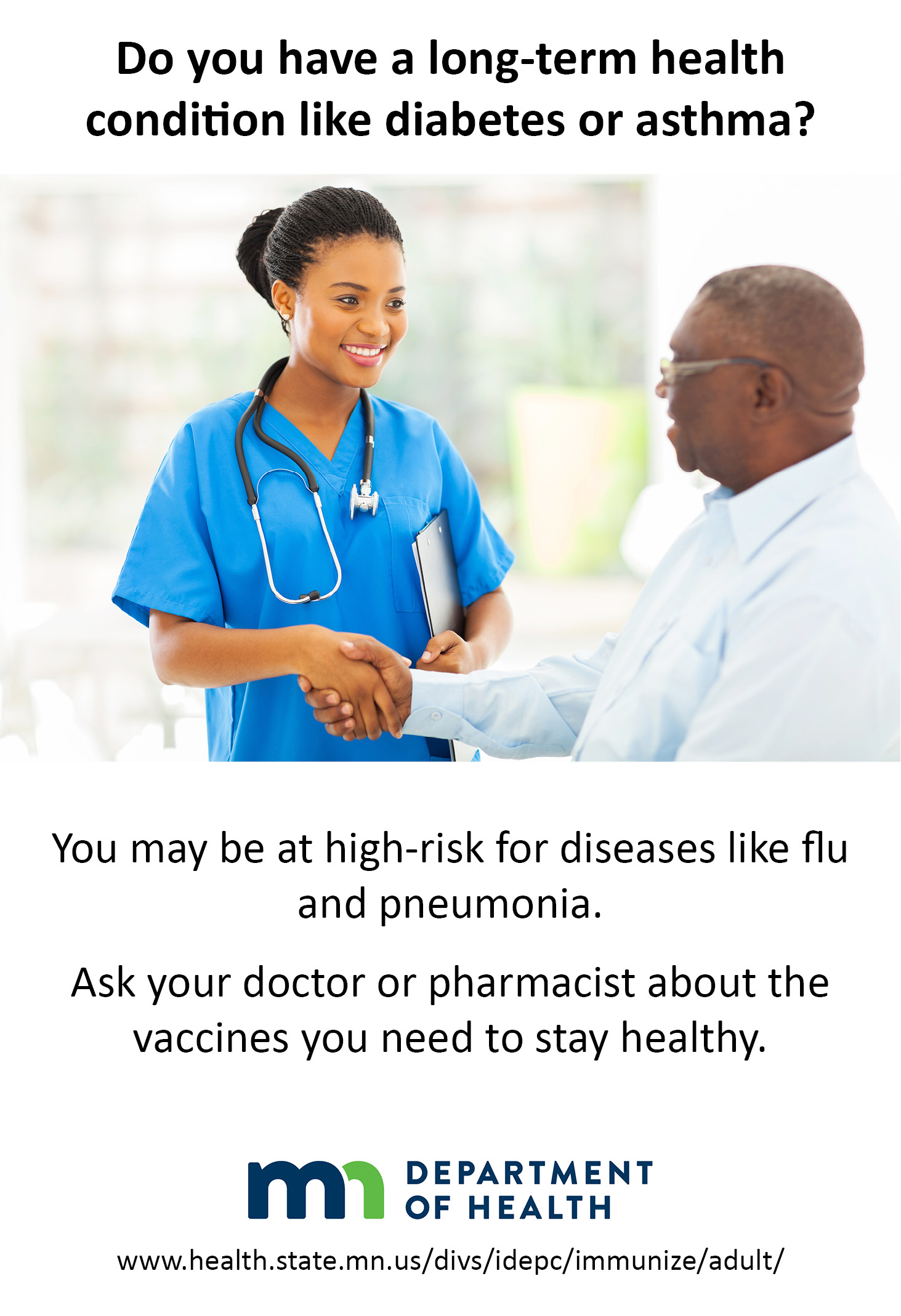
Adults with long-term health conditions need vaccines to stay healthy
Adults with long-term health conditions need vaccines to stay healthyAdults with long-term health conditions need vaccines to stay healthy
Each year, thousands of adults in the United States suffer from serious illnesses that could have been prevented by vaccines. These diseases can be serious and require you to go to the hospital or be out of work for a long time.
Many adults simply do not know they are at high risk for diseases like influenza (flu) and pneumococcal, which vaccines can prevent. Many long-term health conditions like diabetes or asthma place adults at higher risk for problems if they get sick. Some diseases are more common or more dangerous as adults get older, like shingles.
Some adults may not have gotten certain vaccines because they were not available when they were children putting them at risk for the disease. It is important to talk your doctor or pharmacist about vaccines you need to stay healthy.
Ask about these vaccines at your next visit:
Flu: Everyone 6 months of age and older should get vaccinated every year. It is especially important for young children, pregnant women, older people and those with long-term health conditions.
Tetanus, diphtheria, pertussis (Td or Tdap): All adults need a Tdap vaccine one time, and then a Td vaccine every 10 years. Pregnant women need a Tdap vaccine during every pregnancy to protect them and their newborns.
Measles, mumps, rubella (MMR): Many adults need a second dose of this vaccine to be fully protected against the measles. This vaccine also protects against mumps and rubella disease.
Varicella, also called chickenpox: You may need this vaccine if you never had chickenpox disease.
Human papillomavirus (HPV): If you are 26 or younger, make sure you have been vaccinated to prevent certain kinds of cancer.
Zoster, also called shingles: Adults 50 and older need this vaccine to be protected against this disease. Shingles disease can cause a very painful rash that may last for several months. If you already got a shingles vaccine, talk to your health care provider because there’s a new vaccine for shingles that you should get as well.
Even if you usually feel healthy, long-term health conditions may worsen when your body is fighting another disease like the flu or pneumonia. If you see your doctor for any long-term health condition, ask if you need any of the following vaccines:
Pneumococcal: There are two types of pneumococcal vaccine, ask your doctor if you need both. The vaccines help prevent infections in the lungs, blood, and lining of the brain or spinal cord.
Meningococcal: This vaccine protects against a rare but dangerous infection.
Hepatitis A and B: These vaccines protect you from viruses that cause liver disease.
If you travel outside of the United States, you may need additional vaccines. You may also need certain vaccines because of your job, for example if you are a health care worker. Your health care provider can help you determine what vaccines you need.
We all need vaccines throughout our life to stay healthy. Talk to your clinic or pharmacist about what vaccines you need.
Don’t let cost stop you from getting vaccinated. Adult vaccines should be covered by health insurance. Call the number on the back of your insurance card to ask about vaccine cost. Uninsured adults and adults whose insurance does not cover vaccines may receive them at low cost at a clinic enrolled in the Uninsured and Underinsured Adult Vaccine program. Go to Vaccination Clinics Serving Uninsured and Underinsured Adults: http://www.health.state.mn.us/uuavsearch.
Abdirahman Kahin, owner of Afro Deli, seen here at the African Awards gala accepting the Business of the Year Award on October 13, 2018. Kahin and fellow African Jaylani Hussein will serve on the transition board advising Minnesota's newly elected governor, Tom Walz. Photo: Richard Ooga/Mshale
Abdirahman Kahin, owner of Afro Deli, seen here at the African Awards gala accepting the Business of the Year Award on October 13, 2018. Kahin and fellow African Jaylani Hussein will serve on the transition board advising Minnesota's newly elected governor, Tom Walz. Photo: Richard Ooga/MshaleAbdirahman Kahin, owner of Afro Deli, seen here at the African Awards gala accepting the Business of the Year Award on October 13, 2018. Kahin and fellow African Jaylani Hussein will serve on the transition board advising Minnesota’s newly elected governor, Tim Walz. Photo: Richard Ooga/Mshale
Abdirahman Kahin, whose Afro Deli business won Business of the Year at last month’s African Awards Gala is among those selected by Minnesota Governor-elect Tim Walz to serve on his transition board that will “provide counsel and advice.”
According to the governor-elect, in a statement sent to Mshale, the board will help him fill important roles in his new administration, shape the state’s budget priorities for the next year, and provide diverse knowledge and experiences in facing Minnesota’s biggest challenges.
Kahin, a native of Djibouti, is also joined on the board by another prominent Africa-born person, Jaylani Hussein, a native of Somalia. Hussein leads the Minnesota chapter of the Council on American-Islamic Relations (CAIR).
The 30-person board is led by the lieutenant governor-elect Penny Flanagan and consists of a cross-section of Minnesotans. Flanagan made history during the midterms by being the first Native American woman elected to statewide office in Minnesota.
“I am excited to announce an outstanding group of people to serve on the One Minnesota Transition Advisory Board,” said Flanagan. “From civil rights advocates to business owners to tribal leaders to Greater Minnesota mayors, our team worked intentionally to bring together a diverse group of people to share their expertise as we lay the groundwork for our administration. Together, we will cast a wide net across the state to ensure we truly run state government as One Minnesota.”
“Made up of people from all different backgrounds, this advisory board is One Minnesota in action,” said Walz. “We believe all those affected by policy should have a seat at the table, and this is our very first time pulling out the chairs. We thank these passionate Minnesotans for lending their time and talents to the people of our great state.”
One of the main objectives for the board will be to identify individuals to fill 22 agency commissioner positions. The commissioners are in charge of leading the various state agencies. Those interested will need to submit their applications by December 7. The Walz administration will take office on January 7.
Additionally, the board will also give guidance on budget and policy priorities. The new Walz administration plans to unveil a $50 billion two-year budget when it takes office.
The appointment of Kahin and Hussein to the board is acknowledgment of the growing political and business influence of the African immigrant community, especially those from Somalia. During the November midterms, the Somali community doubled their number at the Minnesota House of Representatives from one to two. Mohamud Noor easily won the seat formerly occupied by Ilhan Omar to keep that seat within the community, while Hodan Hassan prevailed at House District 62A. Ilhan Omar moved on to even bigger things by becoming the first Africa-born black to be elected to the US Congress when she won Minnesota’s Fifth Congressional District.
Here is the full board of the advisory board announced by governor-elect Walz:
Abdirahman Kahin, owner of Afro Deli
Armando Camacho, President and CEO of Opportunity Partners
Ben Schierer, Mayor of Fergus Falls
Bharti Wahi, Executive Director of the Children’s Defense Fund-MN
Bo-Thao Urabe, Executive and Network Director at the Council on Asian American Leaders
Carl Crawford, Human Rights Officer at the City of Duluth
Carly Melin, Executive Director of the Minnesota State Building and Construction Trades Council and former State Representative
Chief Executive Melanie Benjamin, Mille Lacs Band of Ojibwe
Dave Durenberger, former U.S. Senator
David Nicholson, Executive Director at the Headwaters Foundation for Justice
Denise Specht, President of Education Minnesota
Eric Sannerud, CEO of Mighty Axe Hops
Harold Wolle, past President and current Board member of the Minnesota Corn Growers Association
Javier Morrillo, President of SEIU Local 26
Jaylani Hussein, Executive Director of CAIR-MN
Jeff Ettinger, Chairman of the Hormel Foundation
Kathleen Annette, M.D., President and CEO of the Blandin Foundation
Marcia Zimmerman, Senior Rabbi at Temple Israel
Marvin Roger Anderson, CEO of Rondo Commemorative Plaza and Chair of Reconnect Rondo
Michelle Behr, Chancellor of the University of Minnesota Morris
Paul Austin, Executive Director of Conservation Minnesota
President Shelley Buck, Prairie Island Indian Community
Rassoul Dastmozd, President/CEO of Saint Paul College
Senta Leff, Executive Director of the Minnesota Coalition for the Homeless
Stella Whitney-West, CEO of North Point Health & Wellness Center
Tawanna Black, CEO of the Center for Economic Inclusion
Tim Mackey, President of the Laborers District Council
Tom McLaughlin, former Legislative Chairman for the Minnesota Veterans of Foreign Wars, a retired Blue Earth County Commissioner, and Marine Combat veteran
Tony Sertich, President of the Northland Foundation
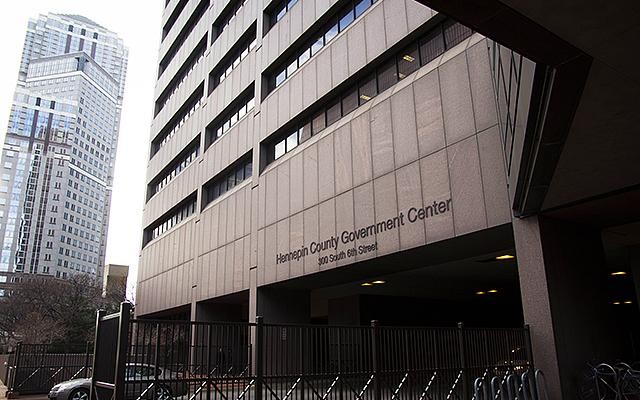
Hennepin County is accepting applications for its citizen advisory board through December 31, 2018.
Hennepin County is accepting applications for its citizen advisory board through December 31, 2018.Hennepin County is accepting applications for its citizen advisory boards through December 31, 2018.
Minnesota’s largest county, Hennepin County, is recruiting volunteers for 28 citizen advisory board positions through its annual open appointment process. The board appoints residents to volunteer service positions on advisory boards, commissions, councils and special task forces each year. Those appointed advise commissioners and help set policy on a variety of topics.
Applications are due by December 31.
Current openings include adult Mental Health Advisory Council (11 vacancies), County Extension Committee – University of Minnesota Extension (four vacancies), Community Action Partnership of Hennepin County (two vacancies, open to local elected officials), Workforce Innovation and Opportunity Act Board (three vacancies), Human Resources Board (three vacancies), Library Board (three vacancies), Mental Commitment Attorney Panel Advisory Board (one vacancy) and Three Rivers Park District Board of Commissioners (one vacancy).
Those interested may apply online at www.hennepin.us/advisoryboards. Hennepin County will accept applications through Dec. 31. The board will conduct interviews beginning in January 2019.
Prior to this month’s midterms, no people f color had ever been elected to serve on the county’s board of commissioners. That changed on November 6 when voters made history by electing Angela Conley, in District 4, and Irene Fernando, in District 2 to serve in the seven-member board.
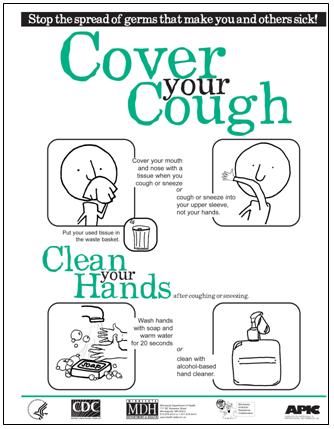
Its Flu season, do thisIt’s flu season! There are some simple things you can do to help you and your family stay healthy, like getting your flu vaccine, covering your cough, and staying home if you are sick. Watch this short video from CDC to learn more. #NIVW