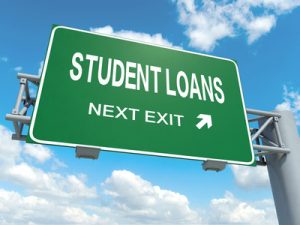
According to the U.S. Department of Education, federal student loan borrowers may be reconsidered for loan forgiveness through an expansion of the Public Service Loan Forgiveness (PSLF) Program.
According to the U.S. Department of Education, federal student loan borrowers may be reconsidered for loan forgiveness through an expansion of the Public Service Loan Forgiveness (PSLF) Program. According to the U.S. Department of Education, federal student loan borrowers may be reconsidered for loan forgiveness through an expansion of the Public Service Loan Forgiveness (PSLF) Program.
The federal government is temporarily expanding its student loan forgiveness program.
According to the U.S. Department of Education, federal student loan borrowers may be reconsidered for loan forgiveness through an expansion of the Public Service Loan Forgiveness (PSLF) Program.
Dr. Alana Bibeau, a lecturer at the University of Rhode Island, recently realized she made almost ten years worth of student loan payments that didn’t qualify for the federal student loan forgiveness. She brought the issue to Sen. Sheldon Whitehouse’s attention.
“I just said, ‘Here’s my situation. If I’ve made this mistake, I’m going to guess there are a lot of people in Rhode Island and around the country that are making the same mistake,'” Bibeau said.
The program dates back about a decade. People who committed to working at government jobs or for nonprofits were promised loan forgiveness after 10 years of consistent loan payments. But there has been confusion about which loan payments actually qualify for the program.
Sen. Whitehouse called it a ‘glitch’ in the loan forgiveness program, and championed a law that allocated $350 million to student loan borrowers who believed they were making qualifying loan payments.
“This was intended to help them,” Whitehouse said. “So we want to put a nice net underneath for people who are falling through the cracks.”
Now, the Department of Education will reconsider eligibility for loan forgiveness using a new list of qualifying repayment plans, which includes the Graduated Repayment Plan, Extended Repayment Plan, Consolidated Standard Repayment Plan, and Consolidated Graduated Repayment Plan.
According to the Department of Education, to qualify for the expanded loan forgiveness program, a borrower must have done the following:
Submitted the Public Service Loan Forgiveness: Application for Forgiveness and had that application denied because some or all of the payments were not made under a qualifying repayment plan for PSLF
Worked at least 10 years of full-time employment with a qualifying employer, certified by the employer, and approved by the Department
Made 120 qualifying monthly payments under the new requirements for the TEPSLF opportunity while working full-time for a qualifying employer or employers
Borrowers who believe they may qualify should email a request for reconsideration to [email protected].
The funding is limited, and borrowers will be considered on a first come, first served basis.
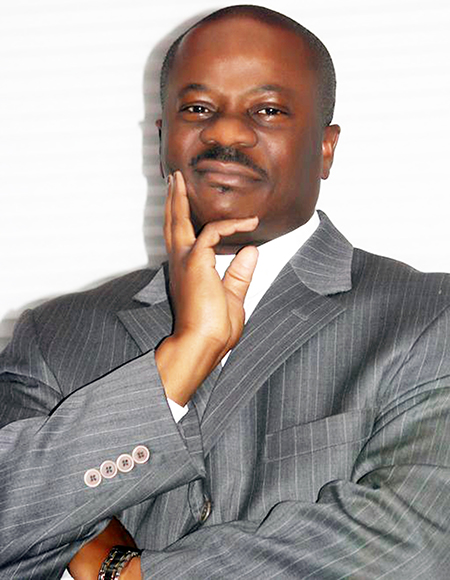
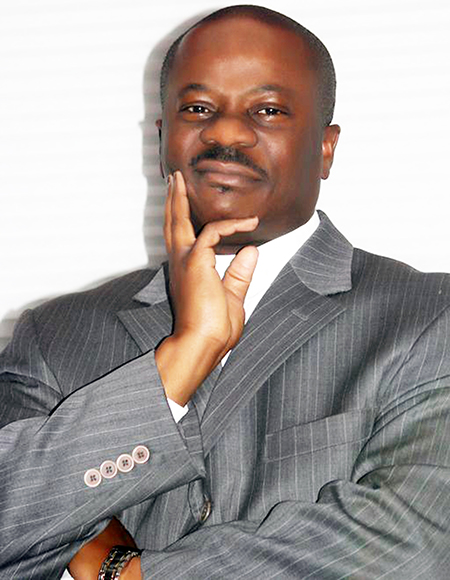
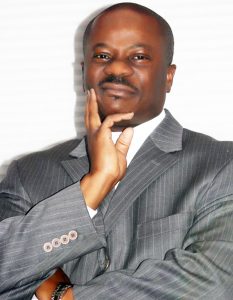
Pastor Charles Goah of United Christian Fellowship Church in Minneapolis died on May 10, 2018 of cancer. He will be buried on Saturday, June 16, 2018 in New Hope, Minnesota. Photo: Courtesy of United Christian Fellowship Church
Pastor Charles Goah of United Christian Fellowship Church in Minneapolis died on May 10, 2018 of cancer. He will be buried on Saturday, June 16, 2018 in New Hope, Minnesota. Photo: Courtesy of United Christian Fellowship ChurchPastor Charles Goah of United Christian Fellowship Church in Minneapolis died on May 10, 2018 of cancer. He will be buried on Saturday, June 16, 2018 in New Hope, Minnesota. Photo: Courtesy of United Christian Fellowship Church
The funeral details for the late pastor Charles Garjay Goah of the United Christian Fellowship Church have been released by the planning committe arranging it through a statement to Mshale by Reverend Francis Tabla.
The public will be able to pay their respects starting with a viewing of the body on Friday, June 15 followed with a funeral service and burial the next day on Saturday, June 16.
Friday, June 15, 2018 – Pastor Goah lies in state (viewing of the body)
Location: United Christian Fellowship Church
4300 Queens Ave. N., Minneapolis, MN 55412
Time: 3:00 PM to 5:00PM
Friday, June 15, 2018 – Wake Keeping
Location: Grace Evangelical Free Church
755 73rd Ave N.E., Fridley, MN 55432
Time: 6:00 PM to 10:00 PM (Followed by refreshments)
Saturday, June 16, 2018 – Funeral Service
Location: Shiloh Temple International Ministries
1201 W. Broadway Ave., Minneapolis, MN 55411
Time: 9:00 AM
Committal Service After the Funeral Service
Location: Gethsemane Cemetery
8151 42nd Ave N., New Hope, MN 55427
Repast
Location: Grace Evangelical Free Church
755 73rd Ave NE
Fridley, MN 55432
Charles Goah, pastor and author, dies at 55Liberian-American pastor, Charles Garjay Goah of United Christian Fellowship Church in Minneapolis, died of cancer on May 10, 2018 at the age of 55. He will be buried on June 16, 2018. Photo: Courtesy of United Christian Fellowship Church
Charles Garjay Goah, a beloved Liberian-American pastor who delivered the gospel to many as the longtime pastor of United Christian Fellowship Church in Minneapolis’ North Side, died on May 10. He was 55.
The cause was cancer, his wife of 20 years said.
For over two decades, pastor Goah led a ministry credited with winning converts with a style that went beyond the spiritual needs of those he ministered to. Even as he preached the gospel, he was known to have a keen interest in the civic and entrepreneurial endeavors of those he ministered to, whether they were his parishioners or not.
“He would ask me every time we met, how my business was doing and if there was anything he could do to help”, Theodore Morgan, a Liberian-American businessman, said.
Pastor Goah was also keen in building bridges beyond the Liberian community. Boyd Morson, a civic leader in the City of Brooklyn Park wrote in a Facebook message “Pastor Goah was a friend and supporter of mine. And he shared meaningful and uplifting words and conversations with me about my campaign and vision as Mayor in Brooklyn Park. Pastor Goah also sincerely thanked me for my presence, involvement and engagement within the Liberian community over the many years.”
Goah was born in Liberia’s capital city of Monrovia on June 11, 1962. He first came to the United States as a youth missionary in 1988 before the civil war broke out in his native Liberia. He had received some limited theological training in Liberia but got his full training as a minister while in the United States. He received his bachelors in theology while in Virginia and a master’s degree in theology from ACTS International Bible College in Blaine, Minnesota. He also received masters in global leadership from Fuller Theological Seminary.
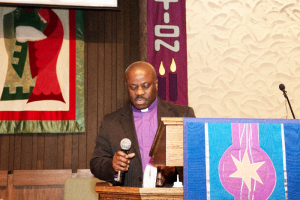
Pastor Charles Goah of United Christian Fellowship Church in Minneapolis delivering a sermon at a past event. The Liberian-American pastor died on May 10, 2018 and will be buried on June 16, 2018. Photo: Courtesy of Liberian Brothers and Sisters Keepers Organization (LIBASKO)
Goah met his wife Danuta in 1995. She had come to the United States on a similar youth mission trip through a Polish church.
“He came and visited me and my family in my hometown of Gorzow Wielkopolski in Poland and we got married in 1997 in my hometown,” Mrs. Goah said.
At the time of his death, Goah was enrolled at Bethel University pursuing his doctorate. He had already completed a year of the program. He is survived by his wife Danuta, son Jakub, daughter Mayetti, his mother Julia Gaarduwar who lived with them, his brother in Liberia Stanley Goah and a large extended family.
The late Goah was also an author. He authored two books. The first one he wrote was Adultery: A Contemporary Interpretation. In March 2017, he authored From Praise to Petition: Experiencing the Power and Passion of Prayer, which is still available in bookstores, and Amazon.
He was also an active member of the Liberian Ministerial Alliance in Minnesota as well as the Brooklyn Area Ministerial Association.
He was known to preach love and peace and was prominent during difficult times that the community faced.
In 2015, he was the presiding pastor at the high profile funeral of Henry T. McCabe, a Minnesota Department of Revenue Corporate Auditor, who had been missing for almost a month and was discovered dead on Rush Lake in New Brighton. The death that shook the Liberian and wider African community to its core. Delivering the sermon at the McCabe funeral, pastor Goah preached from among other books in the bible, the book of Luke, directing mourners specifically to chapter 7. That chapter tells the story of how Jesus raised the son of the widow of Nain from the dead. Goah said death for those left behind many times leads to suffering but like what Jesus did with the widow, he showed compassion towards her.
“In our darkest moments, where there is the presence of Jesus, there cannot be hatred,” Goah told mourners.
The funeral service will be on June 16, according to Reverend Francis Tabla in a statement on behalf of the funeral planning committee. The June 16 funeral will be preceded by the viewing of the body on June 15 at United Christian Fellowship Church.
Updated details on the viewing, the wake and funeral of the late pastor Charles Garjay Goah can be found at this link.
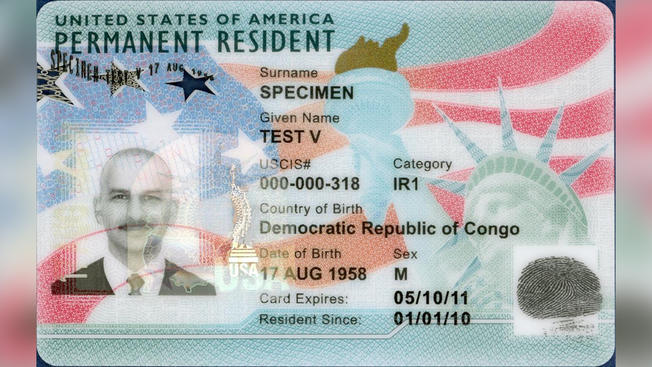
U.S. Citizenship and Immigration Services has announced that thousands of Green Cards will be recalled because of a production error.
U.S. Citizenship and Immigration Services has announced that thousands of Green Cards will be recalled because of a production error.U.S. Citizenship and Immigration Services has announced that thousands of Green Cards will be recalled because of a production error.
U.S. Citizenship and Immigration Services announced Monday that thousands of Permanent Resident cards will be recalled because of a production error.
The federal immigration agency said in a news release approximately 8,543 Green Cards will need to be returned because they were printed with an incorrect “Resident Since” date.
Those affected were spouses of U.S. citizens approved for Form I-751, a petition to remove conditions on residence status. The form is used for people who received a conditional Green Card based on a marriage to a U.S. citizen or permanent resident and apply to obtain a regular Permanent Resident card.
Spouses of U.S. citizens may apply for naturalization after three years of permanent residency. Because of the incorrect “Resident Since” date on the Permanent Resident cards, applicants could wait longer than necessary to apply to become U.S. citizens.
According to the USCIS, the affected cards were mailed between February and April 2018.
The agency said it will mail notices to individuals who received the incorrect cards and they should return their inaccurate Green Card to USCIS in the provided prepaid envelope within 20 days of receiving the notice. They may also return their cards to USCIS field offices. USCIS will send replacement Green Cards within 15 days of receiving the incorrect card.
The Green Card holders’ status as lawful permanent resident is not affected by the recall, the USCIS said.
If affected individuals need to travel internationally or prove their lawful permanent residence while they wait for a replacement card, they may contact the USCIS at 800-375-5283 to determine if they need additional proof.
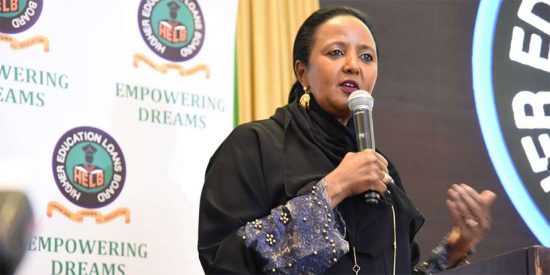
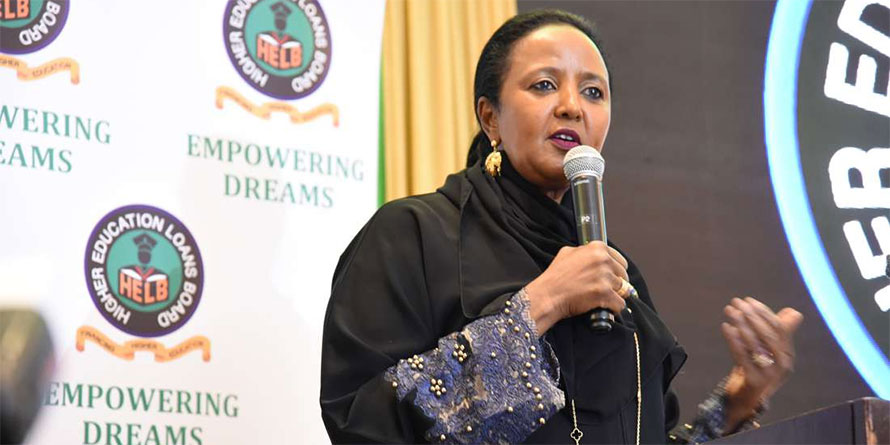
Kenya's education minister, Amina Mohamed, announcing a full penalty reprieve for those who clear their student loans by June 30, 2018. Photo: Courtesy Capital FM
Kenya's education minister, Amina Mohamed, announcing a full penalty reprieve for those who clear their student loans by June 30, 2018. Photo: Courtesy Capital FMKenya’s education minister, Amina Mohamed, announcing a full penalty reprieve for those who clear their student loans by June 30, 2018 and asked those in the diaspora that owe to pay up. Photo: Courtesy Capital FM
Did you attend a Kenyan university and still owe the Higher Education Loans Board (HELB) money on your student loan? if you do, then you are among the 78,000 Kenyans, some in the diaspora, that owe HELB a whopping Kenya shillings 8.1 billion (US$81 million) collectively.
Education minister, Amina Mohamed, announced this month a waiver on all penalties for those who clear their loans by June 30.
HELB is under mounting pressure to collect from defaulters as the Treasury cut its budget by almost 6% this year after a drop in university enrolment due to fewer high school students qualifying. Government figures show a drop of 43,614 fewer students being admitted as many did not make the required C+ to gain admission to a public university. University enrolment currently stands at 520,893, down from 564,507 a year ago.
The university loan scheme has since 1974 supported over 645,000 Kenyans to pursue higher education at a total cost of Kenya shillings 72 billion, according to HELB records. Of the 396,680 loan accounts created to date, a total of 175,003 loanees have completed their repayment valued at Kenya shillings 16.7 billion. About 81,994 of the accounts worth Kenya shillings 8.2 billion have defaulted. In the 2016 to 2017 financial year, HELB recovered Kenya shillings 4.1 billion which accounted for 40 per cent of its financing budget of Kenya shillings 10.2 billion for the year.
HELB CEO Charles Ringera, speaking after Minister Mohamed’s penalty reprieve announcement said the penalty reprieve is valid for those who pay off the entire sum they owe.
The education minister, while announcing the penalty reprieve, also said efforts were underway to ensure those in the diaspora that benefitted from the loan scheme pay up.
Paul Morande, a telecom engineer in Minneapolis, is an alumnus of the University of Nairobi and a recipient of the loan scheme. He told Mshale via phone that he just recently paid off his loan when minister Mohamed made the reprieve announcement.
“The savings are substantial, as I saved Kenya shillings 300,000 (US$3,000) by paying off the loan this month,” Morande said. He encouraged others to pay so that HELB can avail loans to more students. Morande, the executive director of the Minnesota Kenyan International Development (MKIDA), a non-profit that supports education efforts in Kenya said it feels good to have paid off the loan.
“I call upon HELB to fast-track the conclusion of these discussions and sign the appropriate Memorandum of Understanding to enhance loan repayments by the Diaspora,” said Mohamed.
More details on HELB can be found on their website.
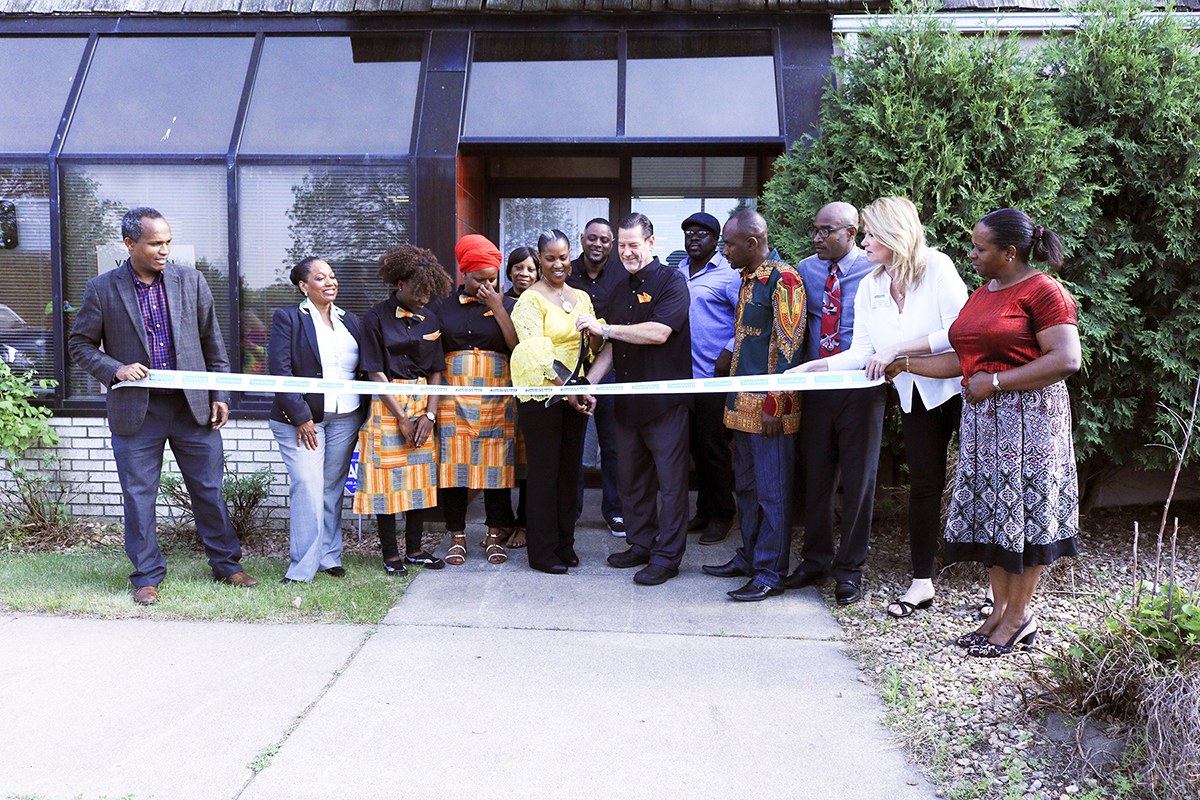
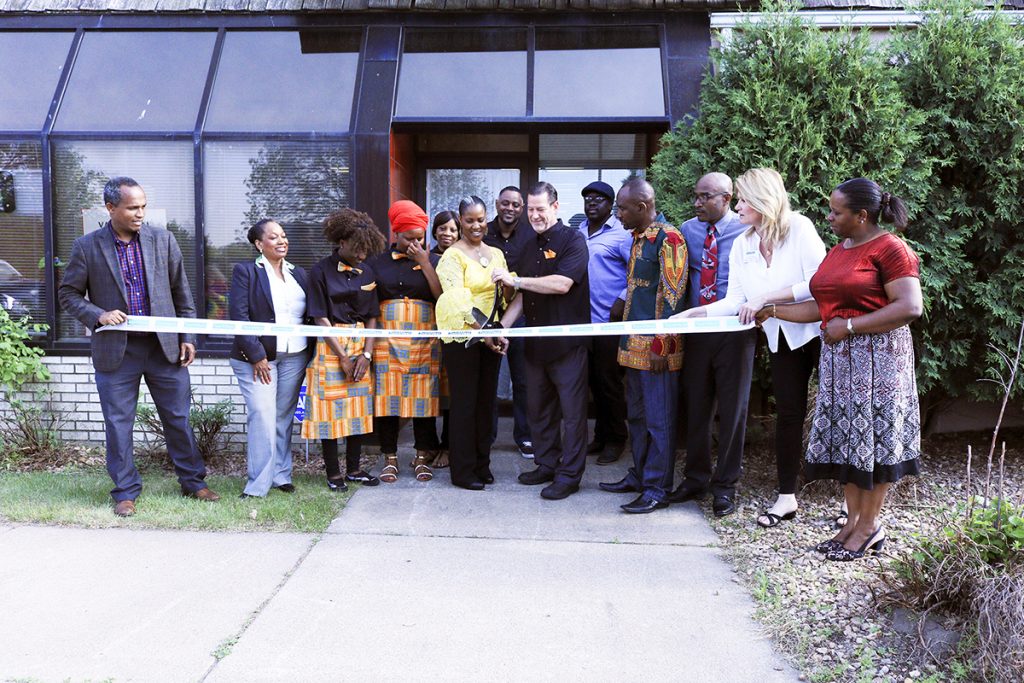
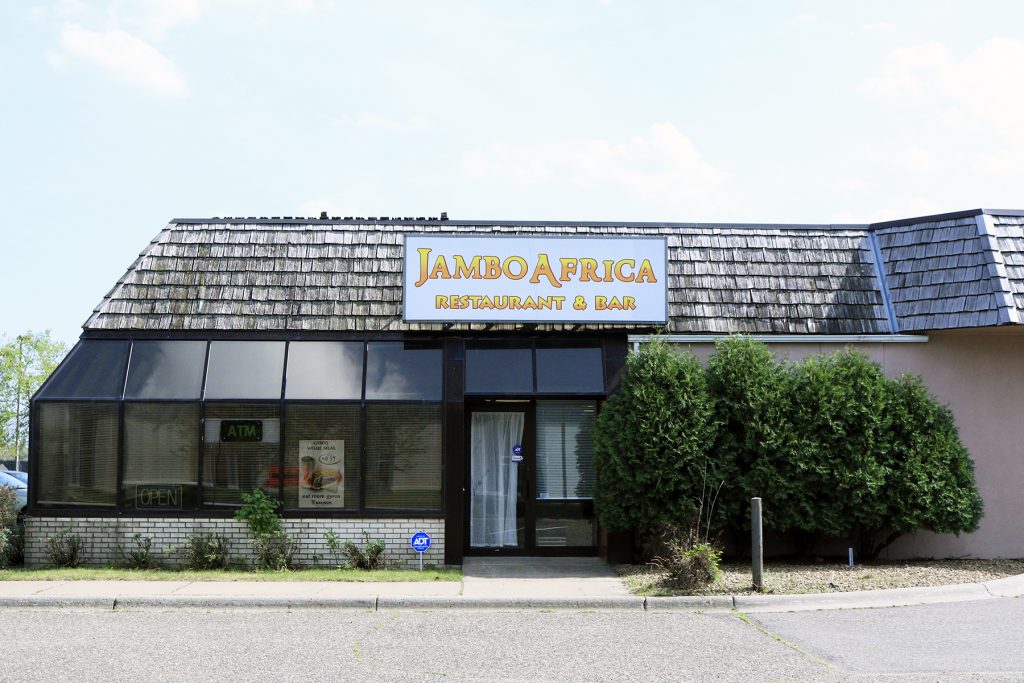
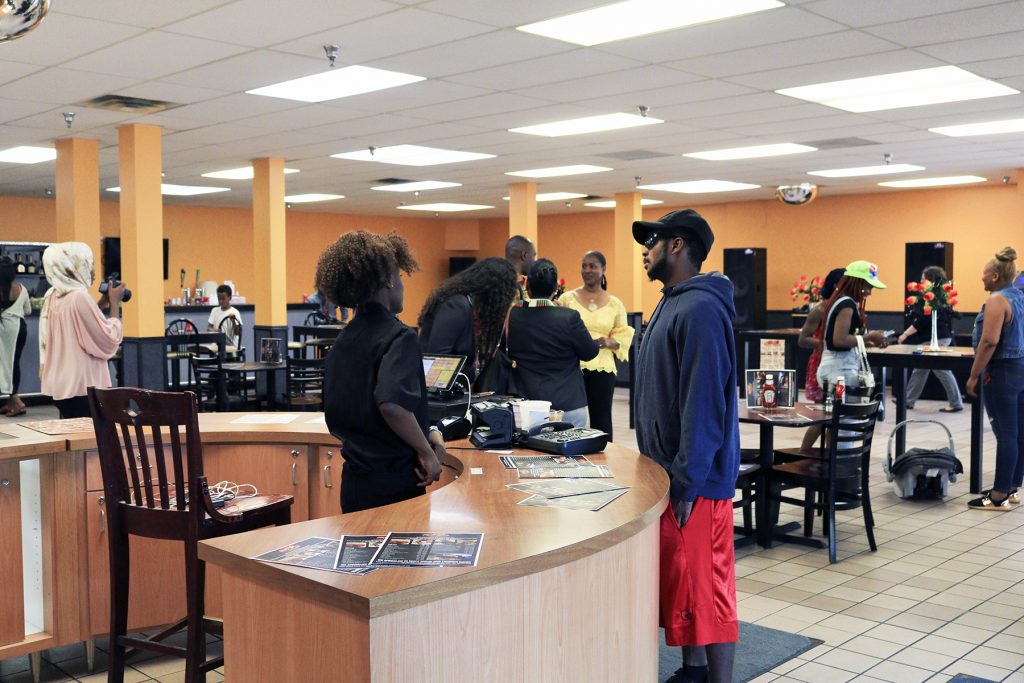
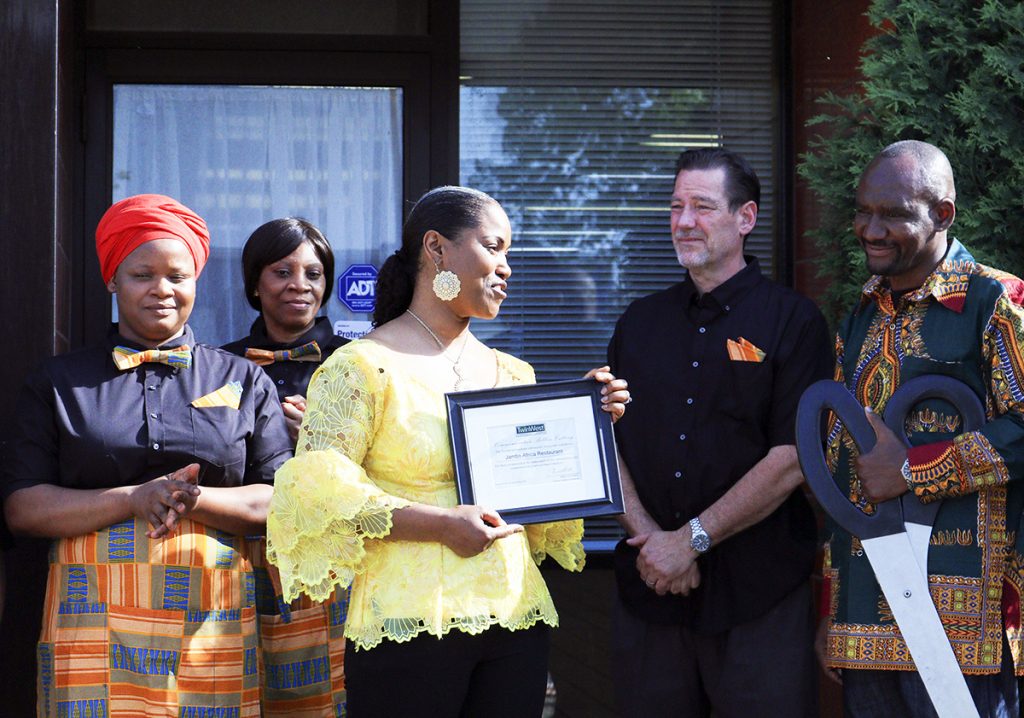
Jambo Africa Restaurant held a ribbon cutting ceremony for its second location on Friday, May 18 2018. Photo: Bethel Gessesse/Mshale
Jambo Africa Restaurant held a ribbon cutting ceremony for its second location on Friday, May 18 2018. Photo: Bethel Gessesse/MshaleJambo Africa Restaurant held a ribbon cutting ceremony for its second location on Friday, May 18 2018. Photo: Bethel Gessesse/MshaleThe outside view of the new expansive Jambo Africa Restaurant’s second location which grand opened on Friday, May 18 2018 in Brooklyn Center, Minnesota. Photo: Bethel Gessesse/MshaleInside the expansive new Jambo Africa Restaurant second location on its grand opening day on Friday, May 18 2018 in Brooklyn Center, Minnesota. Photo: Bethel GessesseSimone Chamblish, owner of Jambo Africa Restaurant in Brooklyn Cente, holds a commemorative ribbon cutting certificate from the TwinWest Chamber of Commerce shortly after the ribbon cutting to signal the grand opening of her restaurant on Friday, May 18 2018. She is flanked by Nasibu Sareva (holding scissors), executive director of the African Development Center which provided financing. Photo: Bethel Gessesse/Mshale
Jambo Africa Restaurant has opened a second location about a mile south of its current location on 1601 Freeway Blvd, Brooklyn Center. The new location is the former Oriental Market. African Development Center of Minnesota provided major financing to restore the building and facilitate the new operation. The new spacious location however features a full service bar. Read about their first location opening on Shingle Creek parkway five years ago here.
On Friday, May 19, Jambo Africa held a ribbon cutting ceremony to mark its second location’s opening. Owner, Simone Chamblish, received praise from the TwinWest Chamber of Commerce VP of Investor Relations, Catherine Reller, who called her a “pioneer for many others.”
“I see myself as a motivator… The challenges [are] always a task to make you go forward, not to set you back. So sometimes, you look at these things and you think, I can’t do it. It’s just the beginning of getting further. If we don’t get those problems that come in our way, we wouldn’t know if we can withstand it or not. So just keep going. That’s how I look at it,” Chamblish stated.
After the ribbon cutting and an invocation from Reverend Francis Tabla of Ebenezer Community Church in Brooklyn Park, Chamblish gave thanks to the sponsors, God, family, crew, and friends. She greeted guests with thanks, taking the time to speak with each of them.
Also present was Nasibu Sareva, African Development Center’s executive director, who was on hand to witness his organization’s latest success story.
The new restaurant continues in the style of its first location, offering various West and East African cuisines including oxtail, curry stew, chicken wings, jollof rice, collard greens, plantains, sambusas, and more.
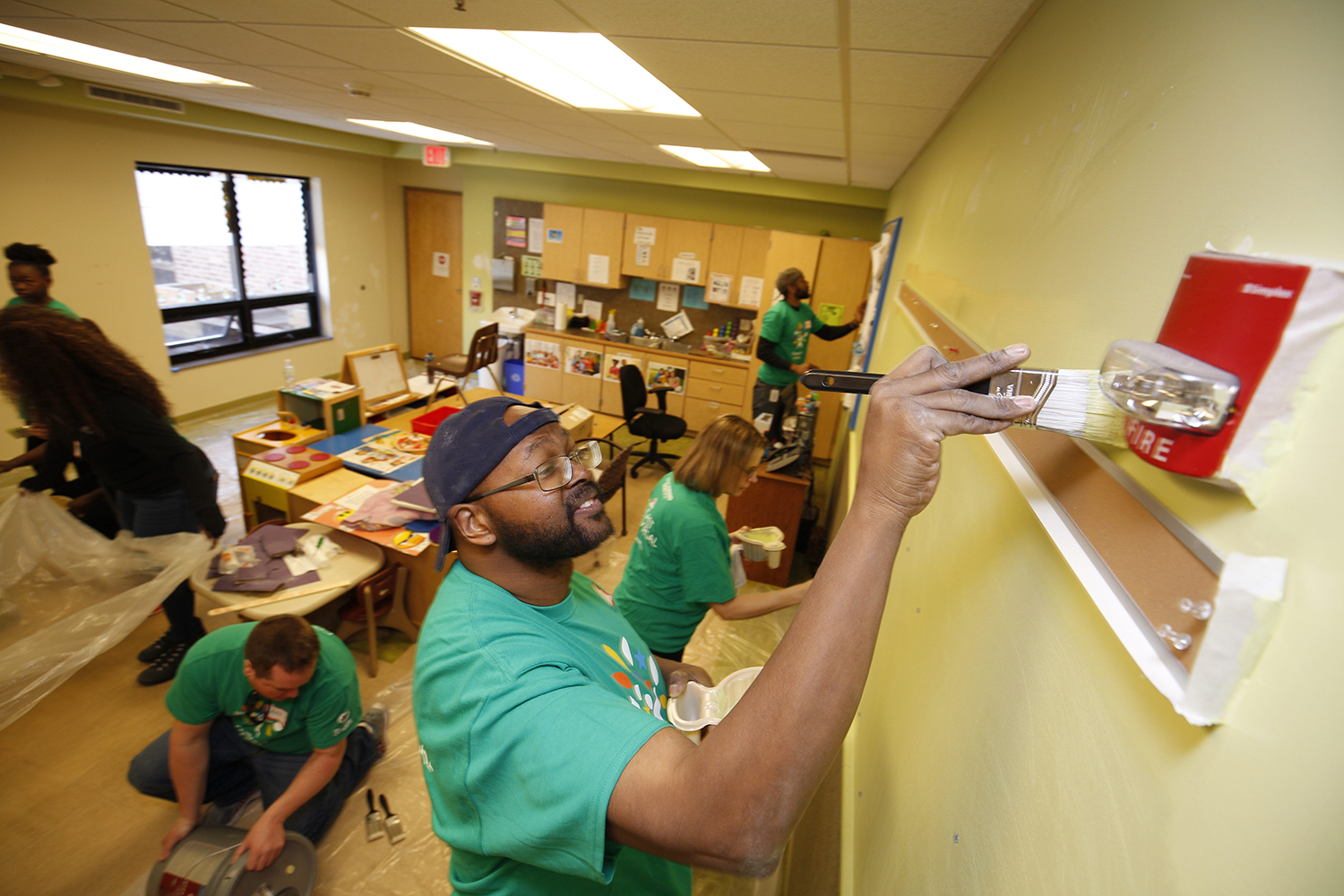
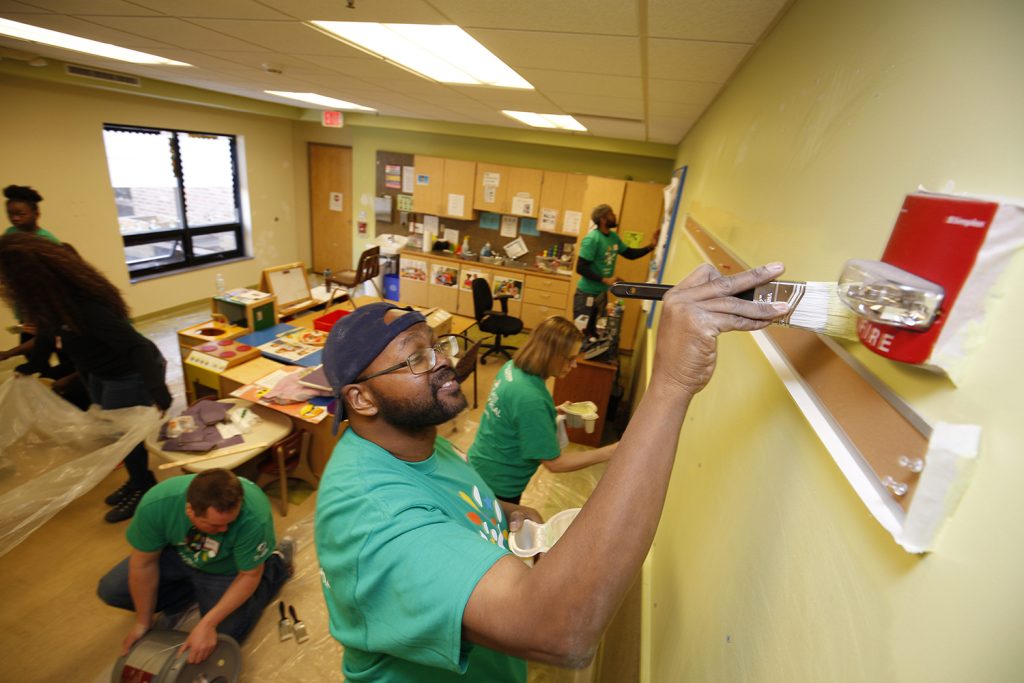
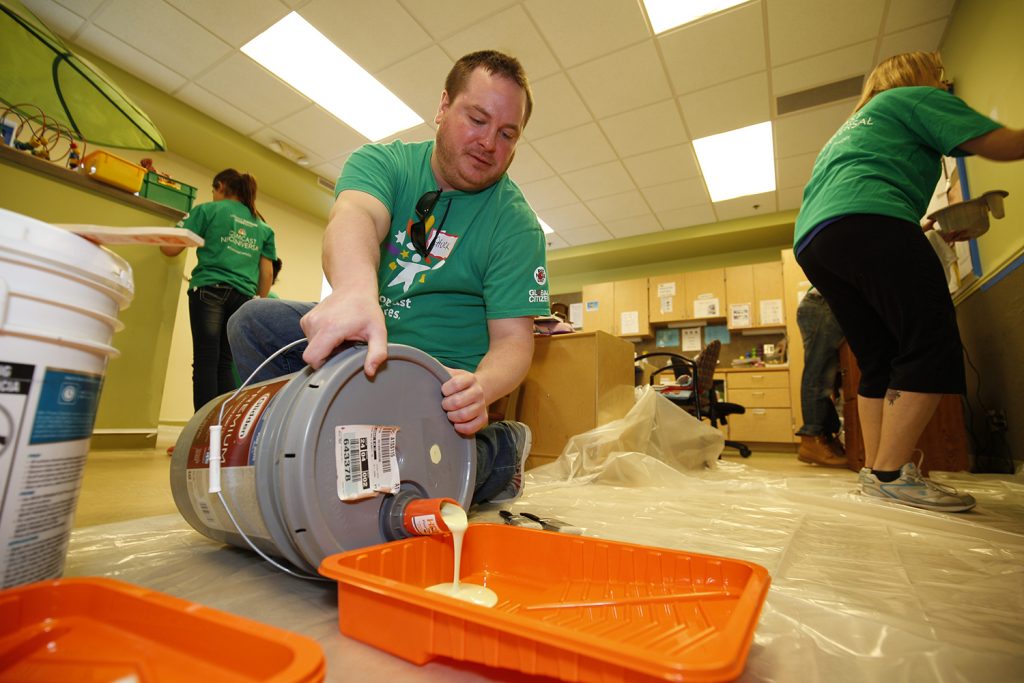
A Twin Cities Comcast employee volunteers at the Phyllis Wheatley Community Center in Minneapolis during "Comcast Cares Day" on April 21, 2018. Photo: Courtesy Comcast
Comcast NBCUniversal employees and their families, friends, and community partners participated in the 17th annual Comcast Cares Day on April 21. It is the nation’s largest single-day corporate
A Twin Cities Comcast employee volunteers at the Phyllis Wheatley Community Center in Minneapolis during “Comcast Cares Day” on April 21, 2018. Photo: Courtesy Comcast
volunteer effort in what the company said was a powerful representation of its year-round commitment to community service. What started with 6,100 volunteers in 2001 in one city has now grown to more than 100,000 volunteers this year at over 1,000 sites in about 20 countries.
In the Twin Cities area, more than 2,000 local Comcast employees and their families, friends and community partners made “make change happen” as they volunteered at more than a dozen project sites across the metro area as part of the 17th annual Comcast Cares Day. This year’s volunteers were also a part of a significant milestone of Comcast Cares Day – reaching 1 million volunteers since the program began in 2001.
Comcast volunteers helped clean, paint and restore a variety of project sites around the Twin Cities. One of the beneficiaries was the Phyllis Wheatley Community Center in Minneapolis where they helped give the center get a fresh coat of paint. Gamble Boys & Girls Club, Haven House – Ascension Place, and Pillsbury United Communities also were beneficiaries of the Comcast Cares volunteers.
“As we celebrate our 17th annual Comcast Cares Day, we are delighted to partner with a variety of great organizations to give back to the Twin Cities community,” said J.D. Keller, regional vice president, Comcast Twin Cities Region in a statement. “It’s humbling and inspiring to see how we can drive positive change when our employees, their family and friends, and our agency partners rally together
A Twin Cities Comcast employee pours out paint as he and his fellow employees painted the the Phyllis Wheatley Community Center in Minneapolis during “Comcast Cares Day” on April 21, 2018. Photo: Courtesy Comcast
to make a lasting difference in our communities. I am very thankful for the participants who help to make this effort a success today and throughout the year.”
Sarah Caruso, president and CEO of Greater Twin Cities United Way, said “We are thrilled to be partnering with Comcast and its employee volunteers to help give back to the Twin Cities community on both Comcast Cares Day and all year long.”
Caruso’s organization has played a key role in helping Comcast coordinate its many volunteer project locations across the Twin Cities. She added that the volunteers would have a lasting impact.
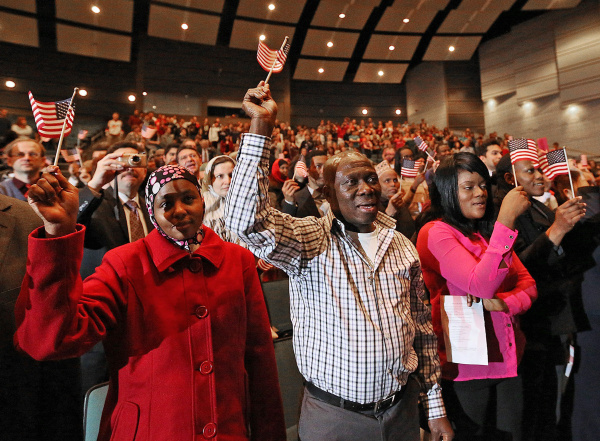
New citizens at a swearing-in ceremony. Photo: Courtesy Florida Consumer Action Network
New citizens at a swearing-in ceremony. Photo: Courtesy Florida Consumer Action Network
New citizens at a swearing-in ceremony. Photo: Courtesy Florida Consumer Action Network
A Trump supporter named John B. who emailed me recently wrote that, “No one is against legal immigration.” President Trump and his administration are, I replied.
Yes, Trump still wants his big, beautiful wall to stop illegal border crossings. But he’s been railing against all forms of immigration since his campaign. And he’s having a much easier time chipping away at legal immigration than funding his wall. In some cases, the methods are strict quotas or new rules. But paperwork and red tape work, too. For instance, this administration tripled the number of pages in green card applications. Forms for sponsoring a foreign-born spouse are nine times longer than they used to be.
Here’s an overview of key ways Trump has made it more difficult and expensive to come here legally for foreign students, skilled temporary workers, green cards holders, refugees and others.
H1-B visas
The Trump administration has piled new compliance rules, documentation requirements and other regulations on H-1B visas. These changes make it much more costly for employers to use H-1B visas to hire skilled foreign workers, which is a likely reason that applications dropped by 20% from 2016 to 2018.
The number of foreign students at U.S. universities was down about 17% in 2017 and likely will fall further this year. A major draw of studying in the United States is the ability to work here after graduation. Those on student visas can legally work for 12 months after earning their degrees, and STEM graduates can stay for three years under a program called Optional Practical Training. In 2016, about 200,000 students signed up for OPT, which is often a first step toward an H-1B visa.
Trump temporarily halted the entire refugee program last year, claiming that terrorists would get into the country masquerading as refugees. It started up again for most countries, but Trump precipitously cut the number of refugees the U.S. will accept. If admissions for 2018 continue at their current pace, 75% fewer refugees will arrive this year than in 2016. Trump even canceled a planned pilot program that would have allowed private individuals or charities to sponsor refugees and absorb all welfare costs — the kind of program Canada has had for more than a decade.
Muslim ban
Preventing terrorism was the reason given for Trump’s so-called Muslim ban, an executive order that limits or altogether bars visas for citizens of several Muslim-majority countries, North Korea and Venezuela. Lower courts keep ruling against it, but the ban and related policies are having a big effect. For instance, while all refugee numbers are down from 2016, the number of Muslim refugees has been cut by 91%. Immigrant visas issued to people from Muslim-majority countries are down 26%, and temporary visitors from Muslim-majority countries by 32%.
‘Extreme vetting’
Last year, former Secretary of State Rex Tillerson ordered additional security screenings for all immigrants and visitors seeking visas — a move also presented as a way of keeping out terrorists. Immigration attorney Shabnam Lotfi told me that these new procedures, “are causing significant and expensive delays for visa applicants who have already been vetted under the current effective security procedures.”
Asylum
The administration has directly and indirectly hampered the ability of foreigners to ask for asylum in the U.S. For instance, it cut the number of visas issued to Venezuelans by as much as 74% relative to 2013. That country is in political and economic crisis, but Venezuelans have to get to the U.S. to request asylum — and they can’t get here without a visa. Meantime, the Border Patrol is discouraging asylum-seekers from Central America by breaking up families who arrive at the southern border. The government places parents and children in separate immigration detention cells, sometimes for months.
Temporary Protected Status
In a string of announcements over recent months, Trump has said he’ll end Temporary Protected Status by 2020 for about 437,000 migrants mostly from El Salvador, Honduras and Haiti. TPS allowed them to stay here legally after natural disasters struck their home countries. More than 80% of TPS migrants from those countries have jobs here. They have about 273,000 U.S.-born children. Many have been here for decades; they won’t leave now, just as Salvadorans didn’t leave between 1996 and 2001 when their TPS was rescinded.
This is just the low-hanging fruit on the immigration tree. Trump would happily prune more if he could get Congress to go along. He endorsed the RAISE Act, which would cut legal forms of immigration by 50%. He so badly wants to eliminate diversity visas and severely restrict family-based immigration that he seemed willing to trade partial amnesty for some Dreamers (the young people enrolled in the Deferred Action for Childhood Arrival program). Still, the changes Trump pushed for would have resulted in the largest policy-driven gutting of legal immigration since the 1920s. Thankfully, they didn’t make it through the Senate.
Trump campaigned that he would take steps to grow the economy by 3% per year or more. To that end, he’s cut taxes and slashed regulation. But he needs legal immigrant entrepreneurs, investors and workers to keep expanding economic growth — especially with unemployment now below 4%. He won’t make America great again without letting in more legal immigrants.
Alex Nowrasteh wrote this article for the Los Angeles Times.
Ade Aruna, born and bred in Nigeria has been dfrafted by the Minnesota Vikings. Photo: Courtesy Vikings
Ade Aruna, born and bred in Nigeria has been dfrafted by the Minnesota Vikings. Photo: Courtesy VikingsAde Aruna, born and bred in Nigeria has been dfrafted by the Minnesota Vikings. Photo: Courtesy Vikings
The Vikings had the final pick of the sixth round of the 2018 NFL Draft on and used the 218th overall selection on Ade Aruna.
Aruna played four seasons at Tulane, appearing in 44 career games (with 34 starts). He recorded 107 total tackles (70 solo) with 19 tackles for loss, 12 sacks, three forced fumbles and three fumble recoveries during his time with the Green Wave.
Aruna was listed at 6-foot-5 and 262 pounds at the 2018 NFL Scouting Combine.
Here are five things to know about the newest Minnesota Viking:
1. A long way from home
The 24-year-old Aruna was born in Nigeria and moved to the United States by himself when he was 16 to play basketball. Minnesota is more than 6,000 miles from Aruna’s home country.
2. T-Wolves ties
The Vikings new defensive end played high school basketball against Timberwolves guard Andrew Wiggins, who Aruna said scored just 11 points in the matchup.
Aruna was asked about his matchup with Wiggins in a recent conference call:
“I was on him specifically. For me, I played old school,” Aruna said. “I don’t know if you watch the ’70s and ’80s basketball, but that’s how I play my own basketball. I stick to playing physical, man on man.
“I gave him one of the lowest scoring games of his high school career that night,” Aruna added.
3. A Mentor in Millard
Aruna said he trained with Vikings Legend Keith Millard this offseason in California. Millard had 53 sacks in six seasons with the Vikings from 1985-1990, including 18 sacks in 1989, and announced Minnesota’s selection of Brian O’Neill in the second round on Friday night.
4. Eye-Popping Numbers
Aruna showed off his athleticism at the combine alongside some of the best prospects in the country. He had the top vertical jump (38.5 inches) and best broad jump (10 feet, 8 inches) among defensive linemen, and also recorded the second-best 40-yard dash with a time of 4.60 seconds.
5. Riding the Wave
Aruna on Saturday became the fifth former Tulane player to be drafted by the Vikings, and the first since 2004.
Former Vikings running back Tommy Mason was the first overall pick by the Vikings in the 1961 NFL Draft, which led to a six-year career in Purple for the former Green Wave standout. Mason rushed for 3,252 yards and 28 touchdowns in his time with the Vikings and was the team’s first All-Pro selection in 1963.
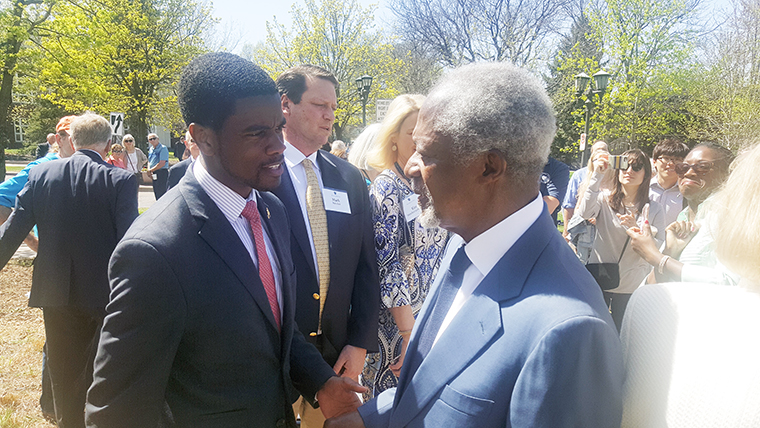
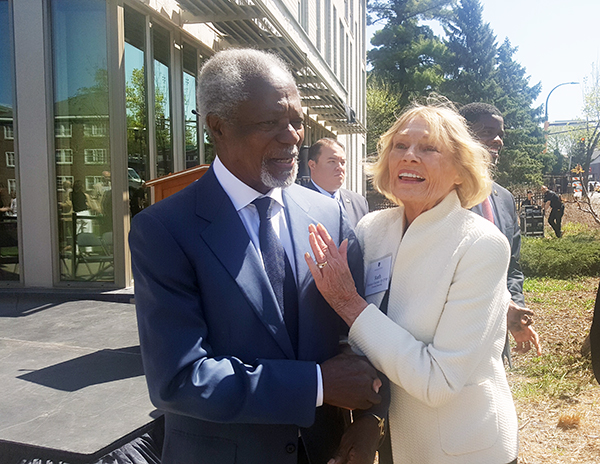
Saint Paul Mayor Melvin Carter speaking with former UN secretary-general Kofi Annan moments after Macalester College of St. Paul, Minnesota renamed its Global Institute in Mr. Annan's honor on Monday, May 7 2018. Mr. Annan is an alumnus of the college. Photo: Tom Gitaa/Mshale
Saint Paul Mayor Melvin Carter speaking with former UN secretary-general Kofi Annan moments after Macalester College of St. Paul, Minnesota renamed its Global Institute in Mr. Annan's honor on Monday, May 7 2018. Mr. Annan is an alumnus of the college. Photo: Tom Gitaa/Mshale
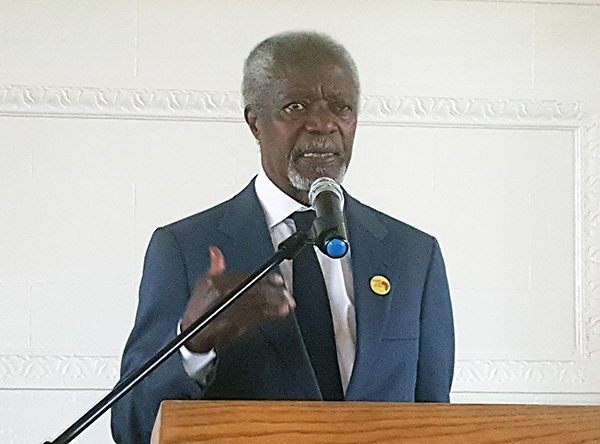
Nobel laureate and former United Nations secretary-general, Kofi Annan, said on Monday the world is squandering the potential of African children by not giving them access to education.
“Despite significant progress in recent years millions of African children have never set foot in a classroom or owned a book of their own in their lives,” said Annan.
Annan, co-chair of the Books for Africa Law and Democracy Initiative alongside former US vice-president Walter Mondale, was speaking during a reception to mark the 30th anniversary of Books for Africa, the St. Paul non-profit that ships millions of donated school textbooks to the continent.
Nobel laureate and former UN secretary-general, Kofi Annan, speaking at the Books for Africa 30th anniversary reception at the University Club in Saint Paul, Minnesota on Monday, May 7, 2018. Photo: Tom Gitaa/Mshale
“Numerous studies have shown that no development tool is more effective than education and literacy,” Annan said. “When people are able to access education, they can break free of the cycle of poverty and contribute to building a fairer and more peaceful society.”
Annan said the ongoing literacy crisis in Africa is a source of great concern, as the children who are not attending school are the future doctors and teachers that the continent will miss.
While commending Books for Africa for the progress it has made in the last 30 years in sending books to address, he nonetheless urged the organization and its supporters to “redouble their efforts.”
“One area of particular importance to Africa and the world is the strengthening of the rule of law,” Annan said, as he made the case about the significance of Books for Africa’s Law and Democracy Initiative, which sends new law books to law schools in Africa. Thomson Reuters provides the Law and Democracy Initiative with new law books and that company’s vice-president for Government Affairs, former Minneapolis mayor Sharon Sayles Belton was on hand to reiterate Thomson Reuters continued support.
Saint Paul Mayor Melvin Carter speaking with former UN secretary-general Kofi Annan moments after Macalester College of St. Paul, Minnesota renamed its Global Institute in Mr. Annan’s honor on Monday, May 7 2018. Mr. Annan is an alumnus of the college. Photo: Tom Gitaa/Mshale
Annan said his conviction about the rule of law being the pillar to security has grown stronger since he founded the Kofi Annan Foundation.
“No society can prosper without the rule of law and respect for human rights,” Annan went on to say.
The Jack Mason Law and Democracy Initiative is named after former US federal judge Jack Mason who was also a Books for Africa board member. His wife, Vivian, was present as Annan addressed the 30th anniversary reception. Also, present were former US vice-president Walter Mondale who co-chairs the initiative with Annan. Nane Annan, Kofi Annan’s wife, accompanied him to the celebration.
“Numerous organizations have benefitted from it including Women Lawyers Association of Gambia, Zambia Lawyers for Human Rights and the parliament of Liberia,” said Annan.
One of those inspired by Mr. Annan’s many years of global service is Jote Taddese, president of the Books for Africa board of directors. A native of Ethiopia, Taddese said he was graduating college in the US in 1997 when “I learnt a great African diplomat had been elected UN secretary-general.”
Kofi Annan Institute for Global Citizenship
Earlier in the day, Mr. Annan, was the focus of a historical development at his alma mater, Macalester College when that institution renamed the Institute for Global Citizenship to the Kofi Annan
Institute for Global Citizenship in his honor. The institute faces Grand Avenue and is on the intersection of the busy and historical Grand and Snelling
Ruth Stricker Dayton, a Macalester College patron shares a laugh with former UN secretary-general Kofi Annan moments after the college renamed its Global Institute in Mr. Annan’s honor on Monday, May 7 2018. Mr. Annan is an alumnus of the college. Photo: Tom Gitaa/Mshale
avenues.
At the dedication, Annan sat next to another historical figure in his own right. Saint Paul Mayor Melvin Carter was born and grew up within walking distance of Macalester and could not hide his joy of having the opportunity to sit next to Mr. Annan and made sure everyone knew it.
“I am honored to just be sitting next to you and I wanted to make sure my staff got a picture of us sitting next to each other,” Mayor Carter said to loud laughter. Carter became St. Paul’s first black mayor when he worn in a convincing fashion last November.
Macalester President Brian Rosenberg called Mr. Annan a role model for everyone. He referred to him as the most “visible and courageous” UN secretary-general of our time that has inspired many.
“It is one of Macalester’s great privilege to claim Kofi Annan as one of our graduates, and Macalester’s great privilege to rename and rededicate the Institute for Global Citizenship, as the Kofi Annan Institute for Global Citizenship,” Rosenberg said to loud applause. He and added that, henceforth “I don’t know about everyone but I will just be calling it The Annan Institute.”
Speaking before the unveiling of the institute’s new name, Annan told students not to be afraid to lead and not to hesitate, as “one is never too young to lead.”
Annan was part of the class of 1961 at Macalester College.
United States Citizenship and Immigration Services has issued new rules on F-1 students after they graduate. Photo: Courtesy of World Education Services
United States Citizenship and Immigration Services has issued new rules on F-1 students after they graduate. Photo: Courtesy of World Education ServicesUnited States Citizenship and Immigration Services has issued new rules on F-1 students after they graduate. Photo: Courtesy of World Education Services
A new revision by the United States Citizenship and Immigration Services (USCIS) is expected to dampen international students’ prospects of getting a job in the US after graduating.
USCIS has reinterpreted the science, technology, engineering and mathematics (STEM) Optional Training (OPT) extension rule to require that these STEM graduates be placed inhouse at their employer’s worksite only, law firm Lewis Rice LLC wrote in Lexology. Third-party employment placements are no longer allowed.
This “significant change” applies to the 24-month extension of post-completion OPT international students in STEM courses are eligible for after graduating.
“USCIS has now essentially prohibited off-site placement. The student’s training experience must take place on-site at the employer’s place of business or worksite(s), where US Immigration and Customs Enforcement (ICE) has authority to conduct employer site visits to ensure that the employer is meeting program requirements,” Lewis Rice LLC wrote.
International students on F-1 study visas are allowed to work in the US for 12 months under the OPT program. Those with STEM degrees from Student and Exchange Visitor Program (SEVP)-certified and accredited US colleges and universities are eligible for a further 24-month OPT extension.
USCIS guidelines state that “The employer’s training obligations” must now take place “onsite at the employer’s place of business or worksites to which US Immigration and Customs Enforcement (ICE) has authority to conduct site visits to ensure the OPT requirements are being met”.
“The training experience may not take place at the place of business or worksite of the employer’s clients or customers because ICE would lack authority to visit such sites.”
Remote work will now be prohibited too: “The employer may not fulfill its training obligation to provide a structured and guided work-based learning experience by having the student make periodic visits to the employer’s place of business to receive training, while the student is actually working at the place of business or worksite of a client or customer of the employer. For the same reason, online or distance learning arrangements may not be used to fulfill the employer’s training obligation to the student.”