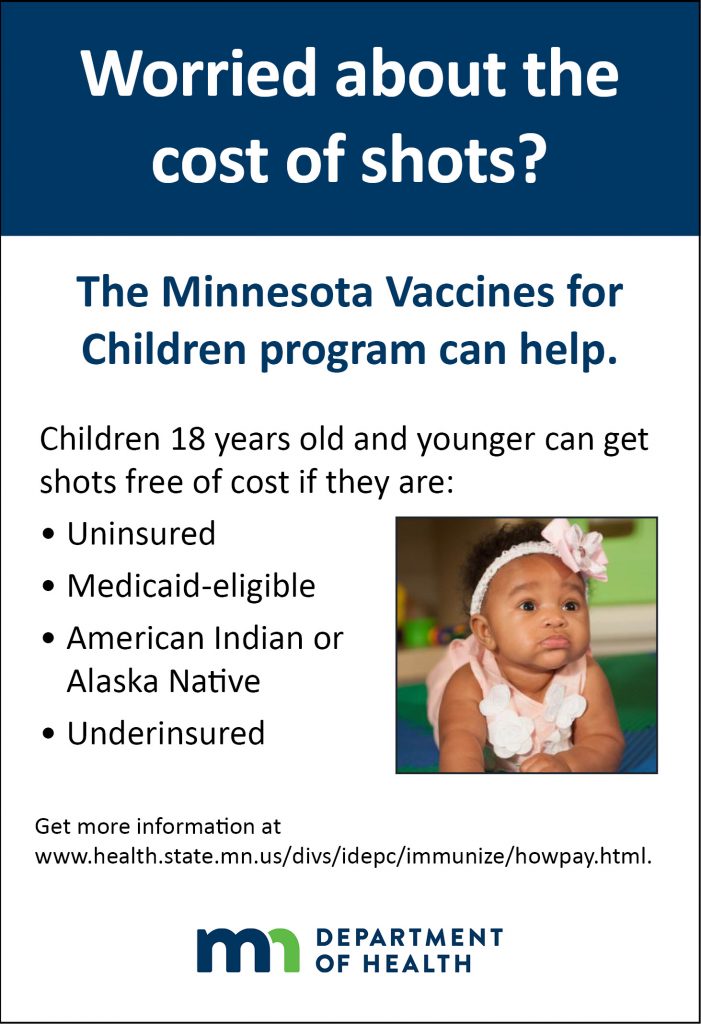
Your child may qualify for free or low cost vaccines through the Minnesota Vaccines for Children program.
Your child may qualify for free or low cost vaccines through the Minnesota Vaccines for Children program.Your child may qualify for free or low cost vaccines through the Minnesota Vaccines for Children program.
Parents with young children have many things happening in their life. They want to do what is best for their child and make sure they stay healthy. However, sometimes that can be difficult.
For example, we hear about situations like this often. A mother of a 2-month-old child has a checkup scheduled with the doctor before her child starts child care. At this appointment, the doctor mentions the recommended vaccines her child should get. She knows that getting her child vaccinated is an important thing to do to protect them from dangerous diseases, but she does not have medical insurance. Vaccines can be expensive, so the mother is worried she will not be able to afford them. She asks her child’s doctor if there is anything she can do. The doctor tells her about the Minnesota Vaccines for Children program.
Through the Minnesota Vaccines for Children program, children 18 years old and younger who do not have medical insurance, are enrolled in Medicaid, are Native American or Alaska Native, or whose insurance doesn’t cover the cost of the vaccine can receive all recommended vaccines free of cost.
The Minnesota Vaccines for Children program helps make sure children can get all recommended vaccines at the right time by not letting the cost of vaccines stop a parent from vaccinating. Delaying or skipping vaccines can put children at risk for diseases that can cause serious health problems. Children who are behind on their shots can get caught up, but it is best to get vaccines at the recommended age to help protect the child when they need it most.
By age 2, children can be protected from 14 diseases if they get all of the recommended vaccines. Getting vaccinated protects your child and others in the community so disease does not spread.
Vaccinating your child is one of the most loving things you can do. Diseases that used to be common in the United States are rarely seen. That is because vaccines work and vaccines are safe.
Almost all clinics that see children in Minnesota participate in the Minnesota Vaccines for Children program. Ask your clinic if they participate in the Minnesota Vaccines for Children program and if your child can get vaccines free of cost. There are other fees you may still have to pay when you go to the doctor for the vaccines. You can call your clinic to ask if there are other fees before your visit.
If you are looking for more information about vaccines and the diseases they prevent, look at the Vaccine Information Sheets on this website: www.immunize.org/VIS. They are available in many languages.
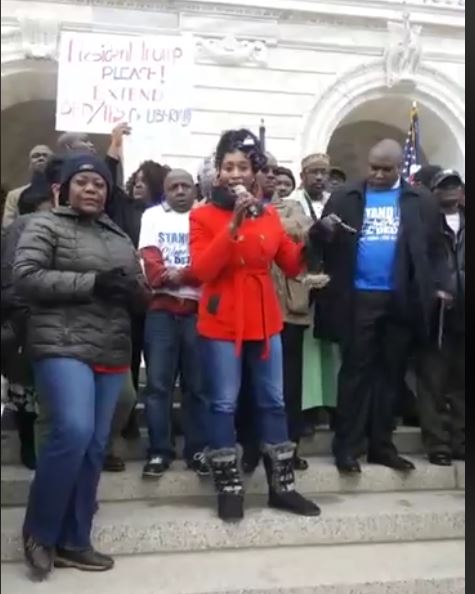
Liberians rally at the Minnesota State Capitol in support of the extension of Deferred Enforcement Departure (DED) for Liberians on Monday, March 26, 2018. DED was set to expire on March 31, 2018. President Trump in a memo today (March 27, 2018) has given a 12-montb wind-down extension of DED through March 31, 2019 when it will be terminated. Photo: Tom Gitaa/Mshale
Liberians rally at the Minnesota State Capitol in support of the extension of Deferred Enforcement Departure (DED) for Liberians on Monday, March 26, 2018. DED was set to expire on March 31, 2018. President Trump in a memo today (March 27, 2018) has given a 12-montb wind-down extension of DED through March 31, 2019 when it will be terminated. Photo: Tom Gitaa/Mshale
President Trump today gave Liberians under the Deferred Enforced Departure (DED) some breathing room through March 31, 2019. Their DED status that president Obama extended for 18 months as he was about to leave office in 2016 was set to expire on March 31, 2018. Liberians nationally and locally under the direction of groups such as African Immigrant Services (AIS) and Acer have mobilized and have lobbied their legislators and the White House to extend DED.
The DED breather comes less than 24 hours after Liberians in Minnesota held a rally at the State Capitol in support of a DED extension that hundreds attended.
In a Presidential Memoranda to the Secretaries of State and Homeland Security, Trump said that the situation in Liberia does not warrant an extension of DED but that “the foreign policy interests of the United States warrant affording an orderly transition (“wind-down”) period to Liberian DED beneficiaries.”
The presidential memo went on to say that, the 12-month period will give the government of Liberia time to reintegrate those returning from the United States and “to allow DED beneficiaries who are not eligible for other forms of immigration relief to make necessary arrangements and to depart the United States.”
According to the presidential memo, the 12-month wind-down period shall apply to any current Liberian DED beneficiary as well as any employment authorization.
Come March 31, 2019, Liberians under DED will be in the same situation and will face a risk of deportation unless they have received another form of immigration relief. For now however, they can breathe a sigh of relief.
Spotify is launching its services in South Africa.
Spotify is launching its services in South Africa.Spotify is launching its services in South Africa.
The music streaming company Spotify has launched in South Africa, its first entry into Africa.
The company is making its services available at a time when smartphone use is becoming more widespread.
Spotify now operates in over 60 countries and is the most popular streaming service in the world.
The Swedish company was founded in 2008. The launch in South Africa comes as the organization anticipates a direct listing of its shares on the New York Stock Exchange.
Spotify has 159 million monthly active users and 35 million songs on its platform.
Will South Africa tune in?
“Africa as a continent is the origin of music, ” Claudius Boller, the Managing Director for The Middle East and Africa, told CNN. “We are really excited to be launching in South Africa now.”
Apple Music and a couple of other local music streaming services are already operating in South Africa.
Spotify plans to make a musical offering bespoke for the country. “We are working with an absolutely brilliant team of local music curators,” Boller said.
Musicians and songwriters have previously criticized Spotify for being unfairly compensated. Boller responded, “Spotify globally really wants to help artists live off their art.”
he United States Citizenship and Immigration Services announced on Tuesday, March 20, 2018 that it will temporarily suspend fast processing for H-1B visa applications from for-profit companies until Sept. 10.
he United States Citizenship and Immigration Services announced on Tuesday, March 20, 2018 that it will temporarily suspend fast processing for H-1B visa applications from for-profit companies until Sept. 10.he United States Citizenship and Immigration Services announced on Tuesday, March 20, 2018 that it will temporarily suspend fast processing for H-1B visa applications from for-profit companies until Sept. 10.
The United States Citizenship and Immigration Services announced Tuesday that it will temporarily suspend fast processing for H-1B visa applications from for-profit companies until Sept. 10.
This means the agency will not accept any H-1B applications requesting “premium processing,” under which a company can pay a fee to learn in 15 days if the foreigner it would like to employ will be granted an H-1B visa or not. This suspension only applies to H-1B applications from for-profit companies, which are subject to an annual cap of 85,000 visas.
The agency will continue to accept premium processing applications for organizations not subject to the cap, such as nonprofits and research institutions.
This move comes just a few weeks before the agency will begin accepting H-1B applications for fiscal year 2019.
The agency said this temporary suspension will help it reduce overall H-1B processing times, which can take months at a time due to the high volume of petitions it receives each year.
Premium processing was also suspended for several months last year, which impacted some employers in Silicon Valley that rely on rapid processing. Tech companies sometimes hold off on projects or other ventures until they know whether they will have enough engineers to execute them.
Miguna Miguna of Kenya, speaking in the suburb of Brooklyn Park, Minnesota on Saturday, March 17, 2018. Photo: Tom Gitaa/Mshale
Miguna Miguna of Kenya, speaking in the suburb of Brooklyn Park, Minnesota on Saturday, March 17, 2018. Photo: Tom Gitaa/MshaleMiguna Miguna of Kenya, speaking in the suburb of Brooklyn Park, Minnesota on Saturday, March 17, 2018. Photo: Tom Gitaa/Mshale
BROOKLYN PARK, Minn. – A Miguna Miguna diaspora forum in Minnesota veered into unexpected territory last weekend for those unfamiliar with his non-public persona: conciliatory remarks. Or what would pass for conciliation for the mercurial Miguna.
Miguna holds both Canadian and Kenyan citizenship and was ‘deported’ by the regime in power after he presided over the swearing in of Raila Odinga as the ‘people’s president.’ A Kenyan court has since ordered the government to allow him back into Kenya without any interference. His ‘deportation’ became a cause celebre in the large Kenya diaspora many who also have dual citizenship, especially in North America.
All week the self-proclaimed general of the National Resistance Movement had been battling perceptions of irrelevancy following the ‘handshake’ between Kenyan president Uhuru Kenyatta and his erstwhile opponent Raila Odinga; the undisputed father of modern day opposition politics.
Even before Miguna took the stage on Saturday in the ‘African suburb’ of Brooklyn Park, the chairperson of the Minnesota chapter of the National Super Alliance (NASA), John Makori, cryptically endorsed the handshake, even as he demurred on its significance was to those seeking electoral justice in Kenya. Makori’s remarks at the meeting exemplified the conflicted views towards the ‘handshake’ that the US Kenya diaspora has.
A week before his Minnesota appearance Miguna angered die-hard supporters of Raila Odinga. His critical remarks in Texas, delivered a day after the handshake, seemed oblivious to the fact that most Raila Odinga supporters, by most accounts, had decided to give “Baba”, as Odinga is affectionately referred to, the benefit of the doubt.
During a 62-minute address in Minnesota, Miguna spoke about the Uhuru-Raila ‘handshake’ and expressly called it a surrender by the doyen of opposition politics and went on to explain why. He did not call it a sellout by Odinga in the fashion that he did in Texas but his remarks were just as biting in the characteristic Miguna fashion.
“One side has the army, has the air force, the navy, the police, the national intelligence, the treasury and you have nothing and then you tell your supporters ‘demobilize’ give up your arms to my enemies, we have surrendered and you tell me you have leverage?” Miguna asked rhetorically. He asked aloud how Odinga was going to ensure sure Uhuru adheres to whatever the two agreed to after the latter “had killed your supporters, maimed them, and stole your elections.”
Miguna said it was noteworthy that terms of what Raila Odinga and Uhuru Kenyatta agreed was not public and cautioned that Kenyatta cannot be trusted.
Miguna told Minnesota Kenyans that NRM is a political movement and not a political party. Its primary purpose was not to contest elections and thus was equipped to take on the quest for electoral justice that Odinga has now seemingly abandoned.
“NRM was formed after we realized that following the fraudulent August 8 2017 elections that a system has been put in place in Kenya today and institutionalized, that has made credible and verifiable elections impossible,” Miguna said.
He described Kenya’s discredited Independent Electoral Boundaries Commission (IEBC) as an appendage of the ruling Jubilee party and its chairman, Wafula Chebukati as “Uhuru’s errand boy” who goes to the president’s office like a lamb to take and execute instructions. As for the IEBC’s CEO, Ezra Chiloba, Miguna described him as someone who reports to the Interior ministry instead of to the IEBC Commissioners as required.
Miguna urged the Kenyan diaspora to contribute funds to towards the NRM cause for electoral justice.
“We need money and I am not ashamed to say so,” Miguna said. He outlined the progress towards democracy in Kenya starting in the 80s and 90s that ended one party rule in the country that ultimately gave it the much heralded 2010 constitution that the “the rogue regime” in power was determined to undermine and return to the days of one party rule.
Quoting Frederick Douglass, the American social reformer and abolitionist, Miguna said, “if you want rain you have to be prepared for thunder; if you want water for your crops you have to be prepared for the storms; no one will give you power because you are a good beggar, or you are nice, as power is never given, even democratic power.”
It was however not just fire and brimstone from Miguna. He likened NRM to Umkhonto we Sizwe (Spear of the Nation), the armed wing of Nelson Mandela’s African National Congress (ANC).
“Umkhonto we Sizwe did not give up arms when Mandela was released but until he was sworn in, that is what gave them (ANC) power, it wasn’t the English, the foreign diplomats, it was the Spear of the Nation, same thing with the Sinn Féin,” Miguna thundered as he neared the end of his wide-ranging address.
He said Mandela resisted repeated calls to renounce Umkhonto we Sizwe.
“Have you heard Raila say anything against NRM?” Miguna asked. He said Odinga called him before meeting with Kenyatta for the ‘handshake’ and he did not try to dissuade him from going to State House, just like “he (Odinga) has not stopped me from leading NRM.”
Miguna told the Minnesota meeting to bear in mind that Odinga is 73 and should not be expected to fight alone as the fight for electoral justice should be waged from multiple fronts. A point that found ready agreement from Ben Muko, a Kenyan-American candidate for City Council in Brooklyn Park (West Ward) who is skeptical of the ‘handshake’.
“I like Raila (Odinga) but the fight has to continue,” Muko said afterwards.
Miguna also confirmed that his going back to Kenya on March 26 is still on and said he was not afraid for his life “as my brain and God are my protection.”
In a March 9 YouTube post, Miguna said upon his return there will be a “Lunga Lunga dance of liberation” without elaborating. Lunga Lunga is a border post town at the southeast border between Kenya and Tanzania. The latter is the country Miguna fled through in 1988 on his way to exile in Canada during the autocratic Daniel Arap Moi presidency. Miguna had been detained for his political activism while a student at the University of Nairobi. Upon his release, he fled the country fearing for his life. At the Minnesota meeting, Miguna was clear that he is a changed man and he no longer fears for his life as he seeks electoral justice for Kenyans.
At the conclusion of his remarks, supporters posed for photos with him for $10 as a fundraiser for the NRM and to offset costs of the Minnesota event.
Immigration Alert: Community Meeting for Liberians as DED and TPS about to end
Deferred Enforced Departure (DED) for Liberians which was extended in September of 2016 by President Obama for Liberians for an additional 18 months expires in two weeks from today, on March 31, 2018. Given the immigration climate under president Trump, not many expect DED to be extended by his administration.
The Organization of Liberians in Minnesota (OLM) is hosting a “Community Talk About Immigration” at the Liberian Community Center on Friday, March 16 at 5pm. The organization, working with The Advocates for Human Rights and the Minnesota Volunteers Lawyers Network will have lawyers available to talk about Deferred Enforced Departure (DED) and Temporary Protected Status (TPS) and other immigration issues.
Last month, African immigrants from Minnesota were part of a demonstration and lobbying in Washington by black leaders from around the nation to demand a permanent solution for those under DED and TPS, as well as passage of the Dream Act.
Immigrants from Haiti, Guinea, Liberia, Sierra Leone, Sudan, South Sudan and Somalia have a combined 70,000 of their people under DED and TPS.
What: Community Immigration Meeting on TPS and DED
When: Friday, March 16, 2018 @ 5PM
Where: Liberian Community Center, 7001 78th Ave. N., Brooklyn Park, MN 55443
Contact: 612-251-2139, 612-872-8237 or 612-703-6003
Miguna Miguna, Kenyan opposition figure, will speak to Kenyans in Minnesota on Saturday, March 17, 2018. Photo: Courtesy of Citizen TV Kenya
Miguna Miguna, Kenyan opposition figure, will speak to Kenyans in Minnesota on Saturday, March 17, 2018. Photo: Courtesy of Citizen TV KenyaMiguna Miguna, Kenyan opposition figure, will speak to Kenyans in Minnesota on Saturday, March 17, 2018. Photo: Courtesy of Citizen TV Kenya
Miguna Miguna, a Kenyan opposition figure is scheduled to give an address to Kenyans in Minnesota on Saturday, March 17 at the City of Brooklyn Park Community Center. The event starts at 4pm with the official program expected to commence at 5pm, organizers told Mshale.
Miguna who holds dual Canadian and Kenyan citizenship was ‘deported’ to Canada by the regime in power in his birthplace of Kenya after he was held in detention for four days for officiating the swearing in of opposition leader Raila Odinga as the “People’s president”. Following a court order to produce him in court, government authorities defied the order and dramatically ‘deported’ him to Canada. He has been on a tour to meet with the Kenyan diaspora and has so far spoken in New Jersey, Washington DC, and Texas.
His visit was planned before last week’s major political event in Kenya where president Uhuru Kenyatta and his erstwhile opponent Raila Odinga announced a Memorandum of Understanding (MoU) to work together, a development Miguna has termed a sellout by Odinga. Kenyatta has been governing under a cloud of illegitimacy since the October 26 elections last year that the main opposition led by Odinga boycotted. Last week’s MoU development came a day after country’s finance minister said in parliament that the country was broke and cannot fund its development projects. The IMF issued a warning last month that the country’s debt levels was approaching “unsustainable levels.” Moody’s has forecast that government debt in East Africa’s largest economy will increase to 61 per cent of GDP in the 2018/19 financial year from 56 per cent in 2016/17 and 41 per cent in 2011/12.
Miguna’s visit to Minnesota will be watched closely as it will be the first public event he will address since the Uhuru-Odinga MoU. His ‘deportation’ has sparked renewed interest in the dual citizenship clause in Kenya’s constitution by its citizens in the diaspora who like Miguna have dual citizenship.
John Makori, chairman of the Minnesota chapter of NASA which is hosting Miguna said they look forward to hearing from him “on the changed landscape” referring to the MoU between Kenyatta and Odinga.
What: Miguna Miguna in Minnesota When: Saturday, March 17, 2018 Time: 4PM-10PM (formal program starts at 5PM) Where: Brooklyn Park Community Center, 5600 85th Ave N, Brooklyn Park, MN 55443
ALERTS: Subscribe to text alerts from Mshale on any late developments to this event: Text KENYA to 24587.
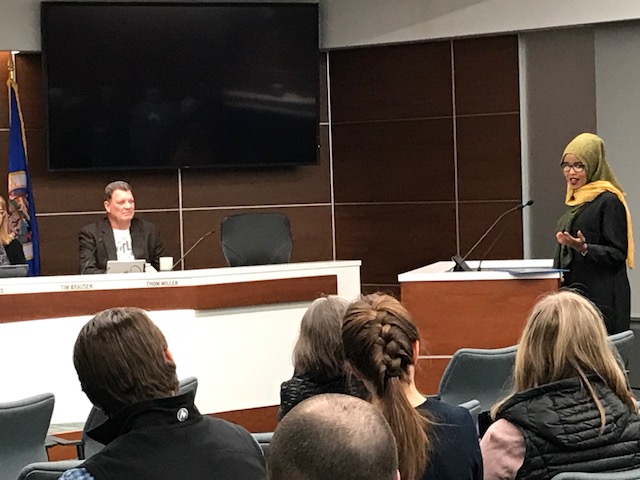
Fatuma Irshat accepting the City of St. Louis Park Human Rights Award on Monday March 5, 2018. Photo: Courtesy City of St. Louis Park
Fatuma Irshat accepting the City of St. Louis Park Human Rights Award on Monday March 5, 2018. Photo: Courtesy City of St. Louis Park Fatuma Irshat accepting the City of St. Louis Park Human Rights Award on Monday March 5, 2018. Photo: Courtesy City of St. Louis Park
The City of St. Louis Park’s Human Rights Commission has awarded its 2017 Human Rights Award to Fatuma Irshat. She received the award during the City Council meeting on March 5. St. Louis Park is a first-ring suburb of Minneapolis bordering Uptown.
The award was in recognition of Irshat’s engagement work with the African immigrant community and especially Somalis where she has taken it upon herself to drive neighbors to vote with her “Vote Local” initiative while providing childcare to enable parents to vote.
Prominent in local issues, in addition to voter engagement, her work also includes affordable housing issues and renters’ rights.
The city’s Human Rights Award, facilitated through its Human Rights Commission, recognizes individuals, groups, organizations or businesses that have made an outstanding contribution toward increasing understanding and cooperation between people of different backgrounds in St. Louis Park.
The St. Louis Park Human Rights Commission advises the city council on how to ensure equal opportunity and participation in housing, employment, public service, public accommodations and education.
In a brief acceptance (which you can watch below at the 7:10 mark), an emotional Irshat thanked the city for the award and those who have supported her in her engagement efforts. City Council members also made remarks about the award and Irshat’s inspirational work.
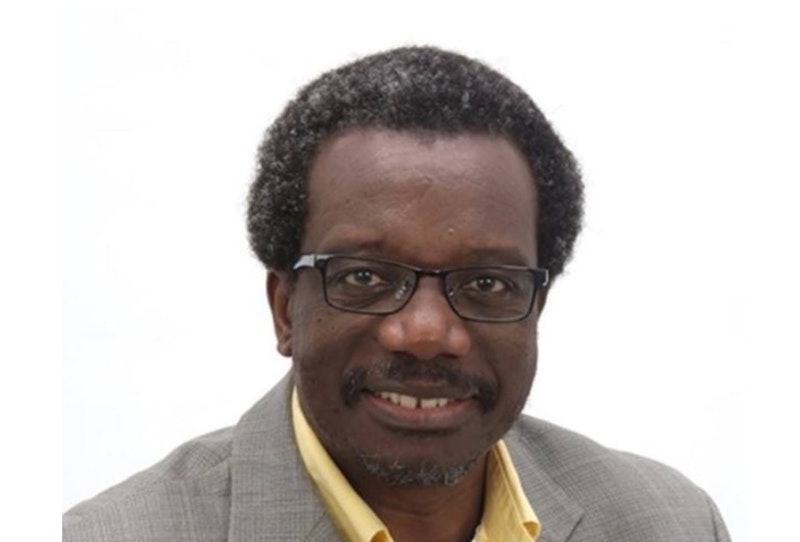
Mzenga Wanyama, a tenured professor at Augsburg University in Minneapolis faces deportation. Photo: Courtesy
Mzenga Wanyama, a tenured professor at Augsburg University in Minneapolis faces deportation. Photo: CourtesyMzenga Wanyama, a tenured professor at Augsburg University in Minneapolis faces deportation. Photo: Courtesy
Nearly 46 million people tuned in to Donald Trump’s State of the Union in January, when he announced his vision for “merit-based” immigration reform, a system that would welcome only the most educated, wealthy, and English-fluent people from around the world.
Does that mean tenured English professors are in the clear? Evidently not.
Augsburg University’s Dr. Mzenga Wanyama, a Kenyan-born graduate of the University of Minnesota who now teaches post-colonial theory and African American literature, has just been asked to attend a meeting Friday morning at the ICE office in St. Paul to discuss his immigration status and “plans for removal.”
Wanyama arrived in the United States in 1992, at a time when Kenya’s transformation from a one-party state into a multiparty system provoked ethnic violence. Thousands were murdered and many more displaced.
After his wife and two children joined him in America, Wanyama began to write articles for a popular Kenyan newspaper criticizing the government and praising primary opposition leader Raila Odinga, who lost a bid for the presidency last summer in an election that also erupted in violent clashes over accusations of election fraud.
Later Wanyama applied for asylum, claiming the Kenyan government had retaliated against his family members in Kenya, harassing his mother about his whereabouts and firing his brother from his job in a public development corporation. In 2009, an immigration judge ruled that although Wanyama had reason to have feared persecution, what he suffered really wasn’t as bad as what other refugees experienced. (Prior court rulings had found that isolated attacks on family members isn’t always enough to admit an asylum applicant, if he himself hasn’t been sufficiently tortured.)
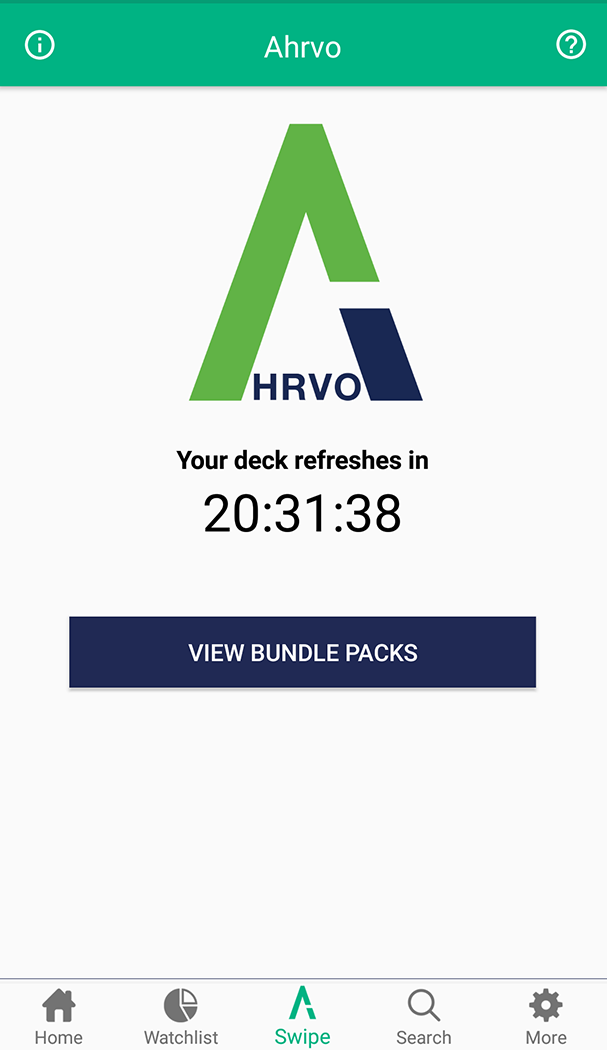
A screenshot of Ahrvo, the investment app invented by Nigerian-American Appo Agbamu of Minneapolis. Photo: Google Play Store Screen Grab
A screenshot of Ahrvo, the investment app invented by Nigerian-American Appo Agbamu of Minneapolis. Photo: Google Play Store Screen GrabA screenshot of Ahrvo, the investment app invented by Nigerian-American Appo Agbamu of Minneapolis. Photo: Google Play Store Screen Grab
While in college at the University of Minnesota-Duluth, Appo Agbamu was the student director of Bulldog Fund LLC, a student-run $1.2 million hedge fund. Becoming a director at the hedge fund was not an accident. He had developed a passion for the stock market while in high school because of his father, Atare Agbamu, an active trader who provided the younger Agbamu with the investment basics.
It was therefore natural by the time the younger Agbamu showed up in college that a major in finance was almost a given.
A turning point in his future finance career was an internship during his senior year at a small investment firm that used what is called a multi-factor ranking system which enabled the small firm to find ‘high caliber investments.’ The success the small firm was having with the system left a lasting impression on Agbamu.
The multi-factor ranking system at its core is a scoring system on stocks that helps an investor make a better decision on which stock to pick and invest in. When he finished his internship and graduated college, he landed a job as a portfolio associate and real estate analyst at a major bank in Minneapolis.
While working in the high rolling world of finance and mixing it up with high net worth clients, Agbamu found his true passion was in helping small investors and individuals make successful investment decisions.
“There was just no tool out there, especially for the busy folks and millennials that could help them do that,” Agbamu said during an interview with Mshale.
He set out to develop the tool himself. That tool is in the form of an app, which he called Ahrvo and combines the multi-factor ranking system he was exposed too while in college and artificial intelligence. The artificial intelligence aspect was achieved through a strategic partnership with a colleague in the UK.
Ahrvo became available in January on both iTunes and Google’s Playstore.
“It is actually the first mobile-only investment platform that uses the multi-factor ranking system and artificial intelligence,” he proudly states. The app considers 4,000 companies and updates scores weekly to come up with AhrvoScores so users can make a sound investment decision.
Ahrvo is not only for individual small investors.
“Investment clubs can use it,” said Agbamu. “They will find Ahrvo very useful as it will provide them with the information I know many (investment) clubs look for.”
Agbamu’s parents are from Nigeria. His father, Atare, came to the United States from Nigeria in 1979 to attend college in New York. He returned to Nigeria, got married, came back to New York where he worked in adult education until 1996. He then moved with his wife and children to Minnesota, where he eventually got into the mortgage business while his wife taught in the St. Paul school system.
Does the younger Agbamu see Ahrvo being useful in the emerging markets in Africa?
“Part of the challenge (in Africa) is the quality of data. However, as that data improves I don’t see a reason why Ahrvo cannot be a player in that very important emerging market.”
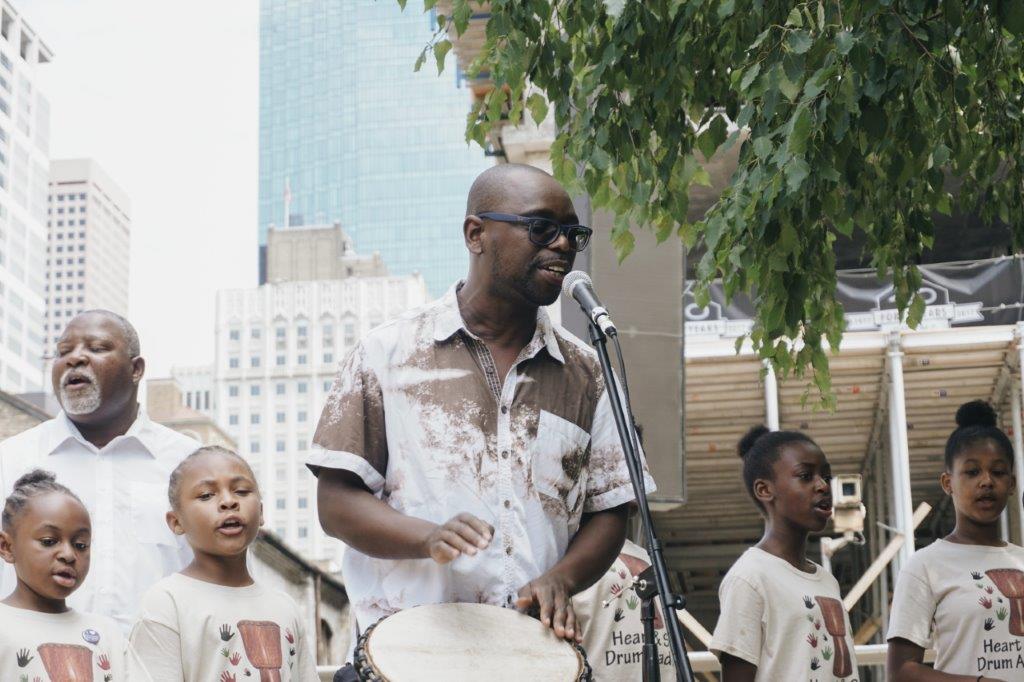
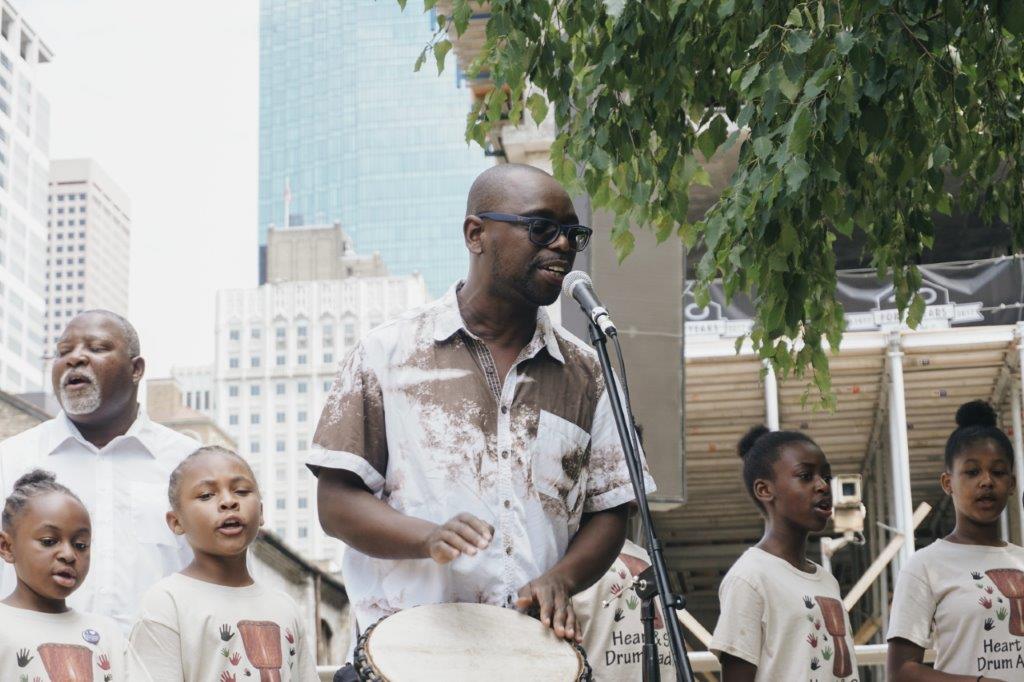
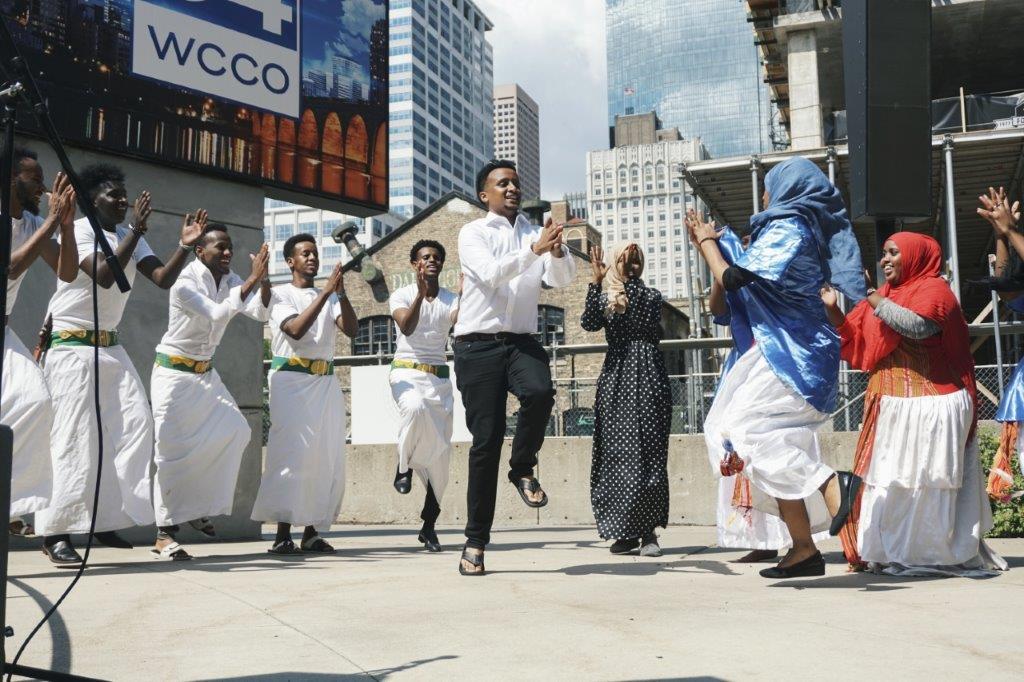
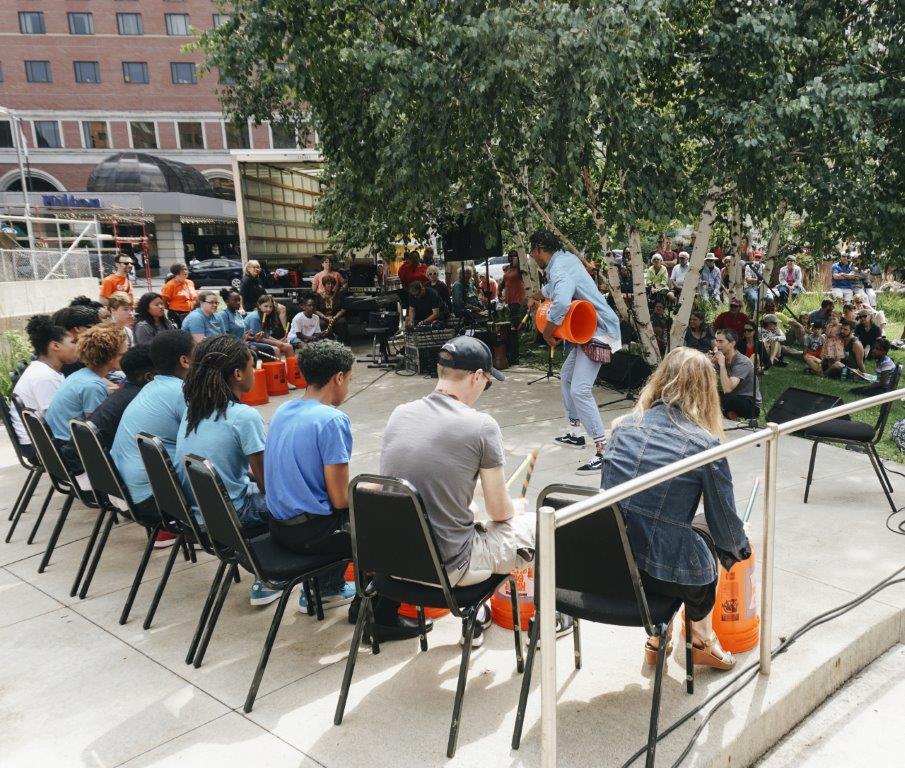
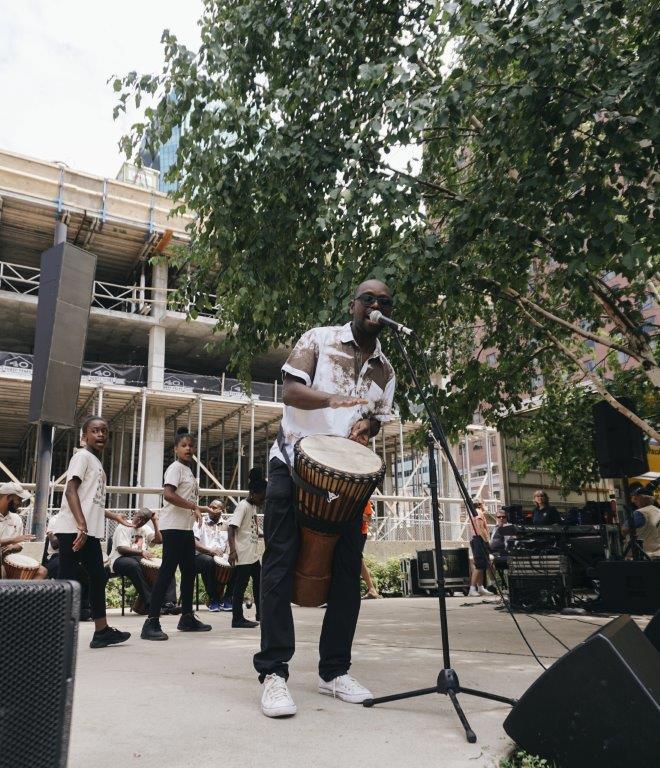
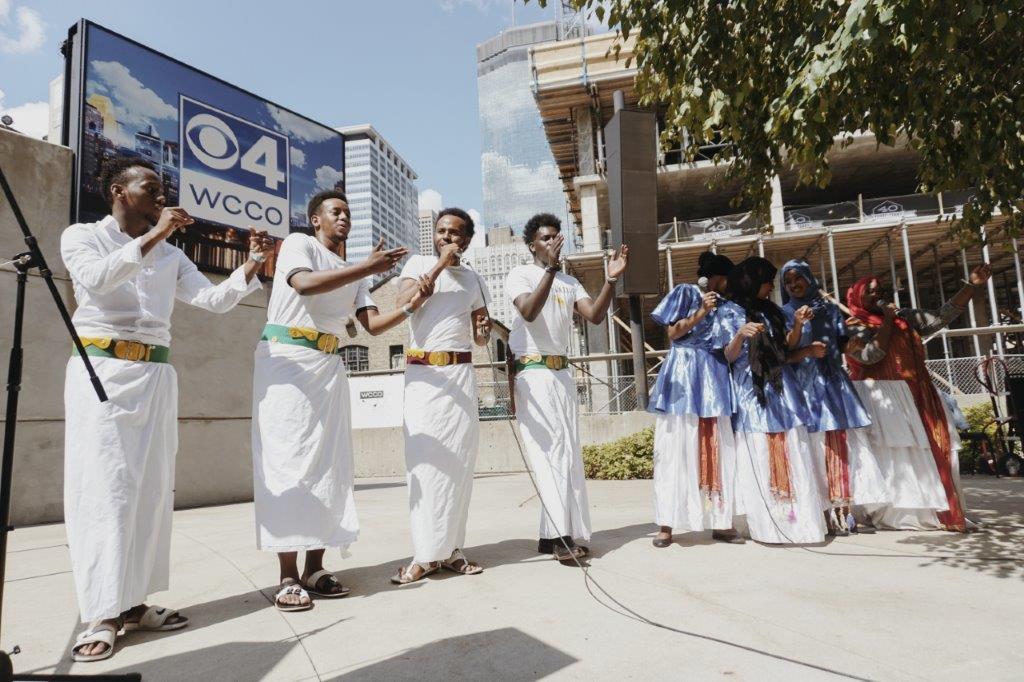
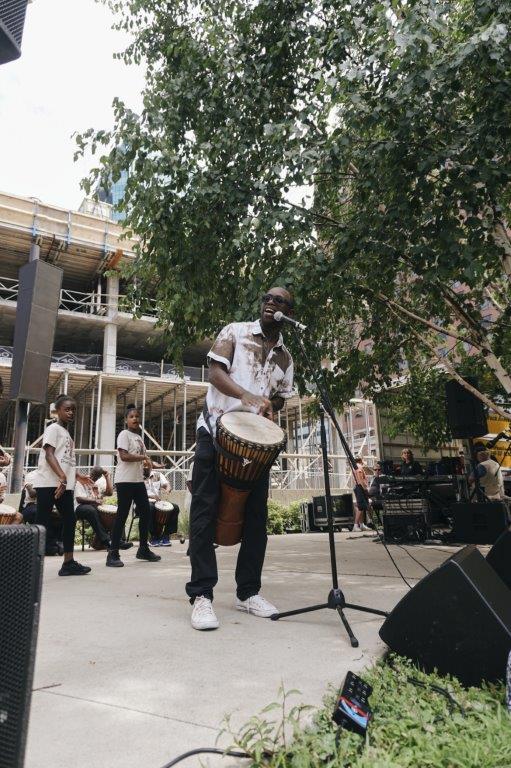
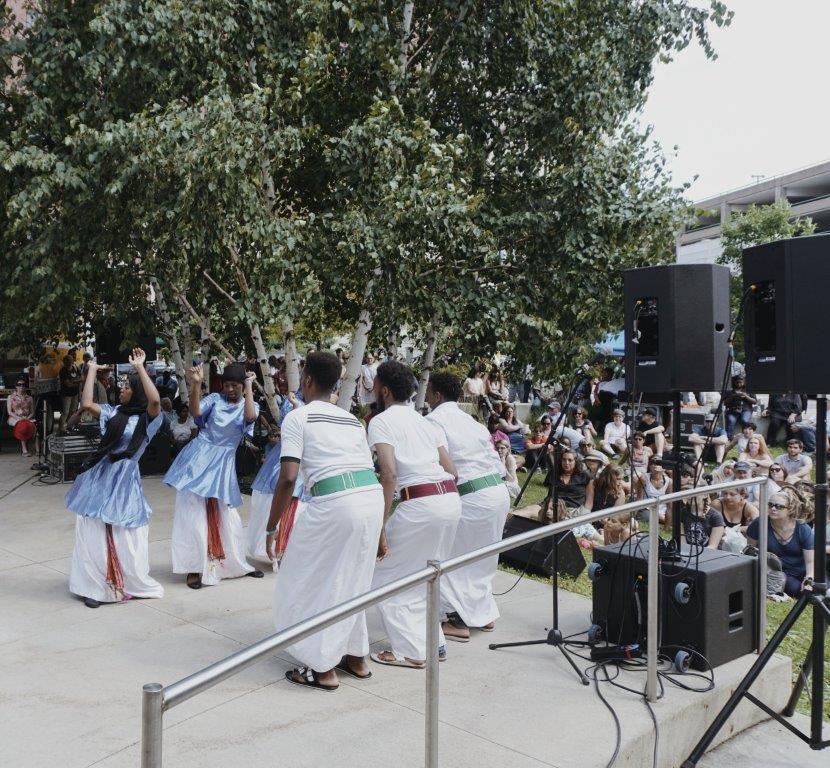
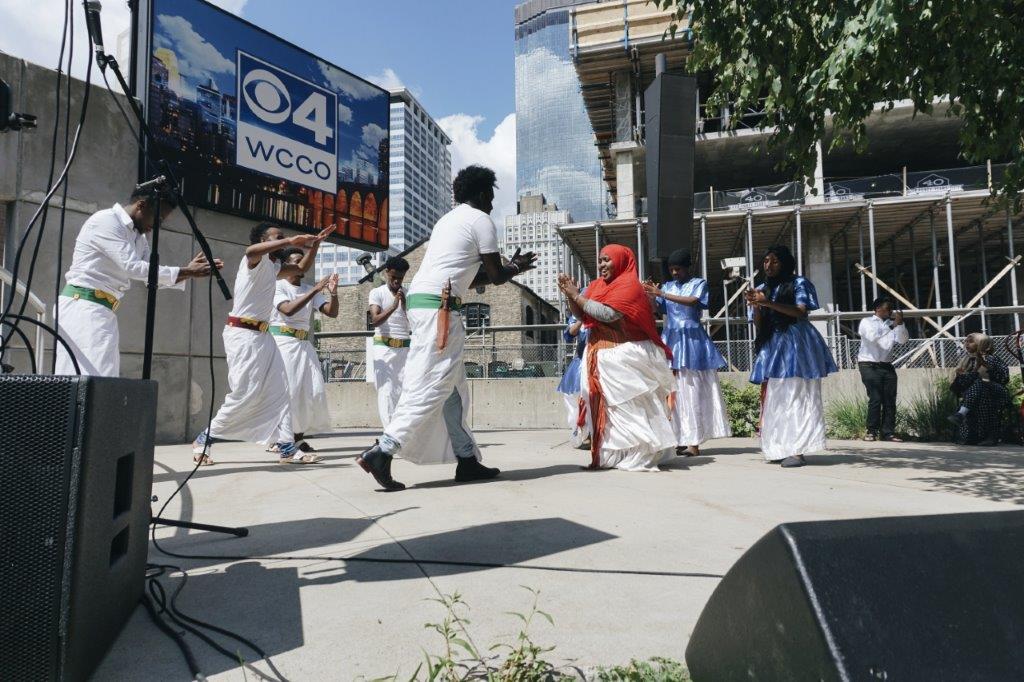
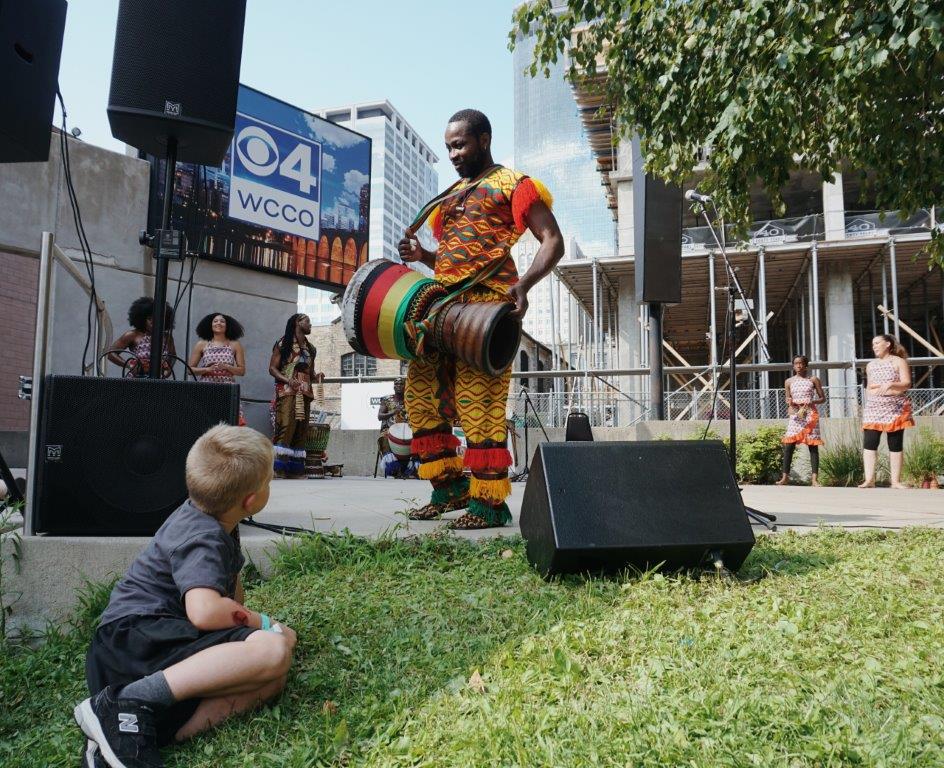
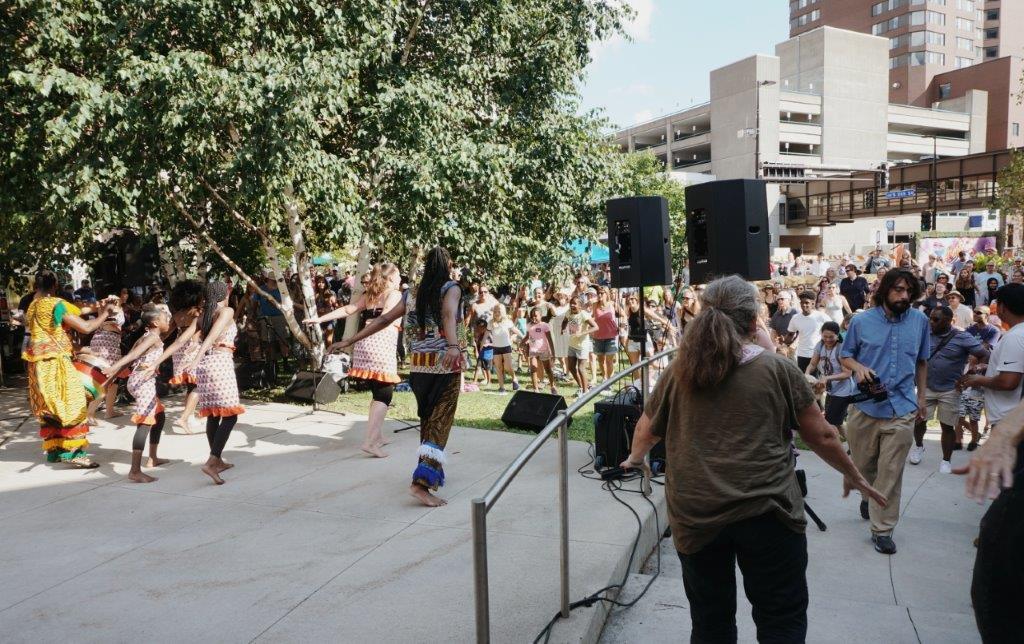
Insingizi performs alongside dancers, drummers, and singers of the Heart & Soul Drum Academy of St. Paul at Sommerfest 2018 held at Orchestra Hall in downtown Minneapolis on Saturday, July 21, 2018 during Music for Mandela. Photo: Bethel Gessesse/Mshale
Insingizi performs alongside dancers, drummers, and singers of the Heart & Soul Drum Academy of St. Paul at Sommerfest 2018 held at Orchestra Hall in downtown Minneapolis on Saturday, July 21, 2018 during Music for Mandela. Photo: Bethel Gessesse/Mshale
The Minnesota Orchestra will have Nelson Mandela as a focus in this year’s Sommerfest festival. It runs July 13 through August 1 at Orchestra Hall in downtown Minneapolis. The Minnesota Orchestra under the leadership of its director Osmo Vanska will follow it with a five-city tour of South Africa. Mandela would have turned 100 this coming July 18.
This year’s Sommerfest includes a partnership between the Orchestra and Books for Africa. Donation spaces will be set up at the Orchestra Hall during the festival to collect books that will be sent to the continent. 20,000 books are expected to be collected.
A news release from the Orchestra said it would be the first professional U.S. orchestra to travel South Africa in this manner.
Insingizi, an a cappella trio from Zimbabwe will also perform as will South African-born composer, musician and cultural activist Bongani Ndodana-Breen who will premier his Harmonia Ubuntu. Ladysmith Black Mambazo will also be on the lineup at Sommerfest 2018. They are currently on their US tour and performed just two weeks ago the Ordway. They will perform on July 31 a day before sendoff party for the Orchestra on August 1. Local Minnesota African acts will soon to be added to the lineup.
Full details on Sommerfest including the lineup and ticket information can be found here.