

Home Blog Page 160

Sunday launch for Kenya Diaspora Development Forum of Minnesota

0
Sunday launch for Kenya Diaspora Development Forum of Minnesota

The Kenya Diaspora Development Forum of Minnesota (KDDF) has scheduled an official launch for this coming Sunday, September 2 at Brookview Park in Golden Valley at 3:00pm. It is one of two groups in the state jostling for effective representation of the large number of Kenyans resident here. The other is the Kenya Diaspora Advisory Council of Minnesota (KDAC), known for its current petition to the Kenya government to make voting possible for the Kenya Diaspora as provided for in the new constitution the country adopted two years ago.

Key KDDF interim officers were originally in KDAC but moved on as interests diverged. Prominent among those who moved on is KDDF’s Secretary, Benson Metho, who takes exception to community perceptions of competition between the two groups. He prefers to see KDDF as “as a new avenue for the pursuit and realization of the Kenyan communities cherished values, ideals and aspirations.”

A slick KDDF flyer sent to Mshale proclaims “A Great Outdoor Family Season Ender” as part of the launch and invites families to come out for a “fun-filled day” to celebrate “Community Progress”. A free barbeque and jumping castles for the kids is planned.

The launch event’s theme is “Building a Progressive Diaspora Community”.

A press release the group sent to Mshale indicates that the launch will also feature the presentation of Community Service Awards to Kenyan community organizations and individuals that “have performed exemplary roles and made a significant contribution to the social and economic experience of the Kenyan community in Minnesota.” The launch event coordinator, Cyrus Keriago, said the service awards are meant to demonstrate the group’s commitment to “community progress.”

National Cohesion and Integration Commission

Interestingly as KDDF and KDAC strive to win the hearts and minds of Kenyans in Minnesota, KDDF’s launch comes on the eve of a visit by the National Cohesion and Integration Commission (NCIC) to Minnesota. NCIC is a statutory body in Kenya enacted by an Act of parliament following the post election violence that rocked Kenya in 2007/08 and has been associated mostly with the policing of ‘hate speech’. At the time of this writing, the visit to Minnesota by the NCIC is set for Monday, September 3 led by its chairman, Mzalendo Kibunja.

Meanwhile, Eric Yancy, President and CEO of the non-profit Extended Family Network will be the launch event’s keynote speaker, according to KDDF. His address will center on the launch event theme of “building a progressive Diaspora Community”.

KDDF Launch

Sunday, September 2, 2012
Brookview Park, 200 Brookview Parkway, Golden Valley, MN 55426
Free event
www.kddfgroup.org

Deferred Deportation Program: Fear causes youth to wait

0
Deferred Deportation Program: Fear causes youth to wait

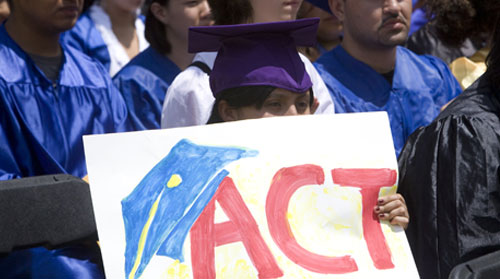
NEW YORK, N.Y. – Thousands of young undocumented immigrants formed long lines at help-centers and churches across the United States last Wednesday to start their process of gaining temporary legal status, under President Obama’s new program to defer deportations for many brought to this country as children.

But others are purposely delaying their applications for the deferred-deportation program — at least until after the upcoming U.S. presidential election. The program delays deportation for two years (potentially renewable) for young people brought to the United States before they were age 16. The new immigratin policy only applies to those who were 30 or younger by June 15, 2012.

But many undocumented immigrants postponing applications want to be sure first that President Obama gets reelected. That would provide them some assurance the deferred action program will not be discontinued were he to lose, thus placing them and their families in jeopardy of being deported.

Romney Could Revoke Program

“Look, if Mitt Romney wins, he may revoke this program,” said Andres Zamora, 20, an undocumented college student from the Bronx, N.Y. He asked to be identified only by his mother’s maiden surname. “If that’s the case, I will be scared to come out and apply [for a deferral]. It would just make me and my parents more vulnerable.”

Andres, a native of Guatemala, came with his parents to the United States via Mexico when he was seven. While his younger sister was born in New York and therefore a U.S. citizen, he and his parents remain undocumented and have no path to legalize their immigration status.

“It’s better to be careful,” he added. “What’s really a temporary relief could cause more harm than good in the end, right?”

Similar sentiments were posted by other young unauthorized residents on a number of websites tackling cost-benefit analysis of the Obama administration’s deferral policy, called the Deferred Action for Childhood Arrivals (DACA).

“I’ve been wrestling with the idea of applying now or after the election. I spoke with a lawyer, who suggested I should wait after the election because at any time DACA could be removed,” said one post on DREAM Act Portal.com, identified as bigdreamer2010. “I agreed that it’s possible for Mitt Romney to revoke it.”

DACA, through Obama’s executive order, could provide eligible undocumented youths to forestall removal from the U.S., as well as provide them a work permit. Some states would allow them to have a driver’s license. It is crucial for many to have transportation to jobs or school, without fear of a traffic stop that could result in deportation.

Thousands Gathered to Apply

When the policy officially took effect on August 15, thousands of young unauthorized immigrants gathered in different cities nationwide for a daylong orientation about eligibility requirements and free legal services supported by immigrant-rights groups and some public officials.

In Chicago alone, about 5,000 undocumented youths were reportedly lined up that day at the Navy Pier, holding a numbered piece of paper and a folder of documents in their hands.

At St. Mary’s Church in New York’s lower Manhattan, about 1,500 undocumented youth, along with their family members and friends, showed up as early as 6 a.m. New York City Council Speaker Christine Quinn joined advocates and supporters to help the thousands gain an opportunity to live, work and get an education in this country.

However, Sarala, 25, an immigrant from South Asia, said in an interview that she is reluctant to apply for now. She said relatives raised concerns about what happened with the special registration program, known as the National Security Entry-Exit Registration System (NSEERS).

“It might be similar,” said Sarala, who volunteers for a community organization in the Jackson Heights area of Queens, N.Y.

She explained that a few months after the September 11 terrorist attacks, the Department of Homeland Security required certain immigrants of Arab and South Asian countries to register under the U.S. Patriot Act II. After families complied, some who overstayed their visas were placed under deportation proceedings.

“It’s hard to trust. It’s been very rough for my family,” she said.

Muzaffar Chishti, director of Migration Policy Institute’s (MPI) office at the New York University School of Law, noted that the deferred-action policy could, legally speaking, be discontinued if Romney becomes president — or even if Obama wins and decided to revoke or limit the policy.

“These are just guidelines issued by the Department of Homeland Security and not a statue enacted by Congress,” Chishti said in a phone interview. Ideally, these young immigrants would gain legal protection if the DREAM Act or a broader immigration reforms are passed, he said. But he believes it’s still favorable for affected youth to avail of the deferral program.

Chishti also said he hopes Romney, if elected, would opt not to reverse DACA.

“These young immigrants can work, travel and live a normal life, and their deferral can be renewed after two years. It’s going to be like the Temporary Protected Status (TPS) given to Ecuadorians, Hondurans and Salvadorans since the 1990s,” Chishti said. “But at the end of the day, people make their own decision.”

The American revival of Janka Nabay

0
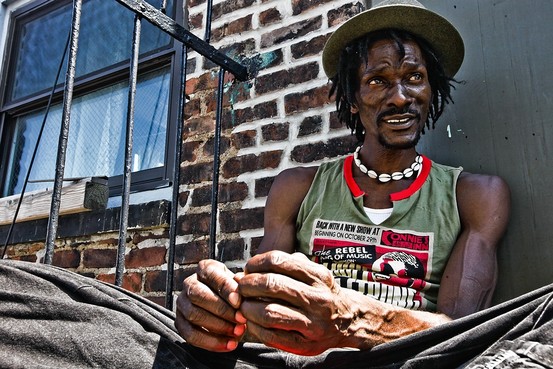
Sierra Leone-born musician Janka Nabay at the Manhattan offices of his U.S. label, Luaka Bop. Photo: Courtesy Wall Street Journal

Earlier this month, singer Ahmed Janka Nabay was milling about the Brooklyn warehouse concert venue 285 Kent. In the crowded, windowless confines of the space, he stood out. Mr. Nabay is tall and sinewy, with pencil-thick dreadlocks. And at age 47, he had a good 25 years on most of the crowd. Also, he was probably the only person in the room who hailed from the rural Temne region of Sierra Leone.

As Mr. Nabay and his bandmates took the stage, they began to play an upbeat, bubbling type of music known as “bubu,” a traditional style in Sierra Leone played at religious processionals during the month of Ramadan, typically rendered on batteries of drums, bamboo horns and discarded car-exhaust pipes. In this particular iteration, though, Mr. Nabay was supported by an electric guitar, bass, Acetone organ and electronic drums. He introduced his band as the Bubu Gang: with Syrian backup singer Boshra Alsaadi, British guitarist Douglas Shaw, and others hailing from locales that, in Mr. Nabay’s elocution, suddenly sounded exotic: Hawaii, Nebraska, Milwaukee.

“We are all different, but this is how we play bubu music,” he said. “Brooklyn, just give me a chance and rock to this song.” The young crowd, once standing stock still, soon gave itself over to the percolating, kinetic rhythm.

During the 1990s in Sierra Leone, Mr. Nabay was a bona fide pop star and cultural ambassador—among the first to record and sell bubu music. During his country’s civil war, he filled stadiums and conferred with United Nations representatives. When the war came to a close in 2002, he made his way to the United States, putting his music on hold as he worked through a string of menial jobs on the East Coast, from frying chicken to washing garbage trucks.

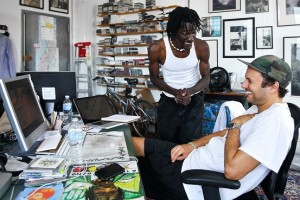
Mr. Nabay with Luaka Bop's Eric Welles. Photo: Wall Street JournalA decade later, Mr. Nabay is marking the release of his first American album (after four popular cassettes in his country), the bright and ebullient “En Yay Sah,” which was released on David Byrne’s esteemed Luaka Bop imprint on Aug. 7. He’ll celebrate the release on Thursday night with a performance at the Museum of Modern Art.

Like many of his countrymen, Mr. Nabay started out playing “popular music” forms like funk, American R&B and reggae, avoiding African music altogether. “My father didn’t want me to play music,” he said at the Luaka Bop offices on the Lower East Side, the morning after the 285 Kent show. “I then lived with my brother in Freetown and he wanted me to be a mechanic. But instead I learned hundreds of Bob Marley songs.”

When civil war broke out in neighboring Liberia in 1992, an influx of refugees spilled into Sierra Leone. Strangely, producers for “SuperSound,” a Liberian talent competition, also came. They wanted local musicians for the program, and wondered aloud why no one played Sierra Leonean music, only Western music. So when he went to audition, rather than sing Bob Marley, Mr. Nabay tried a different tack.

“I had one bubu song,” he recalled, clapping and singing: “‘Everyone dance to the bubu music.’ And right there they pick me. They say go to the studio, buy stage outfits.”

Full Story at WSJ.

The “race-neutral” presidency

0

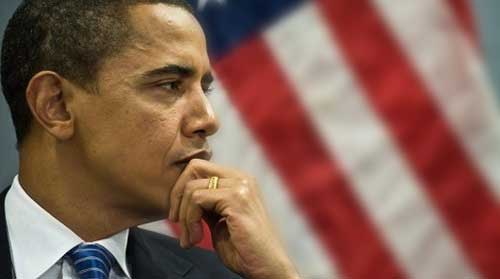
President Obama has been hearing one persistent grumble from the moment he entered the White House. And that’s that he has not said and done enough to boost African-Americans.

It’s been nothing more than a low intensity grumble for two simple reasons. One is that blacks backed him in near record numbers in his 2008 presidential drive. They will back him again in November in vote numbers that will equal or come close to those they gave him four years ago.

The other reason is that many blacks are disgusted and outraged that Obama has been the victim of a relentless and unprecedented battering by legions of bloggers, websites, talk show jocks, Tea Party leaders and followers, and assorted racist and fringe hate groups. This has made the overwhelming majority of blacks even more determined to circle the wagons and back him. That means keeping their grumbles about his efforts on behalf of blacks to themselves.

But Obama still has to remind blacks on occasion that he’s not the black president but the American president. He did it again recently in an interview. And he went a slight step further to reassure that his low-keyed record of aiding blacks in education and business through selected programs, initiatives and funding is a record he’s proud of. The explicit message is that I don’t have to put my blackness on parade or wear it on my shoulders to push programs that aid blacks. Yet, that still begs one, really, two questions. They are, should Obama do even more for blacks? And if he does, what are the political risks versus rewards?

The crisis problems of poor black communities are astronomical. A high crime and murder rate, near Great Depression level jobless rate among young black males, a disproportionate number of black uninsured, chronic failing inner city schools, and home foreclosures that hit blacks harder than any other group. The problems are so great that the Congressional Black Caucus, and a handful of other black activists, have taken occasional shots at Obama demanding that he drop the president of all the people stance, and do more than the quiet, even cautious, initiatives that directly benefit some blacks, and that he frontally attack some of the draining problems of poor blacks.

A compelling case can be made for Obama to be more aggressive in earmarking specific programs and initiatives for blacks. He took a step in that direction with his recent African-American Education initiative. That included actually labeling it as such.

But Obama has walked a shaky racial tightrope from the moment he declared his presidential candidacy in 2007. The danger was that as a relatively new and untested African-American presidential candidate, if there was so much as a hint that he’d make race a factor in the campaign his presidential candidacy would be DOA. The memories, suspicions and fears of many whites were too great of the perceived race-tinged politics of Al Sharpton or Jesse Jackson. It wasn’t just Obama’s cross to bear, though. For a quarter century before Bill Clinton won the White House in 1992, Democratic presidential candidates have had to bear the racial cross. During that period Democrats were regarded and reviled by conservatives as the party that tilted to and pandered to minorities. The backlash was swift and devastating. Blue collar and rural white males deserted the Democrats in droves. Their sprint to the GOP became the reliable trump card for Reagan, Bush Sr. and George W. Bush’s White House wins. In the South, the result was even starker. The Democrats and the GOP directly reversed roles. The Democrats went from a lily white, segregationist party to a liberal-to-moderate near-black majority party. The GOP became just the opposite; it morphed into an ultra-conservative, strongly evangelical, white male dominated party.

Clinton slightly broke the Democrat’s slide among whites, particularly white males. But he had to reverse gears and tout a strong defense, the war against terrorism, tax reform for the middle class, pro- business solutions to joblessness and, most importantly, tiptoe around civil rights and poverty issues. Democratic presidential candidates Al Gore and John Kerry followed the Clinton blueprint to the letter during their campaigns. If either had won, the likelihood is they would not have made these problems priority items in their White House tenure.

Obama is tugged hard by corporate and defense industry lobbyists, the oil and nuclear power industry, government regulators, environmental watchdog groups, conservative family values groups, conservative GOP senators and house members, foreign diplomats and leaders. They all have their priorities and agendas and all vie hard to get White House support for their pet legislation, as well as legislation that threatens their interests.

This has demanded a cautious, conciliatory, and above all, a race-neutral presidency during his first four years. While Obama can, and at times in his own way, has not ignored the plight of the black poor, it demands that he continue to take the same cautious approach on race in his fight to keep the presidency.

National Oil Company of Liberia to hold Diaspora forum in Minnesota on August 18

0
National Oil Company of Liberia to hold Diaspora forum in Minnesota on August 18

The Organization of Liberians in Minnesota (OLM), in collaboration with the City of Brooklyn Park, will host a consultative community forum on the establishment of a national oil policy for Liberia, on Saturday August 18, in Brooklyn Park, Minn.

The event begins at 6 p.m., at the Community Activity Center (5600 85th Ave., Brooklyn Park, MN 55443).

Organized by the National Oil Company of Liberia, also called NOCAL, the Minnesota forum is part of a series of Liberian Diaspora stakeholder consultations scheduled to take place in five major U.S. cities, including Washington D.C., Providence (Rhode Island), Philadelphia (Pennsylvania), and Atlanta (Georgia).

The purpose of the gathering is to facilitate a robust discussion, where the contributions of Liberian stakeholders in Minnesota will help influence a national oil policy that will reflect a more inclusive participation and painstaking deliberations.

A four-man NOCAL delegation is expected to arrive in Minnesota Friday to participate in the event. The team will include Israel Akinsanya, Vice-President for Public Affairs, Renee Wright, a financial analyst, Sam Jackson, a consultant, and Jake Kabakole, an advisor to the board.

To ensure that the voices of the Liberian Diaspora are reflected in the evolving new Liberian oil policy, OLM Executive Director, Wayne Douglas Doe, said it is critical that Liberians in Minnesota show up and offer their best suggestions, “especially on a development that could become our nation’s most viable economic asset.

The forum will be divided into three parts: presentation, Q &A, and nine break-out sessions, lasting over two hours. OLM is determined to create an environment that fosters the exchange of diverse, constructive ideas.

“We expect a minimum of 150 participants from all walks of life, including leaders of county organizations, alumni associations, faith-based institutions, among others”, Doe added.

After 50 years of explorations, Liberia finally discovered oil deposits in some parts of the country in February. Although the Liberian government has expressed its determination to use the deposits to the maximum benefit of all Liberians, the country’s current oil policy is widely regarded as a patchwork, lacking substance, especially a coherent national strategy to address the development agenda of communities in which exploration is a promising possibility.

According to NOCAL officials, the outcomes of forums in the Liberian Diaspora will be included in a national draft report, which will subsequently be presented to President Ellen Johnson-Sirleaf for approval.

IBM bets on Africa, sets up first research center

0
IBM bets on Africa, sets up first research center

IBM is opening its first research center in Africa, capping several years of international marketing by the Kenyan government and visits by IBM officials.

The center will be at Catholic University of Eastern Africa in Nairobi and will be a collaboration with the Kenyan Ministry of Information, Communication and Technology, IBM announced Monday.

“IBM has had a presence in Africa for more than 60 years and we are now taking our presence to a new level — we are establishing a foundation for IBM’s long-term success,” said Anthony Mwai, country general manager, East Africa at a press conference.

The research center will focus on next-generation public sector issues such as how governments can use big data, advanced analytics and cloud technologies to decrease the costs of social services, improve efficiency and productivity and improve access to services by citizens, among other objectives.

IBM has an exchange program that allows global employees to work in Africa and share skills. Researchers will also work on so-called “smarter cities” research with a focus on water and transportation issues.

The center will also collaborate with universities, government agencies and companies on how to contend with a skills shortage that hampers advancement of industries in Africa.

“Innovation is the main driver for a competitive national economy. The IBM research lab will not only rubber stamp Kenya as Africa’s leader in ICT, but will help the country to transform into a knowledge based economy,” said Bitange Ndemo, permanent secretary, Ministry of Information, Communication and Technology, at an event organized for private and public sector officials.

Full Story @ ComputerWorld.

Competitive Liberian-American forces recount in Brooklyn Park

0
Liberian born Wynfred Russell after elections results came in at City hall on Tuesday. He narrowly lost a Brooklyn Park City Council special election by 5 votes on August 14, 2012. A recount is to be conducted. Photo: Tom Gitaa/Mshale
Liberian born Wynfred Russell after election results came in at City hall on Tuesday. He narrowly lost a Brooklyn Park City Council special election by 5 votes on August 14, 2012. A recount is to be conducted. Photo: Tom Gitaa/Mshale

With all 7 precincts in the West District of Brooklyn Park reporting last night, Liberian born Wynfred Russell, came within 5 votes of being the first African born person to sit on the Brooklyn Park City Council during a special election Tuesday to fill the remainder of Councilmember Jeanette Meyer who died of cancer on May 20.

The city decided to hold the special election alongside the primaries that were taking place Tuesday for federal, state and local elections. City Council elections in Brooklyn Park are non-partisan races meaning there is no party identification.

Russell lost to Bob Mata who got 536 (41.52%) votes to Russell’s 531 (41.13%). A disappointed Russell said the narrow loss is testimony to the age old saying that “every vote counts, “a few more people voting would have tipped the scales in our favor,” he said. Joseph Meyer Gearin, son to the deceased Councilmember Jeanette Meyer trailed with 215 votes (16.65%).

Russell serves as a Planning Commissioner in the city and is also executive director at Acer and board secretary at Envision Minnesota.

Brooklyn Park City Clerk, Devin Montero, who ran the projector inside the Council chambers as the results trickled in told Mshale that the results are tight enough that Mr. Russell is “entitled to a recount at the city’s expense”. He however has to request it in writing. As he walked out of City Hall, Russell said he planned to request the recount as early Wednesday.

The city is home to many African immigrants, many in the middle class and this is the closest the community has come to putting one of their own on the Council. It is often referred to as the “African suburb”. The city is the sixth largest in the state.

Wynfred Rusell with supporters as they watch election results come in on the big screen at the Brooklyn Park City hall on Tuesday, August 14 2012. He narrowly lost by 5 votes to Bob Mata and a recount is planned. Photo: Tom Gitaa

A Wynfred Russell supporter, Brian Rogers, visibly upset at the loss held hope last night as he walked out of City Hall that his candidate might still prevail “Having worked with Wynfred for years to make Brooklyn Park a better place, I have never doubted he is the best person to have on the council,” he said.

Another supporter John Jordan was equally disappointed and maintained “he (Wynfred) is still the better candidate.”

Russell on his part thanked his supporters for their hard work.

East District

In the East District where another African born candidate, Benard Muko, was running, it was not much of a contest. The District had five candidates running and the top two were to advance to the November election to decide who the eventual Councilmember will be. Incumbent Peter Crema, handily beat the other four candidates, easily garnering 48.25% of the vote or 771 votes after all precincts had reported.

The second closest to Crema could not even manage half of the vote the incumbent received. Dakota Huseby came in a distant second with 291 votes (18.21%) followed by Reva Chamblis at 223 (13.95%), David Anderson with 188 (11.76%) while Kenya born

Brian Rogers

Benard Muko, owner of Brookdale Auto, trailed with 125 votes (7.82%).

Flanked by his wife after the results came in, Mr. Muko said “I gave it my all but the voters have spoken.” He too thanked his supporters for their hard work on behalf of his campaign.

Benard Muko

Over 400 take Oath of Allegiance as new citizens

0
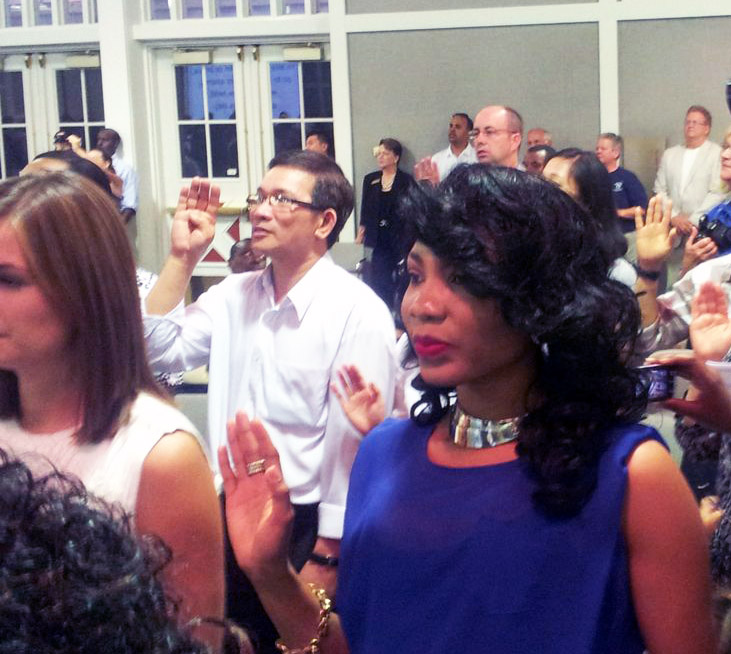
Perpetual Garyeazon (right) from Liberia was among 431 individuals from 70 countries that took the oath of allegiance to the United States when they were naturalized last month during a ceremony in Brooklyn Center, Minnesota before Judge Gregory Kishel of the United States District Court of Minnesota. Photo: Tom Gitaa/Mshale

For Perpetual Garyeazon, there was only one word to describe her experience  last  month as she was sworn in as an American citizen during a naturalization ceremony at the Earl Brown Heritage Center in Brooklyn Center.

“(I) am so happy,” said Garyeazon,  a native of Liberia. A beaming Garyeazon  said she was thrilled to be part of the process. She attended the ceremony with her aunt and cousin, Monnie, and was one of 431 people sworn in  as new citizens during a U.S. Citizenship and Immigration Services  naturalization ceremony.

According to Wanjirah Wanjiru, Adjudications Officer with the U.S. Citizenship and Immigration Services, 431 individuals sworn in as new citizens represented more than 70 countries.

Judge Gregory Kishel of the U.S. District Court for the District of Minnesota  administered the Oath of Allegiance.

Perpetual Garyeazon and Cousin Monnie are all smiles after the naturalization ceremony. Photo: Tom Gitaa/Mshale

“I am a child of immigrants myself, my grandfather having come here from Europe,”Kishel said. “Our strength as a country comes from our diversity.”

Kishel told the new citizens that becoming an American citizen carries rights and responsibilities such as the ability to vote. Becoming an American citizen does not mean abandoning the culture of where you came from but is part of a new experience where all cultures are celebrated.

Judge Kishel’s message was reinforced by President Barack Obama. He told the new citizens via a video message to go forth and “be responsible citizens.”

The League of Women Voters was also present to register the new citizens as voters. For this particular ceremony the League partnered with Brooklyn Park based African immigrant Services (AIS), a local non-profit that focuses on civic engagement.

AIS Executive Director, Abdullah Kiatamba, said he was there to help with the registration of potential voters “because such process helps increase electoral participation of African immigrants in Minnesota,” he said. He prowled the aisles of the expansive hall collecting filled out voter registraion cards  after the ceremony and encouraged everyone to vote.

Garyeazon said she will do exactly that.

Joseph Morande Onyambu

0
Joseph Morande Onyambu. 1940-August 2, 2012

The late Joseph Morande Onyambu was born in 1940 to the late Paul Onyambu and Alexina Momanyi at Nyamare Village, Charachani Sub-location, Keera Location, Nyamira District in West Mugirango.

Mzee Morande was the 3rd Born in a family of 8 children: 3 sisters and 5 brothers. He married Yovensia Nyaboke in 1960, and later Maria, Mary, and Josephine respectively.

He was baptized Catholic and was a parishioner of Kebirigo Parish.

The late Joseph Morande was a pioneer entrepreneur and enterprising businessman in Mokomoni area. As a young man he picked tea around the teas estates of Kericho, and engaged part-time in the sale of livestock to butcheries within the tea estates. He also ran thriving tailoring and posho mill businesses. Mzee was a tailor in Kebirigo and Ting’a, where he met his wife Yovensia Nyaboke.

In 1961, Mzee went back to Keoge and Embonga primary schools to complete his Standard 5-8 certificate. Meanwhile, he constructed his first hydro-electric posho mill on Charachani River. Around 1968, he bought land in Mokomoni. He opened a shop there in 1969. In 1970, he built and ran a successful shop business. In 1974, he opened a modern power posho mill at Nyagware.

He was a dear father to: Paul (1st Born), Menecha (Late), Jane, Florence, Peter (Late), Nyangoya, Julius (Juma), Jackline, Finbar, Fred, and James, as well as Kennedy, Temutura, Regina, Kebaso, Geke, Geoffrey, Joel, and Job, among others. He was blessed with several grandchildren and great-grandchildren.

Mzee loved “emebayeno” (Gusii proverbs) and telling stories, especially about personal development. He was a great orator and leader, and could regale you for hours on end.

Note: Read about the memorial service in Minnesota here.

Stories and comfort at memorial service for Joseph Morande Onyambu

0
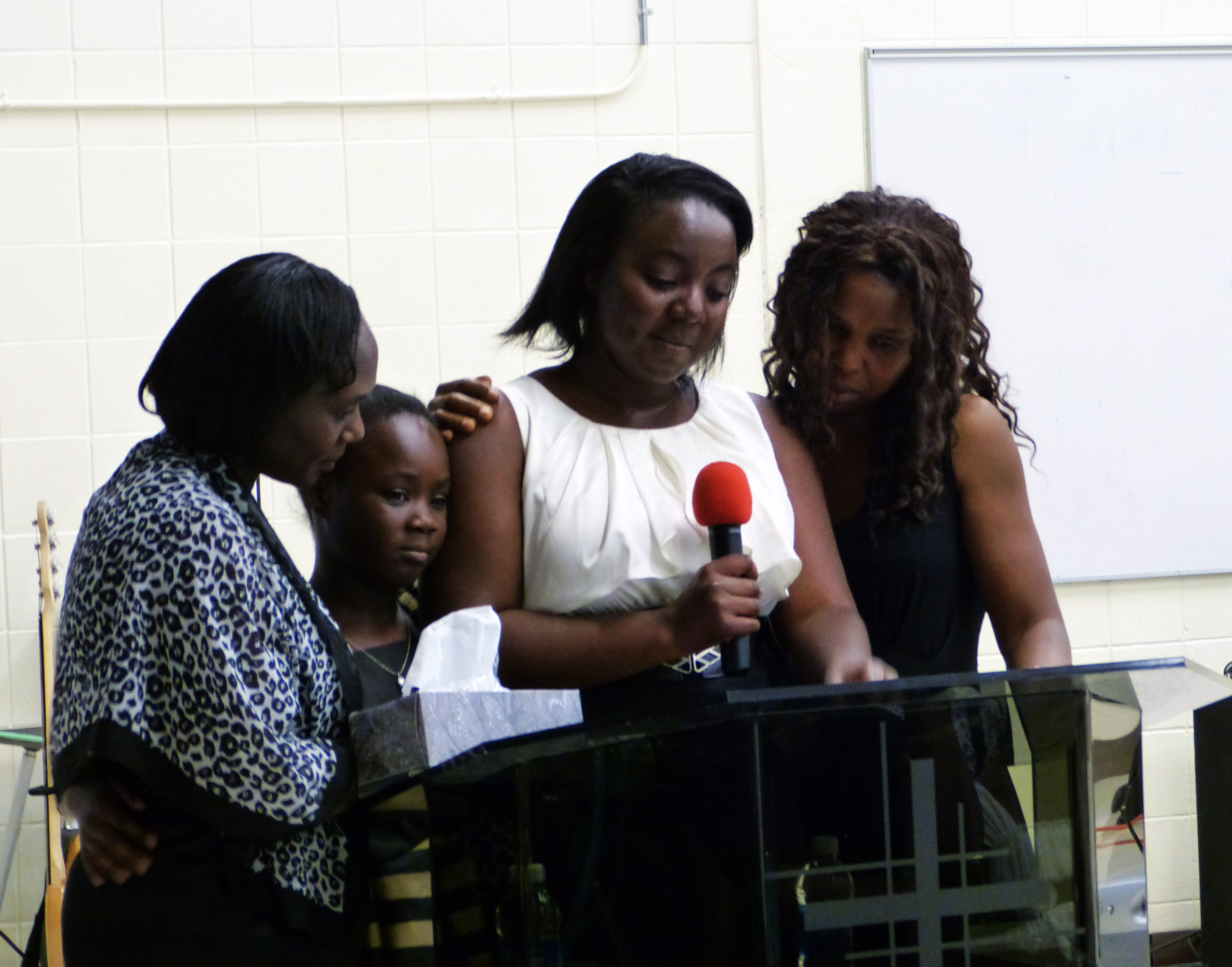
Sandra Morande, a junior at Duke University and daughter to prominent Kenyan-American, Paul Morande eulogizes her grandfather, Joseph Morande Onyambu who died in Kisii, Kenya on August 2, 2012. Ms. Morande eulogized her grandfather at a memorial service in Brooklyn Park, Minnesota on Sunday, August 5 2012. PHOTO: Dickens Nyabuti

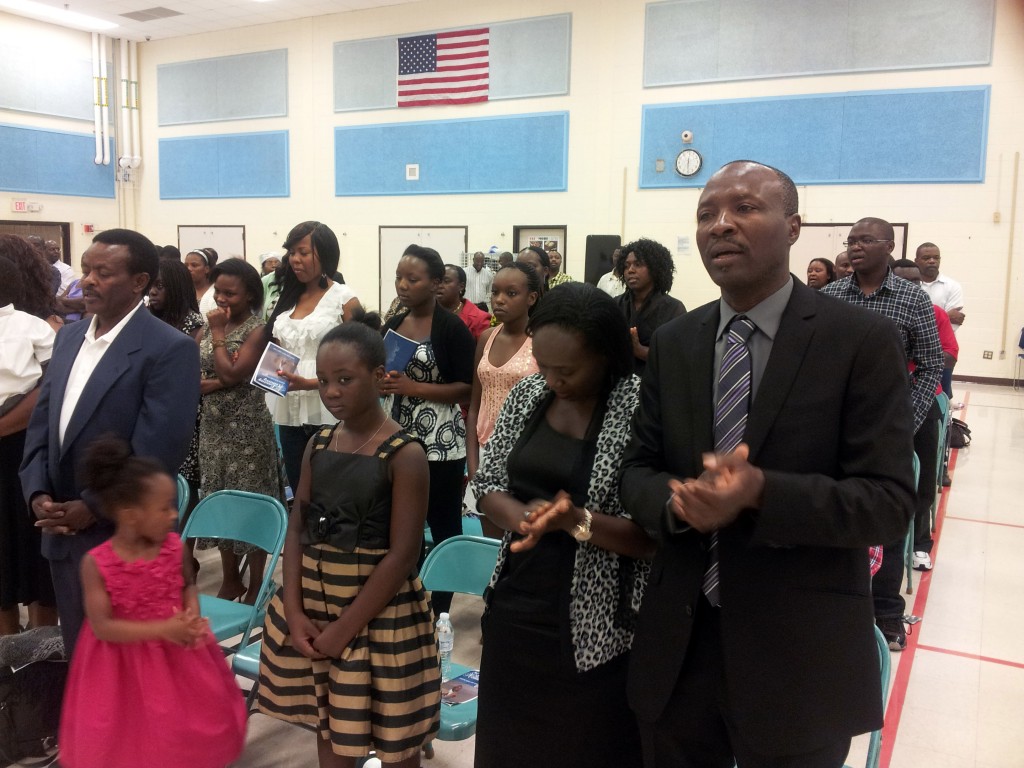
BROOKLYN PARK,  Minn  – Hundreds gathered Sunday at the Brooklyn Junior High School gymnasium for a memorial service to honor the late Joseph Morande Onyambu. Onyambu died Thursday, August 2 in Kisii, Kenya. He was 72.

Joseph Morande Onyambu. 1940-August 2, 2012. PHOTO: Submitted

He was father to prominent Kenyan-American, Paul Morande, on whose account most came to the memorial service as many did not know Mr. Onyambu personally. Paul Morande is the Executive Secretary of the Minnesota Kenyan International Development Association (MKIDA).

“My grandfather’s favorite color was blue,” his granddaughter Sandra Morande, a junior at Duke University said during the service. “He made me realize where my father’s (Paul) sense of service to the community came from.” A tearful Sandra then gave a moving eulogy of her grandfather narrating the time three years ago when the late Onyambu visited them in their Twin Cities home. “I never had a relationship with him before that”, she said, concluding that his visit was the start of something special.

Paul Morande (right) and wife Betty join in the singing at a memorial service in Brooklyn Park, Minnesota on August 5, 2012 for his father Joseph Morande Onyambu who died on August 2, 2012 in kisii, Kenya. Paul is a prominent Kenyan-American leader in the Minnesota Kenyan community and Executive Secretary of the Minnesota Kenyan International Development Association (MKIDA). PHOTO: Tom Gitaa

Laughter seemed to prevail over tears however as community members who came to console the Morande family chose to remember the good times they had whenever they crossed paths with the late Mr. Onyambu.

Pastor Zipporah Bogonko shared the joy the late Onyambu brought to her family during her daughter’s graduation, “he turned out to be the blessing God had planned for us when he attended our daughter’s graduation”, she said. Bogonko’s parents were denied a visa to come for the graduation and the late Mr. Onyambu filled the role of bringing a sense of ‘home’ to the graduation experience.

Several of Paul Morande’s family spoke at the memorial and thanked the community for their support. They said their late father was a great orator and lover of “emebayeno” (proverbs in the Gusii language) who would regale you with endless stories.

Mr. Paul Morande was among those who recalled the good days with his late father. He described his father as enterprising and how he and his siblings were “raised in the back of the store” drawing laughter from the audience as he described the shops his late father had back in Kenya and how the back of the store was the living quarters for the family.

Pastor James Maina of Destiny Faith Ministries delivered the sermon. He preached from the book of Mark 5:25 about the woman who had been hemorrhaging for twelve years and who physicians could not cure. Upon hearing about Jesus, she believed that if she could touch the garment Jesus was wearing, she would be healed which indeed she was as her hemorrhaging stopped immediately after touching Jesus’ cloak.

Pastor Maina told those at the Morande memorial to have faith similar to that of the woman and that “when all the doctors fail, come to Dr. Jesus.”

Mr. Paul Morande and his family are scheduled to leave for Kenya on Monday, August 6 for the funeral.

Note: Read the late Joseph Morande Onyambu’s obituary here.

At Global Diaspora Forum Clinton urges turning ‘Brain Drain’ into ‘Brain Gain’

0
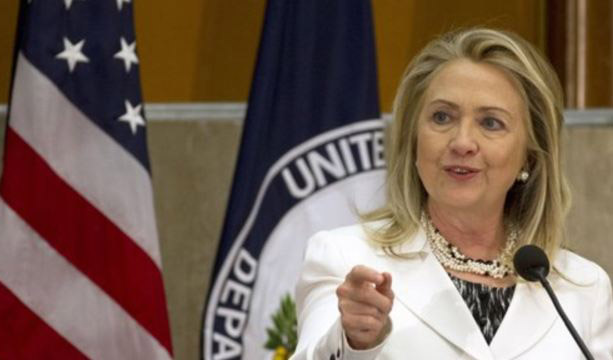
Secretary of State Hillary Rodham Clinton speaks at the Second Annual Global Diaspora Forum at the State Department in Washington last week.

Secretary of State Hillary Clinton recognized on Wednesday the crucial role of diaspora communities in national and global development efforts, emphasizing their potential to solve problems in their home countries and spur U.S. economic growth.

“By tapping into the experiences, the energy, the expertise of diaspora communities, we can reverse the so-called ‘brain drain’ that slows progress in so many countries around the world, and instead offer the benefits of the ‘brain gain,’” she said at the opening ceremony of the second annual Global Diaspora Forum.

Speaking to about 500 diaspora community leaders, advocates and senior U.S. officials, Clinton cited the support of Syrian Americans and organizations as an example of how the Syrian diaspora serves as a link between the international community and opposition activists to address the ongoing civil uprising in Syria.

“I want to recognize the work of Syrian diaspora organizations to shine a light on what is happening in Syria and to carry the concerns of the Syrian people not only onto the pages of American newspapers, but also into the halls of Congress,” she said. “They’re helping to collect funds and humanitarian assistance for Syrians who are suffering because of this terrible violence.”

This year’s forum, titled “Moving Forward by Giving Back,” focused on how to foster partnerships between diaspora communities and the U.S. government to address global challenges. The two-day event also drew members of the ethnic press— including Ethiopian, Filipino, Haitian, Latino and African-American news outlets—from the nation’s capital to Virginia, Maryland and New York.

Migration Policy Institute, New America Media, USAID, United Nations Foundation, and a number of private companies supported the forum.

Speaking about her recent trip to Asia, Clinton told the story of a Vietnamese-American entrepreneur who brings famous American brands into the Vietnamese market, generating thousands of jobs and in the process bringing Vietnam and the United States closer together.

“That’s one way the diaspora has and continues to make a difference, but it’s certainly not the only way,” Clinton said.

She added that the International Diaspora Engagement Alliance (IDEA)— a network of private sector, nonprofit and government agencies that she launched last year— has also expanded its initiatives. One of these is a collaboration between Canadian, U.K. and U.S. governments to finance innovative business proposals from the Caribbean diaspora in order to generate employment and increase economic growth in the Caribbean.

Similar efforts by the communities are taking place in Liberia, Tunisia and in Latin America.

Thomas Debass, director for global partnerships for the State Department’s Global Partnership Initiative, was hopeful about the direction of the International Diaspora Engagement Alliance.

“Through IDEA, we’re evolving and recognizing diversity, utilizing that asset and our American diplomatic relations around the world,” he said. “We’re creating a footprint and certainly taking the diaspora’s commitment into action to benefit both their home countries and the United States.”

Debass admitted that the initiative is a work in progress, but said he was confident that the alliance would continue to carry out its goals around diplomacy, innovation and economic development.

“We’re not at the promised land yet, but we know that we are on the right track to advance causes that we care about,” he said.

Meanwhile, on the home front, Clinton praised the ways immigrant communities have revitalized American cities like Baltimore, Md., which may be losing its economic luster due to dwindling populations. When cities struggle, she noted, the presence of immigrants replenishes their strength and vitality.

“The fact is that the United States has always benefited from the influx of talent and dynamism that diasporas of all kinds bring to our shores. And so they are reaching out and inviting— opening the doors of that venerable American city to immigrants from everywhere,” she said. “We are well aware that our diversity is one of our greatest assets in the 21st century.”