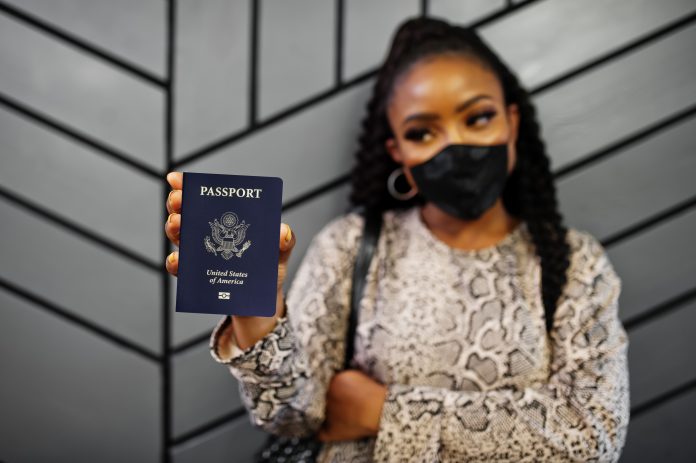
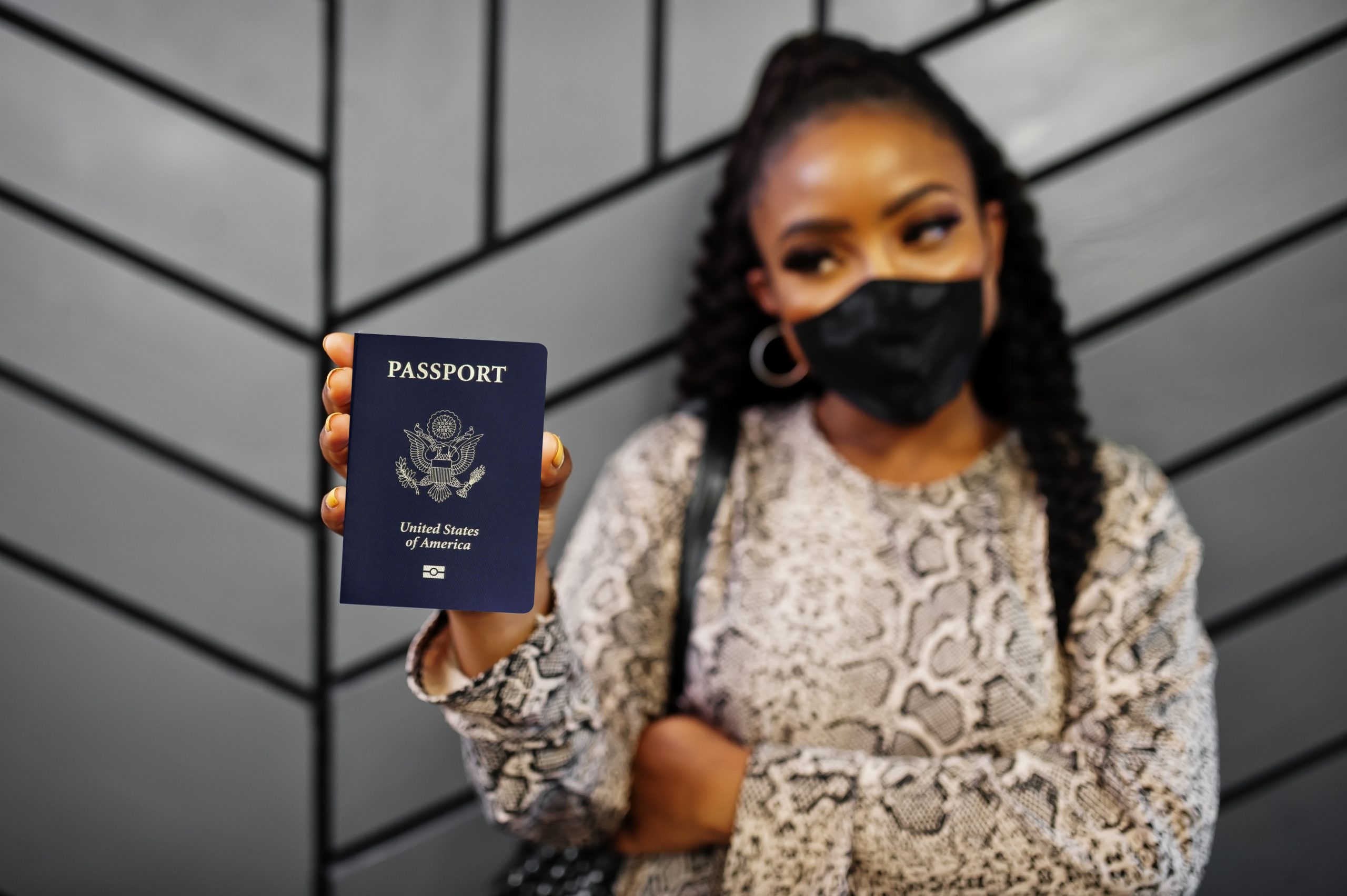
The US State Department announced on Monday, May 24, 2021 that Americans overseas with passports that expired on or after January 1, 2020 can use them to travel to the US directly through December 31, 2021. Photo: Shutterstock
The US State Department announced on Monday, May 24, 2021 that Americans overseas with passports that expired on or after January 1, 2020 can use them to travel to the US directly through December 31, 2021. Photo: ShutterstockThe US State Department announced on Monday, May 24, 2021 that Americans overseas with passports that expired on or after January 1, 2020 can use them to travel to the US directly through December 31, 2021. Photo: Shutterstock
The US State Department announced Monday (May 24) that US citizens can travel back to the United States using their recently expired passports under certain conditions through December 31, 2021.
The passport must have expired on or after January 1, 2020. That is around the time when many US consulates abroad closed to the public as the COVID-19 pandemic got underway, making it difficult to access consular services.
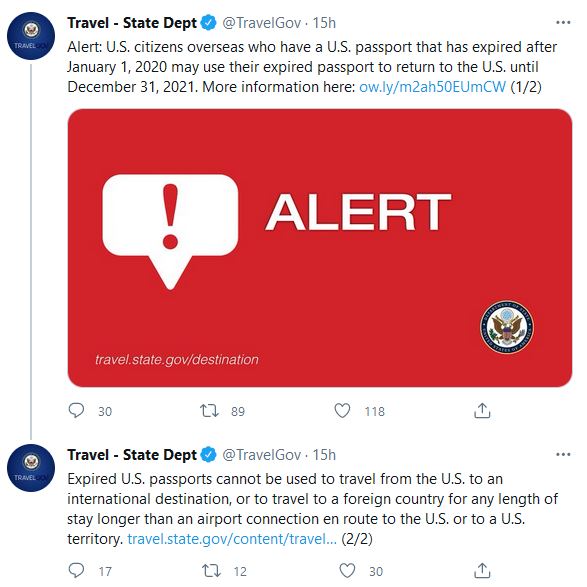
You however cannot travel out of the United States on an expired passport.
According to details posted on the State Department website,
You qualify for this exception if all the following are true:
You are a U.S. citizen.
You are currently abroad seeking direct return to the United States.
You are flying directly to the United States, a United States territory, or have only short-term transit (“connecting flights”) through a foreign country on your direct return to the United States or to a United States Territory.
Your expired passport was originally valid for 10 years. Or, if you were 15 years of age or younger when the passport was issued, your expired passport was valid for 5 years.
Your expired passport is undamaged.
Your expired passport is unaltered.
Your expired passport is in your possession.
You do not qualify for this exception if:
You wish to depart from the United States to an international destination.
You are currently abroad seeking to travel to a foreign country for any length of stay longer than an airport connection en route to the United States or to a United States territory.
Your expired passport was limited in validity.
Your expired passport is a special issuance passport (such as a diplomatic, official, service, or no-fee regular passport).
Your expired passport is damaged.
Your expired passport is altered.
Your expired passport is not in your possession.
Negative coronavirus test
The State Department also said all air passengers ages 2 and older must present a negative coronavirus test taken no more than three days before a flight to the U.S., or proof that they recovered from the virus within the past three months.
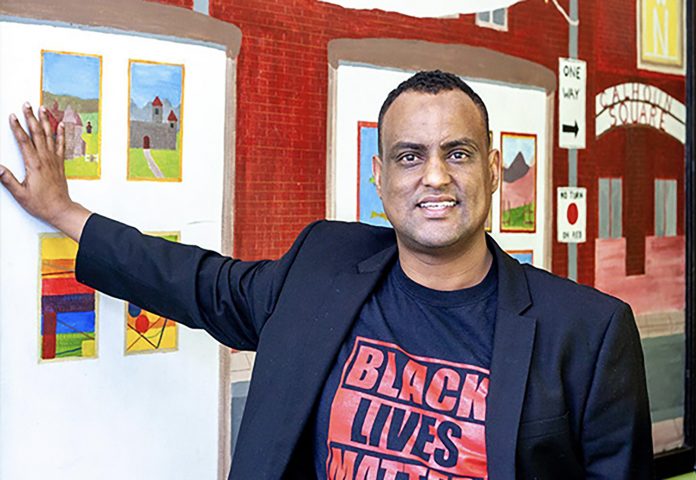
Yussuf Haji, a candidate in Minneapolis’ Ward 9 in the 2021 city elections has as his priorities public safety, affordable housing, small business assistance among others. Photo: Courtesy of Yussuf Haji
Yussuf Haji, a candidate in Minneapolis’ Ward 9 in the 2021 city elections has as his priorities public safety, affordable housing, small business assistance among others. Photo: Courtesy of Yussuf Haji
For Yussuf Haji, a seat on the Minneapolis City Council means an opportunity to make real change. He is running to represent Ward 9. Alondra Cano, who currently represents the ward is not seeking reelection.
Haji and his wife Anisa run an online organic cosmetics business in addition to Anisa’s day job as a program manager at a local nonprofit. To make ends meet, Yussuf said he has had to supplement the family income by driving for Uber part-time.
It is his part-time gig as an Uber driver that has given him the opportunity to hear firsthand the many ways in which the city appears to sideline its residents, many of whom are members of marginalized communities.
Passengers sharing their experiences with him about the city, combined with his longtime activism speaking up against racism and Islamophobia, contributed to his decision to run for office.
“Minnesota is still Minnesota, and the minority communities are still facing a host of issues, which I have been fighting against over the last ten years,” Haji said.
Yussuf, a Somali immigrant from Kenya, has called Minnesota home for the last 22 years with ten of those years spent in Saint Cloud where he attended college.
He received his bachelor’s in media and mass communication from St. Cloud State University and a master’s in arts and leadership from Augsburg University.
His entry into activism was sparked by a Paul Wellstone rally he attended in Minneapolis when the late senator was running for reelection.
“Paul inspired me and his words stuck with me as I joined in the causes of my fellow Black, brown and indigenous people and others who were striving for acceptance, recognition and opportunity,” Haji said. “I used to listen to his speeches before he died in a plane crash in 2002.”
Yussuf’s priorities include public safety with an emphasis on police reform and what he calls “community involved public safety” where the community is an active participant in the police reform movement.
“Racist and brutal police officers, who break the law, violate the public trust and oppress people must be held accountable,” said Haji.
Affordable housing is one of his other priorities. He says there is a housing crisis in Minneapolis where 44 percent of the city’s residents are ‘cost-burdened’, meaning they spend more than 30 percent of their income on housing.
According to Haji, having a secure job and feeling safe in your city are “basic human needs” and that the city’s elected officials should provide an environment where that can be achieved.
He points to the vulnerability that small businesses in Ward 9 have been exposed to as regards crime and security after the unrest that followed the killing of George Floyd by Minneapolis police.
Haji says businesses in the area need short-term grants from the city to improve the security of their buildings, terming the need as “urgent.”
He says he understands the challenges of the gig economy and said Uber, Lyft and gig workers such as DoorDash need city parking permits. Yussuf believes these are changes that the city is well positioned to implement and should.
“It is at city hall where the real change happens,” said Haji.
Haji and his wife Anisa have four children.
The city of Minneapolis’ municipal election is scheduled to take place on Nov. 2, 2021, with early voting expected to begin on Sept. 27.
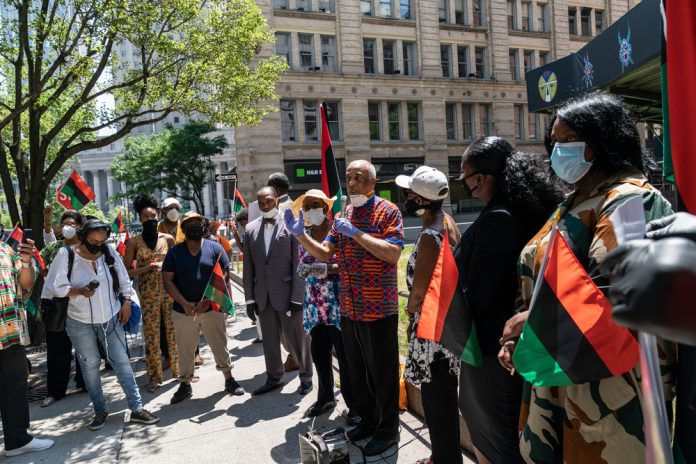
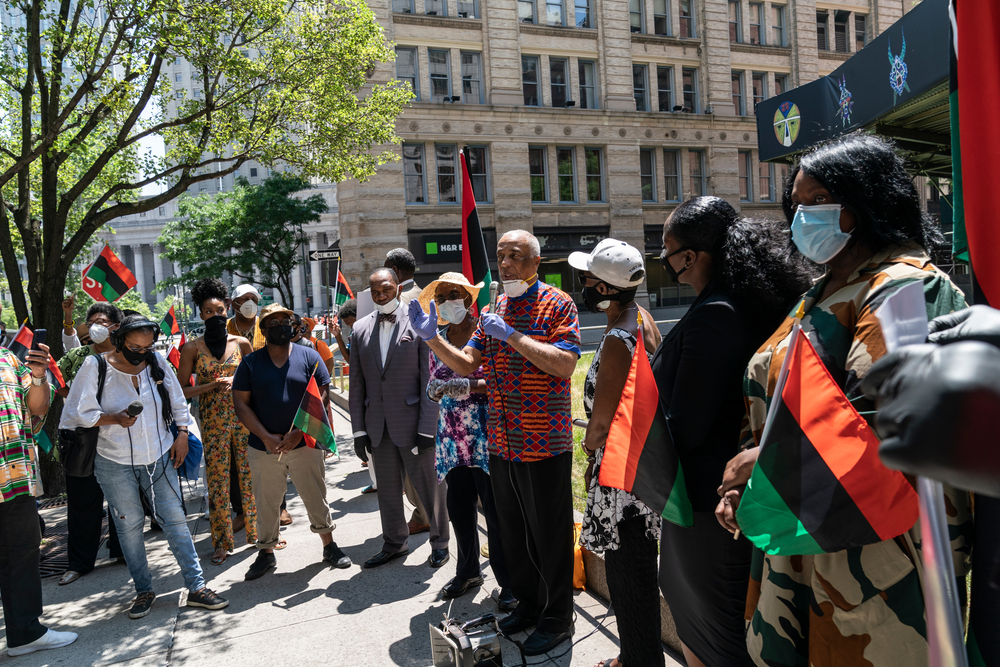
New York Assembly member Charles Barron organized Reparation Rally and Press Conference at NYC African Burial Ground Memorial on July 2, 2020. Photo: Lev Radin/Shutterstock
New York Assembly member Charles Barron organized Reparation Rally and Press Conference at NYC African Burial Ground Memorial on July 2, 2020. Photo: Lev Radin/ShutterstockNew York Assembly member Charles Barron organized Reparation Rally and Press Conference at NYC African Burial Ground Memorial on July 2, 2020. Photo: Lev Radin/Shutterstock
By Luis Andres Henao – Associated Press
The faith community should guide the way on reparations for America’s history of slavery and racial discrimination and help the nation’s process of reconciliation and healing, religious leaders said during a panel held to discuss the issue.
U.S. religious groups have seen widespread interest in reparations, especially among Protestant churches that were active in the era of slavery. Many are starting or now considering how to make amends through financial investments and long-term programs benefiting Black Americans.
“The faith community not only can lead but should lead, and is in a unique position to lead,” the Rev. Iva E. Carruthers, general secretary of the Samuel DeWitt Proctor Conference, said during the Wednesday panel organized by The Associated Press, The Religion News Service and The Conversation.
The Episcopal Diocese of Maryland voted last year to create a $1 million reparations fund, likely to finance programs supporting Black students, nursing home residents, small-business owners and others. The vote followed years of research into how the diocese had benefited from racial inequality and slavery.
“If not the faith community, who? And if not now, when?” said the Right Rev. Eugene Sutton, the first Black cleric to hold the post of bishop of the diocese.
“Perhaps one of the reasons why so many in our society are saying, ‘Well, I can be spiritual, but I don’t have to belong to any religious organization,’ is because religious faith communities have failed to live up to their scriptures and to our words,” Sutton said. “We need to put our money where our mouth is. And reparations is one way to do that.”
Panelists were asked what they tell those who oppose reparations on the grounds that they’re not guilty of slaveholding or racism and shouldn’t be asked to pay for those crimes. Sutton said it’s not about guilt but a responsibility to repair the damage caused.
“Reparations is not a transfer of money from white people to Black people,” Sutton said. “It’s rather what this generation will do to correct the wrongs that previous generations have started.”
University of South Carolina history professor Nicole Maskiell, who has worked with congregations involved in reparations initiatives, praised faith communities for being first and leading by example.
“That takes courage,” she said. “It takes commitment, and it also takes a willingness to tell the truth.”
The Minnesota Council of Churches has cited a host of injustices — from mid-19th century atrocities against Native Americans to police killings of Black people — in launching a first-of-its kind “truth and reparations” initiative.
The initiative engages a diverse collection of 25 Christian member denominations, including some that are predominantly Black, and will model some of its efforts on South Africa’s post-apartheid Truth and Reconciliation Commission. It is based in Minneapolis, where the police killing of George Floyd last May sparked global protests over racial injustice.
“When I was growing up, white supremacy was a problem of the South. … Within the last five years, just here in Minneapolis, we’ve had the killing of Jamar Clark, Philando Castile, George Floyd, Daunte Wright,” said the Rev. Jim Bear Jacobs, the council’s director of racial justice. “All of this within 7 miles of each other, each one of those young men all at the hands of police, all unwarranted killings.”
“How did we, as a city of Minneapolis, how did we get to this point? And the only answer one can arrive at is white supremacy.”
Jacobs, who belongs to a Wisconsin-based Mohican tribe but was born in Minnesota, said the initiative seeks to address social justice concerns of African Americans and Native Americans in a unified way: “We are so much stronger together than we are doing our justice work in silos.”
Panelists said they’re hopeful that the latest attempts to address reparations will turn into meaningful action because the country is in the midst of a historic reckoning on racism, because young people are engaged and seeking justice and because faith communities have come together to demonstrate.
“Every night over the roar of the cries for justice, you could hear the indigenous drumbeat. … We’re there,” Jacobs said. “I have linked arm-in-arm with rabbis and imams and bishops and pastors.”
Rep. Sheila Jackson Lee, D-Texas, who has sponsored a bill that would create a commission to study slavery and discrimination in the United States from 1619 to the present, said she hopes it will be passed by the House in late June.
The commission would also recommend ways to educate Americans about its findings and appropriate remedies, including how the government would offer a formal apology and what form of compensation should be awarded.
Support from the faith community, she said, is crucial: “It can help people, Americans, grapple with, understand and feel comfortable with doing the right thing.”
“We’ve come this far by faith, our beliefs, whether or not we’re reading from the Quran or the Torah, we’re reading from the Bible or any other faith book somewhere in there about love and charity and somewhere in there about restoration. I know there’s something in there about redemption,” Jackson Lee said. “That’s what America has to do.”
__
Associated Press writers David Crary and Kevin Freking contributed to this report.
___
Associated Press religion coverage receives support from the Lilly Endowment through The Conversation U.S. The AP is solely responsible for this content.
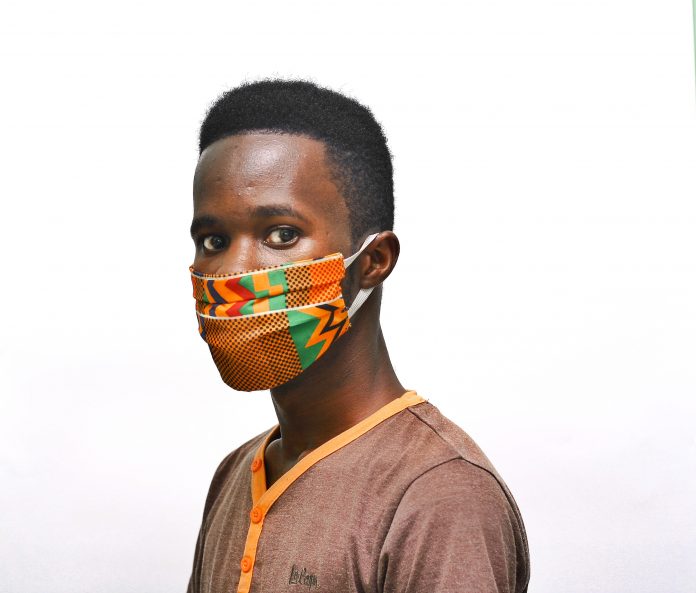
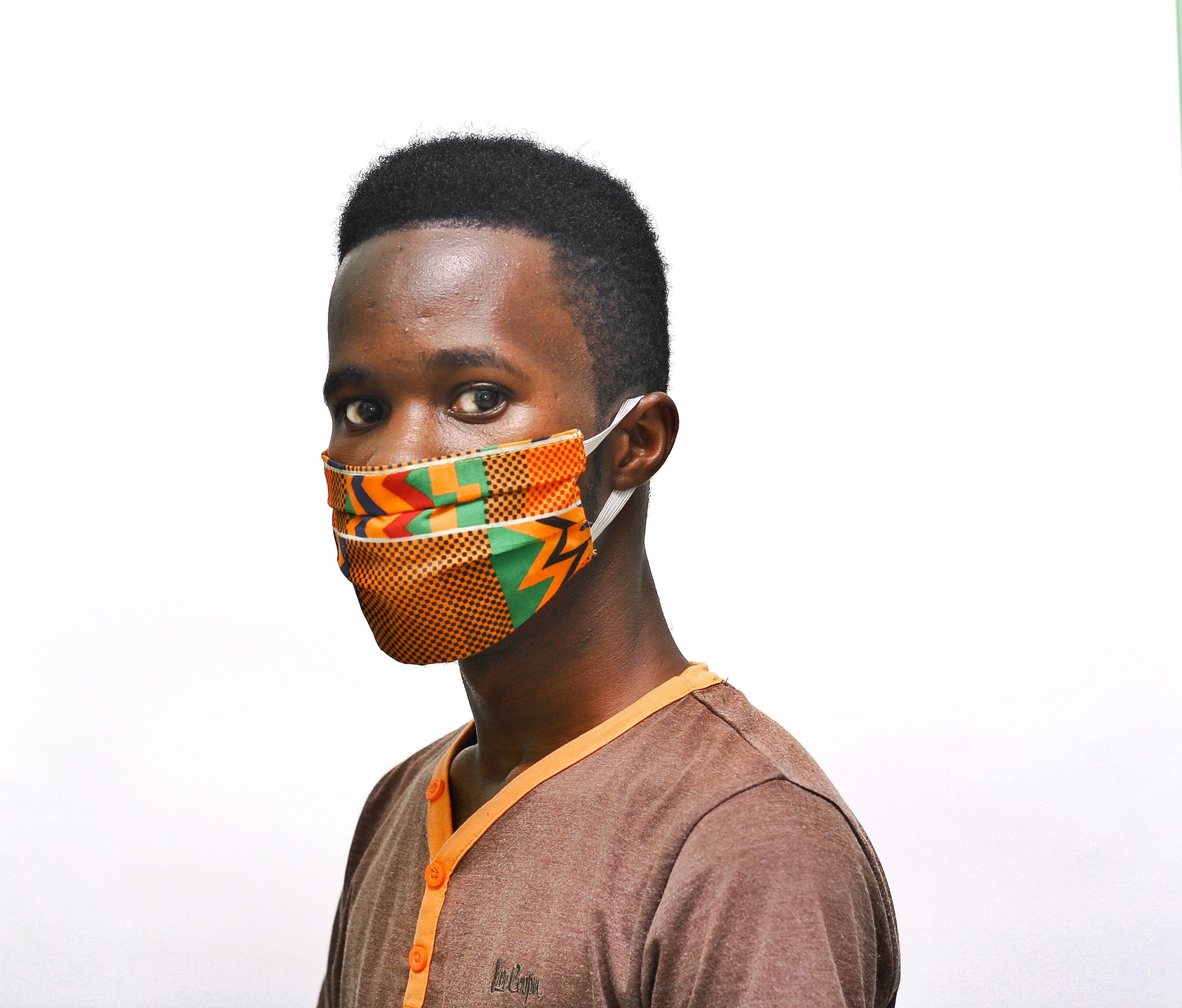
Following CDC guidelines that fully vaccinated people no longer need face masks indoors or outdoors, Gov. Walz of Minnesota has lifted the state's mask mandate. Photo: Daniel Mensah Boafo/Shutterstock
Following CDC guidelines that fully vaccinated people no longer need face masks indoors or outdoors, Gov. Walz of Minnesota has lifted the state's mask mandate. Photo: Daniel Mensah Boafo/Shutterstock
Gov. Walz follows advice and ends mask mandate
Following CDC guidelines that fully vaccinated people no longer need face masks indoors or outdoors, Gov. Walz of Minnesota has lifted the state’s mask mandate. Photo: Daniel Mensah Boafo/Shutterstock
The Centers for Disease Control said Thursday that people that are fully vaccinated against the coronavirus no longer need to wear face masks, indoors or outdoors, for most situations.
The CDC said the three vaccines in use in the United States have proved effective in preventing the spread of the coronavirus and reducing hospitalizations.
“If you are fully vaccinated, you can start doing the things that you had stopped doing because of the pandemic,” CDC Director Dr. Rochelle Walensky said. “We have all longed for this moment when we can get back to some sense of normalcy.”
The CDC announcement comes as data shows 36 percent of the US population is fully vaccinated while 59 percent have at least one shot.
One is considered fully vaccinated against COVID-19 two weeks after receiving their final vaccine dose.
Governor Walz of Minnesota had planned to lift his mask mandate on July 1 when 70 percent of the state had received at least their first shot. Following the new CDC guidelines, Walz announced the state will end the mandate today (May 14) but encouraged the unvaccinated to continue wearing them.
As of Thursday, 50 percent of eligible Minnesotans (2.2 million) have been fully vaccinated while 61 percent have received at least one shot, according to the state’s covid vaccine tracker.
Gov. Walz said cities and businesses are free to keep their mask requirements. The mayors of the state’s two largest cities, Minneapolis and Saint Paul, issued statements Thursday evening saying they will keep the mandates while they consult with their health experts.
Minnesota Department of Health Commissioner Jan Malcolm said with millions of doses administered, the vaccines have been proved to work and are effective.
“But you need to roll up your sleeves and get the shots to get the protection. Minnesotans who aren’t protected should continue to wear a mask and stay safe,” said Malcom.
“This great day is possible because vaccines have proven to be effective,” said Governor Walz. “Once you are fully vaccinated you are protected. You can confidently return to the people you love and things that you miss – all without a mask. The message is clear — get vaccinated and let’s put the pandemic behind us once and for all.”
How to get your free COVID-19 vaccine in Minnesota
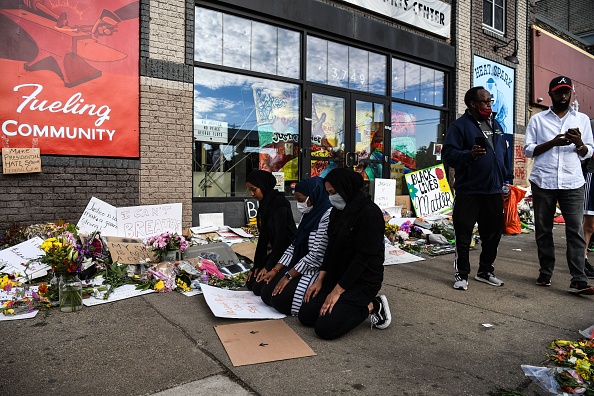
Muslim women offer evening prayers (namaz) at the makeshift memorial in honor of George Floyd, on June 4, 2020 in Minneapolis, Minnesota. Minnesota health officials have released guidleines on how the state's Muslim community can celebrate Eid al-Fitr safely during the pandemic. Eid will tentatively land on May 13, 2021. Photo: Chandan Khanna/AFP via Getty Images
Muslim women offer evening prayers (namaz) at the makeshift memorial in honor of George Floyd, on June 4, 2020 in Minneapolis, Minnesota. Minnesota health officials have released guidleines on how the state's Muslim community can celebrate Eid al-Fitr safely during the pandemic. Eid will tentatively land on May 13, 2021. Photo: Chandan Khanna/AFP via Getty ImagesMuslim women offer evening prayers (namaz) at the makeshift memorial in honor of George Floyd, on June 4, 2020 in Minneapolis, Minnesota. Minnesota health officials have released guidleines on how the state’s Muslim community can celebrate Eid al-Fitr safely during the pandemic. Eid will tentatively land on May 13, 2021. Photo: Chandan Khanna/AFP via Getty Images
Eid al-Fitr, which will tentatively land on May 13 this year is usually celebrated by Muslims around the world by attending Eid prayers, gathering with the community, family and friends, giving gifts, dressing up, and eating lots of food. Eid marks the end of the holy month of Ramadan.
Muslims in Minnesota are no exception and the Minnesota Department of Health, well aware of the significance of the holiday, has issued guidelines on how to celebrate Eid during the pandemic safely.
Gov. Walz announced last week that capacity and social distancing restrictions at businesses, gyms, social gatherings and at bars and restaurants will end on May 28, but Eid is arriving about two weeks before that.
The following are the guidelines from the Minnesota Department of Health:
Guidelines to help prevent the spread of COVID-19:
Do not host or attend large gatherings at mosques, restaurants, or your home, if possible. If you must, follow these recommendations:
Attend or host an outdoor gathering instead of an indoor gathering, if possible.
Wear a mask if you are indoors with anyone you do not live with. If you are in a crowded outdoor space, it is recommended to still wear a mask.
Stay 6 feet away from anyone you do not live with.
Consider delaying travel, even after you are vaccinated.
Every time you travel, you can spread COVID-19 variants to your community when you return. Help prevent COVID-19 variants from spreading in your community.
Get tested if you are exposed to someone with COVID-19, feel sick, or traveled recently.
Guidelines unvaccinated people should follow:
If you gather with people from other households, remember to:
Wear a mask at indoor gatherings. If you are in a crowded outdoor space, it is recommended to still wear a mask.
Stay at least 6 feet away from others.
Gather in an area with good ventilation. If indoors, bring in fresh air by opening windows and doors, if possible.
Cover coughs and sneezes, and wash or sanitize your hands often.
Write down the guest list in case someone tests positive for COVID-19 afterward and others at the gathering need to know.
Get tested at least five days after attending a large gathering.
If you are sick, waiting for COVID-19 test results, or were in close contact of someone who has COVID-19, stay home and do not attend a social gathering.
Get vaccinated if you are eligible. It is the best way to help prevent getting COVID-19 and be able to celebrate with community safely.
Guidelines vaccinated people should follow:
If you have been fully vaccinated for COVID-19 and it has been at least two weeks since the final dose of vaccine (enough time for your body to develop immunity), you have good protection against illness for yourself.
Wear a mask when gathering with anyone who is unvaccinated or when visiting a household with anyone at higher risk for severe illness from COVID-19.
You can gather indoors with smaller groups of fully vaccinated people without wearing a mask. Avoid larger gatherings.
You can gather indoors with unvaccinated people from one other household (for example, visiting with relatives who all live together) without masks.
Do not visit people who have an increased risk for severe illness from COVID-19.
You can gather with others outdoors without wearing a mask except in crowded settings and venues, such as sporting events, outdoor concerts, or other places where you cannot stay 6 feet from others and you are with people you don’t know. Recommendations may differ by setting.
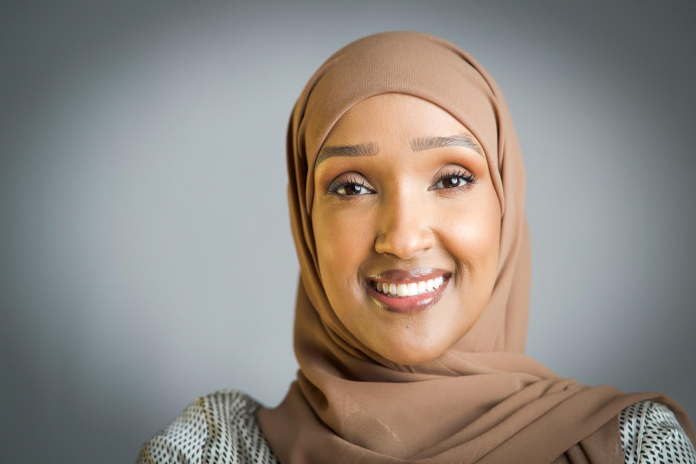
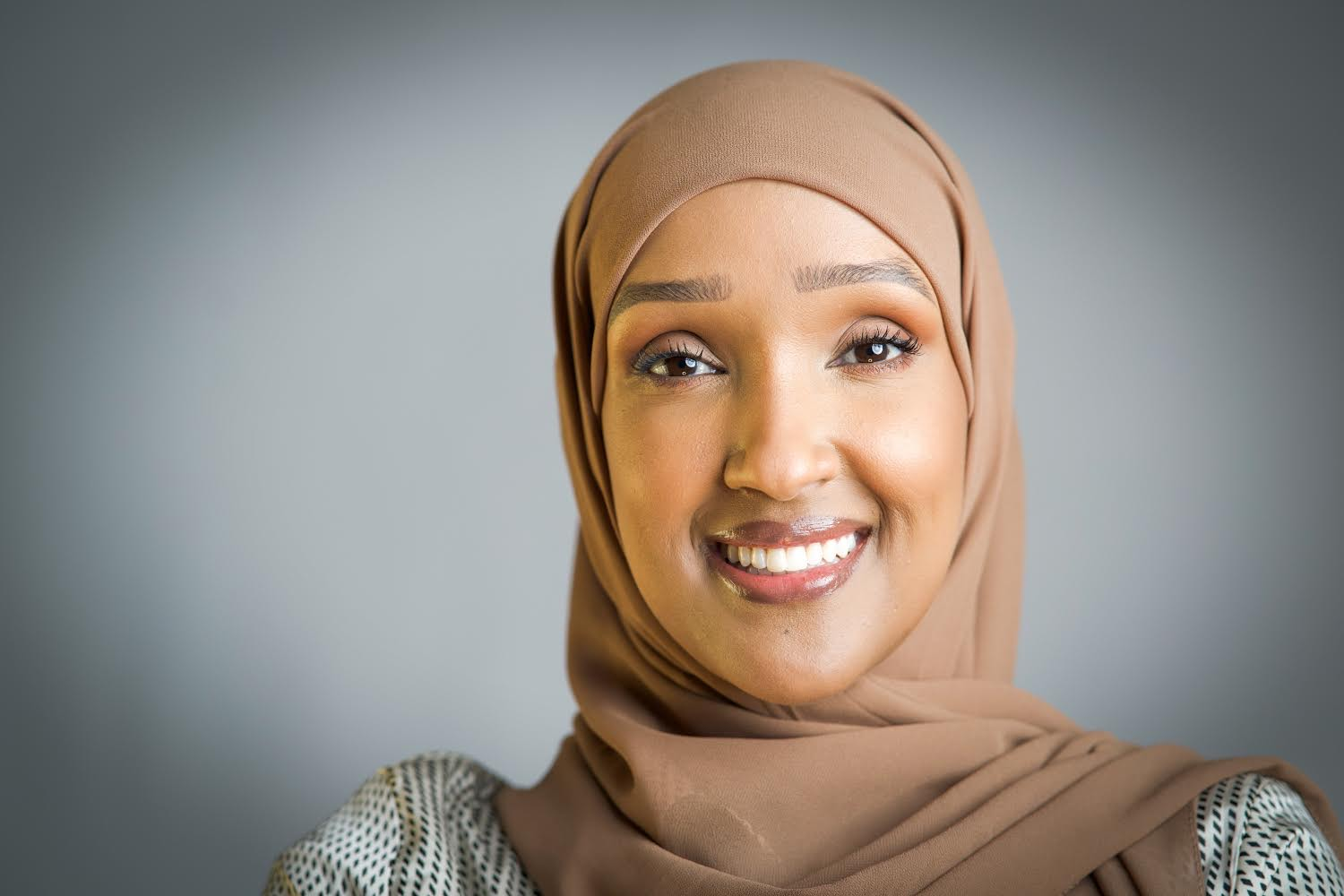
Yusra Arab, a candidate in Minneapolis' Ward 2 in the 2021 city elections has as her priorities community safety, affordable housing, support for small businesses, environmental justice, and having a more collaborative government. Photo: Courtesy of Yusra Arab
Yusra Arab, a candidate in Minneapolis' Ward 2 in the 2021 city elections has as her priorities community safety, affordable housing, support for small businesses, environmental justice, and having a more collaborative government. Photo: Courtesy of Yusra ArabYusra Arab, a candidate in Minneapolis’ Ward 2 in the 2021 city elections has as her priorities community safety, affordable housing, support for small businesses, environmental justice, and having a more collaborative government. Photo: Courtesy of Yusra Arab
Yusra Arab, a policy advocate, mental health practitioner, and community organizer, has announced her intention to challenge incumbent Cam Gordon in Ward 2 of the Minneapolis City Council.
Ward 2 covers the eastern part of Minneapolis, and spans both the east and the west banks of the Mississippi river. The ward is home to some of Minnesota’s most cultural and economically diverse populations. It has both high-density housing, as well as single-family residential neighborhoods. It is also home of the Twin Cities campus of the University of Minnesota, as well Augsburg College, University Medical Center, and Fairview Hospital.
Arab, who was born in Somalia, has lived in the ward since 2008. Like many Americans with a refugee background, Arab and her family were forced to flee her native country due to civil war. They fled to neighboring Kenya when she was just four years old, where they lived for nearly a decade before immigrating to the United States in 2001. Arab and her mother Hali spent a year in Tennessee before moving to Minnesota.
Upon arriving to the north star state, Arab says she instantly felt at home.
“I saw people that looked like me,” she said of the significant population of the Somali community in the ward.
The family settled in the Twin Cities, where her mother was able to find work in environmental services.
Arab has spent her teenage and adult years in the Twin Cities. She is a graduate of Washburn High School in Minneapolis. She holds a bachelor’s degree in Political Science and International Relations from the University of Minnesota, and a Master’s degree in Health Care and Human Services from Saint Mary’s University.
Upon completing her undergraduate studies in 2010, Arab found work as an educator in a local school. It was during that time that she also received some life-changing news. She was diagnosed with Lupus, an autoimmune disease that weakens immunity and attacks healthy tissues.
“It was a learning curve,” she said.
Arab said the new health challenge provided her with new opportunities to learn about the disparities that existed within her community as she researched her own treatment options. It led her to pursue work in public advocacy as a policy advisor to the Minneapolis City Council on affordable housing, economic inclusion, and community-police relations.
While fulfilling that role, Arab witnessed first-hand the disconnect that existed between the council’s leadership and its constituents, she said.
“I’d walk into a room and I’d be the only person [of color] in it,” she said.
Her experience at City Hall motivated her to launch her campaign in February to fill that gap.
“There has been a lot of changes,” Arab said.
In recent years, Ward 2 has seen a series of demographic changes which have led to a more diverse population.
“Minneapolis doesn’t look like Minneapolis from twenty to thirty years ago,” she said.
The demographic changes present a new set of challenges as income disparities have become more apparent. Public safety has also become a bigger issue, especially since the murder of George Floyd by a Minneapolis police officer in May.
Arab intends to advocate for community safety, affordable housing, support for small businesses, environmental justice, and having a more collaborative government, issues she said are of equal importance.
“I would love to see a more inclusive ward,” she said. “A ward that interacts with its neighbors.”
If elected to office, Arab promised to have an open policy between the council and its constituents.
“They can expect a more connected Ward 2 office,” she said. “A Ward 2 office that serves as an extension of the community. My goal more than anything is to fill that gap that exists right now in Ward 2.”
Arab resides in the Southeast Como neighborhood with her mother, Hali, and 11-year-old daughter, Aisha. To learn more about her campaign you can visit her website.
The city of Minneapolis’ municipal election is scheduled to take place on Nov. 2, 2021, with early voting expected to begin on Sept. 27.
Chase is now offering a $5,000 homebuyer grant to help to more customers cover closing costs and down payment when buying a home in 6,700 minority neighborhoods nationwide. Photo: Andrey Popov/Shutterstock
Chase is now offering a $5,000 homebuyer grant to help to more customers cover closing costs and down payment when buying a home in 6,700 minority neighborhoods nationwide. Photo: Andrey Popov/ShutterstockChase is now offering a $5,000 homebuyer grant to help to more customers cover closing costs and down payment when buying a home in 6,700 minority neighborhoods nationwide. Photo: Andrey Popov/Shutterstock
Advertorial
For many, the first step to buying a home is saving up for the down payment. It can feel like a difficult goal when you first start, even if you don’t plan to buy for years. Here are some tips to help you start saving and speed up the process:
Determine your budget
Knowing how much you need to save will help you create a focused plan for reaching your goal. Keep in mind that most people can qualify for a bigger mortgage than they can comfortably afford. Use a mortgage affordability calculator to help you determine what you could borrow, then speak with a home lending advisor to better understand what fits your budget.
A common down payment amount is 20%, but there are lower options available. However, a higher down payment can mean lower monthly payments, and paying less interest over the life of the loan. It can also help you avoid the extra expense of private mortgage insurance (PMI).
Be sure to calculate other costs of home buying, like:
Consider breaking your savings amount into monthly amounts. For example, say you want to buy a home in five years and you need to save $60,000 for the down payment and other costs:
You’d need to save $1,000 a month for five years ($60,000/60 months = $1,000 per month).
A monthly savings plan can provide focus and make the down payment goal more achievable. It can also help you make better decisions about what you can afford and a reasonable timeline for doing so.
Pay down your debt
When trying to save for a home, it can feel counterintuitive to spend money paying down debt. After all, shouldn’t every extra penny go toward savings? Not necessarily. Paying down debt can help with your home purchase in two big ways:
It’s good for your credit score.Credit scores have a significant impact when qualifying for a mortgage. The better your credit score, the lower your mortgage interest rate is likely to be. Paying down debt shows lenders you’re able to cover your expenses.
It can free up savings in the future. The money you used to pay bills can now go directly into your savings account rather than paying interest on other debts like credit cards. The bonus is you won’t notice the difference in your budget because the money was going out anyway.
Paying down your debt can help when you buy your home, too. The money you were spending can now go toward updating and decorating.
Reduce your expenses
Review your expenses and decide what you can temporarily do without. Saving doesn’t have to mean eliminating all discretionary spending, but the more you cut back, the faster you’ll reach your financial goal. Steps to reduce your expenses include:
List all of your expenses, to see where you could cut back. Consider everything, even an expense like rent. Could you move into a less expensive property or split bills with a roommate?
Examine your monthly membership expenses. Do you need cable when you use mostly use streaming services? Could you ditch the gym membership in favor of running local trails?
Only you can decide what you’re willing to live without while saving for a down payment. But remember, you won’t be saving for a down payment forever. A few years without that subscription will feel worth it when you’re sitting in your new home.
Automate your savings
The more you can automate saving, the easier it can be to stick to the plan. Create a monthly automatic withdrawal on payday to send money directly to your savings account. Keep your savings separate, too, either by opening a new account with your current bank or even opening a new account with another bank.
This automated savings plan is known as “paying yourself first.” You pay your savings account first, then see what’s left to spend for the rest of the month, removing the temptation of waiting to see what’s left to save at the end of the month.
Unsure how to set up an automatic transfer to your savings account? Talk to your bank. Savings apps can also help you automate the process. Just be sure you read the fine print to make sure the money will be available for withdrawal when you need it.
Put “found” money to work
Found money is the money you earn that doesn’t come from your monthly income – unexpected windfalls not factored into your budget. Tax refunds, cash gifts for birthdays or holidays, a bonus at work, and rebate offers are all “found” money.
Instead of pocketing the money, put it toward paying down your debt or building your savings. Even small amounts can add up quickly over the years you’re saving for your home.
Cover yourself with an emergency fund
Plans are great, but life happens. Protect yourself and your savings by creating an emergency fund. Set aside some cash you can dip into for unexpected expenses like car repairs or a medical emergency.
You can use this money instead of paying with a high-interest credit card or withdrawing from down payment funds. When the emergency is over, pay back your emergency fund first, then resume your savings plan.
When you start saving, it can feel like reaching your goal is a long way off. But as months go by, your enthusiasm will build as will your savings. While you’re saving, make sure you know all of your mortgage options and keep an eye on interest rates.
Chase is now offering a $5,000 homebuyer grant to help to more customers cover closing costs and down payment when buying a home in 6,700 minority neighborhoods nationwide.
For more info and to see if you qualify, or to find a Chase Home Lending Advisor in the Twin Cities, visit www.chase.com/communitylending, or reach out to Chase Community Home Lending expert Felton Ellington at [email protected].
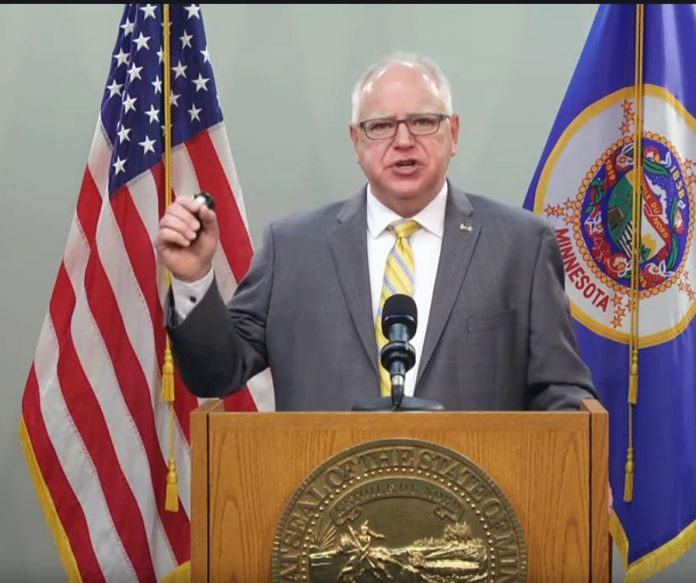
Governor Walz speaking on May 6, 2021 when he announced the end of COVID restrictions in the state. Photo: Governor's Youtube Channel Screenshot
Governor Walz speaking on May 6, 2021 when he announced the end of COVID restrictions in the state. Photo: Governor's Youtube Channel Screenshot
Big changes start on May 7 ahead of May 28 end date. No masks starting July 1.
Gov. Tim Walz on Thursday announced a three phased approach to rolling back what remains of Minnesota’s COVID-19 restrictions starting Friday, May 7.
Here are the highlights and timelines of the changes (you can watch the broadcast above):
May 7
No capacity restrictions for outdoor dining for bars and restaurants. Indoor capacity of 75 percent for bars and restaurants still remains.
Curfew is over. The governor has ended the 11 p.m. curfew on bars and restaurants.
Large outdoor venues which had been limited to 10,000 (such as Target Field), capacity restrictions are now removed.
No masks required for outdoor venues if they are less than 500 people.
Large indoor venues (like Xcel Center in St. Paul where the Minnesota Wild play) that had been limited to 3,000, those restrictions are now removed. However, for these large indoor venues, physical distancing is still required. Masks still required.
Social gatherings: Limit increased to 50 from 15.
Playing outdoor sports: No masking required. No more distancing rules.
May 28
When Minnesotans wake up the morning of May 28, capacity and social distancing restrictions at businesses, gyms, social gatherings and at bars and restaurants will be over.
However, masks are still required for indoor and outdoor events that have more than 500 people.
July 1
All restrictions on gatherings will end including masking requirements. However, if 70 percent of Minnesotans 16 and older have at least one dose of their COVID-19 vaccine prior to July 1, then all restrictions will end sooner than July 1.
What is not changing
Eviction moratorium: The governor said the eviction moratorium in place because of the pandemic will remain in place as will his emergency powers.
Additionally, the governor will still allow businesses and local government to still have their own requirements n masking or other coronavirus prevention measures.
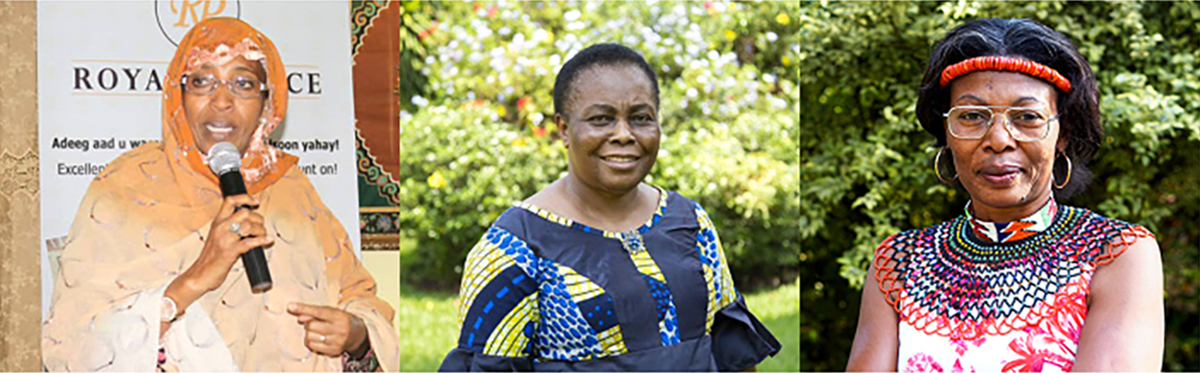
Three African women, Julienne Lusenge, Zahra Mohamed Ahmad and Maximilienne Ngo Mbe have been awarded the US State Department's International Women of Courage Award.
Three African women, Julienne Lusenge, Zahra Mohamed Ahmad and Maximilienne Ngo Mbe have been awarded the US State Department's International Women of Courage Award.Zahra Mohamed Ahmad, Julienne Lusenge and Maximilienne Ngo Mbe are recipients of this year’s US State Department’s International Women of Courage Award whose ceremony was held virtually this year due to the ongoing pandemic. Photos: Courtesy of US State Department
When Maximilienne Ngo Mbe was in her final year of high school in Cameroon, the principal discarded learning materials in a blatant act of sabotaging students’ readiness to succeed in their final exams. It was in the early ‘90s, during an election year, and – as young people often do – Mbe and her fellow students were opposed to their principal’s preferred candidate, President Paul Biya.
If the principal’s action was supposed to intimidate students, it failed. Instead, it ignited a student movement of opposition.
“We got together to discuss what we could do, what action we could take to make it stop,” Mbe said. “On a Monday morning, we organized.”
Mbe continued her activism after high school. In 1991, she decided that she was going to become a human rights defender. She has fearlessly continued her advocacy work for three decades fighting for democracy, workers’ rights, as well as children’s and women’s rights.
Her efforts to advance human rights go beyond the borders of Cameroon. Over the years, she has created partnerships with various organizations that have negotiated ceasefires and sought lasting resolution to armed conflicts in the African continent. Since 2010, Mbe has led the Network of Human Rights Defenders of Central Africa, an organization that unites and supports advocates from the region.
Mbe is one of this year’s recipients of the International Women of Courage Award, given annually by the U.S. Department of State to honor female activists from around the world. Recipients are women who have demonstrated exceptional courage, and leadership in advocating for peace, justice, human rights, gender equality, and women’s empowerment – actions that often come with great sacrifice and risk to them and their families. This year’s awards were hosted virtually due to the pandemic with special remarks delivered by the First Lady, Dr. Jill Biden.
The honorees came from 14 different countries, including three from the African continent. Mbe from Cameroon, Julienne Lusenge from the Democratic Republic of the Congo (DRC), and Zahra Mohamed Ahmad from Somalia, were the three African women honored.
Mbe knows all too well the risk women who try to speak up against injustices take. In addition to her life being under continued threat, her children have not been exempted. For example, they were targeted after she openly questioned the government’s use of violence in disciplining corrupt officials, as well as the use of excessive force in the fight against Boko Haram, the Nigerian terror group, whose fighters often flee to Cameroon.
“They began by threatening my children with kidnap,” Mbe said.
Security forces went to her children’s school and abducted her niece.
“They thought that my niece was my daughter because they are very similar,” Mbe explained. “They raped her and they left her at the edge of town.”
Soon after, Mbe moved her children to France for protection, an action she received criticism for as being influenced by the west.
Lusenge, the activist from the DRC, has been fighting against gender based violence and promoting women’s rights in conflicted regions for more than 40 years. Lusenge, who grew up in a home with a father who valued gender equality, was inspired to begin her advocacy work in order to help other women. Growing up in the DRC, she witnessed the limitations and injustice that women around her experienced.
“When I was young I saw people in villages, women and girls who were submitted to traditional customs and customs that don’t respect human rights,” Lusenge said.
She began her career as a journalist for a local radio station, a job that allowed her to travel around the DRC. In her profession, she was able to highlight the need for more women’s rights and provide a platform for women to use their voices. During the civil war that began in 1998 in the DRC and lasted for five years, Lusenge used her journalistic experience to document injustices against women in order to be used to prosecute offenders.
In 2000, Lusenge created Women’s Solidarity for Peace and Integral Development, the DRC’s principal organization defending the rights of women and girls against gender-based violence. Her work has contributed to the adoption of United Nations international agreements such as UN 1820, which recognizes sexual violence as a weapon of war. Lusenge said the progress has made in her career, and the optimism she has for the future generations of women in her country motivate her to continue her advocacy.
“The sense of solidarity with other women keeps me going,” she said. “We must continue to struggle, to work, so that we can also feel the positive change.”
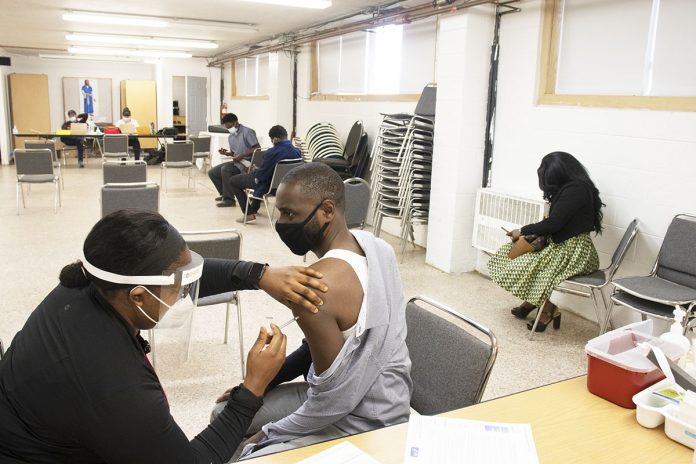
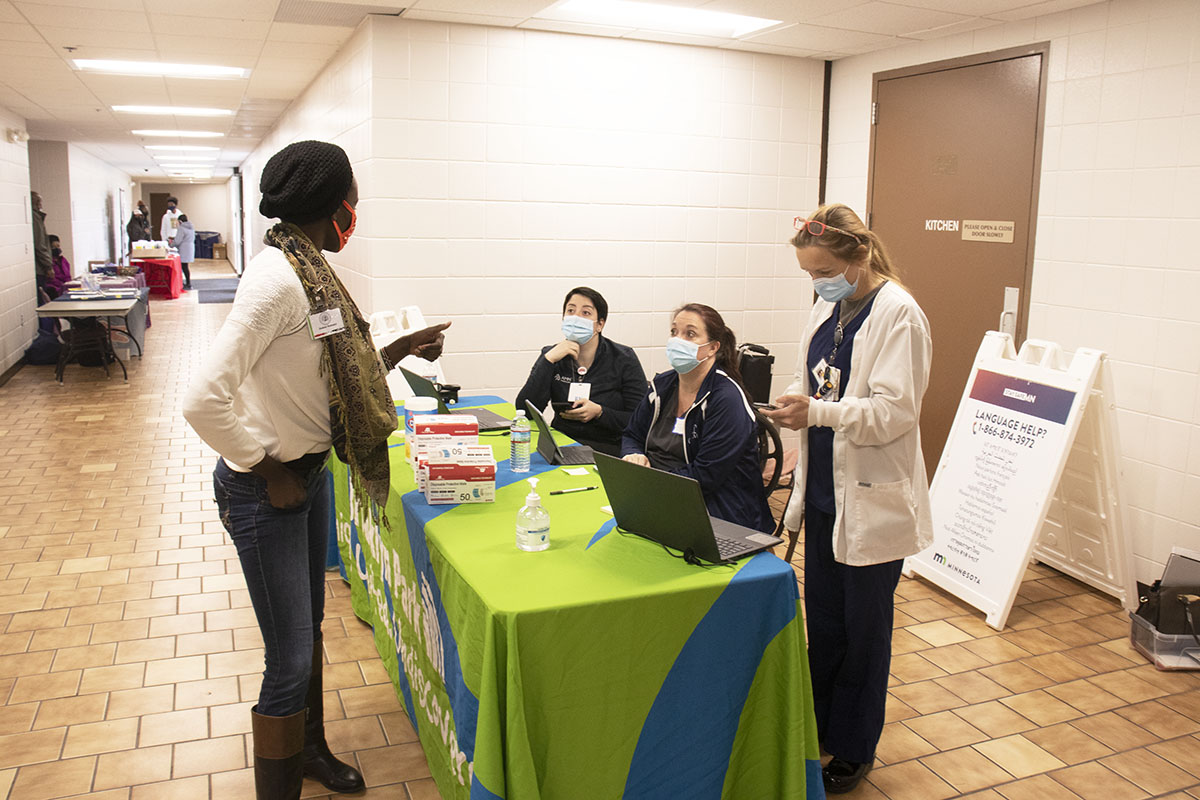
M Health Fairview nurse Palisa Panton administers the Pfizer-BioNTech dose on Pastor Ezra Kenyanya, the youth pastor at the Kenyan Community Church located in Brooklyn Center, Minnesota when the church hosted a coronavirus vaccination mobile clinic on Sunday, April 25, 2021. Photo: Tom Gitaa/Mshale
M Health Fairview nurse Palisa Panton administers the Pfizer-BioNTech dose on Pastor Ezra Kenyanya, the youth pastor at the Kenyan Community Church located in Brooklyn Center, Minnesota when the church hosted a coronavirus vaccination mobile clinic on Sunday, April 25, 2021. Photo: Tom Gitaa/Mshale
As the youth pastor at the Kenyan Community Church in Brooklyn Center, Ezra Kenyanya never thought he would play a role in providing COVID-19 vaccines to the local community until the church pastor, Simeon Momanyi asked him to take the lead on behalf of the church.
It was a culmination of weeks of turmoil that rocked the neighborhood following the killing of 20-year-old Daunte Wright by Brooklyn Center police Officer Kim Potter during a traffic stop. Days of protests outside the Brooklyn Center police station followed and the church, which shares a fence with the station, became a refugee for protestors as they recovered from the teargas and rubber bullets law enforcement was using.
“We run a weekly food ministry, and many families come through that we serve every week. During the protests outside the police station the food ministry was serving those who needed food and water each night, we kept our doors open,” Kenyanya said.
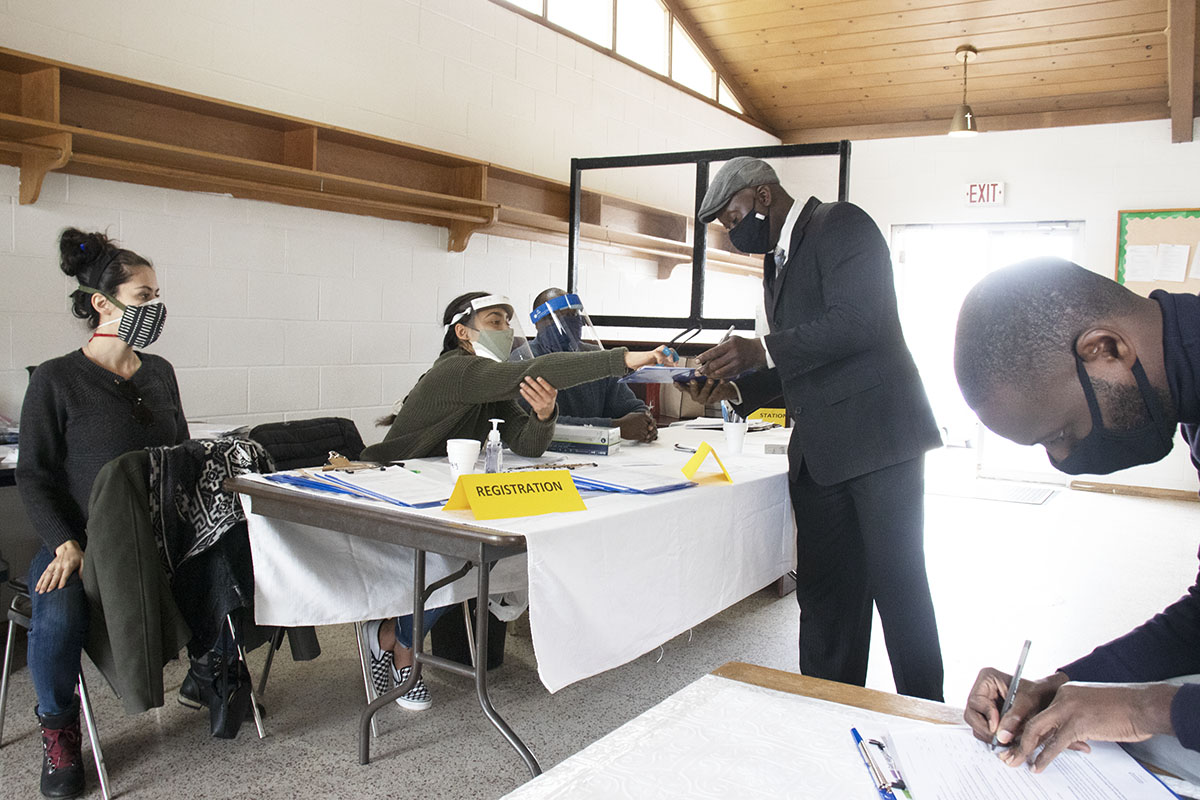
Staff from the office of Representative Ilhan Omar manned the registration desk during a COVID-19 vaccination exercise at the Kenyan Community Church in Brooklyn Center, Minnesota on Sunday, April 25, 2021. Photo: Tom Gitaa/Mshale
Upon request from the office of Congresswoman Ilhan Omar and Mayor Mike Elliott, the church jumped at the chance to host a mobile vaccination clinic. It followed days of consultations between Rep. Omar’s district office and the mayor’s office on what else the community needed following two weeks of turmoil. COVID-19 vaccines were on top of the list.
Mobile vaccination clinics have become an important component of the Minnesota Department of Health (MDH)’s strategy to address vaccine access disparities, particularly among people of color and immigrants. The mobile vaccine clinics have been launched in partnership with churches and other trusted community groups.
Kenyanya and Momanyi are among the faith leaders that have been tapped to address the gaps in vaccine access in the immigrant communities. Others are immigrant community associations and non-profits. One such association is Mwanyagetinge Association of Kenyans in Minnesota, the largest grouping of Kenyans in the state and ACER (African Career, Education and Resource, Inc.), a non-profit which operates out of Brooklyn Park and also hosts a community COVID-19 hotline.
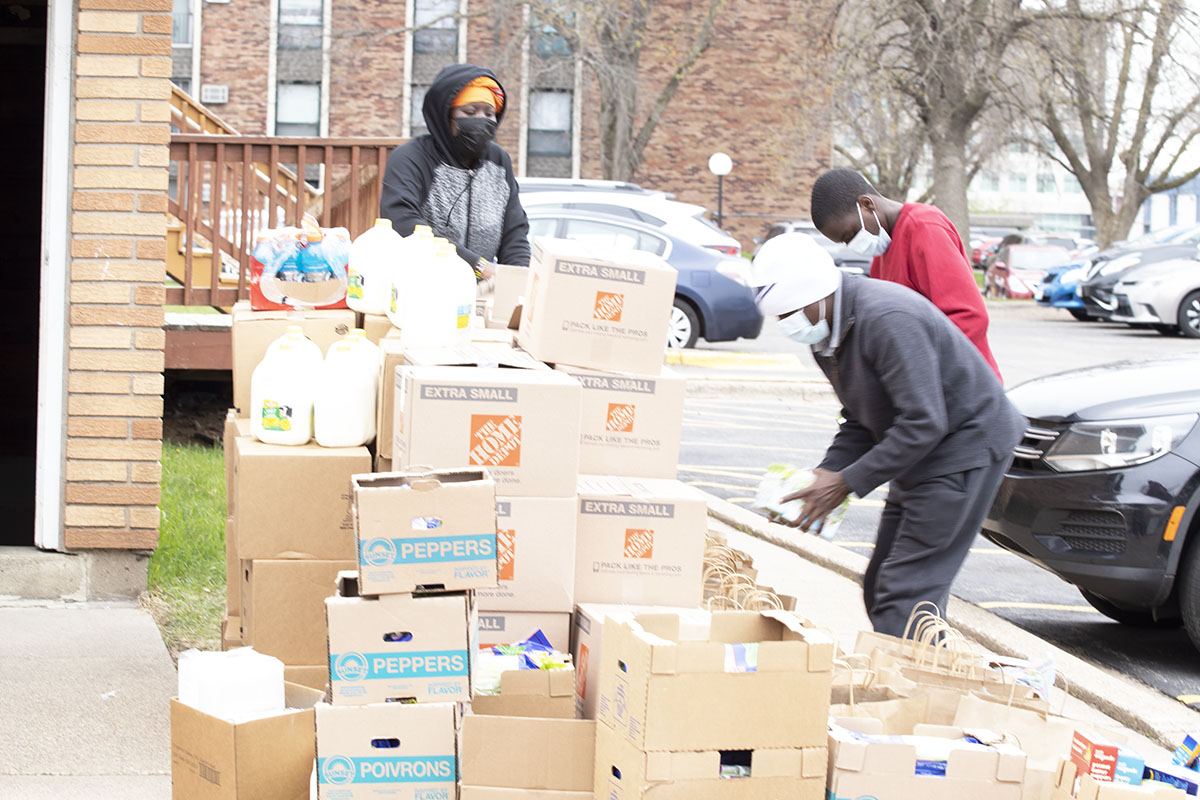
Volunteers at the Kenyan Community Church in Brooklyn Center during a food drive that happened outside the church parking lot during a COVID-19 vaccination exercise that took place inside the church on Sunday, April 25, 2021. Photo: Tom Gitaa/Mshale
“We are having conversations with ACER to host another mobile vaccination clinic, and also other faith leaders, providing them the opportunity to sponsor mobile vaccine clinics,” MDH African Immigrant Lead Coordinator Aisha Galaydh said Sunday.
Officials are hoping with the outreach being done by trusted community leaders and clergy, and vaccines being offered at sites immigrants and people of color are familiar with, vaccine distribution will become more equitable.
According to Kenyanya, 300 individuals signed up to receive their first shot of the Pfizer vaccine at the Sunday clinic. Some were members of the KCC congregation, but the majority were residents of the surrounding neighborhood that leaders reached out to following the protests outside the police station. Kenyanya was among those who received his first shot on Sunday.
The vaccines were administered by M Health Fairview.
Some in his congregation have been hesitant to receive the vaccine, either out of fear or due to medical issues, but he said many were happy to hear about the opportunity to take it at their own church.
“The community associates our church as being a safe place. I am sure when they see clergy members like myself take the vaccine, it can help to dispel some of the misconceptions about vaccinations,” Kenyanya said.
The president of Mwanyagetinge Association of Kenyans in Minnesota, Huldah Momanyi-Hiltsley, speaking with nurses from the Minnesota Department of Health during a COVID-19 vaccination pop-up clinic that her organization hosted at the Brooklyn Park Community Center on Sunday, April 25, 2021. Photo: Tom Gitaa/Mshale
Three miles away in Brooklyn Park, another pop-up clinic was being held the same day at the Brooklyn Park Community Center under the auspices of Mwanyagetinge.
Mwanyagetinge president Huldah Momanyi-Hiltsley, and her board leadership, had spent the last month leading to the event on the phone and social media relentlessly promoting it. In their outreach, they found that many Kenyans were unvaccinated because of what can be a confusing process of getting an appointment at the mainstream providers, to making sense of the eligibility criteria, before Gov. Walz opened vaccine eligibility to everyone.
Mwanyagetinge or Kenya Community Church hosting a vaccine clinic on the other hand, are entities that Kenyans are familiar with, even if they are not members, and they felt comfortable signing up, Momanyi-Hiltsley said.
“We had slots for 200,” she said. “Those 200 were snapped up quickly during signup online and luckily MDH came with 300 and it looks like we will use all of them as some more people are coming.”
In his efforts to increase vaccinations among his residents, Mayor Mike Elliot of Brooklyn Center told Mshale that churches and mosques in his city play a large part.
“People trust and are already used to going to those places and are comfortable there. We are reaching out and getting them involved, because I believe they play a critical role in ensuring members of our community are vaccinated,” Mayor Elliott said.
Darrel German has been named TCF regional president for Minnesota. Photo: Courtesy TCF
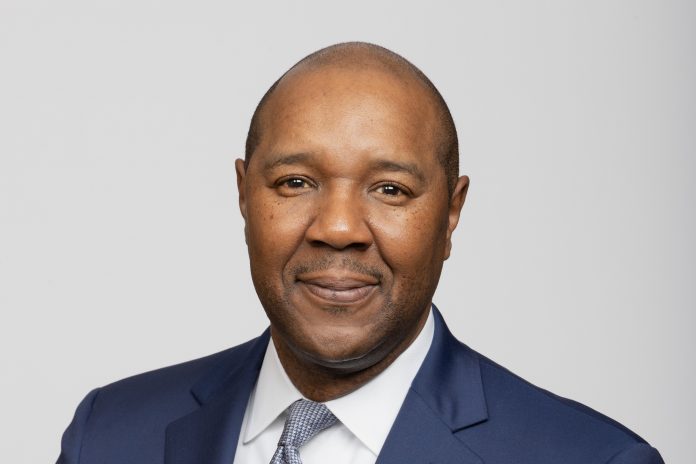
Darrel German has been named TCF regional president for Minnesota. Photo: Courtesy TCF
TCF Financial Corp. has announced that Darrel German will be the regional president of its Minnesota region. German will lead the Middle Market team and be responsible for all TCF business activity in the Twin Cities and throughout Minnesota, according to a news release from TCF.
German has more than 30 years of banking and financial services experience, including 15 years dedicated to commercial banking. His time in the banking and financial services industries overlapped with his 33 years in the United States Army, from which he retired in 2016 as Colonel.
“We are thrilled to have Darrel join TCF as our regional president in the Twin Cities. He will continue in this role following our merger with Huntington, which is expected to close late in the second quarter, pending regulatory approvals,” said Mike Jones, president and chief operating officer, TCF Bank. “German has extensive experience successfully entering new markets, building highly effective teams, and developing and executing strategies that result in profitable growth in market share.”
“TCF has a long history of serving customers in the Twin Cities, and we see enormous opportunity in this market to help middle market businesses succeed — whether that be working capital lines of credit, acquisition financing, or services to improve operational efficiencies,” said German. One of the things that drew me to TCF is its commitment to customers, team members and the community. I am proud to be a part of this stellar team.”
In the Minneapolis/St. Paul metro area, TCF is the fourth largest bank with $8.5 billion in deposits and employs 2,700 employees, naming it among the top-50 largest employers in the state.
TCF Bank and Huntington Bank are in the middle of a merger that is scheduled to complete in the summer.
After the merger, the name TCF will disappear and become Huntington Bank.
In addition to branches’ names changing, among the most visible change to Minnesotans will be TCF Bank Stadium whose name will change according to a December 2020 story by the Minneapolis/St. Paul Business Journal.
The Business Journal quoted Steve Steinour, president and CEO of Huntington, as saying
“We’re going to take the name from TCF to Huntington,” he said. “I believe that contract facilitates the name change.”
Mr. German’s role as regional president will be unaffected once the merger is complete.


 You do not qualify for this exception if: