Home Blog Page 84

Do Brooklyn Park voters want another white mayor?

0
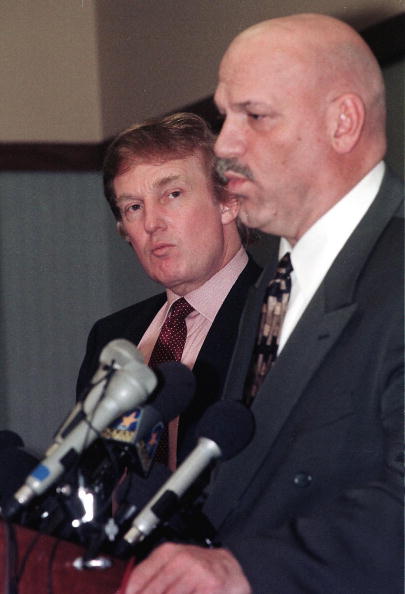
Former President Donald Trump (L), then a potential Reform Party candidate listens as then Minnesota Govenor Jesse Ventura takes a question at a news conference after Trump gave a speech at a Chamber of Commerce luncheon 07 January 2000 in Brooklyn Park, Minnesota, the city where Ventura was once mayor. Trump also spoke later that day at a fund-raiser for the Jesse Ventura Volunteer Committee in Brooklyn Park. Since its incorporation as a Township in February 1954 and later as a charter city in September 1969, the city has yet to elect a person of color. Photo: Craig Lassig/AFP via Getty Images
Ventura and Trump in Brooklyn Park in 2000
Former President Donald Trump (L), then a potential Reform Party candidate listens as then Minnesota Govenor Jesse Ventura takes a question at a news conference after Trump gave a speech at a Chamber of Commerce luncheon 07 January 2000 in Brooklyn Park, Minnesota, the city where Ventura was once mayor. Trump also spoke later that day at a fund-raiser for the Jesse Ventura Volunteer Committee in Brooklyn Park. Since its incorporation as a Township in February 1954 and later as a charter city in September 1969, the city has yet to elect a person of color. Photo: Craig Lassig/AFP via Getty Images

Almost 10 years since Brooklyn Park became a majority-minority city, and 66 years since its incorporation as a Township, the sixth largest city in Minnesota has yet to elect a mayor that is not white.

The state where George Floyd was killed by a policeman that lived in a suburb not too different from Brooklyn Park, has forced Minnesota to confront its legendary racial disparities in most facets of its society, including elective office.

That reckoning for Brooklyn Park came quickly on the heels of Floyd’s death when in November it elected its third person of color into the city council. There are six elected council members plus the mayor for a seven-person council. African American Boyd Morson won in November by just over 500 votes, beating the DFL endorsed Christian Eriksen. Council elections are non-partisan but the DFL has not been shy about endorsing candidates in those races.

Susan Pha, was the first person of color elected to the council in 2017, becoming the first Hmong American to do so. By electing Pha, voters in the city set in motion the process to realign the council to better reflect the city’s demographics. One year after Pha’s election, Liberian American Wynfred Russell was elected to the council.

After the 2020 general election and the ascendancy of Morson, the council is now close to 50 per cent people of color.

In last year’s general election, then Mayor Jeff Lunde got elected to the Hennepin County Board of Commissioners representing District 1 which includes Brooklyn Park. His move to the county seat created a rare open seat that has to be filled by a special election as stipulated by the city charter.

Electing a mayor of color in August will make the council majority-minority for the first time in the city’s history.

February 16 was the last day to file for a special primary election that will be held on April 13 to narrow the field to two candidates that will proceed to the August 10 special election. Seven candidates have filed to run in the special election with five them filing on the very last day. Candidates can withdraw their candidacy by February 18 – 48 hours after the filing period closed.

Absentee voting for the primary will begin on February 26 through April 12.

Four of the seven that have filed are Black men, two of them sit on the council already – Wynfred Russell and Boyd Morson. Hollies Winston and Benjamin Osemenam round up the slate of Black candidates running.

The other three include two white women and a white man. One of the women, Lisa Jacobson easily won reelection to the council in November’s election beating Nigerian American engineer Benjamin Osemenam. Osemenam, unable to convince voters in the East District to elect him in November, seems convinced he can convince voters citywide to entrust him with the mayorship. He was among the last-minute filers on February 16. November was his second unsuccessful attempt to join the council.

Yelena Kurdyumova, who can best be described as a fringe candidate, is the other white woman bidding to be mayor. After a landslide loss to Susan Pha in last year’s primary where she only managed to garner 385 votes to Pha’s 1,765, she joined former President Trump in denouncing mail-in ballots as fraudulent and asking residents to write her in as a candidate in November.

‘Culture of hostility’

Mark Mata, was a member in the previous council but did not seek reelection in November. He is the only white man in the race. It appears the decision not to run was informed by his desire to be mayor. Mata was in 2017 accused by fellow council members of a “culture of hostility” which cost the city $173,000, so that the city’s beloved fire chief, Ken Prillaman, could leave without suing the city.

Mata was a paid on-call fire fighter at the fire department and was accused of using his council position to intimidate the fire chief. Fellow Republican Jeff Lunde who was the mayor then said “We are here because of the culture of hostility created by a council member.” The council member in question being Mark Mata. Mata at one time served on the council at the same time with his father Bob Mata, representing different districts. The elder Mata was defeated in his reelection bid in 2018 by Wynfred Russell.

The Frontrunners

When given the chance since 2016, Brooklyn Park voters have shown the proclivity to go with a person of color at the council. In three consecutive election cycles since the historic election of Pha, the voters have chosen at least one person of color.

Are the voters ready for a mayor of color this year?

Wynfred Russell, one of the candidates said “it is about time we have someone of color in the mayoral seat,” when he spoke with Mshale during an interview soon after declaring his bid, referring to the changed demographics in the city that call for it.

If the voters are ready for a person of color to be mayor, they will probably take a look first at Hollies Winston. Of all the seven candidates running, he is the only one that has run a substantive citywide race. He faced off against Jeff Lunde in the last mayoral election in 2018 and received 13,203 votes to Lunde’s 15,174.  66% of the 43,460 registered voters turned out to vote that year.

Wynfred Russell, Mark Mata and Lisa Jacobson are the other three candidates besides Winston with the name recognition likely to propel them past the April primary. The three have run winning council races but none has contested citywide.

Charges of racism

Recent events might suggest how a white candidate like Lisa Jacobson might be poorly positioned for the times we are in. In a blistering attack on November 14, 2020 soon after it became clear the office of mayor will be vacant, Abdullah Kiatamba, a mercurial leader and grassroots organizer in the Liberian community called Jacobson “racist, anti-immigrant and dangerous.” The accusation sparked an intense discussion on Liberians in Minnesota, a popular Facebook group with over 8,000 members, many of them voters in Brooklyn Park. Some of the angry comments directed at her by the group’s members are not fit to publish.

Mshale spoke via phone with Kiatamba in Liberia, where he is currently attending a funeral, to seek clarity on his criticism of Jacobson. Kiatamba said the Republican councilwoman is very good with superficial interactions with the Black community “but works against our top interests such as when we were trying to get the city to work with the (West African) Ebola Taskforce.”

Another Brooklyn Park resident expressing concern with the Jacobson candidacy is Hassanen Mohamed.

“Lisa does not have the leadership skills needed to get our city where it needs to go,” Mohamed said. “We need a mayor that understands all the communities that live in this city.”

Mohamed recalled what he calls a defining moment in the character of Lisa Jacobson. In 2017 as then president Trump moved to restrict immigration and ban travel from majority Muslim countries, cities around the country started issuing resolutions in support of immigrants and Muslims. Councilwoman Susan Pha, then the only person of color in the council introduced such a resolution in a February 13, 2017 council meeting. “Among those pushing back was Lisa,” said Mohamed. Jacobsen eventually voted in favor of what Councilwoman Pha said was a “watered down” version, after a lot of waffling, according to Mohamed.

In regards to Mata, after costing the city $173,000 in the separation agreement with popular former Fire Chief Ken Prillaman, it is difficult to see how he gets past the primary. Memories of that settlement still linger among city residents. His decision not to seek reelection might have been a nod to the new realities in the city but could also have been a positioning move to run for mayor.

As of the time of this writing, the Mata candidacy was the only one without a website or email address listed on the city’s website that shows candidates that have filed and cleared to be on the ballot.

The crowded field, which was predicted by the former mayor, has come to pass and it is worrying those hoping to see a person of color elected as mayor. With seven candidates running in the primary, one only needs a plurality of voters to be among the top two. Even with their reduced numbers, whites still constitute 45% of the city. The DFL party machine is expected to pull all the stops to get Winston past the primary and they might prevail given what happened in 2018 when Winston was also the party’s endorsed candidate. Congressman Dean Phillips who represents the city in Congress has endorsed him, as has the Speaker of the Minnesota House of Representatives, Melissa Hortman. The speaker lives in the city.

Should Winston come out on top, it will matter a great deal who comes in second in April. Some of the white voters, because of the DFL endorsement will go for Winston, but many of them, appalled at Mata’s past behavior, will for the most part line up behind Jacobson giving her the plurality she needs to get past the primary.

Lyna Nyamwaya is the founder and president of the African Nurses Network which boasts a strong membership base in the city. Speaking to Mshale in her private capacity, she sounded exasperated at the number of Black candidates running, saying it will aid in frustrating the dream of a mayor of color for the city.

“From past experience and history, divide and conquer is still very existent. If the Black brothers unite, umoja ni nguvu (Swahili for unity is strength). Dividing the Black voters, Africans and African-Americans, gives the other candidates more votes,” Nyamwaya said.
People of color questioning Covid-19 vaccine aren’t conspiracy theorists, Dr. Fauci, Muslim-American doctors, say

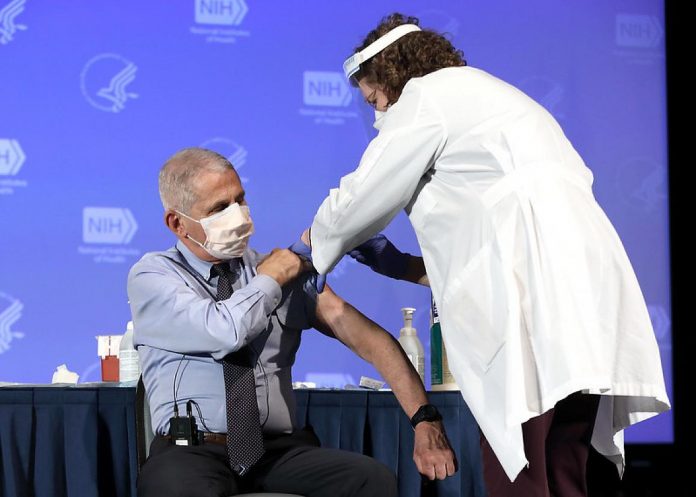
Dr. Anthony Fauci, director of the National Institute of Allergy and Infectious Diseases, receives his first dose of Moderna's COVID-19 vaccine on Tuesday, December 22, 2020 at the National Institutes of Health in Bethesda, Md. Photo: Courtesy National Institutes of Health
Fauci Receiving Modena Vaccine on Dec 22 2020 Photo by NIH
Dr. Anthony Fauci, director of the National Institute of Allergy and Infectious Diseases, receives his first dose of Moderna's COVID-19 vaccine on Tuesday, December 22, 2020 at the National Institutes of Health in Bethesda, Md. Photo: Courtesy National Institutes of Health

President Joe Biden’s chief medical adviser on Covid-19, Dr. Anthony Fauci, and Muslim-American doctors asked health care professionals to engage vaccine skeptics in minority communities, and to distinguish them from antivaccine conspiracy theorists.

“You have to respect people’s skepticism and don’t immediately jump on them and criticize them for it,” Fauci said. “Rather than telling them that they have no idea what they are talking about, I think you need to embrace them and engage them.”

Fauci advised medical practitioners to instead put more effort into explaining to skeptics the dominant role science plays in the implementation of public health measures.

“In the history of everything we’ve done in public health, there is no doubt that scientific data leads to the best outcomes,” Fauci said. “We just need to convince people who have skepticism about the scientific method.”

Fauci was speaking Thursday during an online conference held by Illinois-based American Muslim Health Professionals, and moderated by Dr. Hasan Shanawani, the organization’s president.

The speed at which the Covid-19 vaccine was developed – 11 months – has led to millions of people around the world questioning its safety. Previously, the fastest vaccine to go from development to distribution was the one for mumps, which was done in four years in the 1960s. Covid-19 vaccine Skepticism is higher among minority communities, especially African Americans, who in the past have been used by governments as experimental guinea pigs. The most famous was the Tuskegee Study during which researchers injected African-American men who had served in the military with syphilis, under pretense of providing them with free health care. The participants – whose consent was never sought – were left untreated for years.

Another panelist, Dr. Shereef Elnahal, a physician who is the president and CEO of University Hospital in Newark, N.J., said that given that history, it was understandable that people of color would be hesitant to accept the Covid-19 vaccine.

“That skepticism is well rooted in the history of systemic racism, sometimes by the medical establishment itself against the very communities we’re trying to convince right now to take this vaccine,” Elnahal said. “The history of slavery also involved people doing experimental surgeries, gynecological surgeries, on enslaved women.”

Elnahal said because of those past injustices against people of color, today’s medical practitioners must work harder to earn their trust.

“People take that and say, ‘Why should we trust the medical establishment, the government, that has done this to us before?’” Elnahal said. “So, we have to walk through that door of trust, and that takes time.”

Elnahal said leaders of medical and government institutions could start improving how communities of color perceive them “by earning the badge of trustworthiness” and showing that they are willing to participate in clinical trials and take the vaccine themselves.

“We have to show that we are also willing to sit there and listen, and acknowledge the fact that that skepticism is well rooted and very different from the quote, unquote, anti-vaccinator campaign of misinformation and disinformation,” Elnahal said. “Once you establish that trust, you can start to answer some of the scientific questions.”

Addressing the speed of development question, Fauci explained that scientific advancements that had been taking place at least a decade before January 2020, when scientists began the process of developing a vaccine for the coronavirus, played a significant role in cutting down the time it took.

“It is true that it was extraordinarily fast, relatively speaking, but the point we need to make to people who question that is that this was speed as a result of scientific advances, not as a result of cutting corners, or as the result of being recklessly fast,” Fauci said. “That was not [done] by compromising safety, nor by compromising scientific integrity.”

Dr. Noor Jihan Abdul-Haqq, a pediatrician based in Oklahoma City who is also a member of the National Black Muslim Covid Coalition, said misinformation about the Covid-19 vaccine was also making parents question other vaccines. Many parents had gone to her saying they had heard that children’s vaccines were being injected with the coronavirus, she said. Several had gone as far as refusing to get their children any more immunizations, she said. Abdul-Haqq said that those who had the knowledge should continue to speak out and to engage members of the vulnerable communities they serve in order to counter the spread of misinformation, though she admitted that it was not going to be easy.

“How do I explain the truth in the scientific process to someone who maybe hates science, someone who never took a science class outside of what was recommended in high school?” Abdul-Haqq said. “It’s going to take a lot of time.”

Elnahal said because faith-based organizations like churches and mosques had earned the trust of people through decades of service to the communities, they could help health professionals increase trust of vaccines and public health officials and institutions in general. He said in New Jersey, health care professionals were already working with religious leaders and had had several of them take the Covid-19 vaccine publicly. He said that by one influential Newark pastor alone taking the vaccine, public health officers saw the enrollment of people to be vaccinated go up by 50 percent in the two days that followed.

“We have a lot of work to do in building that trust, but making sure you focus on people who are already trusted as leaders and can be your ambassadors is very important, and I do think the Muslim community is a big part of that,” Elnahal said. “I know that there have been troubling narratives and disinformation circling communities of faith and our faith for quite some time, so we do need Imams side by side with us taking vaccines themselves, hopefully, but very importantly spreading the message to folks who go to their mosques.”

Abdul-Haqq said she deeply relied on her faith to combat misinformation about vaccines, and urged other health care professionals who believe in God to use their faith to challenge myths, especially those rooted in religious beliefs.

“If we truly are believers in God, and we feel that He controls everything, then what makes us believe that He is not the one who assisted mankind to actually produce a vaccine?”

Fela Kuti nominated for induction into the Rock and Roll Hall of Fame

0
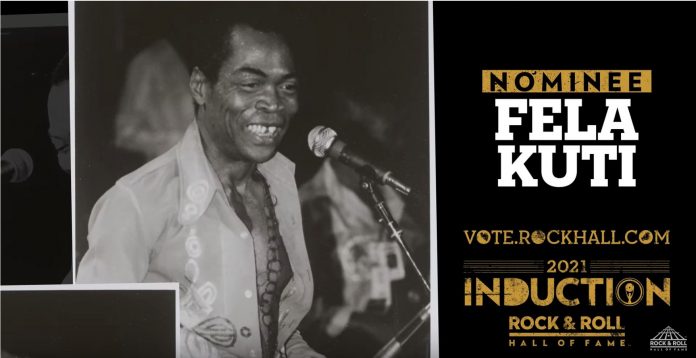
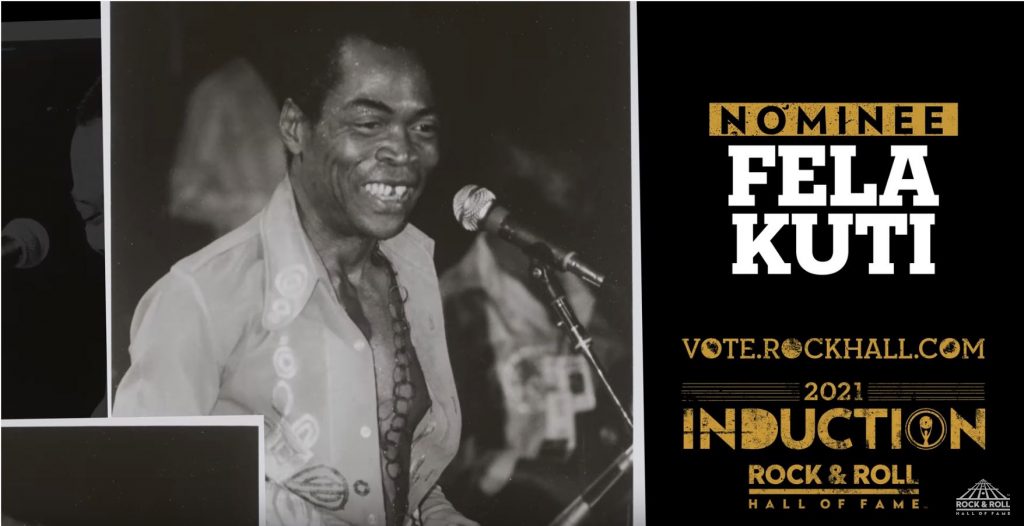
Fela Kuti was on February 10, 2021 nominated for induction into the Rock and Roll Hall of Fame. Public voting will close on April 30, 2021. Photo: Rock and Roll Hall of Fame YouTube Screenshot
Fela Kuti Screenshot
Fela Kuti was on February 10, 2021 nominated for induction into the Rock and Roll Hall of Fame. Public voting will close on April 30, 2021. Photo: Rock and Roll Hall of Fame YouTube Screenshot
Fela Kuti Screenshot
Fela Kuti was on February 10, 2021 nominated for induction into the Rock and Roll Hall of Fame. Public voting will close on April 30, 2021. Photo: Rock and Roll Hall of Fame YouTube Screenshot

Afrobeat pioneer Fela Kuti has been nominated for induction into the Rock & Roll Hall of Fame, following years of complaints that inductees into the hall have been white and male.

Kuti’s nomination comes 23 years after his death. Last year, the Notorious B.I.G  and Whitney Houston were inducted posthumously

The hall announced Wednesday that Kuti is among 15 other artists nominated. This is the first time he has been nominated. A public vote is already underway and will close on April 30.

Follow this link to vote daily to for up to five nominees.

Inductees will be announced in May after the public vote closes.

Artists are eligible for nomination 25 years after they premier their first commercial musical work. Others nominated along with Fela Kuti include Jay-Z, LL Cool J, Mary J. Blige, Chaka Khan and Tina Turner.

Voting link: https://vote.rockhall.com/

One of these four candidates may be named president of Saint Paul College

0
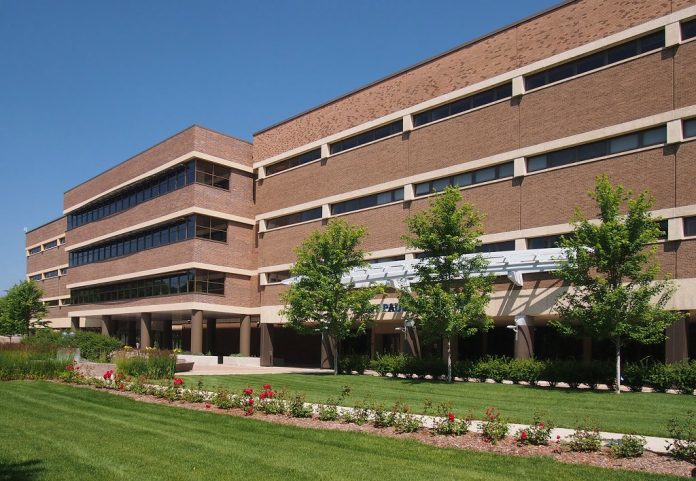
Saint Paul College, located a few hundred feet from the Minnesota State Capitol, announced on February 11, 2021 four finalists to be its next president. Photo: Wikimedia
Saint Paul College Wikimedia
Saint Paul College, located a few hundred feet from the Minnesota State Capitol, announced on February 11, 2021 four finalists to be its next president. Photo: Wikimedia
Finalists
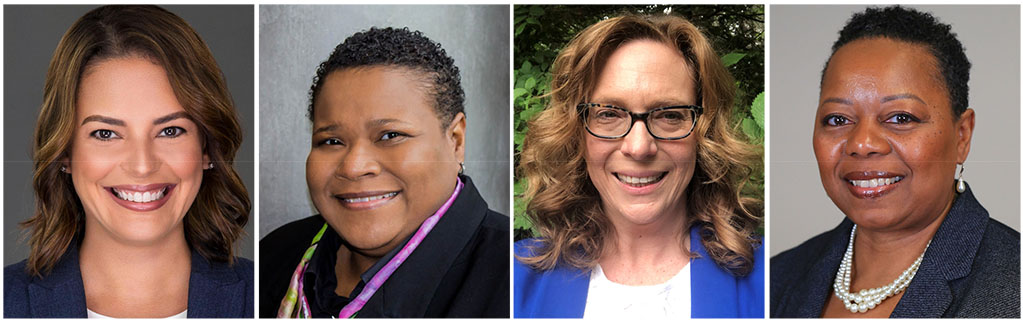
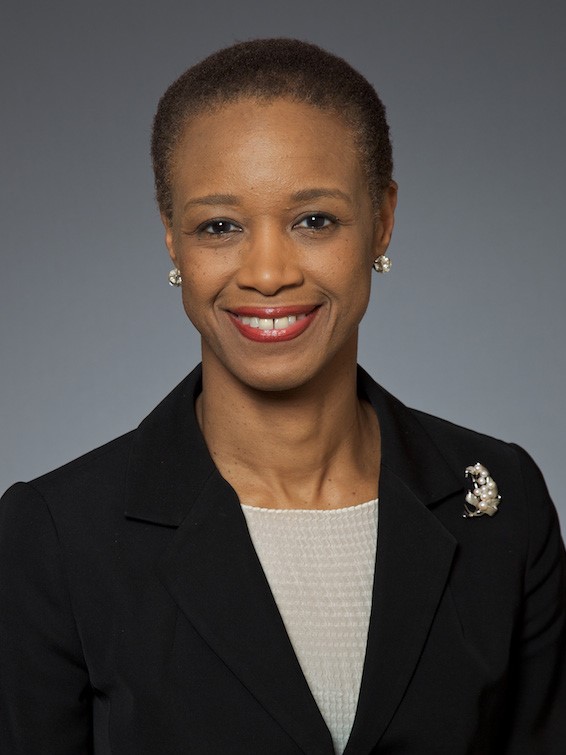
Saint Paul College on February 11, 2021 announced four finalists for president of the college, they are left to right: Sunem Beaton-Garcia; Felicia Ganther; Deidra Peaslee; and Tia Robinson-Cooper. Photo: Saint Paul College

Saint Paul College, located a few hundred feet from the Minnesota State Capitol, on Thursday announced an all women cast of finalists for consideration as the college’s next president. One of the four finalists is the current interim president, Deidra Peaslee.

Students of color comprise 65% of the student body.

The college has been without a president since May 2019 when Rassoul Dastmozd resigned after faculty staged a protest against his leadership style of “fear and intimidation.” Saint Paul College is part of the Minnesota State Colleges and Universities system which includes all the state universities and community colleges.

Adenuga Atewologun, president of Riverland Community College chaired the search advisory committee that recommended the four finalists. The search committee included students, faculty, staff, and community leaders.

The four finalists are Sunem Beaton-Garcia, Felicia Ganther, Deidra Peaslee, and Tia Robinson-Cooper.

Chancellor Devinder Malhotra who heads the Minnesota State Colleges and Universities will present the names of the four finalists to the system’s board of trustees at its March 17 meeting. The new present will be expected to start on July 1, 2021.

One of the challenges facing the new president is the probation that the college is under. The Higher Learning Commission placed the college under what is called “Accredited – On Probation” status on July 11, 2019, just two months after Dastmozd’s resignation. The probation was to last two years and is to end on July 11, 2021, shortly after the new president takes over. The commission’s reason for placing the college under probation included “high staff turnover, inadequate record keeping and underqualified instructors.”

The four finalists

Sunem Beaton-Garcia currently serves Broward College (FL) as president, North Campus and vice provost of academic services and interim president, South Campus, and vice provost of academic resources. Since 2009 she has served Broward College in several capacities, including the interim president, Central Campus and vice provost of teaching excellence and learning; dean of libraries and Academic Success Centers; associate dean, public services; senior instructional designer; and tenured faculty. She continues to adjunct for Broward College’s Education Pathway and served on the faculty of Saint Thomas University (FL) from 2008 to 2009. She holds a bachelor’s degree from the University of Phoenix, a master’s from the University of South Florida, and a doctorate from Nova Southeastern University (FL). She will conduct a virtual campus visit on Feb. 17.

Felicia Ganther has served the Maricopa County Community College District as associate vice chancellor and chief student affairs officer since 2012. Previously, she served the College of Lake County (IL) as the executive director of student life from 2006 to 2012; and director of the Office of Student Activities from 2000 to 2006. She has served as an adjunct faculty for Northern Arizona University, Webster State University (UT), College of Lake County (IL), and at Maricopa. She holds a bachelor’s degree and a master’s from Norfolk State University, a juris doctor from the University of Illinois-Chicago John Marshall Law School, and a doctorate from Arizona State University. She will conduct a virtual campus visit on Feb. 17.

Deidra Peaslee has served as interim president of Saint Paul College since 2019. Previously, she served Anoka-Ramsey Community College as vice president of academic and student affairs from 2011 to 2019 and as Dean of Educational Services from 2002 to 2011; and DePaul University from 1997 to 2002 as assistant dean and director, and director of the international MBA. She served on the faculty of Saint Mary’s University of Minnesota since 2019. She holds a bachelor’s degree from South Dakota State University, a master’s from Minnesota State University, Mankato, and a doctorate from Saint Mary’s University of Minnesota. She will conduct a virtual campus visit on Feb. 18.

Tia Robinson-Cooper has served Inver Hills Community College since 2018 as provost and vice president of academic affairs. Previously, she served East Central College (MO) from 2016 to 2018 as vice president for academic affairs; Olive Harvey College as dean of instruction from 2013 to 2015; Northwestern College (IL) as dean of academic affairs from 2008 to 2013; and American InterContinental University (IL) as Dean of Instruction from 2004 to 2006. She holds an associate’s degree from Kishwaukee College (IL), a bachelor’s degree from Northern Illinois University, two masters’ degrees from National Louis University, and a doctorate from Northern Illinois University. She will conduct a virtual campus visit on Feb. 18.

As Brooklyn Park mayor, Wynfred Russell would prioritize economic development, bridge-building approach

0
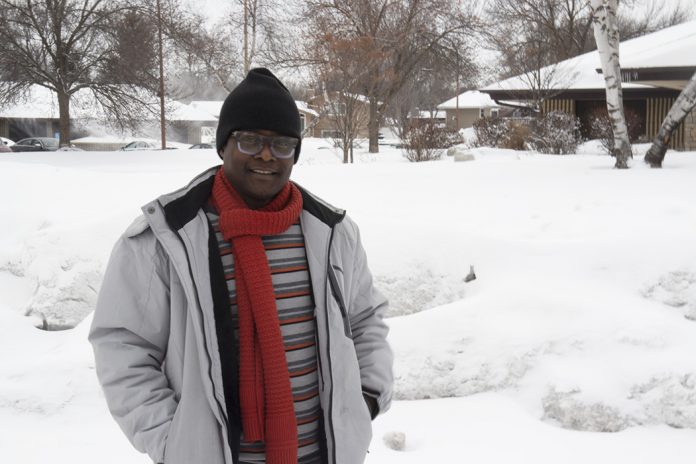
Wynfred Russell is a Brooklyn Park city councilmember who is vying to be the city's next mayor during a special election on either April 13 or August 10 2021. he is seen here shortly after an interview with Mshale outside his office in Brooklyn Park. Photo: Tom Gitaa/Mshale
Wynfred Russell Photo After Mshale Interview Feb 2021
Wynfred Russell is a Brooklyn Park city councilmember who is vying to be the city's next mayor during a special election on either April 13 or August 10 2021. he is seen here shortly after an interview with Mshale outside his office in Brooklyn Park. Photo: Tom Gitaa/Mshale

Brooklyn Park City Council member Wynfred Russell is running for mayor. He was the first one to file, making him the most prominent candidate yet in the race to succeed former Mayor Jeff Lunde. A special election will be held on April 13 if only a maximum of two candidates file. Should more than two file to run, then April 13 will be a primary election day to narrow the field to two candidates that will be on the ballot during an Aug. 10 special election.

Russell is serving his first term in the council representing the West District, a seat he won in 2018 after his second try. In his first attempt to join the council in 2012, he lost by just five votes, an experience other aspirants for office have used to warn supporters against complacency when it comes to voting.

Liberian-born Russell came to the United States as a refugee student on a scholarship. He received a masters in international and global studies from Northern Michigan University upon which the University of Minnesota recruited him to work as a public health researcher at the university’s Center for Infectious Disease Research and Policy (CIDRAP), which was founded by Dr. Michael Osterholm.

That was over 15 years ago. Little did he know that his life will take a different turn than he had envisioned. Upon arriving in Minnesota, he settled in New Brighton and started his life in academia. A devout Methodist, he immediately had to look for a church home and started attending United Methodist Church in Brooklyn Park.

“Attending church there is what sparked my involvement in local issues,” Russell said. “The city wanted to demolish Huntington Pointe and the pastor was asking me if I was involved in stopping it.”

Huntington Pointe was a 306-unit apartment complex on Brooklyn Boulevard that the city, under pressure from residents tired of numerous police calls to the site, acquired in 2007 and demolished in 2008 to make way for what it said was to be affordable housing. 300 families were displaced in the process.

“This is twelve years later and nothing has been built there until now,” a visibly frustrated Russell says.

The city succeeded in demolishing Huntington Pointe but not the spirit of activism that they had awakened in the young university researcher. He moved from New Brighton to Brooklyn Park to be closer to “where I can be more effective.” He lives in the Candlewood neighborhood.

That activism culminated in his election in 2018 to the city council. Regarding his first elected position, Russell wants one more thing — to be elected mayor of his adopted city.

Wynfred with Biking Team
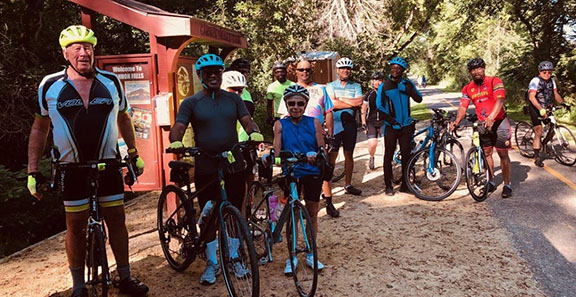
Wynfred Russell (3rd from right), an avid biker, with members of Metro Ryders which he founded. The group rides together on weekends for recreational bicycling to explore local parks. Photo: Facebook

In a wide-ranging interview with Mshale on his candidacy, Russell said he’s running because he believes with more than 56% of the city being people of color “it is about time we have someone of color in the mayoral seat” that understands how the system works.

If elected, he said he would work to be a bridge builder between the diverse communities that make up Brooklyn Park. “Not only am I a policy maker as a councilmember, but I am on the ground and I have worked with different coalitions of people and understand the effects of what we do as elected officials,” said Russell.

Russell’s top issue is economic development, which he says would involve two goals: “working closely with small businesses but especially microbusinesses and changing the culture of how the city looks at economic development.”

On the first goal, Russell says the city should be proactive in working with microbusinesses, and should find a balance on how it caters to the small businesses and big business. He wants the city to be equally accommodating to small business as it is to big business that come calling for help, saying the small businesses in the city “are the backbone of our community.”

“If you go to Brooklyn Blvd. & Zane next to the AutoZone, there are a lot of small microbusinesses, a lot of them owned by women, who is looking out for them?” Russell asks rhetorically.

Russell’s other top issue is affordable housing. “We need more affordable housing stock in Brooklyn Park,” he said. “There are large families paying over $1,000 for a one-bedroom apartment, we need to do something about that as a city.”

Public safety is likely to be a top issue for all candidates running for mayor in the city but Russell says he looks at the issue from a “holistic perspective.”

When talking about public safety, Russell says he doe not just mean police. He said there are many issues that affect public safety including whether people have a place to stay and if they have jobs. “If we address the issues of affordable housing and are good at how we approach economic development and public health, then public safety should be an issue we can address well,” said Russell.

Meet Hollies Winston who is running for Brooklyn Park mayor

0
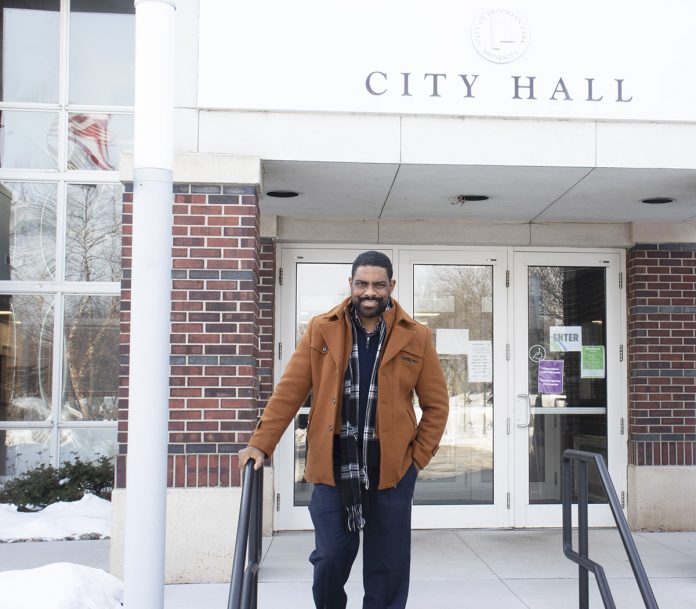
Hollies Winston was the first to announce his bid for mayor of Brooklyn Park. He is the DFL endorsed candidate and has garnered endorsements from US Representative Dean Phillips who represents Brooklyn Park and Minnesota House Speaker Melissa Hortman who lives in the city. Photo: Tom Gitaa/Mshale
Hollis Winston by Tom Gitaa
Hollies Winston was the first to announce his bid for mayor of Brooklyn Park. He is the DFL endorsed candidate and has garnered endorsements from US Representative Dean Phillips who represents Brooklyn Park and Minnesota House Speaker Melissa Hortman who lives in the city. Photo: Tom Gitaa/Mshale

After winning a seat on the Hennepin County Board of Commissioners, former Brooklyn Park mayor Jeff Lunde resigned his position on Jan. 3, sparking a special election to fill the seat.

The special election will be held on April 13 if a maximum of two candidates file to run. If more than two candidates file, the special election will be held on Aug. 10, with April 13 serving as the primary election day to narrow the field to two.

The candidate filing period opened on Feb. 2 and will end on Feb. 16.

The first one to announce his candidacy was Hollies Winston, a self-employed small business consultant and advocate. “I want to create a Brooklyn Park that works for all of us,” he said when announcing his bid one week after Lunde won the county seat.

This is his second attempt to be mayor having run unsuccessfully against Lunde in 2018 when he received 45.68% of the vote against Lunde’s 52.50%.

Winston, 42, was born in Chicago but raised in the Twin Cities where his family moved to when he was 10. After the move to the Twin Cities, his father who is a lawyer went on to become vice president at Northern States Power Company, the predecessor to present day Xcel Energy, the power company that serves most of Hennepin county. His mother spent most of her career as well in corporate America. They have both since retired to Arizona.

Winston graduated from the International School of Minnesota High School and then Northwestern University for his bachelors degree, before receiving an MBA from the Carlson School of Management at the University of Minnesota. He lives in Brooklyn Park’s Maplebrook neighborhood with his wife Latrice and their three children.

Winston admits to struggling as a youngster after moving to the Twin Cities at a young age with trying to adjust to his new surroundings “but a strong support system from my family back then is what made me succeed in life,” he says.

That strong family support structure is the foundation for his candidacy, he says, and guides him on how he approaches public policy.

Elections for the mayor and city council in Brooklyn Park, as in most cities, are nonpartisan but Winston is the DFL endorsed candidate and has secured big name endorsements including the area’s US Representative, Dean Phillips, as well as the speaker of the Minnesota House of Representatives Melissa Hortman, who lives in the city.

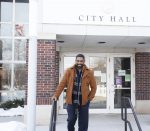
In an interview with Mshale on his candidacy outside city hall, Winston outlined his top priorities for Brooklyn Park if elected.

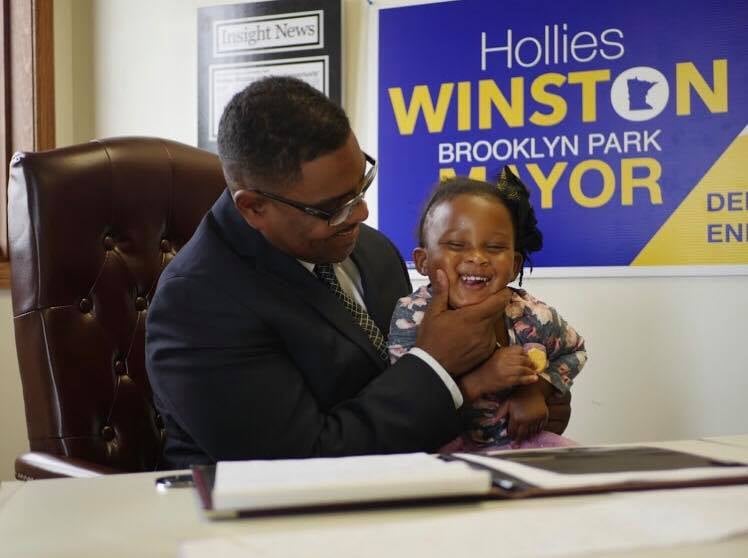
Hollies with Youngest Daughter
Hollies Winston in a playful moment with his youngest daughter Brianna at his home office. Winston is running to be mayor of Brooklyn Park. Photo: Courtesy

Winston said he’s running because he believes “everyone should have the same equal opportunities,” adding that while the city has made strides in providing access, opportunities are not extended equally to those who choose to make Brooklyn Park home.

But Winston’s top issue is the covid-9 pandemic which is superseding other issues at the moment, he says: “we have to get our arms around the pandemic, as many of our residents are frontline workers whether they be in the healthcare field or in businesses where they cannot work from home.”

To address the pandemic, Winston says there is a role for the city in terms of getting out information to residents about the resources available to them, so that “people know their options.”

Winston also listed crime as a priority, saying there is an uptick in crime that is concerning to all residents. He attributes the increase partly to the pandemic but also to a lack of opportunities for the youth. “People want to feel safe,” he said.

Asked about his view on the relations between the city’s police and residents, Winston said that “it depends who you talk to. People of color if you ask them, they would say it could be better. For other communities they would say it is great.”

Winston does not believe police and public relations in the city are strained to the level they are in big cities like Minneapolis, but that police in Brooklyn Park could do better. “We do need to move those relations to where we are not just okay but to excellent,” he said. He wants to see the department engaging the public more, “so they are not meeting you for the first time when there is an emergency.”

Another priority is the rebalancing of the city’s revenue source. Winston serves on the city’s budget advisory commission and his term ends on April. He says serving on the commission has given him a better understanding and appreciation of the intricacies of the city budget.

He however believes the city’s residents, especially homeowners, are bearing the brunt of providing more revenue to the city. The way to address the imbalance is to attract more businesses to the city, both small and big. “That way as we grow as a city we have a better mix to be able to support our budget,” said Winston.

This article has  been updated to reflect the correct college Mr. Winston received his bachelors degree from. It is Northwestern University and not Northwestern College as earlier stated.

MNsure opens up three-month special enrollment following Biden executive order

0
MNsure, Minnesota’s state-run health insurance exchange will have a COVID-19 special enrollment period starting Feb. 16 through May 17, 2021.
MNsure COVID 19 Screenshot Web
MNsure, Minnesota’s state-run health insurance exchange will have a COVID-19 special enrollment period starting Feb. 16 through May 17, 2021.

Following President Biden’s executive order on Jan. 28 to reopen Healthcare.gov for a special enrollment period, MNsure, Minnesota’s state-run health insurance exchange said Wednesday it will also open enrollment starting Feb. 16 through May 17.

Biden’s executive order cited provisions of the Affordable Care Act (ACA), also known as Obamacare, that governs the marketplaces allows for a special enrollment due to “exceptional circumstances,” in this case, the COVID-19 pandemic.

In a statement to the media, MNsure CEO Nate Clark said “COVID-19 is still with us, so having access to comprehensive health care coverage is critical at this time.”

The special enrollment period could be particularly useful to those who might have just lost their jobs after the enrollment period ended.

It should be noted however that individuals and families can sign up anytime for coverage through MNsure without the need for a special enrollment period if they have what is defined as a “qualifying life event.” You can visit this MNsure page to see what such a qualifying event is.

Go here for: MNsure COVID-19 Special Enrollment Period.

Biden appoints Enoh Ebong as acting director of USTDA

0
President Biden on February 2, 2021 announced the appointment of Enoh Ebong as the acting director of the USTDA. Photo: Courtesy USTDA
Ebong Enoh
President Biden on February 2, 2021 announced the appointment of Enoh Ebong as the acting director of the USTDA. Photo: Courtesy USTDA
Ebong Enoh
President Biden on February 2, 2021 announced the appointment of Enoh Ebong as the acting director of the USTDA. Photo: Courtesy USTDA

President Biden on Tuesday announced the appointment of Nigerian-born Enoh T. Ebong as the acting director of the U.S. Trade and Development Agency. The federal agency is responsible for helping American companies “create U.S. jobs through the export of U.S. goods and services for priority development projects in emerging economies.”

Political appointees of federal agencies typically leave their positions when a new administration comes in. Incoming administrations then fill the positions with officials in acting capacities, until they can nominate and the Senate confirms permanent leaders.

Until her appointment to the USTDA, Ebong was the head of strategic partnerships at the Milken Center for Advancing the American Dream. She previously worked at USTDA from 2004 to 2019 when she worked a variety of roles including as general counsel, deputy director and chief operating officer.

Ms. Ebong earned a Juris Doctor from the University of Michigan Law School, a Master of Arts in Communication from the Annenberg School for Communication at the University of Pennsylvania, and a Master of Arts in History, with Honors, from The University of Edinburgh, Scotland.

“It is an honor to return to USTDA. The opportunity to lead the Agency comes at a critical moment when the world is turning to the United States for leadership on clean energy and climate-smart infrastructure, as well as safe and secure ICT solutions,” said Ms. Ebong during her swearing-in ceremony. “The Agency is one of the most effective, targeted and proven tools within the U.S. government. I’ve long believed in USTDA’s mission and program, which are fully aligned with the President’s vision of strengthening our economy and addressing climate as an essential component of American foreign policy and national security.”

Google Pledges $10 Million to help Kenyan economy mitigate effects of COVID-19

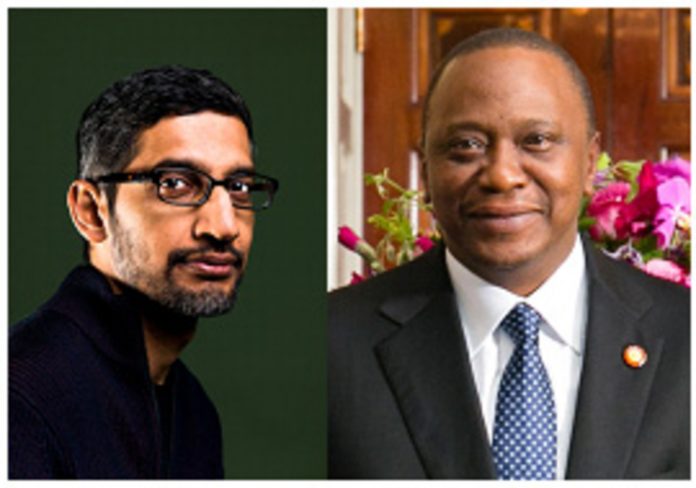
Google CEO Sundar Pichai (left) announced Wednesday, January 27, 2021 during a virtual meeting with Kenya's president Uhuru Kenyatta (right) a $10 million grant to fight the effects of COVID-19.
Uhuru Kenyatta and Sundar Pichai 5
Google CEO Sundar Pichai (left) announced Wednesday, January 27, 2021 during a virtual meeting with Kenya's president Uhuru Kenyatta (right) a $10 million grant to fight the effects of COVID-19.

Google Chief Executive Officer Sundar Pichai announced Wednesday that the American tech giant will make a $10 million grant to help Kenya’s economy recover from the downturn related to the coronavirus pandemic.

Pichai made the pledge during a virtual meeting with Uhuru Kenyatta, the East African nation’s president.

“As economies begin to reopen from a tough 2020, recovering from the pandemic, we see opportunity to support governments, to help businesses, people who are looking for jobs, and communities recover,” Pichai said. “Today, I’m excited to announce a $10 million (1.1 billion Kenyan shillings) for economic recovery.”

Although the African continent has been largely spared by the coronavirus, long shutdowns to curb the spread of the pandemic have taken a heavy toll on economies that were already struggling. With a population of 52 million people and a GDP of $95.5, Kenya is one of the largest economies in Africa. It has recorded over 100,000 cases and 1,751 deaths. Last week, Kenyan scientists announced that they had identified a new coronavirus strain in the country, which could complicate recovery. But if used wisely and as Google mandates, the $10 million grant could make a significant impact on the recovery of the country, where the per capita income is $1,816.5, according to 2019 World Bank data.

Pichai said the $10 million would be divided into three separate grants. The first $2 million will go to Kenyan nonprofit organizations that work in underserved communities. Small and mid-size enterprises (SMEs) will get $3 million. The remaining $5 million will go towards supporting technology startups.

“I have always felt Kenya as being very entrepreneurial and willing to drive technology and innovation,” Pichai said.

He said the grant was “just a beginning” and that he looked forward to “announcing more in the coming months.”

President Kenyatta said access to digital technology in Kenya had grown exponentially in the last 20 years. Because of that growth, 95 percent of Kenyans now have access to financial services mostly via their mobile devices. Twenty years ago, only 30 percent of the population had a bank account, and everyone had to stand in long queues to in banks to conduct financial business, Kenyatta said. He promised to continue to invest in the sector. The president added, however, that Kenya hadn’t seen the full impact of technology in driving economic growth.

“Now we need to work together [with Google] to see how we can translate that into economic opportunity for our people,” Kenyatta said, “how they can link small and mid-size enterprises that are the backbone of our economy to global markets. This is really where the future lies.”

This is not the first time Google has given money to Kenya, according to Pichai. In September, the tech giant gave $1 million to help the economic recovery of Kenyan women who had lost income due to the pandemic. The company also started a digital hub to help 300,000 Kenyan SMEs build online presence to take advantage of the growing trend in online commerce. Google has also been working to make remote learning successful in Kenya, Pichai said.

“Society has made huge strides on connectivity and it’s a trend around the world,” Pichai said. “Covid has really accelerated digital trends by years, and online digital has been a lifeline for many businesses around the world.”

Kenyatta’s and Pichai’s meeting was organized by the Corporate Council on Africa, a Washington, D.C.- based organization that aims to strengthen trade and commercial ties between the continent’s economies and the United States. It was moderated by Kenyan journalist and former CNN news anchor, Zain Varjee.

Minnesota asks those with expired driver’s licenses and IDs to renew

0
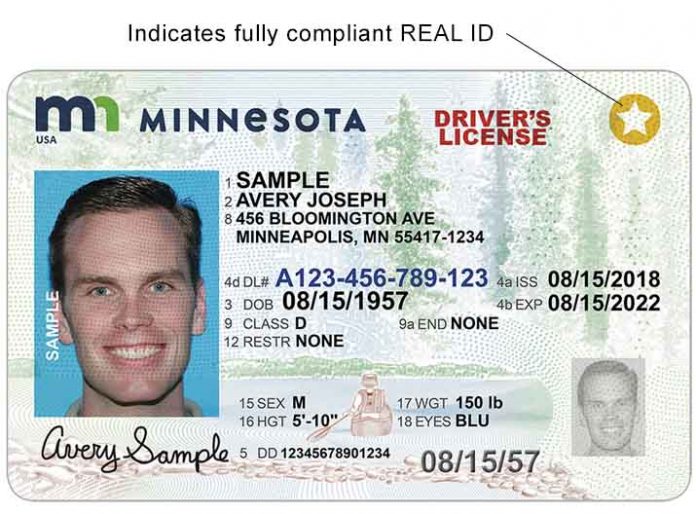
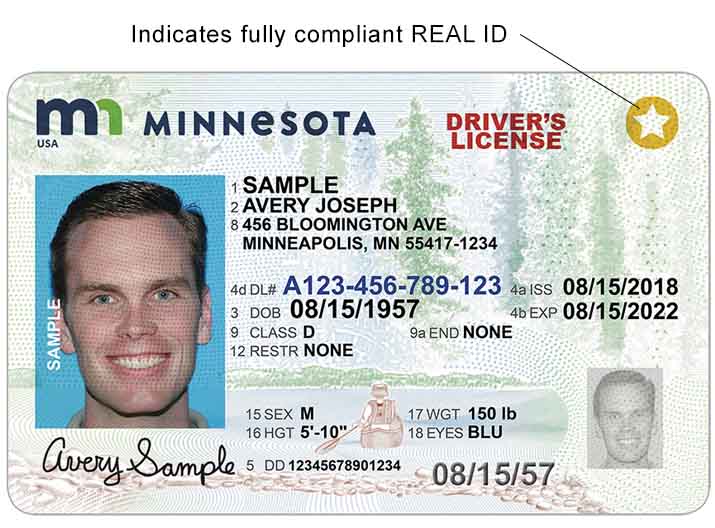
Minnesotans with expired driver's licenses that were kept active due to the governor's emergency orders during the pandemic must now renew them, the state public safety department announced on January 27, 2021.
real id star
Minnesotans with expired driver's licenses that were kept active due to the governor's emergency orders during the pandemic must now renew them, the state public safety department announced on January 27, 2021.
real id star
Minnesotans with expired driver’s licenses that were kept active due to the governor’s emergency orders during the pandemic must now renew them, the state public safety department announced on January 27, 2021.

Minnesotans who have expired driver’s licenses or IDs, or will have theirs expiring by March 1, must ensure they renew them, the Minnesota Department of Public Safety Driver and Vehicle Services division announced on Wednesday. They must renew by March 31

DPS said in a release to the media that additional extensions are not possible under current law. Minnesota Gov. Tim Walz last year, as he exercised his emergency powers during the COVID-19 pandemic, granted an extension to nearly 300,000 Minnesotans whose diver’s licenses and IDs were set to expire between March 13, 2020 and Feb. 28, 2021. The extension was necessary as many state offices and renewal centers closed due to the pandemic.

DPS-DVS said in a statement that it is mailing letters to every cardholder whose credential will expire March 31, 2021, to serve as a second renewal notice. Standard driver’s license renewal notices continue to be sent to all Minnesotans with expiring credentials.

One can renew their driver’s license or ID online if their address has not changed.

Anyone who does not renew their driver’s license by their expiration date will lose their driving privileges until they renew.

“Minnesotans rely on their driver’s license for vital aspects of their lives. We do not want anyone to experience a lapse in driving privileges, because they didn’t renew by their license’s expiration date,” DPS-DVS Director Emma Corrie said.

Below are your options:

  • Renew a standard driver’s license online at drive.mn.gov.
    • This convenient option is available for standard driver’s licenses or ID cards that do not require name, address, signature or driver’s license number changes. A person’s record is updated as soon as the online application is complete.
  • Renew in person at a regional DVS exam station, deputy registrar or driver’s license agent office.
    • Minnesotans must use this option to make changes to their driver’s license or ID card or apply for a REAL ID or enhanced driver’s license or ID card. Customers are strongly encouraged to pre-apply online at mn.gov before visiting their local office.
    • Most regional DVS exam stations accept driver’s license renewals and applications on a first-come-first-served basis. No appointments are required. Customers check into a virtual lobby and wait in their vehicle until they receive a text that it is their turn.
    • Deputy registrar and driver’s license agent offices are independently owned and operated. Many require appointments for all services and have limited appointments available. Locations and service information are on the DPS-DVS website.

Processing Times

DPS-DVS updates current processing times weekly online. Here are the license and ID card processing times as of Jan. 20, 2021:

  • Standard licenses and ID cards: processing standard applications from Dec. 15, 2020.
  • REAL ID-compliant licenses and ID cards: processing REAL ID applications from Dec. 14, 2020.
  • Enhanced driver’s licenses and ID cards: processing enhanced applications from Dec. 11, 2020.

Minnesotans can track their driver’s license online at drive.mn.gov by selecting Where’s My License and entering their driver’s license number.  

Minnesota COVID-19 vaccination pilot program to use lottery system

0
COVID19 Lottery
Minnesota COVID-19 vaccination pilot program to use lottery system

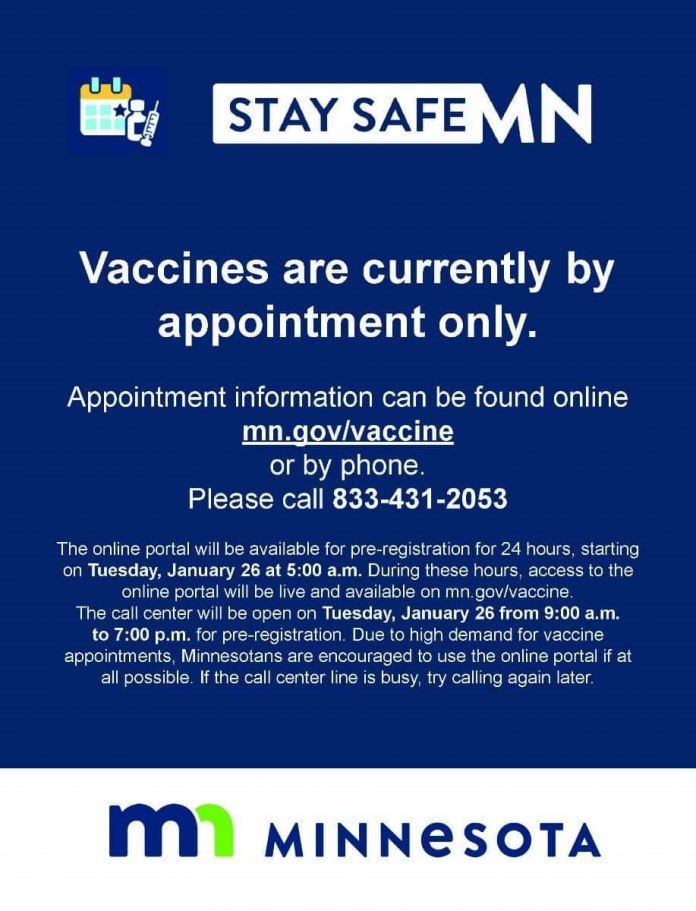
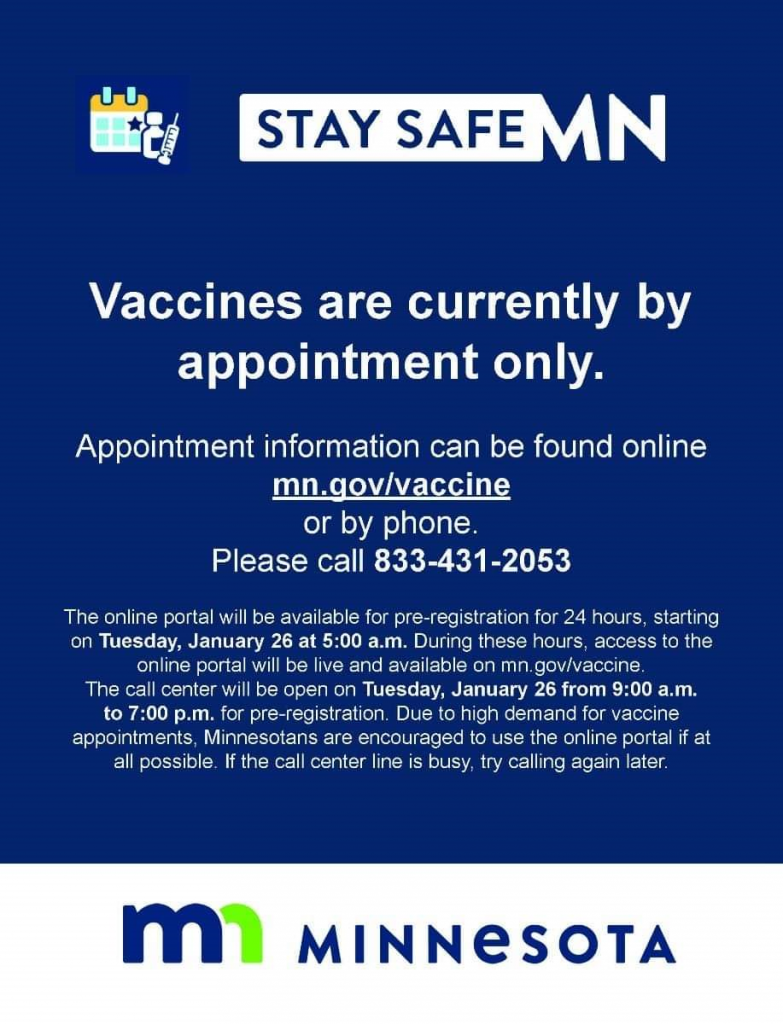
COVID19 LotteryMinnesota’s COVID-19 vaccine pilot program that started last week for seniors (65 and older) is moving to a lottery system starting tomorrow (Tuesday, Jan. 26).

Minnesota Governor Tim Walz announced the changes in statement to the media. The statement said the updated process “accounts for anticipated high demand for appointments online and at the call center and allows for more equitable and orderly access to appointments by eliminating the first come, first served system.”

Last week, the website the state set up to take appointments for the pilot program crashed due to high traffic.

Random selection not first come, first served

Minnesotans age 65 and older will now have a 24-hour window of time beginning at 5:00 am Tuesday to pre-register for a randomized opportunity to get an appointment. The statement went on to say “Signing up for the pre-registration list means you will have a chance to be randomly selected, so you do not have to register right away: it is not a first come, first serve system.”

The governor’s office is strongly encouraging pre-registering online at mn.gov/findmyvaccine. The website will be open for pre-registering from 5:00 a.m. Tuesday, January 26 until 5:00 a.m. on Wednesday, January 27.

If unable to register online, one can call 833-431-2053 to sign up. The call center will be open from 9:00 a.m. to 7:00 p.m. on Tuesday, January 26.

If you are randomly selected for a vaccine you will be notified via text message, email or phone to finalize your appointment. About 8,000 appointments will be available this week.