
Home Blog Page 66

Michigan cop fatally shoots Patrick Lyoya from Democratic Republic of Congo

0
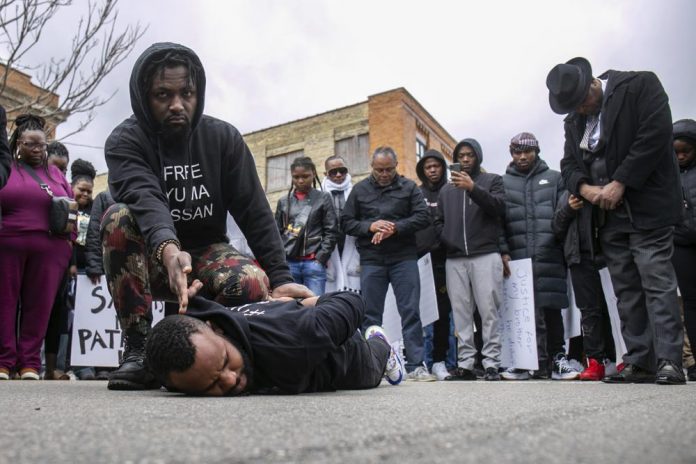
A moment of silence is held as two activists act out how the family of 26-year-old Patrick Lyoya says he was killed in an unreleased video at the end of the Justice for Patrick Lyoya march in Grand Rapids, Mich., on Saturday, April 9, 2022. Lyoya was killed during a traffic stop by a Grand Rapids police officer on Monday, April 4. Photo: Daniel Shular/The Grand Rapids Press via AP
Activist Demo
A moment of silence is held as two activists act out how the family of 26-year-old Patrick Lyoya says he was killed in an unreleased video at the end of the Justice for Patrick Lyoya march in Grand Rapids, Mich., on Saturday, April 9, 2022. Lyoya was killed during a traffic stop by a Grand Rapids police officer on Monday, April 4. Photo: Daniel Shular/The Grand Rapids Press via AP

GRAND RAPIDS, Mich. (AP) — A Black man face-down on the ground was fatally shot in the back of the head by a Michigan police officer, the violent climax of a traffic stop, brief foot chase and struggle over a stun gun, according to videos of the April 4 incident released Wednesday.

Patrick Lyoya, 26, was killed outside a house in Grand Rapids, Michigan. The white officer repeatedly ordered Lyoya to “let go” of his Taser, at one point demanding: “Drop the Taser!”

Citing a need for transparency, the city’s new police chief, Eric Winstrom, released four videos, including critical footage of the shooting recorded by a passenger in Lyoya’s car on that rainy morning.

“I view it as a tragedy. … It was a progression of sadness for me,” said Winstrom, a former high-ranking Chicago police commander who became Grand Rapids chief in March. The city of about 200,000 people is about 150 miles (240 kilometers) northwest of Detroit.
Father
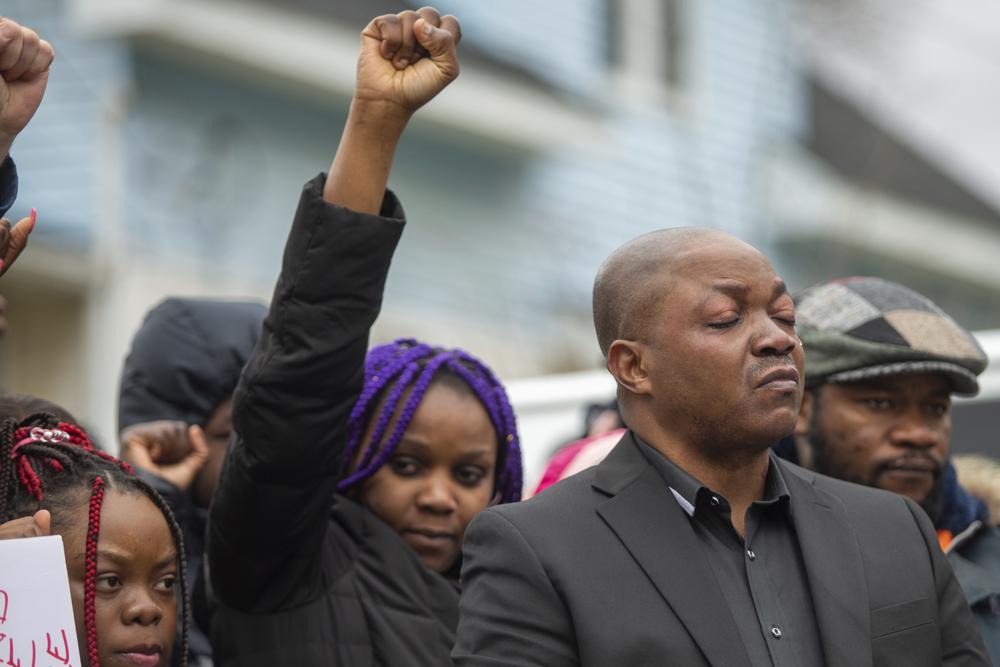
Peter Lyoya, right, father of Patrick Lyoya, closes his eyes as a tear runs down his face during the Justice for Patrick Lyoya march in Grand Rapids, Mich., on Saturday, April 9, 2022. The 26-year-old was killed during a traffic stop by a Grand Rapids police officer on Monday, April 4. Photo: Daniel Shular/The Grand Rapids Press via AP

Video shows Lyoya running from the officer who stopped him for driving with a license plate that didn’t belong to the vehicle. They struggled in front of several homes while Lyoya’s passenger got out and watched.

Winstrom said the fight over the Taser lasted about 90 seconds. In the final moments, the officer was on top of Lyoya, kneeling on his back at times to subdue him.

“From my view of the video, Taser was deployed twice. Taser did not make contact,” Winstrom told reporters. “And Mr. Lyoya was shot in the head. However, that’s the only information that I have.”

State police are investigating the shooting. Kent County’s chief medical examiner, Dr. Stephen Cohle, said he completed the autopsy but toxicology tests haven’t been finished.

The traffic stop was tense from the start. Video shows Lyoya, a native of the Democratic Republic of Congo, getting out of the car before the officer approached. He ordered Lyoya to get back in the vehicle but the man declined.

The officer asked him if he spoke English and demanded his driver’s license. The foot chase began soon after, video shows.
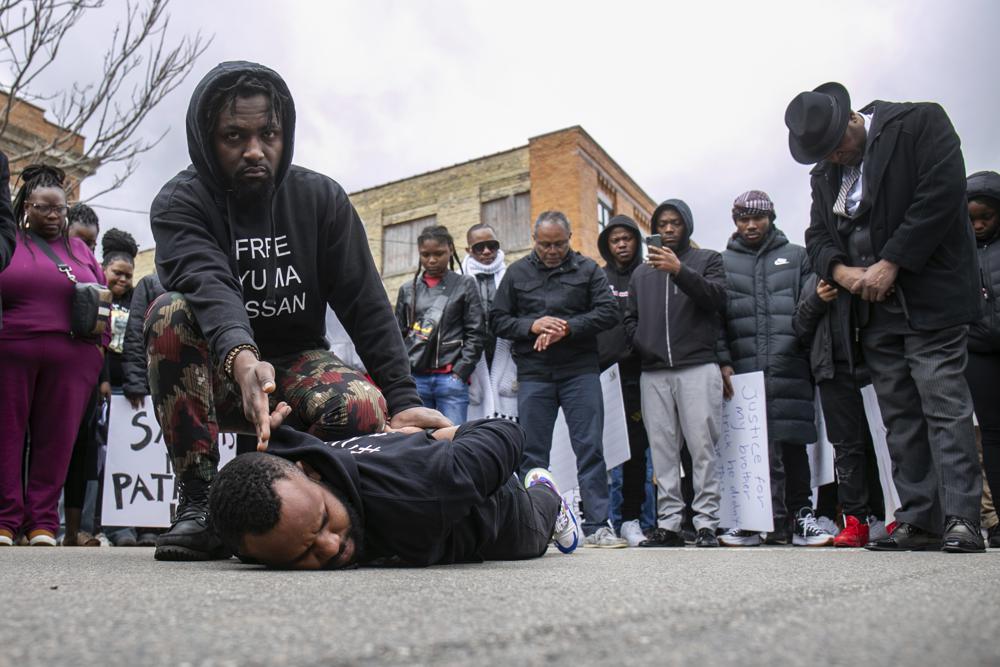
Activist Demo
A moment of silence is held as two activists act out how the family of 26-year-old Patrick Lyoya says he was killed in an unreleased video at the end of the Justice for Patrick Lyoya march in Grand Rapids, Mich., on Saturday, April 9, 2022. Lyoya was killed during a traffic stop by a Grand Rapids police officer on Monday, April 4. Photo: Daniel Shular/The Grand Rapids Press via AP

Winstrom didn’t identify the officer, a seven-year veteran who is on paid leave during the investigation.

“Me being from Chicago for the last 20 years, I’ve handled many police shootings myself, so I do have a lot of experience in this,” the chief said. “I was hoping to never have to utilize that experience here.”

Video was collected from Lyoya’s passenger, the officer’s body-worn camera, the officer’s patrol car and a doorbell camera. Prosecutor Chris Becker, who will decide whether any charges are warranted, objected to the release but said Winstrom could act on his own.

Becker said the public shouldn’t expect a quick decision.

“While the videos released today are an important piece of evidence, they are not all of the evidence,” he said.

Benjamin Crump
Civil rights attorney Ben Crump takes part in a press conference at the Renaissance Church of God in Christ Family Life Center in Grand Rapids, Mich. on Thursday, April 14, 2022. Crump is representing the family of Patrick Lyoya, who was shot and killed by a Grand Rapids Police Department officer on April 4. Photo: Cory Morse/The Grand Rapids Press via AP

City Manager Mark Washington warned that the videos would lead to “expressions of shock, of anger and of pain.” Some downtown businesses boarded up their storefronts, and concrete barricades surrounded police headquarters.

Lyoya had two young daughters and five siblings, said Gov. Gretchen Whitmer, who spoke to his family.

“He arrived in the United States as a refugee with his family fleeing violence. He had his whole life ahead of him,” Whitmer, a Democrat, said.

Prominent civil rights attorney Ben Crump, speaking on behalf of Lyoya’s family, on Wednesday called for the officer in the shooting to be fired and prosecuted.

“The video clearly shows that this was an unnecessary, excessive, and fatal use of force against an unarmed Black man who was confused by the encounter and terrified for his life,” Crump said in a release.

Crump and Lyoya’s family are expected to hold a news conference Thursday afternoon.
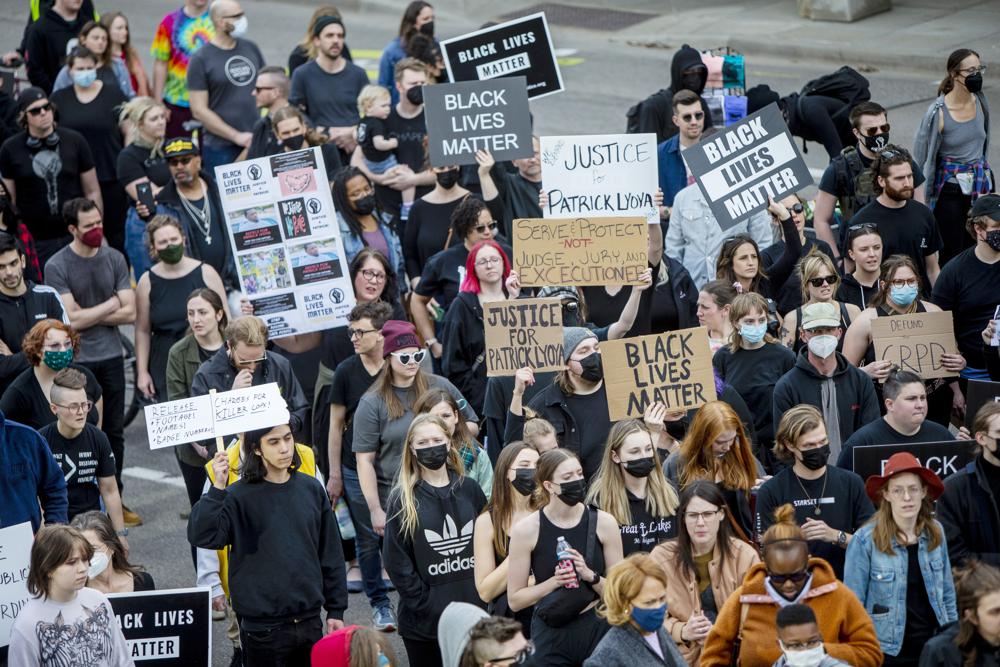
Demonstration
Activists rally for Patrick Lyoya in Grand Rapids, Mich., on Tuesday, April 12, 2022. Grand Rapids Police Chief Eric Winstrom said Lyoya, 26, was shot after a struggle with an officer following a traffic stop on April 4. Photo: Cory Morse/The Grand Rapids Press via AP

More than 100 people marched to Grand Rapids City Hall before a City Commission meeting Tuesday night, chanting “Black lives matter” and “No justice, no peace.”

On Wednesday, several hundred protesters gathered outside the Grand Rapids Police Department following the release of the videos, with some cursing and shouting from behind barricades. The group demanded that officials make public the name of the officer in the shooting.

Some businesses cut their hours short Wednesday, closing early. Some boarded up windows. But the demonstration remained non-violent with protesters demanding justice for Lyoya and other Black lives lost in shootings involving police.

Winstrom last week said he met Lyoya’s father, Peter Lyoya, and that they both cried.

“I get it as a father. … It’s just heart-wrenching,” the chief told WOOD-TV.

As in many U.S. cities, Grand Rapids police have been occasionally criticized over the use of force, particularly against Black people, who make up 18% of the population.

In November, the Michigan Supreme Court heard arguments in a lawsuit over the practice of photographing and fingerprinting people who were never charged with a crime. Grand Rapids said the policy changed in 2015.

A downtown street has been designated Breonna Taylor Way, named for the Black woman and Grand Rapids native who was killed by police in Louisville, Kentucky, during a botched drug raid in 2020.

CDC extends travel mask requirement to May 3 as COVID-19 rises

0
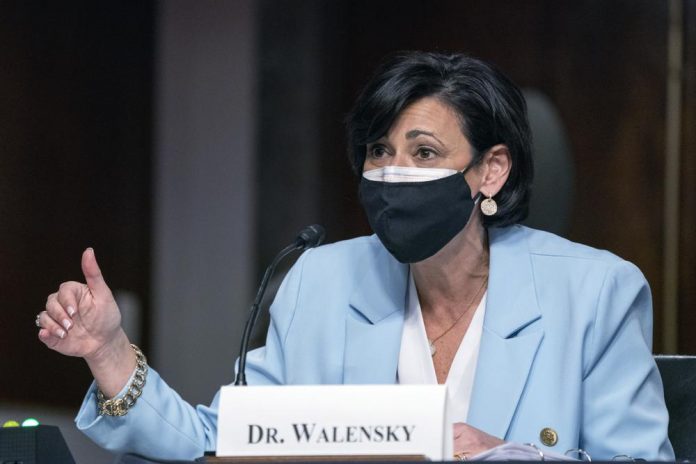
Dr. Rochelle Walensky, Director of the Centers for Disease Control and Prevention, testifies before a Senate Health, Education, Labor, and Pensions Committee hearing to examine the federal response to COVID-19 and new emerging variants, Tuesday, Jan. 11, 2022 on Capitol Hill in Washington. Photo: Shawn Thew/Pool via AP
Centers for Disease Control and Prevention Director Rochelle Walensky
Dr. Rochelle Walensky, Director of the Centers for Disease Control and Prevention, testifies before a Senate Health, Education, Labor, and Pensions Committee hearing to examine the federal response to COVID-19 and new emerging variants, Tuesday, Jan. 11, 2022 on Capitol Hill in Washington. Photo: Shawn Thew/Pool via AP

The mask mandate order is being extended to allow more time to study the BA.2 omicron subvariant that is now responsible for the vast majority of cases in the U.S.

The Biden administration announced Wednesday that it is extending the nationwide mask requirement for airplanes and public mass transit for 15 days as it monitors an uptick in COVID-19 cases.

The Centers for Disease Control and Prevention said it was extending the order, which was set to expire on April 18, until May 3 to allow more time to study the BA.2 omicron subvariant that is now responsible for the vast majority of cases in the U.S.

“In order to assess the potential impact the rise of cases has on severe disease, including hospitalizations and deaths, and health care system capacity, the CDC order will remain in place at this time,” the agency said in a statement.

When the Transportation Security Administration, which enforces the rule for planes, buses, trains and transit hubs, extended the requirement last month, it said the CDC had been hoping to roll out a more flexible masking strategy that would have replaced the nationwide requirement.

The mask mandate is the most visible vestige of government restrictions to control the pandemic, and possibly the most controversial. A surge of abusive and sometimes violent incidents on airplanes has been attributed mostly to disputes over mask-wearing.

Airlines have lobbied for months to kill the requirement, arguing that effective air filters on modern planes make transmission of the virus during a flight highly unlikely. Republicans in Congress also fought to kill the mandate.

Critics have seized on the fact that states have rolled back rules requiring masks in restaurants, stores and other indoor settings, and yet COVID-19 cases have fallen sharply since the omicron variant peaked in mid-January. Florida is one of 20 states that sued the Biden administration last month over the transportation mask mandates.

“It is very difficult to understand why masks are still required on airplanes, but not needed in crowded bars and restaurants; in packed sports arenas; in schools full of children; or at large indoor political gatherings,” Nicholas Calio, the CEO of industry trade group Airlines for America, said Wednesday in a letter to the heads of the CDC and the Health and Human Services Department. “Simply put, an extension of the mask mandate does not make sense.”

There has been a slight increase in cases in recent weeks, with daily confirmed cases nationwide rising from about 25,000 per day to more than 30,000. More than 85% of those cases are the highly contagious BA.2 strain. Those figures could be an undercount since many people now test positive on at-home tests that are not reported to public health agencies.

Severe illnesses and deaths tend to lag infections by several weeks. The CDC is awaiting indications of whether the increase in cases correlates to a rise in adverse outcomes before announcing a less restrictive mask policy for travel.

A poll in mid-March by the Kaiser Family Foundation found that Americans are evenly divided over keeping the mask rule for transportation.

The poll found that 51% wanted the mandate to expire and 48% said it should remain in place – in effect, a tie, given the poll’s margin of error. Democrats overwhelmingly supported the rule, and Republicans were even more united in opposing it. Vaccinated people and those with chronic health conditions favored keeping the rule, but by smaller margins.

Airlines imposed their own mask mandates in 2020, when the Trump administration declined to take action. Unions representing flight attendants, which once backed mask rules, now decline to take a position because their members are divided over the issue.

It is unclear whether eliminating the rule would make people more or less likely to travel on planes or subways.

Ed Bastian, the CEO of Delta Air Lines, said that some people might start flying if they don’t have to wear a mask, and others might stop flying if other passengers are unmasked. He called both groups “fringe,” and he predicted that many people will continue to wear masks even if the rule is dropped.

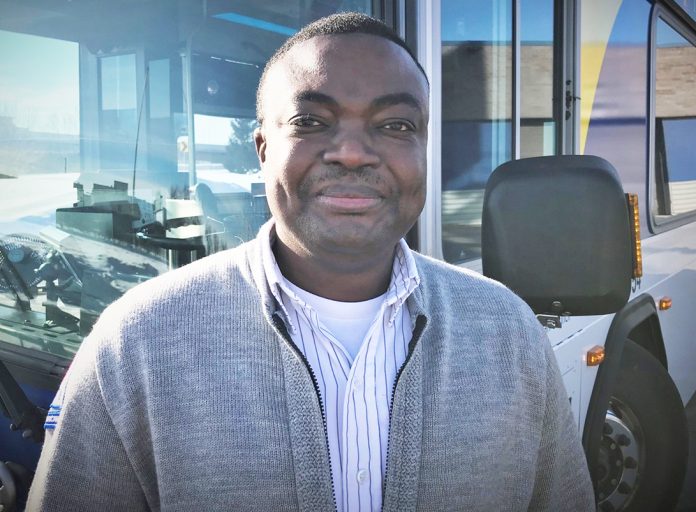
Know your Operator: Kofi Afoutou

0
Metro Transit Operator Kofi Afoutou. Photo: Metro Transit
Kofi Afoutou Published
Metro Transit Operator Kofi Afoutou. Photo: Metro Transit
Sponsored Content from Metro Transit

Know your Operator: Kofi Afoutou

Years of service: 8 
Lives: Richfield
Garage: South
Family: Wife and three kids

While working as a high school principal in Togo, Komi Afoutou won the Visa lottery. So, the recently married 32-year-old and his wife packed their bags. When they immigrated to the United States, however, it was in 2008 during the depths of the Great Recession.

“We wanted to seek something better, the American Dream,” Afoutou said. “We had to move five times in one year, trying to find opportunity.”

In New York, Afoutou sought a Commercial Drivers License so he could get a job as school bus driver.

When he returned to Minnesota, he worked at Team Transit and Metro Mobility. In 2021, he asked a bus operator friend about Metro Transit.

“He told me there was room to advance here and how impressed he was with the system,” Afoutou said. “A year later, I was working at Metro Transit as a bus operator.”

In 2018, he found his chance to not only advance, but return to his life’s passion as an instructor. “I knew I wanted to get back into what I love: education,” he said.

As an instructor, Afoutou helps new bus operators learn the job and helps long-time operators freshen up their skills. He finds that teaching operators is like his previous job, but it presents new challenges.

“Adult education requires a very different approach than when teaching teenagers,” he said. “You work with people from all ages, backgrounds, and experiences, sometimes greater than your own.”

Throughout his journey from Togo to transit, one guiding principle that helped him achieve the American Dream. “Be humble and help people whenever you get the opportunity,” Afoutou said.

Today, he owns a home and is raising a family. He also built a home for his mother back in Togo and supports his family any way he can.

Metro Transit is hiring!

Drivers start at more than $21 per hour – even during training – and receive outstanding benefits, including health care, annual salary increases, a pension plan, an unlimited-ride bus pass and a $1,000 hiring bonus. To learn more and apply, visit metrotransit.org/drive.

You can now choose gender X on your US passport

0
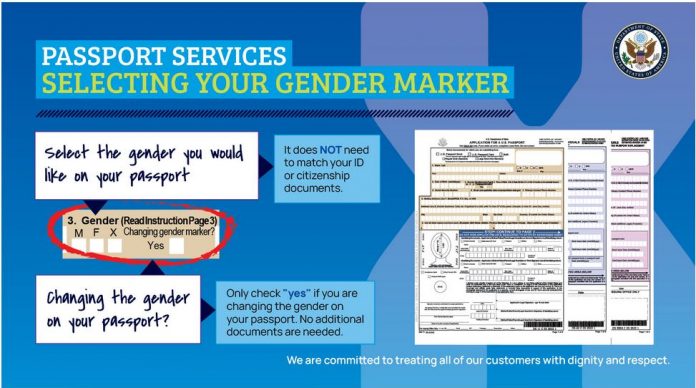
An image on the State Department passport application website provides an example of how you can select your gender marker on a U.S. passport form. Effective April 11, 2022 US passport applicants have the choice of a third gender marker “X” beyond the previous “M” and “F”.
Gender X
An image on the State Department passport application website provides an example of how you can select your gender marker on a U.S. passport form. Effective April 11, 2022 US passport applicants have the choice of a third gender marker “X” beyond the previous “M” and “F”.

It is official. Starting today, April 11, you can select gender “X” in your US passport application. Previously you could only choose “F” or “M”.

The change has already taken effect and forms on the State Department’s website reflect this new choice. The Biden administration had signaled on June 30, 2021 that it will set in motion changes to allow applicants to self-select their gender as “M” or “F” and that it will no longer require medical certification “if an applicant’s self-selected gender does not match the gender on their other citizenship or identity documents.”

On March 30, 2022, the State Department said in a press statement that it arrived at the definition after seeking public feedback and consulting with other partner countries that have already implemented a third gender marker for non-binary, intersex, and gender non-conforming individuals. Countries that already offer options beyond male and female include Canada, Australia, India, Malta, Nepal and New Zealand.

“Finally, we have worked with the Centers for Disease Control and Prevention’s National Center for Health Statistics to conduct qualitative research on how to define an X gender marker, interviewing a demographically diverse group of individuals, including many members of the LGBTQI+ community,” the State Department said.

21 states and the District of Columbia already allow residents to select the “X” gender marker on their driver’s licenses. A report released last month by the Williams Institute, an LGBTQ+ public policy think tank estimated that 16,700 of America’s more than 1.2 million nonbinary LGBTQ+ residents might request the new passport with an “X” marker.

“This estimate is based upon current demand for X gender markers on driver’s licenses in states which allow such an option,” the report said.

U.S. experts discuss COVID boosters for the fall and beyond

0
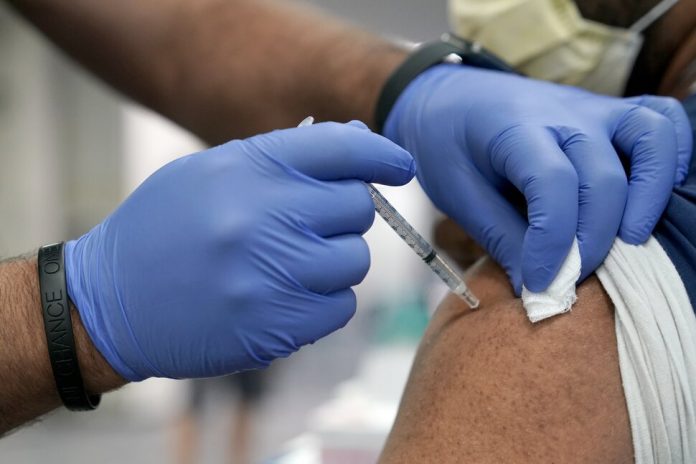
A healthcare worker receives a Pfizer COVID-19 booster shot at Jackson Memorial Hospital, Oct. 5, 2021, in Miami. Photo: Lynne Sladky/AP
Healthcare Worker Booster Shot
A healthcare worker receives a Pfizer COVID-19 booster shot at Jackson Memorial Hospital, Oct. 5, 2021, in Miami. Photo: Lynne Sladky/AP
COVID-19 has yet to fall into a predictable pattern, like the flu.

While many Americans are trying to move on with their lives after two years of the COVID-19 pandemic, U.S. health officials are debating the best way to use vaccines to stay ahead of the coronavirus.

A panel of U.S. vaccine experts was meeting Wednesday to discuss key questions for future COVID-19 booster campaigns. The Food and Drug Administration’s vaccine advisers won’t make any binding decisions during the virtual meeting, but their advice could shape the government’s approach for years to come.

FDA vaccine chief Dr. Peter Marks told reporters last week that it wouldn’t be surprising if the agency authorized another booster dose in the fall to protect most Americans against the latest coronavirus mutations. He opened Wednesday’s meeting by cautioning that waning vaccine protection, new variants and colder weather later this year could raise the risk of more surges.

“All that taken together makes us conclude that a general discussion of booster vaccination against COVID-19 is warranted at this time so that we can potentially intervene,” Marks said.

Some of the key questions for the panel:

How should the U.S. decide when to launch future rounds of booster shots? who should get them?

Last week, the FDA authorized an extra Pfizer or Moderna shot for anyone 50 or older and for some younger people with severely weakened immune systems. It’s an effort to get ahead of another possible surge.

Only about half of Americans eligible for a third shot have gotten one. And some independent experts disagree about the need for even that additional protection in healthy individuals, due to limited evidence of the benefit or how long it might last.

The last U.S. wave was driven by the omicron variant. During that surge, two doses were nearly 80% effective against needing a ventilator or death — and a booster pushed that protection to 94%, federal scientists have reported. COVID-19 cases have dropped to low levels in the U.S., but health officials are warily watching an omicron sibling that now accounts for most cases.

What’s the process for updating vaccines to address new variants?

All the COVID-19 vaccines now used in the U.S. are based on the original coronavirus version that emerged in late 2019. Updating the vaccines will be a complex task, requiring coordination between the FDA, manufacturers and global health authorities.

The process for updating annual flu vaccines offers one possible model for dealing with mutations. The FDA panel is expected to discuss the strengths and weakness of adopting such an approach.

Twice a year, World Health Organization experts recommend updates to flu vaccines to target emerging strains. The FDA then brings those recommendations to its own vaccine panel, which votes on whether they make sense for the U.S., setting the stage for manufacturers to tweak their shots and begin mass production.

But COVID-19 hasn’t yet fallen into a predictable pattern like the flu. And vaccine manufacturers will likely need more time to conduct additional studies of their COVID-19 vaccines, which don’t have the same decades-long record of safety and effectiveness as flu shots.

Rep. Ilhan Omar and Congressional Black Caucus pushing for shift in U.S.-Africa policy

Rep. Ilhan Omar and Rep. Gregory W. Meeks listen to the president of the African Development Bank Group Akinwumi A. Adesina, in bowtie, when the Congressional delegation visited the bank's headquarters in Abidjan, Côte d’Ivoire in February. Photo: Courtesy of House Foreign Affairs Committee
Akinwumi A Adesina of AFDB Feb 28 2022
Rep. Ilhan Omar and Rep. Gregory W. Meeks listen to the president of the African Development Bank Group Akinwumi A. Adesina, in bowtie, when the Congressional delegation visited the bank's headquarters in Abidjan, Côte d’Ivoire in February. Photo: Courtesy of House Foreign Affairs Committee

It is no secret that during the four years prior to the election of President Joseph R. Biden,
African countries did not have the best of relations with the United States.

Biden’s predecessor, former President Donald J. Trump, did not have the best opinion of African countries. While discussing immigration with a group of U.S. senators at the White House, Trump is reported to have called Haiti, and African nations “shithole countries” arguing that America should give preference to immigrants from European countries like Norway.

It could be argued, however, that Trump was only saying out loud what the United States’ attitudes towards Africa, which has historically been of condescension and looking at the continent as a place of great suffering that needs saving.

Ilhan Omar and Gregory Meeks in TZ
Rep. Gregory W. Meeks, Chair of the House Foreign Affairs Committee (second right) and the Congressional delegation listen to a briefing in Tanzania by U.S. Embassy staff on priority issues when they visited the county in February. On the chairman’s left is Rep. Ilhan Omar of Minnesota. Photo: Courtesy of House Foreign Affairs Committee

But now Black members of Congress have a rare opportunity to try change those flawed perceptions of Africa at the highest levels of the U.S. government, says Rep. Ilhan Omar of Minnesota, who recently returned from a Congressional Delegation (CODEL) to four African countries.

“A lot of us found the last administration’s policy towards Africa a little challenging for us to engage with,” said Omar during a recent interview with Mshale. “The CODEL was our way of saying that Africa is not going to be on the back burner.”

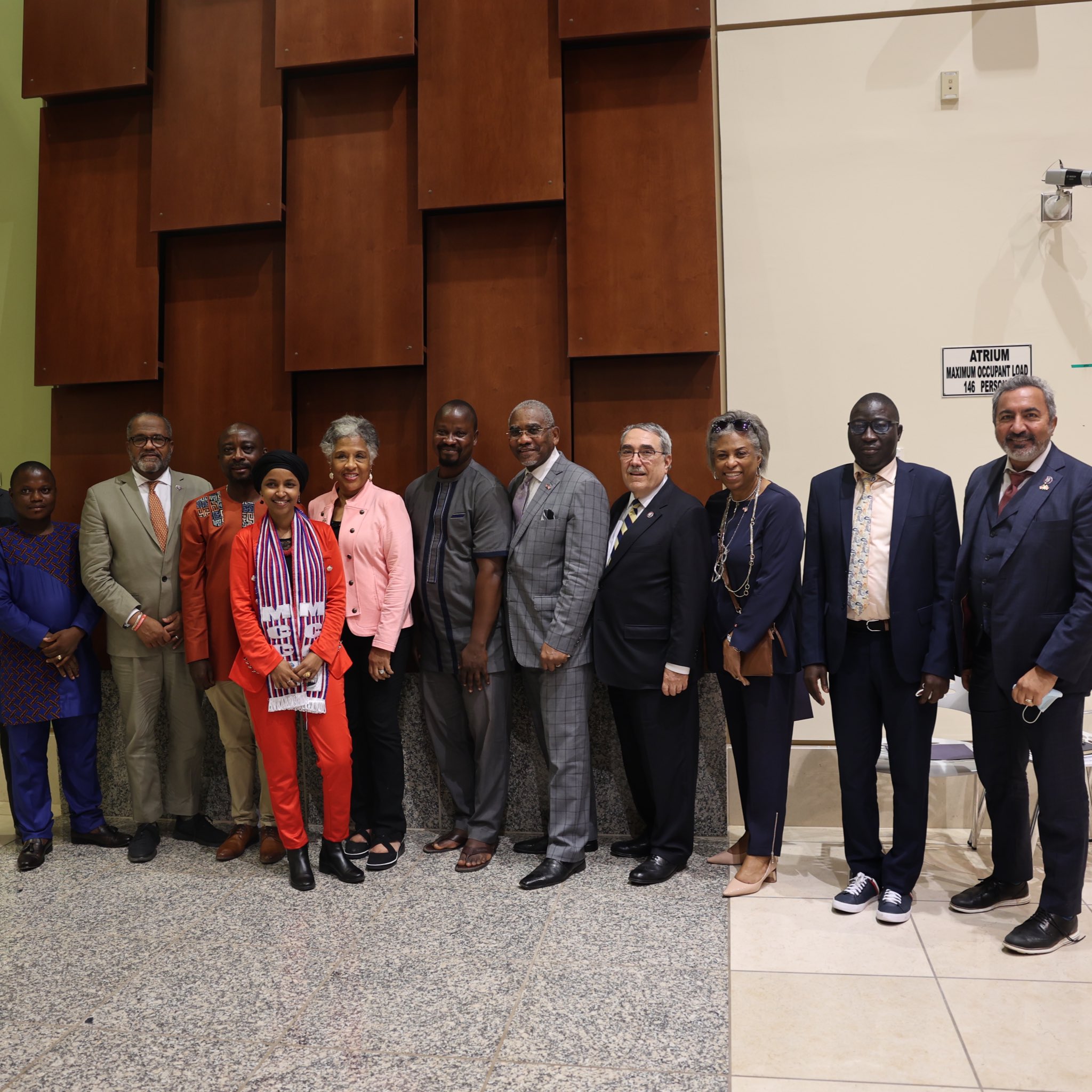
Rep. Gregory W. Meeks, who is also the Chair of the House Foreign Affairs Committee, led a delegation in February that included Democratic members of Congress Omar, Ami Bera, Joyce Beatty, G.K. Butterfield, Brenda Lawrence, and Troy Carter. The lawmakers visited Sierra Leone, Liberia, Côte d’Ivoire, and Tanzania, and held meetings with heads of state, top government officials, and business leaders. They also met with members of the opposition and civil society leaders, Omar says.

“One of the things that we are interested in and have been talking about quite a lot is promoting trade and investment in Africa,” Omar says. “One of the reasons that we visited these four particular countries is that they’re in different stages of development.”

In 2000, the U.S. Congress enacted the African Growth and Opportunity Act (AGOA) to give trade preference by providing duty-free entry of products from 38 countries on the continent into the U.S. market. Since then, the AGOA has been the main avenue of U.S.-African engagement in trade and investment.

“We wanted to affirm that commitment that there was going to be action behind those words, and to highlight some of the things that we will be working as we move forward,” Omar said.

Meeks and President Bio
President Julius Maada Wonie Bio of Sierra Leone (Third left) during festivities to welcome the Congressional delegation to his country in February.The festivities included a homecoming and chief coronation ceremony for Chairman Meeks. Photo: Courtesy of House Foreign Affairs Committee

Mark Ritchie, the executive director of Global Minnesota, a nonprofit, nonpartisan organization that fosters international understanding, says relations with the people, governments, institutions, and companies on the African continent are very important for the United States. That collaboration is even more needed now than ever because of the effects of the coronavirus pandemic on economies around the world.

“The United States has been an excellent partner with the people of many countries in Africa,” Ritchie says. “We can and must do more to partner in the area of health and wellness, including advanced research on long-term solutions to viral pandemics.”

Ritchie says it is also important for the United States to continue to partner with African countries in countering terrorism, and help the continent become free of conflict.

“Recent decisions to abandon our focus on fighting terrorism and pivot to engaging in competition with Great Powers has resulted in a resurgence in terrorism that threatens stability and could trigger refugee flows that need urgent attention,” Ritchie says.

Liberia NGOs Group
Members of the U.S. Congressional delegation with members of Liberia’s NGOs after a roundtable discussion on good governance and accountbaility in February. Photo: Courtesy of House Foreign Affairs Committee

He adds that more emphasis should also be put on addressing issues of climate change in Africa and around the world.

“The entire planet needs to reach a net-zero carbon footprint within this decade and that means some later shifts in personal and society wide actions and behaviors,” Ritchie says. “We are all in this climate crisis together, and it will take every single person’s effort to save the planet from an intolerably hot future.”

While he agrees with Ritchie on the need to act urgently on climate change, Horace Campbell, a professor of African American studies and political science at Syracuse University in New York, says Africa does not need more militarization.

Also Read: America’s largest consulate in the world will be in Africa.

“What I’ve learned in my discussions with Africans is that they are against the so-called war on terror because it diverts attention from reconstruction,” Campbell says.

Campbells says countries on the continent that are struggling with insecurity could learn more about demilitarization from other African nations like Angola, South Africa, and Tanzania, which he says have made provision of education, water, and healthcare more important priorities than funding the military. If they want to prosper, the first thing African countries should do is end all military agreements with countries like the United States, France, Britain, he says.

Ilhan Speaking in Monrovia Feb 23 2022
Rep. Ilhan Omar of Minnesota speaks in Monorovia, Liberia during a Congressional delegation visit to the country to meet with President Weah, members of the Opposition and the NGO sector. Photo: Courtesy of House Foreign Affairs Committee

“Africans cannot demilitarize because they’re compromised by the relationship with the United States, through the United States Africa Command, which signs agreements that deepen the militarization of the continent,” Campbell says.

Campbell says he’d like to see Congressional Black Caucus emulate Ron Dellums, the California congressman who rallied the Black community to support Nelson Mandela at a time when President Ronald Reagan’s administration supported South Africa’s Apartheid government.

“If they want a U.S. foreign policy that turns a page in Africa, it must be a new page to focus on demilitarization, reconstruction, and tackling global warming,” Campbell says. “Anything else would just be supporting white supremacy in Africa.”

Omar says she is aware of the high expectations Black members of Congress have in efforts to shift the U.S policy towards Africa, especially now that Meek, an African American, is the Chair of the House Foreign Affairs Committee.

“There is going to be more investment in trying to engage with the continent differently,” she says. “One thing we have to move away from is the colonial approach to our relationships on the continent.

Omar also agrees with Campbell that the United States has to abandon “the military-first” approach to counterterrorism, which she blames for destabilizing regions like the Horn of Africa and the Sahel, leading to severe violations of human rights.

“Supporting peace and good governance is not only the right thing to do morally,” she says. “it’s a much more productive way to confront the problem of terrorism, whether it’s Al-Shabaab or Boko Haram.”

But Omar says she and her colleagues of African descent in Congress will continue to push for a U.S. foreign policy that sees Africa as a partner and not as a place that needs help.

“I have raised this repeatedly with the State Department and [United States Agency for International Development] and will continue to advocate for policies that I believe will be both morally and strategically better than what we’re doing now,” she says.

U.S. breaks ground on $537 million consulate in Lagos, will be largest in the world

0
A rendering of the U.S. Consulate in Lagos that is expected to be completed in 2027 and will be America’s largest Consulate in the world. The U.S. Ambassador to Nigeria Mary Beth Leonard participated in a groundbreaking ceremony on Thursday, March 31, 2022. Photo: Courtesy of Ennead Architects
060422 US embassy pic
A rendering of the U.S. Consulate in Lagos that is expected to be completed in 2027 and will be America’s largest Consulate in the world. The U.S. Ambassador to Nigeria Mary Beth Leonard participated in a groundbreaking ceremony on Thursday, March 31, 2022. Photo: Courtesy of Ennead Architects

The United States broke ground on a $537 million consulate on Thursday in Nigeria’s megacity of Lagos which is also the country’s commercial hub. The 10-story consulate is being built on a 12.2-acre site in the Eko Atlantic City, a new coastal city being constructed on Victoria Island and includes a 5-mile-long seawall to protect it from rising sea levels and erosion.

Completion of the new consulate is expected in 2027.

A news release from the U.S. Embassy in Abuja said when completed “it will be the largest U.S. Consulate in the world.” 2,500 Nigerians are expected to be employed during the duration of the construction in various capacities including engineers, architects, artisans, construction workers, and administrative staff.

Lagos US Conulate Groundbreaking on March 31 2022
U.S. diplomats in Nigeria led by Ambassador Mary Beth Leonard and Nigerian officials led by Lagos State Governor Babajide Sanwo-Olu at the groundbreaking of the U.S. Consulate in Lagos on Thursday, March 31, 2022. When completed in 2027, it will be America’s largest Consulate in the world. Photo: Courtesy of U. S. Department of State

An estimated $95 million will be invested in the local economy, the statement said.

“Our vision for this remarkable Consulate campus is to create a facility that both honors the vibrant relationship between the United States and Nigeria and communicates the spirit of American democracy, transparency and openness,” US Ambassador to Nigeria Mary Beth Leonard said at the groundbreaking ceremony.

Ennead Architects of New York is the design architect and Pernix Federal of Lombard, Illinois, the design-build contractor. EYP of Albany, New York, is the architect of record.

Ambassador Leonard was joined in the groundbreaking by Lagos State Governor Babajide Sanwo-Olu and U.S. Consul General Claire Pierangelo.

“Nigeria and the United States have a long-standing history of people-to-people engagement fostering bridges between our two nations. We look forward to the many accomplishments we will continue to achieve together in the future,” Consul General Claire Pierangelo said.

Annual trade between Nigeria and the United States stands at $10 billion, according to the State Department.

Number of COVID patients in US hospitals reaches record low

0
Pedestrians wearing protective masks walk along Broadway in the SoHo district of New York, Friday, March 4, 2022. COVID-19 hospitalization numbers have plunged to their lowest levels since the early days of the pandemic, offering a much needed break to health care workers and patients alike following the omicron surge. Photo: John Minchillo/AP
AP COVID 4 5 22
Pedestrians wearing protective masks walk along Broadway in the SoHo district of New York, Friday, March 4, 2022. COVID-19 hospitalization numbers have plunged to their lowest levels since the early days of the pandemic, offering a much needed break to health care workers and patients alike following the omicron surge. Photo: John Minchillo/AP

NORFOLK, Va. (AP) — COVID-19 hospitalization numbers have plunged to their lowest levels since the early days of the pandemic, offering a much needed break to health care workers and patients alike following the omicron surge.

The number of patients hospitalized with the coronavirus has fallen more than 90% in more than two months, and some hospitals are going days without a single COVID-19 patient in the ICU for the first time since early 2020.

The freed up beds are expected to help U.S. hospitals retain exhausted staff, treat non-COVID-19 patients more quickly and cut down on inflated costs. More family members can visit loved ones. And doctors hope to see a correction to the slide in pediatric visits, yearly checkups and cancer screenings.

“We should all be smiling that the number of people sitting in the hospital right now with COVID, and people in intensive care units with COVID, are at this low point,” said University of South Florida epidemiologist Jason Salemi.

But, he said, the nation “paid a steep price to get to this stage. … A lot of people got sick and a lot of people died.”

Hospitalizations are now at their lowest point since summer 2020, when comprehensive national data first became available. The average number of people hospitalized with COVID-19 in the last week nationwide dropped to 11,860, the lowest since 2020 and a steep decline from the peak of more than 145,000 set in mid-January. The previous low was 12,041 last June, before the delta variant took hold.

The optimistic trend is also clear in ICU patient numbers, which have dipped to fewer than 2,000, according to the U.S. Department of Health and Human Services.

“We’re beginning to be able to take a breath,” said Dr. Jeffrey Weinstein, the patient safety officer for the Kettering Health hospital system in western Ohio.

COVID-19 patients had filled 30% of Kettering Health’s nearly 1,600 hospital beds back in January, Weinstein said. Kettering’s eight hospitals now average two to three COVID-19 admissions a day — and sometimes zero.

And while Salemi agreed this is a good time for an exhausted health care system to take a breath, he warned that the public health community needs to keep an eye on the BA.2 subvariant of omicron. It’s driving increases in hospitalizations in Britain, and is now estimated to make up more than half of U.S. infections.

“We’re probably under-detecting true infections now more than at any other time during the pandemic,” Salemi said.

For now at least, many hospitals are noting the low numbers.

In California on Thursday, UC Davis Health tweeted that its intensive care unit had no COVID-19 patients for two consecutive days for the first time in two years.

“The first COVID-19 patient to arrive in our ICU did so in February 2020, and the unit treated at least one positive individual every day since, for at least 761 consecutive days,” the hospital system said.

Toby Marsh, the chief nursing and patient care services officer, said in a statement that they hope the numbers “are indicative of a sustained change.”

In Philadelphia, patients are spending less time in the Temple University Health System because there are no longer backlogs for MRIs, CT scans and lab tests, said Dr. Tony Reed, the chief medical officer.

Temple Health’s three hospitals had six adult COVID-19 patients on Thursday, likely its lowest patient count since March 2020, Reed said.

During the omicron surge, patients waited as long as 22 hours for a routine MRI, which is normally done within 12 hours. Longer waits affected those who came in with trouble walking — and in a lot of pain — for example, because of a herniated disc pinching their sciatic nerve.

“Nobody wants to stay in the hospital a day longer than they have to,” Reed said.

The emptying of beds is also helping patients in rural areas, said Jay Anderson, the chief operating officer for Ohio State’s Wexner Medical Center in Columbus. During the surges, the hospital faced challenges accepting people from community hospitals who needed elevated care for brain tumors, advanced cancer and stroke. That burden is now being lifted.

Visitors also will return in higher numbers, starting Tuesday. Ohio State will no longer restrict patients to two designated guests, who could only stop by separately.

“Patients heal better when they have access to their family and loved ones,” Anderson said.

Doctors, nurses and respiratory therapists are also getting a much needed break in some areas.

In Colorado, Dr. Michelle Barron said the consistently low COVID-19 hospitalizations prompted smiles among staff, even as she double-checks the numbers to make sure they’re actually correct.

“I had one of these moments like, oh this is amazing,” said Barron, medical director of infection prevention and control at UCHealth University of Colorado Hospital. “It feels unreal.”

UCHealth loosened some restrictions, including dropping testing requirements for anyone who entered a facility. And while that produced some anxiety among staffers, Barron says the numbers haven’t spiked.

“I think some people have started to take vacations and not feel guilty,” she said. “I had spring break with my kids and it was a level of happiness where I went, oh my god, this is actually normal.”

The omicron surge had stretched staff at work — but also at home, said Dr. Mike Hooper, chief medical officer for Sentara Norfolk General Hospital in southeastern Virginia.

“It was stressful to be at the store … to visit your family,” Hooper said. “We’re all hoping that some ‘return to normalcy’ will help people deal with the inherent stresses of being part of the health care team.”

But just because hospitalizations are down does not mean hospitals are empty, said Dr. Frank Johnson, chief medical officer for St. Luke’s Health System in Idaho.

Some measures — like wearing masks in certain settings — will remain in place.

“I don’t know when we may go back to old practices regarding mask wearing in our clinical areas,” Johnson said. “We’ve seen some benefits of that in terms of reduction in the number of other viral infections.”

In the meantime, the public health community is keeping an eye on the BA.2 subvariant of omicron.

Salemi, the University of South Florida epidemiologist, said the increase in at-home testing means that more results are not being included in official coronavirus case counts. Therefore, wastewater surveillance will be the early warning signal to watch, he said.

“BA.2 is here,” he said. “We don’t have to look that far in the rear-view mirror to know things can change very rapidly. We saw what happened with delta. We saw what happened with omicron…. We don’t want to wait until we see a lot of people hospitalized before we take action.”

Black Violin concert at the Ordway postponed due to travel delays

0
The Black Violin concert scheduled for Sunday, April 3, 2022 at the Ordway in Saint Paul, Minnesota has been postponed due to travel delays. Photo: Courtesy of the Ordway
Black Violin
The Black Violin concert scheduled for Sunday, April 3, 2022 at the Ordway in Saint Paul, Minnesota has been postponed due to travel delays. Photo: Courtesy of the Ordway

Black Violin’s concert on Sunday, April 3 at the Ordway in Saint Paul has been canceled due to travel delays.

A statement from the Ordway said the group is experiencing travel complications and unable to make it to Saint Paul in time for the concert.  It said a new date is being set and that tickets for tonight’s performance will be automatically transferred to the new date.

Black Violin is composed of classically trained violist and violinist Wil B. and Kev Marcus, who combine their classical training and hip-hop influences to create a distinctive multi-genre sound that is often described as “classical boom.”

Twin Cities celebration of Francophone culture stars Congolese artist, Miloe

Miloe performing at the Cedar Cultural Center in Minneapolis on Friday, March 25, 2022 as part of a month-long celebration of Democratic Republic of the Congo by Alliance Française of Minneapolis/St Paul. Photo: Panashe Matemba-Mutasa/Mshale
Miloe 1
Miloe performing at the Cedar Cultural Center in Minneapolis on Friday, March 25, 2022 as part of a month-long celebration of Democratic Republic of the Congo by Alliance Française of Minneapolis/St Paul. Photo: Panashe Matemba-Mutasa/Mshale

Even at the age of six, Miloe knew he was destined to be a musical artist. Miloe, who was born Bobby Kabeya in the Democratic Republic of Congo, credits his parents for supporting him unconditionally.

“I feel very fortunate to have parents who love music so much and didn’t stop me from doing it,” Miloe said.

The up-and-coming artist was speaking at the Cedar Cultural Center in Minneapolis, where the nonprofit Alliance Française held an event titled “An Evening with MILOE: Concert & Conversation” on Friday, March 25. Miloe, 21, debuted his new single, “Where U Are”, which was held to celebrate Francophone culture.

“To be able to have artists like Miloe from French-speaking countries here in Minneapolis is really enriching for our community,” said Christina Selander Bouzouina, the executive director of Alliance Française.

Kabeya shared the story of how he got into music. His parents met through a church choir in college. His father named him after Bob Marley, and got him to start playing piano at age six. Miloe’s father was a journalist in the DRC at time when the country was going through political unrest because of a disputed election. Fearful that he would be next during the government’s crackdown on reporters, he fled to the United States in 2006 and sought asylum. Three years later, in 2009, 8-year-old Miloe and the rest of his family reunited with him, and eventually they moved to St. Paul’s Como neighborhood.

Miloe’s mother, who attended the concert, said that her son has always had clear plans to pursue music, and that his surefootedness in his path put her at ease.

“The only time I was scared for him was during Covid, because he was set to go on tour and it was such a scary time,” she said. “But now that we are moving back to in-person shows, I am in full support of where he is going.”

Miloe in Discussion
Miloe during a post-concert discussion at the Cedar Cultural Center in Minneapolis on Friday, March 25, 2022 as part of a month-long celebration of Democratic Republic of the Congo by Alliance Française of Minneapolis/St Paul. Photo: Panashe Matemba-Mutasa/Mshale

In middle school, Miloe started his own band, which he said was inspired by the St. Paul-based rock band “Hippo Campus.” From there, he continued to develop his sound, drawing on the influences of rock, indie pop, rumba folk, and traditional Congolese instrumentals. He said some of his biggest musical inspirations were the late South African reggae legend, Lucky Dube, and Mike Kalambay, a Congolese gospel singer.

Cece Ryan, a local retiree and great-grandmother of six who hosted the Kabeyas 15 years ago when they first came the United States, said has since been a supporter of Miloe and his music.

“I think the fact that he writes his own music is amazing,” Ryan said. “I have always been blown away by his musical talent.”

Cindie Kouame, whose family has been long-time friends of the Kabeyas, said that for many years they attended the same church, where Miloe played drums and guitar during worship. Over the years, the two families have become very close. Her youngest son was in the official music video of “Where U Are”, Kouame said. She described Miloe as down-to-earth and said that his increased popularity has not changed his character.

“He isn’t very flashy at all,” Kouame said. “He’s kept the same people close to him since he got started.”

By the end of the year, Miloe said his fans can expect more music. He also plans on launching a world tour, including stops in his current home of the Twin Cities and abroad.

“I’d like to go to Europe this year, and possibly tour France,” he said. “And of course, it’s always been my dream to share my music with Congo.”

Founded in Paris in 1883, Alliance Française is a Minneapolis-based nonprofit that hosts events, classes, and programs to promote French language and culture. The organization’s Minneapolis location was established in 1920, when University of Minnesota professor Jacques Fermand assumed presidency, according to their website. The local chapter has since grown from a modest 100 members to over 1,000 across the metro area.

CDC ends COVID warning against cruise ship travel

0
Passengers disembark from the Carnival Sunshine cruise ship Monday, March 16, 2020, in Charleston, S.C. Federal officials are dropping a health warning that they have attached to sailing on cruise ships since the start of the pandemic. The U.S. Centers for Disease Control and Prevention said Wednesday, March 30, 2022 that they will leave it up to vacationers to decide whether they feel safe getting on a ship. Photo: Mic Smith/AP
Cruise Ship
Passengers disembark from the Carnival Sunshine cruise ship Monday, March 16, 2020, in Charleston, S.C. Federal officials are dropping a health warning that they have attached to sailing on cruise ships since the start of the pandemic. The U.S. Centers for Disease Control and Prevention said Wednesday, March 30, 2022 that they will leave it up to vacationers to decide whether they feel safe getting on a ship. Photo: Mic Smith/AP

Two years after warning travelers against cruise ship travel, the U.S. Centers for Disease Control and Prevention (CDC) on Wednesday removed from its website the COVID-19 notice against cruise travel.

Cruise ships had criticized the CDC for discriminating against them when airlines and hotels were not subjected to such. The CDC warning had come early in the pandemic when outbreaks occurred aboard cruise ships, and many were barred by some seaports from docking.

Data from The Cruise Lines International Association, an industry group, says cruise companies lost a collective $63 billion and thousands of jobs in the process during the pandemic.

The CDC guidelines for traveling on cruise ships previously had a scale that showed the level of coronavirus transmission risk on cruise ships. As of yesterday, the guidelines now just advise travelers to be up to date with their vaccines before boarding ships. It also advises travelers who are immunocompromised to consult with their doctor before traveling.

“While cruising will always pose some risk of COVID-19 transmission, travelers will make their own risk assessment when choosing to travel on a cruise ship, much like they do in all other travel settings,” the CDC said in a statement.

The Cruise Lines International Association said in a statement that the CDC’s decision to remove its health warning “recognizes the effective public health measures in place on cruise ships and begins to level the playing field between cruise and similarly situated venues on land.”