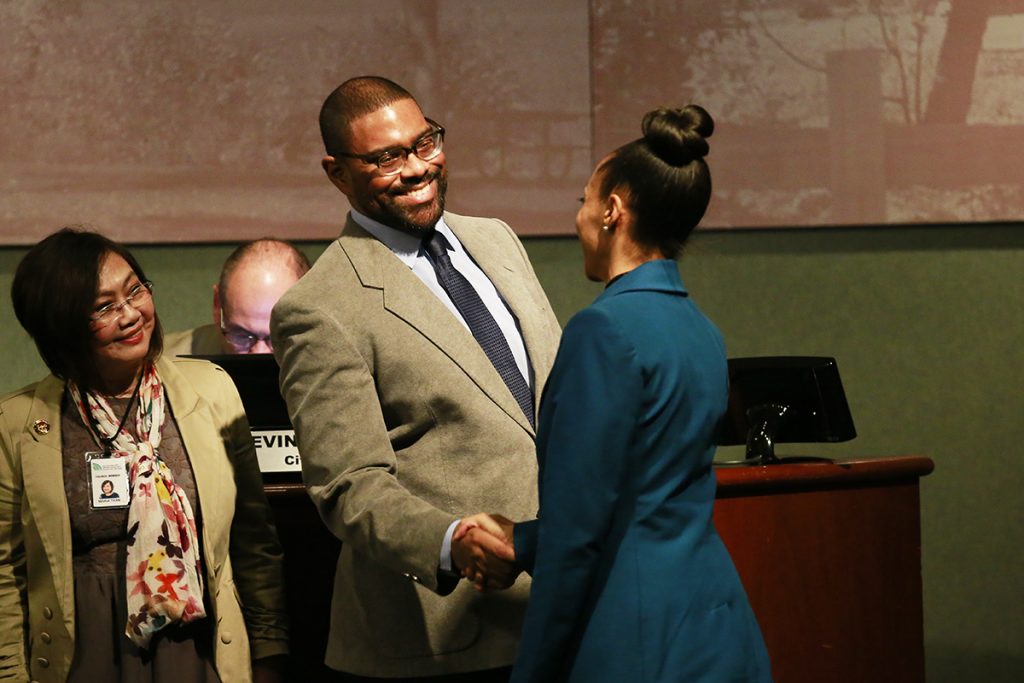
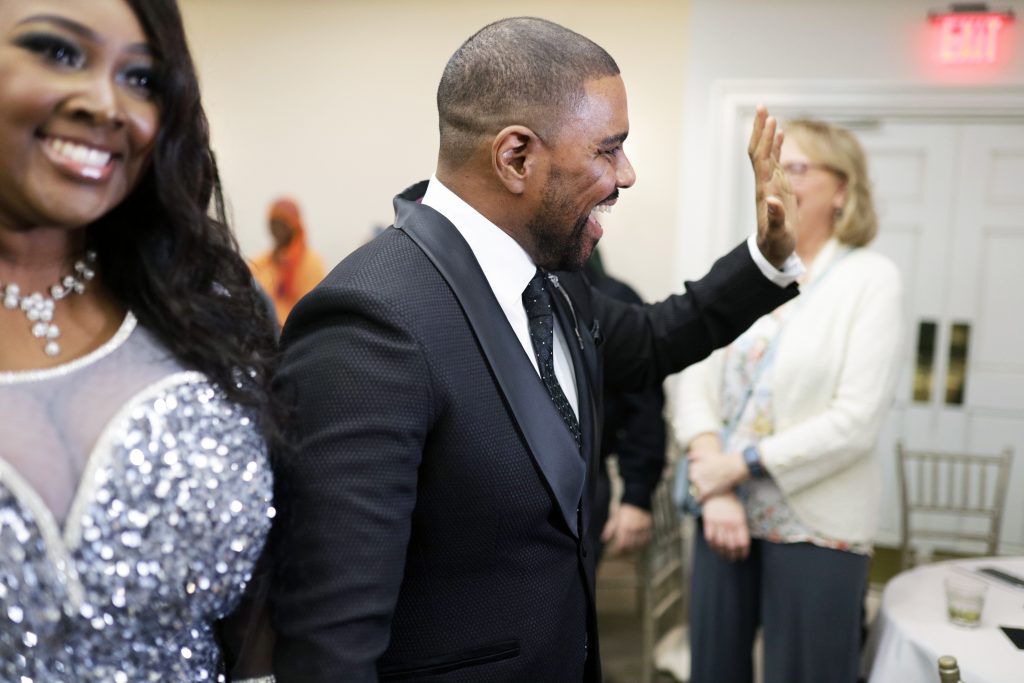
Winston makes his grand entrance, his wife beside him and three children not far behind. Attendees immediately rose from their seats, applauding as the new mayor made his way to the stage for photos and to give his speech. Mshale Staff Photo by Panashe Matemba-Mutasa
Winston makes his grand entrance, his wife beside him and three children not far behind. Attendees immediately rose from their seats, applauding as the new mayor made his way to the stage for photos and to give his speech. Mshale Staff Photo by Panashe Matemba-Mutasa
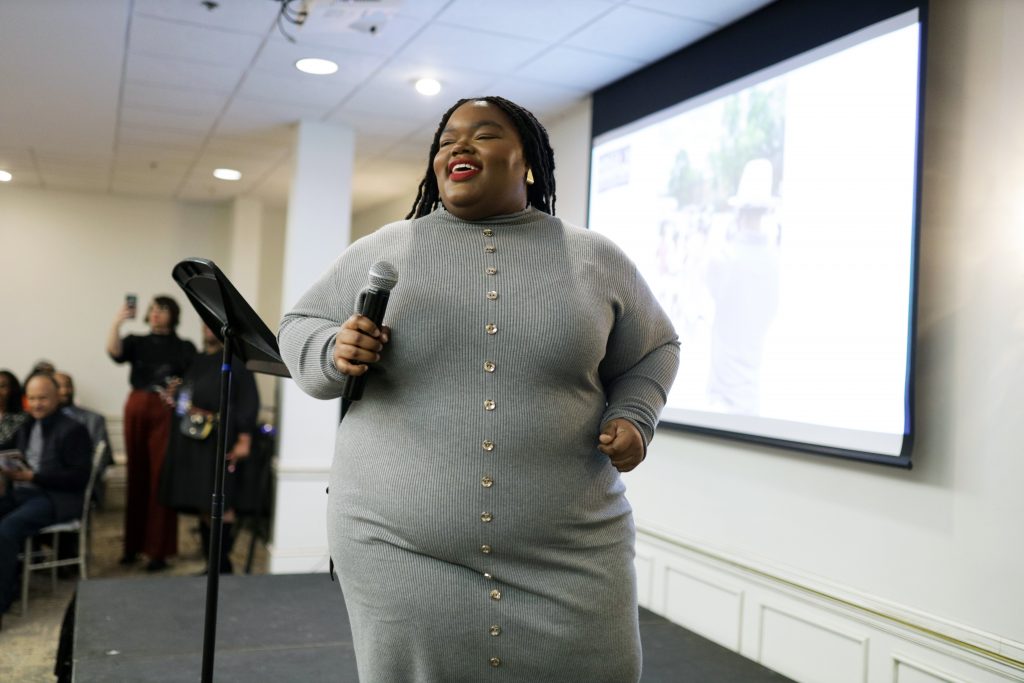
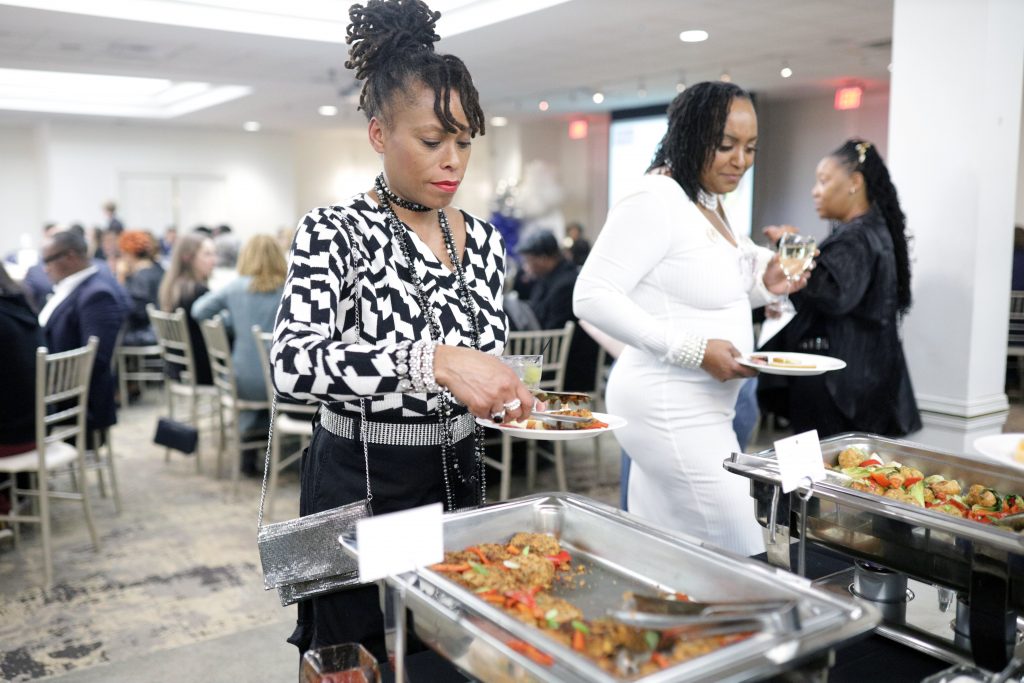
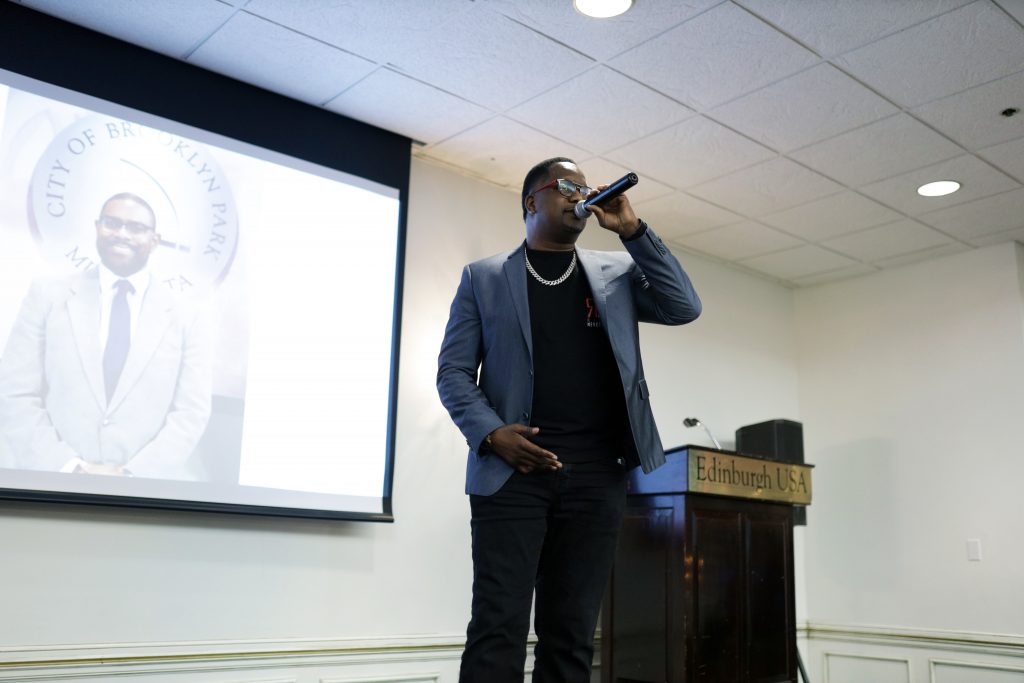
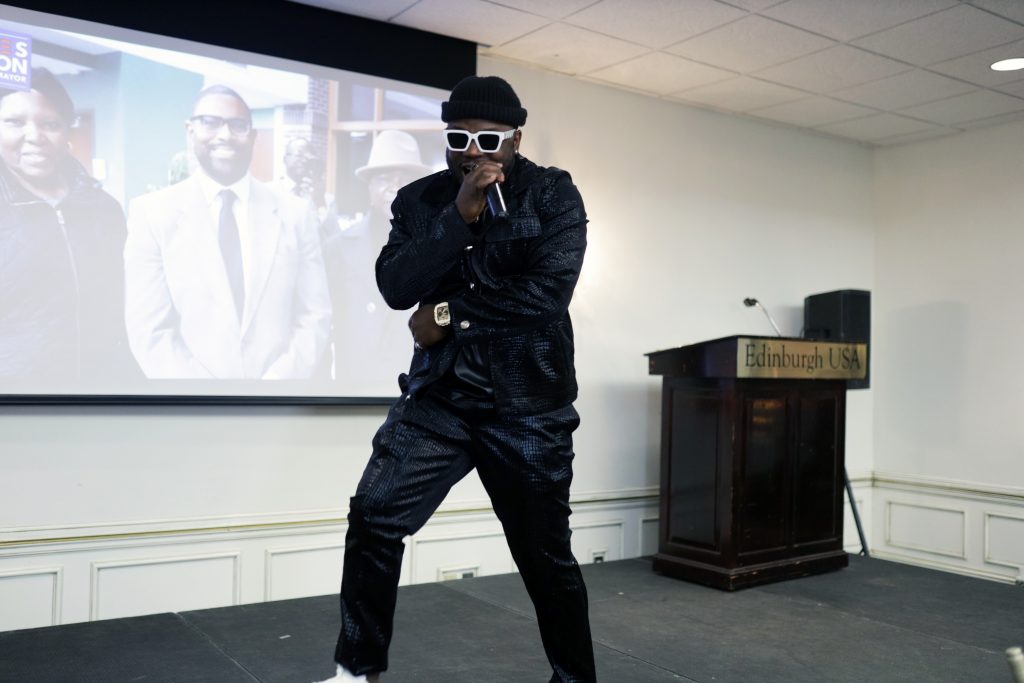
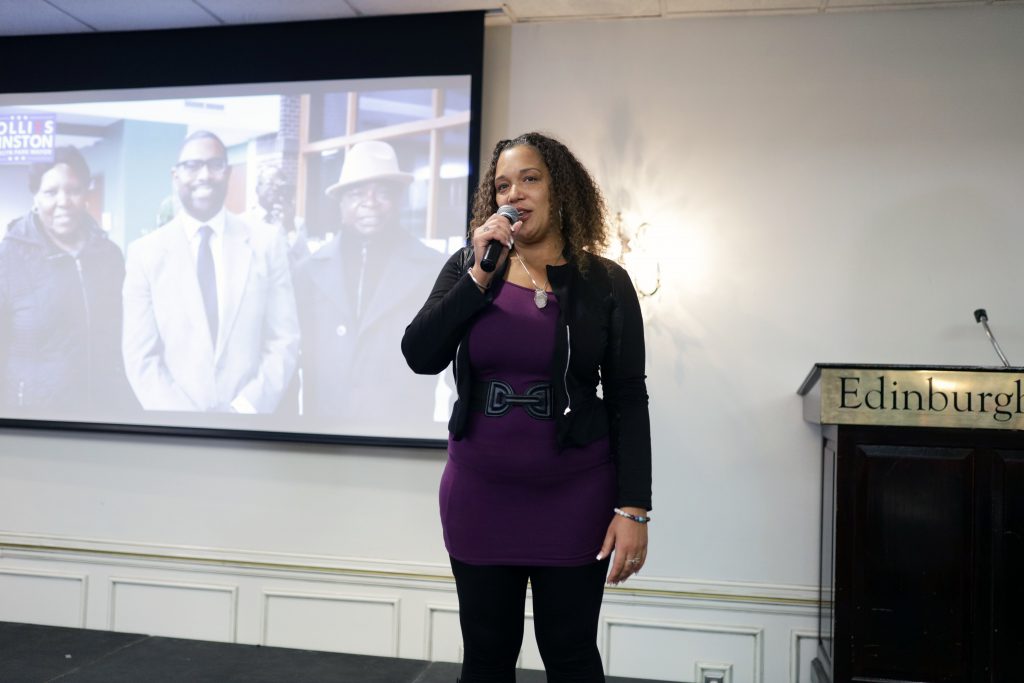
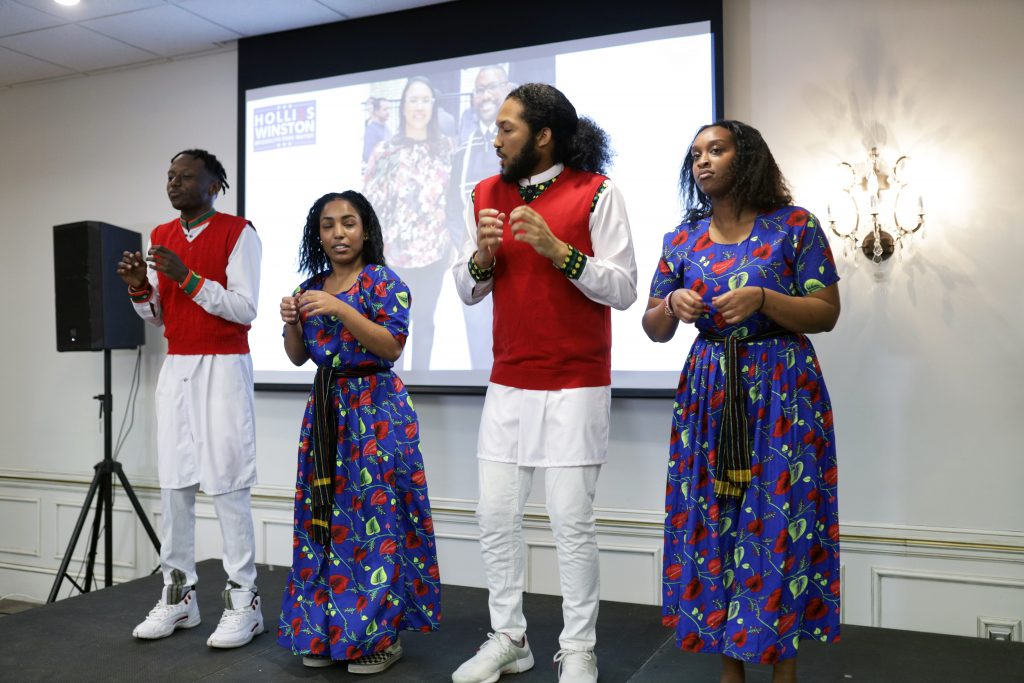
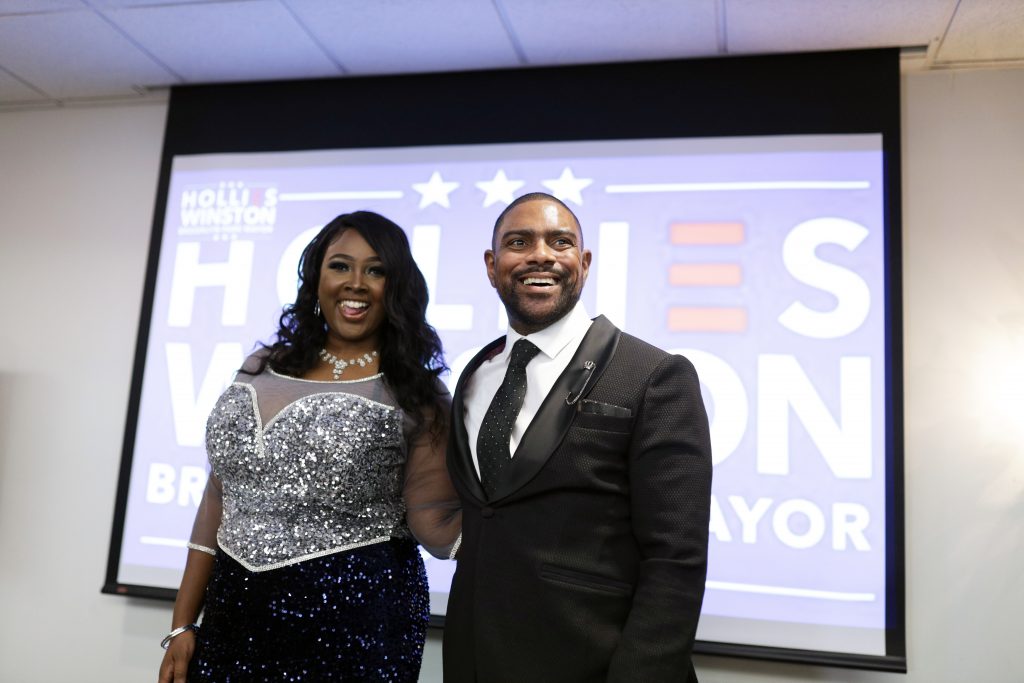
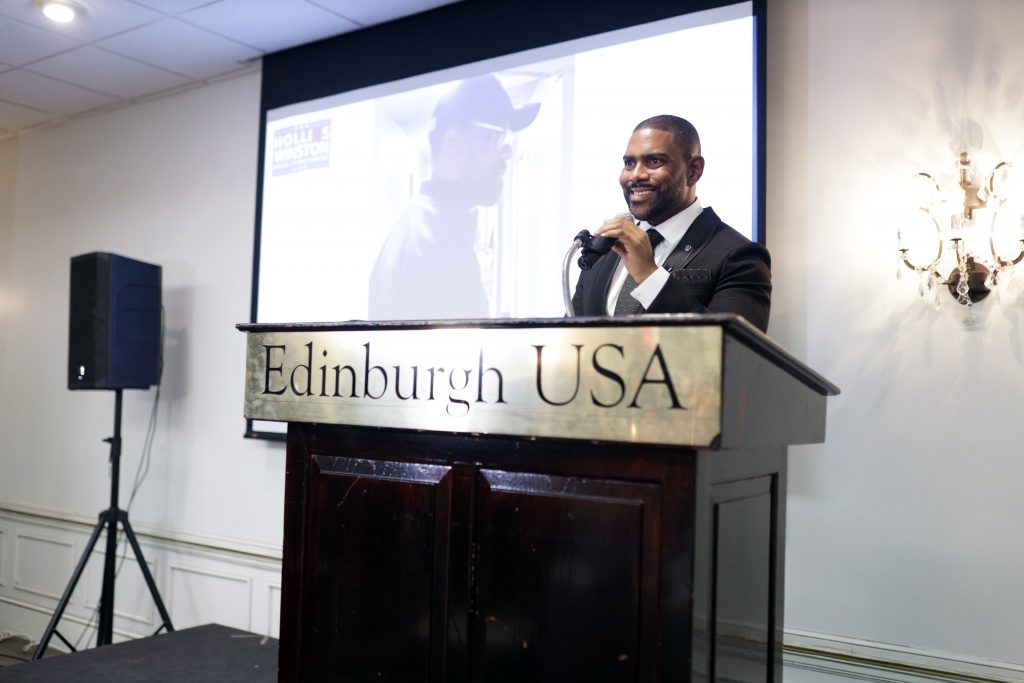
Friends, family, and supporters gathered on Friday in Brooklyn Park to celebrate Hollies Winston, who on Jan. 9 became the first Black mayor of the suburban Minneapolis city. The event, which was held at Edinburgh USA public golf course, featured food and drinks, and a diverse entertainment lineup.
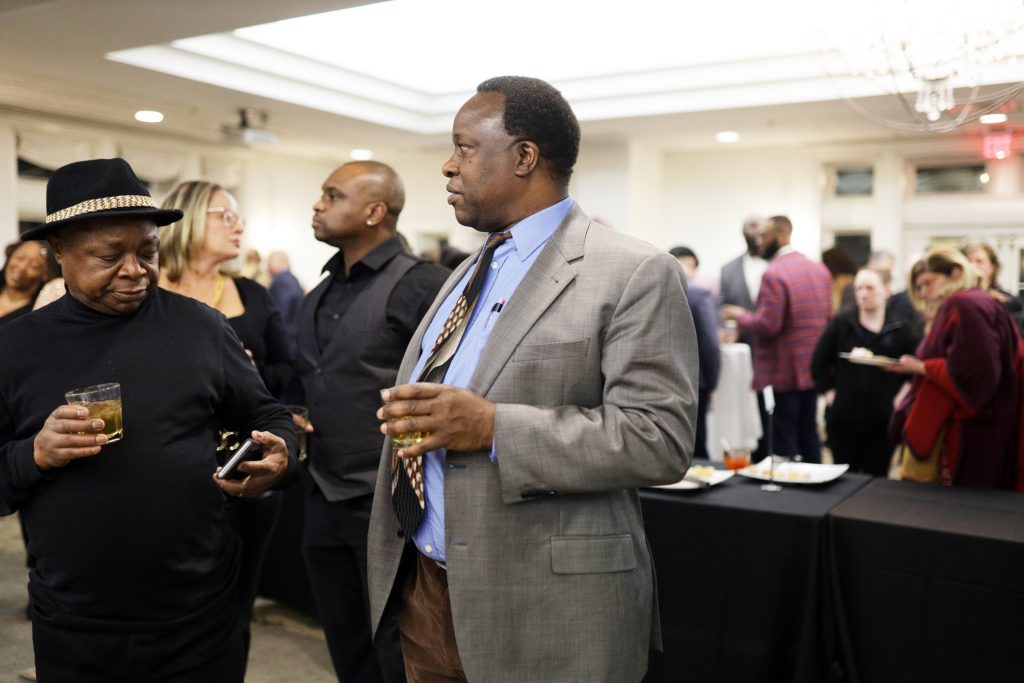
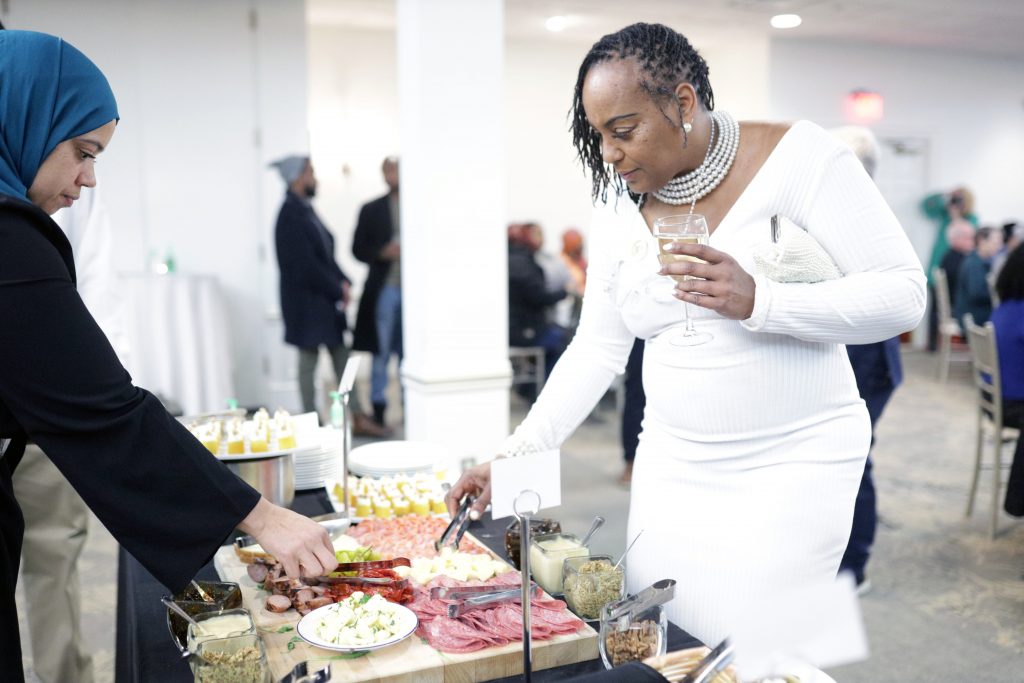
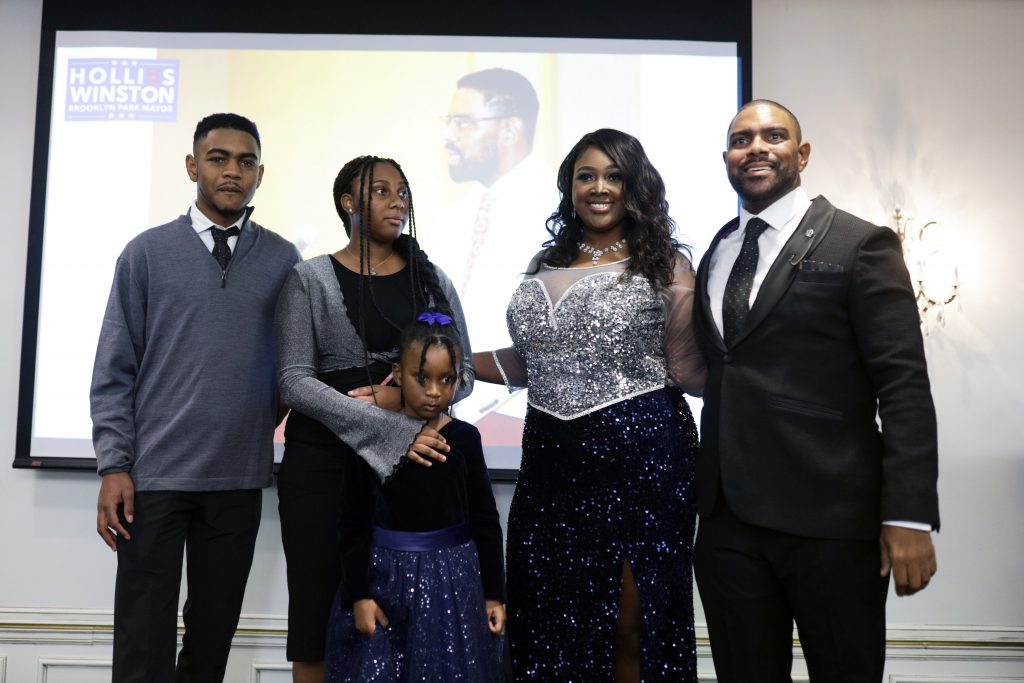
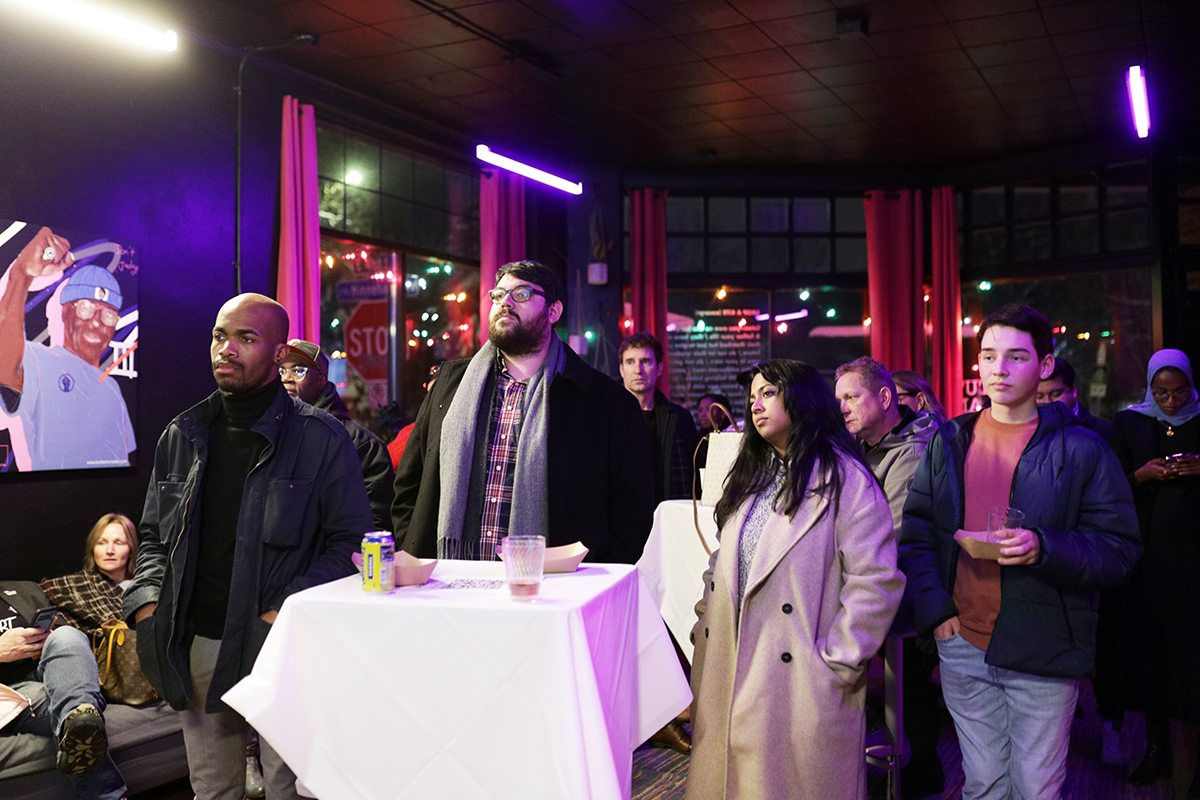
Winston makes his grand entrance, his wife beside him and three children not far behind. Attendees immediately rose from their seats, applauding as the new mayor made his way to the stage for photos and to give his speech. Mshale Staff Photo by Panashe Matemba-MutasaKenyan American businessmen Alex Ong’ou and Henry Momanyi join other guests in enjoying drinks and socializing as they wait for the program to start. An eclectic mix of African and American music played as people weaved around each other at the bar, exchanged warm embraces, and laughed heartily. Mshale Staff Photo by Panashe Matemba-MutasaGuests choose from the array of finger foods, which include catering from gourmet Italian café, D’Amico & Sons. Mshale Staff Photo by Panashe Matemba-MutasaWinston’s family is all smiles on stage as guests snap photos. He spoke about the support his family has given him since his early campaigning days. “Without them I wouldn’t be in this spot that I am now,” Winston said. “Brooklyn Park would not be in this spot right now.” Mshale Staff Photo by Panashe Matemba-MutasaKennadie Hurst kicks off the agenda with a rendition of “Lift Every Voice and Sing.” The song, originally composed by African American writer and civil rights activist James Weldon Johnson in 1871, began resonating with Black families across the nation in the early 1900s. It was pushed by the NAACP as the “Negro National Anthem” in 1917 and officially became so shortly after. Mshale Staff Photo by Panashe Matemba-MutasaGuests line up at the snack bar. On the joined tables is a variety of hors d’oeuvres platters, including Thai style meatballs, cured deli meats and cheeses, and an assorted selection of breads, crackers, and biscuits. Mshale Staff Photo by Panashe Matemba-MutasaSolo R&B artist, Rico Nevotion, performs his original song, “I can’t Breathe.” The audience applauded as he sang, “how can you love our culture without the Black woman or man?” from the song about Black exploitation. Mshale Staff Photo by Panashe Matemba-MutasaBigg Timee, a Liberian American artist, delivers an electrifying Afropop performance. Mshale Staff Photo by Panashe Matemba-MutasaApril Graves, who herself made history in November when she was elected the first Black woman mayor of neighboring Brooklyn Center, speaks about what the victories mean for her and Winston. “We’re going to get a lot done together and get to know each other more,” she said. Mshale Staff Photo by Panashe Matemba-Mutasa: Members of Oromo Youth Group, who are originally from Ethiopia, perform an Eskista, a traditional dance originating in the Amhara region. It features dancers, usually in groups, rolling their shoulders and jilting their chests. Mshale Staff Photo by Panashe Matemba-MutasaWinston and his wife Latrice smile for photos on stage. Mshale Staff Photo by Panashe Matemba-MutasaWinston delivers his long-awaited speech. He said that he was humbled to be in his current position, considering that his grandfather was a sharecropper who picked cotton and even saw someone lynched. Winston also emphasized the importance of community support in being able to get work done. “We need you as residents to be involved,” he said. “If we can center the issues that matter and do it together, I am confident we can create the Brooklyn Park ya’ll elected me to create.” Mshale Staff Photo by Panashe Matemba-MutasaGuests listen as Winston expresses gratitude and shares the importance of family and community to his victory. Mshale Staff Photo by Panashe Matemba-Mutasa
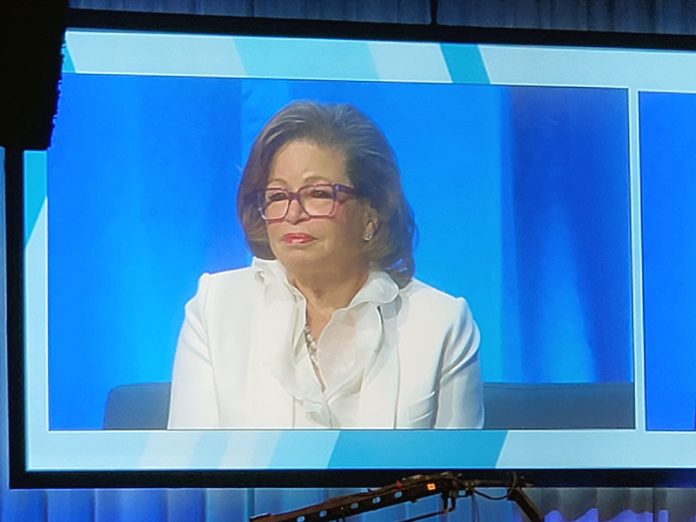
A giant screen projects Valerie Jarrett inside the Minneapolis Convention Center as she participated on stage in a fireside chat moderated by Twin Cities lawyer Abou Amara during the annual Martin Luther King, Jr. Breakfast on Monday, Jan. 16, 2023. Photo: Tom Gitaa/Mshale
A giant screen projects Valerie Jarrett inside the Minneapolis Convention Center as she participated on stage in a fireside chat moderated by Twin Cities lawyer Abou Amara during the annual Martin Luther King, Jr. Breakfast on Monday, Jan. 16, 2023. Photo: Tom Gitaa/Mshale
Valerie Jarrett, who served as a senior adviser to former President Barack Obama, said that in addition to celebrating Dr. Martin Luther King, Jr. Day, the United States should strive to advance the legacy of the civil rights icon.
“The world is watching,” said Jarrett, who is currently the Chief Executive of the Barack Obama Foundation. “’When you say, ‘Keep moving on,’ you recognize the shoulders on which we all stand. You run with the baton for as long as you can and then turn it to someone else.”
Jarrett was the keynote speaker on Monday at the Minneapolis Convention Center during this year’s MLK Breakfast, an event organized by United Negro College Fund (UNCF) and General Mills, the Minnesota-based international processed consumer foods company, which has been hosting the breakfast for 33 years. She said that a recent series of events in the United States and around the world made Dr. King’s message even more relevant.
“I think many of us see what is happening in Washington and around the world and right here in Minneapolis, and we are left with a feeling of hopelessness,” Jarret said.
The annual breakfast is one way Minneapolis has carried the torch of King’s legacy by bringing civil rights issues to the forefront. MLK Day is celebrated on the third Monday in January each year, and honors the civil rights hero’s birthday.
Born on January 15, 1929, King became best known for his dedication to nonviolent resistance to racial injustice in the United States. In 1955, he organized the Montgomery Bus Boycott to protest segregation in the Alabaman city’s transit agency. In 1963 he co-led the March on Washington protest that saw more than 250,000 people from all over the United States to travel to Washington D.C., to hear him deliver his “I Have a Dream” speech the Lincoln Memorial. King efforts led to the passing of the Civil Rights Act of 1964, which outlawed segregation and racial discrimination in public and private spaces. King was assassinated in 1968, and eventually got a federal holiday to honor his selfless dedication to civil rights.
However, the day didn’t come without a fight. On April 8, 1968, Rep. John Conyers, a congressman from Michigan who also cofounded the Congressional Black Caucus, proposed a bill to make MLK Day a federal holiday. Despite a petition for the bill garnering over 300,000 signatures and a stamp of approval from then President Jimmy Carter, it failed to pass the House when it initially came to a vote in 1979. But public support for the holiday continued to grow, aided by Stevie Wonder’s song, “Happy Birthday,” which he released in 1980 to honor King. Working together with King’s wife Coretta Scott King and the Congressional Black Caucus, Wonder collected six million signatures in favor of the holiday. When the bill reached the house floor again in 1983, it passed easily with a vote of 338 to 90, and President Ronald Reagan officially signed it into law.
Jarrett, who is of African American ancestry, shared the story of her upbringing that helped shape her perspective on race relations today. Unable to secure jobs in the United States, Jarrett’s parents left country for Shiraz, Iran, where she was born in 1956. She attended multicultural schools where children spoke a variety of languages on the playground, including French, English, and Farsi, Iran’s national language. Jarrett said growing up in a multilingual melting pot helped her see how possible it was for people to get along, no matter where they came from.
“My experiences abroad have taught me that while the United States is a great country, it isn’t the only country on Earth,” Jarrett said. “We can learn a great deal if we are willing to be curious and look outside of our own shores.”
Jarrett also said that the solution to a more just world could be as simple as having a more altruistic outlook. She emphasized the importance of putting others first and being community oriented. She said that making progress starts with making the choice to care about others.
“Make a career of humanity,” she said. “If humanity is your true north and guiding principle, you can help put an end to this world’s toxicity.”
Sean Walker, president of General Mills Group International, emphasized the importance of moving within one’s capabilities. He said that no movement in the fight for justice was too small.
“All that matters is that you cover the distance,” Walker said. “Decency, fairness, justice, respect, and dignity are attributes of the type of society that we all aspire to be a part of. The only way we get there is if we choose to participate along the way to making some progress.”
Dr. Michael L. Lomax, the president and CEO of UNCF, talked about the concept of historic movements. He said that, for example, he often had heard people wonder if the murder George Floyd was a moment or the beginning of a movement. Every movement, he said, begins as a moment.
“Twenty-twenty was our Montgomery. Our Montgomery moment,” Lomax said. “It is up to all of us to make it our transformational movement.”
Laverne McCartney Knighton, the area development director at UNCF, said that on aspect of King’s life that continued to inspire her was his commitment to peace in his pursuit of justice. In addition to being an impactful leader, she said, King demonstrated power in how he processed his circumstances.
“Dr. Martin Luther King Jr. embodied the power that choices can have,” Knighton said. “Even though during his time here on Earth, he was not able to make some of the choices that he wanted to, he was able to choose how he responded to situations.”
With regards to justice, Knighton reminded the audience of the long road ahead. She urged people to recall the many years that King dedicated to the struggle for liberation, despite not reaping the benefits in full himself. Perseverance, she said, is essential in getting any work done.
“The civil rights movement was not a fast process in gaining equal rights for all. In fact, it was and still is long and arduous,” Knighton said. “Keep moving.”
African musicians awarded in Senegal at annual ceremony
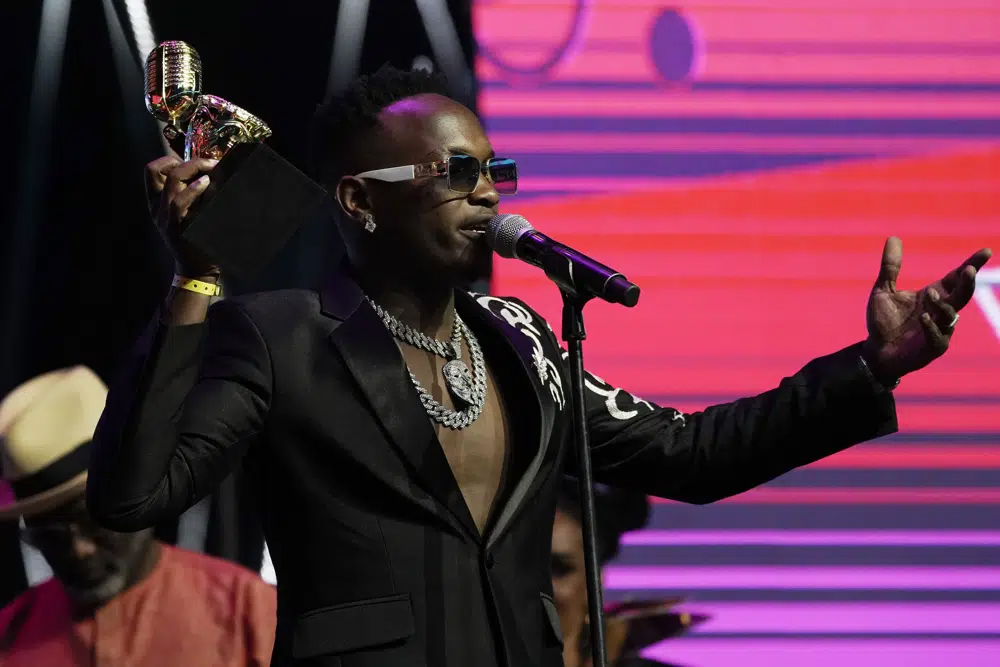
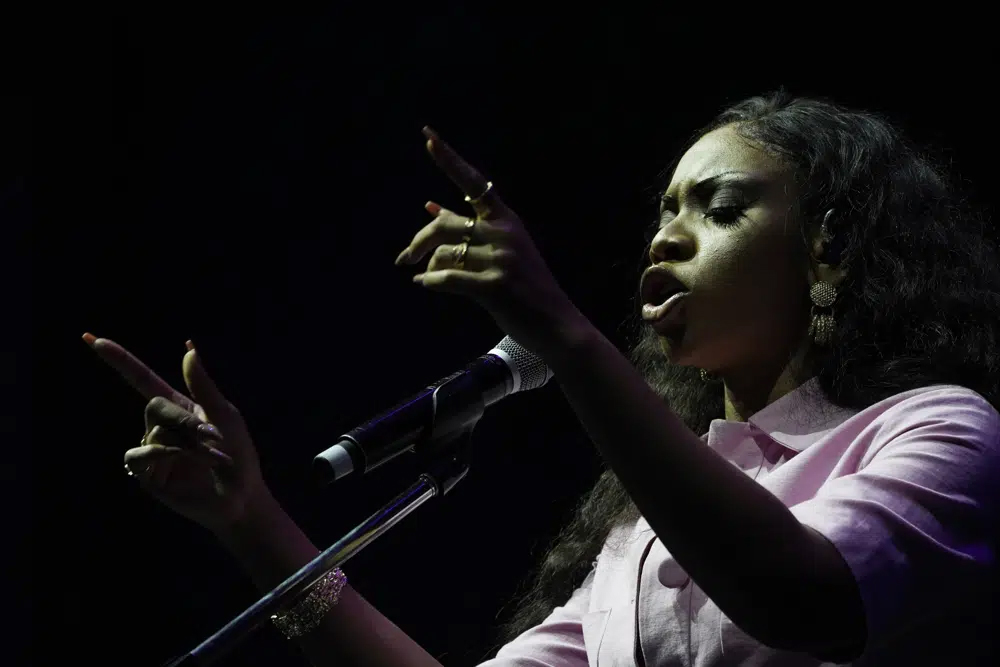
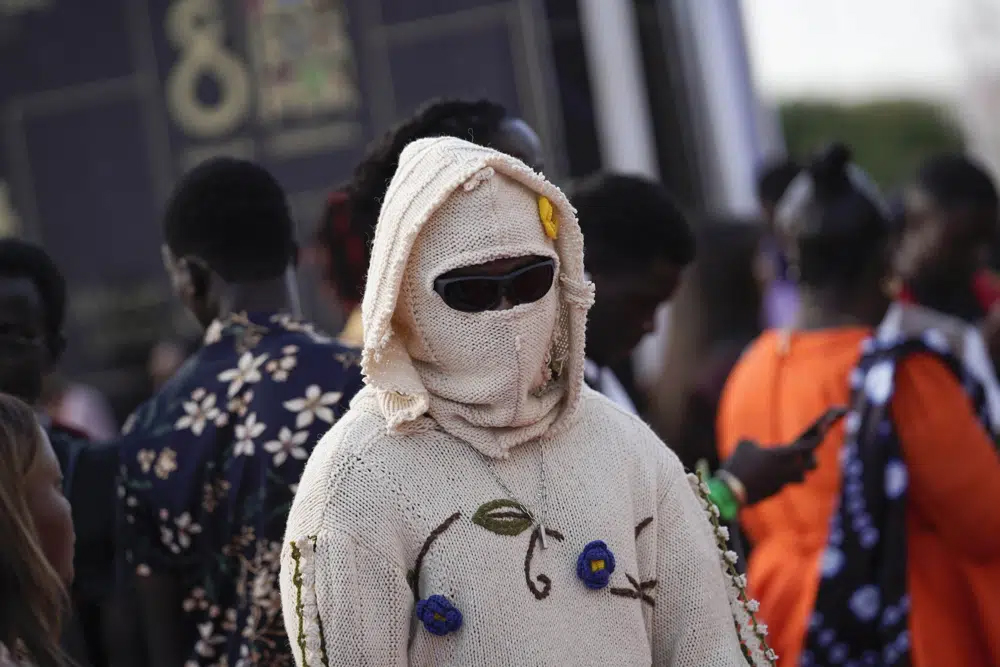
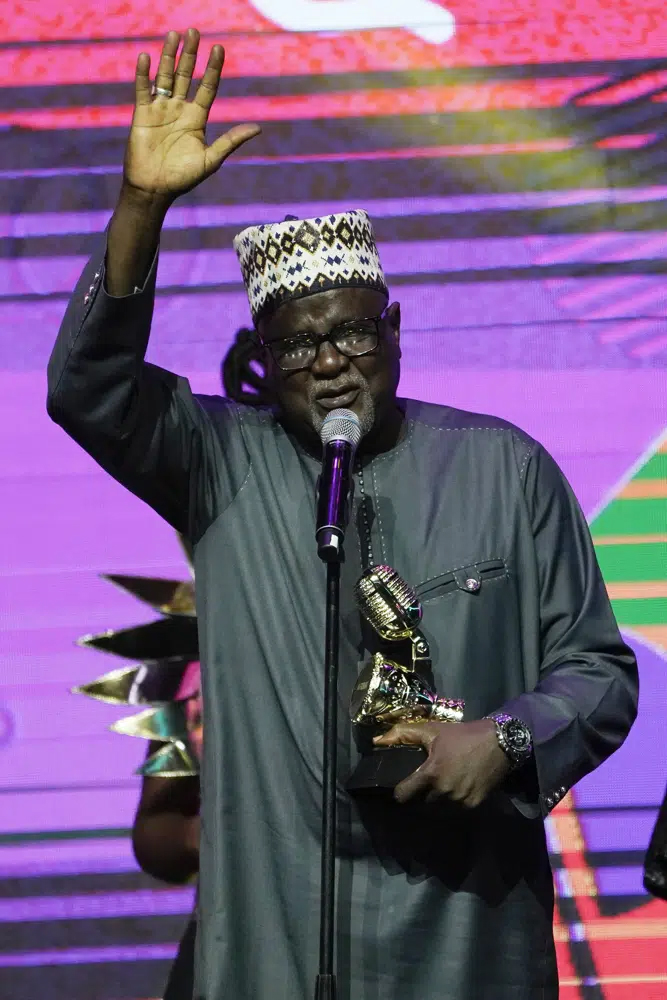
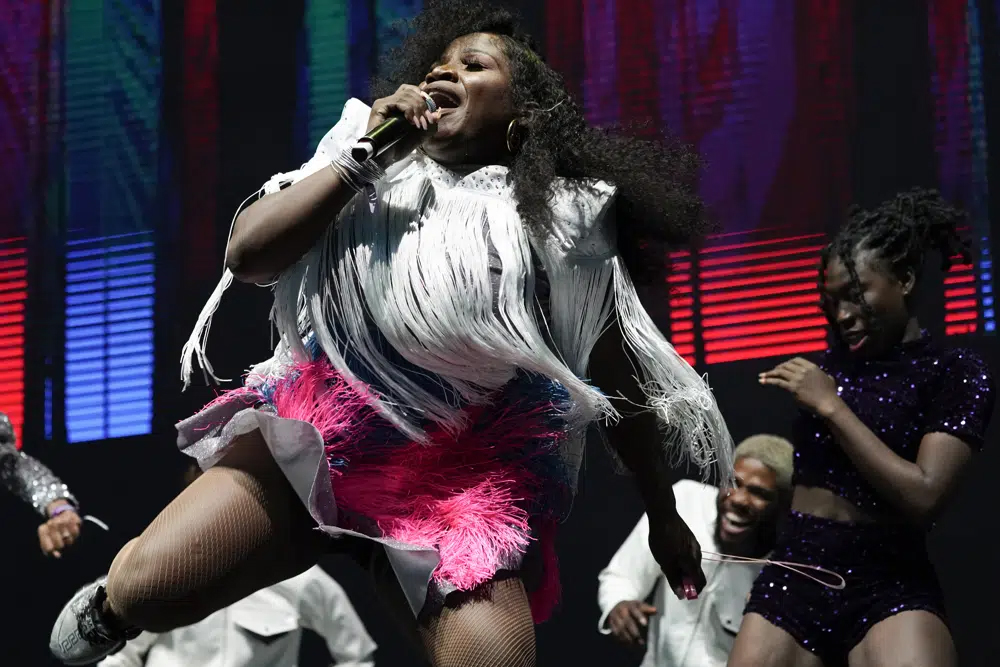
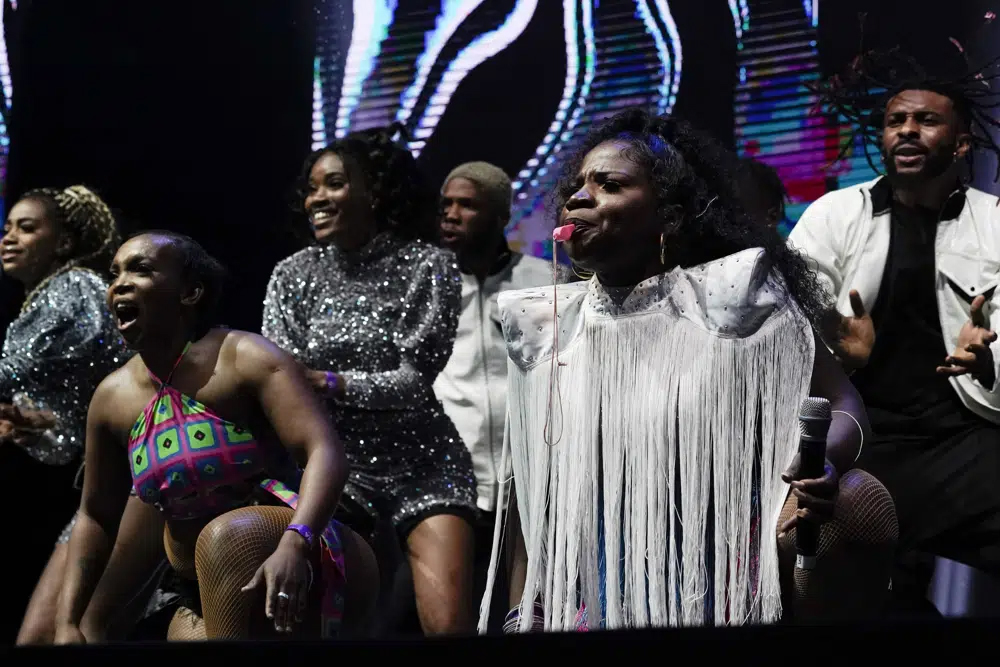
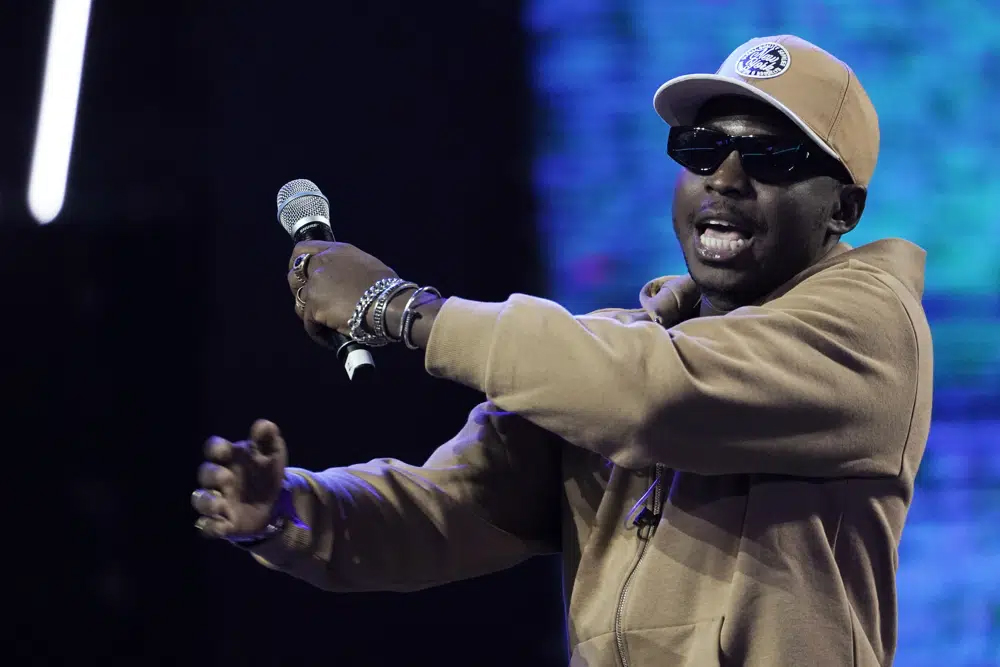
DAKAR, Senegal (AP) — Africa’s star musicians hit the red carpet this past weekend at the annual All Africa Music Awards, celebrating the continent’s best talent.
The four-day event culminated Sunday evening at an awards ceremony on the outskirts of Senegal’s capital, Dakar, and included performances from some of Africa’s most popular musicians such as Nigeria’s P-Square and Tiwa Savage, Mali’s Rokia Kone and Senegalese singers, Youssou N’dour and Baaba Maal.
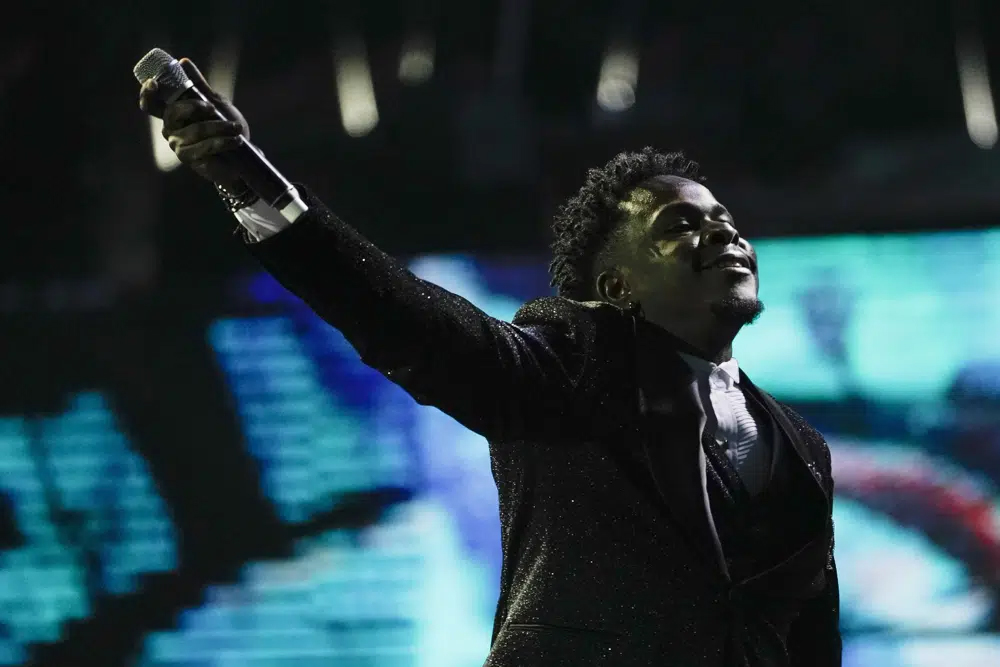
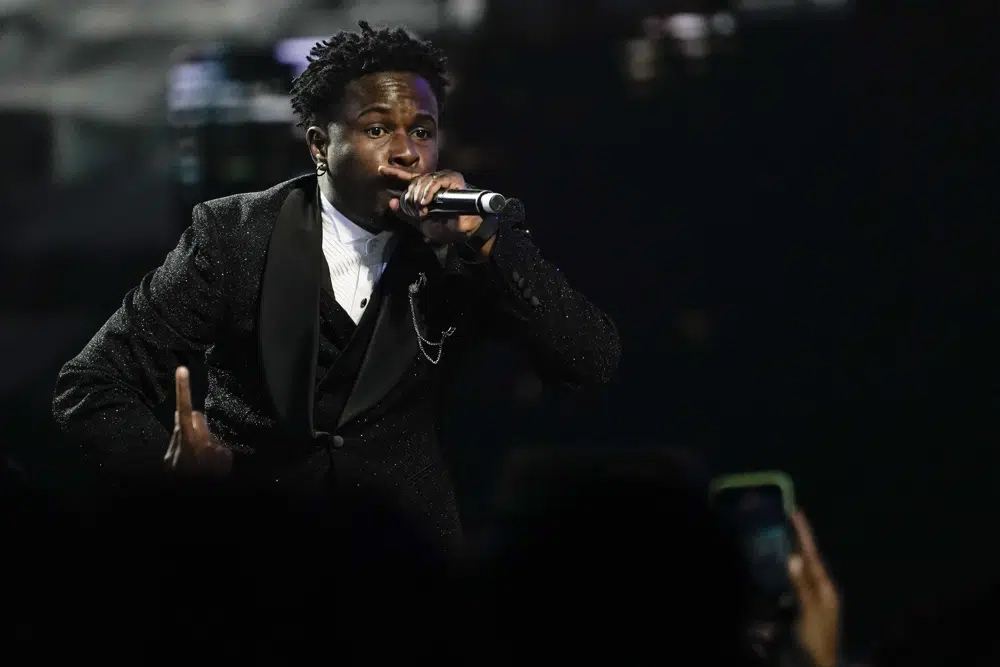
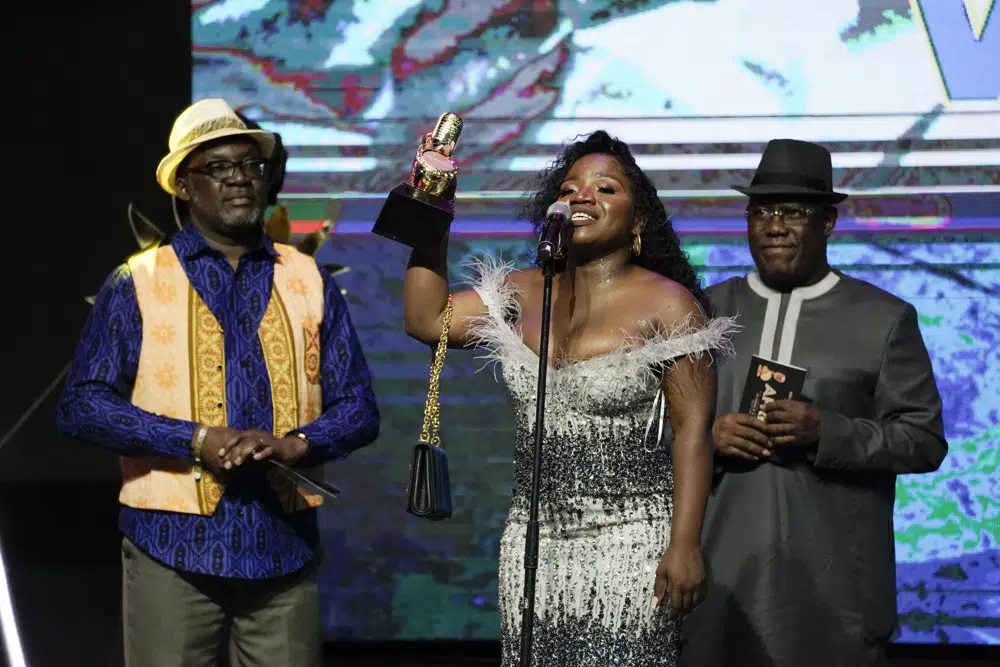
Ivorian singer Didi B won best song of the year for his rap song “Tala.” Ascending the stage in front of a boisterous audience, he thanked his colleagues and said it was his first award of the year.
“I dedicate it to my mother and my fans,” the Ivorian rapper, singer and songwriter said.
“Tala” — Ivorian slang used to describe a type of dance — has been watched nearly 6.5 million times in seven months on YouTube and is played in nightclubs across the continent.
This was the eighth edition of AFRIMA and the first to be held in a French-speaking country. Nigeria has hosted most of the events, including the last one in Lagos city in 2021, where Malian singer, Ibrahim Mahamadou Fily Sissoko, known as Iba One, clinched best album. This year, One, took home best songwriter.
Other well-known singers also collected awards Sunday, including Nigerian Afrobeat star Burna Boy, who won the Best Act in Africa award. Another Nigerian, Asake, won breakout artist of the year and Wizkid won the Best Act in West Africa award.
AFRIMA aims to connect African musicians to global markets while embracing the continent’s cultural diversity and heritage, organizers say.
“This is such an exciting moment in African music and we are proud of the way these artistes have been able to cross over to several markets both on the home front and even globally,” said Mike Dada, executive director for the event.
More than 9,000 entries were submitted for this year’s contest, the highest since its inception in 2014. The winners beat out more than 380 entries in 39 categories representing five regions in Africa as well as the diaspora.
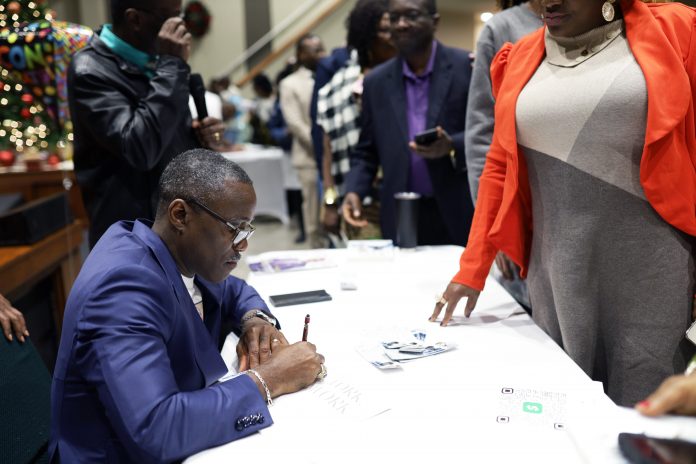
Rev. Dr. Francis Tabla of Ebenezer Community Church signs a copy of his new book for a reader during the book's launch in Brooklyn Park, Minnesota on Sunday, Jan. 8, 2023. Mshale Staff Photo by Panashe Matemba-Mutasa
Rev. Dr. Francis Tabla of Ebenezer Community Church signs a copy of his new book for a reader during the book's launch in Brooklyn Park, Minnesota on Sunday, Jan. 8, 2023. Mshale Staff Photo by Panashe Matemba-Mutasa
If you think it’s too late to start making a New Year’s resolution, Rev. Dr. Francis Tabla wants you to think again.
Tabla, a local pastor, has a book that teaches how to set goals and encourages readers to start planning better today. He celebrated the launch of his new book, Plan Your Work, and Work Your Plan, with a signing event on Sunday at Ebenezer Community Church.
“As a pastor I wrote this book to give the church what they need to be successful,” Tabla said.
Tabla, originally from the small town of Kingsville in Liberia, has been the pastor at Ebenezer Community Church since 2000. He was a pastor at a handful of churches in Liberia before immigrating to the United States, where he founded an eight-member church that has grown into the 700-member Ebenezer Community Church, which is based in Brooklyn Park today.
Plan Your Work, and Work Your Plan is a 61-page guide to plan formation and execution. According to Tabla, the book walks readers through effective planning techniques to help them achieve their goals. Tabla said that January was the perfect month for his book launch due to the popularity of New Year’s resolutions.
Unfortunately, the statistics for people who follow through on their resolutions are dismal. About 43% of all people can expect to fail come February, most quit before the end of January, and a mere 9% report sticking through with their plans through the end of the year. One of Tabla’s main motivation for writing the book, he said, was his desire to help people form sustainable plans for the achievements they wish to have in their lives.
“I am so happy because I believe this book is going to help our community and beyond,” Tabla said.
Tabla referenced a glowing review he received from a non-African reader outside of the country, which he said was an indication that the book had potential to resonate with various communities outside of just his church. The goal, he said, was to create a book with a plan that everyone could implement in their lives to start planning more effectively.
“This book transcends borders, ethnicities, races, and disciplines,” Tabla said. “You can be in the church, a businessperson, an athlete, or a politician. You can find meaning in this book no matter your walk of life.”
Tabla dedicated the book to Marie Yarsiah Hayes, the director of international student and scholar affairs at Luther Seminary in St. Paul, who he said he is forever grateful to for the services she granted him, his family, and the local Liberian Community at large. Hayes helped Tabla obtain a scholarship for his doctoral studies at Luther Seminary. Hayes, who is retiring, said that the book dedication helped her to finally see her purpose in life.
“My purpose in life is to help educate leaders for Christian communities who are called and sent by the Holy Spirit to administer God’s Word,” Hayes said.
Liberian American Tuakah Whiangaro was among those in the congregation who expressed enthusiastic support for the book. Prior to reading it, he said he lacked knowledge on how to plan effectively. Whiangaro said he wished to see the book become popular among the youth.
“The principles of this book should be taught in high school,” Whiangaro said. “I plan to get copies for my sons and young relatives in Liberia.”
Nancy Omondi, a Kenyan American who serves on the budget advisory commission for the City of Brooklyn Park, sang the book’s praises as well. Omondi said the book set an example of how to plan, a skill she said many people need to master. She said that the book teaches the reader how to lay out clearly what they want to accomplish financially, professionally, and even in the house.
“This is 2023, and if the month ends without a plan, then I do not know where you are going,” Omondi said.
Tabla shared his inspiration behind the book, saying that he became heartbroken upon seeing hungry children on his last trip to Liberia. His goal, he said, is to use the proceeds of the book to aid struggling youth in Liberia.
“I want this book to help the next generation thrive,” Tabla said.
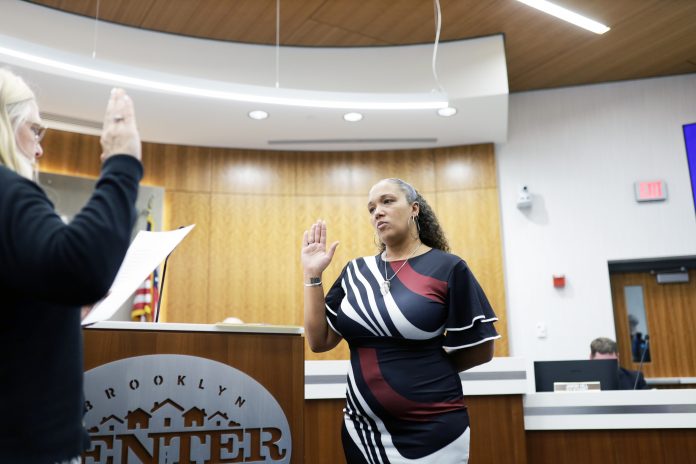
Brooklyn Center City Clerk Barb Suciu swears in April Graves, right, as the mayor of the city of Brooklyn Center and the city’s first Black female mayor on Monday, Jan. 9, 2023, at the City Council chambers. Mshale Staff Photo by Panashe Matemba-Mutasa
Brooklyn Center City Clerk Barb Suciu swears in April Graves, right, as the mayor of the city of Brooklyn Center and the city’s first Black female mayor on Monday, Jan. 9, 2023, at the City Council chambers. Mshale Staff Photo by Panashe Matemba-Mutasa
April Graves took her mayoral oath of office Monday, becoming the first Black woman to lead Brooklyn Center.
“I think we are all ready for change,” Graves said.
Brooklyn Center, whose residents of color make up around 59% of the population, only recently had its first Black top executive, the outgoing mayor Mike Elliot, a Liberian American who was elected in 2018 and took over the city’s leadership in 2019. The swearing in was followed by the first city council meeting under Graves’s leadership, which gave residents an opportunity to express concerns about the city’s law enforcement policy.
Brooklyn Center is one of the cities whose law enforcement policy has been under scrutiny since the 2020 when protests erupted nationwide after a Minneapolis Police Department officer murdered George Floyd, an unarmed Black man. On April 11, 2021 – less than a year since Floyd’s death a Brooklyn Center Police Department (BCPD) officer shot and killed Daunte Wright, another unarmed Black man during a traffic stop. The officer, who was later identified as Kim Potter, a 26-year veteran of the police department, claimed she accidentally shot the 22-year-old because she mistook her handgun for a taser. Most recently, BCPD released a recruitment video that many have described as racist and hyper-militarized.
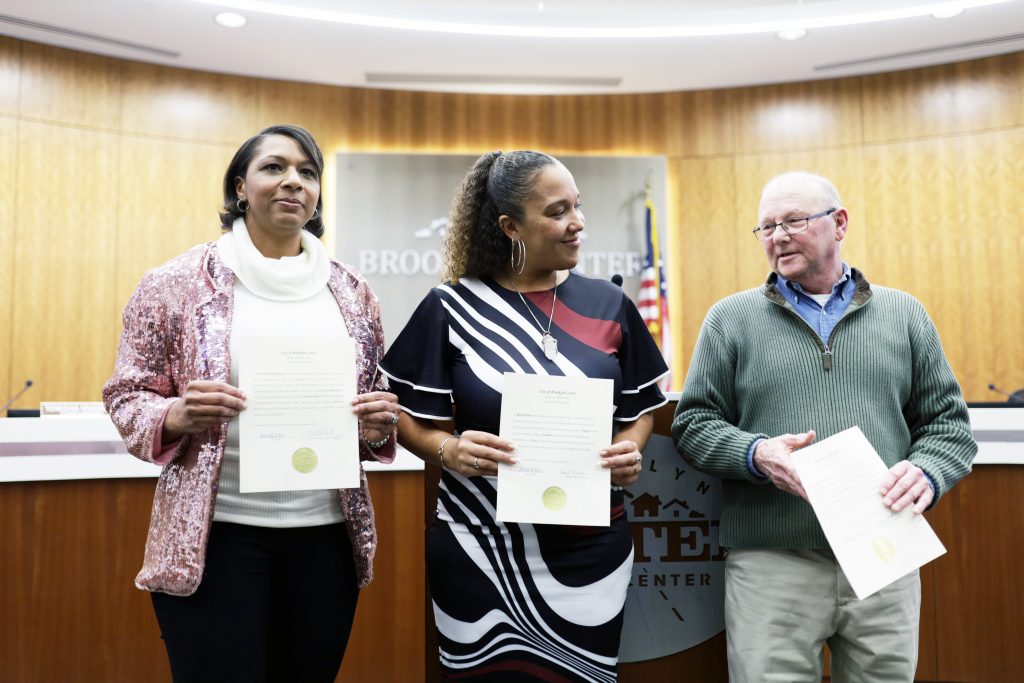
Brooklyn Center City Council members Teneshia Kragness, left, and Dan Jerzak, right, with Mayor April Graves after their swearing-in ceremony at City Council chambers on Monday, Jan. 9, 2023. Mayor Graves is the city’s first Black female mayor. Mshale Staff Photo by Panashe Matemba-Mutasa
Cynthia Wilson, the treasurer of the Minneapolis Chapter of the National Association for the Advancement of Colored People (NAACP), said she postponed her international flight to witness the historic ceremony. Wilson said she wished to see more transparency from both BCPD and city officials regarding Brooklyn Center’s law enforcement policy.
“What I saw in that video was racism,” Wilson said of the 2-minute video that mostly features white officers. “I saw the discrimination. I saw the Klan. We need to denounce this and seek immediate training of our officers.”
Wilson also addressed the newly elected mayor. She said that representation in leadership is not enough to undo the damage that BCPD has done to the community. Looking Graves straight in the eye, she reminded her of that with great power comes great responsibility.
“We’re not in these positions to look cute, we are here to make change,” Wilson said. “Pay the costs to be the boss.”
Graves said she was disappointed when she first saw video, but also said that she did not believe in firing or “cancelling” any individual officers over what she said wasn’t egregious. She attributed the rising tensions over what she said to “simple lack of perspective.”
“I do not believe that [BCPD’s] intention was to create harm,” Graves said.
After Graves’s remarks, about a quarter of the people on the room got up from their seats and left, many uttering expletives under their breaths as they walked out. As residents requested to address her, Graves doubled.
“The video did cause harm, but we need to think deeply about how we are going to rectify that,” Graves said.
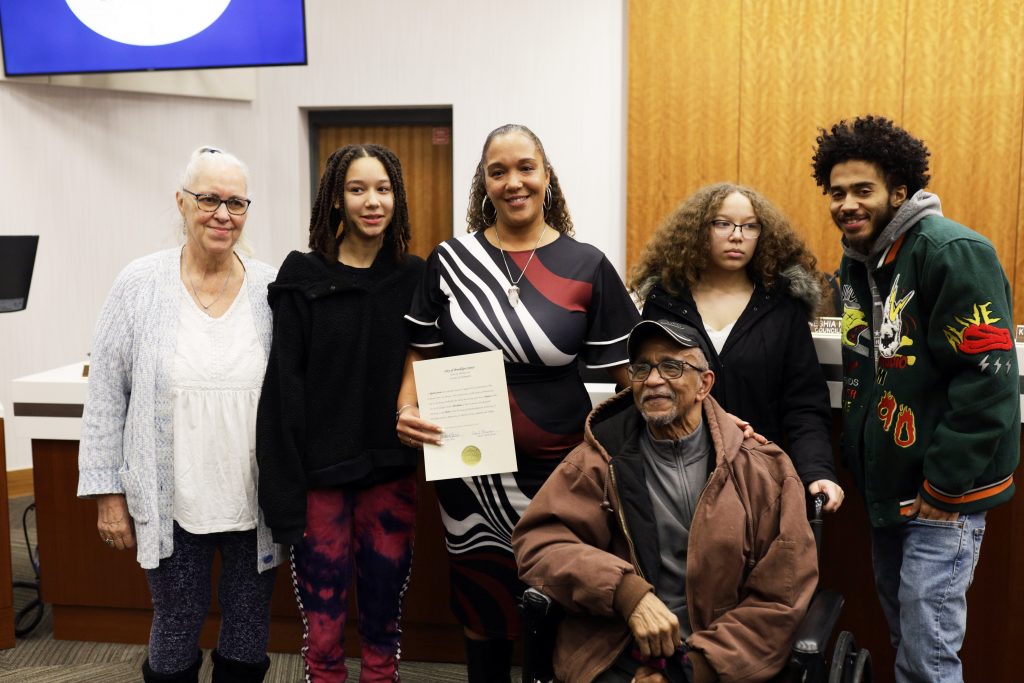
Brooklyn Center Mayor April Graves poses with her family at City Council chambers Monday, Jan. 9, 2023 after taking the oath of office as mayor and the city’s first Black female mayor. Mshale Staff Photo by Panashe Matemba-Mutasa
Alfreda Daniels, a Liberian American union organizer, said that she was appalled by the video and its depiction of the city. She said that the video seemed to have an “us versus them” narrative between residents and police, as it featured officers with military-style weapons. She said this was especially disturbing considering the BCPD’s history of gun violence, most notably the killing of Wright.
“They are portraying our city as a warzone,” Daniels said.
With a shaky voice, Daniels also told a story about how an anti-police brutality spiel on social media has cost her safety and peace of mind. Daniels has been active in expressing her concern about the video on Twitter, where she has been met right-wing vitriol. She said she had received death threats from at least six individuals online.
“They are labelling me as anti-police,” Daniels said. “As a Black woman, this is like putting a gun to my head.”
Local activist Michelle Gross said that recruitment videos are normal, and that the purpose of these videos was to show the culture of an organization. However, she said that what she saw while watching the recent BCPD video was reflective of a toxic culture. She said it was concerning that the video featured all-white officers for a city with a majority people of color. Gross called on the new city council to remove the video from the BCPD website. It is no longer on the city’s website as of the time of this writing. The city’s police chief is Kellace McDaniel, a Brooklyn Center resident who took charge of the department in the summer. He is among a handful of Black police chiefs in the state.
A lot of people were at Brooklyn Center City Hall to express their concern about the City of Brooklyn Center recruitment video. pic.twitter.com/g7fkHh6VES
“The hypermilitarized nature of it all was very concerning to see,” Gross said. “The video needs to be erased from the internet forever.”
While her initial remarks didn’t resonate as well with residents, Graves’s closing statements garnered a round of applause. She reiterated that she was elected to serve the people, and that she would act on that promise. Graves said that she hoped to build strong ties with BCPD to ease the tensions they have caused.
“We need to build relationships, because if we cut off relationships with every sign of a mistake, we are hindering our progress,” Graves said.
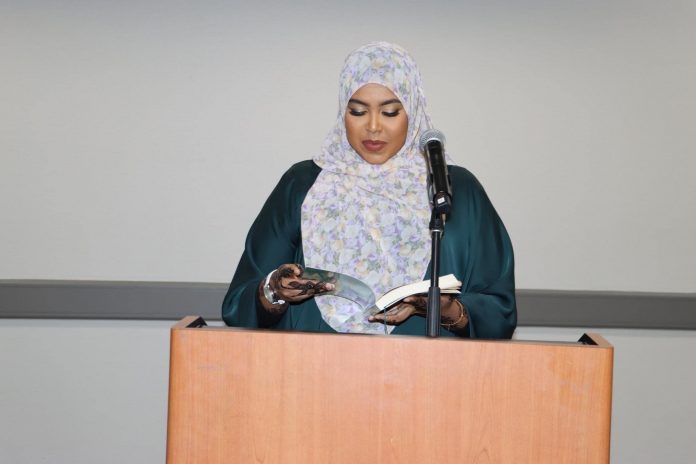
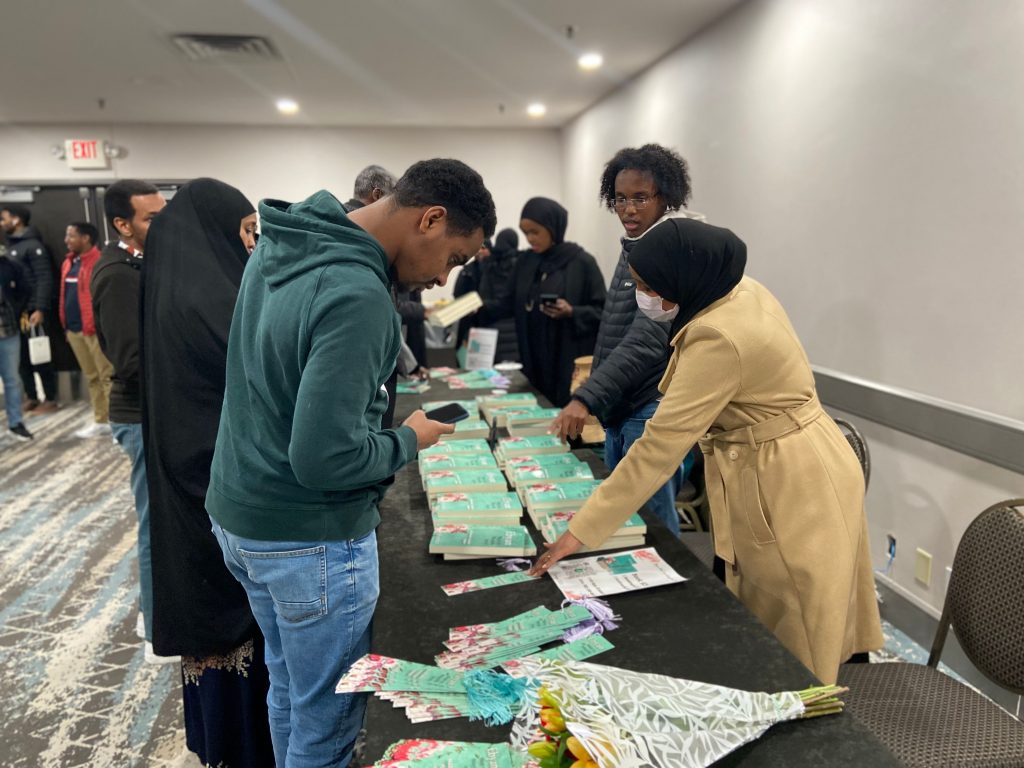
Fadumo Yusuf reads from her second novel "Ebyan, Waqti iyo Waayaha Jacayl" during a book signing event in Bloomington, Minnesota on Saturday, Jan. 7, 2023. Photo: Abdihakim Abdi/SNTV-Minnesota
When she’s not working her day job as a medical device engineer, Fadumo Yusuf writes the stories her younger self yearned for.
“I never saw myself represented in the books I read, so I decided to become the change that I wanted to see,” Yusuf said during a recent signing for her new novel at the Doubletree hotel in Bloomington, Minn.
The book, Ebyan, Waqti iyo Waayaha Jacayl, is Yusuf’s first novel written in the Somali language. Her first, Ayan, of the Lucky was in English. Yusuf, whose family fled Somalia when she was a young child, said that writing is her way of retaining her culture. Ebyan follows a Somali love story, and focuses on themes of heartbreak, healing, and leaning on the community that one is surrounded by. Yusuf said it was important for her to write a book that she and the youth in her family could relate to.
Black authors are severely underrepresented in English book publishing in the United States. Of the more than 7,000 authors in the United States, a measly 5.8% identify as Black or African American, even though they make up 14% of the population. The publication of books in African languages is even less common because many Africans prefer European languages and Arabic, which are more useful in conducting global business. For example, Somali linguists have expressed concern that their language could become “endangered” as a result of many Somalis now embracing Arabic. Authors like Yusuf aim to preserve their heritage and restore pride by writing in their African languages.
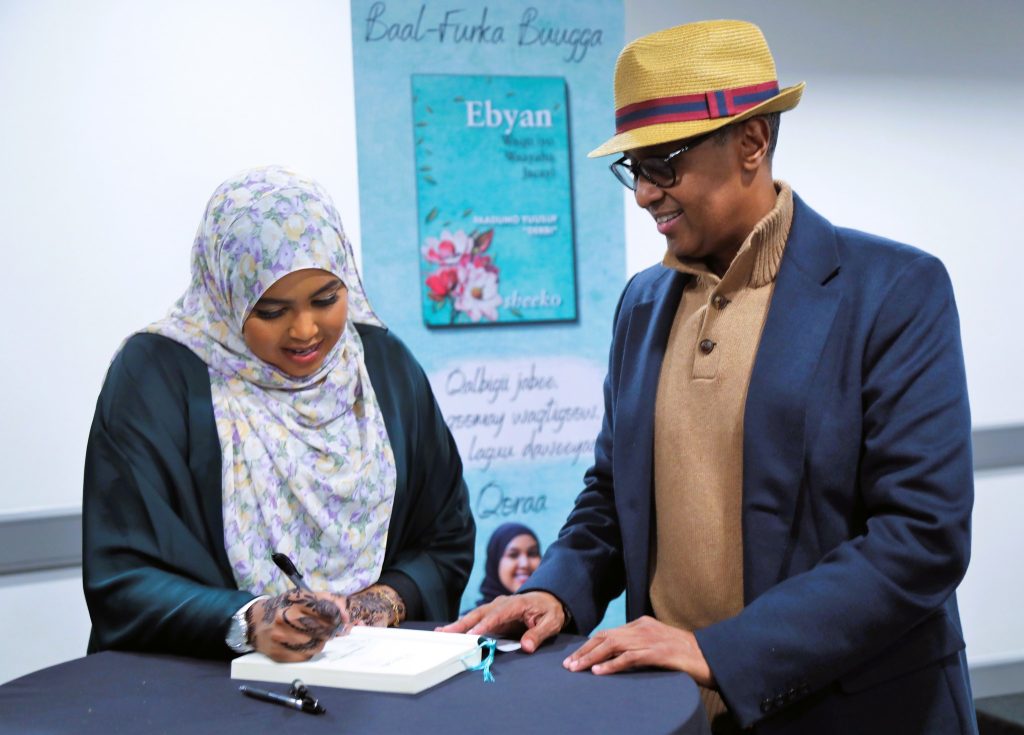
Fadumo Yusuf signs her second novel “Ebyan, Waqti iyo Waayaha Jacayl” for a reader during a book signing event in Bloomington, Minnesota on Saturday, Jan. 7, 2023. Photo: Abdirahman Mukhtar/Tusmo Times
“I’ve been trying to teach my siblings and cousins Somali,” Yusuf said. “I am hoping to create more books that they can relate to.”
Minnesota is home to over 70,000 people of Somali descent, more than any other state in the nation, according to according to Minnesota Compass. Thousands of Somalis fled the East African country after war broke out in 1991. Many ended up in Minnesota because the state’s resettlement agencies have had a long history of welcoming refugees from all over the world. Additionally, Minnesota’s robust economy and relatively low unemployment rates have made the state a hot spot for new arrivals seeking a high quality of life. The highest concentration of Somalis in Minnesota is in Minneapolis, with the majority residing in the Cedar-Riverside, Phillips, and Elliot Park neighborhoods.
Sheikh Shuaib, a member of the Somali community, echoed Yusuf, saying that if more books are not written in Somali, the language would be at risk of dying. Shuaib also said that the future of preserving the language and culture rests in the hands of the next generation.
“It is so important to the future of Somali heritage for us to have young people writing books like this,” Shuaib said.
Attendees at a book signing event for author Fadumo Yusuf’s second novel Ebyan, Waqti iyo Waayaha Jacayl” in Bloomington, Minnesota on Saturday, Jan. 7, 2023. Mshale Staff Photo by Panashe Matemba-Mutasa
Yusuf’s cousin Faduma Omar, talked about how the book trailblazes in a culture where romance in media is still considered a taboo. Omar described her cousin as a “pioneer” for being bold enough to address themes that often are not discussed openly in the Somali community such as heartbreak and healing. Having grown up in the West, Omar said it she does not regularly see books written in Somali, and so seeing Ebyan on the shelves defying cultural norms made her especially proud.
“She’s changing the culture and how we talk about love,” Omar said. “It also makes me want to learn the language more because I can only understand some of it.”
Zakaria Illeye, 19, said like many children of immigrants, he had not seen his country of his parents. Still, he said that he tried to engage with Somali culture in whichever ways that he can. Illeye said that he was excited to see the young people like him reading Ebyan to carry the culture forward.
“It’s a romance book, so I can see it resonating with the teens,” Illeye said. “Just because many of us haven’t seen Somalia doesn’t mean we can’t engage with our culture.”
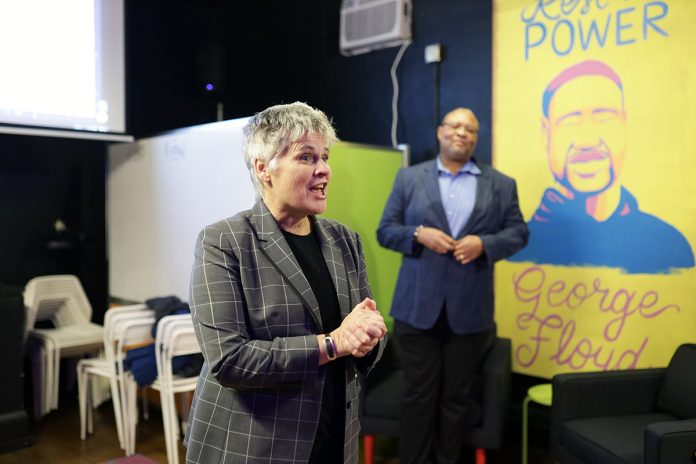
Hennepin County Attorney Mary Moriarty who was sworn into office on Tuesday, Jan. 3, 2023 speaking at the All Square restaurant in Minneapolis on Thursday, Jan. 5, 2023 where supporters gathered to celebrate her election. Mshale Staff Photo by Panashe Matemba-Mutasa
Hennepin County Attorney Mary Moriarty who was sworn into office on Tuesday, Jan. 3, 2023 speaking at the All Square restaurant in Minneapolis on Thursday, Jan. 5, 2023 where supporters gathered to celebrate her election. Mshale Staff Photo by Panashe Matemba-Mutasa
The new Hennepin County Attorney Mary Moriarty celebrated her election Thursday and promised to make changes that will restore trust in the county’s law enforcement system.
“People have asked me if I see this as overwhelming,” Moriarty told her supporters at the All Square restaurant in Minneapolis. “I see it as an opportunity to create change.”
In the last decade, the Minneapolis Police Department (MPD) has been heavily criticized for continuous malpractice in officers’ encounters with residents of color. The scrutiny has intensified since 2020 when MPD officer Derek Chauvin murdered George Floyd, sparking nationwide riots. An investigative report released in 2022 by the Minnesota Department of Human Rights found that since 2010, more than 90% (13 out of 14) of individuals killed by MPD officers were people of color. Cops were also more likely to search vehicles during traffic stops, issue unjustified citations, and use excessive force during arrest when the person was Black, according to the same report. Moriarty said that as Hennepin County Attorney, she would advocate for a more ethical criminal justice system.
“We strive to do the right thing in every case,” Moriarty said.
As Hennepin County Attorney, Moriarty leads the largest public law office in the state of Minnesota. Every year, the county attorney’s office oversees tens of thousands of cases.
A native of Minnesota, Moriarty grew up in the small town of Benson. She graduated from the University of Minnesota Law School in 1989 and dedicated the next 31 years of her career to serving as a Hennepin County public defender. During her service, she became a champion for racial equity in the criminal justice system, which earned her popularity among progressives. In 2014, Moriarty was named Hennepin County’s first female Chief Public Defender.
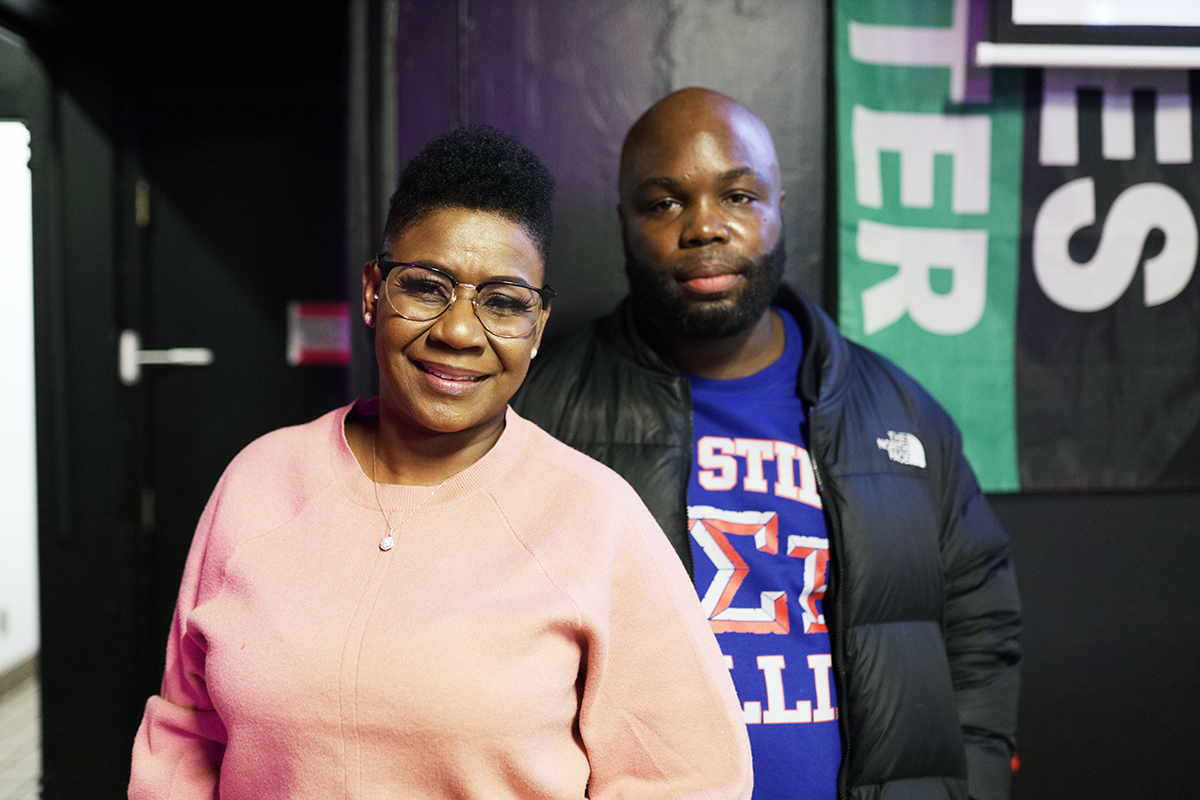
Addie Hammond and Ármel Green at Hennepin County Attorney Mary Moriarty election celebration at All Square restaurant in Minneapolis on Thursday, Jan. 5, 2023. Mshale Staff Photo by Panashe Matemba-Mutasa
With decades of experience and track record of advocating for change, Moriarty seamlessly prevailed at the polls in November. She defeated nonpartisan opponent Martha Holton Dimick by getting 57.6% of the vote. Moriarty takes over from Mike Freeman, who served in the role since 2006. Freeman, who openly endorsed Dimick, has come under fire in recent years after he claimed his team did not have enough evidence to prosecute the other four officers seen in the video of Floyd’s murder. Moriarty crossed the finish line with more than 60% of the vote in Minneapolis and led in most of the surrounding suburban cities.
Zaynab Mohamed, the newly elected state senator for District 63, ran alongside Moriarty in November’s elections. Mohamed said that she was excited to see the work that Moriarty would do to make changes to the criminal justice system in Minnesota.
“She wants to create a criminal justice system that doesn’t just lock people up, but is humane,” Mohamed said.
Having witnessed criminal justice inequity impact her family, Cathy Stroud Caldwell said she was motivated to vote for Moriarty based on the policies she campaigned on. Caldwell, a nurse, detailed an event that led to her son to be unjustly imprisoned. Her son was accused of getting involved in a crime with a group of other individuals, which led to a murder. He received a sentence of life without parole for aiding and abetting while the murderer only received a 5-year sentence.
“They told me I couldn’t come to his own trial, and I am his mother,” Caldwell said. “He has been in there for 17 years. This is the corruption Mary is fighting against.”
Community member Addie Hammond said that Moriarty’s stance on drug crimes is what reeled her in. Moriarty’s team discovered that marijuana stings disproportionately target Black residents of Hennepin County. Ever since, she has been committed to advocating for appropriate penalties for drug crimes.
“I like that she really advocated for minorities in those cases,” Hammond said.
Ármel Green, founder of Deberry Foundation, said that Moriarty’s campaign resonated with him personally due to an event where a friend of his was incarcerated. Green’s friend Myon Burrell was convicted of a crime, and Moriarty fought for his release. Burrell was sent to prison for life as a teenager and Minnesota commuted his sentence after he had been in prison for 18 years. The commutation happened after the Associated Press and American Public Media uncovered new evidence and serious flaws in the police investigation into Burrell’s case, raising questions about whether he may have been wrongfully convicted. Green said that Moriarty demonstrated courage to stand up for what was right when many did not agree with her.
“I heard about how passionate she was for my friend’s release,” Green said. “She is for the people.”
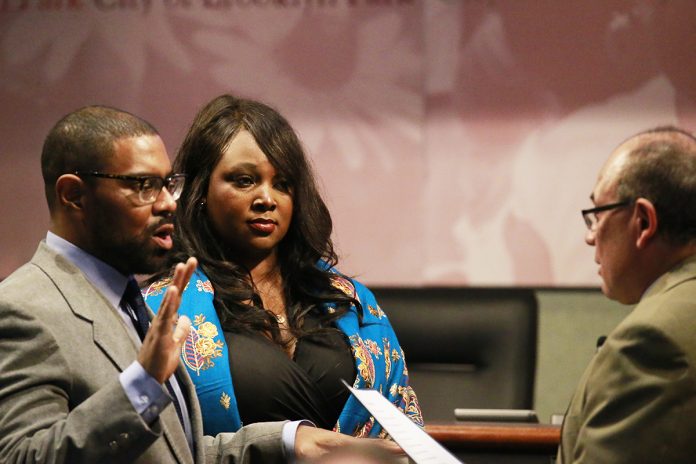
Brooklyn Park City Clerk Devin Montero swears in Hollies Winston as the mayor of the city of Brooklyn Park and the city’s first Black mayor, while his wife Latrice holds the bible, on Monday, Jan. 9, 2023, at the City Council chambers. Mshale Staff Photo by Richard Ooga
Brooklyn Park City Clerk Devin Montero swears in Hollies Winston as the mayor of the city of Brooklyn Park and the city’s first Black mayor, while his wife Latrice holds the bible, on Monday, Jan. 9, 2023, at the City Council chambers. Mshale Staff Photo by Richard Ooga
Hollies Winston, the businessman that successfully sold a vision of an inclusive city to voters in November, the grandson of a Mississippi sharecropper and son of retired corporate executives, was officially sworn in Monday as Brooklyn Park’s first Black mayor.
In the chambers of Brooklyn Park’s City Council, Mr. Winston, 43, clad in a slate green blazer that belonged to his late grandfather, took the oath of office and delivered brief introductory remarks that outlined his desire to foster the city’s strengths that include “diversity, dedicated city staff and our wonderful institutions.”
“While we have some challenges we have to face, which I talked about while in the campaign trail, we (city) have some real great strengths that I want the residents to know that the real strength to my mind is them,” Mr. Winston said. “I ask you to continue to be involved. I thank you for your trust in putting us up here. We very much understand the responsibility that comes with that.”
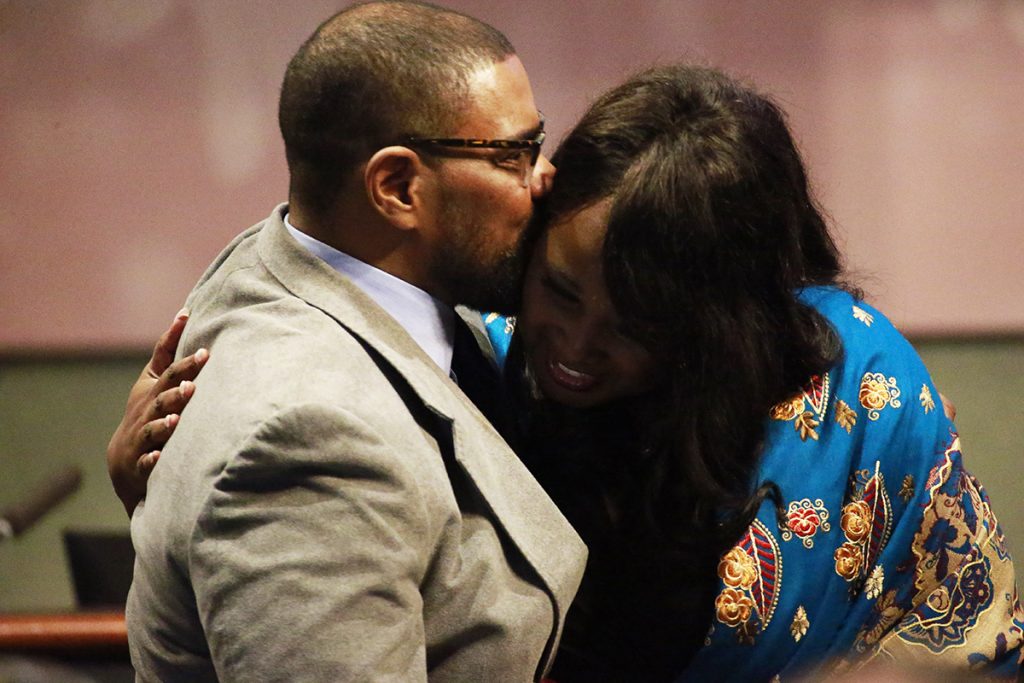
Mayor Hollies Winston kisses wife Latrice after being sworn in as the mayor of the city of Brooklyn Park and the city’s first Black mayor, on Monday, Jan. 9, 2023, at the City Council chambers. Mshale Staff Photo by Richard Ooga
The oath of office to swear in the first Black mayor in city history was administered by City Clerk Devin Montero shortly after 6 p.m. Looking on from the crowd were local leaders such as James Burroughs, who lives in the city, and is the former State of Minnesota first chief inclusion officer.
Mr. Winston’s wife, Latrice, held the bible for him as he took the historic oath. Their three children sat in the front row. Their oldest, Tierney, is a freshman at New York University. She said she was glad she did not have to make a special trip home for the swearing in as she was already here for winter break.
Tierney Winston said she loves her father because he practices what he preaches.
“He is always telling us to get involved in the community and to make sure we vote, I was lucky I turned 18 last year in time to vote for him” Ms. Winston said.
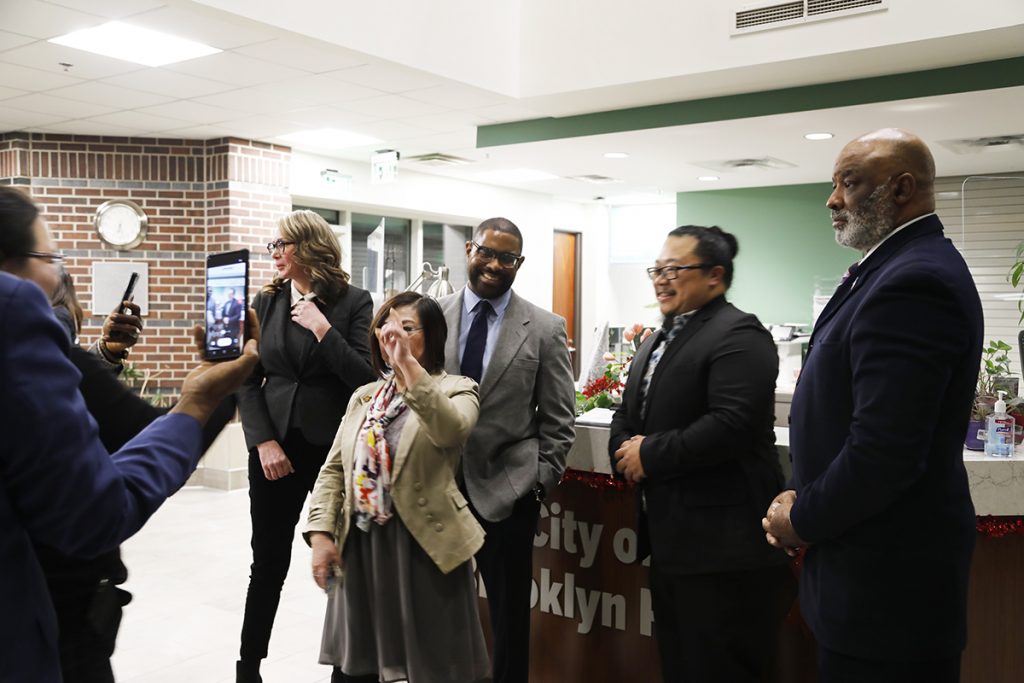
Brooklyn Park City Council members Nichole Klonowski, Maria Tran, XP Lee and Boyd Morson join with Mayor Hollies Winston in a meet and greet with residents after the swearing-in ceremony at City Council chambers on Monday, Jan. 9, 2023. Mshale Staff Photo by Richard Ooga
The new mayor, speaking to the media moments before taking the oath of office, promised to focus on livability issues in apartments, especially at Huntington, as well as crime and economic development, in that order. Water quality will be a consideration, although not a top priority, he said.
“We just want to make sure that Brooklyn Park works for all and everyone,” Mr. Winston told Mshale as he waited to be sworn in.
Mr. Winston said despite the spike in crime the city witnessed last year, he has a lot of faith in Chief Mark Bruley, saying he “has been doing a great job and has the right approach.”
“I just want to make sure they (police) have the support they need such as violence interrupters, so we are going to double down on that” Mr. Winston said.
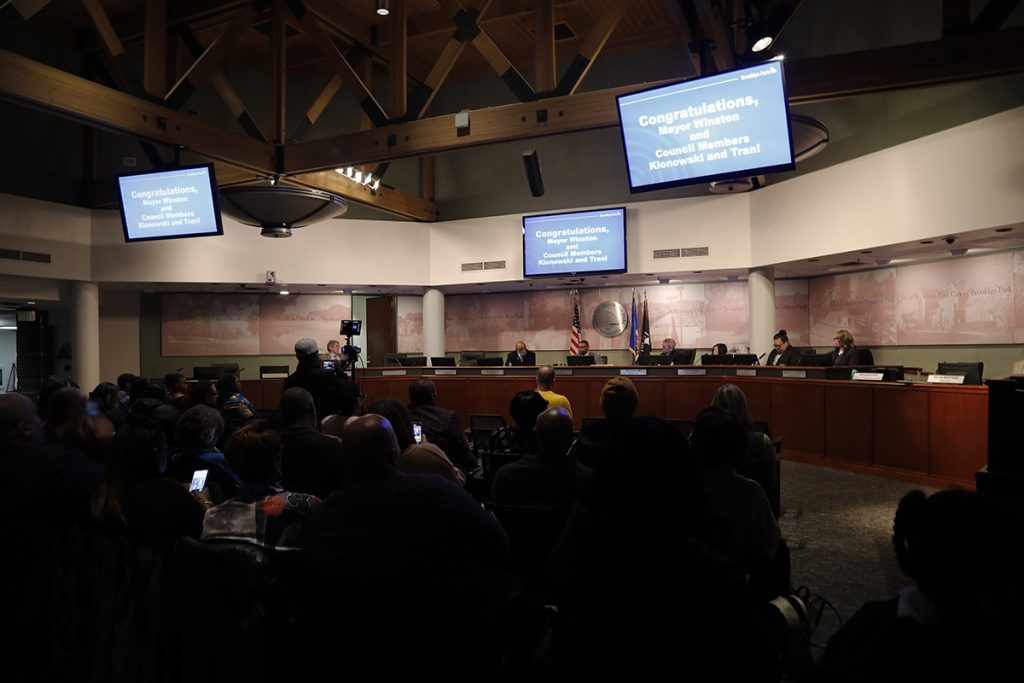
Mayor Hollies chairs his first Brooklyn Park City Council meeting as mayor on Monday, Jan. 9, 2023 after being sworn in. He is the city’s first Black mayor. Mshale Staff Photo by Richard Ooga
Chief Bruley who was present at the swearing in, said he looked forward to working with the new mayor whom he described as a great supporter of the police. The chief described the election of new leaders as “always refreshing as they bring in new ideas we might not have thought of and excited to see where the new Council will take us.”
“When we were doing community meetings he always showed up, he is very supportive of the police and his vision aligns with my vision of a police department,” said Chief Bruley.
The city, Minnesota’s sixth largest and fourth largest in the metro, was incorporated as the Village of Brooklyn Park in 1954, and incorporated as a city in 1969, according Brooklyn Historical Society. The city’s mayor from 1991-1994 was Jesse Ventura who went on to become Governor of Minnesota in 1999.
In one of his first official acts as Mayor of Brooklyn Park, Mayor Hollies Winston welcomes incoming Assistant City Manager Dr. Angel Smith whose start date was on the same day as the swearing-n ceremony as Councilmember Maria Tran looks on. Mshale Staff Photo by Richard Ooga
Changing demographics in the last 20 years is what has brought the city to the present, where the grandson of a sharecropper is now mayor. People of color now form close to 58% of the city’s almost 85,000 people, and it was evident from the crowd that showed up to witness the historic swearing-in. Amongst the crowd was Jude Nnadi, a Nigerian American businessman that lives in Brooklyn Center with a business in Brooklyn Park. His city of Brooklyn Center was also making history an hour later by swearing in its first Black female mayor. He said he was glad Brooklyn Park’s oath ceremony was an hour before Brooklyn Center as he planned to witness both in person.
“This is a very good thing for our cities as our elected leaders now look like the cities they are leading,” Nnadi said.
During Mayor Winston’s swearing in, the city also swore in two of the three new Council members elected in November. Councilmembers Maria Tran and Nichole Klonowski will represent the West and Central Districts. Christian Eriksen who was also elected in November to represent the East District had given notice he will be absent. He will be sworn in at a later date.
Brooklyn Park Police Chief Mark Bruley watches as new mayor Hollies Winston takes the oath of office at City Council chambers on Monday, Jan. 9, 2023. Mshale Staff Photo by Richard Ooga
After the swearing-in formalities completed, Mayor Winston chaired his first City Council meeting. Among the first official duties he performed included welcoming new city employees, including new assistant city manager Dr. Angel Smith whose first day on the job was Monday, and two new police cadets. The Council also voted Councilmember Xp Lee as Mayor Pro Tem, succeeding Susan Pha who got elected to the state Senate in November. Pha’s elevation to the state Senate will require a special election to fill the remainder of her term on the Council. On Monday, the Council declared the seat vacant which triggers a special election later this year based on a timeline determined by state statue.
Paula Weakly, a retiree, has lived in Brooklyn Park for over 30 years and could not conceal her excitement over the new changes on the Council. She proclaimed herself an enthusiastic Winston supporter. She said she looks forward to something finally being done at Huntington.
“It is always good to have new people come in with new ideas, and I am very sure Hollies will come through for Huntington,” said Weakly.
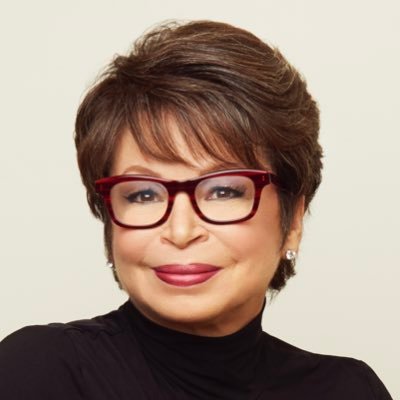
Valerie Jarrett, CEO of the Barack Obama Foundation, will keynote the 33rd Martin Luther King annual breakfast in Minneapolis on Monday, January 16, 2023. Photo: Valerie Jarrett Twitter
Valerie Jarrett, CEO of the Barack Obama Foundation, will keynote the 33rd Martin Luther King annual breakfast in Minneapolis on Monday, January 16, 2023. Photo: Valerie Jarrett Twitter
Former Obama senior adviser Valerie Jarrett will be the keynote speaker at the annual Dr. Martin Luther King Jr. Holiday Breakfast on Jan. 16, which will return in-person for the first time since 2020 with a corresponding virtual program.
The in-person event will be held at the Minneapolis Convention Center starting at 8 a.m.
Martin Luther King Jr. Day became a federal holiday when President Ronald Reagan signed it into law in 1983 and is observed each year on the third Monday of January.
The annual breakfast, which is in its 33rd year, is presented by General Mills Inc. and the United Negro College Fund and was created to honor the legacy of the civil-rights leader by fundraising for UNCF to fund scholarships for Twin Cities students. The UNCF funds scholarships for Black students and general scholarship funds for private historically Black colleges and universities.
This year’s breakfast theme is “Keep Moving Forward,” inspired by Dr. King’s leadership and lessons applied to the pressing social issues of today, according to a news release from General Mills.
Entertainment at this year’s breakfast includes Minnesota’s four-sibling family band, NUNNABOVE, which describes itself as “positive alternative pop,” and Minneapolis-based TKO Drumline, a musical group founded in 2010 by Byron Hawkins to teach drumming techniques and rudiments to young people ages 8-18.
“The legacy and words of Dr. King continue to inspire our advocacy for the importance of minority education and community engagement,” said Dr. Michael L. Lomax, president and CEO of UNCF. “We are grateful to work in partnership with General Mills to bring our community together each year and build up the essential support and awareness for our students and HBCUs.”
Jarrett was senior adviser to President Obama from 2009 to 2017, making her the longest serving senior advisor to a president in history. She is the author of the New York Times bestselling book Finding My Voice: My Journey to the West Wing and the Path Forward, published in April 2019.
Currently she is the CEO and a member of the board of directors of the Barack Obama Foundation. The foundation broke ground on the Obama Presidential Center in September 2021.
Previous breakfast keynote speakers have included Dr. Bernice King, Ambassador Andrew Young, the Honorable Eric H. Holder, CNN’s Laura Coates and Don Lemon, former Secretary of State Gen. Colin Powell, actor David Oyelowo, New Jersey Sen. Cory Booker, Rev. Joseph Lowery, the late Yolanda King, U.S. Rep. John Lewis, Marian Wright Edelman, Donna Brazile, Vernon Jordan and former Massachusetts Gov. Deval Patrick.
In-person ticket prices are $60 with a maximum of four tickets per purchase. Ticket prices for the virtual event are $30 per household ticket with one access code. Non-profit groups can purchase virtual tickets for $600 and receive 20 online access codes. Corporate virtual access codes are also available from $3,000 to $5,000.
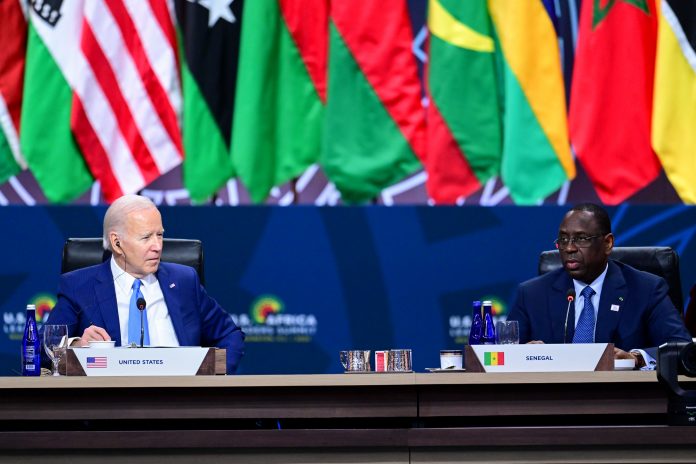
President Biden listens to President Macky Sall of Senegal during the plenary session at the U.S.-Africa Leaders Summit at the Walter E.
Washington Convention Center in Washington, D.C. on Thursday, December 15, 2022. Photo: Ben Solomon/U.S. Department of State
President Biden listens to President Macky Sall of Senegal during the plenary session at the U.S.-Africa Leaders Summit at the Walter E.
Washington Convention Center in Washington, D.C. on Thursday, December 15, 2022. Photo: Ben Solomon/U.S. Department of State
To President Joseph R. Biden Jr., and perhaps most of the African leaders who traveled to Washington D.C. in December for the U.S.-Africa Leaders Summit, the meeting was a major success.
The gathering presented Biden with an opportunity to spell out a foreign policy on Africa that’s forward-looking. It was a much-needed summit to engage Africa and begin repairing relations, which were strained by former President Donald J. Trump, who once referred to Africa as a continent of “shithole” countries.
“The United States is all in on Africa’s future,” Biden told African leaders at the summit.
What Biden did next to prove that the United States is “all in” is perhaps why the African heads of state and other leaders from the continent would think the summit was a major success. He pledged more than $55 billion to help 50 countries combat food insecurity and the climate change factors that lead to it.
“Simply put, if a parent can’t feed their child, nothing else really matters,” Biden said.
Those of who understand Africa, however, know that the money is unlikely to significantly benefit most Africans because our leaders don’t feel the same about the children. Such handouts are the reason leaders never ask why Biden – or any of his predecessors – doesn’t come to Africa to talk to them, instead of always summoning them to the United States. They drop everything and rush to Washington at the snap of an U.S. president’s fingers because they know it’s easy money that they can spend discretionary.
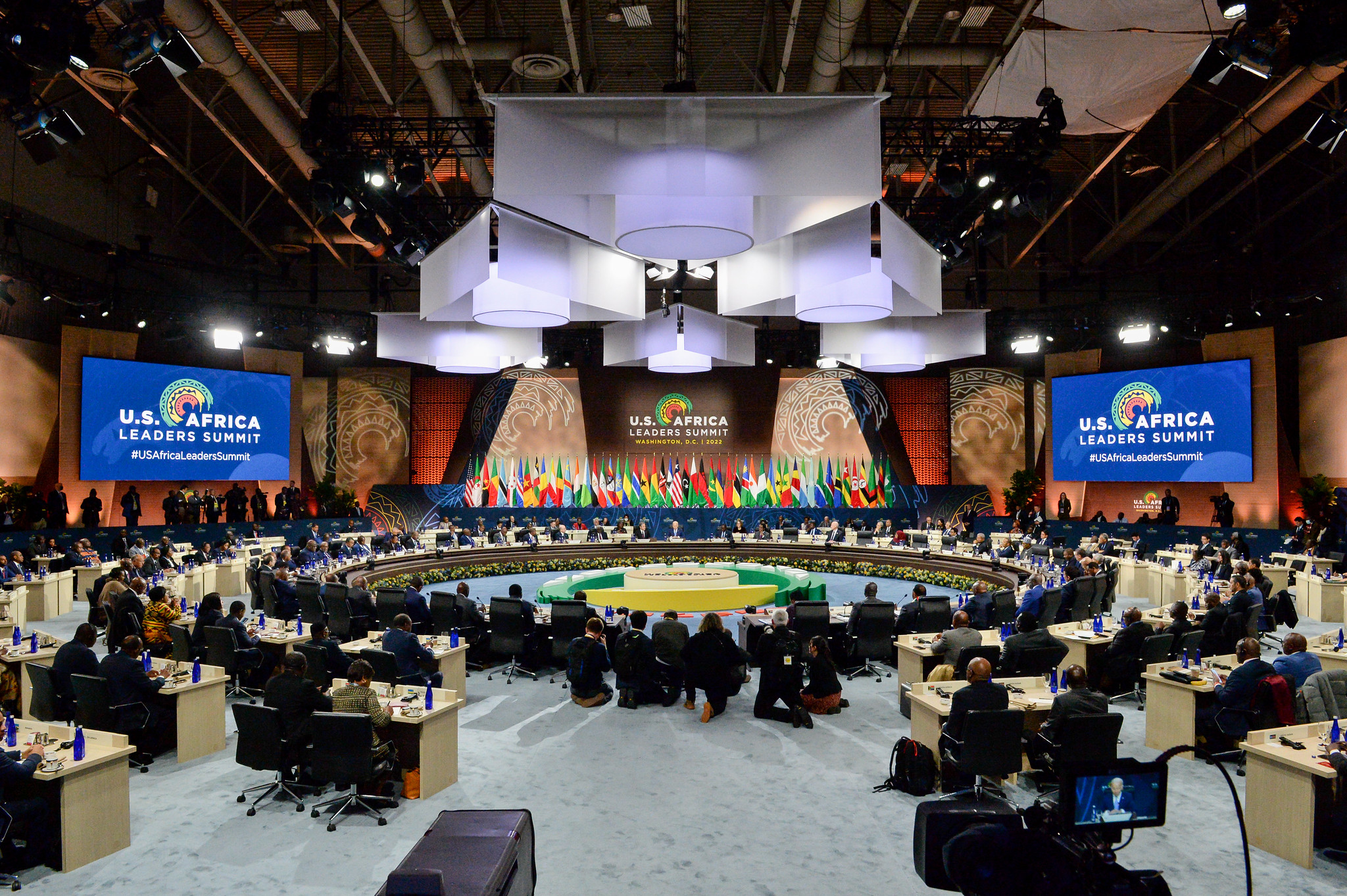
The Plenary session at the U.S.-Africa Leaders Summit that President Biden hosted at the Walter E. Washington Convention Center in Washington, D.C. on Thursday, December 15, 2022. Photo: Ben Solomon/U.S. Department of State
Of course, you wouldn’t know that by listening to African presidents at these summits give speeches about their visions for the continent’s children. When in Washington, African leaders often sound like they are pan-Africanist revolutionaries, who genuinely care about making lasting changes in the countries they rule. Take, for instance, what President Nana Akufo-Addo of Ghana said at the summit.
“The urgent responsibility that we face is to make our countries and our continent attractive for our peoples to see them as places of opportunities,” Akufo-Addo said. “It means that we must provide education – quality education – and skills training. It means our young people must acquire the skills that run modern economies.”
On the African continent, the response has been starkly different from the mood in Washington. Many thought it was laughable that anyone thinks $55 billion, which will be distributed over the next three years to 50 countries, is enough to prove that the United States is going all in on the future of Africa.
“$55 billion for 50 states over 3 yrs period? What a joke! …. America, other than superpower patronage, has no development agenda for Africa. It never had. It never will,” Ahmednasir Abdullahi, a prominent constitutional lawyer and publisher of the Nairobi Law Monthly, tweeted.
Dr. Willy M. Mutunga, who served as the chief justice of the Supreme Court of Kenya from 2011-2016, agreed with Abdullahi.
“The US has both underdevelopment and military agendas,” he said in a tweet. “Such meetings are for giving our leaders imperial economic, social, and political orders.”
Mutunga’s and Abdullahi’s views are becoming common on the continent, thanks to the ease at which people can access information about countries like the United States, which claim to be beacons of democracy and good governance. Africans are much more informed and can see the real motives of the superpowers.
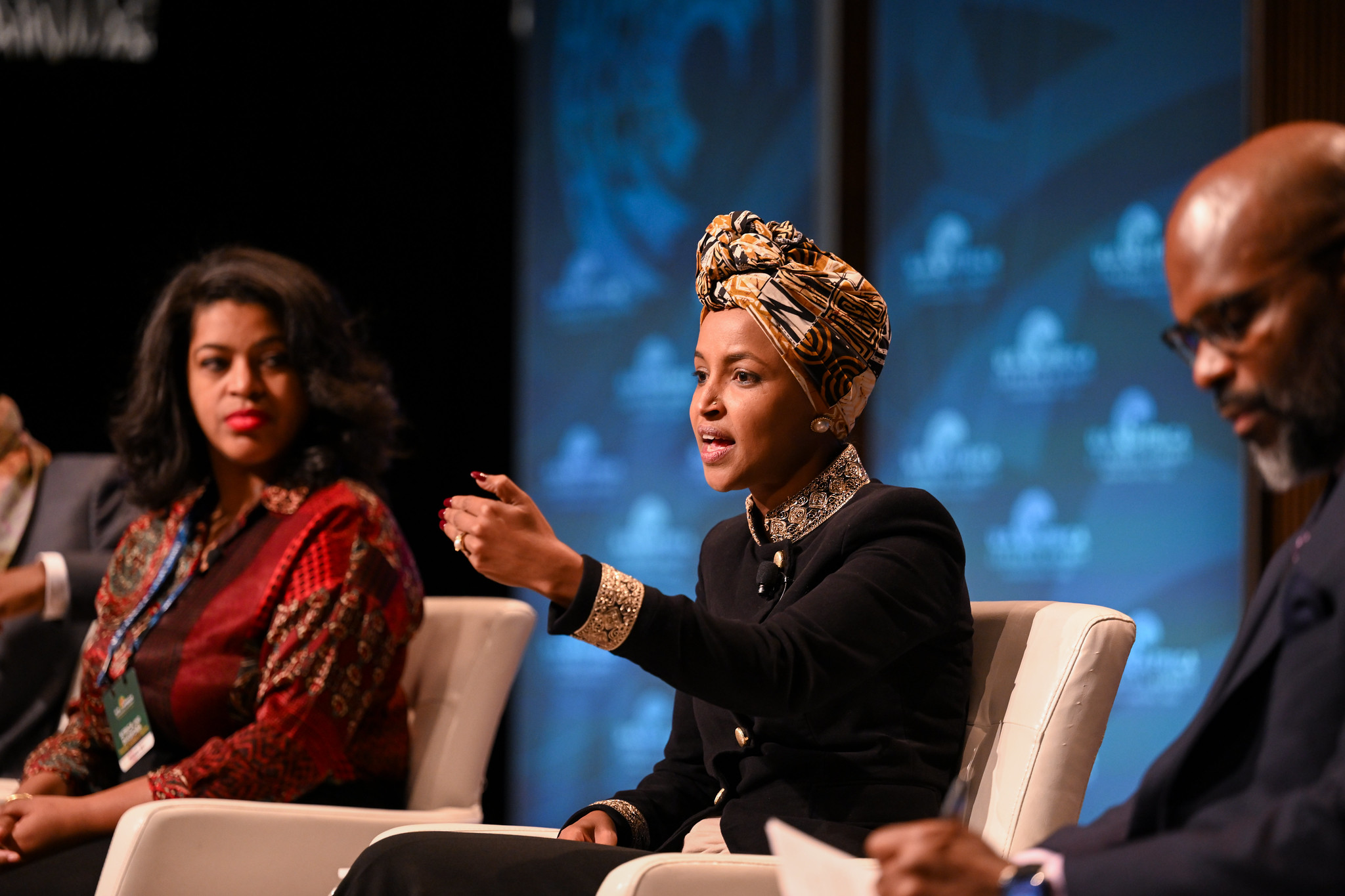
Congresswoman Ilhan Omar of Minneapolis was a panelist at one of the sessions at the U.S.-Africa Leaders Summit at the Walter E. Washington Convention Center in Washington, D.C. on Thursday, December 15, 2022 hosted by President Biden. Rep. Omar is the only member of Congress born in Africa. Photo: Ben Solomon/U.S. Department of State
One doesn’t have to be an expert on the complicated matters of internationals politics to know that there is a battle for Africa’s rich resources, pitting the United States and western European powers on one side, and China and Russia on the other. This recent struggle by the superpowers has come to be known unofficially as the second scramble of Africa. It’s understandable that Biden wouldn’t want to admit that his administration is engaged in any kind of scramble for Africa. But saying that the United States is going “all in” is still problematic, some might say.
“In American usage, the phrase “all in” began as a colloquial expression meaning to be in a bad spot—exhausted, worn out, and spent. In the game of poker, it refers to the moment when a player—whether out of bravado, recklessness, or desperation—bets all of his or her chips on a single hand,” Crouch wrote in a piece about the misuse of the phrase.
We know that Biden didn’t mean to imply that the United States is going into Africa “exhausted, worn out, and spent”. But by using language used in poker, Biden might have made things worse because those words imply that the United States gambling on the continent. This should worry anyone who believes that African countries need to be treated as partners, rather than as some prized possession that powerful countries must scramble for and gamble on.
Another reason the idea of the summit wasn’t convincing to many in Africa is that it took eight years for it to return. The inaugural one took place in 2014 under the administration of Barack Obama, Biden’s former boss. The fact that nearly a decade passed before another summit shows that Africa is not a priority in the foreign policy of the United States. Sure, four of those years were under Trump, who loathed Obama and spent much his term in the White House trying to undo everything his predecessor did. But the truth is that not much happened in the two years between that first summit and Jan. 20, 2017, when Obama handed over to Trump. And why did it take Biden nearly two years to revive the summit?
There is also the fact that there was no significant progress in keeping the promises made after that first summit under Obama. At a townhall meeting held before the most recent one, President Paul Kagame of Rwanda, who was one the heads of state who attended the first conference during Obama’s administration, was asked if anything came out of the 2014 meeting.
“Well, we had a good meeting,” he said after a long pause, sparking laughter from the audience. “And I’m sure we are going to have another good meeting.”
Whether there will be another U.S.-Africa Leaders Summit in the future remains to be seen. But if history is something to go by, the United States will have other more important matters like the 2024 elections to attend to. In Africa, another human crisis will happen in a country that received a share of the $55 billion. No one in the United States will care ask what happened to the money, perhaps because most of it will be in offshore banks and some might make its way back into the U.S. economy the next time African presidents and their cronies visit the United States.
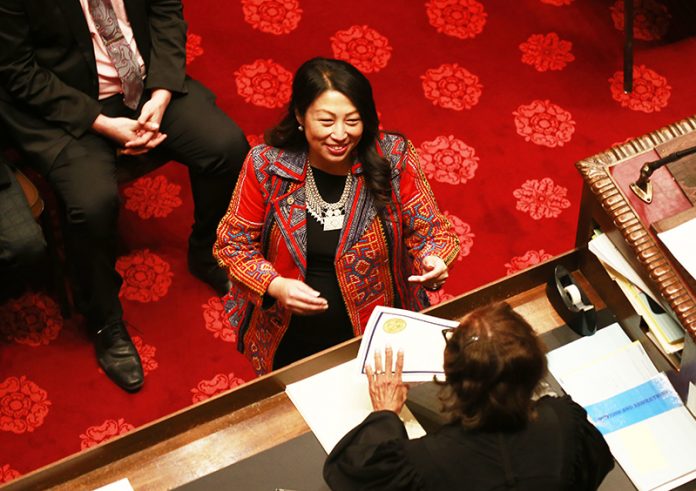
Minnesota state Senator Susan Pha, who represents District 38, presents her election certificate to Justice Natalie E. Hudson of the Minnesota Supreme Court when the 93rd Minnesota Legislature convened to take the oath of office. Sen. Pha is the second Hmong woman in state history elected to the Minnesota Senate. Mshale Staff Photo by Richard Ooga
Minnesota state Senator Susan Pha, who represents District 38, presents her election certificate to Justice Natalie E. Hudson of the Minnesota Supreme Court when the 93rd Minnesota Legislature convened to take the oath of office. Sen. Pha is the second Hmong woman in state history elected to the Minnesota Senate. Mshale Staff Photo by Richard Ooga
The swearing in of three Black women at the Minnesota state senate on Jan. 3 was indeed historic, but it might have taken the spotlight away from another remarkable achievement for people of color in general.
In addition to Clare Oumou Verbeten, Zaynab Mohamed, and Erin Maye Quade, who jointly made history as the first Black women ever elected to the Minnesota state senate, there was Susan Pha, a Hmong American who left her city council seat in Brooklyn Park to run for the senate. Pha is no stranger to the African immigrant community, having defeated Kenyan American leader Huldah Momanyi Hiltsley in the Democratic primaries.
Pha is the second Hmong woman in state history to be elected to the Minnesota Senate.
In past interviews, Pha said that she never thought she’d be interested in politics, until her friends and family encouraged her to run for the city council seat in 2016. She went on to make history by becoming the first person of color to be elected to the Brooklyn Park’s city council. It was her first attempt to run for office, easily winning with 56 percent of the vote.
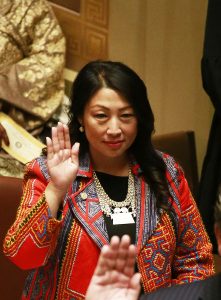
Minnesota state Senator Susan Pha, who represents District 38, takes the oath office on the floor of the Minnesota Senate chamber on January 3, 2023 when the 93rd Minnesota Legislature convened. The oath was administered by Justice Natalie E. Hudson of the Minnesota Supreme Court. Sen. Pha is the second Hmong woman in state history elected to the Minnesota Senate. Mshale Staff Photo by Richard Ooga
Pha announced her candidacy for the senate in August 2021, shortly after incumbent Sen. Chris Eaton announced her retirement from representing District 40. When Pha and Hiltsley announced their intentions to enter state politics, there was hope among communities of color in Brooklyn Park and nearby Brooklyn Center that they both would become successful. But when district boundaries were redrawn in 2021, as they must every 10 years to reflect population changes after the U.S. census, both women found themselves in the same constituency, District 38. That lead to months of them competing against each other in a nomination exercise that ended without endorsement of any candidate by the Democratic Farmer-Labor Party, as the Democratic Party is known in Minnesota.
The contest was decided at the ballot box in August when Pha won more than 61% of the vote to carry the flag for Democrats against Republicans in November. After her defeat, Hiltsley rallied the African community to support Pha in the battle against Brad Kohler, the Republican candidate. Pha won the senate seat by 64% of the vote.
Pha’s city council term was set to end in 2024, but she said that she wanted more out of her political career. The self-proclaimed community-centered politician said she wanted to make an impact on an even larger scale at the state level.

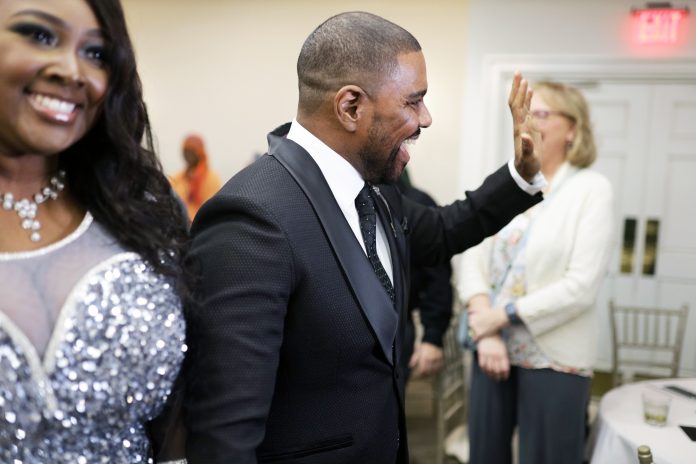








 Ármel Green, founder of Deberry Foundation, said that Moriarty’s campaign resonated with him personally due to an event where a friend of his was incarcerated. Green’s friend Myon Burrell was convicted of a crime, and Moriarty fought for his release. Burrell was sent to prison for life as a teenager and Minnesota commuted his sentence after he had been in prison for 18 years. The commutation happened after the Associated Press and American Public Media uncovered new evidence and serious flaws in the police investigation into Burrell’s case, raising questions about whether he may have been wrongfully convicted. Green said that Moriarty demonstrated courage to stand up for what was right when many did not agree with her.