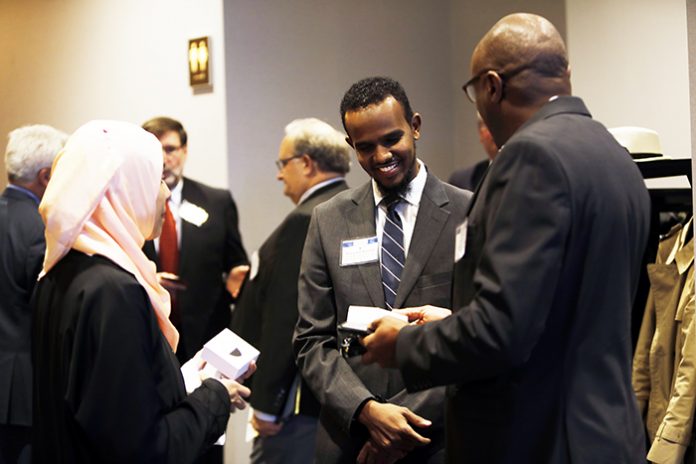
Assistant Commissioner Abdiwahab Mohamed speaks to guests during the Governor's International Trade Awards held at the Minneapolis/St. Paul Airport Intercontinental Hotel on Dec. 14, 2022. He was named Minnesota’s permanent assistant commissioner for immigrant and refugee affairs on Feb. 28, 2023 after being interim for six months. Mshale Staff Photo by Richard Ooga
Assistant Commissioner Abdiwahab Mohamed speaks to guests during the Governor's International Trade Awards held at the Minneapolis/St. Paul Airport Intercontinental Hotel on Dec. 14, 2022. He was named Minnesota’s permanent assistant commissioner for immigrant and refugee affairs on Feb. 28, 2023 after being interim for six months. Mshale Staff Photo by Richard Ooga
The Minnesota Department of Employment and Economic Development (DEED) on Tuesday announced the appointment of Abdiwahab Mohamed as Assistant Commissioner for Immigrant and Refugee Affairs, a position he has been holding on an interim basis since September 2022.
In a news release, DEED said Mohamed was chosen for the permanent role following “a competitive statewide application process.”
Since taking up the position on an interim basis, Mohamed has been instrumental in writing DEED’s budget requests and brought together state agencies to compile legislative proposals that impact immigrant and refugee communities, according to the release.
In Gov. Walz’s final budget submitted to the legislature, the governor is requesting $1.5 million in each biennium to establish the “Office of New Americans.” The office will focus on supporting immigrants and refugees in integrating into Minnesota society and also help employers connect with them.
DEED Commissioner Steve Grove said it is important to provide those newly arrived to the state with the opportunities to thrive as they “bring fresh perspectives, skills, and talent to Minnesota.”
Elizabeth Frosch will become Minnesota Department of Employment and Economic Development (DEED) assistant commissioner for operations. Photo: Courtesy MN DEED
Over 50% of Minnesota’s labor force growth between 2010 and 2020 was driven by immigrants, according to DEED.
“Abdiwahab has great experience working with Minnesota employers and with the immigrant and refugee communities in our state. He will build on work already underway to accelerate New Americans’ full participation in Minnesota’s economy,” said Marc Majors the deputy commissioner for workforce development.
Also announced Tuesday is the elevation of DEED’s current chief of staff, Elizabeth Frosch, to the position of Assistant Commissioner for Operations. She will start on March 16.
Before becoming DEED’s chief of staff, Frosch was the agency’s director in charge of strategic communications and research.
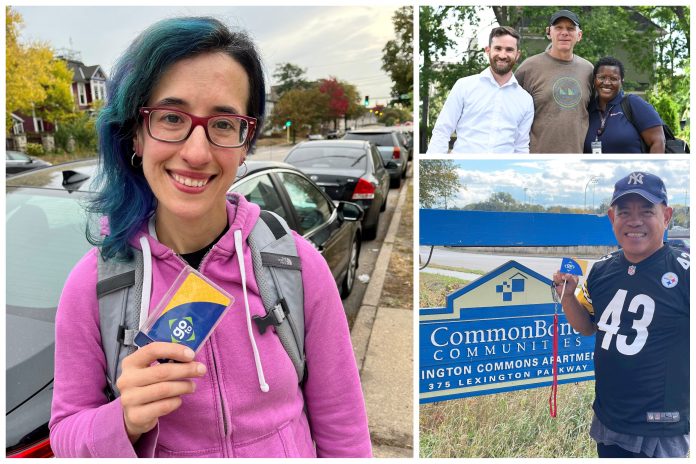
Clockwise: Residential Pass holder Sarah Cohen; TOD Manager Michael Krantz, Green Rock Apartments Property Manager Dale Howey, and Senior Commuter Programs Specialist Tenille Warren; and Philip Montesa, who lives at CommonBond Communities’ Lexington Commons Apartments.
Clockwise: Residential Pass holder Sarah Cohen; TOD Manager Michael Krantz, Green Rock Apartments Property Manager Dale Howey, and Senior Commuter Programs Specialist Tenille Warren; and Philip Montesa, who lives at CommonBond Communities’ Lexington Commons Apartments.
Sponsored Content from Metro Transit
Sarah Cohen values the solar panels and heat pumps that help reduce energy use at the Minneapolis apartment building where she lives.
Another green feature she appreciates – the Residential Pass that she and more than 70 other tenants at Green Rock Apartments receive. The unlimited ride passes are purchased and distributed by the building owner, allowing Cohen and her neighbors to ride transit as often as they need to at no direct cost.
“It ranks pretty darn high among the amenities,” said Cohen, who rides the bus when it’s too cold to bike. “I think this is a really wonderful addition, and I’ll save up to $60 a month in what I would have spent on transportation.”
Stories like Cohen’s are becoming more common as Metro Transit’s Residential Program slowly expands. The program was piloted in 2019 and is now being marketed to multi-family housing owners across the region.
Through the program, property owners pay $14 a month to buy passes for each building unit. For building owners, the passes are another selling point and a way to win city support for new projects without the addition of costly parking stalls.
So far, six properties have bought Residential Passes from Metro Transit for a total of 225 units.
The passes can be a great strategy for attracting renters and are especially helpful to those living in affordable housing. Housing and transportation costs can account for more than half of an average household’s budget.
“Pairing the Residential Pass with affordable housing is a powerful way to improve financial security by tackling both transportation and housing affordability,’’ said Michael Krantz, manager of Metro Transit’s Transit Oriented Development Office.
In Saint Paul, residents at CommonBond Communities’ Lexington Commons Apartments are using their Residential Passes to access jobs, food, and other services.
“It’s definitely a top-shelf amenity,” resident Philip Montesa said. “I do not have a vehicle, and I use public transportation on a daily basis.”
Pass program increases ridership
A 2019 Metro Transit pilot helped show that residents are more likely to ride transit with a Residential Pass. After six months:
– Nearly 60% of residents in four buildings used the transit passes they received
– Overall, renters took transit 50% more often
– Renters who didn’t already have a monthly pass took 78% more rides
Owino’s new Netflix series, ‘African Queens: Njinga,’ highlights complexities of Black History
Peres Owino’s latest film series is the story of true pre-colonial African patriotism. It is the story of Njinga, the warrior queen who fiercely fought against the enslavement of her people by the Portuguese.
The series, known as “African Queens: Njinga,” debuted on Netflix on Feb. 15 and stars Adesuwa Oni, a London-born actress of Nigerian descent, as Njinga. Oni’s performance is so captivating that it’s difficult not to watch all four episodes in one sitting. Queen Njinga ruled the kingdoms of Ndongo and Matamba in present-day Angola from 1624 until her death on Dec. 17, 1663. It is a remarkable story of guts, resilience and willpower as European powers violently ripped apart the fabric of African communities and captured men and women for the trans-Atlantic slave trade. Owino, who co-wrote the series with Nigerian-born NneNne Iwuji, says such stories are important because they not only show what Africans endured, but also present the untold history of how powerful and smart the continent’s people are.
“I think the stories are very important to people of African descent because they show us who we are, not who we were,” Owino says. “The greatness of Njinga still lives in you because [she is your] ancestor.”
Jada Pinkett Smith, one of Hollywood’s most iconic celebrities, is the executive producer and narrator of the docudrama, which features commentary from present-day African royalty, historians, and archival records to create re-enactments of Njinga’s life and reign. Owino points to Njinga’s ability to outsmart rivals and get the Pope to validate her, which in turn leads to the king of Portugal to acknowledge the existence – and legitimacy – of her kingdom, as one of the victories that cement Njinga’s legacy. But getting there for Njinga isn’t easy for many reasons, the main being that she is a woman in a kingdom dominated by men.
“We told the story a head of state dealing with the sort of pressure that I’m glad I never had to deal with,” Owino says.
During the reign of her father, Ngola (King) Kilombo Kia Kaseda, Njinga develops the reputation of a skilled fighter who is also a trusted political advisor of her father’s. When her father gets assassinated, the pressures Owino is referring to begin. Her brother Mbande maneuvers his way to the throne, even though it is very clear to many that he doesn’t have the qualities it takes to be a strong leader who can protect his people against the Portuguese. After a defeat that nearly annihilates his kingdom, Mbande finally admits that he needs his sister’s help in protecting Ndongo. By then, the two siblings do not see eye-to-eye because of one act of Mbande betraying his sister in a way that cannot be revealed here without spoiling the story.
Despite their seemingly irreconcilable differences, Njinga agrees to help her brother to govern. But soon, Mbande dies of unclear – some might say, suspicious – circumstances. With Mbande’s son too young to take the throne, Njinga becomes the obvious leader of Ndongo. Like her brother, she employs some immoral tactics to consolidate her power.
“[She was] forced into this situation, where she had to make choices between options that were not really options – because two wrongs are not really an option,” Owino says. “And having no option is why you must decide how to save the little you can, because you don’t have the power to save it all. That kind of pressure is very destructive, and it leads to bad decisions and even worse outcomes.”
Njinga becomes the queen, not of only of Ndongo, but also of nearby Matamba, which she captures peacefully in 1631 by cajoling the leader of Imbangala – one of the fiercest mercenary armies in the region – into pledging loyalty to her royalty. In the end, Njinga mobilizes and commands an army of more than 100,000 fighters, which makes her a powerful player and forces the Portuguese and the newly arrived Dutch slave traders to negotiate with her.
Owino and Iwuji really deserve kudos for “African Queens: Njinga.” It is not often that an African women get the opportunity to write such an important documentary. But it’s not by accident either. She has earned it.
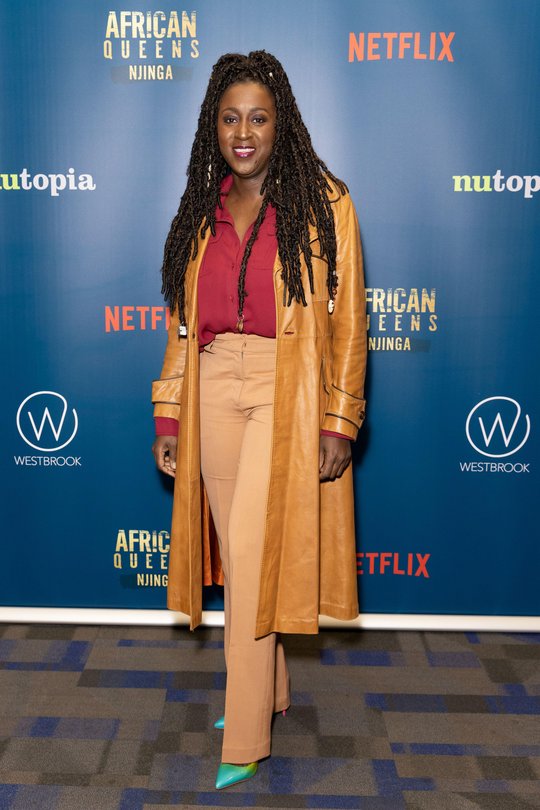
Peres Owino arrives at the Netflix UK Screening of African Queens: Njinga at Brunei Gallery, SOAS University of London on Feb. 13, 2023. Credit: SOPA Images Limited/Alamy Live News
Owino is so passionate about filmmaking that several times during the interview she closes her eyes so tightly as she tells the story. Looking at what she has accomplished, one might think her filmmaking comes from watching tons of films in her childhood as is common in Hollywood. But her love for writing and storytelling began in Kenya at a time when getting access to films wasn’t easy. She was at Loreto High School when a schoolmate urged her to join Drama Club, as theater performance is known in her country of birth. The club traveled to different festivals competing against other high schools. During the process, she learned the writing skills that would later lead to a career in filmmaking.
“The good thing about growing up in Kenya and being part of the drama club is you had to write everything,” she says. “All the content you had to create had to be original.”
Later, Owino got a scholarship to study in the United States, at the University of Wisconsin in Green Bay. During her second year, she saw a post at the theater hall calling for actors to audition. She auditioned and got the role.
“So, I became a classically a trained actor,” she says.
Owino describes herself as someone who loves reading about all peoples, not just Africans. She has read extensively about Jews, Asians, and Europeans.
“I will sit [down] sometimes and be like, ‘I wonder what was going on in Ireland.’ And then I’ll just sit and read about Irish history,” she says.
By the time Owino came to the United States, she had read the biographies of Frederick Douglass, Dr. Martin Luther King, Jr., and Malcolm X, and had developed great interest in learning about slavery and the African American experience. One thing she wanted to do when she arrived was to share stories of Africa with African Americans, hoping they’d be just as fascinated about her history as she was about theirs.
“And it was upon arriving here that I realized that there was a little bit of tension between the two groups of people,” she says.
After graduating from Wisconsin, she moved to Los Angeles. There, Owino says she became friends with her neighbor, Xavier Green, a Howard University-educated African American filmmaker who died two years ago of pancreatic cancer. Owino says they used to have passionate conversations centered around the tensions between Africans and African Americans.
“I said, ‘OK, I’m gonna make a film about this so that I can give Africans and African Americans sort of conversation starter,” she says.
In 2014, “BOUND: Africans vs African Americans,” was released. The documentary, which was her directorial debut, brought together African immigrants and descendants of Africans slaves for candid discussions about the tension between them, which Owino says the is the result of each group having limited knowledge of the other’s history.
The gist of the conflict is that some Africans view African Americans as lazy people who do not want to take advantage of the opportunities their country has to offer. Some African Americans, on the other hand, say they resent Africans for having sold them to slavery.
“I felt like it was very important for us to understand each other’s story so that we meet each other, and have less judgment and more grace, because we understand where everybody’s coming from,” she says.
“BOUND: Africans vs African Americans” won several awards, including the Audience Award for Best Documentary at the 2015 Pan African Film Festival in Los Angeles. Owino has since made several other films, but “African Queens: Njinga” is undoubtedly the one that has introduced the world to what she is capable of.
Njinga’s isn’t just a story about the existence of a powerful woman ruler in Africa. It is a historical document that spotlights what has been left out of history books written by the true perpetrators of slavery and colonization in Africa. It bursts the myth that Europeans were just buying slaves from African sellers and shows the difficult choices leaders like Njinga had to make to save their people from mass murder and slavery.
“It’s at a pivotal point in African people’s history,” Owino says.
She adds that when making the series, they looked at Njinga, on multiple levels, not just “at her as a king.”
“We told the story of a mother, a sister, a queen, a politician, [and] we told the story of a freedom fighter,” she says.
Owino says she is optimistic that stories like Njinga’s will inspire Africans to start telling similar ones, in a continent that is abound with heroes like her. In fact, Owino’s collaboration with men and women from various African countries and the Diaspora in the making the Netflix series is evidence that Africans are already joining hands to tell their own story. Two to three generations from now, the world is going to have a very different image of Africa, she says.
“I’m not gonna live long enough to see it, but I think it’s going to be magical,” she says.
CORRECTION:
An earlier version of this story incorrectly stated that Owino was the director of “African Queens: Njinga.” It has been corrected to reflect that she co-wrote the series with NneNne Iwuji. We regret the error.
Minnesotans convicted of a felony will have their voting rights restored as soon as they leave prison even if still under probation. This follows action Tuesday by the Minnesota Senate which voted 35-30 with a single Republican, Sen. Jim Abeler of Anoka, joining Democrats to pass SF26 known as “Restore the Vote.”
It was passed in the House on Feb. 2 in a 71-59 vote and was sponsored by Rep. Cedrick Frazier of New Hope.
“These disenfranchised individuals live in the community, they are our neighbors, our friends, our daughters, our sons, our cousins, our mothers, our fathers,” Frazier said. “They have jobs, they help take care of their families, they pay taxes, they are subject to the law and policy decisions that we make in this body, but in our representative government they are deprived of the foundational right to vote, the right to give them a voice and allow them to participate in our democracy.”
On the Senate side, Democratic Senate President Bobby Joe Champion carried the bill. Tuesday, Sen. Champion put up a spirited defense of the bill after it was brought before the chamber and led Democrats in blocking repeated attempts by Republicans to weaken it.
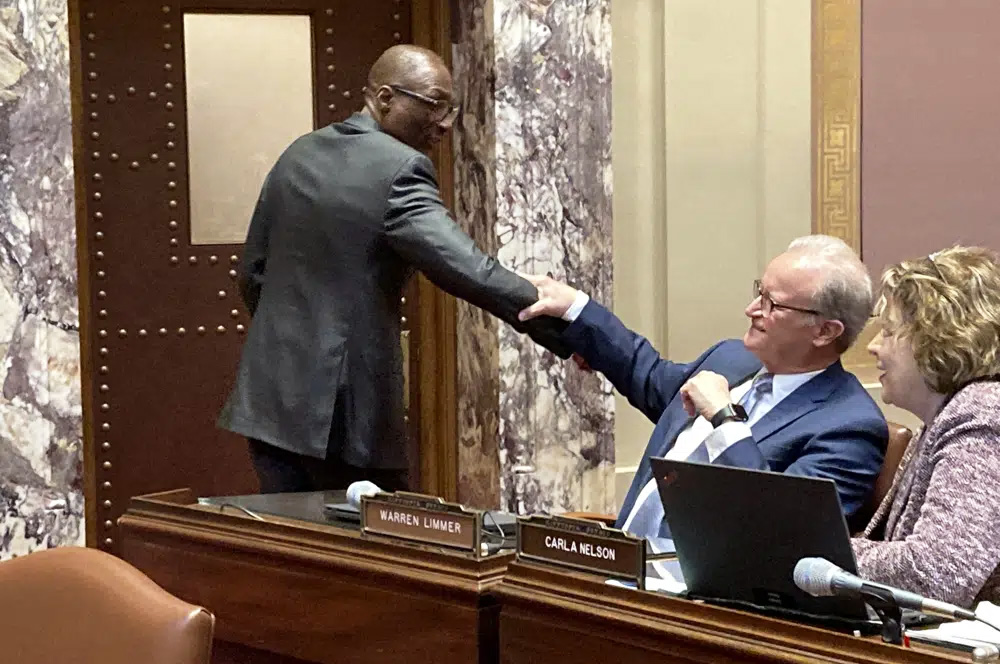
Minnesota Senate President Bobby Joe Champion, left, a Democrat from Minneapolis, and Sen. Warren Limmer, a Republican from Maple Grove, joke with each other on the floor of the Minnesota Senate on Tuesday, Feb. 21, 2023, during a break in the debate over Champion’s bill to restore voting rights to felons when they get out of prison before they complete their parole, which Limmer opposes. Photo: Steve Karnowski/AP
Gov. Walz has said he will sign the bill if it makes it to his desk. With his signature, Minnesota will become the 22nd state to have such a law.
“Today is a very exciting day, a day when over 55,000 Minnesotans are on the precipice of having their voting rights restored,” said Senator Champion, after the bill’s passage. “For more than a decade, I have had the honor to work with Minnesotans of all walks of life from across our state to restore this right, and now together our hard work has gotten us over the finish line. We, as a great state, should celebrate this moment because those 55,000 people who will have their rights restored are our friends, neighbors, and family members. There is no better way for us to celebrate this together than to all participate in our democracy by voting.”
Minnesota Senate passes Driver’s Licenses for All, allowing driving privileges for immigrants
The Minnesota Senate, shortly before 2 a.m. Wednesday, voted 34-31 along party lines to pass the Driver’s Licenses for All bill that will allow immigrants, regardless of their immigration status, the ability to obtain a state driver’s license.
First term DFL Sen. Zaynab Mohamed, was the chief author of the bill in the Senate, which passed in the House last month. Gov. Walz has said he will sign the bill into law if it reaches his desk.
With the governor’s signature expected, the new law will end a ban the state instituted 20 years ago that barred those without legal immigration status from obtaining a Minnesota driver’s license.
In 2003, Republican governor Tim Pawlenty changed the administrative rules and barred the state from issuing driver’s licenses to immigrants who are undocumented and who have temporary status. Veena Iyer, the executive director of the Immigrant Law Center of Minnesota hailed Senate passage of the bill as a “a major victory for all Minnesotans” calling Gov. Pawlenty’s actions in 2003 as “unilateral.”
Those backing the ability for the undocumented to get driver’s licenses included the business community and members of law enforcement, all of whom testified before the Senate in support of the bill.
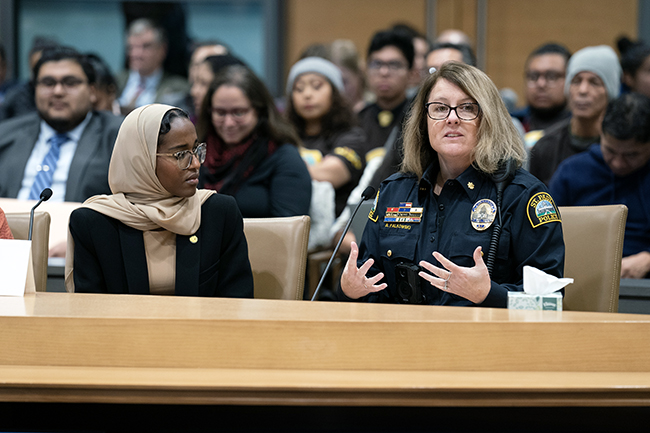
St. Paul Police Department Law Enforcement Officer Sheri Falkowski appears before the Transportation Committee with Sen. Zaynab Mohamed (D-Minneapolis) to offer testimony in favor of SF 27 the Driver’s License for All Bill Wednesday, January 11. The Minnesota Senate passed the bill shortly before 2 a.m. on Wednesday, Feb. 22, 2023. Photo: A.J. Olmscheid/MN Senate
Debate on the bill went on all night Tuesday and into the early hours of Wednesday as Republicans introduced a multitude of amendments to guard against what they called voter fraud. They for example wanted driver’s license issued to the undocumented to state they are not valid for voting. The Democrats blocked all such amendments.
“The biggest thing that I hear in my district is why are we giving a legal driver’s license that is the identical license that we as legal citizens have to people who are here illegally? There should be some differentiation between the two,” Republican Sen. John Jasinski asked on the Senate floor.
Senate President Bobby Joe Champion who co-authored the bill said he was excited to be a part of the solution to restore the freedoms of those denied the right to a driver’s license for two decades, adding “We realize that this is a public safety issue, and it’s going to make our streets safer. It will allow our fellow Minnesotans to get to work, take their kids to soccer, and do all the other things that Minnesotans do. So today I am excited to say that our undocumented friends and neighbors can come out of the shadows and have the freedom to drive.”
Passage of the bill is a signature win for the youngest woman ever elected to the state Senate, freshman Democratic Senator Zaynab Mohamed, who is just into her seventh full week having been sworn in on Jan. 4.
“This is a huge win for Minnesota’s immigrant movement,” said Senator Mohamed. “I am so proud to have co-led this effort to restore the freedom to drive alongside my friend and colleague, Senator Champion. This victory belongs to Minnesota’s immigrants and the dedicated advocates who have bravely fought for this legislation for over 20 years. Today we sent a message to Minnesota’s undocumented community: we hear you, we see you, and you are a part of our beloved community.”
Congolese musician Pierre Kwenders debuts on the Cedar's stage in March
If James Brown jumps on stage; Fela Kuti writhes on stage, and Papa Wemba struts onto the Cedar Cultural Center stage March 10th, you might be in the audience watching the magic of Pierre Kwenders.
Kwenders, born in the Democratic Republic of Congo and now living in Montreal, Canada, isn’t impersonating these music icons to highlight his own prowess, but to pay homage to them, to shed the spotlight on those who have inspired him.
Mshale spoke to Pierre Kwenders recently in anticipation of his upcoming show, his first for Minnesota. “I definitely represent the continent of Africa,” the Kinshasa-born and raised musician said, “I only moved to Canada in 2001. It would be a lie to say that Canada is not represented in my music. It’s definitely represented in my music, but the path that I’ve chosen with my music is to tell the story of where I am from, which is Congo. So Congo is always on the front of the narrative of the story that I’m telling.”
Kwenders didn’t start out in music and it wasn’t until he was 23 years old that he ventured into music in a formal way. But fifteen years later, he’s garnered many accolades and last year he landed the Polaris Music Prize for his album José Louis and the Paradox of Love, an annual award for Canada’s best album juried by writers, programmers, and broadcasters.
Friday evening, March 10th, we’ll hear his acclaimed sound when he performs. His entourage is unique. “My band, there is one musician, but also with my collective, Moonshine, when we travel, we have different DJs and we usually have percussionists. It’s a different set-up, but it’s made for fun,” Kwenders said. He also assured he’s keeping Minnesotans in mind, “It’s a very simple set-up to make sure people are ready to dance. That’s our job, to keep everybody warm.”
Congolese-born Pierre Kwenders will debut The Cedar stage in Minneapolis on Friday, Mar. 10, 2023. Photo: Kim Yang/Pitch Perfect
It’s not dance-music alone, however. “I’m presenting a work of art, telling a story. I like to open myself to other horizons and challenge myself musically and also bring my culture and my world to other people’s worlds and see how we can play together,” Kwenders said as he described his music. “Whenever there’s singing or performing, there’s art and we need to present it in a way that people will appreciate it and remember it. So that’s what I try my best to do.”
While The Cedar embraces all and has no dress code, Pierre Kwenders show will be an opportunity for attendees to dress up and have fun. “I have a song in my album, Papa Wemba, who’s the king of rhumba and also very charismatic, but also who would dress pretty well,” Kwenders said. Papa Wemba, the world ambassador of Congolese rhumba was also the father of sapologie.
La Sape, a movement that embodies the elegance in style and manners of colonial predecessor dandies, is present in Kwenders music videos, particularly Kilimanjaro. Kwenders incorporates the flare and fantastical in his music.
“I believe all of that, energy-wise, I love to dance on stage so I move a lot on stage, also it’s part of who I am. I’m a bit like, when we do this job, whenever we are on stage, we’re presenting something, you know, it is a piece of art.”
Kwenders concludes, “so what I like to do is try to tell a story through my music and song and the way that I play the song, so I just like to take the people on a journey with me during the shows. My wish is just for them to enjoy the ride along with me.”
The Cedar Cultural Center presents Pierre Kwenders on March 10, 8 pm show. Tickets available at The Cedar website.
Ms. Roselidah Nyaberi, a registered nurse, was elected by 62% of the vote on Saturday, Feb. 18, 2023 to become the next president of Mwanyagetinge Association of Kenyans in Minnesota. Photo: Courtesy of Roselidah Nyaberi Campaign
Ms. Roselidah Nyaberi, a registered nurse, was elected by 62% of the vote on Saturday, Feb. 18, 2023 to become the next president of Mwanyagetinge Association of Kenyans in Minnesota. Photo: Courtesy of Roselidah Nyaberi Campaign
BROOKLYN CENTER, Minn. – Incumbent Mwanyagetinge president, Ms. Huldah Momanyi Hiltsley, the organization’s first elected female president and who last year almost won a Democratic nomination for state senate lost her bid for reelection Saturday, according to results released just before midnight by the Mr. Gilbert Atima led elections commission.
Mwanyagetinge is the largest organized group of Kenyans in Minnesota that draws members from the state’s large Abagusii community.
Ms. Roselidah Nyaberi, a registered nurse and mother of four, was able to convince 62% of members of the premier Kenyan organization in the state to vote for her, over the trailblazing Ms. Momanyi Hiltsley who had to fend off criticism that her administration lacked financial transparency.
Ms. Nyaberi hammered the alleged transparency failing incessantly in prolific community TV appearances such as KJTV’s ‘Dr. Omandhi Show, promising to bring in a new era of accountability if elected.
The stunning margin of defeat served as a rebuke of Ms. Momanyi Hiltsley, even as members acknowledged her administration was responsible for the largest influx of grant money into the organization in its almost four-decade old existence. One board member who resigned midway through her term attributed her move to the fixation on fundraising by the administration at the expense of the organization’s other needs.
This was the second time in the organization’s history two women have faced off for the top post.
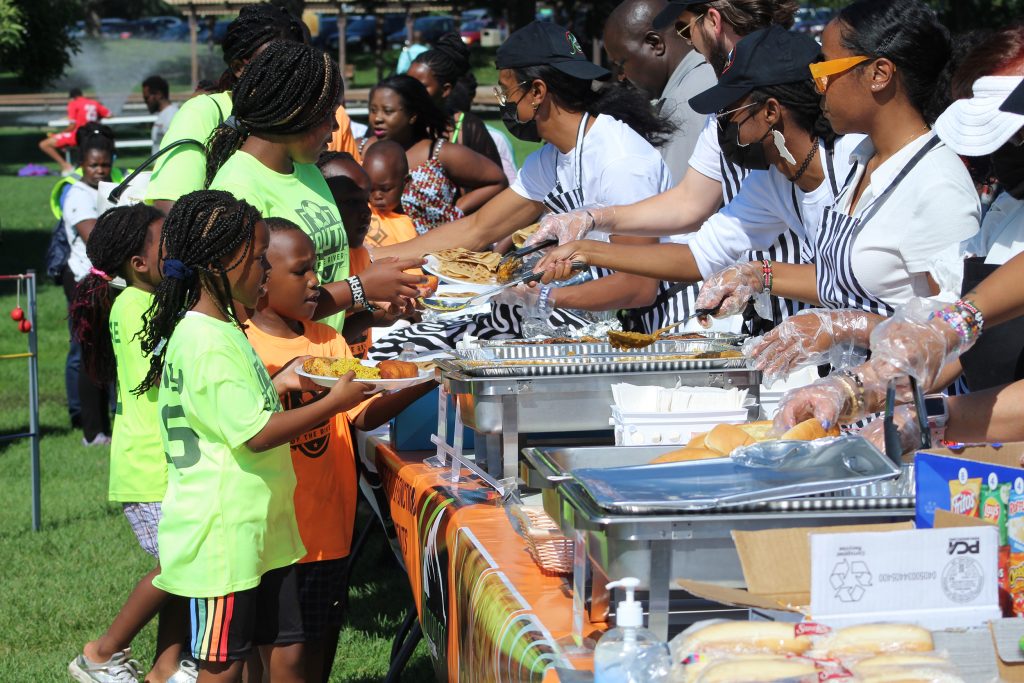
Children line up for food during a Mwanyagetinge Association of Kenyans in Minnesota annual family picnic at Centennial Park in Brooklyn Center on Sunday, August 29, 2021. Photo: Mshale Staff Photo by Jasmine Webber
Contestants for the various positions in the organization run as individuals, but in the last race that Ms. Momanyi Hiltsley won in 2020, saw the introduction of unofficial tickets with like minded aspirants banding together and urging members to vote them in as a team. That was the case this year again and Ms. Momanyi Hiltsley saw her entire administration ousted and Ms. Nyaberi’s slate of candidates getting the thumbs up.
Among Ms. Nyaberi’s preferred candidates was Mr. Kastone Albert Nyamari, famous for his take-no-prisoners approach to issues. Mr. Nyamari won handily in a three way race for vice president, with 58% of members voting for him to edge out the incumbent Mr. Amenya Amenya who had 33% of members on his side. Mr. Robert Nyagaka trailed with less than 10 percent.
Ms. Momanyi Hiltsley conceded shortly after results were announced. Writing on the organization’s Telegram channel, she said “Let me be the first one to CONGRATULATE the newly elected Mwanyagetinge team! I truly applaud the mobilization that was done for this election. As we look forward, I pray that the new team comes in with a heart to serve the community as much as this outgoing team has done. We wish them all the best!”
“Special congratulations to PRESIDENT-ELECT MADAM Roselidah…COME AND TAKE YOUR RIGHTFUL PLACE!” Ms. Momanyi Hiltsley said in her post, concluding in all caps with “Long Live Mwanyagetinge.”
President-elect Nyaberi in a statement to Mshale said the huge margin she won by was “a statement that our people believe in my team.”
“As a leader I am here to deliver service to Mwanyagetinge and Omogusii in Minnesota,” Ms. Nyaberi said.
The full list of those elected Saturday is as follows:
President: Roselidah Nyaberi Vice President: Kastone Albert Nyamari Secretary: Yophesh Nyamasege Treasurer: Donald Gwako Organizing Secretary: Wilfred Nyangaresi Hennepin Upper County Representative: Isaac Nchoroke Hennepin Lower County Representative: Innocent Marube Dakota County Representative: Wycliffe Ombati Scott County Representative: Barongo Nyamari Sherburne/Wright County Representative: William Kiage Ramsey County Representative: Meshack Nyamwaya Anoka County Representative: Tie vote between two write-in candidates Dr. Orina Machoka and Geoffrey Gichana. Election Commission will communicate on next steps regarding tie.
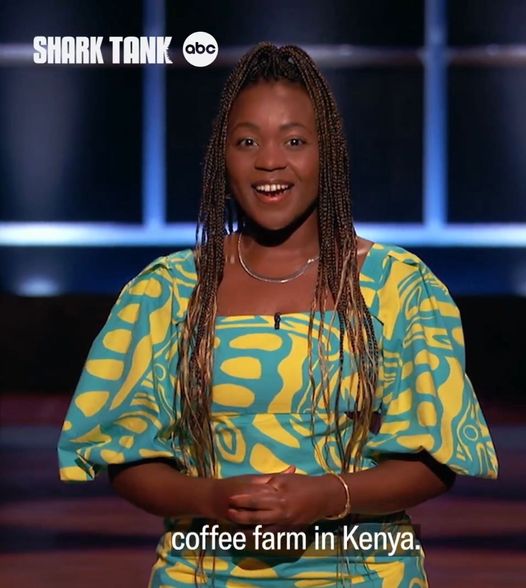
New York based Kenyan entrepreneur Margaret Nyamumbo will make her pitch on 'Shark Tank' on the Friday, Feb. 17, 2023 episode. Photo: Instagram Screengrab
New York based Kenyan entrepreneur Margaret Nyamumbo will make her pitch on 'Shark Tank' on the Friday, Feb. 17, 2023 episode. Photo: Instagram Screengrab
Margaret Nyamumbo, the Kenyan woman who was the subject of one of Mshale’s best stories of 2021, will be among the entrepreneurs featured on “Shark Tank,” one of the biggest television shows in the United States.
Nyamumbo told Mshale in 2021 that she wanted to use Kahawa 1893, a coffee company she founded in 2018, to tell the stories of the women of the Gusii highlands of southwestern Kenya, where she was born and raised. She said she wanted to highlight the fact that most of the labor that goes into the small farms that produce one of the world’s most valuable crop comes from women, but most of the proceeds go to their husbands and other patriarchs who own the land.
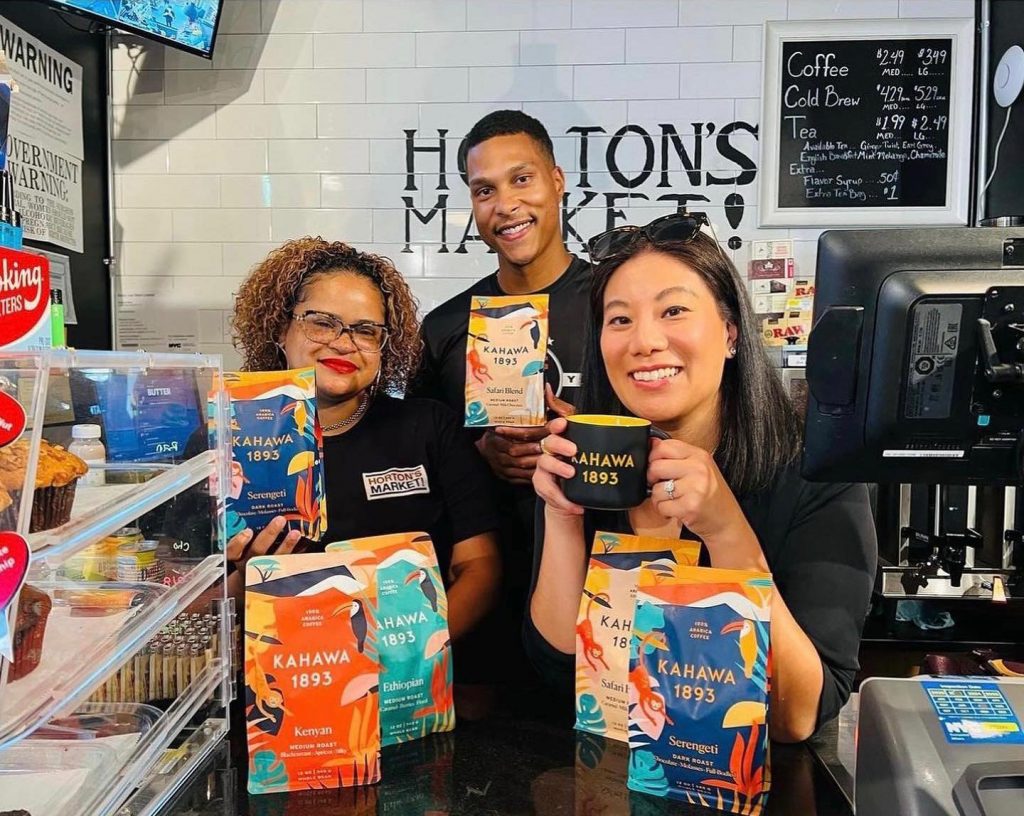
Barristers at New York’s Horton’s Market with Kahawa 1893 on Small Business Saturday on Nov. 26, 2022. Photo: Courtesy Horton’s Market Instagram
Nyamumbo caught the attention of Mshale in 2021 because she had become the first Black woman to have her coffee displayed for sale at all 200 Trader Joe’s stores in California. That’s no small feat, not only because the coffee industry is very competitive, but also because the trendy supermarket chain is very selective.
An ethical brand of delicious coffee that goes above and beyond for their farmers?? I'm in! 😍 pic.twitter.com/uZfcFNTnOd
On Friday night (Feb. 17), Nyamumbo will get a chance to take Kahawa 1893 to new heights when she pitches the company to investors on “Shark Tank,” a show that has turned entrepreneurs into millionaires. According to a teaser released on the show’s Instagram account this week, Nyamumbo is offering the sharks, as the investors are known, 5% of the company for $350,000. Whether she gets a deal or not, it’s a win for her because being on the show introduces Kahawa 1893 to millions of potential customers. Check your local TV listings to see when the episode airs on ABC in your area tonight.
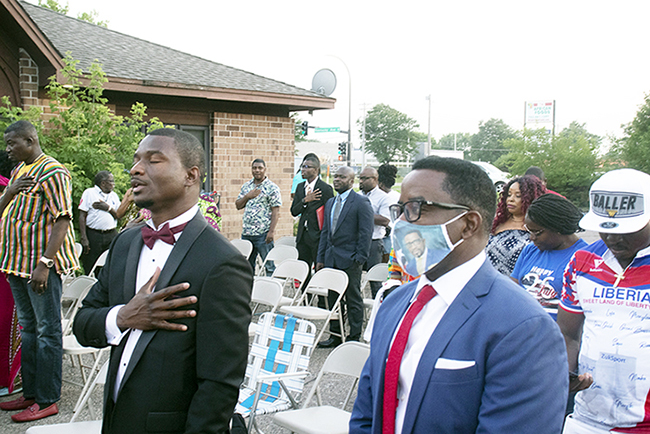
Liberians sing the national anthem during a Liberian Independence Day celebration on the grounds of the Liberian Community Center in Brooklyn Park, Minnesota in July 2021. Photo: Tom Gitaa/Mshale File
Liberians sing the national anthem during a Liberian Independence Day celebration on the grounds of the Liberian Community Center in Brooklyn Park, Minnesota in July 2021. Photo: Tom Gitaa/Mshale File
In elections concluded last week for the Organization of Liberians in Minnesota board of directors, members elected two new directors and reelected three to serve in the Liberian community’s premier organization in the state.
The race for board seats attracted eight candidates for the five available slots. The board of directors consists of nine members elected by members, each serving a three-year term.
Ms. Bernice Yeiah, chair of the board of commissioners that conducted the election, announced Ms. Edwina T. Willie, Mr. Erasmus T. Williams and Mr. Sizi G. Goyah as the three that were reelected.
Mr. Jackson K. George and Ms. Cora N. C. Sneh are the new board members.
Board members that were not up for election were Messrs. Arthur Biah, Ishmael Komara, Alec Deah and Mohammed Dukuly.
Two board members who did not seek reelection were outgoing chair of the board Abraham Brima Bah, who ran unsuccessfully for a Brooklyn Park City Council seat last year, and Princess Yanforh Wilson.
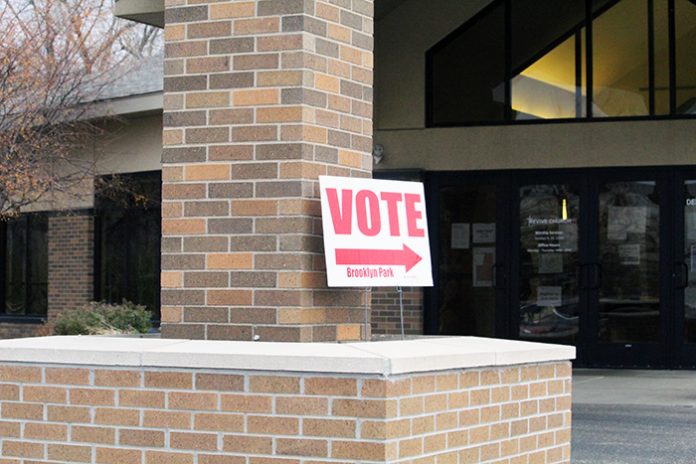
A Vote sign directs voters at a previous election in Brooklyn Park. Mshale Staff photo by Jasmine Webber
A Vote sign directs voters at a previous election in Brooklyn Park. Mshale Staff photo by Jasmine Webber
A May 9 special election will determine who will take over the Brooklyn Park City Council West District seat left empty after Councilwoman Susan Pha was elected to the state Senate last November. The winner will complete the remainder of her term which goes through December 31, 2024.
Candidate filing for the election opened today (Feb.14) at 8:00 a.m. and will close at 5:00 p.m. on Feb. 28, according to the City Clerk’s office.
If by the Feb. 28 deadline more than two candidates file to run, May 9 will instead be a special primary election to elect the top two candidates to move on to a special election which will be held on August 8.
This will be the third time in a span of two years that the city is holding a special election to fill a vacancy. In 2021, a special election was held to fill the vacancy left by the departure of then Mayor Jeff Lunde after he got elected as a county commissioner. In that special election, then Councilmember Lisa Jacobson of the East District won by two votes to fill the remainder of Lunde’s term. Jacobson becoming mayor triggered another special election to fill her East District seat which went on to be won by Xp Lee.
Details on requirements and how to file to run can be found at the city’s website at this link.
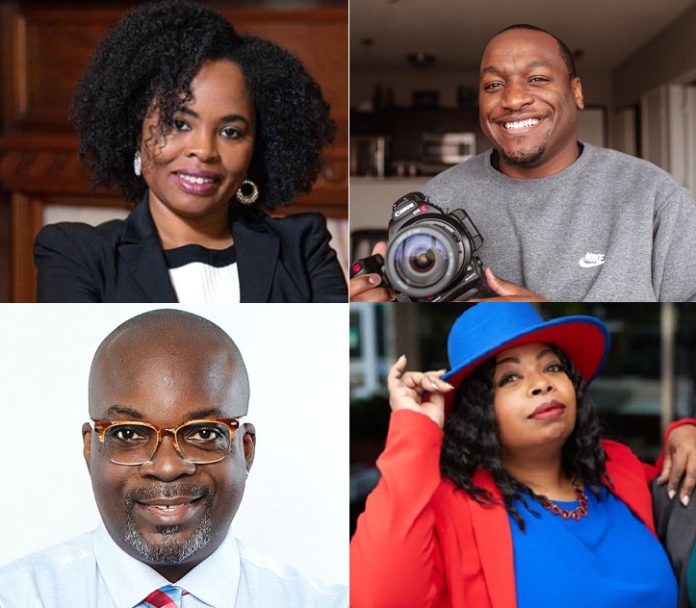
Clockwise from bottom left: Teto Wilson, Kenya Mcknight Ahad, Kevin Sullivan and Tameka Jones participated in a “Black History Month Conversations” event on how to nurture and sustain Black-owned businesses held at the Minnesota African American Heritage Museum and Gallery on Thursday, Feb. 9, 2023. Photo: Courtesy of Minnesota African American Museum and Gallery and Linkedin
Clockwise from bottom left: Teto Wilson, Kenya Mcknight Ahad, Kevin Sullivan and Tameka Jones participated in a “Black History Month Conversations” event on how to nurture and sustain Black-owned businesses held at the Minnesota African American Heritage Museum and Gallery on Thursday, Feb. 9, 2023. Photo: Courtesy of Minnesota African American Museum and Gallery and Linkedin
Business leaders from various communities came together Thursday to celebrate Black History Month at an event that focused on finding ways to nurture and sustain Black-owned businesses.
The event, which took place at the Minnesota African American Heritage Museum and Gallery in Minneapolis, provided space for seasoned and aspiring entrepreneurs to learn about ways they can improve and expand in their business endeavors.
“If people like you and you’re putting in the work, you will succeed,” said Kevin Sullivan, the owner of the eponymous filmmaking and photography company, Kevin Sullivan Films.
Black-owned small businesses were hit hardest by the coronavirus pandemic, according to a study from the National Bureau of Economic Research. But the plight of Black entrepreneurs predates COVID-19. Looking at data from 2016 to 2019, the Federal Reserve found that only a little over 2 % of businesses had Black owners, despite African Americans accounting for more than 14 % of the country’s population. The conversation on Thursday aimed to connect successful Black business owners with those in the community aspiring to launch, grow, and improve their businesses.
Having the money to launch a business can be especially difficult for Black Americans, considering that their households hold just under 3% of the country’s wealth, compared to nearly 87% held by white Americans, according to the Federal Reserve. For those who have navigated economic barriers and wish to proceed with their business ventures, Sullivan stressed the importance of being wise with money.
“Don’t just quit your job with no money for the business,” Sullivan warned. “You will fail.”
On the topic of financial wisdom, Sullivan also spoke about the correlation between lifestyle and wealth building. Despite being the lowest earning by race, Black Americans are the second largest consumer group, with a staggering $1.4 trillion in spending power, according to Forbes. Sullivan said he believed the key to success in any field, and particularly business, was to maintain a modest lifestyle.
“Be a little frugal because your lifestyle is what can put you on the street,” Sullivan said.
The panelists were also invited to speak on their views about entrepreneurial mentorship. While most experienced business owners enthusiastically turn to a mentor for professional advice, only around 40% of newer business owners do the same. Teto Wilson, a small business mentor and the owner of Wilson’s Image Barber and Stylists, said that mentorship “is vital.”
“There is so much to learn about business,” Wilson said.
Tameka Jones, who owns the cosmetic brand Lip Esteem, said she had mentored students from numerous colleges across the country. She said that as well as being a mentor herself, she was always looking for people to mentor her.
“I appreciate the people who have guided me,” Jones said.
Kenya McKnight Ahad, the CEO and Founder of Black Women’s Health Alliance, spoke about the importance of networking. She encouraged people to go after their goals, even in the face of social adversity.
“You’ll show up and people will make you feel insufficient,” Ahad said. “You gotta have that mindset of, ‘I am not inferior to anybody.’”
On the topic of business expansion, panelists discussed choosing the right time to expand a business. They all seemed to agree that the right time to do so is when the required input of labor for business operation becomes “too much” for a sole owner. Often, the costs of paying employee salaries can be a burden for business owners, especially if they are new. A 2020 report from the U.S. Small Business Administration found that 81% of small businesses were “non employers,” which means that the owner was the only person working for the company. Ahad said that her long-term goal was to see the Black community deviate from the business model.
“Now I sit here as a multimillionaire, and I want to develop my company into a model, something that will last beyond me,” Ahad said.
Jones, the cosmetic company owner, said that while hiring employees could be expensive, it was difficult to build a business on the back of the owner alone. She said that she had always wanted to become an international brand and did not see that route in her future without the help of others.
“I’ve always known I want to be an international brand, when you do everything from marketing, to accounting, to branding, to networking, it’s a lot,” Jones said.
Sullivan spoke about the importance of the humility of accepting outside help. He said that for the six years he’d been in business, he pulled through most of the way on his own. He said he would have gotten where he is today faster, had he sought out and accepted help earlier on.
“Everyone has this ‘got it out the mud’ mentality,” Sullivan said. “The help from community, your surroundings, your friends, and your family will get you further, faster.”